Disclosure: airfryerkitchensupply.com is reader-supported. When you buy through links on our site, we may earn an affiliate commission at no extra cost to you.
Where to buy
All six picks for the best afrodable blenders are sold on Amazon. Budget models are often listed in several bundle and color variants, so match the model number and jar details to the pick before you order — the same name can hide a different jar, a different cup count, or last year’s revision, and the model number is the only reliable fingerprint.
- Hamilton Beach Wave Crusher Blender 54221 — Check the current price on Amazon
- Oster Classic Series Heritage Blender — Check the current price on Amazon
- Ninja Professional Blender BL610 — Check the current price on Amazon
- BLACK+DECKER Countertop Blender BL2010BG — Check the current price on Amazon
- nutribullet Full-Size Blender Combo NBF50500 — Check the current price on Amazon
- Oster Pro 1200 Blender — Check the current price on Amazon
Introduction
Type it however it comes out — “best afrodable blenders” lands in search boxes every day, usually from someone setting up a first kitchen, replacing a dead machine mid-month, or feeding a family on a budget that does not care about appliance marketing. This guide is for that shopper. It assumes the budget is real, the blender will be asked to do a bit of everything, and the worst outcome is not an imperfect smoothie — it is spending the money twice.
So the ranking below optimizes for real-life coverage per dollar: machines that handle smoothies on weekdays, soups and sauces on weekends, and the occasional frozen drink without drama; machines from brands whose jars, blades, and gaskets you can replace instead of replacing the whole appliance; and machines simple enough that everyone in the household — roommates, teenagers, grandparents — will actually use them. Every pick was verified against current manufacturer data before it earned a link.
Expect honesty about the tier throughout: affordable blenders are loud, their jars are mostly modest in size, and none of them is a nut-butter factory. Within those limits, though, the six below cover an astonishing amount of kitchen life for the money — and two of them have designs with decades of service behind them.
How to use this guide: the Quick Picks are the whole answer for the impatient; the reviews explain each machine’s personality and limits; the buying sections translate the category’s traps — wattage labels, jar materials, parts supplies — into a two-minute checklist you can apply to any listing, including ones we did not pick. Readers who finish the guide should be able to walk into any blender aisle, physical or digital, and sort the serviceable from the disposable at a glance. That skill outlasts any single recommendation, and it is the real deliverable of an affordability guide.
In this guide
Quick Picks
- Best Overall: Hamilton Beach Wave Crusher 54221 — 700W, a 40 oz glass jar, fourteen functions, and Ice Sabre blades shaped for smooth results. Check price on Amazon
- Best Durability Value: Oster Classic Series Heritage — a 1000 peak-watt, 6-cup glass-jar classic backed by a long warranty and Oster’s all-metal-drive heritage. Check price on Amazon
- Best for Families: Ninja Professional BL610 — a 1000W, 72 oz pitcher machine that makes a full round of smoothies in one blend. Check price on Amazon
- Best for First Apartments: BLACK+DECKER BL2010BG — a 6-cup glass jar and ten simple speeds, at a price that leaves budget for everything else a first kitchen needs. Check price on Amazon
- Best Two-in-One: nutribullet Full-Size Combo NBF50500 — a 1200W base running both a 64 oz pitcher and a 24 oz personal cup. Check price on Amazon
- Best Glass Jar Step-Up: Oster Pro 1200 — a glass jar, seven speeds, Smart Settings, and a dual-direction blade for thick mixtures. Check price on Amazon
How These Picks Were Chosen
Verification came first: each pick’s brand, model, wattage, jar, and features were confirmed against current Amazon product data. Then we ranked for the budget-realist brief — versatility, durability, and replaceability — rather than for any single recipe’s perfection.
Versatility meant the machine had to cover the five jobs budget households actually rotate: smoothies, shakes, soups, sauces, and frozen drinks. Durability meant proven designs and brands with service networks. Replaceability meant jars, blade assemblies, and gaskets sold separately at sane prices, because in a budget kitchen the ability to fix a machine for a few dollars in year three is worth more than any feature. Simplicity acted as the tiebreaker: controls a household can share without a manual.
Excluded: unbranded machines with no parts supply, premium models discounted into temporary affordability, and single-purpose gadgets (personal-only or smoothie-only machines live in their own guides in this series, linked at the end).
One more ranking principle deserves daylight: we weighted the second year as heavily as the first blend. A budget blender’s true character emerges after hundreds of cycles — when the gasket has been heat-cycled, the jar has met the dishwasher two hundred times, and the coupling has absorbed every frozen strawberry the household could throw at it. Picks with proven designs and deep parts supplies (Oster, Hamilton Beach, Ninja, nutribullet) dominate this list precisely because their year-two behavior is a known quantity, while newer no-name wonders are, at best, a promising hypothesis your budget should not have to test.
The 6 Best Afrodable Blenders for Real Budgets

1. Hamilton Beach Wave Crusher Blender 54221 — Best Overall
The Wave Crusher takes Hamilton Beach’s budget formula — a 700W motor in a smart jar — and tunes it for smoothness: fourteen functions, a 40 oz glass jar, and Ice Sabre blades designed to draw the mixture down and through consistently. In a budget household, this is the blender that makes the fewest excuses: morning smoothies, weekend salsa, a pot of soup blended in batches, and shakes for dessert, all from one modest machine.
Strengths
- Ice Sabre blades and jar design deliver consistently smooth results
- Fourteen functions cover the household rotation
- Glass jar resists stains and odors
Trade-offs
- 700W asks for pulsing and liquid on heavy frozen loads
- 40 oz jar means batches for big families
- No preset programs — you run the blend
| Spec | Detail |
|---|---|
| Motor | 700 watts |
| Jar | 40 oz glass |
| Functions | 14 |
| Blades | Ice Sabre |
The “consistently smooth” claim in its name is the thing budget buyers should care about: inconsistency — one great smoothie, one chunky one — is what makes cheap blenders feel cheap. The Wave Crusher’s blade-and-jar system narrows that variance, so the recipe you dialed in on Monday repeats on Friday. For households where the blender is a shared utility rather than one cook’s instrument, that repeatability is the difference between a machine everyone trusts and one everyone works around.
It also handles the cooked side of the rotation gracefully: a tomato soup blends silky in two batches, a pan sauce smooths in seconds of pulsing, and the glass jar goes from turmeric-heavy curry soup to a pale milkshake without carrying yesterday’s color or smell — a small, daily quality-of-life advantage that plastic jars in this tier cannot promise. Add Hamilton Beach’s parts availability, and the Wave Crusher is the complete budget package: capable on day one, serviceable on day one thousand.
If your budget buys exactly one countertop blender and your kitchen is small-to-medium, start here and stop shopping.
Best for: small-to-medium households wanting one do-everything budget blender / Not suited for: large families blending in single batches

2. Oster Classic Series Heritage Blender — Best Durability Value
The Heritage is Oster’s argument that a budget blender can be a decade-long appliance: 1000 peak watts, a 6-cup glass jar, a stainless steel blade, two speeds, easy-clean design — and a warranty whose length signals how the manufacturer expects it to live. Its design descends from the beehive-era classics, with the all-metal drive philosophy that made those machines heirlooms.
Strengths
- Long warranty backing unusual in the budget tier
- 6-cup glass jar and stainless blade in a proven design
- 1000 peak watts handle everyday frozen work
Trade-offs
- Only two speeds — control is basic
- Traditional design needs liquid discipline on thick blends
- Retro looks will not suit every kitchen
| Spec | Detail |
|---|---|
| Motor | 1000 peak watts |
| Jar | 6-cup glass |
| Speeds | 2 |
| Blade | Stainless steel |
Two speeds sounds like a limitation until you inventory what households actually do: blend smoothies (high), pulse and stir sauces (low), and crush the occasional ice (high, in bursts). The Heritage covers that map without a single electronic component to fail, and its jar standard is shared across Oster’s enormous installed base — gaskets, blades, and jars will be findable for as long as you own it. In budget terms, this is the buy-it-for-the-decade pick, and its total cost of ownership is likely the lowest in this guide.
There is a quieter virtue here, too: predictability. A two-speed machine behaves identically every day for years, so recipes become repeatable and every cook in the house calibrates to it once. Feature-rich budget machines, by contrast, often change behavior as their electronics age. For the household that values a tool becoming invisible through familiarity, the Heritage’s simplicity is not a missing feature — it is the feature.
Choose it if your instinct is to fix rather than replace, and your recipes are classic rather than experimental.
Best for: durability-first buyers and classic-recipe households / Not suited for: anyone who wants programs or fine speed control
3. Ninja Professional Blender BL610 — Best for Families
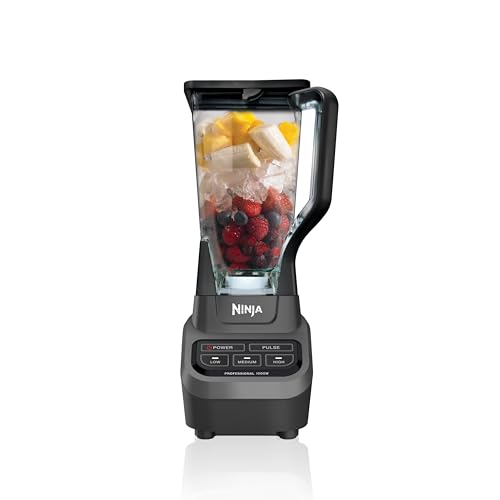
Family math changes the blender question: four smoothies from a 40 oz jar is two batches and a queue at the counter; from the BL610’s 72 oz pitcher it is one blend and done. Add 1000 watts of Total Crushing power — stacked blades that process the full height of that big pitcher — and you have the budget family’s default machine, proven over years of production.
Strengths
- 72 oz pitcher ends the batch queue
- Total Crushing blades handle ice and frozen fruit properly
- Simple controls the whole household can run
Trade-offs
- No presets — timing is yours to manage
- Big pitcher blends single servings poorly
- Tall and loud
| Spec | Detail |
|---|---|
| Motor | 1000 watts |
| Pitcher | 72 oz |
| Blades | Total Crushing technology |
| Care | Dishwasher-safe parts |
The BL610’s family virtues compound: one blend means one washing cycle, one noise event, one set of ingredients measured. Its pitcher and blade assemblies are among the easiest replacements to source in the category — a real consideration in houses where things get dropped — and its control simplicity means a teenager can run breakfast without a tutorial. What it will not do is a single small smoothie well; families that also blend solo should pair it with a personal cup machine later or choose the nutribullet Combo below.
It is worth adding that the BL610’s longevity in the market is itself evidence: blender models that disappoint get discontinued, while this design has been bought, reviewed, and re-bought for years, which means its failure modes are known, its parts are stocked, and its behavior in a real family kitchen is a matter of record rather than promise. In a budget purchase, that kind of boring certainty is worth money.
Best for: families of three or more blending together / Not suited for: solo blenders or small households

4. BLACK+DECKER Countertop Blender BL2010BG — Best for First Apartments
First kitchens have a budget shaped like a cliff: everything is needed at once, and the blender competes with the skillet, the kettle, and the knife set. The BL2010BG respects that reality — a real 6-cup glass jar, ten speeds, a mainstream brand’s parts support — at a price that leaves the rest of the kitchen funded. It is the blender you buy when the blender cannot be the budget.
Strengths
- Lowest price here for a full-size glass-jar blender
- Ten speeds cover smoothies, soups, and shakes
- Nothing to learn and nothing to configure
Trade-offs
- Frozen performance is adequate rather than strong
- No programs or specialty blade systems
- Basic fit and finish
| Spec | Detail |
|---|---|
| Jar | 6-cup glass |
| Speeds | 10 speed settings |
| Format | Countertop blender |
| Finish | Black |
Judged as a first-apartment appliance, its compromises are the right ones: it spends nothing on styling or electronics, keeps the glass jar that makes a cheap blender feel respectable, and covers the fresh-and-cooked repertoire completely. Frozen smoothies are possible with thawed fruit and honest liquid; daily hardcore frozen blending is the one habit that should push a first-apartment buyer up to the Wave Crusher instead. For everyone else in their first kitchen, this is the sensible line item.
It is also, not incidentally, the easiest blender in this guide to live with as a gift or a hand-me-down: no accounts, no apps, no proprietary cups, and a jar standard shared with a mainstream brand’s wide installed base. First kitchens inherit appliances as often as they buy them, and the BL2010BG is built to be inherited gracefully.
Best for: first apartments, dorms-plus, and anyone funding a whole kitchen at once / Not suited for: daily heavy frozen blending

5. nutribullet Full-Size Blender Combo NBF50500 — Best Two-in-One
Shared households have a format problem: one person blends solo shakes, another makes family smoothies, and a single-format machine serves one of them badly. The Combo ends the argument with one 1200W base, a 64 oz pitcher, and a 24 oz tumbler — the pitcher for the group, the cup for the individual, and nutribullet’s extraction-style texture in both.
Strengths
- One base covers family batches and solo servings
- 1200W with excellent green-smoothie texture
- Both vessels included in a single purchase
Trade-offs
- Plastic vessels, not glass
- Costs more than the single-format budget picks
- Wide footprint on the counter
| Spec | Detail |
|---|---|
| Motor | 1200 watts |
| Pitcher | 64 oz |
| Also included | 24 oz tumbler cup |
| Care | Dishwasher safe |
The budget logic is consolidation: instead of a cheap pitcher blender now and a personal blender later — two bases, two budgets — the Combo buys the capability once. Its texture on green smoothies is the best in this guide, which matters in households where kale is a staple rather than an event. If your kitchen’s blending is genuinely mixed-format, this is the most economical way to cover it properly, even though its sticker is the highest here after the Oster Pro.
Best for: mixed households blending solo and family formats / Not suited for: glass-jar loyalists or the strictest budgets
6. Oster Pro 1200 Blender — Best Glass Jar Step-Up
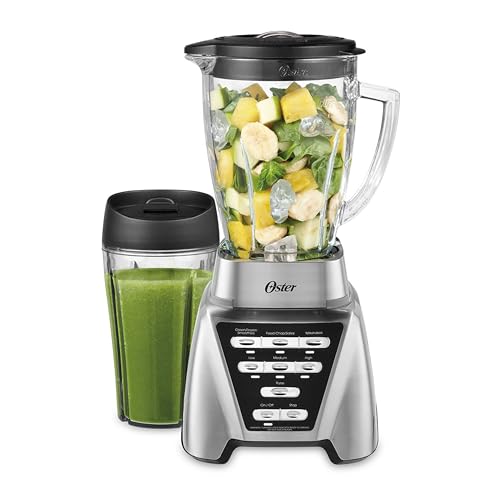
The Pro 1200 is where the budget tier starts feeling premium: a glass jar, seven speeds with Smart Settings programs, a 24 oz smoothie cup in the box, and Oster’s dual-direction blade that reverses to pull thick mixtures back into the cut. For households that have outgrown a basic machine — thicker smoothies, frozen drinks, more cooking — it is the natural step up that stays affordable.
Strengths
- Dual-direction blade defeats the thick-blend dome problem
- Glass jar plus a personal smoothie cup included
- Smart Settings programs for common recipes
Trade-offs
- The priciest pick in this guide
- Full glass jar is heavy to pour
- More machine than fresh-only households need
| Spec | Detail |
|---|---|
| Jar | Glass |
| Speeds | 7 with Smart Settings technology |
| Blade | Dual-direction |
| Also included | 24 oz smoothie cup |
Thick blends are the budget tier’s final boss, and the reversing blade is a genuinely clever weapon against them: where a conventional jar leaves a stationary dome of frozen fruit and yogurt above the blade, the Pro 1200’s periodic reversals collapse it back into the cutting path, finishing blends that would otherwise need two spatula interventions. Combined with Oster’s parts ecosystem and the bonus personal cup, it is the most complete single purchase in this guide.
The included smoothie cup deserves emphasis in a budget guide, because it quietly covers the second format most households eventually want — the solo shake — without a second appliance. Between the full jar and the cup, the Pro 1200 spans the same territory as the nutribullet Combo, but in glass and with Oster’s serviceability; choosing between them is really choosing a material and a brand ecosystem, and either answer is defensible.
Buy it as the “buy once, cry once” option of the affordable tier — the machine a budget household grows into rather than out of.
Best for: households ready to step up for thick blends and glass / Not suited for: the tightest budgets or fresh-only routines
Comparison Table
| Pick | Badge | Key spec | Best for |
|---|---|---|---|
| Hamilton Beach Wave Crusher 54221 | Best Overall | 700W, 40 oz glass, 14 functions | Small-to-medium households |
| Oster Classic Series Heritage | Best Durability Value | 1000 peak W, 6-cup glass, 2 speeds | Decade-long ownership |
| Ninja Professional BL610 | Best for Families | 1000W, 72 oz pitcher | Family batches |
| BLACK+DECKER BL2010BG | Best for First Apartments | 6-cup glass, 10 speeds | First kitchens |
| nutribullet Full-Size Combo NBF50500 | Best Two-in-One | 1200W, 64 oz pitcher + 24 oz cup | Mixed-format households |
| Oster Pro 1200 | Best Glass Jar Step-Up | Glass jar, 7 speeds, dual-direction blade | Thick blends, growing households |
How to Choose a Blender on a Real Budget
Start with the household, not the specs
Count the people and name the three most common blends. One or two people with fresh smoothies and soups: the Wave Crusher or BL2010BG. A family blending together: the BL610’s capacity is the whole argument. Mixed solo-and-family: the Combo. Thick-blend ambitions: the Pro 1200. The Heritage fits the household that keeps appliances for a decade. Specs only matter after the household profile picks the shortlist.
The replaceability checklist
Before buying anything in this tier, spend two minutes confirming three listings exist from the brand itself: the replacement jar, the blade assembly, and the gasket. All six picks pass. Any machine that fails this checklist should be priced in your head as a disposable with a one-to-two-year life, whatever its other virtues — and compared against these picks on that basis, it will usually lose. The checklist takes two minutes and is worth more than an hour of review-reading, because it tests the manufacturer’s own expectations for the machine’s lifespan rather than a stranger’s first impressions.
Glass vs. plastic, budget edition
Glass jars dominate this guide because they age gracefully — no stains, no odors, no clouding — and their replacement cost is low for Oster and Hamilton Beach. Plastic (Ninja, nutribullet) is lighter and survives drops, which in family kitchens is not a trivial virtue. Choose glass for cooking households, plastic for drop-prone ones, and do not pay a premium for either at this tier.
Power, honestly translated
In this guide, 700W with a smart jar (Wave Crusher) covers fresh and moderate frozen work; 1000W-class machines (Heritage, BL610) add frozen headroom; 1200W (Combo, Pro 1200’s class) adds thick-blend confidence. What none of them do is repeal the liquid rule: every affordable blender needs liquid to vortex, and the households that thrive with budget machines are the ones that learn that in week one.
A final translation note: when a listing pairs a big wattage with an unknown brand and no parts page, read the wattage as marketing and the missing parts page as the specification that matters. Conversely, when a mainstream brand publishes a modest number — Hamilton Beach’s honest 700W is the example — the machine usually performs at or above it, because brands with service networks cannot afford systematic disappointment. In the budget tier, the conservative claim is often the faster blender.
How to Use Your Blender: The Household Playbook
- Load in order: liquid first, soft ingredients next, frozen last — the vortex forms before the hard work arrives.
- Pulse, then blend: a few pulses to break the frozen mass, then 45–60 seconds of blending for smoothies.
- Blend soup in batches: hot soup expands; fill the jar half at most, start low, hold the lid with a towel — or let it cool a few minutes first.
- Use the right speed: low for sauces and stirring, high for smoothies and crushing, pulse for salsa texture.
- Rest the motor: thick load plus rising pitch plus warm smell equals a one-minute pause. It is cheaper than a motor.
- Rinse now, wash later: the ten-second soap-and-water blend after use keeps jars, blades, and gaskets young.
One Blender, Five Jobs: Getting Full Value From a Budget Machine
A budget blender earns its keep across the week, not in a single recipe. Monday’s smoothie is the obvious job. Tuesday’s soup — blended in batches from the pot — replaces a food mill and a sieve. Wednesday’s pancake or waffle batter mixes more evenly than hand-whisking and pours straight from the jar. Thursday’s salsa or sauce uses pulses to keep texture where you want it. Friday’s frozen drinks close the week. A machine that covers all five — as every pick here does, within its capacity — is not a smoothie appliance with extras; it is core kitchen infrastructure bought at a budget price.
The playbook that unlocks the five jobs is mostly about confidence: new owners underuse blenders because the first chunky soup or cavitation stall teaches them the machine is fragile. It is not fragile; it is procedural. Liquid discipline, pulsing, batch sizes matched to the jar — the techniques in the section above — convert a budget blender from a morning appliance into an all-day one, and that conversion is where the real affordability lives. A machine used five ways a week for five years costs pennies per use; the same machine used for smoothies only is a luxury by comparison.
The First-Kitchen Playbook: Buying Once, Buying Right
First kitchens fail at sequencing: the budget goes to the photogenic appliances and the workhorses get whatever is left. Reverse it. The blender, the skillet, and the knife do ninety percent of first-kitchen work, and of the three, the blender is the one where a modest step up buys the most daily relief — the difference between the BL2010BG’s adequacy and the Wave Crusher’s consistency is felt every single morning.
Sequencing also means knowing what to defer. A first kitchen does not need a personal blender and a countertop blender on day one; it needs one format chosen honestly (countertop for cooks, personal for solo smoothie drinkers — our single-serve guide covers that branch). It does not need programs it will not use, or a jar sized for parties it does not host. Buy the machine for the life being lived this year, from a brand whose parts will still exist when the household grows into the next machine — and the budget will have been spent the way this guide’s picks spend theirs: on the parts that touch the food.
What Changes When You Step Up a Tier
Readers comparing this guide with premium roundups deserve a plain account of what more money buys, so the decision to stay affordable is an informed one rather than a default. Stepping up buys sustained power: the ability to grind through a fully frozen, low-liquid load continuously, without pulsing technique or rests. It buys texture at the extremes — nut butters, seedless purees, greens reduced to true uniformity. It buys quiet, through insulated bases and better motor mounts, and it buys warranty length and jar materials (thick Tritan, glass on some lines) that shrug off years of daily abuse.
What it does not buy is a better ordinary smoothie, soup, or sauce — the everyday repertoire where this guide’s picks perform within a whisker of machines costing several times more. The honest dividing line is recipe ambition and usage intensity. A household blending twice a day with thick, frozen, fibrous loads will feel the affordable tier’s edges weekly and should consider stepping up (our all-purpose and all-around guides cover that territory). A household blending a few times a week across the normal repertoire will feel no edge at all — and will have spent the difference on groceries, which also improve smoothies.
Troubleshooting: Five Budget-Blender Complaints, Solved
Problem: The blender is too loud for my household. All affordable motors are loud; manage the schedule, not the machine. Blend the night before and refrigerate (smoothies keep a day happily), close the kitchen door, and place the base on a folded towel to dampen counter resonance. If 6 a.m. blending is non-negotiable and the household is fragile, the personal-blender formats in our single-serve guide finish faster, which is its own quiet.
Problem: The jar smells like last week’s smoothie. Residue lives in the gasket channel and under the blade. Remove the blade assembly, wash the gasket separately, soak the jar in warm water with baking soda, and store the jar dry with the lid ajar. Plastic jars hold odors more than glass — one more data point for the material choice.
Problem: The base walks across the counter. Vibration plus a light base plus a smooth counter. Dry the feet, blend on a towel or silicone mat, and do not walk away from a budget blender at full speed — a hand on the lid is both safety and stability.
Problem: Ice floats and never blends. The load is too dry or the ice went in first. Liquid first, ice last, pulse to crack the cubes into the vortex, then blend through. If ice drinks are a weekly ritual, the Ninja’s stacked blades and the Pro 1200’s programs exist precisely for you.
Problem: The smoothie separates in the fridge. Natural separation is normal for real-ingredient smoothies — a shake reconstitutes it. Blending a small amount of banana, yogurt, or a few oats into the recipe improves next-day texture for meal-prep households.
Care and Maintenance for the Long Haul
Budget machines reward small disciplines disproportionately. Rinse the jar immediately — the ten-second soap blend described earlier — and dried-on smoothie will never become your weekend project. Wash the gasket as its own part monthly, inspect it for flattening, and replace it at the first weep; a leaking jar ignored becomes a motor bath, which is how affordable blenders actually die. Keep the blade assembly sharp-side respected: brush-wash it, never fingertip-wash it, and never run the jar empty on high.
Store the machine assembled loosely and dry, cord unstressed, in the spot where it will be used — a blender stored in a high cupboard is a blender in early retirement. And keep the manual’s parts diagram: the day you need a gasket or a blade, the model and part numbers turn a research project into a two-minute order. These habits, none of which cost money, are the entire difference between the households whose budget blenders last a decade and those whose last a season.
A Note on Wattage Labels, Because They Confuse Everyone
Budget blender boxes advertise watts the way carnival games advertise prizes — enthusiastically and with fine print. Three different numbers circulate: rated watts (what the motor draws in normal operation), peak watts (the momentary maximum at startup or under sudden load), and the occasional horsepower conversion that inflates both. A “1000 peak watt” machine and a “700 watt” machine may be far closer in sustained blending than the boxes suggest, which is why this guide ranks by system — motor plus jar plus blade — and treats wattage as a tier marker rather than a score.
The practical translation for shoppers: within a tier, ignore wattage differences of a hundred or so; across tiers, respect them. A 300W personal blender will never do what a 1000W countertop machine does, no matter how the listing phrases it, and a 700W jar blender with smart circulation (the Wave Crusher) will out-blend a careless 1000W design on real recipes. Buy the system, verify the parts supply, and let the wattage be the last tiebreaker rather than the first filter — your smoothies will be smoother for it.
Safety Basics for Budget Blender Households
Three rules keep a budget blender a benign appliance. First, hot liquids: fill the jar no more than half, start on the lowest speed, and keep a folded towel and a firm hand on the lid — steam pressure in a sealed jar is the category’s one classic accident, and it is entirely preventable by procedure. Second, blades: treat every blade assembly as the sharpest object in the kitchen, brush-wash rather than finger-wash, and unplug the base before any spatula goes near the jar. Third, electricity and water: the base is not waterproof, the cord stays away from burners and sink water, and a machine that has been dropped, soaked, or smells of electrical burning retires rather than risks a second act.
Households with children should add a fourth: the blender lives unplugged or out of reach, and smoothie-making is a supervised privilege until the loading order and the hot-liquid rule are second nature. None of this is specific to budget machines — premium blenders obey the same physics — but budget households often include first-time users, and the two minutes spent teaching these rules is the best-value safety equipment in the kitchen.
Blending at Home on a Budget: Where a Cheap Blender Helps Most
The strongest economic case for a budget blender is not the appliance aisle — it is the grocery and café receipts it replaces. A household that blends at home converts frozen fruit, bananas, yogurt, and greens bought at supermarket prices into the smoothies that cafés sell at a steep multiple, and the machine pays for itself in weeks at café frequency. The same math applies to soups (the cheapest course in home cooking, transformed by blending from rustic to restaurant-smooth), sauces, and baby food, where homemade batches cost a fraction of jarred equivalents and freeze beautifully.
This is also where the affordable tier’s limits stop mattering: café-style smoothies are fresh-or-frozen fruit blends with plenty of liquid — precisely the repertoire every pick in this guide handles well. The budget blender is not a compromised version of the café machine for home purposes; for the drinks most households actually make, it is the appropriate machine, and the premium tier’s advantages address recipes most homes rarely attempt. Buy the affordable blender, spend the savings on better ingredients, and the results will embarrass the expensive-machine-with-cheap-ingredients combination every time.
The Shared-Kitchen Test: Roommates, Relatives, and Other Cooks
Budget blenders rarely serve one careful owner; they serve whoever is in the kitchen, including people who will load them wrong, run them dry, and leave them unrinsed. That reality should shape the purchase more than it usually does. Shared kitchens reward machines with simple controls (nothing to misconfigure), robust jars (glass for the careful, plastic for the chaotic), and parts that survive other people’s learning curves — which in practice means the mainstream picks in this guide rather than anything delicate or proprietary.
It also rewards a household agreement, stated once: liquid first, frozen last; rinse after use; the blender gets unplugged before anyone reaches in. Two minutes of shared rules prevent the three classic shared-kitchen failures — the burnt motor (dry load), the leaked jar (gasket left dirty), and the mystery chip in the blade (a spoon, always a spoon). If your kitchen is shared, weight the BL610’s simplicity and the Heritage’s indestructibility heavily, keep a spare gasket in the drawer, and accept that the machine is infrastructure. Infrastructure should be boring, replaceable, and hard to kill — which is a fair description of this entire list.
Common Buying Mistakes
- Letting a sale choose the machine. A discounted wrong blender is a down payment on the right one. Decide the model by household and criteria first.
- Buying for the biggest household event of the year. Size for the weekly routine; borrow capacity for the annual party.
- Skipping the parts check. No replacement jar listing means a disposable machine at a non-disposable price.
- Expecting silence or nut butter. Budget motors are loud and nut butter is premium work. Plan blend times and recipes accordingly.
- Filling hot soup to the brim. Half-fill, low speed, towel on the lid — the category’s one genuinely dangerous habit is skipping this.
- Judging by the first blend. Every blender has a liquid floor and a rhythm; week one is calibration, not verdict.
Final Recommendation
For most budget households, the Hamilton Beach Wave Crusher is the buy: consistent results, glass jar, household coverage, sensible price. The Oster Heritage is the decade-long alternative, and families should go straight to the Ninja BL610 and enjoy the one-blend breakfast.
Same cluster, every spelling: Best Affordable Blenders, Best Afordable Blenders, Best Affodable Blenders, Best Afforadble Blenders, and Best Affordable Blenders For Smoothies.
Final word to the budget shopper who arrived by an imperfectly spelled search: you are asking the right question. The blender market rewards people who buy systems instead of spec sheets, parts supplies instead of launch-day features, and capacity matched to Tuesdays instead of holidays. Every pick above was chosen by those rules, and any of them — loaded with liquid, pulsed before blending, rinsed after — will serve a budget household faithfully for years. That is what affordable is supposed to mean.
Frequently Asked Questions
How much should I actually spend on a budget blender?
Spend to the floor of serviceability, not below it: a mainstream brand, a replaceable jar and blade, and a design with a track record — the territory of every pick in this guide. Spending less buys a disposable; spending more buys convenience and texture, which are worth it only if your routine (daily frozen, thick blends, family batches) demands them. A useful self-test: name the three blends you will make most. If all three are fresh or cooked, the floor is your ceiling and the Wave Crusher class is the whole answer. If any of the three is frozen-daily or thick, budget for the step-up tier within this guide and consider the purchase a five-year one, because with parts support, it will be.
Is a 700W blender enough for a family?
For fresh smoothies, soups, and sauces, yes — the Wave Crusher feeds a small family happily in batches. For a family blending frozen smoothies together every morning, capacity and power both argue for the BL610 class: the constraint is the 40 oz jar as much as the motor. The deciding question is not the headcount alone but the headcount multiplied by the frozen habit — four people drinking fresh smoothies is a 700W household; four people drinking frozen smoothies daily is a 72 oz household.
Glass jar or plastic for a household with kids?
Plastic survives drops; glass survives stains and years. Households with tile floors and small children often rationally choose plastic (Ninja, nutribullet here) and accept eventual clouding; households with careful handlers get more years from glass. There is no universal answer — only your floor’s answer.
Can a budget blender make baby food?
Yes — cooked vegetables and fruits blend smoothly in any pick here with enough liquid, and batch-and-freeze is a classic budget-kitchen routine. Blend thoroughly, check texture carefully, and follow current pediatric guidance on ingredients, storage times, and reheating. Many parents find the blender pays for itself on this job alone within the first months, which is worth remembering when the budget discussion happens.
Why does my blender leave chunks at the top?
The load is too dry or the jar is overfilled, so the top layer never enters the vortex. Add liquid, reduce the batch, pulse first to break the mass, and — for chronic thick blends — consider a reversing-blade machine like the Oster Pro 1200, which was designed against exactly this failure.
When should I replace rather than repair a budget blender?
Repair while the failure is a wear part — jar, blade, gasket — and the brand sells it. Replace when the motor itself fades (persistent hot smells, falling power), the drive socket rounds off on a model without a replacement, or the parts supply dries up. The picks here were chosen to keep you on the repair side of that line for years, and a blender that stays repairable stays affordable long after its purchase price is forgotten.

