Disclosure: airfryerkitchensupply.com is reader-supported. When you buy through links on our site, we may earn an affiliate commission at no extra cost to you.
Adding a toilet to a house built on a concrete slab is a plumbing problem before it is a shopping problem, which is why the best add on toilets fir a slab house are almost never conventional toilets. A standard toilet drains down through the floor into a waste line buried under the slab. If no roughed-in drain exists where you want the bathroom — a converted garage, a new ensuite, a workshop corner — the conventional route means cutting and jackhammering the slab, trenching to the main line, and repouring concrete. The add-on route skips all of it: a macerating upflush toilet grinds waste and pumps it through a small-diameter pipe that can run up and across to the existing soil stack, at floor level, inside walls or above ceilings. The toilet looks and flushes like a normal toilet; behind or beneath it sits a macerator pump doing the work gravity cannot. This guide shortlists six verified macerating systems — from the long-established Saniflo kits to complete value kits — every one cross-checked against Amazon listing data, with the pump configuration in each review taken from the real listing title.
Where to buy
The confirmed picks in this guide are sold through Amazon, where you can check the current price on Amazon for each system, confirm exactly what the kit includes — pump only, or pump plus bowl and tank — and arrange delivery of a heavy kit. Start with these confirmed options:
- Saniflo SaniPLUS Macerating Upflush Toilet Kit with Elongated Bowl — Best Overall: Check the current price on Amazon
- SANIFLO Saniaccess 3 with Elongated Bowl and Tank Bundle — Best for a Full Bathroom Addition: Check the current price on Amazon
- Flodream Macerating Toilet with Pump, Complete Kit — Best Complete-Kit Value: Check the current price on Amazon
- SUPERFLO 750W Macerating Toilet System — Best Pump Power: Check the current price on Amazon
- Simple Project Macerating Toilet System, 500W — Best Compact System: Check the current price on Amazon
- VEVOR Macerating Toilet System, 700W — Best Alternative Kit: Check the current price on Amazon
Read kit contents with care in this category: some listings are the complete toilet system, others are the macerator pump alone, designed to pair with a compatible rear-discharge bowl. The reviews below state what each listing is. Also confirm the pump’s inlet count if you plan to connect a basin or shower later — adding a full bathroom is much easier when the pump already has the inlets for it.
In this guide
Quick Picks
- Best Overall: Saniflo SaniPLUS Macerating Upflush Toilet Kit with Elongated Bowl — The established macerating brand’s complete kit with elongated bowl and extension pipe for installs set off the wall — Check the current price on Amazon
- Best for a Full Bathroom Addition: SANIFLO Saniaccess 3 with Elongated Bowl and Tank Bundle — Bundle with bowl and tank, on the Saniaccess pump designed with service access panels and inlets for a full bathroom — Check the current price on Amazon
- Best Complete-Kit Value: Flodream Macerating Toilet with Pump, Complete Kit — Complete kit with a 4-inlet pump, a stated 24 foot vertical lift and quiet-operation design, extension pipe included — Check the current price on Amazon
- Best Pump Power: SUPERFLO 750W Macerating Toilet System — A 750 watt pump with four inlets, aimed at longer or higher discharge runs from basement and garage conversions — Check the current price on Amazon
- Best Compact System: Simple Project Macerating Toilet System, 500W — A space-saving complete system with a 500W four-inlet pump and extension pipe, sized for small added bathrooms — Check the current price on Amazon
- Best Alternative Kit: VEVOR Macerating Toilet System, 700W — A 700 watt rear-discharge system with dual flush and three inlets from a broad tool-and-equipment brand — Check the current price on Amazon
How These Picks Were Chosen
The filter for this guide was strict: the product had to let a homeowner add a flushing toilet where no below-floor drain exists, without breaking the slab. That means macerating upflush systems — a pump that liquefies waste and discharges it through small-bore pipe to the existing stack. Composting and cassette toilets were excluded: they solve off-grid problems, not the slab-house problem of connecting to a normal sewer or septic system.
Each system was verified on this site, and the Amazon title had to confirm the format — complete kit versus pump — plus the pump’s stated power or inlet configuration where the listing provides it. Kit completeness is called out in every review because it is the category’s biggest source of ordering mistakes.
The six picks were spread across the real decision points: the established brand’s complete kits at two pump levels, and the value complete-kit makers at several pump ratings, so a reader can choose by brand confidence, by how many fixtures the pump must serve, and by budget tier — without any pick pretending that cutting the slab is still on the table.
The 6 Best Add-On Toilets for a Slab House

Saniflo SaniPLUS Macerating Upflush Toilet Kit with Elongated Bowl — Best Overall
| Specification | Detail |
|---|---|
| Format | Macerating upflush toilet kit |
| Includes | Pump, elongated bowl, extension (per listing) |
| Brand | Saniflo SaniPLUS |
| Use | Adds a toilet without breaking the slab |
Saniflo effectively created this category, and the SaniPLUS kit is its benchmark form: a macerating pump, an elongated bowl, and the extension pipe that lets the pump sit behind a wall or further from the bowl when the layout demands it. The system flushes like an ordinary toilet — because from the seat, it is one — while the pump behind it grinds waste and discharges it through small-diameter pipe that can rise vertically and run horizontally to the main stack. For a slab house, that pipe run replaces the jackhammer entirely: it can travel inside a stud wall or above a ceiling to reach plumbing that already exists.
Strengths
- Complete kit from the category’s most established brand, with dealer and parts support to match
- Elongated bowl gives a full-size, adult toilet rather than a compromise fixture
- Extension pipe allows the pump to hide behind a wall for a cleaner install
Trade-offs
- Premium tier compared with the value complete kits in this guide
- Tank and seat configuration should be confirmed on the listing before ordering
- The pump needs an electrical supply and makes a brief pump sound on each flush
Choose the SaniPLUS when the added bathroom is permanent and the household wants the deepest support network behind it. Macerator pumps are mechanical devices with blades, seals and a motor; over a long life, the brand with the widest parts availability and the most plumbers who know it by name is worth a premium. This is the pick for the primary ensuite addition, the granny flat on the slab, and any install where the toilet will be used daily for decades rather than occasionally.
Best for: Permanent bathroom additions where brand support and parts availability matter most / Not suited for: Occasional-use spaces where a value kit covers the duty at a lower tier
Check the current price on Amazon

SANIFLO Saniaccess 3 with Elongated Bowl and Tank Bundle — Best for a Full Bathroom Addition
| Specification | Detail |
|---|---|
| Format | Macerating upflush bundle |
| Includes | Pump, elongated bowl, tank (per listing) |
| Pump line | Saniaccess 3 |
| Use | Full bathroom addition on a slab |
The Saniaccess 3 bundle is the full-bathroom version of the idea. The pump in this line is built with access panels — the ‘access’ in the name — so the macerator can be serviced from above without disconnecting the toilet, a design detail that matters the first time anything needs attention years from now. Its inlet configuration is made to accept more than the toilet: a basin and a shower can drain into the same pump, which is what turns ‘adding a toilet’ into ‘adding an ensuite’ on a slab where no floor drainage exists at all.
Strengths
- Access-panel pump design allows servicing without removing the toilet
- Inlets for additional fixtures make a complete ensuite possible on one pump
- Bundle includes the elongated bowl and tank for a single-order project
Trade-offs
- The largest project in this guide — plan basin and shower drainage falls to the pump carefully
- Premium brand tier, above the value complete kits
- Pump access must be preserved in the design; do not tile it into a corner it cannot be reached from
This is the pick for the converted garage bedroom, the slab-house master ensuite and the accessory dwelling unit — projects where the toilet is one of three fixtures and the pump is the bathroom’s entire drainage system. Design around it properly: keep the pump reachable, give the shower tray the height the drainage fall requires, and the result is a full bathroom that guests will never guess sits on an unbroken slab. For a toilet-only addition, the simpler kits in this guide are the more proportionate spend.
Best for: Full ensuite or granny-flat bathrooms where basin and shower share the pump / Not suited for: Toilet-only additions that do not need the extra inlets
Check the current price on Amazon

Flodream Macerating Toilet with Pump, Complete Kit — Best Complete-Kit Value
| Specification | Detail |
|---|---|
| Format | Macerating upflush toilet, complete kit |
| Pump | 4-inlet macerator pump |
| Stated vertical lift | 24 ft (per Amazon title) |
| Includes | Extension pipe (per listing) |
The Flodream kit states its numbers in the listing, which makes comparison refreshingly direct: a four-inlet pump, so a basin and more can join the toilet later; a stated vertical lift of 24 feet, comfortably beyond the single-storey rise a slab-house addition usually needs; and a noise design the listing describes as under 45 decibels — pump hum territory rather than appliance roar, a real consideration when the new bathroom shares a wall with a bedroom. The extension pipe is in the box, so the pump can sit behind the wall line like the premium kits.
Strengths
- Stated lift and inlet figures make planning the pipe run straightforward
- Four inlets leave room to add a basin or shower to the same pump
- Complete kit with extension pipe included, at a value tier
Trade-offs
- A newer brand with a thinner service network than Saniflo
- Stated figures come from the listing; a plumber should still confirm the run design
- Like all macerators, it needs power and should stay accessible for service
This is the value pick that does not ask you to give up the full-bathroom future: the inlets are there if the project grows. For the classic slab-house jobs — a toilet and basin in a converted garage, a workshop bathroom, a pool-house WC — it covers the brief completely, and the quiet-operation design suits installs near living space. Households that will lean on a local plumber’s brand familiarity for decades may still prefer the Saniflo name; households comfortable with a newer brand get a lot of specified pump for the tier.
Best for: Toilet-plus-basin additions and buyers who want stated specs in a value complete kit / Not suited for: Buyers who want the longest-established brand network behind the pump
Check the current price on Amazon

SUPERFLO 750W Macerating Toilet System — Best Pump Power
| Specification | Detail |
|---|---|
| Format | Macerating upflush toilet system |
| Pump rating | 750W (per Amazon title) |
| Inlets | 4 water inlets (per Amazon title) |
| Use | Basement and garage additions |
Pump wattage is the shorthand for how hard a macerator can push, and at a stated 750 watts the SUPERFLO sits at the strong end of this guide’s value tier. That headroom matters when the discharge run is long — across a wide slab to a stack on the far side of the house — or rises through a storey and then runs horizontally, because every horizontal metre after a vertical lift spends pressure the pump must have in reserve. Four inlets keep the full-bathroom option open, and the listing pitches the system squarely at basement and garage conversions, which on a slab house are the same job wearing different clothes.
Strengths
- 750W pump gives headroom for longer and higher discharge runs
- Four inlets support adding basin and shower fixtures
- Aimed at garage and basement conversions — the core slab-house use case
Trade-offs
- More pump than a short, simple run needs; match the pump to the actual route
- Newer brand; confirm parts and support expectations before a permanent install
- Installation quality decides noise and reliability more than the badge does
Choose this system when the tape measure argues for it: pace out the route from the new toilet to the existing stack, count the vertical rise and the horizontal run honestly, and if the numbers are big, buy the pump with headroom. Macerators fail by being underspecified more often than by being cheap — a pump working at its limit on every flush lives a shorter, louder life. For a short hop to a nearby stack, the gentler kits in this guide are the proportionate choice and will run quieter for it.
Best for: Long or high discharge runs across a slab to a distant stack / Not suited for: Short, simple runs where a smaller pump is quieter and sufficient
Check the current price on Amazon
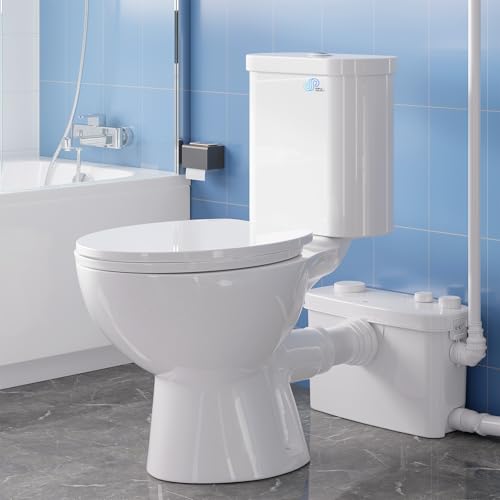
Simple Project Macerating Toilet System, 500W — Best Compact System
| Specification | Detail |
|---|---|
| Format | Macerating upflush toilet system |
| Pump rating | 500W, 4-inlet (per Amazon title) |
| Flush volume | 1.6 GPF (per Amazon title) |
| Includes | Extension pipe (per listing) |
Not every slab-house addition is an ensuite; some are a WC under the stairs, a toilet in the corner of a workshop, or a small cloakroom carved from a utility space. The Simple Project system is pitched at exactly that scale: a 500 watt pump with four inlets — enough for a small basin alongside — a space-saving format, and the extension pipe in the box so the pump can tuck behind the wall or a boxing panel. The listing’s 1.6 GPF flush figure is the fuller legacy volume, which suits a macerator: more water per flush helps carry solids through the pump and the small-bore line.
Strengths
- Compact format suits under-stairs and workshop-corner bathrooms
- Four inlets still allow a small basin on the same pump
- Extension pipe included for a concealed pump position
Trade-offs
- 500W is the gentlest pump here — keep discharge runs short and simple
- Value brand with a developing support record
- Space-saving still requires service access to the pump; do not box it in permanently
This is the proportionate pick for the smallest version of the project: one toilet, maybe one basin, a short run to the stack, and a premium on every inch of floor. In that setting the bigger pumps buy nothing and the compact format buys a bathroom that actually fits. Treat the install with the same care as any macerator — accessible pump, gentle bends, no sagging pipe — and a system at this scale will quietly do its one job for years.
Best for: Small toilet-only or toilet-and-basin additions with short discharge runs / Not suited for: Long runs, full bathrooms with showers, or high vertical lifts
Check the current price on Amazon

VEVOR Macerating Toilet System, 700W — Best Alternative Kit
| Specification | Detail |
|---|---|
| Format | Macerating upflush toilet system |
| Pump rating | 700W (per Amazon title) |
| Inlets | 3-inlet (per Amazon title) |
| Flush | Dual flush (per Amazon title) |
VEVOR arrives in this category from the tool and equipment world, and its system reads like it: a strongly rated 700 watt pump, rear discharge, dual flush so liquid waste uses less water, and a three-inlet configuration that covers a toilet plus a basin, or a toilet plus a shower, if not every fixture at once. The space-saving pitch matches the slab-house brief — these systems earn their keep in rooms that were never meant to be bathrooms. For buyers who already own the brand’s equipment, the familiarity is a legitimate part of the appeal.
Strengths
- 700W pump rating gives strong discharge headroom
- Dual flush trims water use on liquid-only flushes
- Three inlets cover the common toilet-plus-one-fixture additions
Trade-offs
- Three inlets, not four — a full three-fixture bathroom is at the limit
- A generalist brand rather than a macerator specialist
- Confirm the included bowl and seat configuration on the listing before ordering
Position this pick as the strong alternative: when the run is long enough to want real pump power but the project does not need the fourth inlet or the premium brand’s network, the VEVOR splits the difference. As with every system here, the install decides the ownership experience — accessible pump placement, swept bends rather than sharp elbows where the design allows, and a discharge line with no low spots. Get those right and the badge on the pump matters much less than the plumbing around it.
Best for: Toilet-plus-one-fixture additions wanting strong pump power at a value tier / Not suited for: Full three-fixture bathrooms that need the fourth inlet
Check the current price on Amazon
Comparison Table
The honest separators in this table are pump configuration, inlet count and what is in the box. Match the pump to your measured discharge route first; brand and tier come second, because an underspecified pump from a famous brand still underperforms a correctly specified one.
| Pick | Badge | Key spec | Best for |
|---|---|---|---|
| Saniflo SaniPLUS Macerating Upflush Toilet Kit with Elongated Bowl — Check price | Best Overall | Complete kit, elongated bowl, macerating pump | Permanent bathroom additions where brand support and parts availability matter most |
| SANIFLO Saniaccess 3 with Elongated Bowl and Tank Bundle — Check price | Best for a Full Bathroom Addition | Full bundle, multi-inlet pump for basin and shower | Full ensuite or granny-flat bathrooms where basin and shower share the pump |
| Flodream Macerating Toilet with Pump, Complete Kit — Check price | Best Complete-Kit Value | Complete kit, 4 inlets, stated 24 ft vertical lift | Toilet-plus-basin additions and buyers who want stated specs in a value complete kit |
| SUPERFLO 750W Macerating Toilet System — Check price | Best Pump Power | 750W pump, 4 inlets | Long or high discharge runs across a slab to a distant stack |
| Simple Project Macerating Toilet System, 500W — Check price | Best Compact System | 500W pump, 4 inlets, space-saving format | Small toilet-only or toilet-and-basin additions with short discharge runs |
| VEVOR Macerating Toilet System, 700W — Check price | Best Alternative Kit | 700W pump, rear discharge, dual flush | Toilet-plus-one-fixture additions wanting strong pump power at a value tier |
How to Choose an Add-On Toilet for a Slab House
Start by mapping the discharge route, because it specifies the pump. From the new toilet’s position, trace the path the small-bore discharge pipe will take to the existing soil stack or main line: how high must it rise, how far must it run horizontally, and how many bends does the route force? A short rise and a brief run suit any pump in this guide. A full storey of lift followed by a long horizontal run is the case for the higher-rated pumps, and every system here should be checked against its listing’s stated lift figures before ordering.
Decide the fixture count now, not later. A toilet alone needs one inlet; a toilet and basin need two; a full bathroom with a shower needs the multi-inlet pumps, and retrofitting inlets that do not exist means replacing the pump. This is the cheapest decision in the whole project to get right at the start and the most expensive to change. While planning fixtures, remember the shower and basin drain to the pump by gravity, so their heights and falls must be designed around the pump’s inlet positions — a shower tray on a raised plinth is normal in these installs, not a mistake.
Finally, plan power and access. Every macerator needs an electrical supply near the pump, installed to bathroom standards. And the pump must remain reachable: behind a removable panel, in an accessible void, anywhere but entombed behind tile. Macerators are reliable, but they are machines with blades and seals; the install that assumes it will never need opening is the install that becomes expensive. Check your local code position too — macerating systems are widely accepted, but permits and inspection for a new bathroom apply to slab houses exactly as they do anywhere else.
Macerating vs Cutting the Slab: The Honest Comparison
Cutting the slab is the conventional route and it is not wrong — it produces a standard gravity toilet with no pump, no noise and nothing electrical in the drainage path. Its costs are disruption and commitment: concrete cutting inside a finished home is dusty, loud and slow, the trench must reach the main line at the correct fall, and the floor build-up has to be reinstated afterwards. For a whole-house renovation with floors already up, that calculus can favour the trench.
Macerating wins when the house is finished and the bathroom is an addition: no concrete is broken, the work is ordinary plumbing and carpentry, and the project is reversible in a way a trenched drain never is. Its costs are the pump itself — a machine that hums briefly per flush, needs power, and will eventually need service or replacement — and a discharge pipe that must be routed thoughtfully. Most slab-house additions land on the macerating side of this comparison, which is why an entire product category exists to serve them. The deciding question is simple: are you renovating the house, or adding a room to it?
What a Macerating Toilet Can and Cannot Flush
A macerator is designed for human waste and toilet paper, and toilet paper only. The category’s golden rule deserves printing on the pump: nothing else goes in. Wet wipes — including those marketed as flushable — sanitary products, cotton buds and dental floss are the standard causes of jammed blades and blocked small-bore lines, and they jam a macerator far faster than they trouble a conventional drain, because the pump and pipe are smaller and the blades must cut whatever arrives.
Households adding a macerating bathroom should brief every user, especially guests and children, with a small polite sign if necessary. Choose ordinary toilet paper, which disintegrates quickly, over ultra-plush multi-ply that breaks down slowly. With that single discipline observed, a correctly installed system is a low-drama appliance; without it, no brand in this guide can protect the pump from its users.
How to Plan an Upflush Toilet Install on a Slab (Without Breaking Concrete)
Step one is the route survey. Identify the existing soil stack or main drain the discharge will join, then walk the pipe’s path from the new bathroom to that point, noting the vertical rise, the horizontal distance and every wall or ceiling void the pipe can use. Small-bore discharge pipe is flexible in routing compared with gravity drainage — it can rise first and run overhead — but it must never sag, because a low spot becomes a sediment trap. Mark the pump position with service access in mind before anything is fixed.
Step two is setting the fixtures. The toilet connects to the pump’s main inlet with the extension pipe if the pump sits behind the wall line; basin and shower wastes run to the side inlets with a continuous gentle fall toward the pump, which usually means raising a shower tray on a plinth to buy the gradient. The pump needs its electrical supply in place, and the discharge line leaves the pump rising vertically first — that initial lift is how these systems are designed to work — before turning toward the stack with swept bends.
Step three is commissioning honestly. Fill and flush the system repeatedly, checking every joint dry-handed and then with tissue, and run the basin and shower to confirm they drain into the pump without backing up toward the toilet. Listen to a full cycle: the pump should start promptly, run briefly and stop cleanly. Label the isolation points, keep the pump’s access panel reachable in the finished room, and leave the next owner — or your future self — a note of the pipe route. The slab underneath remains untouched throughout, which was the entire point.
Designing the Added Bathroom: Layouts That Work on a Slab
The rooms slab houses gain are predictable: the garage conversion, the under-stairs cloakroom, the workshop corner, the pool house, the granny flat carved from a large utility space. Each has a layout lesson. In garage conversions, the toilet usually wants the wall nearest the house’s existing plumbing — every metre of discharge run you save is pump effort, pipe cost and noise avoided. Place the new bathroom against the shared wall with the kitchen or laundry and the route to the stack becomes short enough that almost any pump in this guide is comfortably specified.
Under-stairs and cloakroom additions trade space for proximity: they are often close to the hall and the main stack, which is ideal for the pump, but tight for the user, so choose compact fixtures, an outward-opening or sliding door, and ventilation that actually vents — a small room with a shower is a condensation trap without it. Remember the pump needs floor or wall space plus service access; in the smallest rooms, the pump-behind-a-panel arrangement used with an extension pipe is what makes the layout possible at all.
Full ensuite additions add the shower question. The shower tray must sit high enough for its waste to fall to the pump inlet, which typically means a raised tray on a plinth — design it as a deliberate step with proper support and waterproofing rather than an afterthought. Basins are the easy fixture: their waste falls readily and their inlets are forgiving. Plan the room in section — heights, not just floor plan — and the macerating bathroom designs itself.
Costs, Permits and Living With a Macerator Long-Term
Budget the project in layers. The system itself — pump or complete kit — is the visible layer. Behind it sit the ordinary costs of any bathroom addition: the discharge and supply plumbing, the electrical point for the pump, ventilation, waterproofing where a shower is involved, and the finishes. The macerating route’s economic argument is what it avoids: no concrete cutting crew, no trenching across the slab, no structural reinstatement of the floor. Against a conventional below-slab install in a finished house, that avoidance is usually the largest single number in the comparison.
Permits and codes apply normally. A new bathroom is regulated work in most jurisdictions regardless of how its drainage is achieved, and macerating systems are widely accepted when installed to the manufacturer’s instructions and local code — but ‘widely accepted’ is a reason to file the permit confidently, not to skip it. Keep the pump’s documentation with the house papers; a future buyer’s surveyor will ask what the humming box behind the panel is, and the manual plus the permit answer the question completely.
Long-term ownership is a rhythm, not a burden. The pump asks for three things: users who respect the toilet-paper-only rule, an installer who left it accessible, and an owner who treats the first change in its sound as information rather than background. A pump that starts running longer, or cycling when nothing was flushed, is reporting a fact — usually a slowly leaking inlet valve or debris at a seal — and a service visit at that stage is minor. Ignored, the same fact becomes the emergency. Choose the system with that rhythm in mind and the added bathroom becomes the least dramatic room in the house.
Noise, Smell and Neighbours: The Practical Worries Answered
Three worries recur in every macerating conversation, and each has a practical answer. Noise first: the pump runs for a few seconds per flush, and its sound is a hum-and-whir, not a roar. The listing for the Flodream kit in this guide states a below-45-decibel design, and installation choices matter as much as the pump itself — a pump sitting on a solid floor behind a panel, with its pipework clipped so it cannot drum against studwork, is dramatically quieter than the same pump loose in a resonant void. If the new bathroom shares a wall with a bedroom, put the pump on the far side of the room and let the wall build-up do its work.
Smell is a plumbing-design question, not a macerator flaw. A correctly vented system with water-sealed fixtures smells exactly like a conventional bathroom, because the pump chamber is sealed and the discharge line is closed. Odour complaints trace to venting shortcuts or a dry trap on a little-used basin — both installation matters with known fixes, which is another reason the commissioning checks in this guide’s how-to section are worth doing slowly. A macerator does not need scented additives; it needs correct venting and regular use.
Neighbours and future buyers form the third worry, and documentation answers both. The discharge pipe inside your own walls is your business and your building control’s; keep the permit, the manual and a sketch of the pipe route with the house papers. When the house is sold, that folder converts a surveyor’s question mark into a demonstrated, permitted system with a service history. Macerating bathrooms have been normal in slab and basement homes for decades — the paperwork simply lets everyone else see that yours is one of the good ones.
Choosing Between the Kits: A Decision Walk-Through
Walk the decision in the order a plumber would. First, the route: measure the rise from the new bathroom to the level of the existing stack connection and pace the horizontal distance. A rise within one storey and a short run puts every kit in this guide in play. A full storey plus a long traverse argues for the stronger pumps — the 750 watt SUPERFLO or the 700 watt VEVOR — or for the Saniflo kits whose stated figures your plumber can check against the route. Never buy the pump before this measurement exists; it is the specification, and everything else is preference.
Second, the fixtures. Toilet only: the compact Simple Project or any complete kit suffices, and the choice becomes brand confidence versus tier. Toilet plus basin: still every kit here, since four-inlet and three-inlet pumps both cover it — check the inlet positions suit your layout. Toilet, basin and shower: narrow the field to the multi-inlet systems and give the Saniaccess 3 bundle and the four-inlet kits your closest attention, because the shower’s drainage design, not the toilet, will dominate the install.
Third, the ownership horizon. A workshop toilet used weekly and a granny-flat bathroom used daily for twenty years are different purchases wearing the same clothes. The daily, permanent, someone-else-will-maintain-it case is where the established brand’s parts network earns its premium. The occasional-use, owner-maintained case is where the value complete kits shine, provided their pumps are specified with headroom. Decide all three questions honestly and the shortlist in this guide collapses to one obvious name — which is what a buying guide is for.
Common Buying Mistakes
Mistake one: ordering a pump-only listing expecting a complete toilet. This category sells pumps alone, pumps with bowls, and full bundles under similar names. Read the listing’s contents line by line and match it to what your project actually needs before the box arrives.
Mistake two: underspecifying the pump for the route. A gentle pump on a long, high run works at its limit on every flush and lives a short, loud life. Measure the rise and the run, then buy headroom — the stronger pump is cheaper than the second pump.
Mistake three: boxing the pump in permanently. Tiling over the only access to a macerator converts a routine service into demolition. Build the access panel into the design from the start; future you, holding a screwdriver at midnight, will be grateful.
Mistake four: flushing wipes. Nothing ages a macerator like wet wipes, however flushable the packet claims they are. The rule for every user of the new bathroom is toilet paper only, and it is worth a small sign until the habit is set.
Final Recommendation
For a permanent addition with the deepest support behind it, the Saniflo SaniPLUS kit is the benchmark, and the Saniaccess 3 bundle is its full-bathroom counterpart when a basin and shower join the plan. The Flodream kit is the value standout with stated lift figures and four inlets; the SUPERFLO’s 750 watt pump suits long runs, the Simple Project system fits the smallest spaces, and the VEVOR splits power and value with its 700 watt, three-inlet design.
Whichever system you choose, the project succeeds on planning: route first, fixture count second, access always. The slab stays whole, and the new bathroom flushes like it was always there.
Keep comparing within this range: Best Adult Toilets Best Add On Budets For Toilets Best Ada Toilets With Elongated Seats Home Depot Best 1.28 Gallon Toilets Best Afforable Toilets
Re-check the leading picks here: Check the current price on Amazon · Check the current price on Amazon · Check the current price on Amazon
A final planning note belongs to timing and sequence. The macerating route compresses a bathroom addition dramatically compared with slab work, but the order of operations still matters: route survey and pump specification first, fixtures and drainage falls second, first-fix plumbing and electrics third, and finishes last — with the pump’s access panel designed into the finish rather than discovered as a problem by it. Households that run the sequence in that order find the project almost disappointingly straightforward. Households that choose pretty fixtures before measuring the discharge route are the ones writing the cautionary tales. The technology in this guide is mature; the planning is the product.
It is also worth stating plainly what this guide did not recommend, and why. Ejector-pump basins set into a pit in the floor can serve a slab house, but they require breaking a section of slab for the pit — the very disruption the macerating route exists to avoid — so they belong to the conventional-renovation conversation, not this one. Composting and incinerating toilets solve a different problem entirely: sites with no sewer or septic connection at all. A slab house on mains drainage or a septic tank has a connection; it simply lacks a hole in the floor where the new bathroom wants to be. Macerating systems are the precise answer to that precise problem, which is why six of them, and nothing else, fill this guide.
Frequently Asked Questions
Can you really add a toilet on a concrete slab without cutting it?
Yes. A macerating upflush toilet grinds waste and pumps it through a small-diameter pipe that runs at floor level, inside walls or above ceilings to the existing soil stack. No trench is cut and the slab stays intact, which is why these systems are the standard solution for slab-house bathroom additions.
Does a macerating toilet feel different to use?
From the seat, no — it is a normal-looking toilet with a normal flush. The difference comes a second later: a brief pump hum as the macerator clears the bowl. Quieter designs keep that sound modest, and mounting the pump behind a wall or panel muffles it further.
Can a basin and shower run through the same pump?
Yes, with the right pump. Multi-inlet models accept a basin and a shower alongside the toilet, which is how full ensuites are added on slabs. The basin and shower drain to the pump by gravity, so their heights and pipe falls must be planned around the pump’s inlets — a raised shower tray is normal.
What can go wrong with a macerating toilet?
The common failures are user-made and installation-made: wipes and other non-paper items jamming the blades, discharge pipes with sags that trap sediment, and pumps boxed in where they cannot be serviced. Correct specification, a clean pipe route, service access and toilet paper only prevent almost all of it.
Does an upflush toilet need electricity and a vent?
It needs electricity for the pump, supplied to bathroom standards near the pump position. Venting follows the pump maker’s instructions and local code — many systems vent into the existing vent network or use an approved alternative. A new bathroom also generally requires permits, slab house or not, so check with your local authority.
How long do macerator pumps last?
They are service appliances rather than lifetime fixtures: with correct use — toilet paper only, correct pipework — a quality pump runs for many years, and access-panel designs let a plumber service blades, seals and switches without removing the toilet. Buying a brand or kit with available parts is the practical way to protect that lifespan.


