Disclosure: airfryerkitchensupply.com is reader-supported. When you buy through links on our site, we may earn an affiliate commission at no extra cost to you.
Finding the best adaptive toilets children can actually use independently is less about the toilet itself and more about adaptation: a standard adult toilet is too tall, too wide and too intimidating for a small child, and for a child with additional physical or developmental needs it can be genuinely unusable without help. Adaptive solutions solve different parts of that problem. A family toilet seat with a built-in child ring shrinks the opening to child size while leaving the adult seat untouched. A ladder seat adds steps and handles so a child can climb up, turn around and sit with feet supported — feet support matters more than most parents realise, because a child whose legs dangle cannot brace properly. A portable potty ring travels between home, grandparents and holidays, and a starter potty keeps the whole learning process at floor level. For families whose child benefits from routine, warmth and gentle automation, a smart toilet with a child mode appears in this guide too. Every pick below was verified, so the product in each review is a real, orderable listing, described exactly as the listing returns it.
Where to buy
The confirmed picks in this guide are sold through Amazon, where you can check the current price on Amazon for each model, confirm whether it fits a round or elongated bowl — the single most important check in this category — and arrange delivery. Start with these confirmed options:
- Mayfair NextStep2 Toilet Seat with Built-In Potty Training Seat, Elongated — Best Overall: Check the current price on Amazon
- Jool Baby Quick Flip Toilet Seat with Built-In Potty Seat, Elongated — Best for Quick Independent Use: Check the current price on Amazon
- Forbena Potty Training Toilet Seat with Step Stool Ladder — Best for Climbing Independence: Check the current price on Amazon
- Munchkin Sturdy Toddler Toilet Seat — Best Portable Potty Ring: Check the current price on Amazon
- Munchkin Arm & Hammer Multi-Stage 3-in-1 Potty — Best Floor-Level Starter: Check the current price on Amazon
- Smart Tankless Toilet with Child Mode, Dual Flush 0.8/1.2 GPF — Best Built-In Adaptation: Check the current price on Amazon
Bowl shape is the trap in this category. Family seats, flip-down child seats and ladder seats are made in round and elongated versions that do not interchange. Look at your toilet from above before ordering: elongated bowls are noticeably longer front to back, roughly egg-shaped, while round bowls are close to circular. Match the version to the bowl and every pick below fits the way it should.
In this guide
Quick Picks
- Best Overall: Mayfair NextStep2 Toilet Seat with Built-In Potty Training Seat, Elongated — A normal adult seat with a child ring built into the lid, slow-close throughout and a mount designed never to loosen — Check the current price on Amazon
- Best for Quick Independent Use: Jool Baby Quick Flip Toilet Seat with Built-In Potty Seat, Elongated — Built-in child seat with a splash guard that flips down in one motion and stays out of the adults’ way — Check the current price on Amazon
- Best for Climbing Independence: Forbena Potty Training Toilet Seat with Step Stool Ladder — Seat, steps and handles in one folding unit, so the child climbs, turns and sits with feet supported — Check the current price on Amazon
- Best Portable Potty Ring: Munchkin Sturdy Toddler Toilet Seat — A simple, grippy potty ring that drops onto the adult seat at home, at grandparents, or on holiday — Check the current price on Amazon
- Best Floor-Level Starter: Munchkin Arm & Hammer Multi-Stage 3-in-1 Potty — A floor potty that converts to a toilet-topper ring and a step stool as the child progresses — Check the current price on Amazon
- Best Built-In Adaptation: Smart Tankless Toilet with Child Mode, Dual Flush 0.8/1.2 GPF — A full smart toilet whose listing includes a dedicated child mode with gentler wash settings — Check the current price on Amazon
How These Picks Were Chosen
Adaptive, for this guide, means a product that changes the fit between a child and a toilet: a smaller opening, a supported climb, handles to hold, a seat that cannot slam, or a routine the child can run alone. Products that were merely small or merely cute were excluded; each pick had to remove a specific barrier — height, opening size, stability, fear of falling in, or the need for an adult to lift and hold.
Each product was verified on this site, and the Amazon title had to confirm the format — built-in potty seat, flip seat, portable ring, ladder seat, multi-stage potty or smart toilet with a child mode — before it earned a link. Bowl-shape variants are called out in every review, because ordering the round version for an elongated bowl is the most common failure in this category.
The six picks deliberately span the developmental arc: a floor-level starter potty for the first stage, a portable ring for the transition, two built-in family seats for the main family bathroom at two different design philosophies, a ladder seat for climbing independence, and a smart toilet with a child mode for families who want the adaptation built into the fixture itself. A family with twins, a child with low muscle tone, and a confident four-year-old all need different things; the badges say which is which.
The 6 Best Adaptive Toilets for Children
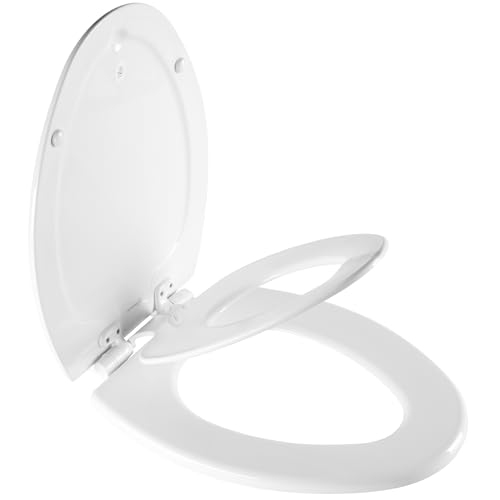
Mayfair NextStep2 Toilet Seat with Built-In Potty Training Seat, Elongated — Best Overall
| Specification | Detail |
|---|---|
| Format | Family toilet seat with built-in child ring |
| Bowl fit | Elongated (this version) |
| Close | Slow-close |
| Mount | Removable, will-never-loosen fixing |
The NextStep2 solves the family bathroom problem in the tidiest way available: the child seat lives inside the lid. An adult uses the toilet exactly as normal; a child flips the smaller ring down and gets an opening sized for them, held in place magnetically when not in use. The slow-close action matters more than it sounds — the classic childhood toilet injury is a slammed lid on small fingers, and this design removes it for both rings. The mounting system is the other quiet triumph: the listing describes a fixing that will not loosen, and anyone who has re-tightened a wobbling family seat monthly will understand why that earns its place in the title.
Strengths
- Child ring is built in, so there is nothing to store, carry or balance on the adult seat
- Slow-close on both rings removes the slammed-lid finger risk
- Stays tight on the bowl, which keeps the child seat stable and confidence-building
Trade-offs
- This version fits elongated bowls only; a round version exists but is a different listing
- The child ring suits the training and early-years stage, not older or larger children
- It adapts the seat, not the height — a step stool is still needed for the climb
This is the pick for the main family bathroom in a home that hosts both adults and a training child all day. It keeps the room looking and working like a normal bathroom, which matters for the adults, while quietly making the toilet child-sized in two seconds, which matters for the child. Pair it with a simple step stool so feet are supported, and the setup covers most children from first training through to confident independent use. For a child who needs handles or a supported climb as well, look at the ladder seat further down this guide instead.
Best for: Family bathrooms where adults and a training child share one toilet all day / Not suited for: Round bowls (choose the round version) or children who need handles and a supported climb
Check the current price on Amazon

Jool Baby Quick Flip Toilet Seat with Built-In Potty Seat, Elongated — Best for Quick Independent Use
| Specification | Detail |
|---|---|
| Format | Family toilet seat with built-in potty seat |
| Bowl fit | Elongated (this version) |
| Extras | Built-in splash guard |
| Close | Slow close |
The Quick Flip takes the same built-in idea as the Best Overall pick and tunes it for speed and for boys. The child seat flips down in one easy motion — the listing emphasises that kids can do it themselves, which is the entire point of an adaptive product — and it includes a splash guard, the small raised shield at the front of the child ring that keeps a sitting boy’s aim inside the bowl. When the child is done, the seat flips back up and disappears into the adult seat stack, so the bathroom never looks like a training academy.
Strengths
- One-motion flip-down that children can operate themselves
- Built-in splash guard addresses the most common little-boy mess at the source
- Slow close minimises noise and pinching, per the listing
Trade-offs
- Elongated version only in this listing; round bowls need the matching variant
- Like all family seats, it does not solve the climb — pair with a step stool
- The splash guard needs a wipe as part of the cleaning routine
Choose this pick when the child is past the first wobbly stage and the goal is speed and independence: walk in, flip, sit, flush, done, no adult stage-management. It is also the pragmatic pick for households with boys, where the splash guard saves the floor and the base of the toilet from the daily evidence of learning. Grandparents’ houses are a natural second home for one of these — the bathroom stays adult-normal for them and child-ready in one flip when the family visits.
Best for: Confident training children, especially boys, who can manage a flip-down seat alone / Not suited for: Children who still need handles or a ladder to climb and turn safely
Check the current price on Amazon

Forbena Potty Training Toilet Seat with Step Stool Ladder — Best for Climbing Independence
| Specification | Detail |
|---|---|
| Format | Ladder-style training seat |
| Extras | Step stool ladder, handles, soft cushion |
| Grip | Non-slip |
| Storage | Foldable |
A ladder seat adapts the whole journey, not just the sitting. The child climbs the steps facing the toilet, holds the handles, turns around at the top — the manoeuvre that defeats most toddlers on a plain step stool — and sits on a cushioned child seat with feet resting on the step rather than dangling. That foot support is physiologically important: children brace through their feet to bear down comfortably, and a child swinging their legs over a tall bowl is working against their own body. The handles give the same security to a child with weaker core stability or a cautious temperament.
Strengths
- Steps plus handles support the full climb-turn-sit sequence, not just the seat
- Feet stay supported on the step, which helps the child relax and brace properly
- Folds away when the bathroom returns to adult duty
Trade-offs
- Takes floor space in front of the toilet while deployed, which matters in small bathrooms
- An adult must move or fold it for their own use, every time
- Suits the training window rather than older children, who will outgrow the ladder
This is the strongest pick in the guide for a child who needs physical support structures — lower muscle tone, balance caution, or simple small stature in a house with tall comfort-height toilets. It is also the pick that most reduces adult involvement: no lifting onto the seat, no holding in place, no hovering. Set it up, check the non-slip feet are planted on your floor surface, and supervise from a decreasing distance as the routine beds in. When two children are training at once, the ladder is the unit they can queue for without a referee.
Best for: Children who need steps, handles and foot support to use a full-height toilet / Not suited for: Very small bathrooms or households that cannot spare the floor footprint
Check the current price on Amazon
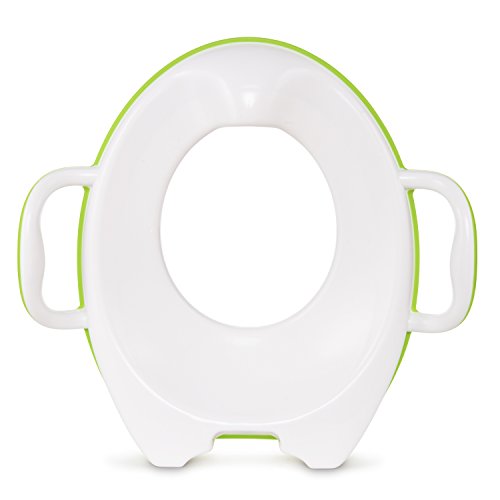
Munchkin Sturdy Toddler Toilet Seat — Best Portable Potty Ring
| Specification | Detail |
|---|---|
| Format | Portable potty ring / toilet topper |
| Brand | Munchkin Sturdy |
| Use | Sits on top of the adult seat |
The portable ring is the oldest adaptive idea in the category and still the most flexible. The Munchkin Sturdy drops onto the adult seat, shrinks the opening to child size, and lifts off again in a second. Its superpower is consistency: the same ring the child trusts at home can travel to a grandparent’s house, a holiday rental or a nursery, so the toilet setup stays familiar when everything else changes. For children who find change itself difficult — a common thread in adaptive needs — that portability is not a convenience, it is the feature.
Strengths
- Travels anywhere, keeping the child’s toilet setup identical in every location
- No installation at all — it sits on the seat and lifts off
- Simple, sturdy format with nothing electronic or mechanical to fail
Trade-offs
- It adapts the opening only — the child still needs a step and possibly a hand to climb
- It must be stored somewhere between uses, unlike the built-in seats
- Fit and stability depend on the adult seat shape underneath, so check it sits without rocking
Buy this pick as the universal spare even if you also buy a built-in seat: one for the main bathroom’s permanent setup, this one for everywhere else. It is also the lowest-commitment way to discover whether your child is ready to graduate from a floor potty to the real toilet — if the ring works, the built-in seats become an easy upgrade; if the height still overwhelms, nothing expensive has been committed. Rinse-clean simplicity keeps it hygienic without a cleaning ritual.
Best for: Travel, grandparents’ houses, and testing readiness for the real toilet / Not suited for: Children who need handles, steps or a fixed, cannot-shift seat
Check the current price on Amazon
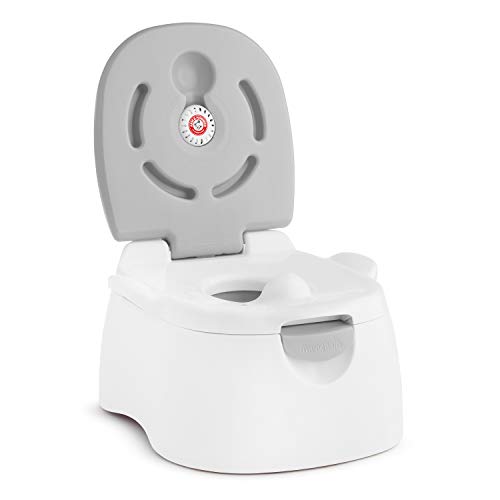
Munchkin Arm & Hammer Multi-Stage 3-in-1 Potty — Best Floor-Level Starter
| Specification | Detail |
|---|---|
| Format | Multi-stage 3-in-1 potty |
| Stages | Floor potty, toilet ring, step stool |
| Brand | Munchkin Arm & Hammer |
Training starts at floor level for a reason: feet flat on the ground, no height to fear, no climb to organise, and a bowl that is entirely the child’s own size. This 3-in-1 covers that first stage as a standalone potty, then converts — the ring lifts to serve as a toilet topper for stage two, and the base becomes the step stool the child needs for stage three. One purchase quietly spans the whole arc, which keeps the child’s equipment familiar at exactly the age when familiarity is calming.
Strengths
- Floor-level start removes height fear from the first stage entirely
- Converts to a toilet ring and then a step stool, following the child’s progress
- A single familiar product across stages suits children who rely on routine
Trade-offs
- A floor potty means emptying and cleaning a removable bowl — the labour built-in seats avoid
- The stages are sized for the training window, not for older children
- It lives on the bathroom floor, so small bathrooms feel it
Choose this pick when the child is at the very beginning, or when previous attempts at the big toilet have stalled on fear. Starting where the child feels safe and graduating in stages is slower on paper and faster in practice, because none of the progress is spent un-frightening them. It is also the kindest option for a child with physical delays who will spend longer in the early stages: nothing about the setup rushes them, and each stage is ready when they are.
Best for: First-stage training and children who need a gradual, floor-level start / Not suited for: Families who want to skip the floor potty and go straight to the toilet
Check the current price on Amazon

Smart Tankless Toilet with Child Mode, Dual Flush 0.8/1.2 GPF — Best Built-In Adaptation
| Specification | Detail |
|---|---|
| Format | One-piece tankless smart toilet |
| Child feature | Child mode (per Amazon title) |
| Flush | Dual flush 0.8 / 1.2 GPF |
| Extras | Heated seat, warm water wash, air dry |
At the top of the adaptive range, the adaptation is built into the fixture. This smart toilet’s listing includes a dedicated child mode alongside its heated seat, warm water wash and air dry functions — a gentler, simplified wash routine designed for a smaller user. The warm seat deserves a mention of its own: a cold ceramic seat is a genuine deterrent for a sensory-sensitive child at night or in winter, and removing that shock can be the difference between a child who goes independently and one who holds on and calls for help. The dual flush offers a light 0.8 gallon option for liquid waste.
Strengths
- Dedicated child mode adapts the wash routine to a smaller user
- Heated seat removes the cold-seat deterrent for sensory-sensitive children
- Auto flush removes a step — and a lever — from the child’s routine
Trade-offs
- It is still an adult-height toilet; a step stool remains necessary for most children
- Needs an electrical outlet and sits firmly in the premium tier
- A full fixture replacement to solve what a seat alone solves for many families
This pick makes sense in a specific, real scenario: a family renovating a bathroom anyway, with a child who benefits from warmth, routine and automation, and who will use this bathroom for years. Bought for that scenario, the child mode and heated seat are durable adaptations rather than novelties. Bought purely for a training toddler, it is far more fixture than the problem requires — the seats above solve training for a fraction of the commitment. Read the badge literally: best built-in adaptation, for homes where built-in is the plan.
Best for: Renovating families with a sensory-sensitive or routine-driven child / Not suited for: Training toddlers, renters, or anyone solving a short-term stage
Check the current price on Amazon
Comparison Table
The six picks adapt different barriers, so read the table by barrier rather than by rank: opening size, climb, stability, familiarity or automation. Most families end up combining two — typically a built-in seat plus a step, or a ladder seat at home plus a portable ring for everywhere else.
| Pick | Badge | Key spec | Best for |
|---|---|---|---|
| Mayfair NextStep2 Toilet Seat with Built-In Potty Training Seat, Elongated — Check price | Best Overall | Built-in child ring, elongated, slow-close | Family bathrooms where adults and a training child share one toilet all day |
| Jool Baby Quick Flip Toilet Seat with Built-In Potty Seat, Elongated — Check price | Best for Quick Independent Use | Flip-down child seat with splash guard, elongated | Confident training children, especially boys, who can manage a flip-down seat alone |
| Forbena Potty Training Toilet Seat with Step Stool Ladder — Check price | Best for Climbing Independence | Integrated steps and handles, foldable | Children who need steps, handles and foot support to use a full-height toilet |
| Munchkin Sturdy Toddler Toilet Seat — Check price | Best Portable Potty Ring | Portable child ring for adult toilets | Travel, grandparents’ houses, and testing readiness for the real toilet |
| Munchkin Arm & Hammer Multi-Stage 3-in-1 Potty — Check price | Best Floor-Level Starter | Three stages in one product: potty, ring, step | First-stage training and children who need a gradual, floor-level start |
| Smart Tankless Toilet with Child Mode, Dual Flush 0.8/1.2 GPF — Check price | Best Built-In Adaptation | Child mode, dual flush, heated seat and wash | Renovating families with a sensory-sensitive or routine-driven child |
How to Choose Adaptive Toilet Solutions for Children
Identify the actual barrier first, because each product in this guide removes a different one. If the child is frightened of the height or the big opening, the fix is a smaller ring and a lower start — a floor potty or a built-in child seat. If the child is willing but cannot climb, turn and sit safely, the fix is mechanical: steps and handles, meaning the ladder seat. If the child manages at home but falls apart elsewhere, the fix is familiarity, meaning a portable ring that travels. If cold, noise or unpredictability is the issue, the fix is environmental — slow-close lids, a warm seat, a routine that never changes. Naming the barrier honestly saves buying two products that solve the wrong problem.
Check bowl shape before anything else. Family seats and flip seats are manufactured in round and elongated versions, and they do not swap. Look down at your bowl: elongated is egg-shaped and noticeably longer; round is close to a circle. Then check the child’s feet. Whatever seat you choose, the child’s feet must rest on something — a step, a ladder rung, the floor — because unsupported legs make it harder for a child to relax and bear down, and a dangling child is also a child gripping the seat edges instead of relaxing.
Finally, think in stages and handovers. The training window is short but the independence window is long: the best setup is the one the child can operate entirely alone a month from now, not the one that works with you hovering today. Slow-close everything is worth insisting on at every stage — it protects fingers and removes the startling slam that puts cautious children off the whole project.
Adaptive Features That Matter for Children with Additional Needs
For children with additional physical or developmental needs, three features do most of the work. Stability is first: seats that lock or fix firmly to the bowl, ladders with non-slip feet, and handles that give the child something structural to hold through the climb-turn-sit sequence. A seat that shifts even slightly teaches the child that toilets are unpredictable, and rebuilding that trust takes far longer than choosing a stable product would have.
Predictability is second. The same seat, in the same position, with the same routine, in every location the child regularly uses — which is why the portable ring punches so far above its simplicity for this group, and why built-in seats that never move beat removable ones that get put away. Third is sensory management: slow-close lids instead of slams, a warm seat instead of cold ceramic for the child who finds it distressing, and flush timing the child controls or can anticipate rather than an automatic flush that fires without warning — a detail worth checking on any smart fixture, since surprise flushing is a well-known setback for sensory-sensitive children.
Setting Up the Bathroom Around the Seat
The seat is only half the adaptation. A step that does not wobble, positioned where small feet actually land, matters as much as the ring itself. Keep the route simple: toilet paper within the child’s reach without leaning — leaning on a child seat is how slips happen — and a clear floor path for the ladder seat if you use one. Night lighting on the route to the bathroom removes another quiet barrier. And plan the exit strategy for each stage: the floor potty graduates to the ring, the ring to the built-in seat, the ladder folds away. Children read our confidence in the setup; equipment that appears, works and graduates calmly teaches them the toilet is a solved problem.
How to Set Up an Adaptive Toilet Routine for a Child
Begin with the fit check. Fit the seat or ring and sit the child on it fully dressed, feet supported, for short, pressure-free sessions — reading a book on the toilet is a classic for a reason. The goal of the first days is purely that the setup feels stable, comfortable and boring. Check that the child’s feet rest flat on the step or ladder rung and that knees sit at a comfortable angle; adjust the step height before going any further if they dangle.
Build the sequence as a fixed routine and keep the words for it identical every time: climb or step up, turn, sit, go, wipe, flush, wash hands. For children who thrive on structure, a simple picture sequence on the wall beside the toilet — steps in order — turns the routine into something they can run themselves, which is the definition of an adaptive success. Keep sessions short and end on any success, however small.
Troubleshoot by barrier, not by blame. Reluctance to sit usually means instability or height — re-check fixings and foot support. Refusal after progress often traces to a single bad event, a slam or a slip; slow-close hardware and a return to the previous stage for a few days usually restore confidence. Night-time reluctance is frequently about cold and dark: a warm seat or a night light on the route solves more night problems than any amount of encouragement. Graduate one variable at a time — remove the ladder before the ring, the ring before the step — so the child always keeps most of the familiar setup while one support retires.
Adaptive Toileting Beyond the Seat: Routine, Clothing and the Bathroom Layout
Equipment is only one layer of adaptation. Clothing is the layer parents discover second: a child who has mastered the seat but cannot manage trousers, fastenings and underwear independently is still dependent at the exact moment that matters. During the adaptive period, choose elastic waists and simple layers, and practise the clothing sequence away from the toilet, where there is no urgency. The goal is a full routine — clothes, climb, sit, wipe, flush, clothes, hands — that the child owns end to end, and every link in that chain deserves the same patient design as the seat itself.
The bathroom layout can quietly help or hinder. Keep the step or ladder in its working position rather than stored away, because a setup that must be assembled is a setup that gets skipped. Put toilet paper where a seated child can reach it without leaning, and consider a small, stable bin within reach for wipes packaging and clothing accidents. A visual schedule — pictures of each step in order, fixed at the child’s eye height — turns the routine into a self-guided sequence for children who process pictures more reliably than spoken reminders, and it keeps every caregiver, grandparent and babysitter running the identical routine.
Timing is an adaptation too. Scheduled sits — on waking, after meals, before leaving the house, before bed — build the habit loop on the body’s natural rhythms and remove the high-pressure question ‘do you need to go?’ from the day. Short, calm, identical sessions beat long negotiations. For children at school or nursery, share the home routine and, where relevant, the portable ring solution with staff, so the adaptation travels with the child rather than resetting every Monday.
When to Move On: Graduating From Each Adaptive Stage
Every product in this guide is designed to be outgrown, and knowing the exit signs prevents both premature graduation and unnecessary dependence. A floor potty has done its job when the child sits confidently, stays seated without being entertained, and begins showing interest in the real toilet — curiosity is the green light. A portable ring has done its job when the child climbs with a step, sits without gripping, and no longer comments on the setup at all; boredom with equipment is the sound of mastery.
Built-in family seats retire in two steps: first the child ring stays up and the child uses the adult opening with a step, then the step itself shrinks or disappears as legs grow. The ladder seat retires when the climb-turn-sit sequence transfers safely to a plain step stool — test it supervised, on a dry floor, several times before the ladder folds away for good. Retire one support at a time and keep every other element of the routine identical, so each graduation changes exactly one variable.
Some children will use adaptations longer, and that is a plan, not a failure. For a child with ongoing physical needs, the durable versions of these ideas — firmly fixed seats, permanent grab support, consistent routines across home and school — simply become the household’s normal. The measure of an adaptive setup is never how quickly it disappears; it is how completely the child can manage their own toileting with dignity, at whatever pace their development sets.
Working With Schools, Nurseries and Other Caregivers
An adaptive setup that exists only at home is half a solution, because children spend their days in other people’s bathrooms. The conversation with a nursery or school is easier than most parents expect: settings routinely manage toileting adaptations, and what they need from you is specificity. Share the exact routine — the words used, the sequence, the equipment — rather than a general request for help. If the child uses a particular ring at home, the portable pick in this guide exists precisely so the identical ring can live at the setting too, giving the child one familiar object across both worlds.
Grandparents and regular caregivers deserve the same briefing, delivered kindly. Show the setup rather than describing it: where the step lives, which ring flips down, what the child can do alone and where an adult should simply be nearby. Write the routine down if the household runs on written instructions — a short card inside the bathroom cabinet door keeps every adult running the same system and stops well-meaning improvisation from resetting the child’s confidence.
Finally, review the adaptation as the child changes, not just when it breaks. A termly five-minute check — does the step still match the child’s leg length, does the ring still fit, has the child quietly outgrown a support you are still insisting on — keeps the setup matched to the child in front of you rather than the child of six months ago. Adaptation is a moving target because children are; the families who treat it as a light, regular review rather than a one-off purchase are the ones whose children arrive at full independence with the fewest detours.
Adaptive Toilets for Twins, Siblings and Busy Family Bathrooms
Adapting for more than one child changes the arithmetic. Twins training together will queue, compete and copy; a setup that one child must be lifted onto becomes a bottleneck twice over, which pushes the ladder seat and the built-in family seats up the ranking, because both let children take turns with minimal adult choreography. Keep a second portable ring if the house has two bathrooms — children in training do not schedule their needs around which bathroom holds the equipment, and the ring is inexpensive insurance against the downstairs emergency.
Siblings of different ages create a different problem: the bathroom must serve a seven-year-old who needs nothing, a four-year-old mid-training, and adults, all day, without anyone moving equipment for anyone else. That is the built-in family seat’s home ground — the room is simply always ready for everyone — supported by a step that lives permanently in position. The older child’s dignity matters in the design too: a bathroom that still looks like a training academy embarrasses the sibling who has graduated, so equipment that disappears, like the flip-down and built-in rings, protects more than the floor.
Busy family bathrooms also punish fragility. Every product in this guide was chosen partly for how it survives volume: fixings that stay tight, surfaces that wipe clean, nothing with small detachable parts to vanish down the bowl or behind the cistern. When you read any adaptive product’s listing, apply the household test — can it be cleaned in one minute, operated by a half-asleep adult at 3 a.m., and left set up permanently? The products that pass that test are the ones still working, unremarked, a year later, which is the true definition of a successful family adaptation.
Common Buying Mistakes
Mistake one: buying the wrong bowl shape. Round and elongated family seats do not interchange, and a seat that rocks because it was made for the other shape teaches the child the toilet is unsafe. Two minutes looking down at the bowl prevents the most common return in this category.
Mistake two: forgetting the feet. Parents shrink the opening and forget that the child’s legs now dangle over a taller drop. Unsupported feet make it physically harder for a child to go and emotionally harder to relax. A step is not an accessory; it is part of the adaptation.
Mistake three: choosing novelty over routine. Character seats and musical potties entertain for a week; the child who needs adaptation needs the opposite — the same, plain, predictable setup everywhere. Spend on stability, slow-close and consistency instead.
Mistake four: retiring supports all at once. Removing the ladder, the ring and the step in a single proud weekend is how confident children become reluctant again. Retire one support at a time and let each smaller setup become boring before the next change.
Final Recommendation
For the main family bathroom, the Mayfair NextStep2 is the default: built in, slow-close, stable, invisible when adults use the room. The Jool Baby Quick Flip matches it for children who can flip a seat themselves and adds the splash guard boys need. The Forbena ladder is the strongest physical adaptation, the Munchkin Sturdy ring is the one that travels, the 3-in-1 potty is the gentle floor-level start, and the smart toilet’s child mode is the built-in answer for renovating families.
Most families will pair two of these — a permanent seat at home and a ring for everywhere else is the classic combination. Choose by barrier, support the feet, and keep the routine identical, and the adaptation does the rest.
Keep comparing within this range: Best Adult Toilets Best Ada Toilets With Elongated Seats Home Depot Best Add On Budets For Toilets Best 1.28 Gallon Toilets Best Afforable Toilets
Re-check the leading picks here: Check the current price on Amazon · Check the current price on Amazon · Check the current price on Amazon
One more layer deserves a place in any adaptive plan: the child’s own voice in the setup. Even a very young child can choose between two step stools, point to where the picture schedule should hang, or pick which bathroom the portable ring lives in. These micro-choices are not decoration — a child who helped design the routine defends it, uses it, and takes pride in it, while a child presented with a finished system may treat it as one more adult instruction to resist. Adaptation works best as something done with the child, visibly and patiently, at exactly the speed their confidence sets.
Frequently Asked Questions
What does adaptive mean for a child’s toilet?
It means the product changes the fit between the child and an adult toilet: a smaller seat opening, steps and handles for the climb, a seat that cannot slam, or features like a child wash mode. The goal is always the same — the child uses the toilet safely and independently, without being lifted, held or hovered over.
Which is better for training: a floor potty or a seat on the toilet?
Both work, and they suit different children. A floor potty removes height and fear entirely and suits beginners and cautious children. A seat on the real toilet skips the later transition and keeps everything in one place. Many families start on the floor potty and graduate to a built-in family seat, which is why multi-stage products exist.
How do I know if I need the round or elongated version?
Look at the bowl from above. Elongated bowls are egg-shaped and roughly two inches longer front to back; round bowls are close to circular. Family seats and flip seats are made in both shapes and do not swap, so check before ordering — it is the most common mistake in this category.
My child is afraid of falling in. What helps most?
A child-sized ring that fixes firmly and does not shift, feet fully supported on a step, and time spent sitting fully dressed with no expectation. Fear of falling in is almost always a stability problem, and stability — a tight seat, supported feet, handles if needed — is what dissolves it.
Are ladder seats safe for small children?
A ladder seat with non-slip feet, planted on a dry floor and checked before use, gives the child steps, handles and foot support in one unit. Supervise while the routine is new, as you would any climb, and retire it once the child manages a plain step confidently.
When should a child move from a potty ring to the regular seat?
When the ring has become boring — the child climbs, sits and goes without thinking about the equipment. Retire supports one at a time: ring first, then the step, keeping everything else identical so the change never feels like a new toilet.


