Disclosure: airfryerkitchensupply.com is reader-supported. When you buy through links on our site, we may earn an affiliate commission at no extra cost to you.
Where to buy
The fastest way to buy any pick in this guide is through Amazon, where stock and configurations change often, so check the current price on Amazon on the product page rather than relying on any number printed elsewhere. These are the six verified picks for best 6 7 quart slow cookers with stainless steel finish:
- Crock-Pot Oval Manual Slow Cooker, 7-Quart Stainless Steel — Check on Amazon
- Crock-Pot Programmable Slow Cooker, 7-Quart Stainless Steel with Locking Lid — Check on Amazon
- All-Clad Stainless Steel Electric Slow Cooker, 7-Quart — Check on Amazon
- Gourmia 7 Qt Slow Cooker, Stainless Steel — Check on Amazon
- Chefman 7 Quart Slow Cooker — Check on Amazon
- Crock-Pot 6 Quart Cook & Carry Programmable Slow Cooker — Check on Amazon
Availability in this category moves quickly, especially for seasonal colours and smaller brands. If a first choice is out of stock, the alternatives in this guide are ranked so that the next pick down is a sensible substitute, not a compromise.
The best 6 7 quart slow cookers with stainless steel finish are the gathering-class machines that also have to look the part: at this size a slow cooker is a countertop resident and often a serving piece, so the brushed stainless body is not vanity — it is the finish that survives a decade of wiping, matches the rest of a modern kitchen, and does not date the way colours do. This guide covers the verified stainless field at 6 and 7 quarts, from the manual benchmark to the programmable flagship to the premium cookware-house entry.
Size first, because it drives everything else. Six quarts is the large-family and modest-batch size; seven quarts is the gathering and serious meal-prep size, swallowing big roasts and doubled recipes with headroom. Both sizes share a discipline: they cook best half to two-thirds full, so the right question is not ‘how much can it hold’ but ‘how much do I cook at once, most months of the year’. The badges below split the field on that basis as much as on features.
Buy at this size if you feed five or more, host regularly, batch-cook for a freezer, or all three. The stainless requirement narrows the field helpfully — it excludes the colour and pattern models and concentrates on the lines built for long counter life. What follows is that filtered shortlist: six verified stainless machines, each with its household named, and a buying guide that treats finish, crock weight and transport as the first-class decisions they are at this scale.
In this guide
Quick Picks
If you only read one section, read this one. These are the six best 6 7 quart slow cookers with stainless steel finish worth your money, each with a distinct badge so you can match the pick to your situation in seconds:
- Crock-Pot Oval Manual Slow Cooker, 7-Quart Stainless Steel — Best Overall. The 7-quart oval stoneware benchmark in stainless. Check price on Amazon
- Crock-Pot Programmable Slow Cooker, 7-Quart Stainless Steel with Locking Lid — Best Programmable. MyTime scheduling and a locking lid at 7 quarts. Check price on Amazon
- All-Clad Stainless Steel Electric Slow Cooker, 7-Quart — Best Premium Build. Cookware-house finishing with an LCD timer. Check price on Amazon
- Gourmia 7 Qt Slow Cooker, Stainless Steel — Best Grip and Value. Easy-grip handles on a true 7-quart stoneware. Check price on Amazon
- Chefman 7 Quart Slow Cooker — Best Family Value. Ceramic crock, tempered lid, everything dishwasher safe. Check price on Amazon
- Crock-Pot 6 Quart Cook & Carry Programmable Slow Cooker — Best 6-Quart Option. The stainless programmable with a locking lid at 6 quarts. Check price on Amazon
How These Picks Were Chosen
Every product in this guide was verified against Amazon’s own catalogue data for this site before it was written about: the model name, capacity and headline features in each review come from the maker’s verified listing, not from memory or third-party summaries. Products that could not be verified were left out or written about without a purchase link, and this guide says so where that happened.
The criteria, in order, were: honest capacity for the 6-to-7-quart class named in the search; the features that decide daily satisfaction in this category, as set out in the buying guide below; build and care practicality, including whether the parts you wash are dishwasher safe; and a spread of badges so that different households — not just the average one — can find their pick. Where this size class is thin or confusing in the real market, the reviews say that plainly rather than padding the list with products that do not belong.
The 6 Best 6 7 Quart Slow Cookers With Stainless Steel Finish

Crock-Pot Oval Manual Slow Cooker, 7-Quart Stainless Steel — Best Overall
The Crock-Pot 7-quart oval manual is the stainless benchmark at this size: a big removable stoneware crock, High, Low and Warm, and a brushed stainless body that has anchored family kitchens for years. It serves eight and up, fits the roasts and batch chilis that justify owning a cooker this large, and keeps the control set deliberately primitive — there is nothing here to break that a dial and an element do not explain. If you cook for a crowd monthly and batch for the freezer, this is the reference pick.
Strengths
- A true gathering-size oval that takes a large roast with vegetables around it
- Removable stoneware goes to the table and then to the dishwasher
- Manual controls with a Warm setting — the proven, repairable formula at family scale
Trade-offs
- A full 7-quart stoneware crock is heavy; budget two hands and a clear path to the sink
- Manual only — no timer to rescue an overlong day out
- Too much cooker for households under four unless you batch-cook deliberately
| Capacity | 7 quarts, serves 8+ (per listing) |
| Crock | Removable oval stoneware |
| Controls | High / Low cook settings, Warm setting |
| Finish | Stainless steel |
Day-to-day, the Crock-Pot Oval Manual Slow Cooker, 7-Quart Stainless Steel earns its keep in the unglamorous details. The lid seats flat and stays put, which matters more than any setting: slow cooking is trapped-steam cooking, and a lid that rocks quietly leaks the heat and moisture the method depends on. The crock lifts out without drama, carries to the table without sloshing when filled sensibly, and the handles stay cool enough to move the base while a cook finishes. None of that photographs well, and all of it decides whether a 6-to-7-quart cooker gets used three times a week or three times a year.
Consider the recipes this size serves best and the Crock-Pot Oval Manual Slow Cooker, 7-Quart Stainless Steel slots in naturally. A 6-to-7-quart crock is the right vessel for a pot of chili built for a small household with one leftover lunch, a chicken stew that starts with thighs rather than a whole bird, a batch of steel-cut oats that feeds two people for two mornings, or a pork shoulder in the two-to-three-pound range cut to fit. Scale a family recipe down by a third, keep the liquid a little shy of the original proportion — slow cookers lose almost nothing to evaporation — and seasoning concentrated at the end, and the results are reliably better than a big crock half-empty ever manages.
Think, too, about who else cooks with the Crock-Pot Oval Manual Slow Cooker, 7-Quart Stainless Steel. A simple cooker is a shared cooker: partners, teenagers, grandparents and guests can all operate it without a briefing, and that social simplicity is a genuine feature in a busy house. The more a cooker’s interface explains itself at a glance, the more cooking gets distributed — and the more the appliance earns its counter space across the whole household rather than in one person’s routine.
Best for: Gathering households and batch cooks / Not suited for: Small households — it is a lot of cooker

Crock-Pot Programmable Slow Cooker, 7-Quart Stainless Steel with Locking Lid — Best Programmable
This is the 7-quart for households whose cooking runs on a schedule: Crock-Pot’s MyTime programming works backwards from your target serving time and adjusts the cook to land there, and the Cook & Carry locking lid means the finished pot can travel. Feeding nine and up, in stainless, with a brain — it is the convenience flagship of this size class. The honest costs are complexity and tier: more electronics to manage, and a price of admission above the manual models that cook identical food with more of your attention.
Strengths
- MyTime programming adjusts the cook to be ready when you say, not when a fixed timer ends
- The locking Cook & Carry lid makes a full 7-quart pot genuinely transportable
- Programmable convenience at full gathering size, in stainless
Trade-offs
- The most electronics in this guide — power cuts and programming need managing
- A full, locked 7-quart pot is a serious lift; fill it where you will carry it
- Premium tier of this roundup; manual rivals cook the same stews for less
| Capacity | 7 quarts, feeds 9+ (per listing) |
| Controls | Programmable with MyTime technology (per listing) |
| Lid | Cook & Carry locking lid |
| Finish | Stainless steel |
Expect a short learning curve with the Crock-Pot Programmable Slow Cooker, 7-Quart Stainless Steel with Locking Lid: two or three cooks to learn how its Low and High map onto your recipes, and how full you like the crock for your household’s dishes. Fill between half and two-thirds for the most even results — an under-filled crock cooks hot and fast at the edges, an over-filled one risks bubbling over and cooks unevenly in the middle. After that calibration, the cooker disappears into routine, which is the highest compliment a slow cooker can earn.
There is also a budget argument that rarely gets made for this class: a 6-to-7-quart cooker right-sizes expensive ingredients. Braising cuts, dried beans and whole spices go further in small batches because nothing is cooked ‘just to fill the pot’. Households cooking for one or two routinely find that moving down a size cuts both the grocery bill and the leftover fatigue that makes people abandon slow cooking altogether. The cooker pays for itself in avoided waste faster than in energy savings, though it sips electricity compared with heating a whole oven for one small dish.
The Crock-Pot Programmable Slow Cooker, 7-Quart Stainless Steel with Locking Lid also rewards a small amount of system around it: a freezer stock of portioned proteins, a shelf of dried beans and grains, and two or three sauce bases you trust. With those in place, the cooker turns a morning’s five minutes into an evening’s dinner with almost no decision fatigue. Without them, even the best cooker waits idle for inspiration. This is why this guide keeps returning to fit: the right cooker in a small system outperforms the perfect cooker in no system at all.
Best for: Scheduled households and travelling pots / Not suited for: Budget-first and electronics-averse buyers

All-Clad Stainless Steel Electric Slow Cooker, 7-Quart — Best Premium Build
All-Clad’s 7-quart is what happens when a cookware house, rather than an appliance brand, builds a slow cooker: stainless steel finishing of a visibly higher order, a programmable LCD timer, and an aluminum insert that trades stoneware’s heft for responsiveness and a far lighter lift to the sink. It will not make a stew taste different from the Crock-Pot beside it — no honest guide would claim that — but it will feel different every day for a decade, and for buyers who keep appliances that long, that is the entire argument.
Strengths
- All-Clad’s build and finish are the premium standard this category aspires to
- An aluminum insert is lighter than stoneware and heats responsively
- LCD timer programmability with a display you can read across the kitchen
Trade-offs
- The premium pick of this guide by a wide margin — the badge is about build, not better stew
- An aluminum insert is not the stoneware experience; check its care and searing guidance on the listing
- At this tier, replacement parts and service run through a premium brand’s channels
| Capacity | 7 quarts |
| Insert | Aluminum insert (per listing) |
| Controls | Programmable LCD timer |
| Finish | Stainless steel, silver |
Versatility in this category is easy to oversell, but a cooker like the All-Clad Stainless Steel Electric Slow Cooker, 7-Quart covers more than stews. Steel-cut oatmeal overnight, a batch of stock from a chicken carcass, mulled cider held at serving temperature, warm dips for a gathering, pulled chicken for a week of sandwiches — all sit comfortably in a 6-to-7-quart crock. What it will never do is brown, crisp or sear, and no slow cooker will. Judge it as a gentle-heat specialist and it is one of the highest-use appliances a kitchen this size can own.
Consider the recipes this size serves best and the All-Clad Stainless Steel Electric Slow Cooker, 7-Quart slots in naturally. A 6-to-7-quart crock is the right vessel for a pot of chili built for a small household with one leftover lunch, a chicken stew that starts with thighs rather than a whole bird, a batch of steel-cut oats that feeds two people for two mornings, or a pork shoulder in the two-to-three-pound range cut to fit. Scale a family recipe down by a third, keep the liquid a little shy of the original proportion — slow cookers lose almost nothing to evaporation — and seasoning concentrated at the end, and the results are reliably better than a big crock half-empty ever manages.
There is a sensory detail worth naming with the All-Clad Stainless Steel Electric Slow Cooker, 7-Quart: a house that has had a slow cooker running all afternoon smells like someone competent is in charge of dinner. That is not a spec, but it is a real part of why this category endures — the cook comes home to food that is already an atmosphere. At 6-to-7-quart, that effect arrives in exactly the quantity a small household can eat, rather than in leftovers that outstay their welcome by Thursday.
Best for: Long-horizon buyers who keep appliances for decades / Not suited for: Anyone paying for stew quality rather than build quality

Gourmia 7 Qt Slow Cooker, Stainless Steel — Best Grip and Value
Gourmia’s 7-quart entry competes on the detail that matters most at this size: grip. A full 7-quart stoneware crock is one of the heaviest things a home cook carries, and easy-grip handles plus dishwasher-safe stoneware and glass show a designer who has actually moved one. The controls stay manual — Low, High, Warm — and the stainless body keeps it presentable on the counter. For households that want gathering capacity without programmable complexity or a premium badge, this is the sensible middle of the 7-quart market.
Strengths
- Easy-grip handles are a real safety feature on a cooker whose full crock is genuinely heavy
- True 7-quart stoneware with dishwasher-safe crock and lid
- Manual simplicity in stainless at an accessible tier for the size
Trade-offs
- Manual controls only — plan to be home near the end of long cooks
- Gourmia’s spare-crock ecosystem is thinner than Crock-Pot’s
- As with every 7-quart, half-empty cooking is uneven cooking
| Capacity | 7 quarts |
| Crock | Stoneware, dishwasher safe (per listing) |
| Controls | Manual — Low, High and Warm settings |
| Handles | Easy-grip handles (per listing) |
Cleaning is where slow cookers quietly win or lose owners, and the Gourmia 7 Qt Slow Cooker, Stainless Steel is on the right side of that line when its crock and lid go in the dishwasher as its listing promises. Dried-on sauce still rewards a ten-minute soak before the machine does the rest. The glaze is the long-term story: a smooth, intact surface releases food and resists staining for years, while a crazed or chipped crock is the signal to retire it. This guide weighs those care details as heavily as settings when it hands out badges.
There is also a budget argument that rarely gets made for this class: a 6-to-7-quart cooker right-sizes expensive ingredients. Braising cuts, dried beans and whole spices go further in small batches because nothing is cooked ‘just to fill the pot’. Households cooking for one or two routinely find that moving down a size cuts both the grocery bill and the leftover fatigue that makes people abandon slow cooking altogether. The cooker pays for itself in avoided waste faster than in energy savings, though it sips electricity compared with heating a whole oven for one small dish.
Finally, consider the exit costs of the Gourmia 7 Qt Slow Cooker, Stainless Steel, because good buying includes them. If your household grows, this size becomes the second cooker — for sides, dips and drinks — rather than a mistake to sell. If your household shrinks, it becomes the main cooker and the big one leaves. Versatility across life stages is built into this size class, and it is part of why the guide rates the honest middle sizes so highly against both extremes.
Best for: Hosts who carry a full crock often / Not suited for: Timer-dependent cooks

Chefman 7 Quart Slow Cooker — Best Family Value
Chefman’s 7-quart is the family-value route to gathering size: a removable ceramic crock, tempered glass lid, Low, High and Warm, and a cleanup story in which everything you dirty goes in the dishwasher. It skips the locking lids and programming of the premium picks and prices accordingly. For a household feeding six to ten from one pot on a regular rhythm — Sunday sauce, batch chili, holiday sides — it covers the brief without charging for features that would sit unused.
Strengths
- A true 7-quart ceramic crock with every washable part dishwasher safe
- Tempered glass lid lets you monitor a big batch without lifting and losing heat
- Straightforward three-setting controls at a family-first tier
Trade-offs
- Ceramic crocks at this size are heavy and want a cool-down before washing
- No timer or locking lid — cooks at home, stays at home
- Brand depth for spares trails the category’s founding names
| Capacity | 7 quarts |
| Crock | Removable ceramic crock (per listing) |
| Controls | Low, High and Warm settings |
| Lid | Tempered glass, dishwasher safe (per listing) |
One honest note on temperature behaviour: manual slow cookers are simple machines, and their Low and High are wattage settings, not precise thermostats. The Chefman 7 Quart Slow Cooker will hold a gentle simmer on High and a slower climb on Low, which is all a stew asks for. If your cooking life depends on a cooker that switches itself to Warm at a set hour while you are out, a programmable pick elsewhere in this guide is the right tool; if you cook while you are home or nearby, this simpler design has fewer parts to fail and nothing to reprogram after a power cut.
Consider the recipes this size serves best and the Chefman 7 Quart Slow Cooker slots in naturally. A 6-to-7-quart crock is the right vessel for a pot of chili built for a small household with one leftover lunch, a chicken stew that starts with thighs rather than a whole bird, a batch of steel-cut oats that feeds two people for two mornings, or a pork shoulder in the two-to-three-pound range cut to fit. Scale a family recipe down by a third, keep the liquid a little shy of the original proportion — slow cookers lose almost nothing to evaporation — and seasoning concentrated at the end, and the results are reliably better than a big crock half-empty ever manages.
Ownership, month three and beyond, is where the Chefman 7 Quart Slow Cooker either becomes furniture or becomes a favourite. The pattern owners report across this category is consistent: the cooker gets used heavily for the first fortnight, then settles into the two or three dishes it does best for that household — and that settling is success, not failure. A 6-to-7-quart cooker with three signature dishes in rotation is doing more real work than a feature-stacked appliance still waiting for its occasion. Judge this pick by whether its badge matches the dishes your household actually repeats.
Best for: Big families cooking on a rhythm / Not suited for: Transport and programmability seekers
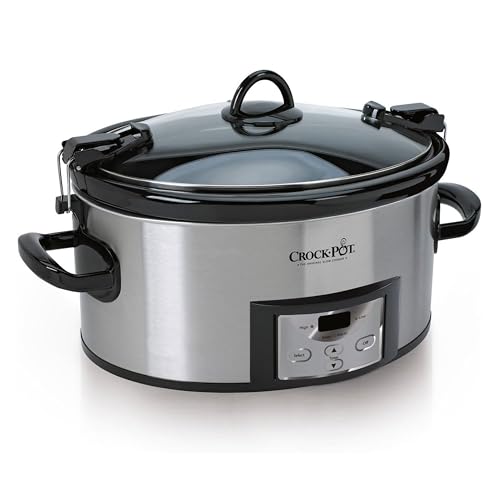
Crock-Pot 6 Quart Cook & Carry Programmable Slow Cooker — Best 6-Quart Option
The second flagged step-up in this guide earns its place on features no true 5-quart pick here matches: a Cook & Carry locking lid for genuine transport, and a digital timer that minds the cook while you are out. If your slow cooking life involves taking the pot to other people’s houses — or leaving it alone all day — this 6-quart Crock-Pot is the machine those patterns point to. It is bigger than this guide’s headline and says so on its badge; buy it for the lid and the timer, with the extra quart as the bonus.
Strengths
- A locking lid makes it the transport pick — potlucks and family dinners without a sloshed car seat
- Digital timer programmability at family size, with automatic shift to warm
- Stainless finish and the original brand’s stoneware ecosystem behind it
Trade-offs
- A 6-quart step-up: check your storage space before falling for the feature set
- Programmable electronics carry the usual extra failure points
- The locking lid’s gasket needs a proper wash after saucy cooks
| Capacity | 6 quarts — a flagged step-up from this guide’s 5-quart headline |
| Controls | Programmable with digital timer |
| Lid | Cook & Carry locking lid (per listing) |
| Finish | Stainless steel |
Storage and counter life deserve a thought at the 6-to-7-quart size. The cooker is light enough to move in and out of a cupboard weekly without becoming a chore, yet substantial enough to live on the counter without looking lost. Measure your shelf height with the lid on before you buy — lids and handles add more height than the headline dimensions suggest — and keep the cord’s short reach in mind when you picture where it will sit relative to your outlets.
There is also a budget argument that rarely gets made for this class: a 6-to-7-quart cooker right-sizes expensive ingredients. Braising cuts, dried beans and whole spices go further in small batches because nothing is cooked ‘just to fill the pot’. Households cooking for one or two routinely find that moving down a size cuts both the grocery bill and the leftover fatigue that makes people abandon slow cooking altogether. The cooker pays for itself in avoided waste faster than in energy savings, though it sips electricity compared with heating a whole oven for one small dish.
A word on longevity with the Crock-Pot 6 Quart Cook & Carry Programmable Slow Cooker: slow cookers fail in boring ways — a cracked crock from a drop or thermal shock, a lid handle loosened, an element that fades after years of service. The design choices in this pick lean against those failures rather than towards novelty, and replacement crocks for established lines remain the cheapest insurance in the category. Treat the crock kindly, keep the base dry, and there is no scheduled end to this appliance’s working life.
Best for: Large families at the smaller end of this class / Not suited for: True 7-quart batch ambitions
Comparison Table
All six picks side by side. Capacity and feature claims are taken from each maker’s verified listing, and where a pick sits deliberately outside the headline size, the table says so rather than hiding it.
| Pick | Badge | Key spec | Best for |
|---|---|---|---|
| Crock-Pot Oval Manual Slow Cooker, 7-Quart Stainless Steel (Check on Amazon) | Best Overall | 7 qt oval stoneware, stainless body, High/Low/Warm | The 7-quart oval stoneware benchmark in stainless |
| Crock-Pot Programmable Slow Cooker, 7-Quart Stainless Steel with Locking Lid (Check on Amazon) | Best Programmable | 7 qt, MyTime programmable, Cook & Carry locking lid | MyTime scheduling and a locking lid at 7 quarts |
| All-Clad Stainless Steel Electric Slow Cooker, 7-Quart (Check on Amazon) | Best Premium Build | 7 qt, LCD programmable timer, aluminum insert | Cookware-house finishing with an LCD timer |
| Gourmia 7 Qt Slow Cooker, Stainless Steel (Check on Amazon) | Best Grip and Value | 7 qt stoneware, 3 temps, easy-grip handles, stainless | Easy-grip handles on a true 7-quart stoneware |
| Chefman 7 Quart Slow Cooker (Check on Amazon) | Best Family Value | 7 qt ceramic crock, tempered glass lid, dishwasher safe | Ceramic crock, tempered lid, everything dishwasher safe |
| Crock-Pot 6 Quart Cook & Carry Programmable Slow Cooker (Check on Amazon) | Best 6-Quart Option | 6 qt (flagged step-up), programmable timer, locking lid | The stainless programmable with a locking lid at 6 quarts |
How to Choose the Right Large Stainless Steel Slow Cooker
Start with capacity, because it is the decision you cannot undo. A slow cooker’s stated quarts are brim capacity; the working capacity is roughly two-thirds of that once you respect the fill line. A 4-quart cooker serves two to four people honestly, a 5-quart stretches to a small family with leftovers, and 6 to 7 quarts is gathering and batch-cooking territory. Choose for the meals you cook monthly, not the feast you host yearly.
Next, crock material. Stoneware and ceramic crocks distribute gentle heat evenly, hold it well, and usually go from cooker to table to dishwasher; they are also heavy and can chip. Coated metal inserts are lighter and sometimes stovetop-safe for searing, which saves a pan and builds flavour, but coatings demand gentler utensils. The finish on the base — stainless steel, coloured enamel-look, or plain — matters for kitchens where the cooker lives on the counter in plain sight.
Controls come in two philosophies. Manual dials (Low, High, Warm) are cheap, repairable and immune to power-cut amnesia, but they will not switch themselves off or drop to Warm when time expires. Programmable models add timers, delayed starts and automatic keep-warm, which suit cooks who load the pot in the morning and leave. Neither philosophy cooks better; they differ in who has to be home.
Finally, judge the details: a glass lid you can see through without lifting, handles that stay cool and give a secure grip on a full crock, a cord length that reaches your outlet without crossing the sink, and dishwasher-safe parts if hand-washing a heavy crock would quietly end your slow-cooking habit within a month.
How to Use a 6-to-7-Quart Slow Cooker for Gatherings and Batch Cooking
Step 1 — Load in the right order. Root vegetables and aromatics go in first, closest to the heat; meat sits on top of them; liquid comes last and should rarely cover the ingredients completely — slow cookers trap moisture, so a stew needs far less added liquid than the same dish on the stove.
Step 2 — Respect the fill band. Fill the crock between half and two-thirds full. Less and the edges scorch before the centre cooks; more and you risk bubbling over the rim and uneven cooking. At this size, that band is the difference between a recipe working and mysteriously failing.
Step 3 — Choose Low for time, High for speed. Low and High reach the same final simmer; they differ in how fast they get there. As a working rule, a dish that takes three hours on High wants seven to eight on Low. Dairy, fresh herbs and delicate vegetables go in during the last half hour either way.
Step 4 — Leave the lid on. Every lift dumps the trapped heat and adds meaningful time to the cook. Look through the glass, trust the plan, and check tenderness near the end of the window rather than throughout it.
Step 5 — Finish actively. Taste and season at the end, when flavours have settled. A splash of vinegar or citrus, fresh herbs, or a knob of butter stirred through a finished stew does more for it than any extra hour of cooking would.
Step 6 — Cool and store safely. Do not leave finished food sitting in the crock at room temperature or on Warm for many hours. Move leftovers to shallow containers, refrigerate promptly, and let the crock cool before washing to protect the glaze from thermal shock.
Common Buying Mistakes
- Buying the headline size for the wrong household. Quarts are brim capacity. A cooker that is too big cooks small meals badly — edges scorching, centres lagging — and a cooker that is too small simply overflows. Match working capacity to your two or three most common meals.
- Treating Warm as a cooking setting. Warm holds finished food at serving temperature; it does not cook raw food safely or finish a stew. Start on Low or High, and use Warm for the last stretch of serving, not the whole afternoon.
- Drowning the dish. Slow cookers lose almost no liquid. Recipes written for the stove need their liquid cut back, often by a third or more, or dinner arrives as soup wearing a stew’s name.
- Lifting the lid to check. Every peek dumps trapped heat and stretches the cooking time. The glass lid exists so you do not have to open it; trust the recipe window and check once, near the end.
- Adding dairy and fresh herbs at the start. Hours of heat split cream and mute fresh herbs to a shadow. Both belong in the final half hour, where they survive to be tasted.
- Washing a hot crock in cold water. Thermal shock is how stoneware crazes and cracks. Let the crock cool on the counter first, soak if needed, and the glaze will serve for years.
Before You Buy: A Final Checklist
- Confirm the size basis. Check the exact capacity statement in the pick’s spec box above, because this category’s headline numbers are not all measured the same way.
- Measure your space. Check the footprint against your counter and the storage spot you actually have, including room for the lid to open or lift clear.
- Match the pick to your three most common meals. Not the most ambitious meal you can imagine — the ordinary ones you cook every week.
- Plan the cleanup. Confirm which parts are dishwasher safe in the verified listing, and be honest about whether you will hand-wash a heavy pot every time.
- Check the current price on Amazon on the product page. Prices and stock in this category move often, and the listing is the only number that counts.
Run through those five checks and the right pick in this guide usually identifies itself. If two picks still tie, choose the one whose trade-offs you mind least — you will live with the trade-offs daily, while the strengths quickly become invisible.
Energy and running costs in perspective
Slow cookers sip electricity compared with heating a whole oven for one dish, and a 6-to-7-quart model sits at the frugal end of even that frugal category. The practical consequence is that long, gentle cooking is cheap enough to be an everyday habit rather than a weekend project. It also means the cooker earns its place in small homes, rentals and RVs where running a full oven heats the whole living space — a hidden cost in summer that a countertop cooker avoids entirely. Over a year of weekly use, the energy difference between this and oven braising is one of the few appliance savings that is real rather than marketing.
Getting the seasoning right in long, gentle cooking
Slow cooking mutes herbs and spices over hours, so season in layers rather than all at once. Dried herbs, whole spices and aromatics go in at the start for depth; salt is best judged at the end, when the liquid has settled into its final concentration. Fresh herbs, citrus zest and juice, vinegar and heat — chilli, black pepper, hot sauce — belong in the last half hour, where they survive to be tasted. A splash of acid at serving wakes up a long-cooked stew more reliably than any extra hour of cooking, and a small pinch of sugar balances tomato-heavy dishes that taste harsh after a full day in the crock. Taste at the end, adjust once, and write down what you did: small batches concentrate both mistakes and triumphs.
Searing first: when it is worth the extra pan
A slow cooker cannot brown anything, and browning is flavour — so the question is when the extra pan earns its washing. For beef stews and pork shoulders, a hard sear on the meat and a deglazed pan tipped into the crock add a depth that hours of gentle heat cannot create on their own. For chicken soups, bean dishes and most weeknight braises, the difference is smaller and the skip is forgivable. A practical middle path: sear when the dish is the event, skip when it is Tuesday. If searing matters to you often, a cooker with a stovetop-safe insert — or a separate heavy pan you already own — closes the gap without changing the rest of your routine.
Adapting stove and oven recipes to this size
Most braises and stews convert gracefully: cut the liquid back, because the crock loses almost nothing to evaporation; keep the aromatics and seasoning at full strength; and scale the solids to sit inside the half-to-two-thirds fill band. Oven braises at low temperatures map to Low on the cooker, with time extended; stovetop simmers map to High for shorter cooks. Dairy, quick vegetables and fresh herbs shift to the end. Write the conversion on the recipe the first time you make it — your future self, standing in the kitchen at 8 a.m. with the crock in hand, will be grateful for the notes.
What actually fits in a 6-to-7-quart slow cooker
Capacity numbers become real when you translate them into food. A 6-to-7-quart crock holds a stew built on a modest cut of meat plus vegetables and liquid, a family pot of soup with room to stir, or a batch of pulled meat with sauce to spare. It will not hold the largest whole chicken plus vegetables, a double party batch of chili, or a big bone-in roast with all the trimmings — and pretending otherwise is how buyers end up disappointed in week two. Match the cooker to the meals you make monthly, and let the rare feast be the job of a borrowed roasting pan or a second, larger cooker you own cheaply. The cookers that stay in weekly rotation for a decade are the ones sized for ordinary Tuesdays, and this size class exists precisely because ordinary Tuesdays are most of cooking.
Batch cooking and leftovers at this size
A 6-to-7-quart cooker is a natural meal-prep tool: cook once, eat twice, and freeze a third portion flat in a bag for a future weeknight. Soups, braises and shredded meats freeze and reheat better than almost anything else you can make, and they are precisely the dishes this size handles best. Label portions with the date and the dish, rotate the freezer stock monthly, and the cooker quietly becomes the reason weeknight dinners stop being a daily negotiation. The other half of the system is containers: a set of identical, stackable, freezer-safe boxes turns a Sunday batch into a shelf of ready meals, and the cooker earns its counter space every time one of them comes back out.
Final Recommendation
Start with the Crock-Pot Oval Manual Slow Cooker, 7-Quart Stainless Steel, our Best Overall pick: it is the model we would buy for the widest range of households searching for best 6 7 quart slow cookers with stainless steel finish. If its particular strengths do not match your situation, the Crock-Pot Programmable Slow Cooker, 7-Quart Stainless Steel with Locking Lid (Best Programmable) is the alternative we would choose next, and every other pick in this guide exists because it serves a specific household better than either of those two. Check on Amazon / Check on Amazon
Still deciding between neighbouring sizes or formats? Compare the related guides in this series: Best 6 Cup Rice Cookers, Best 6 Qt Pressure Cookers, Best 4 Qt Slow Cookers, Best 4 Qt Stoneware Slow Cookers, Best 4 Quart Pressure Cookers. Sizes in this category sit close together, and ten minutes with the comparison tables in those guides is the cheapest way to avoid buying the wrong capacity.
Frequently Asked Questions
How many people does this size of slow cooker actually feed?
Count working capacity, not headline quarts: plan on roughly two-thirds of the stated size as usable volume. In practice the sizes in this guide serve small households through to gathering-sized batches as the comparison table lays out, with the badge on each pick naming the household it suits best.
Can I leave a slow cooker on while I am out of the house?
Slow cookers are designed for unattended cooking on a stable, heat-safe surface away from clutter, and programmable models that drop to Warm add a further margin. Use sensible precautions — nothing flammable nearby, a sound outlet, and a cooker in good condition — and follow the manufacturer’s guidance for your model.
Why is my stew watery when the same recipe works on the stove?
A slow cooker traps nearly all its moisture, while a stove pot evaporates steadily. Cut the recipe’s liquid back — often by a third — and thicken at the end if needed, rather than adding the full stovetop quantity at the start.
Is Low just a slower version of High?
Essentially yes: both settings settle at the same gentle simmer, and differ in how quickly they get there. That is why recipes convert — a dish done in three hours on High generally wants seven to eight on Low.
Can I put a frozen roast straight into a slow cooker?
Food-safety guidance is to thaw meat before slow cooking, because a large frozen piece spends too long in the temperature range where bacteria multiply. Thaw in the refrigerator overnight and the cooker can do the rest.
How do I stop the crock from staining or crazing?
Let it cool before washing, soak dried-on food instead of scouring, and avoid sudden temperature swings. Light staining is cosmetic; a network of fine cracks in the glaze means the crock has done its service and should be retired.


