Disclosure: airfryerkitchensupply.com is reader-supported. When you buy through links on our site, we may earn an affiliate commission at no extra cost to you.
Where to buy
Every pick in this best 5 6 qt air fryers guide is sold through Amazon. Check the exact listing for each model named: the Cosori TurboBlaze Air Fryer 6 Qt, the Ninja AF141 Air Fryer Pro 5 Qt, the Ninja AF161 Air Fryer Max XL 5.5 Qt, the COSORI Pro Gen 2 Air Fryer 5.8QT, the Chefman 6 QT Compact Air Fryer, and the Cosori Pro LE Air Fryer 5 Qt. This class is dense with model numbers that differ by a single digit, and sellers refresh variants mid-year, so match the model in our review to the listing title before ordering.
The best 5 6 qt air fryers are the family class — the size where an air fryer stops being a helpful gadget and becomes the weeknight cooking engine for households of three to five. A 5-to-6-quart basket holds a full family portion in a single layer: a whole batch of wings for the table, fries for four, a small chicken, two pounds of vegetables with room to roast rather than steam. It is also the class where the category’s best engineering currently lives. Cosori’s TurboBlaze brings a DC-motor fan with five speeds and a 90–450°F range to this size; Ninja fields no fewer than three distinct contenders between 5 and 5.5 quarts; and the square-basket school argues — persuasively — that geometry matters as much as volume. If your household cooks real dinners and your current fryer makes you batch, this is the class you are graduating to, and the six machines below are its verified honor roll.
Verification note, because this class needs one: every pick was confirmed against live Amazon catalog data through the Amazon Creators API — ASIN, exact listing title, capacity and headline specifications checked before inclusion. The 5–6 qt shelf is crowded with near-identical model numbers (AF141 versus AF142, TurboBlaze in two colors with different ASINs, a 5.8QT that is not a 6) and with listings whose “6 QT” describes a drawer that cooks like less. We used the verified figures throughout. We print no prices — they change too often to be honest in print — and each pick links to its live listing so you can check the current price on Amazon. We also do not choose by star ratings or review counts, which swing with promotions and say nothing about how a basket fits your family’s dinners.
Who should buy in this class? Households of three to five cooking full dinners, meal-preppers working in family-scale batches, hosts who cook wings and fries for a room, and 4-quart owners whose regular load has quietly become two batches. Who should not? Solo cooks and couples with small appetites — a 4-quart will preheat faster, wash faster and store easier — and anyone whose true need is two different foods at two temperatures at once, which is the dual-basket argument addressed in our 10-quart guide. Within the class, the decisions are: fan sophistication and temperature range (Cosori), proven Ninja all-rounders at three sizes, square versus round basket geometry, and how far the budget tier can really stretch. The reviews take them in order.
In this guide
Quick Picks
- Cosori TurboBlaze 6 Qt — Best Overall. A 9-in-1 with a 90–450°F range, five fan speeds, PFAS-free ceramic coating and 1725W — the most technically complete family fryer here. Check the current price on Amazon.
- Ninja AF141 Air Fryer Pro 5 Qt — Best 5-Quart. 1750W, room for 4 lbs of fries, four functions and Ninja’s cooking discipline in the class’s most manageable body. Check the current price on Amazon.
- Ninja AF161 Max XL 5.5 Qt — Best for Crispiest Results. Max Crisp technology and a 450°F ceiling across seven functions — the wing-and-fries extremist’s pick. Check the current price on Amazon.
- COSORI Pro Gen 2 5.8QT — Best Square Basket. A square basket that packs flat foods efficiently, 13 one-touch functions, and a deep recipe library. Check the current price on Amazon.
- Chefman 6 QT Compact — Best Budget 6-Quart. Hi-Fry finishing and touchscreen presets bring genuine 6-quart capacity to the budget tier. Check the current price on Amazon.
- Cosori Pro LE 5 Qt — Best Compact 5-Quart. A 450°F ceiling, shake reminder and LED glass panel in the class’s most shelf-friendly body. Check the current price on Amazon.
How These Picks Were Chosen
We built the shortlist from the live Amazon catalog via the Creators API, verifying ASIN, title, capacity and key specifications for every candidate, then scored the verified pool on the criteria that decide family-class satisfaction. First, single-layer honesty: does the basket actually cook a family portion in one layer, or is the quart figure a drawer measurement that cooks like a 4-quart? Second, thermal range and control: the spread from gentle (proofing, dehydrating) to violent (450°F finishing) now separates the class’s leaders from its pack. Third, airflow design: fan sophistication shows up in evenness across a full, wide basket — the hardest test in air frying. Fourth, geometry: square baskets pack flat foods with less waste; round and oval baskets suit chickens and roasts. Fifth, cleanup at scale: a family basket is a sink-filling object, so dishwasher-safe parts and coatings that release food matter more here than in any smaller class. Sixth, brand substance and support. We excluded unverifiable listings, anything under an open safety recall, and cosmetic variants that duplicate a sibling pick. The six survivors each win a distinct household argument, which is what a flagship class should offer.
The 6 Best 5 6 Qt Air Fryers

Cosori TurboBlaze Air Fryer 6 Qt — Best Overall
The TurboBlaze is what happens when an air fryer company engineers instead of decorating: a 6 qt basket with a PFAS-free ceramic coating, a temperature range from 90°F to 450°F, five fan speeds driven by an efficient motor, 1725W of power, and nine functions including proof and dry alongside the expected air fry, roast, broil, frozen, bake and reheat. It suits family cooks who want one machine to crisp hard on Friday and proof dough gently on Sunday. It does not suit buyers who want the absolute lowest tier price, or brand loyalists married to another ecosystem’s presets.
Strengths
- Five fan speeds plus a 90–450°F range — the widest, most controllable thermal envelope in the class.
- PFAS-free ceramic coating answers the materials question without going to glass.
- Even cooking across a full family load is its design brief, and it shows in fries and wings alike.
Trade-offs
- Premium-tier positioning within the class — the Chefman undercuts it substantially.
- The function menu rewards a learning week; impatient cooks may ignore its range.
- Ceramic coatings prefer gentle tools and no abrasive scrubbing, like all premium surfaces.
| Spec | Value (verified from listing) |
|---|---|
| Capacity | 6 qt |
| Temperature range | 90–450°F |
| Fan | 5 speeds |
| Power | 1725W |
| Functions | 9-in-1 |
| Coating | PFAS-free ceramic, dishwasher-safe |
Fan speed is the specification nobody shops for and everybody tastes. A single-speed fan is a blunt instrument: full blast for everything, which dries delicate foods and still leaves the center of a full basket behind the edges. Five speeds let the TurboBlaze move air violently for a loaded tray of wings and gently for proofing dough or drying herbs, and the evenness across a full 6-quart layer — the hardest trick in the category — is where owners feel the difference nightly. Add the ceramic surface, which releases food beautifully and answers the coating question for many households, and a safety lock and dishwasher-safe cleanup, and the TurboBlaze assembles the most complete argument in the class. It is the pick for the cook who will actually use a machine’s range — and a standing rebuke to rivals selling one fan speed and fourteen presets as innovation.
Best for: families and versatile cooks who want the class’s best engineering. / Not suited for: strict budget shoppers or single-speed simplicity seekers.


Ninja AF141 Air Fryer Pro 5 Qt — Best 5-Quart
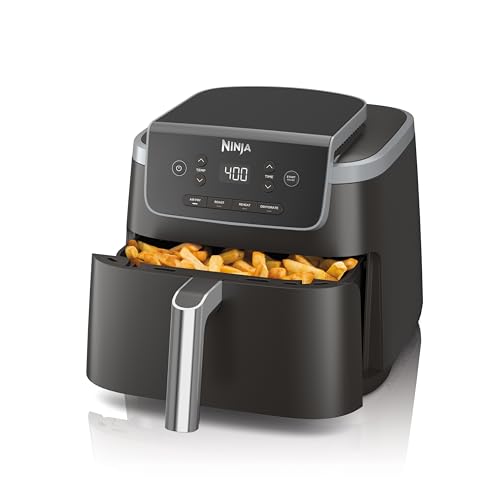
The AF141 is the class’s disciplined middle: a 5 qt basket with 1750W, four functions (air fry, roast, reheat, dehydrate), room for 4 lbs of fries per the manufacturer, and a nonstick dishwasher-safe basket in a body more compact than most 6-quart rivals. It suits households of three to four who want Ninja reliability without the largest footprint, and upgraders from 4 quarts who want a step, not a leap. It does not suit cooks who want a 450°F ceiling — the AF161 below is your Ninja — or the TurboBlaze’s fan finesse.
Strengths
- 1750W is top-tier power for the class, and the 5 qt basket uses it efficiently.
- Four honest functions, no menu padding — the Ninja discipline applied at family size.
- More compact body than most 6 qt rivals while cooking family portions.
Trade-offs
- Standard temperature ceiling — Max Crisp extremists should take the AF161.
- No window, no glass, no ceramic story — a conventional coated basket.
- Five quarts serves four well and five snugly; big households should size up.
| Spec | Value (verified from listing) |
|---|---|
| Capacity | 5 qt (fits 4 lbs fries) |
| Power | 1750W |
| Functions | 4-in-1: air fry, roast, reheat, dehydrate |
| Basket | Nonstick, dishwasher-safe |
| Model | AF141 |
There is a particular pleasure in a machine that does fewer things completely. The AF141’s four functions are the four a family actually cycles through — tonight’s roast chicken pieces, tomorrow’s reheat, the weekend dehydrate project — and its power-to-capacity ratio is the best in this guide, which you taste as shorter cooks and harder browning on full loads. The 5-quart size deserves its own defense: it is the largest capacity many kitchens can store without counter permanence, and for households of three and four it eliminates batching on all but the biggest wing nights. If the TurboBlaze is the class’s engineering showcase, the AF141 is its common-sense champion — the one we would hand to a family member moving into a first house and never think about again.
Best for: households of three to four who want proven power in a manageable body. / Not suited for: 450°F seekers or households of five-plus at full dinners.

Ninja AF161 Air Fryer Max XL 5.5 Qt — Best for Crispiest Results
The AF161 is the class’s heat weapon: a 5.5 qt, 7-in-1 machine built around Max Crisp technology and a 450°F ceiling, with room for 3 lbs of fries and functions spanning max crisp, air fry, roast, broil, bake, reheat and dehydrate. It suits the crispness maximalist — the household whose wing night standards are non-negotiable and whose frozen foods must shatter, not bend. It does not suit gentle-cooking enthusiasts (the TurboBlaze’s low range serves them better) or buyers who find seven functions to be five too many.
Strengths
- Max Crisp plus 450°F delivers the hardest finishes in the Ninja line — the wing specialist.
- Seven functions make it the most versatile Ninja in this guide.
- 5.5 qt capacity threads the needle between the AF141’s compactness and true 6 qt bulk.
Trade-offs
- Its talents are wasted on gentle cooking — proofing and low drying belong to the TurboBlaze.
- Seven functions mean a busier interface than the AF141’s four.
- Conventional coated basket; no materials story for coating-averse buyers.
| Spec | Value (verified from listing) |
|---|---|
| Capacity | 5.5 qt (fits 3 lbs fries) |
| Max temperature | 450°F |
| Functions | 7-in-1 |
| Technology | Max Crisp |
| Model | AF161 |
Every class has a specialist that embarrasses the generalists at one job, and in this class that job is browning violence. Max Crisp is engineered for frozen and breaded foods — superheated air driven hard — and combined with the 450°F ceiling it produces the kind of fries and wings that make people ask what you did differently. The 5.5 qt basket is the connoisseur’s size: a genuine family layer with a body that still behaves in storage. The honest framing is that the AF161 and TurboBlaze split the class crown by temperament — the Ninja for heat, the Cosori for range — and households should choose by which extreme they actually cook at. If your air fryer exists to make frozen food taste fried, end the search here.
Best for: crispness maximalists and frozen-food households. / Not suited for: gentle-range cooks or interface minimalists.

COSORI Pro Gen 2 Air Fryer 5.8QT — Best Square Basket
The Pro Gen 2 makes the geometric argument: its square 5.8 qt basket packs flat and wide foods — fillets, chops, a grid of fries — with less wasted corner space than round rivals, wrapped in a sleek body with 13 one-touch functions and a recipe library running from a printed collection to a deep online archive. It suits flat-food households, recipe followers, and anyone whose current round basket wastes a quarter of its layer. It does not suit whole-bird ambitions (round and deep beats square and wide there) or buyers who prefer a short menu.
Strengths
- Square basket geometry maximizes usable single-layer area for flat foods.
- 13 one-touch functions cover the broadest preset repertoire in this guide.
- Detachable, dishwasher-safe basket and a mature recipe ecosystem.
Trade-offs
- 5.8 qt of square cooks wide, not deep — tall roasts and whole birds are awkward.
- Thirteen functions is a menu some households will never fully open.
- An established rather than cutting-edge design beside the TurboBlaze’s fan tech.
| Spec | Value (verified from listing) |
|---|---|
| Capacity | 5.8 qt, square basket |
| Functions | 13 one-touch |
| Basket | Detachable, dishwasher-safe |
| Model | Pro Gen 2 |
Geometry is destiny in a single layer. Lay four salmon fillets or a grid of pork chops in a round basket and the corners vanish; lay them in the Pro Gen 2’s square and the layer is all food. That efficiency compounds across a family’s weekly cooking — fewer batches, more even edges, less Tetris. The 13 functions deserve a balanced word: nobody uses all of them, but the breadth means your specific staple — the exact frozen item, the exact vegetable — likely has a tested starting point, and the recipe library turns the machine into a guided system for newer cooks. Choose the square if your menu is flat and wide; choose round rivals if it is tall and round. It really is that simple, and the class is better for offering both.
Best for: flat-food households and recipe-guided cooks. / Not suited for: whole-bird cooks or minimal-menu buyers.

Chefman 6 QT Compact Air Fryer — Best Budget 6-Quart
The Chefman 6 QT brings true family capacity to the budget tier: a touchscreen machine with Hi-Fry finishing, four presets, and a nonstick dishwasher-safe basket, in a body the brand honestly calls compact for its size. It suits growing households whose budget is firm, second-fryer buyers who need volume cheaply, and anyone who would rather have capacity than fan speeds. It does not suit engineering connoisseurs — the TurboBlaze exists for them — or buyers who want dehydrate and proofing range.
Strengths
- Genuine 6 qt capacity at the class’s budget tier — the value headline of this guide.
- Hi-Fry finishing rescues the budget class’s traditional weakness, the pale finish.
- Touchscreen presets cover the daily repertoire without menu bloat.
Trade-offs
- Four presets and a conventional fan — capability is honest, not advanced.
- Budget-tier materials and panel feel beside Cosori and Ninja.
- No low-temperature range for proofing or gentle drying.
| Spec | Value (verified from listing) |
|---|---|
| Capacity | 6 qt |
| Controls | Touchscreen, 4 presets |
| Technology | Hi-Fry |
| Basket | Nonstick, dishwasher-safe |
Budget tiers earn skepticism, so let us be precise about what the Chefman does and does not concede. It concedes refinement: the panel, the basket feel, the fan’s sophistication. It does not concede dinner: six quarts of fries crisp properly, wings brown, reheats respect leftovers, and the Hi-Fry finish closes the visual gap on the foods families cook most. For a household whose alternative is a smaller premium machine, capacity is the feature that matters nightly and fan speeds are the feature that matters occasionally — the Chefman’s priorities are correctly ordered for its buyers. If the budget is the binding constraint, this is the class’s honest way through it.
Best for: budget-firm families who need true 6-quart volume. / Not suited for: engineering enthusiasts or low-temperature cooks.

Cosori Pro LE Air Fryer 5 Qt — Best Compact 5-Quart
The Pro LE is Cosori’s answer for kitchens that want class performance in the class’s smallest stance: a 5 qt machine with a 450°F ceiling, ceramic coating, a shake reminder, an LED glass panel, nine functions’ worth of repertoire in a 5 qt body (seven presets plus reheat and keep warm), at 1500W. It suits households of three, counter-tight kitchens, and buyers who want a 450°F option without the TurboBlaze’s flagship tier. It does not suit five-person full dinners — the 6 qt picks exist for those — or buyers indifferent to finish and panel design.
Strengths
- 450°F ceiling and shake reminder in the class’s most compact, polished body.
- Ceramic coating with dishwasher-safe cleanup.
- Keep-warm and reheat functions suit staggered family schedules.
Trade-offs
- 5 qt is the class floor — big households will batch on wing nights.
- 1500W is the gentlest power here, matched to the smaller cavity.
- Design-forward pricing within its size — the Chefman 6 QT offers more volume per tier.
| Spec | Value (verified from listing) |
|---|---|
| Capacity | 5 qt |
| Max temperature | 450°F |
| Power | 1500W |
| Presets | 7, plus reheat and keep warm |
| Coating | Ceramic |
Think of the Pro LE as the class’s city car: engineered, finished and sized for the spaces most kitchens actually have. Its 450°F ceiling gives it the crisping top end that the AF141 lacks, its shake reminder builds good habits, and its keep-warm function acknowledges the reality of families eating in shifts. The trade is pure volume — on the biggest nights you will run a second batch, and the machine’s compactness is the compensation you enjoy the other 360 days. Households of three who cook seriously and store carefully will find this the class’s most liveable machine; households of five should admire it and buy its bigger sibling.
Best for: households of three and tight counters wanting 450°F performance. / Not suited for: large families or volume-first shoppers.

Comparison Table
| Pick | Badge | Key spec | Best for | Link |
|---|---|---|---|---|
| Cosori TurboBlaze 6 Qt | Best Overall | 90–450°F, 5 fan speeds, ceramic | Versatile families | Check on Amazon |
| Ninja AF141 5 Qt | Best 5-Quart | 1750W, 4-in-1, fits 4 lbs fries | Households of 3–4 | Check on Amazon |
| Ninja AF161 Max XL 5.5 Qt | Best for Crispiest Results | 450°F, Max Crisp, 7-in-1 | Wings and frozen foods | Check on Amazon |
| COSORI Pro Gen 2 5.8QT | Best Square Basket | Square basket, 13 functions | Flat foods, recipe followers | Check on Amazon |
| Chefman 6 QT | Best Budget 6-Quart | 6 qt, Hi-Fry, touchscreen | Budget-firm families | Check on Amazon |
| Cosori Pro LE 5 Qt | Best Compact 5-Quart | 450°F, ceramic, shake reminder | Households of 3 | Check on Amazon |
How to Choose the Best 5 6 Qt Air Fryers
Decide first by the layer, not the label. Picture your largest regular dinner — a wing night, a fries-for-four, a small chicken — and ask whether it lies flat in one layer in a 5, a 5.5 or a 6 qt basket. Square footage of layer, not quart volume, is the working capacity; the Pro Gen 2’s square 5.8 qt lays out flat foods like a bigger machine, while deep round baskets serve roasts and birds. Second, choose your thermal temperament: range (TurboBlaze, 90–450°F with five fan speeds) for cooks who proof, dry and crisp in one machine; ceiling (AF161, Pro LE at 450°F) for crisp-first households; balance (AF141) for everyone else. Third, geometry and storage: this class lives on counters, so measure the footprint with the basket fully open and the exhaust clearance included, and check the height against upper cabinets. Fourth, functions honesty: count the programs you will use weekly, not the ones that impress in a listing — four used functions beat thirteen admired ones. Finally, budget: the class runs from a true budget tier (Chefman) through the mainstream (Ninja, Pro LE, Pro Gen 2) to the flagship (TurboBlaze), and the cooking gap is narrower than the refinement gap — spend on the attribute your cooking actually exercises.
How to Use a Family-Size Air Fryer Well
Set up once, properly: heat-safe surface, exhaust clearance behind and above, direct wall outlet, first-use burn-off with a window open. The daily system scales up from smaller classes with one adjustment — respect the layer even more, because a family basket invites heaping and heaping is steaming. Preheat three to five minutes for full loads. Prep dry, oil in a bowl, season before loading. Load a single layer at two-thirds full; for wing nights, run two disciplined batches and re-crisp the first for two minutes rather than one compromised mountain. Shake or flip at the halfway point — at this size, also rotate contents from edge to center once for the most even result. Rest proteins, verify thick items with a thermometer, and stagger sides smartly: dense vegetables first, delicate items last, everything meeting at the table via the keep-warm function where fitted. Wash the big basket warm and promptly; a family basket left to crust overnight is the class’s only genuinely unpleasant chore, and every pick here is dishwasher-safe for the nights you cannot face it.
What Fits in 5–6 Quarts: The Family Layer, Honestly
In a single, crisping-honest layer, this class holds: fries for four (the AF141’s verified figure is 4 lbs at 5 qt — a serious pile, and the layer still governs), a full wing night for a family in one to two batches, a small whole chicken in the deeper baskets, four chicken breasts, or two pounds of vegetables with air to spare. The square Pro Gen 2 fits four fillets or chops in a grid that round baskets waste; the 6 qt machines take a family frozen dinner spread — nuggets, fries, onion rings across two runs — without breaking stride. What the class does not do: two different dishes at two temperatures simultaneously (that is the dual-basket pitch), a large turkey-day anything, or a pizza beyond personal size. The class’s promise is narrower and better: the ordinary family dinner, in one layer, in one batch, on a weeknight, without heating the big oven. Households whose dinners match that description will feel the upgrade from 4 quarts every single day; households feeding six should skip to the 10-quart class and its dual baskets.
Square vs Round Baskets: The Geometry Argument
It deserves its own section because it decides more dinners than any preset. A square basket converts nearly all of its footprint into layer: fillets, chops, burgers, toast and frozen rectangles tile efficiently, corners included. A round or oval basket converts its footprint into depth and flow: whole chickens sit naturally, roasts fit, and air circulates with fewer dead corners for irregular foods. Neither wins in the abstract. Audit your menu: if your top ten air fryer foods are flat, the Pro Gen 2’s square is worth real batches saved across a year; if they are round, tall or irregular, the Ninja and TurboBlaze shapes serve you better. The one indefensible position is choosing by quart number alone while ignoring shape — 5.8 square quarts and 5.5 round quarts are different appliances wearing similar labels, and your menu knows which one it wants.
Troubleshooting Family-Size Cooking
Problem: edges crisp, center lags on full loads. → The layer was too deep or the shake skipped. At family size, shake and redistribute — move edge pieces to the center — at the halfway point; fan sophistication (TurboBlaze) narrows the gap but does not repeal it. Problem: the second batch always beats the first. → The machine is fully hot and the food is drier by then; preheat properly before batch one and pat food dry, and the gap closes. Problem: smoke on fatty family cooks. → Wipe the drawer between batches, use liners for the fattiest items, and give the exhaust its clearance. Problem: a whole chicken browns unevenly. → Truss it, turn it once, and tent any fast-browning area with a small piece of foil for part of the cook; verify the thigh temperature before serving. Problem: leftovers reheat soggy. → You used a gentle setting out of caution; reheating wants real heat for a short time, in a single layer, in a preheated basket. Family-size cooking fails at family-size habits — load, distribution, patience — far more often than at hardware, which is good news: habits are free to fix.
A Week of Family Dinners at 5–6 Quarts
Monday: a small whole chicken in the deep baskets, rested while a quick batch of green beans crisps in the rendered heat — a roast dinner on a weeknight, without the oven’s hour. Tuesday: the full wing night, two disciplined batches with the first re-crisped for two minutes, sauces on the side — the cook that justifies the AF161’s existence and satisfies the TurboBlaze’s fan. Wednesday: four salmon fillets in the square Pro Gen 2’s grid, asparagus laid across for the final minutes. Thursday: frozen family dinner — nuggets, fries, onion rings in rotation — where the class’s capacity turns a freezer clean-out into a meal instead of a queue. Friday: homemade fries for four in one honest layer, burgers’ best friend, with the keep-warm function holding the first side while the second finishes. The weekend adds the range tricks: proofing dough at the TurboBlaze’s gentle floor, dehydrating a batch of apple chips or jerky in the Ninjas. Step back and the pattern is the class’s whole argument: five different family dinners, each in essentially one batch, each faster than the oven, each ending with one basket to wash. That is not a gadget’s week; that is a kitchen appliance carrying its weight — and it is why households that graduate to this class rarely go back.
Care, Storage and Longevity at Family Size
These are counter appliances, so arrange their home once and properly: a heat-safe stretch with exhaust clearance, room to open the basket fully, and a surface you can wipe — family cooking splatters. Storage in a cabinet is possible for the compact end (Pro LE, AF141) in deep cabinets, but measure height with handles and be honest about whether you will really haul a family-size machine out nightly; most owners do not, and a fryer that lives out gets used, which is the point. Care scales with size: the big baskets are dishwasher-safe across this guide, which matters more here than in any smaller class, but a warm hand-wash still treats coatings gentlest. Keep aerosol sprays off the baskets (oil the food in a bowl), use silicone or wood tools, soak rather than scrub, and wipe the cavity ceiling monthly where grease mist settles. Ceramic surfaces (TurboBlaze, Pro LE) reward the same gentleness. Expect years of daily service from the branded picks here; the economics are lopsided in your favor, since a machine cooking family dinners hundreds of times a year displaces oven energy and takeout at a rate that dwarfs its tier. When a coating eventually wears after long service, replace the basket where the brand offers one rather than cooking on a failing surface.
Accessories for the Family Class
Buy few and buy large enough. A two-tier rack sized to your basket doubles dehydrating capacity and lets a finished batch hold crisp above a cooking one — the class’s one legitimate layering tool, because it preserves airflow. Perforated parchment liners in family size turn wing nights into lift-out cleanup; weigh them with food, never preheat them empty. Long silicone-tipped tongs — the full-size kind — reach across a wide basket safely. A sheet-pan-sized cooling rack beside the machine gives batches a landing zone that keeps bottoms crisp while the next load cooks. And the instant-read thermometer remains the highest-value tool in the drawer, because family proteins are thick and the class cooks them fast. Skip the miniature accessory kits inherited from your compact days; in this class, undersized tools are how coatings get scratched and fingers get burned.
Energy and Noise at Family Scale
The verified power figures in this class run from 1500W (Pro LE) to 1750W (the Ninjas), with the TurboBlaze at 1725W — serious draws while heating, on par with a large microwave. The efficiency story is nonetheless strongly in the class’s favor: a family dinner cooked in fifteen minutes in a 6-quart cavity uses a fraction of the energy of the same dinner in a full oven, most of whose hour goes to heating empty space and the kitchen around it. On older wiring, avoid running the fryer on the same circuit as another heating appliance at full draw; a tripped breaker mid-wings is the class’s most preventable annoyance. Noise is a steady, purposeful fan sound — the TurboBlaze’s multi-speed design runs gentler at gentle settings, while max-crisp modes on any machine announce themselves. In open-plan homes the sound is present but brief; nobody has ever cancelled a dinner over it. Heat discipline matters more: the exhaust stream is hot enough to demand its clearances, and upper cabinets should be spared a direct, repeated steam path. Arrange the machine’s home with those three realities — circuit, sound, exhaust — in mind once, and the class repays you nightly without further thought.
Which Family Buyer Are You? A Decision Walk-Through
The engineering admirer — the cook who reads fan specifications for pleasure and proofs dough on Sundays — has one address in this class: the TurboBlaze, whose range and control exist for exactly that temperament. The set-it-and-trust-it family cook, feeding four on a schedule, belongs with the AF141, whose four functions and serious wattage remove decisions rather than adding them. The crispness absolutist, for whom a bendy fry is a failed fry, should stop reading at the AF161 and its Max Crisp ceiling. The flat-food household — fillets, chops, grids of anything — gains real batches from the Pro Gen 2’s square geometry, a weekly dividend no preset can match. The budget governor, feeding a family inside a firm number, takes the Chefman 6 QT and loses refinement, not dinners. The compact-kitchen family of three takes the Pro LE and trades the biggest wing nights for a machine that stores and behaves. Notice that every walk ends at a different machine, and none of the endings is a consolation prize — that is the signature of a healthy class, and it is why the honest answer to “which 5–6 qt fryer” is always another question about your kitchen. Answer that question truthfully and any of the six will feel, within a fortnight, like it was designed for you.
Common Buying Mistakes
Mistake one: buying quarts instead of layer — comparing 5, 5.5 and 6 as if the number were the capacity, when shape and layer area decide your dinners. Mistake two: assuming the class stores like the 4-quart you are replacing; most of these live on the counter, so measure the open-basket footprint and cabinet height before ordering. Mistake three: paying for a flagship’s range and cooking one food at one setting forever — match the machine’s talents to your actual menu. Mistake four: the reverse — buying the budget tier for a crispness-obsessed household and spending a year disappointed by a gap the AF161 was built to close. Mistake five: heaping the family basket because it looks like it can take it; it cannot, and the steamed result will be blamed on the machine. Mistake six: ignoring the second-basket question — if your dinners routinely pair two foods at two temperatures, no single basket in this class will satisfy you, and the dual-basket class is the honest answer.
Final Recommendation
The class crown goes to the Cosori TurboBlaze 6 Qt — the widest range, the smartest fan, the ceramic surface — for families who will use a machine’s full talent. The common-sense crown goes to the Ninja AF141 for households of three to four. Crispness extremists should take the Ninja AF161, flat-food households the Pro Gen 2, budget-firm families the Chefman 6 QT, and compact kitchens the Pro LE. If your dinners outgrow even this class, the Best 10 Quart Air Fryers guide covers the dual-basket flagships; if you are downsizing, Best 4 Qt Air Fryers is the step down; and the whole field is ranked in Best 10 Air Fryers with the heat-focused shortlist at Best 5 Hot Air Fryers.
Frequently Asked Questions
Is 5 or 6 quarts better for a family of four?
Both work. Five quarts (AF141, Pro LE) handles family-of-four dinners with an occasional second batch on wing nights and stores more easily. Six quarts (TurboBlaze, Chefman) removes the batching and suits five-person households. Choose by your largest regular dinner, not your average one. One more consideration: teenagers. A household of four with two adolescents eats like a household of six, and the class’s history is full of 5-quart machines replaced within two years by 6-quart ones as appetites grew. If your family’s trajectory points upward, buy the size at the end of the trajectory — the price difference between the tiers is small, and the second purchase is the expensive one.
Can a 5–6 qt air fryer cook a whole chicken?
Yes — a small chicken fits the deeper baskets in this class. Truss it, turn it once during cooking, and confirm the thigh reaches a safe temperature with a thermometer. Larger birds belong in oven-style or 10-quart machines.
Square or round basket — which should I choose?
Square for flat foods (fillets, chops, fries in grids) because the layer tiles efficiently; round or oval for whole birds, roasts and irregular shapes. Audit your ten most-cooked foods and let the menu decide.
What does fan speed actually change?
Evenness and gentleness. Multiple speeds (the TurboBlaze has five) let the machine blast a full tray of wings evenly and still handle proofing or drying gently. Single-speed machines crisp well but are blunter instruments at the extremes. The difference is most visible on full, wide loads — exactly the loads this class exists for — where a sophisticated fan narrows the gap between the edge pieces and the center pieces that every air fryer owner everywhere knows by sight and by taste and by long experience.
Is ceramic coating worth choosing over standard nonstick?
Ceramic (TurboBlaze, Pro LE) offers a PFAS-free surface with excellent release and dishwasher-safe cleanup, and prefers gentle tools. Standard nonstick is proven and forgiving. Both cook identically; choose by your materials preference and care habits.
Will a 6 qt air fryer fit under my cabinets?
Measure before ordering: this class is counter-resident, and you need the body height plus open-basket clearance and exhaust room. Pull the machine forward while cooking if upper cabinets crowd it — never run it in a closed or steamy pocket. Also measure depth with the basket pulled fully open, since a family basket travels a long way forward and has ended more than one purchase on the edge of a counter. If the open-basket footprint does not fit your counter’s depth, the compact end of the class (Pro LE, AF141) or a slimmer profile is the practical answer.
Still comparing sizes? Our Best 5 Air Fryers shortlist cuts across classes, and Best 2 Quart Air Fryers covers the compact end for second-fryer shoppers. Wherever you land, give the machine its first fortnight before judging it: family-size air frying is a routine — preheat, layer, shake, rest — and the routine, once learned, is what turns a good basket into the most-used appliance in the house. Most families report the same surprise by week three: the oven has become the backup, and the fryer they researched for a month has become the one they think about least, because it simply handles dinner.