Disclosure: airfryerkitchensupply.com is reader-supported. When you buy through links on our site, we may earn an affiliate commission at no extra cost to you.
Where to buy
The machines in this guide to the best 4 or 6 cup coffee makers are all sold through Amazon, where you can check the current price on Amazon for each model, confirm the exact variant, and read the manufacturer’s full listing before you buy. Prices and availability in this category move often, so this guide never prints a fixed price — use the links below to see today’s figure for the pick you choose.
- Hamilton Beach 5 Cup Drip Coffee Maker with FrontFill Basket (46112) — Check the current price on Amazon
- Zojirushi ZUTTO EC-DAC50 Coffee Maker, 5 Cups — Check the current price on Amazon
- Mr. Coffee Programmable Coffee Maker, 5-Cup — Check the current price on Amazon
- Holstein Housewares Programmable 5 Cup Coffee Maker — Check the current price on Amazon
- Amazon Basics 5 Cup Drip Coffee Maker — Check the current price on Amazon
- Primula Classic Stovetop Espresso Maker, 6 Espresso Cups — Check the current price on Amazon
Shopping for the best 4 or 6 cup coffee makers means your household’s pot swings between two mugs on a weekday and a fuller round when family or guests appear — and it runs straight into the small-brewer market’s strangest gap. Four-cup machines are plentiful; true 6-cup electric drip machines barely exist. This guide deals with that gap honestly instead of papering over it.
Below you will find the verified best machines at the 4-cup end, the strong 5-cup machines that serve most ‘sometimes six’ households better than a nominal 6-cup model would, and a genuine 6-cup stovetop option for drinkers whose cups are small and strong. Each pick is labelled with its true capacity in ounces so the comparison is apples to apples.
In this guide
Quick Picks: The Best 4 or 6 Cup Coffee Makers
- Best Overall for Swing Households — Hamilton Beach 5 Cup Drip Coffee Maker with FrontFill Basket (46112): FrontFill swing basket, smart-plug compatible. Check price on Amazon
- Best Quality at Any Batch — Zojirushi ZUTTO EC-DAC50 Coffee Maker, 5 Cups: Japanese-engineered 5-cup brewer, PFAS-free listing. Check price on Amazon
- Best for Weekday/Weekend Swings — Mr. Coffee Programmable Coffee Maker, 5-Cup: Brew Later timer, 25 oz carafe with ounce markings. Check price on Amazon
- Best Budget for Swing Households — Holstein Housewares Programmable 5 Cup Coffee Maker: Auto-start programmable, reusable filter. Check price on Amazon
- Best for Unpredictable Houses — Amazon Basics 5 Cup Drip Coffee Maker: Auto shut-off, auto pause, removable basket. Check price on Amazon
- Best True 6-Cup — Primula Classic Stovetop Espresso Maker, 6 Espresso Cups: Stovetop moka pot, 6 espresso cups, no electricity. Check price on Amazon
How These Picks Were Chosen
Every machine in this guide to the best 4 or 6 cup coffee makers was checked against the manufacturer’s own listing through Amazon’s catalogue data before it earned a place. That verification step matters more in this corner of the market than in most, because small brewers are sold under shifting model names, colour variants get listed as separate products, and capacity claims are notoriously elastic. If a model’s identity or capacity could not be confirmed, it did not get a link — full stop.
From the verified shortlist, machines were shortlisted on five criteria. First, honest capacity: the carafe or brew size had to match the size class in the search, using the coffee industry’s small ‘cup’ measure rather than mug marketing. Second, the features people actually use weekly — pause-and-pour, reusable filters, readable water windows, auto shut-off — counted for more than novelty extras. Third, parts and carafe availability were weighed, because a small brewer with an unreplaceable glass pot is a disposable product. Fourth, footprint and loading style were matched to the kitchens these machines live in: under cabinets, in dorms, on desks. Fifth, each pick had to own a distinct job. Six near-identical black boxes would be a worse guide than six machines that each win for a different household.
This guide applied a no-relabelling rule with unusual strictness: no machine appears here as a ‘6-cup’ pick unless its manufacturer’s own listing supports that capacity. That rule is why the 6-cup slot belongs to a stovetop moka pot — the format that genuinely owns the size — and why several fine 5-cup machines are presented as what they are: the practical centre of a 4-to-6-cup household’s life.
One more rule governed the final list: nothing with a known safety recall was eligible, and no machine was included on the strength of a headline feature its listing could not support. Where a size tier turned out to be thin or effectively empty in today’s market, this guide says so in plain language rather than padding the list with oversized machines relabelled as small ones.
The Best 4 or 6 Cup Coffee Makers Reviewed

Hamilton Beach 5 Cup Drip Coffee Maker with FrontFill Basket (46112) — Best Overall for Swing Households
The Hamilton Beach 46112 solves the most annoying physical problem of small brewers: filling them. Most machines load from the top, which means dragging the brewer out from under the wall cabinet every morning. The FrontFill basket swings out from the front instead, so water and grounds go in while the machine stays parked. Its second trick is subtler — it is designed to work with smart plugs, so a plug you may already own provides scheduling, voice control, and auto-off timers that the machine itself omits.
A household swinging between sizes needs a machine that is effortless at any fill level, and the FrontFill Hamilton Beach is it: front access at any batch size, smart-plug scheduling for the busy mornings, and a carafe that pours cleanly whether it holds two mugs or a family round.
Strengths
- FrontFill basket swings out toward you — fill it without pulling the machine out from under the cabinet
- Smart-plug compatibility gives you app or voice scheduling without a built-in clock to program
- Auto Pause and Pour handles the mid-brew first cup cleanly
Trade-offs
- No built-in timer — scheduling depends on owning or buying a smart plug
- Glass carafe and warming plate, so late cups stale like every plate model
- Front-swinging basket needs clear counter space in front of the machine
| Capacity | 5-cup glass carafe |
| Access | FrontFill swing-out brew basket (manufacturer listing) |
| Features | Works with smart plugs, Auto Pause and Pour (manufacturer listing) |
That division of labour is either clever or annoying depending on your kitchen. If you already run smart plugs, this is the most connected small brewer here for the least built-in complexity — and a mechanical-style brew switch is exactly what a smart plug needs to work reliably. If you do not, the Mr. Coffee Programmable gives you the timer in the box. Either way the brew itself is solid daily coffee, the carafe pours well, and Hamilton Beach’s parts network is one of the stronger ones in the value tier.
The FrontFill mechanism is the ownership headline: because filling is easy, the machine stays in place, and machines that stay in place get descaled and wiped more often. The smart-plug pairing adds an ownership upgrade path — schedules and auto-off rules can improve without replacing the brewer. Hamilton Beach’s parts network is a further quiet strength.
Best for: Under-cabinet kitchens and smart-home households / Not suited for: Buyers who want a self-contained timer with no extra accessories
Check the current price on Amazon
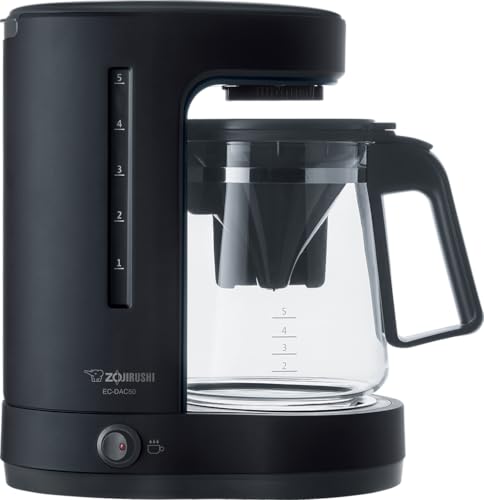
Zojirushi ZUTTO EC-DAC50 Coffee Maker, 5 Cups — Best Quality at Any Batch
Zojirushi is the brand rice-cooker devotees swear by, and the ZUTTO EC-DAC50 applies the same philosophy to a 5-cup pot: do a simple thing with unusual care. The machine is compact and spare — no sprawling control panel — but the tolerances, the carafe fit, and the consistency from pot to pot are where the money goes. For drinkers who use good beans and have been disappointed by tepid, uneven small brewers, this is the upgrade candidate in the category.
When batch size varies, extraction consistency matters more, not less — a half batch and a full batch should taste like the same coffee. The ZUTTO’s controlled brewing is the most forgiving of fill-level variation in this guide, which is why it anchors the quality end of a swing household’s options.
Strengths
- Zojirushi’s build quality and fit-and-finish are a clear step above the budget tier
- Brew temperature consistency is this brand’s calling card, and small pots benefit most
- Compact, tidy industrial design that suits minimalist and Japanese-style kitchens
Trade-offs
- Premium pricing for a machine with a deliberately simple feature set
- No programmable timer — convenience seekers should look at the Mr. Coffee Programmable
- Replacement carafes are brand-specific and pricier than the generic glass pots
| Capacity | 5 cups |
| Design | ZUTTO series compact brewer (manufacturer listing) |
| Listing note | Marketed as PFAS-free (manufacturer listing) |
What you do not get is theatre: no timer, no strength dial, no app. The ZUTTO’s case is that extraction fundamentals — water hot enough, distributed evenly, at a repeatable volume — matter more at 25 ounces than at 60, because there is less margin for error in a small batch. It is also the pick most likely to still be on the counter in a decade. Buy it as a long-term appliance, not as a gadget, and the premium makes sense; buy it expecting features and you will feel short-changed.
Zojirushi ownership is the long game: descale on schedule, treat the carafe as the precision part it is, and the machine simply continues. Spare carafes and parts are brand-channel purchases — pricier than generic glass, but they exist, which is the entire point. Owners tend to measure this machine’s life in decades and hand it down rather than upgrade it.
Best for: Quality-first buyers who keep appliances for years / Not suited for: Feature hunters who want timers and strength settings
Check the current price on Amazon

Mr. Coffee Programmable Coffee Maker, 5-Cup — Best for Weekday/Weekend Swings
Most 5-cup brewers make you choose between simplicity and a wake-up timer; this Mr. Coffee Programmable model is the exception in the small class. Its Brew Later function lets you load water and grounds the night before and have a 25-ounce pot ready when the alarm goes off. The carafe’s ounce markings sound like a trivial detail until you start brewing half-pots for one person — measuring 12 or 15 ounces accurately is what keeps a small batch from tasting watery or sludge-thick.
The programmable Mr. Coffee maps perfectly onto the 4-or-6 household’s week: a timed, ounce-measured small batch for workdays, and a full pot — plus a fast second cycle — when the house fills up. The ounce markings turn the swing from guesswork into a written-down routine.
Strengths
- Brew Later programming means a fresh small pot can be ready at wake-up time — rare at this size and price tier
- Ounce markings moulded into the carafe make repeatable small batches and half-pots easy to measure
- Compact footprint keeps the timer convenience without giving up much counter space
Trade-offs
- More electronics than a switch model, so there is more to fail over a long service life
- The clock and program need resetting after power cuts, a small but recurring annoyance
- Glass carafe on a warming plate will stale coffee left sitting for hours
| Capacity | 5 cups / 25 oz glass carafe with ounce markings |
| Controls | Programmable Brew Later auto-start |
| Design | Compact body, ergonomic carafe (manufacturer listing) |
Living with it is mostly about rhythm: rinse the carafe at night, load the basket, set the time, and mornings take care of themselves. The brew quality is squarely in the good-daily-driver band for the category — hot, consistent, and better with a medium grind than with very fine or very coarse coffee. Where it loses ground to simpler rivals is longevity risk: a display, a clock, and programming buttons are extra failure points a one-switch machine simply does not have. If the timer is a feature you will genuinely use five mornings a week, that trade is worth it; if not, buy the simpler machine.
Ownership adds one chore to the simple life: the clock. After every power cut the time and programme need resetting, and households that skip it wake to a silent machine. Keep the manual’s programme sequence on a phone note for the first month. The carafe is shared with other Mr. Coffee small models, which keeps replacements easy to source.
Best for: Early risers who want a small pot waiting when they wake up / Not suited for: Buyers who prefer the longest possible service life from the fewest parts
Check the current price on Amazon

Holstein Housewares Programmable 5 Cup Coffee Maker — Best Budget for Swing Households
This programmable Holstein takes the brand’s dorm-friendly 5-cup formula and adds the one feature students and shift workers actually ask for: auto start. Set it the night before and a small pot is ready when the alarm goes off — no phone app, no subscription, just a clock and a timer on a compact machine. The reusable filter and Pause and Serve from the base model carry over, so the running-cost and first-cup stories stay intact.
Holstein’s programmable brings the auto-start routine to the value tier, which suits households equipping a kitchen for variable mornings without premium spending — a family home with teenagers on unpredictable schedules is the natural owner. The reusable filter keeps the extra weekend pots cheap to brew.
Strengths
- Auto-start programming at a value-tier position — wake-up coffee without the premium brands’ pricing
- Reusable filter and Pause and Serve carry over from the well-liked base model
- Compact dorm-and-office footprint with a proper glass carafe
Trade-offs
- Programming interface on small budget machines is fiddly — expect a learning curve the first week
- No auto shut-off once brewed, so the warmer still needs a thought at leaving time
- Long-term parts support is thinner than Mr. Coffee or Cuisinart
| Capacity | 5-cup glass carafe |
| Controls | Programmable auto start (manufacturer listing) |
| Features | Pause and Serve, reusable filter (manufacturer listing) |
Budget programmables share a universal quirk: the button sequences are never as intuitive as the manual promises, and you will set the clock wrong at least once. After that first week it becomes muscle memory. The deeper question is brand longevity — Holstein is a value marque, and if the carafe breaks in year three you may replace the whole machine rather than a part. At this tier that math often still works out, especially for a two-to-three-year dorm or first-job horizon.
Beyond the base model’s simple care, the programmable version asks you to learn its button logic once and forgive its clock after power cuts. Everything else is the same value-tier story: reusable filter, glass carafe, minimal fuss. For a dorm or first-job horizon of two to three years, its ownership maths is honestly matched to its lifespan.
Best for: Students and shift workers who need coffee ready on a schedule / Not suited for: Buyers who want a buy-it-for-life appliance
Check the current price on Amazon

Amazon Basics 5 Cup Drip Coffee Maker — Best for Unpredictable Houses
The Amazon Basics 5-cup brewer makes its argument on a single line of the spec sheet that matters more than it should: auto shut-off. In a category where several famous names still leave a hot plate energised until you remember it, a machine that turns itself off is the responsible default for offices, rentals, and any kitchen that empties out in a hurry. Around that headline it is a tidy, conventional drip machine — auto pause for mid-brew pouring, a removable filter basket, and a matte finish that ages gracefully.
Auto shut-off is the swing household’s safety feature: the more variable the morning, the more likely the warmer gets forgotten. The Amazon Basics pairs that protection with auto pause for the first impatient mug, at whichever size the day demanded.
Strengths
- Auto shut-off is the headline: a safety feature several name-brand small brewers still omit
- Auto pause lets you pour mid-brew, and the removable basket rinses clean in the sink
- Matte black finish hides the water spots and coffee splashes that show on glossy machines
Trade-offs
- House-brand support and replacement carafes are a step behind the legacy brands
- No reusable filter included, so budget for paper filters or a separate mesh basket
- No programmability — the timer models are better for strict morning routines
| Capacity | 5 cups / 0.8 qt glass pot |
| Safety | Auto shut-off (manufacturer listing) |
| Features | Auto pause, removable filter basket, matte black finish (manufacturer listing) |
In the cup it is competitive with the other budget 5-cup machines here, which is to say good with fresh medium-grind coffee and unforgiving of stale pre-ground left in a warm cupboard. The compromises are ecosystem ones: if you crack the glass pot in year two, a house brand’s replacement pipeline is less certain than Mr. Coffee’s or Cuisinart’s. Weigh that against the shut-off safety and the typically sharp pricing in its tier, and it is the small brewer we point to first for workplaces and second homes.
The auto shut-off quietly changes ownership: one less thing to check on the way out, one less low-grade worry in a rental or office. The removable basket rinses properly in the sink rather than under a hopeful tap shake. If the glass pot ever breaks, check the house brand’s current replacement listing early rather than assuming a universal fit.
Best for: Offices, rentals, and second homes where a forgotten warmer is a real risk / Not suited for: Buyers who want a brand with decades of replacement-part availability
Check the current price on Amazon

Primula Classic Stovetop Espresso Maker, 6 Espresso Cups — Best True 6-Cup
When a shopper asks for a 6-cup coffee maker, this Primula moka pot is one of the few products that literally is one — six small espresso cups per brew, made on the stove with no counter footprint at all. It belongs in this roundup as the honest alternative: the electric drip industry mostly skips from 5 cups straight to 8 or 10, while the stovetop world has brewed in 3, 6, and 9-cup sizes for a century. If your household’s ‘cup’ is a small strong coffee, this is the true 6-cup appliance.
The Primula 6-cup moka pot is the only pick that is literally a 6-cup machine — six small espresso cups per stovetop brew, no counter space, no electronics. For households whose ‘six cups’ are demitasses after dinner, it is not an alternative to the drip machines; it is the correct appliance and they are the alternatives.
Strengths
- Six espresso cups in one stovetop brew — the true 6-cup format in this category
- No electricity or counter space needed; it stores in a cupboard
- Aluminium construction with replaceable gaskets for a long working life
Trade-offs
- It brews moka-style coffee, not drip — a different drink from a 6-cup drip machine
- Requires stove supervision and a learning curve on heat control
- Hand-wash only, and it must dry fully to avoid stale flavours
| Capacity | 6 espresso cups per brew |
| Method | Stovetop moka pot — no electricity required (manufacturer listing) |
| Use | Italian and Cuban café style brewing (manufacturer listing) |
The difference to understand is the drink itself: moka coffee is concentrated and intense, closer to espresso than to diner drip, and most people lengthen it with hot water or milk. Technique matters — steady medium heat, prompt removal — and aluminium asks for hand-washing. In return you get an appliance with no electronics to die, no carafe to break, and a per-brew size that matches its label exactly, which is more than most of this category can claim.
Like its 3-cup sibling, the 6-cup Primula asks for gasket awareness and dry storage and offers decades in exchange. Its larger size makes it the pot that comes out for family cafecitos and camping trips alike. Rinse the basket while it is still warm and yesterday’s oils never become tomorrow’s flavour.
Best for: Households whose six cups are small, strong, stovetop cups / Not suited for: Drip drinkers who want a mild 6-cup pot at the press of a button
Check the current price on Amazon
Comparison Table
| Pick | Badge | Key spec | Best for |
|---|---|---|---|
| Hamilton Beach 5 Cup Drip Coffee Maker with FrontFill Basket (46112) | Best Overall for Swing Households | FrontFill swing basket, smart-plug compatible | Under-cabinet kitchens and smart-home households |
| Zojirushi ZUTTO EC-DAC50 Coffee Maker, 5 Cups | Best Quality at Any Batch | Japanese-engineered 5-cup brewer, PFAS-free listing | Quality-first buyers who keep appliances for years |
| Mr. Coffee Programmable Coffee Maker, 5-Cup | Best for Weekday/Weekend Swings | Brew Later timer, 25 oz carafe with ounce markings | Early risers who want a small pot waiting when they wake up |
| Holstein Housewares Programmable 5 Cup Coffee Maker | Best Budget for Swing Households | Auto-start programmable, reusable filter | Students and shift workers who need coffee ready on a schedule |
| Amazon Basics 5 Cup Drip Coffee Maker | Best for Unpredictable Houses | Auto shut-off, auto pause, removable basket | Offices, rentals, and second homes where a forgotten warmer is a real risk |
| Primula Classic Stovetop Espresso Maker, 6 Espresso Cups | Best True 6-Cup | Stovetop moka pot, 6 espresso cups, no electricity | Households whose six cups are small, strong, stovetop cups |
How to Choose a Coffee Maker for Home Use
Choosing for a home — as opposed to a dorm, office, or camper — changes the weighting. A home machine is a semi-permanent appliance: it lives on the counter, it gets used by everyone in the house including guests, and it will be judged for years. That argues for three home-specific priorities. First, loading comfort: a machine you fill twice a day should not need dragging out from under a cabinet, which is why front-loading designs score so well for home use. Second, carafe replaceability, because a home machine that dies with its first cracked pot was not a bargain. Third, controls a guest can understand at 6 a.m. without a tutorial.
Matching the Machine to Your Household’s Morning
Households brew in one of three patterns, and each pattern has a right machine. Synchronised households — everyone up, everyone drinking the same pot — suit a programmable drip machine loaded the night before. Staggered households, where people drift through the kitchen over two hours, are better served by a steel carafe that holds heat without stewing, or by a single-serve machine that makes staling impossible. Mixed households, coffee drinkers plus one tea or cocoa drinker, benefit from a hot-water-friendly small brewer or a pod machine’s variety. Naming your pattern honestly saves more disappointment than any feature comparison.
Counter Space, Cabinets, and the Tape Measure Test
Measure before you buy, and measure the right things: the depth available under your wall cabinets, the clearance to open a top-loading lid, and the swing space a front-loading basket needs. Small brewers are compact but not dimensionless, and the most common home-fit failure is a lid that cannot open fully under a cabinet, forcing the daily drag-forward ritual the FrontFill design exists to prevent. Also check the cord length against your outlet position — small machines often have short cords intended for counter-depth use.
Running Costs Nobody Puts on the Box
The purchase is the smallest part of a home brewer’s cost. Paper filters are a slow drip of money and waste; a reusable filter ends it. Pods invert the maths entirely — cheap machine, expensive cups, forever. Descaler, replacement carafes, and charcoal filters all belong in a realistic budget too. None of these costs should scare you off any machine in this guide, but the household that counts them chooses differently from the household that only compares the shelf edge — usually toward simpler machines with replaceable parts and reusable filters.
What the Listings Do Not Tell You
Manufacturer listings for small drip machines share a blind spot: they photograph the machine empty, on an empty counter, in a kitchen with no cabinets. Reality adds a cabinet underside at exactly lid height, a mug that does not fit the marketing photo’s scale, and a second person trying to make toast in the same square metre. Before buying, act out your morning with a tape measure: where the machine stands, how the lid or basket opens, where the carafe travels to the sink. Ten minutes of this pantomime prevents the most common return reason in the category — not bad coffee, but bad fit.
Listings also stay silent about sound and steam. A small drip machine vents a surprising amount of steam for its size, which matters under wooden cabinet fronts; a machine placed permanently under a low cabinet should be pulled forward while brewing, or chosen in a front-loading design. And the last unlisted truth is the kindest: these machines improve noticeably in their second week, not because they change, but because you do — dose, grind, and timing settle into a routine, and the routine is where good small-pot coffee actually comes from.
Small Pots and Sustainability, Briefly
A right-sized brewer is quietly the greener choice in coffee: less water heated, less coffee brewed and discarded, and less energy holding a large plate warm. The reusable-filter machines in this guide remove the daily paper filter from the waste stream entirely, while the single-serve format in the wider series trades that away for per-cup packaging. None of this should override fit and flavour — a machine you replace in a year because it was wrong is the least sustainable outcome of all — but it is worth knowing that the frugal choice and the sustainable choice in this category are usually the same machine.
How to Set Up and Use Your Small Drip Coffee Maker
Step 1 — Wash before the first pot. Rinse the carafe, lid, and filter basket in warm soapy water, then run one full cycle of plain water through the machine. New small brewers carry factory dust and plastic notes that will otherwise season your first pot.
Step 2 — Measure water by the carafe, not the reservoir marks. Fill the carafe to the line for the batch you want, pour it into the machine, and you will never overfill or underfill. This one habit also teaches you your machine’s true capacity in mugs within two days.
Step 3 — Dose, level, and start. Add medium-ground coffee — start with one level tablespoon per coffee-maker cup and adjust — shake the basket gently to level the bed, seat the carafe fully so the pause-and-serve valve opens, and switch on.
Step 4 — Give it a minute. Let the full cycle finish and rest for about a minute before pouring; the last drips are the strongest part of the pot and the first pour is the weakest. Stirring the carafe once with a spoon evens out a small pot noticeably.
Step 5 — Rinse now, descale monthly. Dump grounds and rinse the basket and carafe immediately; coffee oils go rancid on plastic and glass alike. Descale every one to three months depending on your water — white vinegar solution or a descaler, followed by two plain-water cycles — because scale is the silent killer of brew temperature in small machines.
Why the 6-Cup Drip Machine Barely Exists — and What To Do About It
The gap is a tooling story. A drip machine’s carafe, basket, and housing are designed together, and brands invest those tooling lines where volume lives: 5 cups for small households, 8 to 12 for everyone else. A 6-cup drip model would need its own glassware for a demand slice too thin to repay it — so the size survives mainly as a paper label, where some brands call a 30-ounce machine 6-cup using a smaller cup measure than the 5-ounce standard their competitors use. Shoppers comparing ‘6-cup’ listings against ‘5-cup’ listings are sometimes comparing the same ounces wearing different arithmetic.
The workable strategies are three. Brew-and-repeat: a good 5-cup machine’s cycle is short enough that a second pot is a minor event, and two fresh pots beat one large stale one. Step up deliberately: if 30-plus ounces is a daily need, a compact 8-cup machine brewing partial batches is a legitimate, honest purchase. Or change format: if your six cups are small and strong, the stovetop tradition has brewed exactly that size, beautifully, for a century. What does not work is buying a relabelled machine and discovering the arithmetic at breakfast.
Entertaining With a Small Brewer: A Field Manual
The swing household’s hardest test is the gathering: six to eight people, after dinner, all wanting coffee inside the same ten minutes. A small brewer passes this test with choreography rather than capacity. Start the first pot before dessert is served, not after the request circulates — the machine’s few minutes of brewing should overlap the meal, not the conversation. Serve the first pot in small cups at strong ratio; a concentrated pot stretches gracefully with hot water from a kettle for those who want it milder, while a weak pot stretches for no one.
The second pot is where small machines beat large ones: while the first is being poured, the second is already brewing, and its coffee will be fresher than the tail of any banquet urn. Keep the dose pre-measured in a small bowl before guests arrive, and the turnaround becomes a thirty-second task you can do mid-conversation. This is also the moka pot’s finest hour — a strong stovetop round alongside the drip pot gives guests a real choice, and the Primula in this guide exists for exactly that supporting role.
What not to do is apologise for the small machine by buying a huge one ‘for parties’. Parties are six evenings a year; the machine brews six hundred mornings. Households that optimise for the six regret it on the six hundred — the entire philosophy of this size class, stated as a dinner-party parable.
The Second-Brew Ritual: Making Peace With Brewing Twice
Households that choose a smaller machine for a variable life should dignify the second brew as a ritual rather than a failure. It has its own small craft. Rinse the basket hot between pots — thirty seconds that removes the first pot’s oils before they season the second. Keep the second dose measured and waiting; the friction of measuring mid-morning is what makes brewing twice feel like a chore, and it is entirely removable. And if the second pot is for different drinkers, treat it as a fresh canvas: the decaf round, the stronger round for the one who asked, the smaller round that is really a half batch in disguise.
Timed honestly, a small machine’s full cycle is a few minutes — less than the kettle for a round of tea, less than the toaster’s second load. The households that thrive in this size band are the ones that stopped comparing their brewer to an urn and started comparing it to every other small appliance that cheerfully runs twice. Nobody expects one toast cycle to feed six people; a coffee machine deserves the same realism, and rewards it with fresher coffee than any single giant pot ever poured.
A Note for Households That Also Drink Tea
Swing households often contain a tea drinker, and a small coffee maker moonlights as a hot-water source more gracefully than its size suggests: run a plain-water cycle and the carafe becomes a small kettle’s worth of water at tea-friendly temperature, without the coffee maker occupying a second appliance’s footprint. Keep one discipline — a plain-water rinse cycle after any coffee brewed with a reusable filter, since mesh holds oils that tea will find instantly. Households that observe it get two appliances from one small machine, which is the kind of quiet versatility this entire size class is loved for.
One Last Thing: Flexibility Is a Routine, Not a Feature
No machine in this guide — or any guide — can be two sizes at once; the flexibility swing households need lives in routine, not hardware. A measured dose kept ready, a second-brew habit without friction, a moka pot in the cupboard for the strong round: those are the mechanisms that stretch a small machine across a variable life. Buy the brewer that makes the daily pot effortless, build the two small routines around it, and the 4-or-6 question that opened this guide simply stops arising.
Common Buying Mistakes
Trusting the cup number on the box. The single most expensive misunderstanding in this category. A coffee-maker cup is about five ounces; your mug is probably ten to sixteen. Always convert the carafe to ounces and compare it with your real mugs before buying.
Buying the size you wish you drank. People buy the 12-cup machine ‘for guests’ and then brew four cups in it daily, badly, because big machines under-extract small batches. Buy for the daily pot; guests can wait four minutes for a second brew.
Ignoring the carafe’s afterlife. Glass breaks. Before choosing any glass-carafe model, check that a replacement carafe exists and is easy to order. If it is not, price the machine as a disposable.
Leaving the warmer to do the thinking. Machines without auto shut-off will happily cook coffee — and eventually themselves — all day. If your household is forgetful, make auto shut-off a hard filter, not a nice-to-have.
Judging the machine before fixing the ratio. Weak or bitter first pots are usually dose and grind problems. Give any new small brewer a week of consistent ratios before concluding the machine is at fault.
Final Recommendation
Swing households should buy the machine that makes the daily pot effortless — the Hamilton Beach for access, the Mr. Coffee Programmable for routine — and treat the sixth cup as a second quick brew. Households whose six cups are small and strong should skip the drip aisle entirely: the Primula moka pot is the true 6-cup machine.
Start with Hamilton Beach 5 Cup Drip Coffee Maker with FrontFill Basket (46112), Zojirushi ZUTTO EC-DAC50 Coffee Maker, 5 Cups, Mr. Coffee Programmable Coffee Maker, 5-Cup — the three picks most readers of this guide end up choosing between.
Related guides in this series: Best 4 Cup Coffee Makers; Best 6 Cup Coffee Makers; Best 4 Or 5 Cup Coffee Makers; Best 5 Cup Coffee Makers; Best 5 To 10 Cup Coffee Makers.
Frequently Asked Questions
Does anyone make a true 6-cup electric drip coffee maker?
Occasionally one appears in a catalogue, but the size is not a stable category — models come and go, and some ‘6-cup’ listings are 30-ounce machines measured with a smaller cup. The dependable routes are a strong 5-cup machine, a compact 8-cup, or a true 6-cup stovetop moka pot.
How many ounces should I plan for six people?
Six coffee drinkers usually means six mugs — 60 to 72 ounces — which no machine in this guide brews at once. For gatherings, brew a 5-cup pot, serve, and immediately brew again; or use the moka pot for a strong round that stretches with hot water and milk.
Is brewing two small pots better than one big pot?
For flavour, yes: the second pot is fresh when poured, while a big pot’s last mug has sat on a warmer. For convenience on a chaotic morning, it is a wash — which is why swing households do best with a fast, programmable small machine.
What does a 6-cup moka pot actually yield?
About six demitasse servings of concentrated coffee — roughly 10 to 12 ounces of strong brew, typically lengthened with hot water or milk into two or three full mugs. Judge it by drinkers and strength, not by mug count.
Can a smart plug really replace a built-in timer?
For simple machines with a physical brew switch, yes — the plug supplies the schedule, and many add auto-off rules a built-in timer lacks. The Hamilton Beach in this guide is designed for that pairing. Machines with electronic touch controls generally cannot be plug-scheduled.
Which pick suits a household of four light drinkers?
Four light drinkers often total about 25 to 30 ounces — a full 5-cup pot plus the occasional top-up brew. The programmable Mr. Coffee or the Hamilton Beach serves that pattern best; a strict 4-cup machine will feel tight within a month.


