Disclosure: airfryerkitchensupply.com is reader-supported. When you buy through links on our site, we may earn an affiliate commission at no extra cost to you.
Where to buy
The machines in this guide to the best 4 coffee makers are all sold through Amazon, where you can check the current price on Amazon for each model, confirm the exact variant, and read the manufacturer’s full listing before you buy. Prices and availability in this category move often, so this guide never prints a fixed price — use the links below to see today’s figure for the pick you choose.
- Elite Gourmet EHC4128 Automatic 4-Cup Drip Coffee Maker — Check the current price on Amazon
- Mr. Coffee 5-Cup Mini Brew Switch Coffee Maker — Check the current price on Amazon
- Capresso 5-Cup Mini Drip Coffee Maker — Check the current price on Amazon
- Holstein Housewares 5 Cup Coffee Maker — Check the current price on Amazon
- Amazon Basics 5 Cup Drip Coffee Maker — Check the current price on Amazon
- Elite Gourmet EHC-5055 5-Cup Drip Coffee Maker — Check the current price on Amazon
A quick clarification before the picks: ‘best 4 coffee makers’ almost always means the best 4-cup coffee makers — machines that brew about 20 ounces, two honest mugs — and that is the guide you are reading. If you landed here looking for a top-four ranking instead, the first four picks below are exactly that ranking, in order.
The 4-cup class is the smallest true pot in drip coffee, and it rewards honesty: these machines exist for two-mug households, desks, dorms, and anyone whose bigger brewer produces a daily half-pot of waste. Every pick below was verified against its manufacturer listing, and the list leads with a genuine 4-cup machine rather than a 5-cup model wearing a smaller label.
In this guide
Quick Picks: The Best 4-Cup Coffee Makers
- Best Overall 4-Cup — Elite Gourmet EHC4128 Automatic 4-Cup Drip Coffee Maker: True 4-cup size, reusable filter, keep-warm plate. Check price on Amazon
- Best If You Might Size Up — Mr. Coffee 5-Cup Mini Brew Switch Coffee Maker: One-switch brew, compact footprint. Check price on Amazon
- Best Proven Model — Capresso 5-Cup Mini Drip Coffee Maker: Mini drip format, black and stainless finish. Check price on Amazon
- Best for Dorms and Colour — Holstein Housewares 5 Cup Coffee Maker: Auto pause & serve, reusable filter, dorm-friendly. Check price on Amazon
- Best With Auto Shut-Off — Amazon Basics 5 Cup Drip Coffee Maker: Auto shut-off, auto pause, removable basket. Check price on Amazon
- Best Basket Design — Elite Gourmet EHC-5055 5-Cup Drip Coffee Maker: Swing-out basket, reusable filter, Pause & Serve. Check price on Amazon
How These Picks Were Chosen
Every machine in this guide to the best 4-cup coffee makers was checked against the manufacturer’s own listing through Amazon’s catalogue data before it earned a place. That verification step matters more in this corner of the market than in most, because small brewers are sold under shifting model names, colour variants get listed as separate products, and capacity claims are notoriously elastic. If a model’s identity or capacity could not be confirmed, it did not get a link — full stop.
From the verified shortlist, machines were shortlisted on five criteria. First, honest capacity: the carafe or brew size had to match the size class in the search, using the coffee industry’s small ‘cup’ measure rather than mug marketing. Second, the features people actually use weekly — pause-and-pour, reusable filters, readable water windows, auto shut-off — counted for more than novelty extras. Third, parts and carafe availability were weighed, because a small brewer with an unreplaceable glass pot is a disposable product. Fourth, footprint and loading style were matched to the kitchens these machines live in: under cabinets, in dorms, on desks. Fifth, each pick had to own a distinct job. Six near-identical black boxes would be a worse guide than six machines that each win for a different household.
For this guide the capacity test was applied strictly: a pick either brews a true 4-cup pot or earns its place by being the 5-cup machine a 4-cup shopper should knowingly choose instead — with the review stating which situation applies. Single-serve pod machines were evaluated and deliberately excluded from the main list; they solve a different problem, and a reader asking for a 4-cup pot wants a pot.
One more rule governed the final list: nothing with a known safety recall was eligible, and no machine was included on the strength of a headline feature its listing could not support. Where a size tier turned out to be thin or effectively empty in today’s market, this guide says so in plain language rather than padding the list with oversized machines relabelled as small ones.
The Best 4-Cup Coffee Makers Reviewed

Elite Gourmet EHC4128 Automatic 4-Cup Drip Coffee Maker — Best Overall 4-Cup
The EHC4128 is one of the few machines in this roundup that is honestly a 4-cup brewer rather than a 5-cup model rounded down. That smaller carafe is the whole argument: two people, two mugs, no half-pot going stale on a warmer. It includes a reusable filter, Pause N Serve for an early pour, and a water level indicator — a fuller feature set than the bare-bones reputation of this size class suggests, in a body small enough to live in a cabinet between uses.
The EHC4128 leads because it is the real thing: a true 4-cup carafe with a reusable filter and Pause N Serve, in a body sized for the job. Two-mug households get exactly the pot they drink, nothing stales on the warmer, and the cleanup is a rinse. It is the reference point every other pick here is compared against.
Strengths
- A genuine 4-cup carafe — the right size for two standard mugs with no stale leftovers
- Reusable filter and Pause N Serve are features many 4-cup rivals still treat as extras
- Small, light body is easy to move, store in a cabinet, or pack for a work site office
Trade-offs
- Keep-warm function is manual — switch it off or the last cup bakes
- Four cups is four 5-ounce coffee cups, so big-mug households will brew twice
- No programmability and no auto shut-off
| Capacity | 4-cup glass carafe |
| Filter | Reusable filter included |
| Features | Pause N Serve, keep warm, water level indicator (manufacturer listing) |
Expectations should match the format. It brews a small, hot pot quickly and cleans up fast, but there is no timer, no auto shut-off, and no thermal carafe to protect a second hour of drinking. The keep-warm plate does its job for the first 30 to 45 minutes; after that the coffee declines the way all plate-warmed coffee declines. Bought for what it is — a two-mug machine for a small household, a camper kitchen, or a desk — it is one of the most sensibly specced 4-cup options currently sold.
This is a machine you maintain with a sink and thirty seconds: rinse the basket, rinse the carafe, done. The reusable filter removes the only recurring purchase. Its small scale makes descaling quick — a half reservoir of solution is a full treatment — and its light weight makes it the easiest pick here to store in a cupboard between uses.
Best for: Two-mug households that never finish a bigger pot / Not suited for: Anyone whose ‘cup’ is a 16-ounce travel tumbler
Check the current price on Amazon

Mr. Coffee 5-Cup Mini Brew Switch Coffee Maker — Best If You Might Size Up
The Mr. Coffee 5-Cup Mini Brew Switch is the small brewer reduced to its essentials: fill the reservoir, add grounds to the basket, set the glass carafe on the plate, and flip one switch. There is no timer, no strength selector, and no digital display, and for a certain kind of household that restraint is exactly the point. It suits one or two drinkers who brew a small pot in the morning, drink it within the hour, and want a machine that a guest, a teenager, or a half-awake partner can operate without instructions.
Some 4-cup shoppers are really ‘two mugs, sometimes three’ households — and for them the 5-cup Mini Brew is the safer buy, brewing a measured half batch on quiet days and a full 25 ounces when a guest appears. Its one-switch simplicity also makes it the most foolproof machine in this guide.
Strengths
- Dead-simple one-switch operation — no menus, no clock to set, nothing to misconfigure on a groggy morning
- Compact body fits under low cabinets and in corners where a full-size brewer will not
- Replacement glass carafes for this long-running design are widely available, which extends the machine’s working life
Trade-offs
- No programmable auto-start, so coffee cannot be waiting when you wake up
- No auto shut-off beyond the warming plate switch — you have to remember to turn it off
- Basic showerhead coverage can under-extract if you overload the basket with fine grounds
| Capacity | 5 cups / 25 oz glass carafe |
| Controls | Single brew switch with indicator light |
| Design | Compact countertop footprint (manufacturer listing) |
In daily use the appeal is predictability. The brew cycle is short because the water volume is small, the carafe pours cleanly for its class, and the whole machine wipes down in seconds. The trade-off for that simplicity shows up in the cup: with no bloom phase and a basic spray pattern, very fresh light-roast beans will taste a little flatter here than in a brewer with better water distribution. Use a medium grind, keep the dose consistent, and descale on schedule, and it produces a honest, hot, repeatable small pot — which is all most buyers in this size class are actually asking for.
Ownership is as simple as the machine: the carafe and basket tolerate daily dishwashing, the plate wipes clean, and the only recurring task is descaling when the brew slows. Because the design has been sold for years, a replacement carafe is a commodity purchase rather than a treasure hunt — the single biggest predictor of a small brewer’s total lifespan.
Best for: Solo drinkers and couples who want a small pot with zero learning curve / Not suited for: Anyone who wants coffee brewed automatically before they wake up
Check the current price on Amazon
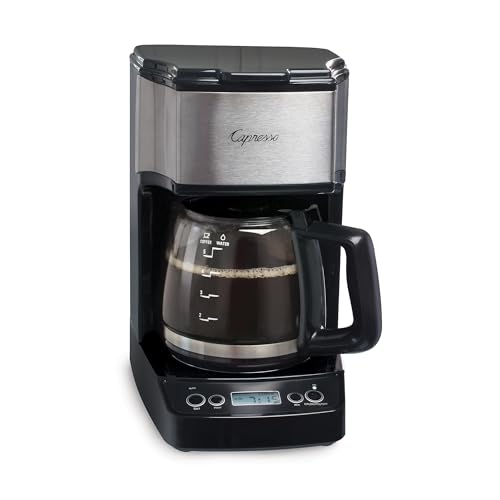
Capresso 5-Cup Mini Drip Coffee Maker — Best Proven Model
Capresso’s 5-Cup Mini Drip is the quiet veteran of this category: a coffee-specialist brand’s small machine that has stayed in the catalogue while flashier rivals came and went. That longevity has a practical benefit buyers overlook — replacement carafes and parts for a long-running model are far easier to source than for a one-season novelty. The black-and-stainless finish also helps it disappear into a modern kitchen rather than announcing itself as a budget appliance.
The Capresso Mini Drip is the veteran’s choice at this size: a coffee-specialist brand, a long production run, and a replacement carafe that is actually sold separately. In a class full of disposable appliances, that parts story is the difference between a machine and a consumable.
Strengths
- Long-running model from a coffee-focused brand, with replacement carafes sold separately
- Black-and-stainless finish blends into modern kitchens better than plain black plastic
- Mini footprint suits galley kitchens, RVs, and office nooks
Trade-offs
- Feature set is minimal next to newer rivals — no timer and a basic control layout
- Brand support is solid but the model’s age shows in small ergonomic details
- Glass carafe fragility applies here as with all glass-pot machines
| Capacity | 5-cup glass carafe |
| Design | Black and stainless steel finish (manufacturer listing) |
| Format | Mini drip countertop brewer (manufacturer listing) |
As a brewer it is a conventional, competent drip machine: fill, switch, wait a few minutes, pour. It does not chase the timer crowd or the thermal-carafe crowd, and its control layout will feel dated next to the newest models. Where it wins is trust and footprint — it is small, it is proven, and its maker actually sells the carafe separately (the listing for the 426-series replacement carafe exists precisely because the installed base is large). For a buyer who values a known quantity over new features, that is a rational trade.
The Capresso’s ownership advantage is documentation and spares: a coffee-specialist brand that sells the replacement carafe for this exact model as a normal catalogue item. Daily care is standard drip fare — rinse, dry, descale — and the model’s long production run means community knowledge for every quirk is a quick search away.
Best for: Buyers who value a proven model with available spare parts / Not suited for: Anyone who wants the newest feature set at this size
Check the current price on Amazon

Holstein Housewares 5 Cup Coffee Maker — Best for Dorms and Colour
Holstein Housewares built this 5-cup machine for the dorm-and-first-apartment brief and then discovered plenty of households wanted it too. The spec covers the essentials properly — Auto Pause and Serve, a reusable filter, a glass carafe — and the range of colours is a genuine differentiator in a sea of identical black boxes. If the brewer lives in a small kitchen where it is also decor, being able to choose something other than black is worth more than another button.
Holstein’s 5-cup machine makes this list as the dorm-and-first-apartment pick: pause-and-serve, a reusable filter, and colours beyond black. Students brewing two mugs between lectures get the features that matter, and the machine can move to a first kitchen without embarrassing it.
Strengths
- Auto Pause and Serve plus a reusable filter — the two most-used small-brewer features included
- Sold in a wide range of colours, a rarity in a category dominated by black plastic
- Positioned by the maker for home, office, and dorm use — and sized accordingly
Trade-offs
- Brand ecosystem and long-term parts support trail the legacy coffee names
- Basic warming-plate design with no auto shut-off
- Colour variants vary in availability; the exact finish you want may not be in stock
| Capacity | 5-cup glass carafe |
| Filter | Reusable filter included |
| Features | Auto Pause and Serve (manufacturer listing) |
The compromises are the usual ones for the value tier: a warming plate with no auto shut-off, glass that will not survive a hard drop, and a brand whose replacement-part pipeline is thinner than the big coffee names. None of that matters much if the machine’s job is two mugs before class or work, and its job in this roundup is to be the cheerful, capable budget option. Treat it as a consumable-grade appliance at a consumable-grade tier and it delivers exactly what it promises.
Holstein ownership is value-tier simple: rinse the reusable filter, wash the glass carafe with care, and do not expect a concierge parts desk. The machine’s low tier is its own insurance — but the colours cut the other way, since a replacement in your exact finish may not exist later. Buy it as a cheerful appliance, not an heirloom.
Best for: Dorms, first apartments, and colour-conscious small kitchens / Not suited for: Buyers planning a decade of service from one machine
Check the current price on Amazon

Amazon Basics 5 Cup Drip Coffee Maker — Best With Auto Shut-Off
The Amazon Basics 5-cup brewer makes its argument on a single line of the spec sheet that matters more than it should: auto shut-off. In a category where several famous names still leave a hot plate energised until you remember it, a machine that turns itself off is the responsible default for offices, rentals, and any kitchen that empties out in a hurry. Around that headline it is a tidy, conventional drip machine — auto pause for mid-brew pouring, a removable filter basket, and a matte finish that ages gracefully.
In a 4-cup guide full of manual warmers, the Amazon Basics’ auto shut-off is a genuine safety distinction — the pick for offices, workshops, and rental units where the person who brewed may not be the person who leaves last. Its auto pause and removable basket keep the daily routine equally sensible.
Strengths
- Auto shut-off is the headline: a safety feature several name-brand small brewers still omit
- Auto pause lets you pour mid-brew, and the removable basket rinses clean in the sink
- Matte black finish hides the water spots and coffee splashes that show on glossy machines
Trade-offs
- House-brand support and replacement carafes are a step behind the legacy brands
- No reusable filter included, so budget for paper filters or a separate mesh basket
- No programmability — the timer models are better for strict morning routines
| Capacity | 5 cups / 0.8 qt glass pot |
| Safety | Auto shut-off (manufacturer listing) |
| Features | Auto pause, removable filter basket, matte black finish (manufacturer listing) |
In the cup it is competitive with the other budget 5-cup machines here, which is to say good with fresh medium-grind coffee and unforgiving of stale pre-ground left in a warm cupboard. The compromises are ecosystem ones: if you crack the glass pot in year two, a house brand’s replacement pipeline is less certain than Mr. Coffee’s or Cuisinart’s. Weigh that against the shut-off safety and the typically sharp pricing in its tier, and it is the small brewer we point to first for workplaces and second homes.
The auto shut-off quietly changes ownership: one less thing to check on the way out, one less low-grade worry in a rental or office. The removable basket rinses properly in the sink rather than under a hopeful tap shake. If the glass pot ever breaks, check the house brand’s current replacement listing early rather than assuming a universal fit.
Best for: Offices, rentals, and second homes where a forgotten warmer is a real risk / Not suited for: Buyers who want a brand with decades of replacement-part availability
Check the current price on Amazon

Elite Gourmet EHC-5055 5-Cup Drip Coffee Maker — Best Basket Design
The Elite Gourmet EHC-5055 earns its place with two practical touches most small brewers skip: a swing-out brew basket that pivots toward you for filling, and a reusable filter included in the box. Anyone who has tried to spoon grounds into a cramped top-loading basket under a low cabinet will understand why the swing-out design matters. Add Pause & Serve for the impatient first cup and a clear water level indicator, and you have a small machine designed around the actual motions of a weekday morning.
The EHC-5055’s swing-out basket is the ergonomic winner at this size: filling and rinsing happen facing you, not under a cabinet overhang. Shoppers whose machine will live in a tight corner — an RV galley, a desk credenza — will feel the benefit every single brew.
Strengths
- Swing-out basket is genuinely easier to fill and rinse than lift-out baskets at this size
- Included reusable filter ends the recurring cost and waste of small paper filters
- Pause & Serve lets you pour the first mug mid-brew without drips running down the plate
Trade-offs
- Keep-warm plate stays on until you switch it off — no auto shut-off safety net
- Reusable mesh can pass a little sediment with fine grinds, so grind choice matters
- Lightweight build feels less substantial than the metal-accented rivals in this roundup
| Capacity | 5-cup glass carafe |
| Filter | Reusable filter basket, swing-out design |
| Features | Pause & Serve, water level indicator, keep-warm plate (manufacturer listing) |
The cup quality is dependable rather than exceptional — this is a straightforward drip brewer, and it tastes like one: clean enough with the reusable mesh if you stay at a medium grind, slightly silty if you push fine. The honest weaknesses are the manual warming plate, which will cook a forgotten pot, and a featherweight body that can scoot on the counter when you swing the basket. For a dorm, a first apartment, or an office desk corner, those are acceptable compromises for a machine this convenient to load and clean.
The swing-out basket is the ownership story: it rinses under the tap in seconds and dries fully, which keeps old-coffee flavours out of the next pot. The reusable mesh wants a weekly soak if you use oily beans. Treat the lightweight body gently when swinging the basket and it will repay you with years of unremarkable, reliable service.
Best for: Dorms, first apartments, and anyone who hates buying paper filters / Not suited for: Households that routinely leave the warmer on and forget about it
Check the current price on Amazon
Comparison Table
| Pick | Badge | Key spec | Best for |
|---|---|---|---|
| Elite Gourmet EHC4128 Automatic 4-Cup Drip Coffee Maker | Best Overall 4-Cup | True 4-cup size, reusable filter, keep-warm plate | Two-mug households that never finish a bigger pot |
| Mr. Coffee 5-Cup Mini Brew Switch Coffee Maker | Best If You Might Size Up | One-switch brew, compact footprint | Solo drinkers and couples who want a small pot with zero learning curve |
| Capresso 5-Cup Mini Drip Coffee Maker | Best Proven Model | Mini drip format, black and stainless finish | Buyers who value a proven model with available spare parts |
| Holstein Housewares 5 Cup Coffee Maker | Best for Dorms and Colour | Auto pause & serve, reusable filter, dorm-friendly | Dorms, first apartments, and colour-conscious small kitchens |
| Amazon Basics 5 Cup Drip Coffee Maker | Best With Auto Shut-Off | Auto shut-off, auto pause, removable basket | Offices, rentals, and second homes where a forgotten warmer is a real risk |
| Elite Gourmet EHC-5055 5-Cup Drip Coffee Maker | Best Basket Design | Swing-out basket, reusable filter, Pause & Serve | Dorms, first apartments, and anyone who hates buying paper filters |
How to Choose the Right Small Coffee Maker
Start with the only number that decides satisfaction in this category: how much coffee your household actually drinks in one sitting, measured honestly. Coffee makers do not measure cups the way your mug does. A coffee-maker ‘cup’ is roughly five ounces, so a 5-cup carafe holds about 25 ounces — two generous mugs, or one mug plus a refill. A 4-cup machine holds about 20 ounces. Buyers who skip this conversion are the ones leaving disappointed reviews on perfectly good machines, so do the mug maths first: count your household’s mugs, multiply by their real size, and let that total choose the carafe.
Glass Carafe, Steel Carafe, or No Carafe at All
Glass is the default because it is cheap, light, and lets you see the coffee level — but it is also the part of the machine most likely to end its life against a sink edge or a tile floor. A stainless steel carafe, like the Cuisinart’s in this guide, removes the breakage risk and holds heat without a warming plate cooking the coffee, at the cost of hiding how much is left. The third option is no carafe: a single-serve machine brews straight into your mug, which eliminates staling entirely but commits you to brewing one cup at a time. None of these is objectively best; the right answer depends on whether your household drinks together or one mug at a time.
The Features That Matter at This Size — and the Ones That Do Not
At 4 and 5 cups, four features earn their keep. Pause-and-pour stops the ‘first cup can’t wait’ drip disaster. A reusable filter quietly saves money every single week. A readable water window is the difference between a consistent pot and a daily guess, because at this scale being off by half a cup of water is being off by a fifth of the recipe. And auto shut-off is a genuine safety feature in any home that rushes out the door. Features that matter far less than marketing suggests: strength selectors on basic drip machines (dose and grind do that job better), built-in grinders (hard to clean at this size), and app connectivity on a machine with one job.
Budget Tiers, Explained Without the Hype
Small brewers fall into three honest tiers. The budget tier is the simple switch machines: they brew a decent pot, they ask you to manage the warmer, and their carafes are the fragile kind. The mid tier adds the conveniences — timers, front-loading baskets, better carafes, branded build quality. The premium tier at this size is small: a steel-carafe machine like the Cuisinart, or a Japanese-engineered brewer like the Zojirushi, where the money buys durability and consistency rather than features. Spend according to how long you intend to keep the machine. A dorm machine and a decade-long counter resident should not be the same purchase, and pretending otherwise wastes money in both directions.
What the Listings Do Not Tell You
Manufacturer listings for small drip machines share a blind spot: they photograph the machine empty, on an empty counter, in a kitchen with no cabinets. Reality adds a cabinet underside at exactly lid height, a mug that does not fit the marketing photo’s scale, and a second person trying to make toast in the same square metre. Before buying, act out your morning with a tape measure: where the machine stands, how the lid or basket opens, where the carafe travels to the sink. Ten minutes of this pantomime prevents the most common return reason in the category — not bad coffee, but bad fit.
Listings also stay silent about sound and steam. A small drip machine vents a surprising amount of steam for its size, which matters under wooden cabinet fronts; a machine placed permanently under a low cabinet should be pulled forward while brewing, or chosen in a front-loading design. And the last unlisted truth is the kindest: these machines improve noticeably in their second week, not because they change, but because you do — dose, grind, and timing settle into a routine, and the routine is where good small-pot coffee actually comes from.
Small Pots and Sustainability, Briefly
A right-sized brewer is quietly the greener choice in coffee: less water heated, less coffee brewed and discarded, and less energy holding a large plate warm. The reusable-filter machines in this guide remove the daily paper filter from the waste stream entirely, while the single-serve format in the wider series trades that away for per-cup packaging. None of this should override fit and flavour — a machine you replace in a year because it was wrong is the least sustainable outcome of all — but it is worth knowing that the frugal choice and the sustainable choice in this category are usually the same machine.
How to Set Up and Use Your Small Drip Coffee Maker
Step 1 — Wash before the first pot. Rinse the carafe, lid, and filter basket in warm soapy water, then run one full cycle of plain water through the machine. New small brewers carry factory dust and plastic notes that will otherwise season your first pot.
Step 2 — Measure water by the carafe, not the reservoir marks. Fill the carafe to the line for the batch you want, pour it into the machine, and you will never overfill or underfill. This one habit also teaches you your machine’s true capacity in mugs within two days.
Step 3 — Dose, level, and start. Add medium-ground coffee — start with one level tablespoon per coffee-maker cup and adjust — shake the basket gently to level the bed, seat the carafe fully so the pause-and-serve valve opens, and switch on.
Step 4 — Give it a minute. Let the full cycle finish and rest for about a minute before pouring; the last drips are the strongest part of the pot and the first pour is the weakest. Stirring the carafe once with a spoon evens out a small pot noticeably.
Step 5 — Rinse now, descale monthly. Dump grounds and rinse the basket and carafe immediately; coffee oils go rancid on plastic and glass alike. Descale every one to three months depending on your water — white vinegar solution or a descaler, followed by two plain-water cycles — because scale is the silent killer of brew temperature in small machines.
Who Should Actually Buy a 4-Cup Machine?
The 4-cup buyer is more specific than the market assumes. The clearest case is the two-mug household with a hard stop: coffee is a morning event, not an all-day beverage, and anything brewed beyond two mugs is waste wearing a warmer. The second case is the solo drinker with a big mug — one 16-to-20-ounce pour is a full 4-cup pot, brewed fresh rather than reheated. The third case is the second location: the desk, the workshop, the caravan, the guest room, where a small pot for one or two people is the entire requirement and counter space is the scarcest resource in the building.
The buyer who should not force this size is equally clear: households of three-plus daily drinkers, all-morning grazers, and anyone whose ‘cup’ is a 20-ounce travel tumbler refilled twice. For them the 4-cup machine becomes a twice-brewed chore, and the honest recommendation is the 5-cup class — close enough in size and price, far enough in capacity to end the double-brewing. Knowing which household you are is the entire skill of shopping this category.
The Second-Location Playbook: Desks, Workshops, and Guest Rooms
Half of all 4-cup machines are bought as second machines, and second locations have their own rules. The desk machine lives among paper and electronics, so its virtues are a small footprint, a carafe that pours without dripping onto documents, and — above all — a shut-off story, because the person who brewed at 9 a.m. is in a meeting at 6 p.m. The workshop machine lives among dust and vibration; it wants a reusable filter (paper filters absorb ambient smells), a body that wipes clean, and no delicate display to fog. The guest-room machine wants to be operable by a stranger at dawn: one switch, an obvious water window, and a small card beside it with the house dose written down.
Second locations also forgive what primary kitchens do not. A basic machine that would feel sparse as a home’s only brewer is perfect at a desk, because its job is narrower and its audience smaller. This is why the value picks in this guide should not be read as ‘worse’ — they are specialised, by price and simplicity, for exactly these satellite roles.
One warning from experience: second machines get descaled last and rinsed least, because they are nobody’s primary responsibility. Assign the descale to a calendar, not a memory, and the satellite brewer will outlast the flagship in the kitchen — a small irony this category produces with metronome regularity.
Taking a 4-Cup Machine Travelling
The 4-cup class has an unofficial second career in caravans, boats, site cabins, and holiday rentals, because it is the largest pot that still packs like a kettle. Travelling with one rewards a short protocol. Pack the carafe inside the machine’s own body if it fits, wrapped in the tea towel that will live under it at the destination — glass survives journeys in proportion to how little it can move. Carry the dose pre-measured in a small jar per day of the trip; foreign kitchens have unreliable spoons and no patience. And choose the machine for the destination’s power reality: a small drip brewer sips electricity compared with a kettle, which matters on a caravan hookup or a boat inverter with opinions.
At the destination, the local water is the variable you cannot pack away. A small bottle of familiar water for the first pot is not preciousness — it is a control sample that tells you whether a disappointing cup is the water or your setup. Travellers who learn that trick stop blaming machines in holiday cottages, and start enjoying the small ritual that makes an unfamiliar kitchen feel occupied.
A Word About the Machines Not in This Guide
For completeness: the 4-cup shelf also holds percolators, pod machines with carafe modes, and a rotating cast of unbranded novelties, and each was set aside for a stated reason rather than overlooked. Percolators brew a different, harsher cup that their devotees love and this guide’s readers rarely seek. Pod-carafe hybrids compromise both formats. The novelties fail the only test that matters at year two — whether a carafe, a gasket, or a brand still exists. What remains is the list above: six machines whose makers will still answer for them next Christmas.
One Last Thing: The Two-Mug Test
Every claim in this guide reduces to one test you can run tomorrow with your current setup: brew or pour exactly two mugs of coffee, your household’s real mugs at their real fill, and watch what remains. Nothing remaining and nobody short — you are a 4-cup household, and the EHC4128 was designed for you. A mug still empty — size up without a backward glance. Half a pot remaining — your problem was never the machine’s size but the batch, and a smaller pot will quietly fix your mornings.
Common Buying Mistakes
Trusting the cup number on the box. The single most expensive misunderstanding in this category. A coffee-maker cup is about five ounces; your mug is probably ten to sixteen. Always convert the carafe to ounces and compare it with your real mugs before buying.
Buying the size you wish you drank. People buy the 12-cup machine ‘for guests’ and then brew four cups in it daily, badly, because big machines under-extract small batches. Buy for the daily pot; guests can wait four minutes for a second brew.
Ignoring the carafe’s afterlife. Glass breaks. Before choosing any glass-carafe model, check that a replacement carafe exists and is easy to order. If it is not, price the machine as a disposable.
Leaving the warmer to do the thinking. Machines without auto shut-off will happily cook coffee — and eventually themselves — all day. If your household is forgetful, make auto shut-off a hard filter, not a nice-to-have.
Judging the machine before fixing the ratio. Weak or bitter first pots are usually dose and grind problems. Give any new small brewer a week of consistent ratios before concluding the machine is at fault.
Final Recommendation
Start with the true 4-cup machine: the Elite Gourmet EHC4128 is the size class done properly. If your household sometimes needs a third mug, the Mr. Coffee Mini Brew at 5 cups is the honest step up, and offices should put the auto-shut-off Amazon Basics at the top of their shortlist.
Start with Elite Gourmet EHC4128 Automatic 4-Cup Drip Coffee Maker, Mr. Coffee 5-Cup Mini Brew Switch Coffee Maker, Capresso 5-Cup Mini Drip Coffee Maker — the three picks most readers of this guide end up choosing between.
Related guides in this series: Best 4 Cup Coffee Makers; Best 4 Cup Drip Coffee Makers; Best 4 5 Cup Coffee Makers; Best 5 Cup Coffee Makers; Best 2 To 5 Cup Coffee Makers.
Frequently Asked Questions
How much coffee does a 4-cup coffee maker make in ounces?
About 20 ounces — the coffee-maker cup is roughly five ounces. That is two standard 12-ounce mugs filled a little under the brim, or one large travel mug plus a small cup.
Is a 4-cup coffee maker big enough for two people?
For two ordinary mug drinkers, yes — it is the size the class was designed around. If both drinkers use large mugs or one of them always has a second full mug, step up to a 5-cup machine and save the daily second brew.
Why do 4-cup machines rarely have timers?
Cost and physics. At the 4-cup price point, a clock and programming board are a large share of the budget, and a small pot brews in just a few minutes anyway — most owners find the wait trivial. The programmable route at this size is a 5-cup model like the Mr. Coffee Programmable.
Can I make tea or just hot water in a 4-cup coffee maker?
You can run plain hot water through any of these machines for tea or instant drinks. Run a plain-water cycle first if the basket last held coffee, unless you enjoy coffee-flavoured tea — the oils linger in reusable filters especially.
How do I stop a small pot from tasting weak?
Dose up before you blame the machine: use a full tablespoon of medium-ground coffee per coffee-maker cup, keep the ratio identical every day, and descale monthly. Small pots punish inconsistent dosing more than large ones because there is less margin for error.
Are 4-cup coffee makers good for an office desk?
They are one of the best desk formats — small footprint, a real pot to share with a colleague, and no pod costs. Choose a model with auto shut-off, or be disciplined about the switch, since office safety rules and hot plates are uneasy neighbours.


