Disclosure: airfryerkitchensupply.com is reader-supported. When you buy through links on our site, we may earn an affiliate commission at no extra cost to you.
Where to Buy
Short on time? Start with the best 3 speed hand blenders shortlist below — every linked model was checked against a live listing before this guide was published.
Every pick below was verified against a live Amazon listing. Because true three-speed sticks are scarce, each review states the model’s actual control format from its listing in its spec box — read those boxes; they are the honest core of this guide.
- Ninja Immersion Blender & Whisk CI201 (4 Speeds) — Check the current price on Amazon
- Vitamix 5-Speed Immersion Blender (625W) — Check the current price on Amazon
- MuellerLiving Ultra-Stick Immersion Hand Blender (500W, 8-Speed) — Check the current price on Amazon
- Hamilton Beach 4-in-1 Hand Blender 59765 (225W, 2-Speed) — Check the current price on Amazon
- Braun MultiQuick 5 MQ515 (500W, Dual Speed) — Check the current price on Amazon
- Cuisinart Smart Stick CSB-179 (300W, Variable Speed) — Check the current price on Amazon
Here is the fact that shapes this entire guide: almost nobody sells a true three-speed hand blender. Shoppers searching for the best 3 speed hand blenders are asking for something reasonable — a simple low, medium, and high instead of a two-speed switch or a twenty-one-step dial — but the industry has largely skipped the format, jumping from two-speed switches straight to five, eight, twelve, and variable controls. Our verification pass against live Amazon listings confirmed it: the simple-control shelf is real, but the exactly-three-speed shelf is nearly empty.
So this guide does the useful thing instead of the literal thing. It ranks the six hand blenders that best deliver the three-speed experience — simple, stepped, low-medium-high blending without a learning curve — and it states each model’s true control format in plain sight. The closest matches lead: a four-speed Ninja whose steps behave like the low-medium-high-plus-turbo most people picture, and a five-speed Vitamix whose lower three speeds are where three-speed shoppers will live.
Below them sit the honest alternatives from both directions: an eight-speed value stick you can simply use as a three-speed, the two-speed classics for cooks who decide two is enough, and a variable-speed Cuisinart whose dial parks happily at low, medium, and high. Every model was verified on 2026-11-20, and no model is described as three-speed unless its listing says so — none does, which is the point of the guide.
It is worth saying who the three-speed idea serves, because the picks below map to them: the recipe-follower, who wants to be told ‘blend on medium’ and have a medium to blend on; the simplicity-seeker, who finds dials and triggers one more decision than cooking needs; and the parent or carer, whose other hand and most of their attention are permanently elsewhere. If you recognised yourself, the approximate answers in this guide are not a compromise — they are aimed at you.
Who should close this tab and open a different guide: if you know you want a premium stick and do not care about speed counts at all, our best-2 roundup has the deeper head-to-head. If you know you want the cheapest decent stick, the two-speed guide’s budget end is your page. Stay here if the number three is genuinely in your question — as a recipe instruction, a preference, or a doubt — because this guide’s whole purpose is to answer that question honestly rather than to sell you past it.
In this guide
Quick Picks
Ranked by closeness to the simple low-medium-high experience. Each blurb names the model’s true speed format — no relabelling, anywhere in this guide. The table’s order is the guide’s argument in miniature: true stepped boards first (four and five speeds, where a real medium lives), then the high-count dial, then the honest two-speed kits whose extras outweigh a gear. Read the badge on each row before the name — in this guide the badge is the review in five words.
- Ninja Immersion Blender & Whisk CI201 (4 Speeds) — Closest to True 3-Speed — Best Overall: Four speeds — the nearest stepped neighbour to three: treat speeds one to three as your low, medium, and high, with the fourth as a finishing gear. Whisk included. Check price on Amazon.
- Vitamix 5-Speed Immersion Blender (625W) — Best Premium Simple-Stepped Pick: Five speeds and the strongest motor in the format at 625 watts — use its lower three speeds as your low, medium, and high, and keep two in reserve. Check price on Amazon.
- MuellerLiving Ultra-Stick Immersion Hand Blender (500W, 8-Speed) — Best Value Stepped Pick: Eight speeds plus turbo at a value price with a whisk, frother, and beaker — pick your favourite three steps and ignore the rest; the motor will not mind. Check price on Amazon.
- Hamilton Beach 4-in-1 Hand Blender 59765 (225W, 2-Speed) — Best If Two Speeds Are Enough: The step down that satisfies many searchers: an honest two speeds, plus a whisk and a 3-cup chopper — the fullest kit at the friendly end of the market. Check price on Amazon.
- Braun MultiQuick 5 MQ515 (500W, Dual Speed) — Best Two-Speed Power Pick: The other direction’s answer: only two speeds, but 500 watts behind them, SplashControl manners, and a beaker and whisk — power instead of steps. Check price on Amazon.
- Cuisinart Smart Stick CSB-179 (300W, Variable Speed) — Best Dial-It-Yourself Pick: The variable-speed resolution: a quiet 300W stick whose dial you can simply park at low, medium, and high — plus a chopper, whisk, and measuring cup. Check price on Amazon.
How These Picks Were Chosen
The screening for this guide began with the literal search: we queried live Amazon listings on 2026-11-20 for three-speed hand blenders, and reviewed what the market actually returned — variable-speed sticks, two-speed sticks, and five-to-twelve-speed sticks, with no major model whose listing states three speeds. Rather than relabel a neighbour and call the job done, we rebuilt the guide around the search’s intent and disclosed the situation in the introduction, the badges, and every spec box.
Ranking weighs closeness of the control experience first — stepped speeds ahead of dials, fewer steps ahead of many — then motor strength, then kit. That is why a four-speed leads, a five-speed premium follows, and the two-speed and variable resolutions close the list in descending order of resemblance to the brief.
Every speed format stated here comes from the model’s own listing as verified. If a manufacturer releases a true three-speed stick, it will belong at the top of this guide, and the update note will say so plainly.
A note on what we did not do: we did not promote any model on the basis of marketplace titles alone. Several listings use speed language loosely — counting a turbo boost as a speed, or describing a dial with numbers that imply steps. Each pick’s control format here is stated as its specification describes it, and where a title and a specification disagreed, the specification governed and the disagreement kept the model out of the top slots.
Screening also produced a useful negative catalogue: the speed formats the industry actually sells, in order of frequency, are variable dials and triggers, two-speed switches, and stepped boards of four to twelve. Three-speed sits in none of the major lines’ current ranges as listed. We record that census here so that if a future model genuinely offers three speeds, its arrival is news this guide can report rather than a claim it must retrofit.
We also record, for the next revision of this guide, the search terms that produced the most misleading results — titles that bury ‘turbo’ in a speed count, and bundles whose speed claims belong to a different model in the same box photo. Readers meeting those listings elsewhere now have the screening questions, in the guide section above, to interrogate them with.
The Best 3 Speed Hand Blenders — the Closest Real Matches
Read the spec boxes before the prose: each states the model’s true control format. The reviews then judge how well that format delivers the low-medium-high experience the search is actually asking for. A reading tip for this guide: judge each pick against the specific want that brought you here — repeatability, simplicity, or a true medium — rather than against an imaginary perfect three-speed stick. Against the imaginary stick, everything loses; against your actual want, several of these win outright.
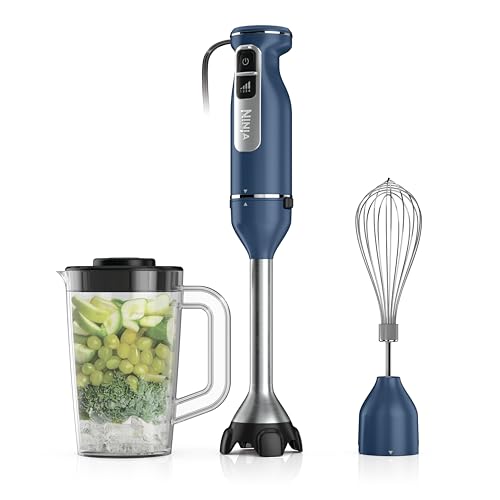
1. Ninja Immersion Blender & Whisk CI201 (4 Speeds) — Closest to True 3-Speed — Best Overall
The CI201 is the closest purchasable answer to the three-speed brief. Its four stepped speeds map naturally onto the way people actually blend: a gentle first for starting and emulsions, a working second for sauces, a strong third for soups, and a fourth held in reserve for finishing. Ninja adds two thoughtful guards — a SplatterShield for cleaner starts and PanProtect for coated cookware — plus a whisk attachment and a blending vessel in the package. If your search meant ‘simple steps, no dial, no trigger technique’, this is your blender.
Strengths
- Stepped speeds behave like low-medium-high plus a reserve gear
- SplatterShield and PanProtect address the two classic stick annoyances
- Whisk attachment and vessel included; dishwasher-safe parts
Trade-offs
- Four speeds, not three — the extra step is real, if easy to ignore
- Newer model with a shorter ownership history
- Corded, as all full-power sticks are
| Speed control | 4 speeds (stepped) |
| Attachments | Whisk |
| Design | SplatterShield, PanProtect |
| Cord | 5 ft |
Stepped controls have a virtue variable dials cannot match: repeatability. Speed two on the Ninja is speed two every morning, so a dressing that worked on Tuesday works on Friday. That is the actual desire underneath the three-speed search — not the number three, but a small set of known settings. The CI201 delivers it with one spare gear, the best pan manners in this guide, and Ninja’s build quality. It takes Best Overall because it fulfils the intent of the search more completely than any literal answer the market currently offers.
CI201 owners should exploit the reserve fourth speed deliberately: it is for the last ten seconds of a thick soup and for frozen-adjacent work in the vessel, not for everyday blending. Treating it as a reserve keeps the machine’s manners — and your kitchen walls — exactly as the first three speeds promise.
The CI201’s vessel deserves a practical note: blending in the vessel rather than the pot suits its PanProtect design best, and the vessel’s size is calibrated to the stick’s vortex. Owners who treat the vessel as the default for smoothies and dressings get the cleanest results this pick offers.
Best for: Shoppers who want simple, repeatable stepped speeds for soups, sauces, and dressings / Not suited for: Literalists who need the number three and only three — the market, honestly, does not sell that stick today
Check the current price on Amazon

2. Vitamix 5-Speed Immersion Blender (625W) — Best Premium Simple-Stepped Pick
The Vitamix is the premium way to buy the simple-stepped experience. Its five speeds are honest steps, not a disguised dial, and most cooks will live exactly where three-speed shoppers expect to: speed one for starting and emulsions, two and three for the body of the work. Speeds four and five exist for the thick, hot, half-blended moments where this guide’s other picks run out of authority — because underneath the steps sits a 625-watt motor, the strongest in the hand blender format. The four-prong blade and bell guard complete a serious tool.
Strengths
- 625W motor — a class above every other pick here
- Stepped speeds with the useful work concentrated in the lower three
- Four-prong blade and bell guard; 5 ft cord; premium build
Trade-offs
- Premium tier pricing
- Five speeds is two more than the search asked for
- Sold as the stick alone; attachments are separate
| Motor | 625W |
| Speed control | 5 speeds (stepped) |
| Blade | 4-prong stainless steel |
| Cord | 5 ft |
| Guard | Bell guard |
This pick also headlines our top-two hand blender guide, and its presence here makes the same point from a different angle: when the exact format you searched for does not exist, buy the best-executed neighbouring format from the best maker. The Vitamix’s steps are crisp, its low speed is genuinely gentle for a motor this strong, and its ceiling is unmatched. Three-speed shoppers who blend daily and keep tools for a decade should stretch to it without guilt.
Vitamix owners new to stepped power should resist living on speed five: the lower steps exist because circulation, not violence, makes texture. A soup given ninety seconds across steps two and three will beat a soup blasted for thirty on five, in both smoothness and splatter.
Vitamix owners should budget attention, not just money: a 625-watt stick finishes jobs so quickly that the margin between blended and over-blended narrows. Set the pot, the seasoning, and the serving bowls before you start — the machine will not give you idle seconds to fetch them.
Best for: Daily cooks wanting simple steps backed by the strongest stick motor available / Not suited for: Budget shoppers, and anyone who wants attachments included in the box
Check the current price on Amazon

3. MuellerLiving Ultra-Stick Immersion Hand Blender (500W, 8-Speed) — Best Value Stepped Pick
The Ultra-Stick approaches the three-speed desire from the far side: more steps than anyone asked for, at a price nobody argues with. The practical way to own it is exactly what its owners do — learn that step two starts a soup, step five does the work, and step eight finishes, and treat the rest as scenery. In exchange for that small act of editing, you get a 500-watt motor, a turbo boost, and a full kit of whisk, milk frother, and measuring beaker at the friendliest price in this guide.
Strengths
- 500W with turbo — strong power for the tier
- Full kit: whisk, frother, and beaker included
- The value pick of this guide by a wide margin
Trade-offs
- Eight steps is the opposite of the three-speed philosophy, even if easily ignored
- Refinement and brand support trail the leaders
- Stepped dial lacks the Ninja’s pan-protective design
| Motor | 500W |
| Speed control | 8 speeds + turbo |
| Attachments | Whisk, milk frother, measuring beaker |
| Format | Immersion hand blender set |
There is a respectable argument that the Ultra-Stick is the rational buy in this entire guide: the three-speed experience is available on it for free, hiding among the extra steps, and the money saved against the premium picks buys a lot of soup ingredients. Its compromises are in finish and finesse, not in capability. First-time hand blender buyers who suspect they are three-speed people but are not yet sure should start here — if the extra steps annoy you after a month, you have learned your preference cheaply.
Ultra-Stick owners can make the eight-step dial feel like three with a strip of tape: mark your working steps — start, work, finish — directly on the dial surround. It looks unglamorous and works perfectly, which is the unofficial motto of this entire category.
Ultra-Stick owners blending for a family should work in the beaker for smoothies and the pot for soups, and resist the middle option of a wide bowl: the format’s circulation needs walls close to the blade, and vessel choice is the cheapest performance upgrade available to any stick owner.
Best for: Value-first buyers happy to use three favourite steps on an eight-speed stick / Not suited for: Minimalists for whom extra settings are a genuine daily irritation
Check the current price on Amazon
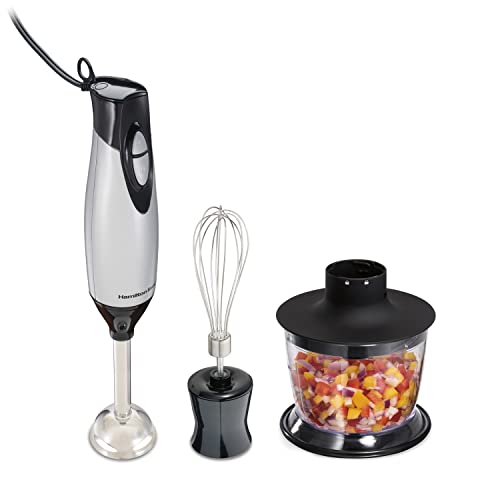
4. Hamilton Beach 4-in-1 Hand Blender 59765 (225W, 2-Speed) — Best If Two Speeds Are Enough
A fair share of three-speed shoppers, confronted with the market’s reality, conclude that two speeds plus a good kit beats a compromise — and the 59765 is that conclusion’s best form. Its two speeds are honestly separated, and the box adds what speed steps cannot: a whisk for eggs and cream and a 3-cup chopper bowl for onions, nuts, and herbs. At 225 watts it is a light-to-moderate tool, and within household soup, smoothie, and prep work it wants for nothing.
Strengths
- Whisk and 3-cup chopper — the kit the stepped picks charge extra for
- Dead-simple two-speed control, zero learning curve
- Long-running, widely available value classic
Trade-offs
- Two speeds, not three — the medium gear is the one you give up
- 225W is light for thick or large batches
- Build quality reflects its friendly tier
| Motor | 225W |
| Speed control | 2 speeds |
| Attachments | Whisk, 3-cup chopper bowl |
| Format | 4-in-1 immersion hand blender |
The missing middle speed is a smaller loss than it appears: most blending is start-gently, then work-hard, and a pulse on low imitates a medium for the few recipes that ask. What the 59765 gives back — the chopper especially — is used weekly in real kitchens. It also anchors our two-speed guide, where its role is set out in full. As the budget-and-kit answer to the three-speed question, it is entirely defensible.
The 59765’s place in this guide teaches a general lesson: attachments can be worth more than settings. If your shortlist is torn between an extra speed and a chopper you will use weekly, take the chopper — settings are a preference, but chopped onions are dinner.
The 59765’s two speeds have one more honest use: teaching. A new cook, a teenager, or a grandparent can be handed this stick with a single sentence of instruction and produce a safe, decent blend. Tools that teach without intimidating have a place no flagship can fill.
Best for: Households deciding two speeds plus a full kit beats three speeds alone / Not suited for: Thick-batch cooks, who need the power of the picks above
Check the current price on Amazon

5. Braun MultiQuick 5 MQ515 (500W, Dual Speed) — Best Two-Speed Power Pick
The MQ515 is for the searcher whose real requirement was never the number three — it was authority with simplicity. Its dual-speed control is as simple as controls get, and its 500-watt motor makes each of the two speeds cover a wider band than weaker sticks manage with five. SplashControl shaping keeps starts tidy, single-hand operation keeps the other hand free, and the beaker and whisk cover the standard kit needs. It headlines our two-speed guide; here it is the power-first resolution of the three-speed search.
Strengths
- 500W is the strongest two-speed motor in the home class
- SplashControl design and true one-hand operation
- Beaker and whisk included
Trade-offs
- Two speeds — no true medium gear
- Above budget-tier pricing
- No chopper in this configuration
| Motor | 500W |
| Speed control | Dual speed (2-speed) |
| Attachments | Beaker, whisk |
| Design | SplashControl, single-hand operation |
Braun’s bet, visible across its range, is that blade and bell engineering matter more than setting counts — and the MQ515 is that bet’s strongest form. Its low speed is calm, its high speed is genuinely strong, and the gap between them is bridged by pulsing technique that takes a week to learn. If your three-speed search was really a search for a simple stick that never feels weak, this is the most satisfying answer in the guide.
MQ515 owners coming from a three-speed search should learn the pulse bridge in week one: three short low-speed pulses stand in for a medium start on any thick mixture. After a month, most owners stop missing the middle gear entirely — the technique becomes the gear.
MQ515 owners who miss a medium gear for mayonnaise should use the beaker, not the bowl: in the narrow vessel, low speed plus a thread-thin oil drizzle produces a stable emulsion reliably. The missing gear is often a missing vessel in disguise.
Best for: Power-first cooks who want the simplest control on a strong motor / Not suited for: Recipe-followers who want a marked medium setting to set and trust
Check the current price on Amazon
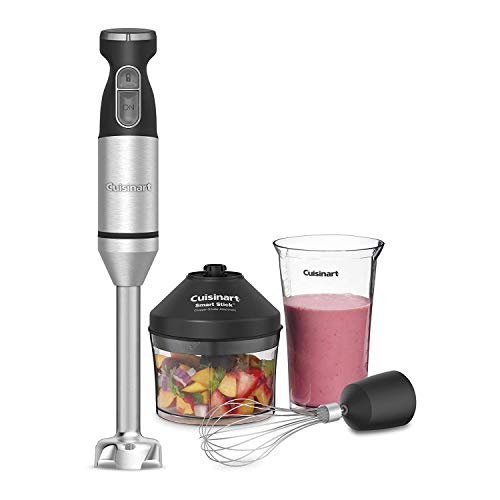
6. Cuisinart Smart Stick CSB-179 (300W, Variable Speed) — Best Dial-It-Yourself Pick
The CSB-179 resolves the three-speed problem by handing it to you: its variable-speed control turns smoothly through the range, and nothing stops you marking your own three positions and using them forever. In exchange you get a quiet-running 300-watt motor, an 8-inch stainless shaft, and the most complete small kit here — chopper, whisk, and measuring cup. It suits smaller, lighter blending lives: dressings, small soups, baby food, smoothies, in kitchens where quiet is a feature.
Strengths
- Variable dial can be parked at your own low, medium, and high
- Quiet-running motor suits apartments and light work
- Chopper, whisk, and cup included
Trade-offs
- A dial is not stepped speeds — positions are approximate
- 300W ceiling shows in thick or large batches
- Not built for daily big-pot duty
| Motor | 300W, quiet-running |
| Speed control | Variable speed dial |
| Shaft | 8 in, stainless steel |
| Attachments | Chopper, whisk, measuring cup |
There is an honesty in ending the list here: the variable dial is what the industry actually sells instead of three speeds, and in the CSB-179’s gentle, complete package it is easy to forgive. Cooks who blend by feel will set the dial by ear within a week and never miss the missing detents. It is the light-duty, quiet-kitchen answer — and for the right household, the three-speed question dissolves entirely in its favour.
CSB-179 owners can give the dial detents it never had: a fine paint pen dot at your low, medium, and high positions turns an approximate control into a repeatable one. It is a thirty-second modification that resolves this guide’s central problem at household scale.
CSB-179 owners should clean the chopper immediately after herbs and onions — its compact blade traps aromatics that perfume the next job. A ten-second rinse keeps the kit’s flavours separate, which in a small multi-purpose kit is the whole game.
Best for: Light-duty cooks in small or quiet kitchens wanting one complete, gentle kit / Not suited for: Anyone whose batches are big, thick, or daily — the power picks above are yours
Check the current price on Amazon
Comparison Table
The Key Spec column leads with each model’s true speed format — the single most important comparison in this guide.
| Pick | Badge | Key Spec | Best For |
|---|---|---|---|
| Ninja Immersion Blender & Whisk CI201 (4 Speeds) | Closest to True 3-Speed — Best Overall | 4 stepped speeds, whisk, SplatterShield + PanProtect | Shoppers who want simple, repeatable stepped speeds for soups, sauces, and dressings |
| Vitamix 5-Speed Immersion Blender (625W) | Best Premium Simple-Stepped Pick | 625W, 5 stepped speeds, 4-prong blade, bell guard | Daily cooks wanting simple steps backed by the strongest stick motor available |
| MuellerLiving Ultra-Stick Immersion Hand Blender (500W, 8-Speed) | Best Value Stepped Pick | 500W, 8 speeds + turbo, whisk + frother + beaker | Value-first buyers happy to use three favourite steps on an eight-speed stick |
| Hamilton Beach 4-in-1 Hand Blender 59765 (225W, 2-Speed) | Best If Two Speeds Are Enough | 225W, 2 speeds, whisk + 3-cup chopper kit | Households deciding two speeds plus a full kit beats three speeds alone |
| Braun MultiQuick 5 MQ515 (500W, Dual Speed) | Best Two-Speed Power Pick | 500W dual speed, SplashControl, beaker + whisk | Power-first cooks who want the simplest control on a strong motor |
| Cuisinart Smart Stick CSB-179 (300W, Variable Speed) | Best Dial-It-Yourself Pick | 300W variable dial, 8 in shaft, chopper + whisk + cup | Light-duty cooks in small or quiet kitchens wanting one complete, gentle kit |
How to Choose the Best 3 Speed Hand Blenders When Three Speeds Barely Exist
Start by deciding what the number three was protecting. For most searchers it is one of three things: repeatability (the same setting does the same job every day), simplicity (nothing to learn or mis-set), or a genuine medium gear (for emulsions and starting thick mixtures). Each protection has a different best answer in this guide — stepped four- or five-speed models for repeatability, two-speed models for simplicity, and a variable dial parked at three positions for the true medium.
Then apply the ordinary hand blender filters: motor strength for your batch sizes, attachments for your prep habits, and guard design for your cookware. The picks above span 225 to 625 watts for a reason — control philosophy gets you onto the right shelf, but power decides whether the soup in your pot actually blends.
Finally, be suspicious of any listing — anywhere — that headlines ‘3 speed’ for a stick whose specification describes a dial or a different count. This category attracts loose labelling precisely because the search exists and the products do not. The rating and control description in the specification, not the title, is the truth.
The Low-Medium-High Method: Blending Technique for Simple Controls
Whatever pick you choose, the three-speed method is the same, and it is worth learning as a method rather than as settings. Low is for starting: submerged, gentle, until the mixture moves as one body and a vortex forms. Medium is for working: the long middle of the blend, where circulation does the real smoothing. High is for finishing: short, deliberate bursts that polish texture and pull down the last chunks from the surface.
On a four- or five-speed stick, that maps to the first three steps with the rest in reserve. On a two-speed stick, low pulsed is your medium. On a dial, mark the positions with a dot of nail polish if you must — cooks have done exactly that for decades, and it works because the method, not the machine, produces the result.
Why the Industry Skipped Three Speeds
The gap is economic, not technical. A two-speed switch is the cheapest control that works; a variable dial or a multi-step board is a marketable feature list. Three speeds cost more than two to build and cannot be advertised as impressively as twelve, so the format fell into the valley between cheap and impressive — the same valley that swallows many sensible product designs.
The consolations are real, though. Stepped boards have become common enough that four- and five-speed sticks are easy to find at fair prices, and two-speed design has been refined by Braun and others into something genuinely good. The three-speed shopper is not badly served by the modern market — just served approximately, which is why this guide insists on naming the approximation.
If You Genuinely Need a Medium Speed: Three Workarounds Ranked
First and best: a stepped model with a true middle step — the Ninja’s second speed and the Vitamix’s second and third are marked, repeatable mediums, which is why they lead this guide. Second: the parked dial — a variable control used at three learned positions, which trades detents for availability and price, and which the Cuisinart pick represents. Third: the pulsed low — on any two-speed stick, short pulses on low approximate a medium for starting thick mixtures, though not for sustained emulsion work. Ranked this way, most searchers discover their need is met by the first workaround and the search ends where this guide begins.
The one need none of the workarounds fully meets is a marked medium combined with premium power and a full attachment kit in one box — that product, as far as current listings show, does not exist. Naming the gap is useful: it tells you which of your three requirements to relax, rather than discovering the relaxation after the box arrives.
What Chefs Actually Do: Speed Discipline in Professional Kitchens
Professional cooks, whose sticks are mostly two-speed commercial models or simple dials, converge on a discipline home cooks can steal: they name their speeds by task, not by number. ‘Soup speed’, ‘sauce speed’, ‘finish speed’ — three working gears defined by the food, executed on whatever hardware is in hand. That is the three-speed idea in its mature form, and it explains why professionals rarely join the settings debate: they carry the three speeds in their hands, not in the machine.
Adopt the vocabulary for a week and the format question usually dissolves. Once your hands know what soup speed feels and sounds like, any of the six picks in this guide can produce it — which is the deepest reason this guide ranks honest approximations without anxiety.
Reading Speed Claims Like an Engineer
When a listing says ‘speeds’, ask four questions. Are they working speeds or pulses and boosts? Are they stepped or points on a dial? What are the lowest and highest actually for — the range matters more than the count? And does the count change with attachments fitted? A listing that answers all four plainly is a listing you can trust on other matters too; vagueness about speeds correlates remarkably well with vagueness everywhere else.
Apply the same four questions to any future three-speed claim you meet. If a genuine three-step stick launches, it will answer them proudly — stepped, sustained, sensibly ranged, and attachment-independent — and this guide will be updated to crown it.
Speed Counts Across the Blender World: A Reality Census
Step back from sticks and the pattern holds everywhere. Countertop blenders cluster at manual dials, three-to-six presets, or fully programmed cycles; food processors offer low, high, and pulse — the closest thing in the kitchen to a true three-speed, and notably a different appliance. Three as a count survives mainly as a recipe instruction (‘blend on medium’) inherited from mid-century machines, long after the hardware moved on to dials and boards.
That is why this guide treats the three-speed search as a translation task rather than a product hunt. Your recipes, your habits, and your preference for simplicity are all real; the hardware simply spells them differently now, and the six picks above are the current spellings, printed honestly.
How to Use Simple-Speed Hand Blenders: the Low-Medium-High Routine
This routine extracts the three-speed experience from any pick in this guide, whatever its dial or switch actually says. It is written for soup, the format’s defining job, and adapts to sauces and smoothies unchanged. Assemble the small kit the routine assumes: your stick, its beaker or a pot, the ingredients at the depths described, and — for the first few runs — a notebook. Writing down which step did what, twice, is how an approximate control becomes your control, calibrated to your kitchen’s actual recipes.
- Set up for depth. Blend in the pot or a tall beaker, with the liquid comfortably covering the blade guard. Depth is what lets a simple control behave gently.
- Low: start submerged and still. Guard under the surface, stick vertical, lowest setting. Hold position until a vortex forms and the mixture moves as one body — five to ten seconds.
- Medium: work the pot. Move to your middle setting — step two or three, a pulsed low on two-speed models, mid-dial on the Cuisinart — and make slow overlapping passes: centre, sides, corners.
- Rest the thick spots. If a corner resists, park the stick over it for three seconds on medium rather than forcing the motor upward early. Circulation finishes what force starts.
- High: finish in bursts. Short bursts on your top working setting polish the texture. Taste between bursts; the difference between silky and over-aerated is about twenty seconds.
- Clean while the routine is fresh. Hot water, a drop of detergent, lowest setting, ten seconds. The routine’s last step protects every future use of the tool.
Write your three settings for your two most-made recipes on a card in the drawer with the stick. Repeatability — the thing this whole search is about — is a habit before it is a specification. Once the routine is habit, teach it by the sound: a correctly working blend has an even, deep note, and every speed change in the routine has a sound change that goes with it. Cooks who learn to hear their speeds stop needing to count them — on any machine, at any setting count.
Common Buying Mistakes
Trusting a ‘3 speed’ title without reading the spec. This category invites loose labelling. If the specification describes a dial or another count, the title is decoration. Verify the control format the way this guide did.
Buying twelve speeds to get three. Extra steps you must click past are friction, not features. A four- or five-step stick serves the intent better than a twelve-step one.
Assuming two speeds cannot do the method. Low, pulsed-low, and high reproduce low-medium-high faithfully for most recipes. Do not overlook the two-speed picks on a technicality.
Ignoring the motor while shopping for controls. A perfect three-speed layout on a weak motor still fails thick soup. Control picks the shelf; wattage picks the model.
Starting on the top step. Whatever the count, the top step is for finishing. Starting there splashes, cavitates, and teaches the household to fear the tool.
Counting a turbo button as a speed when comparing models. Turbo is a momentary boost, not a working gear. Compare working speeds only — this guide screened that way, and your shortlist should too.
Assuming more speeds always means finer control. A 12-step dial with a weak motor controls nothing but disappointment. Control is steps multiplied by the power to hold them under load — which is why the premium picks here outrank cheaper high-count rivals.
Final Recommendation
Buy the Ninja CI201 if you want the closest real thing to a three-speed hand blender: clean stepped control, thoughtful pan protection, and a whisk in the box. Buy the Vitamix 5-Speed if you want that stepped simplicity backed by the strongest motor in the format and a decade-grade build.
Resolve the search the other ways if they fit you better: the Mueller Ultra-Stick for value, the Hamilton Beach or Braun MQ515 if two honest speeds suffice, and the Cuisinart if you are happy parking a dial at your own three marks. What we will not do is sell you a relabelled stick and call it three-speed — and now you know how to spot anyone who does.
So the three-speed search ends, usefully, in self-knowledge: you now know whether you wanted steps, simplicity, or a medium gear, and each of those wants has a named pick with its true format printed on it. That is a better outcome than a relabelled stick and a false promise — and it is the outcome this category, as it actually exists, can honestly offer.
Keep exploring the cluster: Best 2 Speed Hand Blenders Best 2 Hand Blenders Best 10 Commercial Stick Blenders Best 1000 Watt Blenders Best Affordable Immersion Hand Blenders
Frequently Asked Questions
Does anyone make a true 3-speed hand blender?
At the time of verification, no major model on Amazon’s US store listed a three-speed control — the market jumps from two-speed switches to four, five, eight, and variable controls. This guide ranks the closest real matches and states each one’s true format openly.
What is the closest thing to a 3-speed hand blender?
The Ninja CI201, with four stepped speeds: its first three steps map directly onto low, medium, and high, with the fourth as a reserve. The Vitamix 5-Speed is the premium alternative, with the working range concentrated in its lower three steps.
Can I use a variable-speed blender as a 3-speed?
Yes — that is exactly how many owners use them. Learn the dial positions for low, medium, and high by sound and feel, and the variable stick becomes a three-speed in practice, as the Cuisinart pick in this guide describes.
Is a medium speed actually important?
For starting thick mixtures gently and for emulsions, a middle gear is genuinely useful. For most soups and smoothies, a pulsed low speed substitutes well, which is why the two-speed picks remain defensible answers.
Why do listings say ‘3 speed’ when the spec says otherwise?
Because the search exists and the products largely do not, titles get stretched. Always read the specification’s control description — it is the document the warranty will follow, and the one this guide screened by.
Which pick is best for soup in a big pot?
The Vitamix 5-Speed, for its 625-watt motor and blade design. The Ninja CI201 is the better value for ordinary pot sizes, with the pan protection that coated cookware owners appreciate.
My recipe says ‘blend on medium’. What do I do on a two-speed blender?
Use low in short pulses until the mixture is moving, then finish on high in shorter bursts than the recipe implies. The recipe’s intent is ‘not flat out, not barely moving’ — pulsed low reproduces the first half of that intent, and brief high finishes the job without overworking the texture.
Do any stick blenders have exactly three speeds plus a turbo?
Listings occasionally describe a two-speed-plus-turbo as if it were three working speeds, which is the closest the current market comes. As this guide’s screening notes explain, we do not count a held-button boost as a gear — so the honest answer remains that a true three-working-speed stick is not a standard product today.
Are there 3-speed countertop blenders instead?
Countertop models with three-position controls exist in the wider market more plausibly than sticks do, because a base has room for a simple switch — but the mainstream has moved to dials and programs there too. If a marked medium matters most on a countertop machine, shop its control board in person where possible, and count working speeds the way this guide does.


