Disclosure: airfryerkitchensupply.com is reader-supported. When you buy through links on our site, we may earn an affiliate commission at no extra cost to you.
Where to Buy
Short on time? Start with the best 2 speed hand blenders shortlist below — every linked model was checked against a live listing before this guide was published.
Every pick below is a genuine two-speed (dual-speed) hand blender, confirmed from its live Amazon listing. Where a model’s listing describes its control differently, it was excluded — this guide does not relabel variable-speed sticks as two-speed ones.
- Braun MultiQuick 5 Hand Blender MQ515 (500W, Dual Speed) — Check the current price on Amazon
- Hamilton Beach 4-in-1 Hand Blender 59765 (225W, 2-Speed) — Check the current price on Amazon
- Braun MultiQuick 5 Hand Blender (350W, Dual Speed) — Check the current price on Amazon
- Waring Quik Stik WSB35 Immersion Blender (2-Speed, Commercial) — Check the current price on Amazon
- Vitamix 2-Speed Immersion Blender + Whisk (350W) — Check the current price on Amazon
- OVENTE HS560R Hand Blender (300W, 2 Speeds) — Check the current price on Amazon
The best 2 speed hand blenders make a quiet argument against progress: two speeds — a low for control, a high for power, sometimes a turbo moment on top — are all that soup, sauce, and smoothie work ever actually requires. No dials to calibrate, no trigger technique to learn, no twenty-one settings of which nineteen are theatre. You press low, you press high, you blend. This guide is for the cooks who find that honesty appealing, and it is stricter than most: every pick is a true two-speed machine, verified as such.
That strictness cuts famous names. Several beloved sticks are variable-speed or five-speed machines wearing simple styling, and they live in our broader hand blender guides instead. What remains is a genuinely useful field: two Braun dual-speed models at different power levels, Hamilton Beach’s kit-equipped classic, Waring’s commercial two-speed stick, Vitamix’s two-speed entry, and OVENTE’s budget two-speed — a spread from light home use to light commercial duty.
All six were verified against live Amazon listings on 2026-11-20, with the speed format taken from each listing’s own description. If a manufacturer later changes a model’s controls, the listing is the authority — check it before ordering.
A note on where two-speed sticks still outsell their fancier rivals: rental properties, holiday homes, small cafés, and the kitchens of cooks who learned on them. In all four settings the virtues repeat — anyone can use one without instruction, there is nothing to configure wrong, and a replacement, if it ever comes, is neither expensive nor a research project. Simplicity is a feature with a user base, and this guide takes it seriously.
Who else lives in this format’s natural habitat: the boat galley, the caravan, the studio flat, the office kitchenette. Anywhere storage is a shelf and the menu is soups, smoothies, and sauces, a two-speed stick is frequently the only blender that makes sense at all — the countertop formats simply have nowhere to live. Several picks here were assessed with those small, honest kitchens explicitly in mind.
In this guide
Quick Picks
All six are true two-speed sticks. They separate on power, kit, and duty — start with the badge that matches your kitchen’s size and habits. Order in the table follows the guide’s logic rather than price: the general-purpose picks lead, the commercial and premium interpretations follow, and the budget pick closes. If your budget is the first question, read the table backwards — the format’s virtues survive the reversal intact.
- Braun MultiQuick 5 Hand Blender MQ515 (500W, Dual Speed) — Best Overall: The strongest true two-speed package: 500 watts behind a dual-speed control, SplashControl design, single-hand operation, and a beaker and whisk in the box. Check price on Amazon.
- Hamilton Beach 4-in-1 Hand Blender 59765 (225W, 2-Speed) — Best Value Kit: The long-running value classic: a two-speed stick with a whisk and a 3-cup chopper bowl — the most complete kit at the friendly end of the market. Check price on Amazon.
- Braun MultiQuick 5 Hand Blender (350W, Dual Speed) — Best Mid-Power Classic: The original MultiQuick 5 formula: 350 watts, dual speed, stainless blades, and a beaker and whisk — the balanced middle of the two-speed market. Check price on Amazon.
- Waring Quik Stik WSB35 Immersion Blender (2-Speed, Commercial) — Best Commercial Two-Speed: The professional two-speed: a 7-inch fixed shaft and a two-speed control built for cafés, bars, and kitchens that blend small batches all day. Check price on Amazon.
- Vitamix 2-Speed Immersion Blender + Whisk (350W) — Best Premium Two-Speed: Vitamix’s entry stick keeps the two-speed faith: a 350-watt motor, two-speed control, a whisk attachment, and a 5-foot cord, built to the brand’s standard. Check price on Amazon.
- OVENTE HS560R Hand Blender (300W, 2 Speeds) — Best Budget Pick: The entry-level two-speed: 300 watts, two mixing speeds, and stainless blades for smoothies, purees, and baby food — the least expensive way into the format. Check price on Amazon.
How These Picks Were Chosen
The screening rule for this guide was definitional: the model’s live Amazon listing, verified on 2026-11-20, had to describe a two-speed or dual-speed control. Variable-speed sticks with simple styling were excluded, however good they are — they are reviewed in our headline hand blender guide. Turbo buttons did not disqualify a model where the underlying control is two speeds, since a momentary turbo is a boost, not a third working speed.
Ranking within the verified field weighed motor power first, because with only two speeds the motor’s authority at each speed is the whole performance story; then kit completeness, then build and duty class. That ordering puts the 500-watt Braun on top, the kit-rich Hamilton Beach second as the value answer, and the commercial Waring in its own rightful lane.
We also checked that each model’s two speeds are genuinely separated in use — a low that is truly gentle and a high that is truly strong — using each manufacturer’s own description of the control. A two-speed stick whose low is already violent is a one-speed stick with a warning label, and none is listed here.
We also verified that each pick’s two speeds are offered on the current listing configuration, because manufacturers revise controls quietly and a model reviewed last year as a two-speed can return as something else. The spec boxes quote the control format as listed at verification time; if a listing changes, the listing wins, and the model leaves this guide at its next revision.
One more screening choice deserves stating: we did not exclude models for having a turbo boost, but we did exclude any model whose ‘second speed’ was only a turbo — a held-button surge is not a working gear. Every pick here offers two genuine, sustained working speeds, which sounds like a pedantic distinction until you try to blend a soup on a button you must hold down for four minutes.
A final screening note: we required each pick’s two speeds to be reachable in the way the listing describes during actual blending — no model whose ‘low’ exists only with an attachment fitted, and none whose speeds change via a separate dial the listing forgot to mention. The format’s promise is two speeds under one thumb, and every pick here keeps it literally.
The Best 2 Speed Hand Blenders in Detail
Every pick is a verified two-speed machine. Spec boxes list the control format exactly as the listing states it, so you can see the guide’s rule being kept. Watch the spec boxes as you read: in a guide defined by a control format, the honest statement of that format — model by model, exactly as listed — is the review’s foundation, and everything else is commentary on power, kit, and duty.

1. Braun MultiQuick 5 Hand Blender MQ515 (500W, Dual Speed) — Best Overall
The MQ515 is what a two-speed blender looks like when a serious manufacturer refuses to treat ‘simple’ as ‘basic’. Five hundred watts is real power for the format, the dual-speed control keeps operation to a single decision, and Braun’s SplashControl bell design addresses the format’s oldest annoyance — the splash when the blade starts. Single-hand operation matters more than it sounds: the other hand is holding the pot, the jar, or the baby. With a beaker and whisk included, this is the complete two-speed answer.
Strengths
- 500W is the strongest motor among the home two-speed picks
- SplashControl design reduces the classic start-up splash
- Beaker and whisk included; genuine single-hand operation
Trade-offs
- Two speeds mean no in-between finesse for delicate emulsions
- Sits above budget tier pricing
- No chopper in this configuration
| Motor | 500W |
| Speed control | Dual speed (2-speed) |
| Attachments | Beaker, whisk |
| Design | SplashControl, single-hand operation |
Braun’s MultiQuick line is the establishment in hand blenders, and the MQ515 shows why: the engineering budget went into the bell shape, the blade, and the ergonomics rather than a settings menu. In practice, its low speed is genuinely low — dressings and mayonnaise behave — and its high speed has the 500-watt authority to finish a soup without a second pass. If you want the two-speed philosophy executed at the highest level for home kitchens, this is the one.
MQ515 owners should learn the single-hand grip the design intends: thumb on the control, fingers wrapped, the other hand entirely free for the pot. Half the splash complaints about this model trace to a two-handed death grip that tilts the bell — the ergonomics are the instruction manual.
MQ515 owners in hard-water areas should dry the bell and blade after washing rather than air-drying: mineral spots on the blade are cosmetic, but the habit of drying is what keeps the shaft’s finish — and the SplashControl edges — exactly as designed for years.
Best for: Home cooks wanting the best two-speed stick with a complete basic kit / Not suited for: Cooks who know they want fine variable control — see our headline hand blender guide instead
Check the current price on Amazon
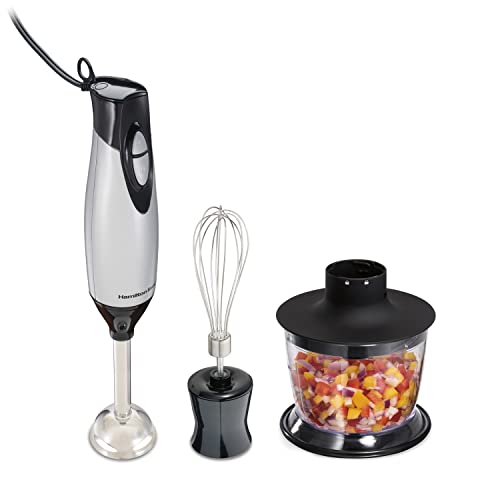
2. Hamilton Beach 4-in-1 Hand Blender 59765 (225W, 2-Speed) — Best Value Kit
The 59765 has been the budget-conscious answer in this category for years, and its formula is unchanged because it works: a two-speed blending stick, a whisk attachment, and a 3-cup food chopper bowl that handles the onion-and-herb jobs a stick cannot. At 225 watts it is the gentlest motor in this guide, which defines its territory honestly — soups, smoothies, sauces, baby food, and light prep, in household quantities. Within that territory, nothing else at its level includes this much kit.
Strengths
- Whisk and 3-cup chopper included — the fullest kit in this guide
- Simple two-speed control anyone can use immediately
- Long production history with easy availability
Trade-offs
- 225W is the lightest motor here — thick, big batches take patience
- Plastic-forward build reflects its tier
- Not suited to commercial or heavy daily duty
| Motor | 225W |
| Speed control | 2 speeds |
| Attachments | Whisk, 3-cup chopper bowl |
| Format | 4-in-1 immersion hand blender |
Judge the 59765 as a system and it wins its tier easily: the chopper bowl alone replaces a separate mini-processor for the small jobs that dominate home prep, and the stick itself covers the standard repertoire without fuss. Judge it as a pure blending tool against the Braun above and the power gap is real. Both judgements are true, and the buyer’s week decides which one matters — for most light-to-moderate households, the kit’s breadth is worth more than watts they will never call on.
The 59765’s chopper bowl has one care rule that decides its lifespan: dry the blade hub fully before reassembly. It is the kit’s hardest-working part and its only fussy one; thirty seconds of towel keeps the whole 4-in-1 system in service for years.
The 59765 has a second life that owners discover by accident: the chopper bowl, used without the motor as a prep bowl with a lid, is the right size for a marinade or a chopped salad for two. Kits earn their keep in these unlisted roles, and this one has several.
Best for: Budget-conscious households wanting a stick, whisk, and chopper in one box / Not suited for: Thick-batch and big-pot cooks, who need the Braun’s or Waring’s power
Check the current price on Amazon
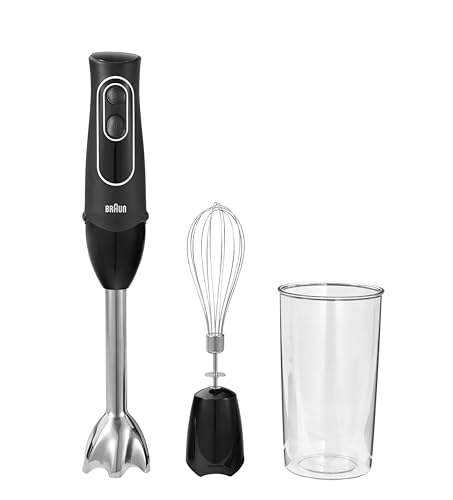
3. Braun MultiQuick 5 Hand Blender (350W, Dual Speed) — Best Mid-Power Classic
This is the MultiQuick 5 in its classic configuration — 350 watts, dual speed, a beaker and whisk, and Braun’s slip-proof ergonomic handle. It sits deliberately between the 225-watt kits and its 500-watt sibling: enough power for proper soups and smoothies, a lighter and handier feel than the flagship, and the same two-button simplicity. Households blending a few times a week, in ordinary pot sizes, will find this the most proportionate pick in the guide.
Strengths
- 350W is the balanced power point for ordinary home blending
- Dual-speed simplicity with Braun blade and bell design
- Beaker and whisk included; comfortable slip-proof grip
Trade-offs
- Outpowered by its own 500W sibling for thick work
- No chopper in the box
- Two listings of the MQ5 exist — check the wattage on the page before ordering
| Motor | 350W |
| Speed control | Dual speed (2-speed) |
| Attachments | Beaker, whisk |
| Blades | Stainless steel |
There is a reason this configuration has sold for years: it is the two-speed idea at its most balanced. The 350-watt motor does not strain on soup, the dual-speed control never confuses, and the whole tool feels designed rather than assembled. Its only real rival is its own sibling — choose the MQ515 above if your batches are big or thick, and choose this one if they are ordinary and you value a lighter hand feel across a week of small jobs.
Classic MQ5 buyers should double-check which MQ5 box is in the cart before checkout — the name covers more than one wattage across listings, and the 350-watt configuration reviewed here is identified by its listing title. Ten seconds of checking prevents the only common disappointment with this pick.
The classic MQ5’s handle deserves a sentence of its own: the slip-proof grip is shaped for wet hands, which is the actual condition of hands mid-recipe. It is the kind of detail that never appears in a comparison table and is felt at every single use.
Best for: Regular home cooks blending ordinary batches a few times a week / Not suited for: Big-pot and thick-puree specialists, who should take the 500W MQ515
Check the current price on Amazon

4. Waring Quik Stik WSB35 Immersion Blender (2-Speed, Commercial) — Best Commercial Two-Speed
The WSB35 brings the two-speed philosophy into a commercial kitchen. Its 7-inch fixed shaft and simple two-speed control are built for the bar well and the café counter — drinks, dressings, small soups, and batters, blended in short bursts, dozens of times a day. The fixed shaft means no joint to loosen and nothing to misplace during a rush. It is light-duty commercial by design: a sprinter, not a marathoner, and superb within that honest brief. It also appears in our commercial stick guide, where its role is explained in full.
Strengths
- Commercial build for frequent short-burst professional use
- Fixed shaft — nothing to loosen, lose, or misassemble
- Two-speed control is trainable in thirty seconds
Trade-offs
- 7-inch shaft cannot reach deep pots
- Light-duty rating excludes production soup volumes
- No home-style attachments — it is a blending shaft, period
| Shaft | 7 in, fixed |
| Speed control | 2-speed |
| Duty class | Light-duty commercial |
| Line | Waring Quik Stik |
Commercial kitchens love two speeds for a reason this guide has made repeatedly: there is nothing to mis-set during service. The WSB35 is that logic in its purest form, with a commercial duty rating behind it. A café blending smoothies to order or a bar batching dressings will get years from it; a restaurant that puts it in a stockpot will kill it and blame the brand. Respect the duty class and it is the most durable pick in this guide.
WSB35 owners in commercial settings should log the purchase date on the housing with a marker. Light-duty commercial tools live on duty discipline, and a visible age makes the ‘is it time to rotate this unit?’ conversation honest when volumes grow.
Commercial users of the WSB35 should rotate two units if the station is truly continuous — alternating sticks across a shift keeps both inside their light-duty design brief while giving the station zero downtime. Two light-duty units often outlast one abused medium-duty one.
Best for: Cafés, bars, and small commercial kitchens blending small batches frequently / Not suited for: Home cooks wanting attachments, or anyone blending in deep pots
Check the current price on Amazon

5. Vitamix 2-Speed Immersion Blender + Whisk (350W) — Best Premium Two-Speed
Buyers who want Vitamix build quality without the five-speed flagship’s price land here. The 2-speed immersion blender pairs a 350-watt motor with the simplest possible control, adds a whisk attachment for eggs and cream, and keeps the details the brand is known for — stainless blades and a generous 5-foot cord. It blends in any container, as a stick should, and it is the premium expression of the two-speed idea for home kitchens: fewer features, better made.
Strengths
- Vitamix build quality and blade engineering
- Whisk attachment included for eggs, cream, and batters
- Long 5 ft cord reaches across a stove comfortably
Trade-offs
- Premium pricing for a two-speed specification
- 350W is mid-pack power despite the badge
- No beaker or chopper in this configuration
| Motor | 350W |
| Speed control | 2-speed |
| Attachments | Whisk attachment |
| Cord | 5 ft |
| Blades | Stainless steel |
The honest way to read this pick: you are paying for manufacturing quality, not for a feature list. The motor is mid-powered, the control is as simple as controls get, and the whisk is the only extra. What the premium buys is the fit, the blade, and the expectation of a long service life — the same reasons people buy the brand’s countertop machines. If your two-speed loyalty is really a durability loyalty, this is your pick; if it is a simplicity-and-value loyalty, the Brauns serve it better.
Vitamix 2-Speed owners get a bonus from the whisk that is easy to miss: it makes this the only pick here that can credibly finish a sauce and then whip the cream for dessert with the same motor. In small kitchens, that double duty is a storage argument as much as a cooking one.
The Vitamix 2-Speed’s whisk has a party trick worth knowing: it whips cream to soft peaks fast enough that the cook must watch it, not time it. First-time users should stop early and check — the attachment’s efficiency surprises everyone exactly once.
Best for: Brand-loyal buyers wanting premium build in the simplest format / Not suited for: Value seekers — the same money buys more kit and power elsewhere in this guide
Check the current price on Amazon
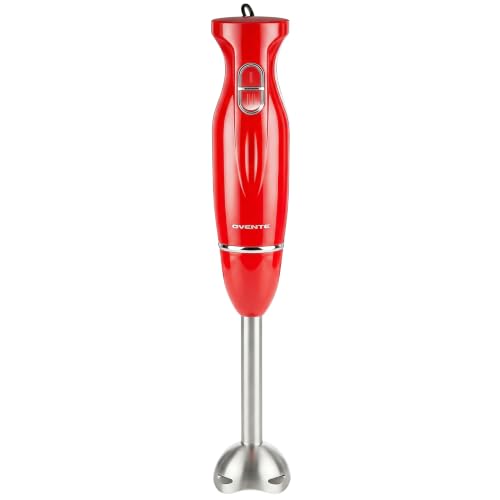
6. OVENTE HS560R Hand Blender (300W, 2 Speeds) — Best Budget Pick
The OVENTE HS560R is the two-speed idea at its most accessible: a 300-watt motor, two mixing speeds, stainless steel blades, and a stated brief of smoothies, purees, and baby food. It is a light-duty home tool and makes no claim otherwise. For a first hand blender, a dorm or small apartment, a baby-food season, or a second stick for a holiday home, its simplicity-to-price ratio is exactly right — and its red finish is easy to find in a crowded drawer.
Strengths
- Most affordable genuine two-speed stick in this guide
- 300W covers smoothies, purees, and baby food comfortably
- Dead-simple two-speed operation
Trade-offs
- Light-duty build — not for thick or continuous work
- No attachments included
- Brand support is minimal compared with the names above
| Motor | 300W |
| Speed control | 2 mixing speeds |
| Blades | Stainless steel |
| Model | HS560R, Red |
Budget picks should be judged on whether they do their stated job, and the OVENTE’s stated job is modest and honestly met. Baby food purees, a morning smoothie in its cup, a pan sauce smoothed out — all well within its ability, at the lowest entry cost here. The mistake would be promoting it to daily family soup duty; the reward for respecting its class is a tool that costs little, asks nothing, and works. Every kitchen roster needs a player like this, priced so that lending it to a neighbour is not a worry.
OVENTE owners blending baby food in batches should freeze portions in the beaker’s measurements: blend, portion into trays, and the measuring discipline of the tool carries into the freezer. Light-duty tools reward organised owners disproportionately.
OVENTE owners should keep the box’s simplicity as a household rule: this stick plus a beaker covers its whole repertoire, and adding accessories from other brands rarely fits or helps. Its virtue is being a complete, closed, inexpensive answer — let it stay one.
Best for: First-time buyers, small households, and baby-food or light smoothie duty / Not suited for: Daily family blending — step up to either Braun
Check the current price on Amazon
Comparison Table
Power separates these picks more than features do. Read the Key Spec column top to bottom as a duty ladder.
| Pick | Badge | Key Spec | Best For |
|---|---|---|---|
| Braun MultiQuick 5 Hand Blender MQ515 (500W, Dual Speed) | Best Overall | 500W dual speed, SplashControl, beaker + whisk | Home cooks wanting the best two-speed stick with a complete basic kit |
| Hamilton Beach 4-in-1 Hand Blender 59765 (225W, 2-Speed) | Best Value Kit | 225W, 2 speeds, whisk + 3-cup chopper kit | Budget-conscious households wanting a stick, whisk, and chopper in one box |
| Braun MultiQuick 5 Hand Blender (350W, Dual Speed) | Best Mid-Power Classic | 350W dual speed, beaker + whisk, stainless blades | Regular home cooks blending ordinary batches a few times a week |
| Waring Quik Stik WSB35 Immersion Blender (2-Speed, Commercial) | Best Commercial Two-Speed | 7 in fixed shaft, 2-speed, light-duty commercial | Cafés, bars, and small commercial kitchens blending small batches frequently |
| Vitamix 2-Speed Immersion Blender + Whisk (350W) | Best Premium Two-Speed | 350W, 2-speed, whisk included, 5 ft cord | Brand-loyal buyers wanting premium build in the simplest format |
| OVENTE HS560R Hand Blender (300W, 2 Speeds) | Best Budget Pick | 300W, 2 speeds, stainless blades, budget tier | First-time buyers, small households, and baby-food or light smoothie duty |
How to Choose the Best 2 Speed Hand Blenders
Choose by motor first. With only two speeds, each speed has to cover a wide band of work, so the motor’s strength decides the band’s width. Light kits at 225 to 300 watts serve small, soft jobs. The 350-watt middle serves ordinary households completely. The 500-watt top of the class serves thick and large work. There is no control cleverness to compensate for an undersized motor in this format — buy the watts your batches need.
Choose by kit second. A bare stick blends; a stick with a whisk and beaker blends, whisks, and measures; a stick with a chopper also preps. The Hamilton Beach and the Brauns cover those steps in this guide. Attachments bought in the box are always cheaper and better matched than attachments hunted later.
Choose by duty last, but honestly. A home two-speed used in a café will fail like any home tool used commercially; the Waring exists for that setting. Conversely, the commercial stick’s bare-shaft simplicity is a drawback at home, where attachments do real work.
Living With Two Speeds: Technique That Replaces the Missing Dial
Two-speed cooking is a technique skill, and it is easily learned. Pulse the low speed to start a thick mixture moving without splashing, then hold it; switch to high only once a vortex exists. For emulsions, low speed plus a slow oil drizzle does everything a dial does. For finishing a soup, alternate ten seconds of high with a slow stir-pass on low — the texture difference is audible before it is visible.
The one job two speeds genuinely concede is the ultra-gentle fold, where a variable trigger can crawl. Cooks who make hollandaise and delicate emulsions weekly should read our headline hand blender guide instead; everyone else will forget the dial exists within a week.
Two Speeds vs Variable Speed: An Honest Verdict
Variable speed is better in the abstract: more control, finer starts, one tool for every liquid. Two speeds are better in the specific: nothing to learn, nothing to mis-set, fewer controls to fail, and — across this guide — consistently lower prices for the same motor class. The market’s centre of gravity has moved to variable, which is exactly why the two-speed survivors are such good value: they are mature designs from serious makers, discounted by fashion.
Our standing advice: if you are buying your only hand blender and the budget reaches, the variable headline pick in our top-two guide is the more future-proof tool. If you know your work — soup, sauce, smoothies — and value simplicity, a two-speed from this page will satisfy you for years and leave money for better ingredients.
The Two-Speed Pantry: Recipes That Prove the Format
If you doubt the format, run its home fixtures: a pot of tomato soup (low to start, high to finish), a vinaigrette (low, with a slow oil drizzle), a batch of hummus in the chopper where fitted (short pulses), whipped cream with the whisk attachment (low, watching closely), and a morning smoothie in the beaker (high, thirty seconds). That is the repertoire the format was built around, and it covers the overwhelming majority of what home sticks actually do in a year.
The recipes that expose the format are equally specific: hollandaise for a crowd, mayonnaise in quantity, and any emulsion where a creep-speed start is the difference between silk and split. Cooks whose repertoire leans there should buy variable control and not look back — the rest can stop shopping and start blending.
Handing Down and Second Homes: Where Two-Speed Sticks Shine
Two-speed sticks are the format most often bought twice: once for the main kitchen, and again — the same model, from memory — for a holiday home, a rental, a parent’s kitchen, or a student’s first flat. That pattern is diagnostic. Tools get re-bought from memory when they never made the owner think about them, and the two-speed’s entire design is a refusal to be thought about. If you are equipping a kitchen you will not personally cook in, this is the format to put in it.
The same logic makes two-speed models the safest gift in the blender world. A variable trigger is a preference; a chopper kit is a lifestyle; a two-speed stick is simply a good tool that any cook can use within a minute of unboxing, which is what a gift should be.
Teaching With Two Speeds: The First Blender for New Cooks
There is a pedagogical case for this format that parents and cooking teachers already know: two speeds can be taught in one sentence, and the learner’s attention stays on the food — its look, its sound, its texture — instead of on the tool’s interface. Every skill the routine section teaches (start low, work the bell, listen for the note change) is a permanent cooking skill that transfers to every blender the learner will ever own.
If you are equipping a young cook’s first kitchen, buy the tool that teaches. The fancy formats will still be there when the skills are, and the two-speed stick will move to the second-kitchen role it has filled in families for decades.
Two Speeds Around the World: Why the Format Dominates Abroad
Travel and you will meet this format everywhere: European and Asian home kitchens run on two-speed and simple-dial sticks to a degree that surprises American shoppers raised on feature lists. The reasons are structural — smaller kitchens, pot-based cooking traditions, and a repair culture that favours simple machines a local shop can fix. Braun’s dual-speed line, represented twice in this guide, is a European staple for exactly those reasons.
The lesson for a buyer anywhere is that ‘basic’ is a market judgement, not a quality one. The format the world’s daily cooks converged on is the format in this guide, and its survivors have been refined by more breakfasts than any premium niche product will ever see.
How to Use a 2-Speed Hand Blender Without Splashing
Ninety percent of hand blender mess is a start-up problem, and two-speed models — which cannot creep up on a liquid — need the right routine most. This one works on every pick in this guide. Gather the small stage this format loves: the beaker or the pot, ingredients cut to thumb size, liquid measured, and a spatula for the one scrape-down the routine includes. Two-speed blending rewards mise en place more than any other format, because the tool’s simplicity puts the cook’s preparation in charge.
- Use a tall, narrow vessel. Blend in the pot, a beaker, or the included jar — never a wide, shallow bowl. Depth above the blade guard is what contains the vortex.
- Submerge before you switch on. Blade guard fully under the surface, stick vertical, hand steady. Then, and only then, press low.
- Start every blend on low. Low speed until the mixture is moving as one body. This takes three to five seconds and prevents the entire category of splashes.
- Earn the high speed. Switch to high only when a vortex has formed and the load is circulating. High speed in a still, chunky load is how counters get painted.
- Move slowly, switch off before lifting. Work the stick in slow passes. Release the button and let the blade stop completely before raising it from the liquid — every time.
- Rinse in a cup of hot water. Ten seconds running in hot water with a drop of detergent, on low. The two-speed’s simplicity extends to its cleaning.
Teach the routine to everyone in the household once, out loud, while you do it. Two-speed sticks are the most borrowed tool in any kitchen, and the borrower is the splash risk. If your two-speed stick walks across the counter or twists in the hand on high, the grip is the problem, not the machine: hold the body lower, closer to the bell, with the cord draped over your wrist. Torque is honest feedback about where the power is — meet it at the right height and it disappears.
Common Buying Mistakes
Starting on high speed. The classic two-speed error. High is a finishing speed; low is the starting speed. The buttons are ordered that way for a reason.
Assuming two speeds means weak. The 500-watt MQ515 outpowers many variable-speed sticks. Speed count and motor strength are independent specs — check both.
Buying a variable stick by accident. Listings use ‘speed control’ loosely. If two speeds is your requirement, confirm the listing says two-speed or dual-speed, as every pick here does.
Using a home stick commercially. Duty class is not a suggestion. Cafés and bars need the Waring’s commercial rating, not a household motor with good intentions.
Blending in shallow liquid. Two-speed sticks splash worst in shallow pans because there is no creep mode. Add depth — a beaker, a deeper pan — or accept a slower, tilted technique.
Confusing a turbo boost with a third speed when comparing listings. Turbo is a held-button boost, not a working gear. Count working speeds only, or you will compare a two-speed-with-turbo against a true three-setting rival that may not exist.
Storing the stick assembled in a utensil crock by the stove. Heat and grease mist age the housing, and the exposed blade waits for a reaching hand. A drawer or a hook away from the hob is the right home.
Final Recommendation
Buy the Braun MQ515 if you want the best two-speed hand blender: the strongest motor in the home class, splash-controlled design, and a complete basic kit. Buy the Hamilton Beach 59765 if value and kit breadth lead your decision, or its 350-watt Braun sibling if your batches are ordinary and you want the balanced classic.
The specialists have clear homes: the Waring WSB35 in cafés and bars, the Vitamix 2-Speed with buyers paying for build quality, and the OVENTE HS560R as the honest budget entry. Two speeds, chosen well, are not a compromise — they are a philosophy with a long, satisfied user base.
And if, after all this, you remain unsure between two speeds and more: buy the two-speed with the best return path, cook your five fixture recipes for a fortnight, and let the food vote. In our experience the food almost always votes to keep it — which is why this format, pronounced dead by feature lists every year, keeps quietly selling.
Keep exploring the cluster: Best 2 Hand Blenders Best 3 Speed Hand Blenders Best 10 Commercial Stick Blenders Best 1000 Watt Blenders Best Affordable Hand Blenders
Frequently Asked Questions
Are two speeds really enough for a hand blender?
For soups, sauces, smoothies, dressings, and baby food — yes, completely. A gentle low and a strong high cover the repertoire. The cooks who genuinely benefit from variable control are those making delicate emulsions weekly.
What is the most powerful 2-speed hand blender?
Among the home picks here, the Braun MultiQuick 5 MQ515 at 500 watts. The commercial Waring WSB35 is the durability pick for professional small-batch use, with a different kind of strength: duty rating.
Is a turbo button a third speed?
No. Turbo is a momentary boost while the button is held, not a working speed you blend at. Models with two working speeds plus turbo are honestly described as two-speed machines, and we screened them that way.
Which 2-speed hand blender is best for baby food?
The OVENTE HS560R for light, dedicated use, or the Hamilton Beach 59765 if you also want the chopper for family prep. Both are gentle, simple, and easy to clean — the three things baby-food duty actually requires.
Two-speed or variable-speed for a first hand blender?
If the budget is tight or the user values simplicity, two-speed — this guide exists for you. If this is a once-a-decade purchase for a keen cook, the variable-speed KitchenAid in our top-two guide is the more flexible long-term tool.
Can a 2-speed hand blender crush ice?
Small amounts of ice in a liquid blend, cautiously, on high — but ice crushing is fundamentally a countertop blender’s job. No stick in this guide is sold for it, and treating one as an ice crusher shortens its life.
Are 2-speed hand blenders being discontinued?
The format is shrinking but not vanishing: Braun and Hamilton Beach continue to sell dual-speed models, and Waring’s commercial line keeps the format for professional reasons. What is disappearing is the mid-market two-speed stick from brands chasing feature lists — one more reason the surviving models here are good value.
Can a 2-speed stick handle ice and frozen fruit?
Small amounts in liquid, yes — frozen berries in a smoothie are routine work for the stronger picks here. Cubes and large frozen pieces, no: that is countertop territory, and forcing a stick through them shortens its life and your patience. Thaw the big pieces for ten minutes and the format copes fine.
Will a whisk attachment work with my two-speed stick?
Only if your model offers one for its exact motor body — the MQ515 and Vitamix picks here include or support one. Never force another brand’s whisk onto a shaft: couplings differ, and a whisk that detaches at speed is a mess with a motor attached. If whisking matters and your stick has no whisk, that is the alternate list’s KHBV83-style kit calling. In practice you have three routes, and they are worth separating before you spend anything. Route one is a stick that already carries a whisk in the box or in its own accessory line, like the two picks named above — the fit is guaranteed and the whisk is designed for the motor’s speeds. Route two is the manufacturer whisk sold separately for your precise model number, which works only when the model number matches exactly, not merely the brand or the range name. Route three is accepting that your current stick stays a blender and buying whisking as part of a kit model when you next upgrade. On the whisk itself, work on low speed, use a tall vessel, and let the wires do the work — cream and egg whites need air folded in, not violence. Read the three routes, check your motor body’s number against them honestly, and stop at the right one of those three.


