Disclosure: airfryerkitchensupply.com is reader-supported. When you buy through links on our site, we may earn an affiliate commission at no extra cost to you.
Where to buy
Every linked pick in this guide to the best 24 inch microwaves was verified against Amazon’s catalog on 2026-11-21, so the model names, capacities and features below match the listings you will actually land on. Start with Panasonic NN-SN97JS 2.2 Cu.Ft Countertop Microwave (Silver), Toshiba 2.2 Cu.Ft Inverter Countertop Microwave (Stainless Steel), Sharp SMC2266KS 2.2 Cu.Ft Countertop Microwave (Stainless Steel). Picks that could not be pinned to a confident API match are written unlinked and flagged honestly, with no link attached. For any linked pick, check the current price on Amazon from its link, because finishes, bundles and configurations rotate often.
The best 24 inch microwaves answer the opposite problem from the compact guides in this cluster: not how small a microwave can be, but how much microwave a generous space can hold. A twenty-four-inch brief usually means a wide counter run, a built-in nook or trim-kit opening, or a family kitchen where the microwave is a primary appliance and its capacity is the point. As throughout this cluster, listings verify capacity and wattage rather than exterior width, so this guide works in the classes engineered for roughly twenty-four-inch installations — the 1.6 and 2.2 cubic foot countertop families — and insists, as always, on confirming the specific cabinet against your measured space.
What the extra width buys is transformative for the right household. Turntables grow to 13.6 and 16.5 inches, swallowing the casserole dishes, platters and double portions that define family cooking. Wattages reach 1100 to 1250. Sensor systems judge family-size reheats, and inverter models deliver that power gently when the job is delicate. A microwave stops being the appliance you apologize for and becomes the second oven you plan around — the one that handles the potatoes, the vegetables, the defrosting and yesterday’s feast while the range does the roasting.
Every pick was verified, spanning Panasonic’s 2.2 cubic foot flagship class, Toshiba’s inverter line in both 2.2 and 1.6, Sharp’s and Farberware’s big countertop models, and Panasonic’s 1.6 sensor oven as the class’s step-down. No prices or fixed ratings appear; check the current price on Amazon through the links, and measure twice — at this size, a wrong cabinet is a heavy return.
In this guide
Quick Picks
Six models made the cut for this guide to the best 24 inch microwaves. Each carries its own badge, and the same badge follows it into the full review below, so you can track a recommendation from summary to verdict without losing the thread.
- Best Overall — Panasonic NN-SN97JS 2.2 Cu.Ft Countertop Microwave (Silver): The big-class flagship: 2.2 cubic feet, 1250 inverter watts, Cyclonic Wave distribution and Genius Sensor, countertop or built-in. Key spec: 2.2 cu ft / 1250W / Cyclonic inverter + Genius Sensor.
- Best Large Inverter Value — Toshiba 2.2 Cu.Ft Inverter Countertop Microwave (Stainless Steel): 2.2 cubic feet and 1200 inverter watts with sensor cook and a huge 16.5-inch turntable, aimed squarely at large families. Key spec: 2.2 cu ft / 1200W / 16.5-inch turntable.
- Best Straightforward Big Oven — Sharp SMC2266KS 2.2 Cu.Ft Countertop Microwave (Stainless Steel): Sharp’s big Carousel oven: 2.2 cubic feet, 1200 watts and a removable 16.5-inch turntable without sensor complexity. Key spec: 2.2 cu ft / 1200W / 16.5-inch Carousel.
- Best Budget Big Oven — Farberware 2.2 Cu.Ft Countertop Microwave (Stainless Steel): The value route to 2.2 cubic feet: 1200 watts, multi-stage cooking, smart sensor cooking and a child lock. Key spec: 2.2 cu ft / 1200W / multi-stage + sensor.
- Best 1.6 Step-Down — Toshiba ML2-EM16 1.6 Cu.Ft Inverter Countertop Microwave (Black Stainless Steel): The step-down that keeps the technology: 1.6 cubic feet, 1250 inverter watts, smart sensor and a 13.6-inch turntable. Key spec: 1.6 cu ft / 1250W / inverter + smart sensor.
- Best Premium 1.6 — Panasonic NN-SN76LS 1.6 Cu.Ft Cyclonic Inverter Microwave: Panasonic’s Cyclonic inverter and Genius Sensor at 1.6 cubic feet — the flagship technology in the step-down size. Key spec: 1.6 cu ft / 1250W / Cyclonic + Genius Sensor.
How These Picks Were Chosen
The pool came from the verified 1.6 and 2.2 cubic foot countertop classes — the capacity bands whose cabinets are engineered for approximately twenty-four-inch installations, whether on a wide counter or in a trim-kit nook. Each model was matched by brand and model against its Amazon record, with capacity and wattage required to be verifiable from that record. Smaller classes were deliberately excluded: a 24-inch guide padded with 1.2 cubic foot models would betray its brief, and those models have their own honest homes in the 20- and 21-inch guides.
Ranking weighed cavity usability first — turntable diameter and genuine dish fit — because capacity on a spec sheet that cannot swallow your casserole is fiction. Second came power quality: sensor systems and inverter delivery, which matter more, not less, as loads grow larger and more uneven. Third came the household layer: family-scale presets, cleanability of a big cavity, and the control clarity that keeps a large appliance friendly to every member of the household.
Spec boxes print only listing-verified figures, and no exterior width is claimed as a verified specification for any model. Large microwaves also raise two practical flags this guide repeats where relevant: they are heavy, and their doors swing wide. Both belong in the measurement step, not the unboxing step.
The 6 Best 24 Inch Microwaves, Reviewed
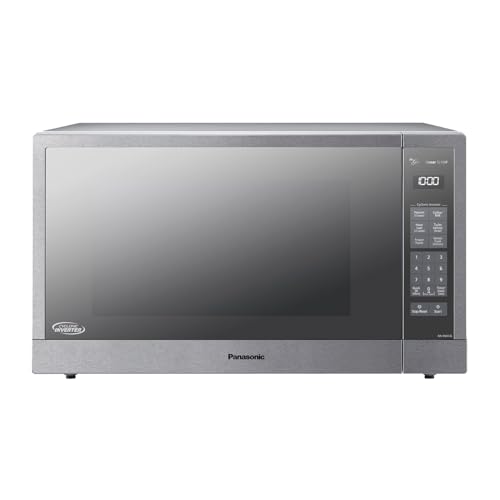
Panasonic NN-SN97JS 2.2 Cu.Ft Countertop Microwave (Silver) — Best Overall
The NN-SN97JS is what the twenty-four-inch brief exists for. Its verified specification stacks the class’s best technologies in the class’s biggest mainstream cavity: 2.2 cubic feet, 1250 watts delivered through Panasonic’s inverter, Cyclonic Wave distribution engineered to push energy into the cavity’s corners rather than its center alone, and the Genius Sensor judging reheats by steam. It is also explicitly a countertop-or-built-in design, which makes it the natural anchor for a trim-kit nook as well as a wide counter.
In family service, the differences compound. The cavity takes the dishes that define the class — the big casserole, the party platter, the double batch — and the inverter’s continuous power defrosts family-size frozen proteins without the cooked-edge penalty that makes cooks distrust microwave defrosting. Sensor reheating scales to family portions with the same judgment it gives a single plate in the smaller class.
The honest costs are size, weight and commitment: this is a heavy appliance that wants a planned home, a door swing to respect, and a household whose cooking justifies it. A couple reheating two plates should buy the 21-inch class and keep the counter. A family cooking at volume should start here and measure carefully.
Strengths
- Largest mainstream cavity with the class’s best power system
- Cyclonic inverter distribution for corner-to-corner evenness
- Countertop or built-in flexibility
Trade-offs
- Heavy — plan the placement and the lift
- Premium positioning
- Oversized for small households
| Capacity | 2.2 cu ft |
| Power | 1250W |
| Technology | Cyclonic Wave inverter (Amazon title) |
| Install | Countertop / built-in (Amazon title) |
Best for: Families and built-in nooks wanting the flagship big microwave / Not suited for: Couples and small households
Check on Amazon — check the current price on Amazon and confirm the exact configuration before ordering.

Toshiba 2.2 Cu.Ft Inverter Countertop Microwave (Stainless Steel) — Best Large Inverter Value
Toshiba’s big entry matches the flagship’s capacity at 2.2 cubic feet and pairs its 1200-watt inverter with the specification family cooks notice first: a 16.5-inch removable turntable, verified in the Amazon title — the largest rotating platform in this cluster of guides, big enough for the platters and party dishes that smaller ovens refuse at the door. Sensor cook and six auto menus cover the programmed work, and a child lock acknowledges the household this oven is built for.
The positioning is value-within-premium: inverter power quality and flagship capacity without insisting on the flagship’s full technology stack. For a large family, that trade is often exactly right — the daily wins are the turntable, the cavity and the defrosting, and all three are present at full strength.
Choose it over the Panasonic flagship when the turntable diameter and family-first tuning matter more than Cyclonic distribution and built-in flexibility. Choose it over the 1.6 class below when your dishes have already voted: a household that regularly heats what a 13.6-inch turntable cannot carry will never regret the bigger cavity, provided the counter honestly fits it.
Strengths
- 16.5-inch turntable — the cluster’s largest
- Full 2.2 cu ft with 1200W inverter
- Family-first features including child lock
Trade-offs
- Very large footprint — measure with discipline
- No built-in trim positioning like the flagship
- Six menus is a modest preset library
| Capacity | 2.2 cu ft |
| Power | 1200W |
| Turntable | 16.5-inch removable (Amazon title) |
| Notes | Inverter, sensor cook, 6 auto menus, child lock (Amazon title) |
Best for: Large families whose dishes outgrew the mid-size class / Not suited for: Small counters and small households
Check on Amazon — check the current price on Amazon and confirm the exact configuration before ordering.

Sharp SMC2266KS 2.2 Cu.Ft Countertop Microwave (Stainless Steel) — Best Straightforward Big Oven
Not every big-microwave buyer wants a sensor’s judgment; some want a large, powerful, predictable oven whose behavior they control completely. The Sharp SMC2266KS is that appliance at full class scale: 2.2 cubic feet, 1200 watts and Sharp’s removable 16.5-inch Carousel turntable, all verified in the Amazon title. Sharp’s decades of turntable engineering show in the rotation’s smoothness and the cooking calibration’s consistency.
This is the pick for households with established microwave technique — cooks who know their power levels, stage their defrosting by hand and distrust automation on principle or from experience. It is also the pick for shared and multi-generational kitchens where a control panel everyone understands beats a smarter panel that confuses half the household.
The concession is exactly its identity: no humidity sensor to rescue an unjudged reheat, no inverter smoothness at low power. If your household’s microwave work is reheating at scale, the sensor models above will forgive more. If it is deliberate cooking at scale, the Sharp’s honesty is a feature.
Strengths
- Full class capacity and power with specialist turntable design
- Predictable, fully manual control philosophy
- Removable Carousel for easy washing
Trade-offs
- No sensor cooking
- No inverter — low power pulses
- Minimalist feature story
| Capacity | 2.2 cu ft |
| Power | 1200W |
| Turntable | Removable 16.5-inch Carousel (Amazon title) |
Best for: Technique-driven cooks and shared kitchens wanting big, simple, powerful / Not suited for: Households wanting set-and-forget sensor reheating
Check on Amazon — check the current price on Amazon and confirm the exact configuration before ordering.

Farberware 2.2 Cu.Ft Countertop Microwave (Stainless Steel) — Best Budget Big Oven
The Farberware is the surprise of this guide: a value-tier model whose Amazon title verifies a feature list that reads like the premium tier’s — 2.2 cubic feet, 1200 watts, ten power levels, multi-stage cooking, smart sensor cooking, defrost settings and a child safety lock. Buyers whose budget says no to the flagship but whose family size says yes to the big cavity should start here and read the trade-offs with clear eyes.
Multi-stage cooking at this scale is genuinely useful: a family-size frozen casserole can defrost, rest and cook in one programmed sequence, which is the closest any countertop microwave comes to oven-like set-and-forget for big food. The sensor covers the reheating shift. Between them, the Farberware automates more family work than its tier suggests.
The honest value notes are finish, refinement and support: materials and control feel sit a tier below Panasonic, Toshiba and Sharp, and long-term parts depth is thinner. For a family buying capacity and automation now, those are rational trades — and the child lock shows the model knows exactly whose kitchen it is entering.
Strengths
- Flagship capacity with sensor and multi-stage automation
- 1200W and ten power levels
- Child lock and family tuning at a value tier
Trade-offs
- Finish and control refinement below the premium brands
- Thinner long-term parts support
- Big footprint, like all 2.2 models
| Capacity | 2.2 cu ft |
| Power | 1200W |
| Levels | 10 power levels (Amazon title) |
| Notes | Multi-stage cooking, smart sensor cooking, child lock (Amazon title) |
Best for: Large families needing big capacity and automation on a budget / Not suited for: Buyers prioritizing finish and brand depth
Check on Amazon — check the current price on Amazon and confirm the exact configuration before ordering.

Toshiba ML2-EM16 1.6 Cu.Ft Inverter Countertop Microwave (Black Stainless Steel) — Best 1.6 Step-Down
Every size class needs its honest step-down, and this Toshiba is the 24-inch guide’s: 1.6 cubic feet for kitchens whose space measures wide but not cavernous, carrying the full technology argument — 1250 inverter watts, a smart sensor and auto defrost — over a 13.6-inch turntable. That turntable still takes dinner plates and standard casseroles with room to spare, which covers the genuine weekly needs of most families; what it surrenders is the party-platter class.
The black stainless finish suits the dark-kitchen movement, and the inverter at this size delivers the defrosting and gentle-cooking quality that makes the technology worth having, at the highest wattage in this guide. Households stepping down from the 2.2 class for space reasons lose volume, not sophistication.
Choose it when the tape measure argues against 2.2 cubic feet but the cooking argues for inverter and sensor. Choose the 2.2 models when the dishes themselves are the argument. The step-down is a compromise only if your cookware disagrees with it.
Strengths
- Full inverter + sensor technology at 1.6 cu ft
- 1250W — joint-highest power here
- 13.6-inch turntable covers plates and standard casseroles
Trade-offs
- No party-platter capacity
- Black stainless only in this variant
- Still a substantial countertop presence
| Capacity | 1.6 cu ft |
| Power | 1250W |
| Turntable | 13.6-inch (Amazon title) |
| Notes | Inverter, smart sensor, auto defrost (Amazon title) |
Best for: Mid-size families wanting premium technology in a smaller cabinet / Not suited for: Platter-and-batch households
Check on Amazon — check the current price on Amazon and confirm the exact configuration before ordering.

Panasonic NN-SN76LS 1.6 Cu.Ft Cyclonic Inverter Microwave — Best Premium 1.6
The NN-SN76LS is the flagship’s technology without the flagship’s footprint: Panasonic’s Cyclonic inverter distribution and Genius Sensor cooking at 1250 watts in a 1.6 cubic foot cavity. For households that cook seriously but measure honestly — the wide-but-not-huge counter, the nook that refuses a 2.2 — this is the no-compromise-on-quality answer, and its existence is why the step-down decision in this guide is about dishes, not about settling.
Cyclonic distribution matters most on exactly the loads this size invites: the full casserole, the family reheat, the defrost of a whole chicken’s worth of parts. Energy pushed into the corners is energy not leaving cold pockets in the middle of family-size food, and the Genius Sensor ends the cycle when the steam — not a timer extrapolated from a smaller portion — says the load is done.
Its competition is its own sibling logic: the Toshiba 1.6 offers the same class and headline power with a stated turntable figure and black stainless character, while this Panasonic counters with Cyclonic distribution and the Genius Sensor lineage. Premium-tier positioning is the shared cost. Pick your technology philosophy; both step-downs honor the brief.
Strengths
- Flagship Cyclonic inverter technology at 1.6 cu ft
- 1250W with Genius Sensor judgment
- Ideal where space is wide but not cavernous
Trade-offs
- Premium positioning
- 1.6 ceiling on dish size
- Stainless upkeep
| Capacity | 1.6 cu ft |
| Power | 1250W |
| Technology | Cyclonic Inverter (Amazon title) |
| Sensor | Genius Sensor cooking (Amazon title) |
Best for: Serious cooks in mid-size spaces wanting flagship technology / Not suited for: Batch-and-platter households
Check on Amazon — check the current price on Amazon and confirm the exact configuration before ordering.
Comparison Table
| Pick | Badge | Key spec | Best for |
|---|---|---|---|
| Panasonic NN-SN97JS 2.2 Cu.Ft Countertop Microwave (Silver) | Best Overall | 2.2 cu ft / 1250W / Cyclonic inverter + Genius Sensor | Families and built-in nooks wanting the flagship big microwave |
| Toshiba 2.2 Cu.Ft Inverter Countertop Microwave (Stainless Steel) | Best Large Inverter Value | 2.2 cu ft / 1200W / 16.5-inch turntable | Large families whose dishes outgrew the mid-size class |
| Sharp SMC2266KS 2.2 Cu.Ft Countertop Microwave (Stainless Steel) | Best Straightforward Big Oven | 2.2 cu ft / 1200W / 16.5-inch Carousel | Technique-driven cooks and shared kitchens wanting big, simple, powerful |
| Farberware 2.2 Cu.Ft Countertop Microwave (Stainless Steel) | Best Budget Big Oven | 2.2 cu ft / 1200W / multi-stage + sensor | Large families needing big capacity and automation on a budget |
| Toshiba ML2-EM16 1.6 Cu.Ft Inverter Countertop Microwave (Black Stainless Steel) | Best 1.6 Step-Down | 1.6 cu ft / 1250W / inverter + smart sensor | Mid-size families wanting premium technology in a smaller cabinet |
| Panasonic NN-SN76LS 1.6 Cu.Ft Cyclonic Inverter Microwave | Best Premium 1.6 | 1.6 cu ft / 1250W / Cyclonic + Genius Sensor | Serious cooks in mid-size spaces wanting flagship technology |
The class divides by cavity before anything else. The 2.2 cubic foot models — Panasonic flagship, Toshiba, Sharp, Farberware — are family-volume appliances whose 16.5-inch turntables redefine what fits. The 1.6 models keep the premium technologies in cabinets a meaningful step smaller. Decide the cavity with your largest weekly dish, then decide the technology with your cooking style: sensor for reheating households, inverter for cooking households, both for families who do everything.
Notice the wattage convergence at the top: 1200 to 1250 watts across all six picks. At this class, power is table stakes and differentiation lives in delivery — Cyclonic distribution, sensor judgment, turntable scale — which is why the badges name technologies and turntables rather than watts.
How to Choose a 24-Inch-Class Microwave
Measure for the heavy class. Beyond width, depth and height with ventilation clearances, this size adds two checks the compact classes forgive: floor or shelf strength — a 2.2 cubic foot microwave is a serious lift and a permanent load — and door swing, because a big door on a side hinge sweeps a wide arc that must clear people, cabinet faces and the cook carrying the casserole. Built-in and trim-kit installations add a fourth check: the kit is model-specific, so confirm compatibility for the exact model before the cabinet work begins.
Second, let the largest weekly dish set the cavity. Write down its footprint and height with its lid. The 16.5-inch turntable class takes nearly anything a home cooks; the 13.6-inch class takes plates and standard casseroles and refuses the extremes. Buyers who ‘might someday’ cook a giant dish should remember that someday rents ovens well, while an oversized cabinet taxes the counter every day.
Third, choose the power system by workload. Reheat-dominant families should weight the sensor — Genius Sensor or Toshiba’s smart sensor — because family portions are where timer guessing fails worst. Cook-dominant families should weight the inverter for defrosting and gentle work. The flagship Panasonic and the Farberware, in their different tiers, refuse to choose, which is part of their appeal.
Finally, plan the lift. These ovens arrive heavy and awkward; two people, a clear path and a prepared destination surface turn installation into a non-event. It is the least technical advice in this guide and the most frequently regretted omission.
Big-Cavity Cooking: Using 1.6 and 2.2 Cubic Feet Well
Large cavities change technique in one important way: distance. Food sits farther from the cavity walls and, on turntable models, travels a longer rotation path, which generally evens heating — but large loads also shadow themselves, so arrangement matters more, not less. Ring arrangements for reheats, lids vented rather than sealed, and a mid-cycle stir or rearrangement for the biggest casseroles are the habits that let a big oven deliver on its promise.
Defrosting is where the class earns its keep for families. Batch proteins — the family pack of chicken, the holiday bird’s parts, the soup bones — defrost in the inverter models with a gentleness small ovens cannot match, because continuous low power lets the exterior wait for the interior. Separate pieces as they loosen, shield thin edges, and let the sensor-equipped models judge the finish where their programs allow.
Batch cooking is the third dividend. A 2.2 cavity cooks rice, grains and vegetables in family quantities in a single covered dish, and reheats the whole production line across the week under sensor judgment. Households that meal-prep at scale will find this class, uniquely among countertop microwaves, sized to the system rather than fighting it.
Built-In and Trim-Kit Reality for the 24-Inch Class
A share of twenty-four-inch shoppers are not buying a countertop appliance at all — they are filling a built-in opening, often with a trim kit that frames the oven into the cabinetry. That installation changes the purchase in two ways this guide wants explicit. First, the kit is model-specific and the opening is kit-specific: the oven, the kit and the cabinet must be chosen as a system, in that order, and a bargain oven without an available kit for your opening is not a bargain. The Panasonic flagship’s explicit countertop/built-in design makes it the natural anchor for this path among the picks here.
Second, built-in microwaves live or die by their ventilation design, because the cabinet that frames them also traps their heat. Follow the kit’s venting provisions exactly — they are engineering, not suggestion — and expect the installation to be a considered project rather than an unboxing. The reward is the cleanest look in the category and a counter entirely returned to cooking. Households mid-renovation should raise the built-in question with their cabinet maker before the boxes are built, because retrofitting the opening afterward is the expensive version of the same decision.
Two Ovens, One Kitchen: Pairing a Big Microwave With the Range
Large microwaves change how a kitchen’s other appliances get used, and the households that love this class most are the ones that plan the partnership. The microwave takes the high-frequency, low-drama work — vegetables, grains, defrosting, reheating, melting — which frees the range and oven for the browning and roasting they alone can do. Thanksgiving is the famous stress test, but the ordinary Tuesday version matters more: potatoes in the microwave while the chicken roasts, sauce held at a gentle inverter simmer while pasta boils, yesterday’s portions resurrected under sensor judgment while tonight’s protein sears.
The pairing also argues for the inverter and sensor technologies on workload grounds. In a two-oven kitchen the microwave’s jobs are precisely the delicate and the repetitive — the jobs pulse-power and timer-guessing do worst. That is why this guide’s badges concentrate on power systems rather than raw size once the cavity decision is made. Buy the cavity for your dishes; buy the technology for your Tuesdays.
Cleaning and Caring for a Very Large Cavity
A big cavity is easier to neglect precisely because it hides its mess across more square inches of wall, and family-size loads — the casserole that bubbled, the soup that erupted — produce family-size films. The discipline that works is the steam clean: a bowl of water with a slice of lemon, run until the interior steams, left closed for five minutes, then wiped with a soft cloth. On the removable 16.5-inch turntables here, take the plate to the sink for a real wash monthly; a greasy roller ring is the hidden cause of the wobble-and-spill cycle that owners blame on the dishes.
Door care scales with size too. A large door is a large lever, and children will treat it as one; teach the household to close it by its handle with a push, never a slam, and keep the sealing surfaces wiped, because the seal’s integrity is both a safety and a cooking-performance matter. The reward for this light regimen is an oven whose sensor — on the models that carry one — keeps reading steam accurately for years, since a filmed cavity lies to its sensor about every load.
When 24 Inches Is Too Much: Stepping Down Without Regret
This guide’s step-down picks exist because the honest answer for many kitchens is restraint. A 2.2 cubic foot oven on a counter that also hosts a coffee station, a knife block and the household’s entire prep surface will be resented daily for a benefit — platter capacity — used monthly. The 1.6 class keeps the technologies that matter and returns a meaningful strip of counter, and the 21-inch sensor class returns more again. Downsizing a microwave is not downsizing a kitchen’s capability when the workload never used the volume.
The reverse regret is rarer but real: the family that bought 1.2 cubic feet and reheats in shifts every evening. The measurement discipline in this cluster — largest weekly dish, honest workload — exists to prevent both errors, and it costs one tape measure and ten honest minutes. Whichever class you land in, land there by measurement, and the microwave will feel inevitable rather than negotiated.
The 24-Inch Class and the Holidays: A Stress Test, Honestly Run
Every large microwave is secretly bought for two weeks a year, so it is worth running the holiday test honestly against this class. The big cavity reheats the day-after plates in family-sized loads under sensor judgment, cooks the make-ahead sides while the oven is occupied by the main event, and defrosts the forgotten bag of rolls or the emergency protein with inverter patience. In that fortnight, the 2.2 cubic foot models are not oversized at all; they are the kitchen’s surge capacity, and surge capacity is bought for peaks, not averages.
The other fifty weeks are the counter-argument, and this guide has made it in the step-down section: surge capacity that taxes daily counter space must justify itself in daily use too. The households that reconcile both truths are the ones whose weekly cooking genuinely runs at family scale — batch cooking, big dishes, constant reheating for many mouths. For them the holidays are merely the visible peak of a year-round pattern. For everyone else, the 1.6 step-downs and the 21-inch class are not lesser choices; they are the correctly sized ones, and the holidays can borrow capacity the way they borrow chairs.
Power, Honestly: What 1100–1250 Watts Changes at Family Scale
Wattage at this class behaves differently than in the compact classes, because the loads themselves are bigger. A family casserole presents more cold mass and more uneven geometry than a single plate, so the difference between adequate and generous power shows up as minutes and as uniformity, not as bragging rights. The convergence of these six picks around 1200 to 1250 watts is the market admitting that family loads set a floor — and the step-down in the twenty-inch class, at 900 to 1000 watts, is equally honest about the smaller loads it serves.
What wattage never buys, at any scale, is judgment. The sensor models here finish family reheats when the steam says so; the manual models finish when the cook says so. Both philosophies have devoted households, and this guide’s badges honor each. The wattage merely guarantees that whichever philosophy you chose, the power will be there when it is called on.
A Note on Noise at Family Scale
Large microwaves move more air and spin larger turntables, and their operating sound — fan, hum, rotation — is a real presence in open-plan homes where the kitchen is also the living room. None of the verified records in this guide publish a noise figure, so none is claimed; the practical advice is placement and expectation. A big oven on a hollow counter or in a resonant nook will sound bigger than it is; a solid surface and respected clearances quiet it noticeably. Households sensitive to appliance noise should weight that placement reality alongside the specification table, because at family scale the microwave runs often and at length.
How to Install a Large Countertop or Built-In Microwave Safely
Installation at this size is a two-person job by design, and treating it as one is the first safety decision. Clear the path from door to destination, prepare the surface — clean, dry, level, and confirmed strong enough for the oven’s full weight plus a full casserole — and agree on the lift before the box opens. Most large ovens give their weight on the listing or carton; believe it.
Position with the manual’s clearances, not the eye’s optimism: vents on the sides, top and rear need their specified air, and built-in trim installations need the exact kit for the exact model, fitted in the kit’s sequence. Level the cabinet so the turntable ring runs true; on the 16.5-inch platforms, a wobble is both noisy and a genuine spill risk with wide dishes.
Electrical planning matters more here than in any compact class. A 1200-to-1250-watt oven belongs on a direct wall outlet, ideally a circuit that is not simultaneously feeding a kettle or toaster oven at breakfast. If the kitchen’s circuits are shared and elderly, an electrician’s opinion is cheaper than a nuisance-tripping breaker routine — and repeated tripping is the circuit asking for exactly that opinion.
Commission with a water test and a dish test: a measured quantity of water heated on time confirms basic function, and your largest lidded dish — empty — should travel its full rotation without kissing the walls. Record the model and serial where the household keeps appliance records. At this size and price, the microwave is infrastructure; document it like infrastructure.
Common Buying Mistakes
**Measuring width and forgetting the door.** A 2.2 cubic foot door sweeps a wide arc. If the arc meets a wall, a cabinet face or the cook’s usual standing spot, the oven is wrong for the space at any width.
**Under-building the shelf.** Big microwaves plus big casseroles are a permanent, heavy load. A flexing shelf or a marginal cubby floor is a slow-motion accident; confirm the structure before the oven, not after the sag.
**Buying 2.2 for a 1.6 life.** Oversized cavities cost counter space daily and return value only on the dishes that need them. If your largest weekly dish fits a 13.6-inch turntable, the step-downs in this guide are the honest buy.
**Ignoring the lift.** Solo-installing a flagship-class oven risks the oven, the counter and the cook. Two people and a clear path are part of the purchase price; budget them.
**Assuming the trim kit is universal.** Built-in kits are model-specific. Ordering cabinetry around a kit that does not exist for your exact model is the most expensive mistake in this category.
Final Recommendation
The Panasonic NN-SN97JS is the class flagship and the default for families and built-in nooks; the Toshiba 2.2 answers with the giant turntable and family-first value; the Sharp serves cooks who want big and manual; the Farberware delivers the big cavity with sensor and staging at a value tier. When the space argues smaller, the Toshiba and Panasonic 1.6 models keep the inverter-and-sensor argument intact in step-down cabinets.
Measure the space, the shelf and the door arc; let your largest weekly dish choose the cavity; let your workload choose the technology. A twenty-four-inch microwave is a decade-scale appliance — chosen this way, it will feel less like an appliance and more like a second oven that happens to live on the counter.
Three more verified options round out the list if the headline picks do not fit your space or budget tier: Farberware 2.2 Cu.Ft Countertop Microwave (Stainless Steel); Toshiba ML2-EM16 1.6 Cu.Ft Inverter Countertop Microwave (Black Stainless Steel); Panasonic NN-SN76LS 1.6 Cu.Ft Cyclonic Inverter Microwave. Each one earned its place in the reviews above for a specific reason, so match the badge to your actual routine rather than buying the longest feature list.
Shortlist it this way: Panasonic NN-SN97JS 2.2 Cu.Ft Countertop Microwave (Silver) if you want the safest all-round choice, Toshiba 2.2 Cu.Ft Inverter Countertop Microwave (Stainless Steel) if the second badge matches your kitchen better, and Sharp SMC2266KS 2.2 Cu.Ft Countertop Microwave (Stainless Steel) if the third badge names your priority. Every other pick in this guide is a specialist — buy those when their specialty is your actual problem.
Best 21 Wide Microwaves Best 20 Wide Microwaves Best 30 Inch Wall Mount Microwaves Best 2.2 Cu Ft Microwaves Best Countertop Microwaves Best Family Microwaves
Frequently Asked Questions
What capacity microwave fits a 24-inch space?
Typically the 1.6 to 2.2 cubic foot countertop classes — the capacity bands engineered for roughly twenty-four-inch installations. Confirm the specific model’s stated dimensions and clearances against your space, since the class is a guide, not a guarantee.
Is a 2.2 cu ft microwave too big for a family of four?
For most families of four, it is generously right rather than too big: family casseroles, platters and batch cooking use the room, and the 16.5-inch turntables here take dishes the mid-size class refuses. It is too big only when the counter itself cannot spare the footprint.
Can these large countertop models be built in?
Some can — the Panasonic flagship is explicitly a countertop/built-in design — but built-in installation requires the model-specific trim kit and its ventilation provisions. Confirm kit compatibility for the exact model before committing to cabinet work.
Does a bigger microwave use much more energy?
Cooking energy scales with the food, not the cavity; a large oven reheating a small plate uses modestly more than a small oven, while batch cooking in the large cavity is more efficient than repeated small batches. Standby draw is similar across classes, and eco modes where fitted trim it.
Why do the big models emphasize turntable size?
Because turntable diameter is the real dish-size limit. A 16.5-inch platform rotates platters and wide casseroles that a 12.4-inch platform cannot accept at the door. Capacity in cubic feet describes air; the turntable describes dinner.
Do I need a dedicated circuit for a 1250W microwave?
A direct wall outlet is the minimum; a dedicated or lightly shared circuit is the ideal, since 1200-plus watts alongside a kettle or toaster oven can trip shared breakers. If tripping becomes routine, have an electrician assess the circuit rather than working around it.
How much counter depth does a 2.2 cu ft microwave need?
More than its footprint suggests: the cabinet depth plus room for the door to open and for rear ventilation. Measure from the wall to the counter’s edge and compare with the listing’s stated depth, and remember the door opens toward you — stand where you will stand and imagine the swing before ordering.
Are large microwaves harder to clean than small ones?
The cavity is bigger, so a full wipe takes longer, but the routine is identical — steam, soften, wipe — and the removable large turntables here wash at the sink like a platter. Neglected large cavities are worse than neglected small ones for the same reason a large spill is worse than a small one; the weekly habit keeps the difference theoretical.
Can a 2.2 cu ft microwave cook a whole chicken?
The cavity can physically accept one in the largest models, but microwave cooking is at its weakest on large, dense, uneven roasts — browning is absent and evenness is a fight. This class shines on the sides, sauces, vegetables and reheats around the chicken; the bird itself belongs to the oven. Buy the big microwave for the work it is great at.
Is a bigger microwave always louder or more expensive to run?
Not meaningfully. Operating sound varies by model and installation more than by size, and cooking energy follows the food rather than the cavity. The real costs of size are counter space and purchase tier — both paid once, visibly, and both worth paying only when the household’s dishes and workload justify them, which is the decision this guide is built around.
Which pick should a first-time big-microwave buyer choose?
The Panasonic flagship if the budget allows, because its combination of cavity, Cyclonic inverter power and sensor judgment forgives the most beginner mistakes; the Toshiba 2.2 if the turntable and family value lead; and a 1.6 step-down if the counter argues for restraint. All three paths are honest — the wrong choice is only the one made without measuring.


