Disclosure: airfryerkitchensupply.com is reader-supported. When you buy through links on our site, we may earn an affiliate commission at no extra cost to you.
Where to buy
Every linked pick in this guide to the best 20 wide microwaves was verified against Amazon’s catalog on 2026-11-21, so the model names, capacities and features below match the listings you will actually land on. Start with BLACK+DECKER 1.1 Cu.Ft Countertop Microwave (Stainless Steel), Sharp SMC1162KS 1.1 Cu.Ft Countertop Microwave (Stainless Steel), Farberware 1.1 Cu.Ft Countertop Microwave (Stainless Steel). Picks that could not be pinned to a confident API match are written unlinked and flagged honestly, with no link attached. For any linked pick, check the current price on Amazon from its link, because finishes, bundles and configurations rotate often.
Shoppers hunting for the best 20 wide microwaves are almost always solving a space problem: a cubby, a shelf, a cart or a stretch of counter that measures about twenty inches and not a fraction more. Here is the honest situation this guide is built around. Microwave listings almost never print exterior width in their titles, and manufacturers describe these models by capacity instead — so the twenty-inch class is really the 0.9 to 1.1 cubic foot countertop class, whose cabinets are engineered to live in roughly that footprint. Every pick below is a verified model from that class, matched, and the buying guide gives you the exact measuring method to confirm any of them against your space before ordering.
That framing matters because a microwave that misses your width by half an inch is not a slightly wrong purchase — it is a return. Width is also never the only dimension in play: depth decides whether the door swings clear of a cabinet face, height decides whether the cubby works at all, and every microwave needs breathing room around its vents. This guide treats the twenty-inch brief seriously by choosing models whose capacity class fits the footprint, then teaching you to verify the three dimensions that decide the fit in your kitchen, dorm or office.
Within the class, the six picks separate on the things you will feel daily: wattage and heating evenness, sensor cooking, turntable size, door style, sound — several of these models can mute their beeps — and the small footprint manners that matter in shared spaces. Prices and ratings are deliberately absent, because both change constantly; check the current price on Amazon through any pick’s link, and confirm the listing’s stated dimensions against your tape measure before you commit.
In this guide
Quick Picks
Six models made the cut for this guide to the best 20 wide microwaves. Each carries its own badge, and the same badge follows it into the full review below, so you can track a recommendation from summary to verdict without losing the thread.
- Best Overall — BLACK+DECKER 1.1 Cu.Ft Countertop Microwave (Stainless Steel): The class benchmark: full 1.1 cubic feet and 1000 watts in the twenty-inch class, with a push-button door and six auto menus. Key spec: 1.1 cu ft / 1000W / push-button door.
- Best Turntable — Sharp SMC1162KS 1.1 Cu.Ft Countertop Microwave (Stainless Steel): Sharp’s Carousel turntable heritage at 12.4 inches, with 1000 watts and a removable plate that washes easily. Key spec: 1.1 cu ft / 1000W / 12.4-inch Carousel turntable.
- Best for Staged Cooking — Farberware 1.1 Cu.Ft Countertop Microwave (Stainless Steel): Multi-stage cooking and ten power levels at full 1000 watts — the most programmable oven in the twenty-inch class here. Key spec: 1.1 cu ft / 1000W / multi-stage cooking.
- Best Compact Fit — BLACK+DECKER 0.9 Cu.Ft Countertop Microwave (Stainless Steel): The 0.9 cubic foot step-down: 900 watts, push-button door and child lock for spaces at the tight end of twenty inches. Key spec: 0.9 cu ft / 900W / push-button door.
- Best Quiet Operation — Toshiba 0.9 Cu.Ft Countertop Microwave (Black Stainless Steel): A mute function, LED lighting and a 10.6-inch turntable in black stainless — built for apartments and quiet hours. Key spec: 0.9 cu ft / 900W / mute function.
- Best Budget in Class — Chefman 0.9 Cu.Ft Countertop Microwave (Black): Express cook, eco mode, a mute button and ten power levels — the value pick that keeps the livability features. Key spec: 0.9 cu ft / 900W / mute + ECO mode.
How These Picks Were Chosen
The pool came from the verified countertop catalog in the 0.9 and 1.1 cubic foot classes — the capacity band whose cabinets are built for roughly twenty-inch spaces. Each candidate had to be a current model matched by brand and model against its Amazon record; anything whose record could not confirm capacity and wattage was excluded, because a width-class guide built on unverified dimensions would be worthless. Models from the 0.7 class were left to the dorm guide, and 1.2 cubic foot models — whose cabinets generally run wider — were left to the 21-inch guide, keeping this list honest to its brief.
Ranking weighed heating performance first: wattage within the class, sensor systems, and turntable diameter, since a twenty-inch space constraint should not sentence anyone to cold-centered leftovers. Second came footprint manners — door swing, control layout and venting — because tight installations punish careless cabinet design. Third came daily livability: mute functions, eco modes and child locks, which matter disproportionately in the dorms, offices and small apartments where twenty-inch microwaves mostly live.
One methodological note, stated plainly: because listing titles verify capacity and wattage rather than width, the mini spec boxes print exactly those verified figures and no invented dimensions. The how-to section explains how to read the full dimension block on any listing and apply the clearance rules that make a tight fit a safe fit.
The 6 Best 20 Wide Microwaves, Reviewed

BLACK+DECKER 1.1 Cu.Ft Countertop Microwave (Stainless Steel) — Best Overall
This is the model the twenty-inch class is measured against, because it refuses to treat the footprint as an excuse. A full 1.1 cubic feet with a genuine 1000 watts — both verified in the Amazon title — means frozen meals cook on their printed directions, popcorn behaves, and a family-size plate of leftovers reheats without the rotation-and-stir choreography smaller ovens demand. In a class where many cabinets hide 700 or 900 watts, that full-power specification is the single most valuable line in this guide.
The push-button door is the right choice for tight installations: no handle to snag on a passing hip or to demand clearance in front of the cabinet, and the door opens with a press that works when your other hand holds a hot bowl. Six auto menus cover the everyday presets, and the child safety lock matters in the family kitchens and shared spaces where this size class lives. Stainless steel finish keeps it visually at home in a real kitchen rather than reading as a dorm appliance that escaped.
Its trade-offs are the class’s trade-offs: 1.1 cubic feet will not swallow a large casserole or a whole chicken, and buyers who regularly cook for a crowd should solve a bigger space problem instead of a bigger microwave problem. Within the twenty-inch brief, though, nothing here beats it — full capacity, full power, sensible door, verified listing.
Strengths
- Full 1000W at 1.1 cu ft — no power compromise for the footprint
- Push-button door suits tight clearances
- Child lock and six auto menus cover family basics
Trade-offs
- Too small for large casseroles or whole birds
- Stainless shows fingerprints without a quick wipe
- No sensor cooking at this tier
| Capacity | 1.1 cu ft |
| Power | 1000W |
| Door | Push-button release (Amazon title) |
| Safety | Child safety lock (Amazon title) |
Best for: Most buyers who need maximum real cooking in a twenty-inch-class space / Not suited for: Large households cooking family-size dishes daily
Check on Amazon — check the current price on Amazon and confirm the exact configuration before ordering.

Sharp SMC1162KS 1.1 Cu.Ft Countertop Microwave (Stainless Steel) — Best Turntable
Sharp invented the microwave turntable’s modern form, and the SMC1162KS carries that heritage into the twenty-inch class: a removable 12.4-inch Carousel plate, verified in the Amazon title, that is large for the cabinet size and — the detail owners appreciate monthly — lifts out for a proper wash instead of being wiped in place around a roller ring. Turntable diameter is an underrated specification in small ovens, because it decides whether a dinner plate rotates freely or kisses the cavity walls on every revolution.
Power matches the Best Overall pick at a verified 1000 watts with the same 1.1 cubic foot capacity, so the choice between them is about character rather than capability. The Sharp is the pick for buyers who trust a microwave specialist’s cooking calibration — Sharp’s preset timing and defrost behavior have a long, consistent track record — and who value the stainless presentation.
Where it concedes: the feature set is deliberately straightforward, without the sensor cooking of the step-up class, and the door and control styling are conservative. If your twenty-inch space serves a household that reheats and defrosts more than it experiments, that straightforwardness is a virtue. Choose the Sharp for the turntable and the cooking manners; choose the BLACK+DECKER for the push-button door and lock.
Strengths
- 12.4-inch removable Carousel turntable — generous for the class
- Full 1000W cooking power
- Microwave-specialist brand calibration
Trade-offs
- No sensor cooking
- Conservative styling
- Feature set is deliberately basic
| Capacity | 1.1 cu ft |
| Power | 1000W |
| Turntable | Removable 12.4-inch Carousel (Amazon title) |
Best for: Reheat-and-defrost households that value turntable size and even rotation / Not suited for: Buyers wanting sensor-driven cooking
Check on Amazon — check the current price on Amazon and confirm the exact configuration before ordering.

Farberware 1.1 Cu.Ft Countertop Microwave (Stainless Steel) — Best for Staged Cooking
Multi-stage cooking is the feature that separates a microwave you program from a microwave you babysit: defrost at low power, rest, then cook at full power, in one entered sequence. The Farberware’s Amazon title verifies exactly that capability alongside ten power levels and six presets, at the same full 1000 watts and 1.1 cubic feet as the leaders. For the twenty-inch class — often bought for offices and small kitchens where one oven does everything — that programmability is real capability, not garnish.
Ten power levels deserve their own sentence, because cheap small ovens quietly offer fewer, and low-power control is what gentle jobs live on: softening butter without melting it, melting chocolate without scorching, proofing dough, keeping a plate warm. A cook who uses a microwave as a precision tool rather than a reheating box will feel those levels weekly.
The compromises are interface-era ones: staged programming takes a manual’s worth of learning the first time, and the Farberware’s control design is functional rather than elegant. Buyers who want press-and-go simplicity should take the BLACK+DECKER. Buyers who will actually program sequences — and in a small kitchen with one oven, many will — get the most capable tool in the class here.
Strengths
- Multi-stage cooking verified in the Amazon title
- Ten power levels for gentle, precise jobs
- Full 1000W and 1.1 cu ft — no class compromise
Trade-offs
- Programming has a learning curve
- Functional rather than elegant controls
- No humidity sensor
| Capacity | 1.1 cu ft |
| Power | 1000W |
| Levels | 10 power levels (Amazon title) |
| Notes | Multi-stage cooking, 6 presets (Amazon title) |
Best for: Small kitchens and offices where one oven must cook in stages / Not suited for: Press-and-go minimalists
Check on Amazon — check the current price on Amazon and confirm the exact configuration before ordering.
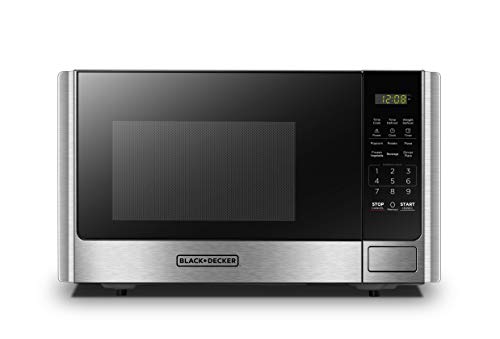
BLACK+DECKER 0.9 Cu.Ft Countertop Microwave (Stainless Steel) — Best Compact Fit
Sometimes the honest answer to a twenty-inch space is the smaller cabinet. The 0.9 cubic foot BLACK+DECKER trades a slice of capacity and 100 watts for a footprint with more air around it — and in a genuinely tight cubby, that air is not wasted space; it is the ventilation clearance the manual demands and the door-swing room your hands need. Its Amazon title verifies a respectable specification for the step-down: 900 watts, ten power levels, push-button door, child lock and six auto presets.
Daily performance stays close to the 1.1 class for the jobs this size actually does — mugs, bowls, single plates, popcorn, vegetables — with cook times modestly longer on dense frozen items. The push-button door again suits tight clearances, and the shared design language with its bigger sibling means a household replacing one with the other relearns nothing.
Choose it when your measured space is at the tight end of the class, when the oven serves one or two people, or when ventilation clearance is the binding constraint. Choose the 1.1 models when the space honestly fits them — capacity you do not need is wasted, but capacity you need weekly and lack is a daily tax.
Strengths
- Friendlier footprint for the tightest twenty-inch spaces
- 900W and 10 power levels — a modest step down, not a cliff
- Push-button door and child lock retained
Trade-offs
- Smaller plates and bowls only
- Slightly longer times on dense frozen food
- No sensor cooking
| Capacity | 0.9 cu ft |
| Power | 900W |
| Door | Push-button (Amazon title) |
| Levels | 10 power levels (Amazon title) |
Best for: One- and two-person households with genuinely tight measured spaces / Not suited for: Families reheating full dinner plates nightly
Check on Amazon — check the current price on Amazon and confirm the exact configuration before ordering.

Toshiba 0.9 Cu.Ft Countertop Microwave (Black Stainless Steel) — Best Quiet Operation
The mute function is the headline, and in the spaces twenty-inch microwaves inhabit — studio apartments, dorms, offices with a kitchenette, homes with a sleeping baby — it is not a gimmick. A microwave that can be silenced reheats at midnight without announcing itself through a wall. Toshiba pairs it with LED interior lighting, a child lock and six auto menus, per the Amazon title, in a black stainless finish that looks deliberately more grown-up than the class average.
The 10.6-inch removable turntable is sized honestly for the 0.9 class: dinner plates in this capacity are a sometimes food, and the plate handles bowls, mugs and standard meal-prep containers without drama. At 900 watts, cooking tracks the other 0.9 pick closely.
Pick the Toshiba when sound is a genuine household constraint or when the black stainless finish settles an argument with your kitchen’s palette. Pick the BLACK+DECKER 0.9 when you want the push-button door instead. Either way, this end of the class rewards buyers who measure first and choose the cabinet their space actually wants.
Strengths
- Mute function for quiet-hours reheating
- LED interior lighting and child lock
- Black stainless finish suits adult kitchens
Trade-offs
- 10.6-inch turntable limits plate size
- 900W pace on dense items
- Smaller capacity class
| Capacity | 0.9 cu ft |
| Power | 900W |
| Turntable | 10.6-inch removable (Amazon title) |
| Notes | Mute function, child lock, LED lighting (Amazon title) |
Best for: Apartments, dorms and quiet households at the compact end / Not suited for: Plate-heavy family reheating
Check on Amazon — check the current price on Amazon and confirm the exact configuration before ordering.

Chefman 0.9 Cu.Ft Countertop Microwave (Black) — Best Budget in Class
Value picks in small microwaves usually cut the livability features first; the Chefman keeps them. Its Amazon title verifies one-touch express cook — the press-a-number, get-that-many-minutes behavior everyone actually uses — plus an ECO mode that trims standby draw, a mute button, a child lock and ten power levels, all at 900 watts in the 0.9 class. For a first apartment, a break room or a rental, that is the correct set of things not to compromise on.
Eco mode deserves its mention because small microwaves live plugged in for years in exactly the spaces where standby draw is pure waste, and mute plus express cook together cover the two most common daily interactions: making food quietly and making it fast. The black finish and compact cabinet keep it visually unobtrusive on a crowded counter.
The honest value-tier notes: fit and finish are a step below the Toshiba and BLACK+DECKER models, and long-term parts support from a value brand is thinner. At this class and duty, those are acceptable trades — this is the pick when the budget is the brief and the space is twenty inches.
Strengths
- Express cook, mute and ECO mode retained at the value tier
- Ten power levels and child lock
- Unobtrusive compact black cabinet
Trade-offs
- Fit and finish below the name-brand picks
- Thinner long-term parts support
- 0.9 class capacity ceiling
| Capacity | 0.9 cu ft |
| Power | 900W |
| Levels | 10 power levels (Amazon title) |
| Notes | Express cook, ECO mode, mute button, child lock (Amazon title) |
Best for: First apartments, rentals and break rooms on a budget / Not suited for: Buyers prioritizing finish quality and brand support
Check on Amazon — check the current price on Amazon and confirm the exact configuration before ordering.
Comparison Table
| Pick | Badge | Key spec | Best for |
|---|---|---|---|
| BLACK+DECKER 1.1 Cu.Ft Countertop Microwave (Stainless Steel) | Best Overall | 1.1 cu ft / 1000W / push-button door | Most buyers who need maximum real cooking in a twenty-inch-class space |
| Sharp SMC1162KS 1.1 Cu.Ft Countertop Microwave (Stainless Steel) | Best Turntable | 1.1 cu ft / 1000W / 12.4-inch Carousel turntable | Reheat-and-defrost households that value turntable size and even rotation |
| Farberware 1.1 Cu.Ft Countertop Microwave (Stainless Steel) | Best for Staged Cooking | 1.1 cu ft / 1000W / multi-stage cooking | Small kitchens and offices where one oven must cook in stages |
| BLACK+DECKER 0.9 Cu.Ft Countertop Microwave (Stainless Steel) | Best Compact Fit | 0.9 cu ft / 900W / push-button door | One- and two-person households with genuinely tight measured spaces |
| Toshiba 0.9 Cu.Ft Countertop Microwave (Black Stainless Steel) | Best Quiet Operation | 0.9 cu ft / 900W / mute function | Apartments, dorms and quiet households at the compact end |
| Chefman 0.9 Cu.Ft Countertop Microwave (Black) | Best Budget in Class | 0.9 cu ft / 900W / mute + ECO mode | First apartments, rentals and break rooms on a budget |
Two decisions structure this table. The first is capacity class: the 1.1 cubic foot models are the full expression of the twenty-inch brief — family plates, full wattage — while the 0.9 models trade a little of both for a friendlier footprint and easier ventilation. Neither is better in the abstract; your tape measure and your plate size decide. The second decision is character: sensor-free simplicity runs through this whole class, so the differentiators are doors, turntables, programmability and sound.
A word on wattage honesty: every model here states its wattage in its verified title, and the spread — 900 to 1000 watts — is the difference between following package directions exactly and adding a modest margin on dense foods. In this class, unlike the 700-watt dorm class, package directions are written for you.
How to Choose a Microwave for a 20-Inch Space
Measure like an installer, not like a shopper. Width is only the first number: record the space’s width, depth and height, then subtract ventilation clearance — typically an inch or more on the sides and top, and more at the back where vents live; your model’s manual is the authority, and the listing’s dimension block is where to confirm the cabinet’s own figures. A microwave that physically fits but cannot breathe will run hot, cook unevenly and age fast. The twenty-inch brief is really a twenty-inch-minus-clearance brief, and the 0.9 class exists in this guide precisely because some honest measurements land there.
Second, measure the door, not just the box. Countertop doors swing from a side hinge and need their arc clear; in a cubby or under a cabinet face, a door that opens against an obstruction makes the oven unusable at any width. Push-button doors, featured on three picks here, reduce the snag and clearance problems of protruding handles in tight installations.
Third, match capacity to the largest object you heat weekly — usually a dinner plate. A 1.1 cubic foot cavity with a 12.4-inch turntable swallows standard plates; the 0.9 class with turntables around 10.6 inches handles bowls and meal-prep containers but can refuse a wide plate. Buy for the weekly object, not the annual casserole, and rent the difference with a neighbor’s oven at Thanksgiving.
Finally, weigh sound and standby features if the oven lives in a studio, dorm or open-plan space. Mute functions and ECO modes, verified on the Toshiba and Chefman picks, are small specifications that dominate daily satisfaction in small spaces.
Wattage, Sensors and What Actually Cooks Your Food
In this class the wattage decision is refreshingly simple: 1000 watts follows package directions exactly, and 900 watts follows them with a small time addition on dense items. Both are honest working wattages — unlike the 700-watt dorm class, nothing here requires relearning how frozen food behaves. Choose 1000 when the space fits the 1.1 models; accept 900 when the tighter cabinet is the right fit, and budget the extra minute without resentment.
None of these six picks relies on humidity-sensor cooking, and that is worth understanding rather than lamenting. Sensors shine on irregular reheating — the casserole of mixed density — and the class’s step-up models in the 21-inch guide carry them. In the twenty-inch class, even heating comes from the turntable and from power-level discipline: reheating at 70 to 80 percent power for longer produces markedly more even results than full-power blasts, in any oven on this list. Technique is the sensor you already own.
Defrost deserves the same realism. Weight-based auto defrost on these models is a good estimator, not a mind reader; turning and separating food at the halfway beep matters more than the algorithm. The Farberware’s multi-stage programming automates exactly that rhythm — defrost, rest, cook — which is why it holds the staged-cooking badge.
Countertop, Cubby or Cart: Where a 20-Inch-Class Microwave Should Live
Placement decides whether a small microwave feels convenient or cramped, and the twenty-inch class offers three honest homes. The countertop is the default and the best ventilated, but it spends the scarcest resource in a small kitchen — work surface. If you bake or prep seriously, measure the counter you will lose, not just the space the oven occupies; a microwave that eats your only chopping zone has cost more than its price. The cooks who thrive with countertop placement are those with a natural dead corner the oven can own permanently.
The cubby or appliance shelf reclaims the counter but introduces the two constraints this guide keeps returning to: ventilation clearance and door swing. Built-in cubbies in rental kitchens were often designed around an older, smaller generation of ovens, so measure the opening rather than trusting that ‘it held a microwave before.’ A shelf also raises the oven to a height where removing a full, hot bowl is a lift-down maneuver — comfortable for most adults, genuinely awkward for shorter cooks and children, and worth a moment’s honest thought about who uses it daily.
The rolling cart is the underrated third option for dorms, studios and offices: the oven lives at working height, vents freely on all sides, and the whole station moves for cleaning or company. Its costs are a cord run to plan and a cart sturdy enough not to flex under a full oven’s weight. Whichever home you choose, the rule is the same — the oven’s vents and door decide the placement, and everything else arranges itself around them.
Small Microwave, Full Kitchen: Cooking Strategies for the Class
A twenty-inch-class microwave earns its keep when its owner stops asking it to be a small oven and starts using it as a fast, precise water-and-steam tool. Vegetables are its native cuisine: broccoli, green beans, corn and potatoes all cook in their own moisture in minutes, with better color and nutrient retention than boiling, and the 1000-watt models here do it on package-defying speed. Rice and grains cook reliably in a covered microwave dish, freeing the stovetop in exactly the small kitchens where burners are scarcest.
Eggs, often feared, reward technique: scrambled eggs in short bursts with stirring between them emerge softer than many stovetop attempts, precisely because the cook controls the set in stages. The Farberware’s multi-stage programming formalizes this burst-and-rest rhythm for defrosting and gentle cooking, but any pick here can do it manually — the button presses are the recipe. Sauces and butter want the low end of the ten power levels every pick in this guide offers; full power is for water, and treating it as the only setting is the root of most microwave disappointment.
Finally, think in combinations. The small microwave that par-cooks potatoes for the skillet, steams vegetables while pasta boils, and reheats the leftovers of both tomorrow is not a compromise appliance — it is the hardest-working twenty inches in the kitchen. Bought at full wattage and used with technique, the class punches far above its footprint.
Energy, Standby and the Small Costs of Small Ovens
Small microwaves are frugal cookers — heating food directly rather than heating an oven cavity and a room — but they have one quiet cost owners rarely audit: standby draw. A microwave sits plugged in for years drawing a trickle to run its clock and keep its controls awake, and in the dorms, offices and studios where this class lives, that trickle is pure overhead. The Chefman’s ECO mode, verified in its Amazon title, exists to cut exactly that draw, and the Toshiba in the twenty-one-inch guide pairs the same idea with its sensor platform.
The honest scale of the matter: standby savings from one small oven are modest in absolute terms, but the habit generalizes — the same shopper who chooses ECO mode unplugs the cart oven in a vacant dorm room over summer. Cooking energy, by contrast, is already efficient at any wattage here; a 900-watt oven run slightly longer uses roughly the same energy as a 1000-watt oven run briefly, so wattage should be chosen for cooking quality and package-direction convenience, never as an energy strategy.
Longevity is the other hidden economy. A small oven that is kept clean, ventilated and un-slammed will serve for many years, and the class’s simple, sensor-free designs — every pick in this guide — have fewer exotic parts to fail. The cheapest microwave energy is the replacement you never buy.
Safety and Sanity in Shared Small Spaces
Twenty-inch-class microwaves disproportionately live where strangers and schedules collide — dorm floors, office kitchenettes, rental shares — and shared duty writes its own rules. The child locks verified on several picks here matter beyond children: they prevent the idle button-presses and prank timers that shared appliances attract, and they keep a cleaning wipe across the keypad from starting an empty oven. An empty-running microwave is not a joke in a shared space; it is how small ovens die and how smoke alarms empty buildings at 2 a.m.
Cleanliness is the second shared-space discipline, and it is a courtesy with a technical edge: yesterday’s soup film becomes today’s burnt smell in everyone else’s food, and a greasy cavity heats less evenly for the next user. The thirty-second rule — wipe it when you spill in it — keeps a shared oven pleasant, and the removable turntables on the Sharp and Toshiba picks exist precisely to make the weekly deep clean a sink job rather than an archaeology dig.
Finally, respect the circuit. Small shared spaces often run a microwave on the same circuit as a kettle, a toaster or a mini-fridge, and simultaneous draw trips breakers that nobody can find in the dark. Stagger the big loads, keep the oven on its own outlet where one exists, and treat a repeatedly tripping breaker as information about the wiring, not as a personality trait of the microwave.
A Word on Lifespan: What Kills Small Microwaves
Small microwaves rarely die of old age in their electronics; they die of their environments and their doors. Steam is the slow enemy — an oven wedged into an unventilated cubby bathes its own electronics in the moisture it vents, which is why this guide treats clearance as a lifespan specification rather than a fit detail. The second killer is the door: slammed latches, food crusted on the sealing surfaces, and bowls levered against the door as a carrying aid all degrade the one component with a genuine safety function. Treat the door gently and the oven’s other systems usually outlast the household’s interest in them.
The third factor is power quality in the loose sense — outlets shared with heavy cycling loads, power strips, and the brownout-prone circuits of older buildings all stress control boards over years. A small oven on a clean, direct outlet in a ventilated spot is, empirically, a decade-scale appliance. The same oven in a steamy, slammed, strip-powered cubby is a two-year appliance. The picks in this guide are built to the same standard; the installation decides which lifespan you collect.
One Last Measurement: The Plate Test
Before any order in this class, run the plate test with your actual dishes. Measure the diameter of the dinner plate you use most, the depth of your deepest everyday bowl, and the footprint of your largest meal-prep container, and compare those three honest numbers with the turntable and capacity figures verified for each pick. More twenty-inch-class returns are caused by a beloved oversized plate than by any defect in any oven — and the plate, unlike the oven, is not going to change. Let your dishes vote early and the space problem this search describes stays solved.
How to Measure and Install a Microwave in a Tight Space
Begin with the space empty and a metal tape measure. Record width between the exact obstructions — cabinet sides, walls, appliance edges — at front and back, because openings are rarely perfectly parallel, and the smaller number governs. Record depth from the back wall to the counter’s front edge, and height to the underside of whatever hangs above. Write all three down; memory edits measurements in the direction of hope.
Next, read the candidate listing’s dimension block and apply clearances before comparing: subtract the manufacturer’s ventilation allowances from your space, then compare the remainder with the cabinet’s stated width, depth and height. Check the door swing separately — open a mental arc from the hinge side and confirm nothing in the real kitchen blocks it, including your own usual standing position with a hot dish in hand.
On installation day, place the oven, level it on its feet so the turntable ring runs true, and confirm the vents are unobstructed — then resist the household urge to store bread, manuals or a fruit bowl on top of a microwave whose top vent you just cleared. Plug directly into a wall outlet rather than a power strip; small kitchens tempt strip use, and microwave draw deserves its own circuit path.
Finally, run a water test: heat a measured cup of water and confirm the oven runs quietly, the turntable rotates without wobble, and the door seals and latches with a clean action. Keep the manual’s dimension and clearance page — when the kitchen is next rearranged, that page is the difference between a five-minute decision and another research project.
Common Buying Mistakes
**Trusting the class instead of the tape measure.** ‘Twenty-inch class’ describes a capacity band, not a guaranteed cabinet width. Confirm the listing’s stated dimensions against your measured space, with clearances subtracted, before any purchase in this category.
**Forgetting ventilation clearance.** A microwave wedged vent-to-wall in a cubby that exactly matches its width will overheat and cook poorly. If your honest measurement leaves no clearance, the correct move is the smaller 0.9 class — which is why it is in this guide.
**Ignoring door swing.** A door that cannot open fully in its cubby makes the oven a sculpture. Check the hinge arc against cabinet faces and walls before ordering, especially in corner installations.
**Buying capacity for the annual casserole.** The twenty-inch brief exists because space is scarce. Size for the weekly plate and bowl; the once-a-year dish can borrow a bigger oven.
**Using a power strip or extension cord.** Microwaves draw heavily and belong on a direct wall outlet. In dorms and offices with limited outlets, plan the outlet before the oven arrives.
Final Recommendation
The BLACK+DECKER 1.1 is the default answer for this brief — full capacity and full wattage in the twenty-inch class — with the Sharp as its turntable-focused equal and the Farberware as the programmer’s choice. At the tighter end, the 0.9 cubic foot BLACK+DECKER, Toshiba and Chefman trade a little capacity for friendlier footprints, quieter operation and value, in that order of emphasis.
Whichever pick you take, let the tape measure cast the final vote: confirm the listing dimensions, subtract clearances, check the door arc. A twenty-inch space rewards precision and punishes optimism, and every model here will serve well in a space that was honestly measured for it.
Three more verified options round out the list if the headline picks do not fit your space or budget tier: BLACK+DECKER 0.9 Cu.Ft Countertop Microwave (Stainless Steel); Toshiba 0.9 Cu.Ft Countertop Microwave (Black Stainless Steel); Chefman 0.9 Cu.Ft Countertop Microwave (Black). Each one earned its place in the reviews above for a specific reason, so match the badge to your actual routine rather than buying the longest feature list.
Shortlist it this way: BLACK+DECKER 1.1 Cu.Ft Countertop Microwave (Stainless Steel) if you want the safest all-round choice, Sharp SMC1162KS 1.1 Cu.Ft Countertop Microwave (Stainless Steel) if the second badge matches your kitchen better, and Farberware 1.1 Cu.Ft Countertop Microwave (Stainless Steel) if the third badge names your priority. Every other pick in this guide is a specialist — buy those when their specialty is your actual problem.
Best 21 Wide Microwaves Best 24 Inch Microwaves Best 700 Dorm Microwaves Best Small Microwaves Best Countertop Microwaves Best 1.1 Cu Ft Microwaves
Frequently Asked Questions
Is a 20-inch-wide microwave the same as a 1.1 cu ft microwave?
Not exactly, but they overlap heavily. Exterior width is a cabinet dimension listings rarely headline, while capacity is the marketed figure — and the 0.9 to 1.1 cubic foot countertop class is the band engineered for roughly twenty-inch spaces. Always confirm the specific model’s stated dimensions against your space before ordering.
How much clearance does a countertop microwave need?
Follow the manual for your model; a common rule is at least an inch on the sides and top and more at the rear vents. Clearance is not wasted space — it is how the oven sheds heat. If your measured space cannot spare it, choose the smaller 0.9 cubic foot class.
Will a 900W microwave cook frozen meals properly?
Yes, with a modest time addition on dense items. Package directions are usually written around 1000 watts and above; at 900 watts, add a small margin and check temperature. For mugs, bowls, vegetables and popcorn, the difference is barely noticeable.
Can a 1.1 cu ft microwave fit a full dinner plate?
Standard dinner plates, yes — especially with the 12.4-inch turntable on the Sharp pick. Oversized platters and large casseroles are the class’s honest limit. Measure your most-used plate’s diameter against the turntable figure before choosing between the 1.1 and 0.9 classes.
Is a push-button door better than a handle for small spaces?
For tight installations, usually. A push-button door needs no grip clearance, cannot snag on clothing or towels, and opens with a press when your other hand is full. Handles offer more leverage for users with limited hand strength — the better choice depends on your constraint.
Can I put a countertop microwave inside a closed cabinet?
Only if the cabinet provides the manufacturer’s required clearances and ventilation, and the door can open fully — most closed cabinets fail on heat. Open cubbies and shelves designed for appliances are the safe version of the idea; a sealed cabinet is a heat trap that shortens the oven’s life.
What is the difference between the 0.9 and 1.1 cu ft models here?
About a plate’s worth of room and 100 watts. The 1.1 cubic foot models take standard dinner plates on turntables up to 12.4 inches and cook at a full 1000 watts; the 0.9 models fit tighter spaces with friendlier ventilation margins, suit bowls and containers best, and run at 900 watts. Your measured space and your largest weekly dish decide between them.


