Disclosure: airfryerkitchensupply.com is reader-supported. When you buy through links on our site, we may earn an affiliate commission at no extra cost to you.
Where to buy
Shopping for the best 12 volt stove? Start here. The verified, linkable heart of this small market is small, so the links below cover the products that genuinely exist as 12 volt stoves and food warmers: RoadPro lunchbox stove: check price on Amazon. Travel Time stove: check price on Amazon. RoadPro frying pan: check price on Amazon. The remaining picks in this guide are product routes described in prose, because no further 12 volt stove models could be verified with confidence — and inventing listings to fill a table would help nobody.
Searching for the best 12 volt stove means meeting one of the smallest categories in vehicle accessories head-on. Unlike 12 volt TVs or coolers, where several brands compete, the 12 volt stove market is essentially the RoadPro class of lunchbox ovens and warming pans, plus a handful of similar food warmers — all of them low-wattage devices that heat or reheat food slowly from a lighter socket. There is no 12 volt equivalent of a household stovetop, and this guide will not pretend otherwise.
That honesty is useful, because the products that do exist are genuinely good at their real job: warming a prepared meal in a truck cab, reheating leftovers at a job site, or keeping food hot on a long drive, all without an inverter, a generator, or a campfire. This guide verifies the real products, gives them their due, and then maps the routes drivers actually use when they need to cook — not just warm — from a 12 volt system, so you can choose the route that matches your vehicle and your meals.
In this guide
Quick Picks
Three of these six picks are verified products with purchase links. Three are routes — the honest alternatives that experienced truck and RV cooks use — covered in prose with no link, because no single verified listing represents them fairly.
- RoadPro Portable Electric Lunchbox Stove 12V (RPSC-197) — Best Overall. The defining product of the category: a lunchbox-format oven that warms a prepared meal from the lighter socket while you drive. Check the current price on Amazon.
- Travel Time 12V Portable Stove with 5 Pans (150W) — Most Stove-Like. A 150-watt warming stove supplied with five pans and lids — the closest thing to a stovetop workflow that a lighter socket can honestly support. Check the current price on Amazon.
- RoadPro RPSL-335 12V Portable Frying Pan — Best for Pan Foods. A small 12 volt frying pan for the narrow set of foods a pan does best at low power: eggs, sandwiches, quesadillas, and reheated flatbreads. Check the current price on Amazon.
- The Direct-Battery Cooking Route (Larger 12V Appliances on a House System) — Best Route for Real Cooking. Not a socket product at all: larger 12 volt cooking appliances wired to an auxiliary house battery, for RV and van users who genuinely need to cook. Sold as a product class rather than one verified listing, so this pick is covered in prose below with no purchase link.
- The Inverter Route (Household Appliances from 12V) — Best Route for Familiar Appliances. A properly sized inverter turns 12 volt battery power into household AC, letting a small rice cooker, kettle, or hot plate do the cooking. Sold as a product class rather than one verified listing, so this pick is covered in prose below with no purchase link.
- The Portable Power Station Route (Cook Anywhere, Recharge Anywhere) — Best Route for Campers. A portable power station carries its own battery and AC outlets to the picnic table, the tent, or the tailgate — cooking untethered from the vehicle entirely. Sold as a product class rather than one verified listing, so this pick is covered in prose below with no purchase link.
If you only remember one line from this page, make it this one: a 12 volt stove warms food; it does not fry, boil, or bake like a kitchen. Buy it for warming and it will please you for years. Buy it for cooking from raw and every product in the category will disappoint you equally.
How These Picks Were Chosen
Selection began with verification. Every candidate had to resolve, through the Creators API, to a real product whose title and description describe 12 volt food heating: a lunchbox oven, a warming stove with pans, or a 12 volt frying pan. Household stoves, camp stoves that burn fuel, and inverter-powered appliances were excluded from the linked picks because they are not 12 volt stoves, however often sellers tag them that way.
The verified field turned out to be three products deep, which matches the known shape of this market. Rather than pad the list with unverified or mislabelled items, the remaining three pick slots were given to the routes that real users take — direct cooking appliances on larger 12 volt systems, the inverter route, and the portable power station route — each labelled prose-only, each described with its costs and limits, and none carrying a purchase link.
Within the verified products, badges follow use: the lunchbox oven for set-and-forget meal warming, the pan-set stove for the most stove-like experience the socket allows, and the frying pan for the narrow job of heating pan-friendly foods. Wattage, warm-up expectations, and cleaning effort were weighed for every badge, and no prices or ratings were used at any point.
The 6 Best 12 Volt Stoves
Read the three product reviews for what you can buy today, and the three route reviews for what you can build. Every entry carries the same strengths, trade-offs, and verdict format so the comparison stays fair.

RoadPro Portable Electric Lunchbox Stove 12V (RPSC-197) — Best Overall
This is the pick for truck drivers, couriers, and site workers who eat one hot meal a day away from any kitchen. Put a prepared meal in before the drive, plug it in, and eat hot food at the stop. It suits warming and reheating completely. It does not suit cooking raw meat from cold, boiling water, or feeding a family.
Strengths
- The proven lunchbox-oven format: sealed, spill-resistant, and sized for a single generous meal
- RoadPro heritage in 12 volt truck accessories, with the model line running for many years
- Set-and-forget operation — food warms during driving time that would otherwise be wasted
Trade-offs
- Warming takes time measured in tens of minutes to hours, not the minutes of a microwave
- Single-meal capacity; not a family or group solution
- Heats and reheats rather than truly cooking, so raw ingredients are out of scope
| Specification | Detail |
|---|---|
| Power source | 12 volt DC, vehicle socket |
| Format | Lunchbox oven / food warmer |
| Model | RPSC-197 (per API listing title) |
The lunchbox oven works because it matches its power budget to a forgiving job. A sealed box, a modest heating element, and an hour of driving add up to a properly hot meal, because warming cooked food to serving temperature asks far less energy than cooking it. Drivers who build the habit — load in the morning, eat at midday — consistently rate this format as the most useful food accessory in the cab, ahead of far more powerful gadgets that demand attention and wiring.
Its limits are the category limits in miniature. There is no browning, no searing, and no thermostat drama to manage, because there is barely enough power for any of that. Foods that reheat well — stews, rice dishes, pasta, burritos, soups in a sealed container — are excellent. Foods that need crispness or precise cooking are not. Judge it as a meal warmer with a decade of road use behind the format, and it is the easiest recommendation in this guide.
Best for: drivers warming one prepared meal a day / Not suited for: cooking raw food or feeding groups
Check on Amazon to see the current listing for the RoadPro lunchbox stove.

Travel Time 12V Portable Stove with 5 Pans (150W) — Most Stove-Like
Choose this if the lunchbox format feels too limiting and you want separate pans for separate foods: a main, a side, and something kept warm for later. It suits organised meal-preppers and drivers who eat in stages across a shift. It remains a warmer at heart, so raw cooking is still out, and the pan set needs washing like any cookware.
Strengths
- Five pans with lids allow separate foods to warm without mixing
- 150-watt rating sits comfortably inside standard socket fuse limits
- Stove-style layout makes portioning and serving simpler than a single box
Trade-offs
- More parts to wash and store than a lunchbox oven
- Still warming-class power — the pans organise heat, they do not multiply it
- Takes more cab space than the compact lunchbox format
| Specification | Detail |
|---|---|
| Rated power | 150W (per API listing title) |
| Power source | 12 volt DC |
| Included | 5 pans with lids (per API listing title) |
| Positioning | Food warmer for car, truck, travel, work (per API listing title) |
The pan set is the real idea here. Anyone who has eaten a warmed meal from a single box knows the compromise: everything reaches the same temperature at the same time and flavours mingle whether you wanted them to or not. Separate lidded pans let a driver warm a main dish fully, keep a side gentler, and hold a third item for a later break — a small luxury that makes daily road eating noticeably more civilised.
Keep the physics in view, though. One hundred and fifty watts shared across a stove top is a warming budget, and the listing itself positions the unit as a food warmer. Foods should go in cooked or mostly cooked. Within that honest frame, this is the most flexible verified 12 volt stove you can buy, and for drivers who meal-prep on Sundays for the week, the pan system fits the routine better than any single-box rival.
Best for: meal-preppers who want separate pans warmed in the cab / Not suited for: raw cooking or minimal-washing simplicity
Check on Amazon to see the current listing for the Travel Time stove.
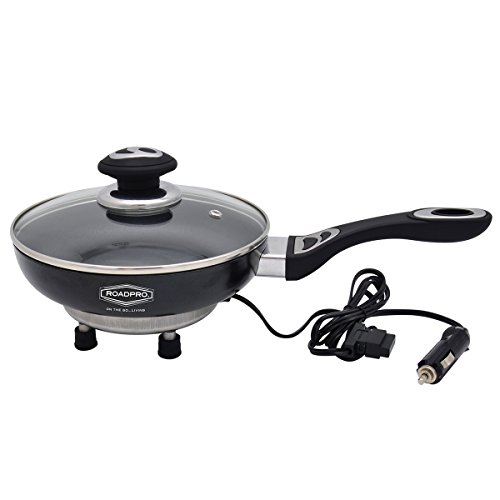
RoadPro RPSL-335 12V Portable Frying Pan — Best for Pan Foods
This niche pick suits drivers whose road menu is pan-shaped: a fried egg for a breakfast sandwich, a grilled cheese, warmed tortillas, or reheated pizza slices. The small pan format concentrates the limited wattage on a small surface, which is the right physics. It does not suit saucy meals, large portions, or anything needing sustained high heat.
Strengths
- Pan format concentrates modest wattage on a small cooking surface
- RoadPro build and parts ecosystem, like the lunchbox stove
- Opens menu options the box warmers cannot do at all, such as eggs and toasted sandwiches
Trade-offs
- Small surface means small portions, one serving at a time
- Low power means gentle frying — browning is light and slow
- Needs supervision while in use, unlike the set-and-forget lunchbox
| Specification | Detail |
|---|---|
| Power source | 12 volt DC |
| Format | Portable frying pan, small |
| Model | RPSL-335 (per API listing title) |
A frying pan is the one cooking shape that can flatter a tiny power budget. The food sits in direct contact with the heated surface, the surface itself is small, and the foods that suit it — eggs, cheese sandwiches, flatbreads — cook through at temperatures a 12 volt element can actually reach and hold. In a category defined by compromise, this is the product whose compromise aligns with its menu.
The discipline it asks in return is attention. Unlike the lunchbox, a pan is an active cooking tool: food needs turning, timing is yours to judge, and the cab will smell like breakfast, which drivers count as a benefit or a drawback depending on the day. As a second device alongside a lunchbox oven it rounds out a genuinely workable cab kitchen; as a sole device it serves pan-food people very well and everyone else poorly.
Best for: eggs, sandwiches, and flatbread-style road meals / Not suited for: sauces, large portions, or unattended use
Check on Amazon to see the current listing for the RoadPro frying pan.
The Direct-Battery Cooking Route (Larger 12V Appliances on a House System) — Best Route for Real Cooking
This route suits vanlifers and RV owners who already run a house battery bank with proper cabling and charging. On such a system, higher-draw 12 volt appliances become feasible in a way a dashboard socket never allows. It does not suit a standard car or truck cab, and it is an installation project, not a purchase.
Strengths
- Escapes the socket wattage ceiling legitimately, through cable and fusing sized for the load
- Integrates with solar and alternator charging that RV systems already carry
- Supports a broader class of 12 volt cooking appliances than any socket product
Trade-offs
- Requires auxiliary battery capacity, heavy cable, fusing, and installation skill or a paid installer
- Cooking loads still drain a house bank fast; energy budgeting is mandatory
- No single verified listing represents the route, so there is nothing to link — it is a system, not a product
The route exists because energy, not voltage, is the real constraint. A house bank of a few hundred amp-hours stores enough energy to cook with, and cabling sized in thick gauge delivers it without the socket fuse ever entering the discussion. This is how off-grid vans run induction-adjacent loads, kettles, and cooking appliances daily. The stove stops being the question; the battery bank becomes the question.
Cost and complexity are the honest trade. Between batteries, cable, fuses, charging, and the appliances themselves, this route costs many times a lunchbox oven and takes a weekend or a professional to install. It is the right answer for people who live in their vehicles. It is the wrong answer for a driver who wants a hot lunch, which is why it appears here as guidance rather than as a product pick.
Best for: RV and van owners with house battery systems / Not suited for: standard cabs or anyone wanting a plug-in purchase
Prose-only pick: Prose-only route: a wiring and battery system, not a single product; no ASIN exists to verify, so no link is given.
The Inverter Route (Household Appliances from 12V) — Best Route for Familiar Appliances
Drivers and campers who already own small household appliances often find the inverter route cheapest in total, because the appliances are familiar and inexpensive. It suits engine-running use or a house battery. It does not suit casual socket use at all — the inverter itself must be wired to the battery for cooking-class loads.
Strengths
- Uses ordinary, inexpensive household cooking appliances you may already own
- One inverter serves many loads beyond cooking
- Appliance performance is full household performance while power lasts
Trade-offs
- Conversion losses waste roughly a tenth or more of the battery energy as heat
- Cooking-class inverters are substantial, wired devices — not socket accessories
- Engine-off cooking drains batteries quickly even through an efficient inverter
The inverter route reframes the problem: instead of hunting for rare 12 volt appliances, convert the power and use the enormous, cheap world of household ones. A compact rice cooker is, for road cooking, a genuinely excellent tool — sealed, thermostatically controlled, forgiving — and through an inverter it works in a vehicle exactly as it works in a kitchen, for exactly as long as the battery and charging system can feed it.
The warnings are electrical, not culinary. Size the inverter to the appliance with headroom, wire it directly to the battery with the cable the manual demands, fuse it properly, and treat engine-off cooking time as a budget you spend from a finite account. Drivers who respect those rules cook real meals on this route for years; the route fails only when it is treated as a socket accessory, which it never was.
Best for: users who already own small household appliances / Not suited for: socket-only setups or casual, unwired use
Prose-only pick: Prose-only route: inverter sizing and wiring vary by vehicle and appliance, so no single ASIN is linked; buy the inverter by verified wattage and wiring requirements for your setup.
The Portable Power Station Route (Cook Anywhere, Recharge Anywhere) — Best Route for Campers
Campers, tailgaters, and families are the natural audience. The station charges from the vehicle while driving, from solar at camp, or from a wall at home, then runs small cooking appliances wherever you set it down. It does not suit a solo driver who only needs a warm lunch — the lunchbox oven does that job for a fraction of the cost and complexity.
Strengths
- Cooking power leaves the vehicle: usable at a table, tent, or beach
- Recharges from vehicle, solar, or wall power, fitting mixed travel styles
- Also runs lights, phones, coolers, and the 12 volt TVs covered elsewhere in this series
Trade-offs
- The most expensive route per cooked meal for simple warming jobs
- Station capacity still limits cooking: one or two appliance sessions per charge is typical
- Weight and bulk are real, especially in capacities that cook comfortably
What the power station buys is location freedom. Vehicle-based routes tie cooking to the cab or the tailgate wiring; a station moves the kitchen to wherever people actually gather, and for family camping that difference is the whole point. It also consolidates the power budget visibly — the display tells you exactly what a cooking session costs, which teaches better energy habits than any other route.
Judge capacity in cooked meals, not headline numbers. A station that runs a small rice cooker or kettle for a family dinner, with reserve for lights and phones, is sized correctly; one bought purely on a watt-hour figure often disappoints on the second day. For campers this route has quietly become the default, and the 12 volt socket products in this guide remain the better tools only for the in-cab warming job they were born to do.
Best for: campers and families cooking away from the vehicle / Not suited for: solo drivers who only need a warm lunch
Prose-only pick: Prose-only route: station capacity choice depends on the buyer appliances and trip length; no single ASIN fairly represents the route, so no link is given.
Comparison Table
The comparison below puts the three verified products and the three routes side by side. If your need is warming, buy a product from the top half. If your need is cooking, choose a route from the bottom half and budget for the system it requires.
| Pick | Badge | Key spec | Best for |
|---|---|---|---|
| RoadPro Portable Electric Lunchbox Stove 12V (RPSC-197) | Best Overall | 12V lunchbox oven, RPSC-197 | drivers warming one prepared meal a day |
| Travel Time 12V Portable Stove with 5 Pans (150W) | Most Stove-Like | 150W, 5 pans with lids | meal-preppers who want separate pans warmed in the cab |
| RoadPro RPSL-335 12V Portable Frying Pan | Best for Pan Foods | 12V small frying pan, RPSL-335 | eggs, sandwiches, and flatbread-style road meals |
| The Direct-Battery Cooking Route (Larger 12V Appliances on a House System) | Best Route for Real Cooking | House-battery system route | RV and van owners with house battery systems |
| The Inverter Route (Household Appliances from 12V) | Best Route for Familiar Appliances | Inverter + household appliance route | users who already own small household appliances |
| The Portable Power Station Route (Cook Anywhere, Recharge Anywhere) | Best Route for Campers | Portable power station route | campers and families cooking away from the vehicle |
Notice the pattern in the key-spec column: everything the socket powers directly is a warmer, and everything that truly cooks needs a battery system behind it. That single insight, kept in mind while shopping anywhere in this category, prevents nearly every bad purchase.
How to Choose a 12 Volt Stove: Warming vs Cooking
The whole category divides on one question: is the food already cooked? Warming cooked food to serving temperature takes modest energy delivered slowly, which is exactly what a socket can supply. Cooking raw food — bringing water to a rolling boil, searing meat, baking — takes several times the energy at several times the power, which a socket cannot supply. Every honest product in this guide lives on the warming side of that line.
Within warming, choose by format. The lunchbox oven is the set-and-forget single meal. The pan-set stove is the organised multi-item warmer. The frying pan is the active tool for eggs and sandwiches. All three are verified, all three are RoadPro-class or equivalent in spirit, and choosing between them is about your menu, not about quality tiers.
If your answer to the opening question is that the food is raw, stop shopping for socket products and choose a route instead: house-battery appliances if you live in the vehicle, an inverter if you own household appliances, or a power station if you cook at camp. Each route is covered in the reviews above with its real costs stated.
Power, Time, and Temperature: What 150 Watts Buys at Lunch
A 150-watt warmer raises a sealed meal steadily rather than quickly. Plan on loading food well before the meal break — during the morning drive for a midday meal is the classic pattern — and on foods that hold heat gracefully. Dense foods such as stews, rice, and pasta warm evenly; thin or delicate foods warm unevenly and dry at the edges, which is a technique problem to manage, not a product defect.
Temperature expectations should be serving temperature, not cooking temperature theatre. The goal is food that steams when the lid opens and eats hot, and the verified warmers achieve that reliably when given time. What they cannot do is rescue a frozen-solid meal quickly or crisp anything. Drivers who plan the menu around those facts — and the menu ideas are endless once you do — report the highest satisfaction in this entire category.
Budget Tiers in a Three-Product Market
With so few verified products, tier talk is simple. The pan-set stove and the lunchbox oven occupy the honest centre of the market, and the frying pan is the low-cost specialist beside them. There is no premium tier of socket stove waiting at a higher price, because the socket caps performance for every maker equally — extra money in this category buys format and convenience, never power.
The real budget decision is between a product and a route. A product costs little and warms lunch for years. A route costs several times more and cooks dinner. Neither is the better buy in the abstract; they answer different questions, and the most common waste in this category is buying a product while secretly needing a route, then blaming the product. Decide which question is yours before spending anything.
A Working Week with a Lunchbox Stove: What Actually Gets Eaten
Abstract warming advice becomes useful when it turns into a menu. Monday is leftover stew, the easiest win in the format: dense, saucy, and better reheated than fresh. Tuesday is a rice bowl — chicken, rice, and a sauce with a splash of water added before loading to keep the grains soft. Wednesday is pasta bake, which warms evenly and eats like it was planned. Thursday is burritos, wrapped in foil, the closest thing road food has to a perfect format. Friday is soup in a sealed inner container with bread kept cold and separate until the stop. None of these meals asks the stove to cook. All of them arrive hot.
The pattern underneath the menu matters more than the dishes: dense and saucy beats dry and delicate, every time. Foods that struggle are equally predictable — anything whose pleasure is crispness, anything very thin that dries at the edges, and anything that was marginal food safety to begin with. Drivers who build their week on the first list describe the lunchbox stove as the best money they spend on work. Drivers who test it with the second list describe it as a gimmick. The stove is the same; the menu is the variable, and it is entirely in the buyer control.
Portion discipline completes the routine. The verified warmers in this guide are single-meal devices, and a meal packed to the designed capacity warms through evenly, while an overpacked box leaves a cool centre. Pack the meal you will eat, not the meal you might share, and let the pan-set pick handle the days when variety matters more than simplicity.
Food Safety on the Road: The Rules That Make Warming Work
A 12 volt warmer is a reheating device, and reheating has rules that deserve print in any honest guide. Food should be cooked properly at home, cooled promptly, and refrigerated until it is loaded. The morning load goes from fridge to stove to plug with as little warm limbo as possible, and the warming drive should be the food last journey before eating — not the first of several warmings across a day. Leftovers that were not eaten should not be re-warmed a second time tomorrow; the road version of kitchen discipline is identical to the kitchen version, because the biology is identical.
Time is the second rule. A warmer holding food for a very long, delayed day is a warmer being misused: plan the meal for the break you will actually take, and if the day collapses and the meal sits warm for many extra hours, the disciplined answer is to discard it. That discipline sounds stern in print and feels trivial in practice once the load-eat-unplug rhythm is habit — and it is what separates the drivers who eat from these devices for years without incident from the stories that give the category an unfair reputation.
Cleaning is the third rule and the one most in the owner control: food-contact surfaces washed or wiped the same day, every day, with the same seriousness as a lunchbox at home. The sealed formats in this guide make that easy. Keep the three rules and the 12 volt stove is not merely convenient; it is a genuinely sound way to eat at work.
The Etiquette and Safety of Cooking Around a Working Vehicle
A short section this guide insists on, because 12 volt food gear lives in working environments rather than kitchens. Heat and food belong at stops, not in motion: warm while driving only in the sealed, latched formats designed for it, like the lunchbox pick, and do all opening, serving, and pan work parked. A vehicle that smells of lunch is pleasant; a driver distracted by lunch is not, and the line between the two is simply whether the food waits for the stop.
Around the vehicle, the courtesies are practical ones. Hot lids and pans need a heatproof resting place that is not the paintwork, the seat, or the load bed of somebody else cargo. Waste food and wash water go where they would go at a campsite, not onto the ground of a rest area or a customer premises. And the electrical courtesy mirrors the rest of this series: unplug at the stop, coil the cord, and leave the socket free — the next device in a working cab, from a phone to a medical cooler, may need it more than a warmer that has already done its job. None of this is burdensome; it is the ordinary professionalism of people who eat at work, and it keeps a genuinely useful category welcome everywhere it travels.
Pre-Purchase Checklist for a 12 Volt Stove or Route
One: answer the founding question in writing — is the food already cooked? If yes, stay in the product half of this guide; if no, choose a route and budget for its system. Two: count the eaters. One eater points to the lunchbox; one organised eater to the pan set; a pan-food eater to the frying pan; a family to a route. Three: time your drive. A warming meal needs a driving leg before the break, so check that your shift pattern actually contains one — drivers whose first break comes twenty minutes after departure should eat differently, and no product fixes a timetable.
Four: check the cab. Is there a level, stable surface for the unit, a socket within cord reach, and a wash routine you will honestly keep? Five: if you chose a route, list its full system cost — battery or inverter or station, cabling, fusing, installation — and compare that total, not the appliance price, against the product alternative. Six: plan the first week menu from the dense-and-saucy list in this guide, and judge the purchase at the end of that week rather than after a single experimental lunch. Bought this way, a 12 volt stove is a decade of hot lunches; bought any other way, it is a garage shelf ornament with a cord.
What Drivers Actually Carry Alongside the Stove
No 12 volt stove travels alone, and the supporting kit that experienced drivers assemble around it is worth a short inventory, because it costs little and completes the system. A small insulated bag carries the cold half of the meal — the salad, the fruit, the drink — so the stove only ever handles the hot course it is good at. A roll of foil, a proper fork rather than a petrol-station plastic one, a cloth for hot lids, and a small bottle of washing liquid with a brush turn the cab at the stop into a civilised place to eat rather than a negotiation with packaging.
The second layer of kit is electrical housekeeping shared with every appliance in this series: a spare fuse of the correct rating for the socket circuit, kept in the glovebox where it can be found in the dark; a short, sound extension only if the maker supports one; and the habit of a monthly cord inspection. None of this is sold as a bundle, and all of it together costs less than a single takeaway week — which is the comparison that matters, because the stove routine replaces takeaway weeks for years. Bought alongside the stove and kept with it, the kit is the difference between a gadget that warms food and a system that feeds a driver.
How to Use a 12 Volt Lunchbox Stove for a Proper Hot Lunch
Load the meal before the drive, not at the stop. Pack cooked food in the oven or pans in the morning — leftovers from the night before are ideal — close and latch the lid, and place the unit where it sits level and cannot slide. Plug in when you set off. The warming happens across driving time that costs you nothing, and the food is ready when you are.
Choose foods that forgive. Stews, curries, rice dishes, pasta bakes, burritos, and soups in a sealed inner container are the proven road menu because they warm evenly and taste as good reheated as fresh. Add a splash of water or sauce to rice and pasta before loading to replace moisture the gentle heat will take. Keep cold items — salad, fruit, a drink — in a separate cooler; the stove is for the hot course only.
At the stop, unplug before eating if you will be parked for a while, to protect the starter battery, and let the unit cool before storing it. Wipe or wash the food-contact surfaces the same day; yesterday stew residue is the category only real hygiene risk, and it is entirely avoidable. Check the cord and plug monthly for heat damage, and the routine will run for years of working lunches.
Common Buying Mistakes
The defining mistake in this category is expecting cooking from a warmer. Raw chicken in a lunchbox oven is not a recipe, it is a food-safety problem: low, slow, uneven heat can hold food in the temperature range where bacteria thrive without ever cooking it through. These devices reheat cooked food. Raw ingredients belong to the route systems, a camp stove, or a kitchen.
The second mistake is impatience. Loading a cold meal twenty minutes before the break and judging the product a failure misunderstands the tool. Warming is measured across a drive, and the drivers who love these products are the ones who load early as a matter of routine.
The third mistake is buying unverified look-alikes with miraculous claims. Sellers periodically list socket products promising boiling water or full cooking at implausible wattages. The socket fuse disagrees, and so does physics. The verified products in this guide claim only what they can do, which is exactly why they are the ones linked.
Finally, do not run any warmer for hours on a parked vehicle starter battery. Warm while driving, eat at the stop, unplug when parked. The battery you save is your own ride home.
Final Recommendation
For the classic hot-lunch job, buy the RoadPro Portable Electric Lunchbox Stove: it is the category-defining product, from the category-defining brand, doing the job exactly as promised. Meal-preppers who want separation and stages should choose the Travel Time stove with its five pans, and pan-food drivers should add or choose the RoadPro frying pan for eggs and sandwiches.
And if your real need is cooking, accept the guide verdict with good grace: no socket stove will do it, and the money is better spent on the route that fits your life — house battery, inverter, or power station. Honest tools for honest jobs is the whole philosophy of this series, and nowhere does it matter more than at lunch.
Shop the verified picks: RoadPro lunchbox stove. Travel Time stove. RoadPro frying pan. Each link goes to the current Amazon listing, where you can check price on Amazon before you buy.
Related guides in this series: Best 12 Volt Space Heater Best 12 Volt Thermoelectric Cooler Best 12 Volt Travel Heated Mug Best 12 Volt Television For Rv Best 12 Volt Television.
Frequently Asked Questions
Can a 12 volt stove actually cook raw food?
No socket-powered 12 volt stove cooks raw food safely or effectively. At roughly 150 watts these devices warm and reheat cooked food to serving temperature. Cooking raw food — especially meat — needs the power of a house-battery system, an inverter with a household appliance, or a fuel stove.
How long does a 12 volt lunchbox stove take to heat a meal?
Plan in terms of a drive, not minutes: load the meal when you set off and it will be properly hot by a mid-shift or midday stop. Dense foods like stews and rice warm most evenly. Loading twenty minutes before eating is the most common cause of disappointment in this category.
Why are there so few 12 volt stoves to choose from?
Because the socket power ceiling makes the category a warming niche, and one brand family — the RoadPro class — has served that niche for years. This guide links the three products that could be verified with confidence and covers the cooking alternatives as prose routes rather than inventing further picks.
Is it safe to leave food warming in a 12 volt stove for hours?
Food should be loaded cooked, warmed during the drive, and eaten at the stop — not held warm indefinitely. Like any warmer, it is not a food-storage device. Eat promptly, refrigerate leftovers properly, and wash the food-contact surfaces the same day.
Can I boil water with a 12 volt stove?
Not practically. Boiling a useful volume of water needs far more energy than a socket warmer delivers in a reasonable time. For hot drinks on the road, the 12 volt kettle and heated mug category — covered in the travel heated mug guide in this series — is the right tool.
Will a 12 volt stove drain my battery?
Used while driving, no — the alternator carries the load. Used for hours while parked, yes, any resistance heater will drain a starter battery. Warm on the move and unplug at the stop.
Can I use a 12 volt stove in an electric vehicle?
Yes — the accessory socket works the same way, and warming while driving draws a modest amount from a very large traction battery. The same discipline applies in reverse at stops: unplug when parked for long periods, because the load then falls on the small 12 volt auxiliary battery, which is no larger in an EV than in any other car.
What foods should I never put in a 12 volt warmer?
Anything raw that needs cooking through — above all raw meat and poultry — and anything whose appeal is crispness, which gentle warming will only make soggy. The warmer reheats cooked food. Keep raw cooking for a real stove, an inverter-powered appliance, or the route systems described in this guide.


