Disclosure: airfryerkitchensupply.com is reader-supported. When you buy through links on our site, we may earn an affiliate commission at no extra cost to you.
Where to buy
The best 12 volt ratchet is a run-down tool, not a torque tool — it exists to spin fasteners fast in places your hand and a wrench cannot work efficiently. Every pick here was verified against Amazon’s catalog data for this site, across the three 12 volt platforms that matter: Milwaukee M12, DeWalt 12V MAX, and Makita 12V CXT. Each pick links to its live listing to check the current price on Amazon; specifications quoted come from the manufacturers’ own listings.
- Milwaukee 2567-20 M12 FUEL High Speed 3/8″ Ratchet (Best Overall) — Check price on Amazon
- Milwaukee 2457-20 M12 3/8″ Ratchet (Best Value — The Proven Original) — Check price on Amazon
- Milwaukee 2560-20 M12 FUEL 3/8″ Extended Reach Ratchet (Best for Tight Engine Bays) — Check price on Amazon
- DEWALT DCF503B XTREME 12V MAX 3/8″ Ratchet (Best for DeWalt 12V Owners) — Check price on Amazon
- Makita RW01Z 12V max CXT Ratchet (Most Versatile — 3/8″ and 1/4″ in One Tool) — Check price on Amazon
- Milwaukee 2457-21 M12 3/8″ Ratchet Kit (Best Starter Kit) — Check price on Amazon
The best 12 volt ratchet earns its place in the toolbox by doing the most tedious part of mechanical work — running long fasteners in and out in cramped quarters — at the pull of a paddle. It is not an impact wrench and it is not a torque wrench: a cordless ratchet’s motor typically delivers torque in the few-dozen foot-pound range, which is exactly the point. You break fasteners loose by hand using the tool as a conventional ratchet, let the motor spin them off, and reverse the process on assembly, finishing with a hand snug. Used that way, a 12 volt ratchet turns jobs like water pumps, alternator brackets, interior panels, and engine covers from knuckle-punishing marathons into quick work.
This guide’s picks were verified through the Creators API catalog for this site, and the field is honestly dominated by one platform: Milwaukee’s M12 line is the deepest 12 volt ratchet catalog in the industry, with standard, high-speed, extended-reach, and specialty models, and it takes four of the six spots on merit. DeWalt’s XTREME 12V MAX ratchet holds the spot for yellow-platform owners, and Makita’s CXT ratchet earns its place with a trick nobody else here offers — interchangeable 3/8 and 1/4 inch anvils in one tool. Platform loyalty is a legitimate deciding factor in cordless tools, because batteries are the real investment, and this guide respects it.
One expectation to set before the picks: every 12 volt ratchet here is sold in the tool-world’s usual formats — bare tool, or kit with batteries and charger — and the right format depends entirely on what you already own. If you are already on a 12 volt platform, the bare tool is the smart buy and costs accordingly less. If you are starting from zero, a kit with two batteries is the correct entry, because a ratchet with one battery is a ratchet that stops mid-job. The reviews flag which format each pick represents so the comparison stays honest.
A final framing note, because this category attracts more exaggeration than most: the internet is full of unbranded 12 volt and 18 volt ratchets advertising torque figures that would embarrass impact wrenches, sold under names that will not exist next year. Those tools are excluded here on principle. A ratchet is a mechanism you will put your hand’s force through, in spaces where a failure means skinned knuckles and rounded fasteners; it is worth buying from a maker whose listing can be verified and whose warranty is a real address. Every pick below clears that bar, and the gap between their honest numbers and the fantasy listings is precisely the gap between a tool and a toy.
In this guide
Quick Picks
Six verified ratchets across the three real 12 volt platforms — find your platform first, then your model.
- Best Overall — Milwaukee 2567-20 M12 FUEL High Speed 3/8″ Ratchet: the brushless FUEL high-speed 3/8 ratchet — the fastest run-down tool in the M12 line and the default recommendation for serious users. Check price on Amazon
- Best Value — The Proven Original — Milwaukee 2457-20 M12 3/8″ Ratchet: the original M12 ratchet: a sub-compact 3/8 tool rated at 35 ft-lbs and 250 RPM with a variable-speed trigger — the value benchmark of the category. Check price on Amazon
- Best for Tight Engine Bays — Milwaukee 2560-20 M12 FUEL 3/8″ Extended Reach Ratchet: the FUEL ratchet stretched — extended reach with a slim head, built for fasteners buried behind belts, brackets, and plumbing. Check price on Amazon
- Best for DeWalt 12V Owners — DEWALT DCF503B XTREME 12V MAX 3/8″ Ratchet: DeWalt’s XTREME 12V MAX 3/8 ratchet — the yellow platform’s entry, and the correct buy if your batteries are already DeWalt. Check price on Amazon
- Most Versatile — 3/8″ and 1/4″ in One Tool — Makita RW01Z 12V max CXT Ratchet: Makita’s CXT ratchet swaps between 3/8 and 1/4 inch square drives — one tool covering both of the ratchet world’s size classes. Check price on Amazon
- Best Starter Kit — Milwaukee 2457-21 M12 3/8″ Ratchet Kit: the proven 2457 ratchet as a complete kit — tool, battery, and charger — the correct first purchase for anyone new to 12 volt tools. Check price on Amazon
How These Picks Were Chosen
Every candidate was verified through the Creators API catalog connection for this site: brand, model number, drive size, and platform are taken from the manufacturers’ listings. No-name ratchets with unverifiable torque claims — a genuine plague in this category, where generic tools advertise impact-wrench numbers — were excluded entirely. If a ratchet’s maker cannot be identified from its listing, it does not matter how impressive the printed numbers are.
Selection then balanced the jobs ratchets actually do. Standard 3/8 inch drive is the default because it covers the widest fastener range in automotive and equipment work. Speed mattered (run-down work is a volume business), head profile mattered (the whole point is access), and reach variants earned a dedicated spot because engine bays punish short tools. One pick had to serve DeWalt owners and one Makita owners, not as tokenism but because platform batteries make cross-brand picks expensive in practice.
- Verified brand, model, drive size, and battery platform from the manufacturer’s catalog listing
- Genuine 12 volt cordless platform with real battery ecosystem support (Milwaukee M12, DeWalt 12V MAX, Makita CXT)
- Ratchet-first design: slim head, paddle or variable-speed control, and manual ratcheting capability for break-loose and final snug
- A defined role per pick — overall, value, reach, platform alternative, versatility, or starter kit
- No unverifiable torque or speed claims; figures quoted only where the manufacturer’s listing states them
- Bare-tool and kit formats identified honestly in every review
The 6 Best 12 Volt Ratchets
Badges are consistent across Quick Picks, reviews, and the comparison table. Where a listing states torque or speed, the spec box quotes it; where it does not, the box says what is verified and no more.

Milwaukee 2567-20 M12 FUEL High Speed 3/8″ Ratchet — Best Overall
The 2567-20 is the ratchet technicians reach for when the ratchet is a living, not a hobby. As the high-speed member of Milwaukee’s M12 FUEL line, it pairs a brushless motor with a 3/8 inch drive in a tool built to spin fasteners down and out faster than the standard models — and in run-down work, speed across dozens of fasteners per job is the whole economy. It is sold as a tool-only unit, aimed squarely at the enormous installed base of M12 owners who already have batteries on the charger.
Strengths
- High-speed brushless FUEL performance — the quickest run-down in this guide
- 3/8 inch drive covers the core automotive and equipment fastener range
- M12 platform depth: batteries from compact to high-output, shared with hundreds of tools
Trade-offs
- Bare tool: M12 batteries and a charger are a separate purchase for newcomers
- Premium of the line — overkill for occasional weekend use, where the 2457 below suffices
- High speed rewards a light trigger finger on small fasteners; finesse is learned, not automatic
| Drive | 3/8 inch |
| Motor | Brushless (FUEL) |
| Platform | Milwaukee M12 |
| Format | Tool only |
| Class | High-speed ratchet |
Judge a work ratchet by a timing test nobody publishes: a valve cover, an intake, a set of accessory brackets — the jobs with twenty fasteners each, half of them reachable only by fingertips. The high-speed FUEL’s advantage compounds across every one of those fasteners, and across a week it is the difference between a tool that saves an hour and a tool that saves a gesture. Brushless construction adds the second professional virtue: efficiency and durability under daily, dusty, oily use.
For the home mechanic, the honest question is volume. If your ratchet comes out monthly, the value pick below does the same work at a friendlier price and has done so for years. If it comes out weekly — project car, fleet of family vehicles, small-engine work, equipment maintenance — the 2567-20 is the correct tool and the M12 platform behind it is the correct ecosystem. This is the guide’s overall pick because most people shopping a dedicated 12 volt ratchet are, in fact, that second user.
Best for: technicians and serious home mechanics who run fasteners daily or weekly / Not suited for: occasional users, or anyone not already owning M12 batteries (see the kit pick)

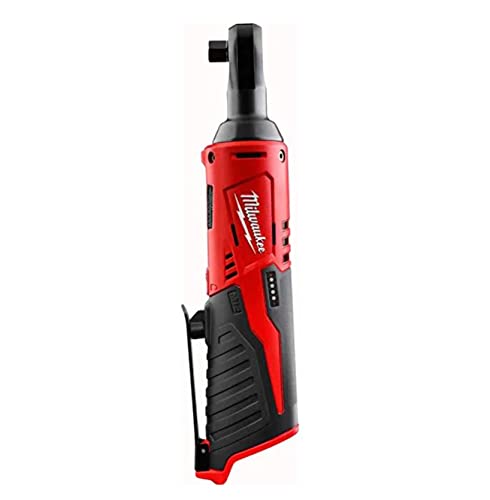
Milwaukee 2457-20 M12 3/8″ Ratchet — Best Value — The Proven Original
The 2457-20 is the tool that defined the modern cordless ratchet, and its listing states the numbers that made it: 35 foot-pounds of torque and 250 RPM from a sub-compact 3/8 inch tool with a variable-speed trigger. Those figures remain the honest center of the category — enough torque for the fasteners a ratchet should touch, enough speed to make run-down work brisk, in a head small enough to work where hands barely fit. Years after launch it remains the value recommendation because the design was right the first time.
Strengths
- Verified 35 ft-lbs / 250 RPM performance — the category’s honest baseline, stated by the maker
- Sub-compact head and body reach fasteners bulkier tools cannot
- Variable-speed trigger gives real control on small and delicate fasteners
Trade-offs
- Brushed-era design: less efficient and slower than the FUEL high-speed models
- Bare tool format assumes you own M12 batteries
- Torque ceiling means stubborn fasteners still start and finish by hand — true of all picks here, felt soonest on this one
| Drive | 3/8 inch |
| Torque | 35 ft-lbs (per listing) |
| Speed | 250 RPM (per listing) |
| Trigger | Variable speed |
| Platform | Milwaukee M12 |
| Format | Tool only |
There is a reason this model has survived in the catalog while generations of competitors cycled through: it is sized and powered for the actual distribution of fastener work. Most fasteners on most machines live well inside 35 foot-pounds, and most ratchet time is spent spinning, not torquing. The 2457-20 was specified by people who understood that, and its compact head — the dimension that decides whether a ratchet is useful or decorative in an engine bay — remains competitive with tools costing far more.
Buy it as the thinking person’s default. New M12 owners get a proven tool at the platform’s friendliest price; existing owners get the second ratchet that lives in the other toolbox. Its limits are the category’s limits, stated plainly: it will not break loose what a breaker bar owns, and it should not be asked to. Within its brief, very little at any price embarrasses it.
Best for: home mechanics and M12 owners wanting the proven tool at the friendly price / Not suited for: professionals billing by the hour, who should buy speed (the 2567-20)


Milwaukee 2560-20 M12 FUEL 3/8″ Extended Reach Ratchet — Best for Tight Engine Bays
Every engine bay has fasteners that seem designed as a practical joke: behind the accessory drive, under the intake, at the back of the block against the firewall. The 2560-20 is Milwaukee’s answer — an M12 FUEL 3/8 inch ratchet with an extended neck that puts the head where a standard ratchet’s body would collide, while keeping the head profile slim enough to engage the fastener once it gets there. It is a specialist, and for the work it specializes in, there is no substitute in this guide.
Strengths
- Extended reach accesses fasteners standard ratchets physically cannot engage
- FUEL brushless performance in the extended format — no power penalty for the reach
- Slim head profile preserves access at the fastener, not just on the way to it
Trade-offs
- The long neck is a liability in open work — leverage and control favor standard length for everyday fasteners
- Bare tool, premium FUEL pricing
- A second-ratchet purchase for most owners, complementing rather than replacing a standard model
| Drive | 3/8 inch |
| Motor | Brushless (FUEL) |
| Format | Extended reach, tool only |
| Platform | Milwaukee M12 |
Access tools should be judged by the jobs they make possible rather than the jobs they make faster. The extended-reach ratchet’s ledger is full of removals that otherwise mean pulling a wheel liner, dropping a subframe component, or working a quarter-turn at a time with a flex-head wrench for forty minutes. Against even one such job, the tool pays its way; across a project car’s life, it pays several times over.
The discipline is knowing when not to use it. Extended necks flex more under hand torque, and the break-loose moment — the highest-load moment in ratchet work — belongs on a standard tool or a breaker bar. Use the 2560-20 to reach, spin, and retrieve; use its standard-length sibling for force. Owners who internalize that division will find this the most satisfying specialty tool they own.
Best for: engine work with buried fasteners — accessory drives, intakes, firewall-side hardware / Not suited for: use as an only ratchet; it complements a standard model
Check the current price on Amazon

DEWALT DCF503B XTREME 12V MAX 3/8″ Ratchet — Best for DeWalt 12V Owners
The DCF503B is the ratchet for the substantial population whose 12 volt batteries say DeWalt. Part of the XTREME 12V MAX line, it delivers the platform’s take on the standard formula — a 3/8 inch cordless ratchet in bare-tool format for owners already invested in the batteries. Cross-platform comparisons of small ratchets are closer than brand loyalists admit; the decisive factor is the battery drawer you already own, and this pick exists to honor that arithmetic.
Strengths
- Native DeWalt 12V MAX compatibility — no second battery ecosystem to buy and maintain
- XTREME line positioning: DeWalt’s performance tier for its 12 volt platform
- Standard 3/8 inch drive covers the core fastener range
Trade-offs
- DeWalt’s 12 volt ratchet catalog is thinner than Milwaukee’s — no high-speed or extended-reach sibling in this guide
- Bare tool: the value case depends entirely on already owning 12V MAX batteries
- Fewer ratchet-specific accessories and variants than the M12 ecosystem offers
| Drive | 3/8 inch |
| Platform | DeWalt 12V MAX (XTREME) |
| Format | Bare tool only |
Platform economics deserve plain speech. A bare-tool ratchet on your existing platform costs the tool alone; the ‘better’ ratchet on a rival platform costs the tool plus two batteries plus a charger, and saddles you with a second ecosystem to store and maintain. That gap buys a lot of forgiveness for small spec differences. The DCF503B is a competent, modern 3/8 ratchet from a major toolmaker — for a DeWalt 12V owner, it is not the compromise choice, it is the correct one.
The honest limitation is trajectory. Milwaukee treats 12 volt ratchets as a category to be led, with speed and reach variants; DeWalt treats its 12V ratchet as a platform obligation, well executed but singular. If your work is standard run-down duty, that distinction never touches you. If you foresee extended-reach or high-speed needs, weigh a platform switch with open eyes — and read the M12 picks above as the alternative future.
Best for: DeWalt 12V MAX owners adding a ratchet to an existing kit / Not suited for: buyers starting from zero, who should compare full ecosystem costs first
Check the current price on Amazon

Makita RW01Z 12V max CXT Ratchet — Most Versatile — 3/8″ and 1/4″ in One Tool
The RW01Z solves the drive-size dilemma mechanically: its interchangeable square-drive design works as both a 3/8 inch and a 1/4 inch ratchet, which makes it the only pick here that serves the small-fastener world of the companion guide as well as the standard automotive range. It runs on Makita’s 12V max CXT slide-battery platform and is sold as a tool-only unit. For Makita owners — and for anyone whose work straddles big and small fasteners — it is the versatility pick by acclamation.
Strengths
- Interchangeable 3/8 and 1/4 inch drives: two ratchet classes in one tool body
- Makita build quality and CXT platform support
- Ideal for mixed work — equipment, appliances, automotive trim, and assembly
Trade-offs
- A convertible is a specialist at neither size; dedicated tools edge it out at each extreme
- CXT is the smallest of the three ecosystems here — check your battery situation first
- Tool-only format; the kit version (RW01R1) is the entry for new CXT owners
| Drive | 3/8 inch and 1/4 inch interchangeable |
| Platform | Makita 12V max CXT |
| Format | Tool only |
The dual-drive idea sounds like a gimmick until a job alternates sizes every third fastener — an appliance teardown, a piece of equipment with mixed hardware, an interior job with both structural and trim fasteners. Swapping an anvil beats swapping tools, and it beats owning two ratchets for owners whose 1/4 inch work is occasional but real. Makita, characteristically, executed the mechanism without turning the tool into a compromise sculpture; it remains a slim, serviceable ratchet in either configuration.
Its natural owner is the generalist: maintenance techs, equipment owners, serious DIYers whose fasteners refuse to standardize. Automotive specialists living entirely in 3/8 will prefer the Milwaukee depth; CXT loyalists get a ratchet that flatters their platform. And for readers of the companion 1/4 inch guide: this tool is the bridge pick, the one that lets a single purchase serve both articles’ needs.
Best for: generalists and Makita CXT owners whose work mixes 3/8 and 1/4 fasteners / Not suited for: single-size specialists who want the dedicated tool for their one size
Check the current price on Amazon

Milwaukee 2457-21 M12 3/8″ Ratchet Kit — Best Starter Kit
Every other pick in this guide assumes a battery drawer. The 2457-21 assumes nothing: it is the original M12 3/8 inch ratchet packaged as a kit with the battery and charger a newcomer needs, turning the platform decision into a single box. The tool inside is the same proven 35 ft-lb-class ratchet as the value pick, so the kit is not a diluted starter version — it is the real tool, bundled the way a first purchase should be.
Strengths
- Complete entry: ratchet, battery, and charger in one purchase — no ecosystem homework required
- The proven 2457 tool inside, not a detuned starter model
- Opens the entire M12 catalog: every future bare tool on the platform gets cheaper from here
Trade-offs
- Kit batteries in this class are typically compact capacity — heavy users will add a larger M12 battery soon
- If you already own M12 batteries, the bare 2457-20 is the smarter spend
- One battery in rotation means a mid-job charge break on the longest days; plan a second battery
| Drive | 3/8 inch |
| Platform | Milwaukee M12 |
| Format | Kit with battery and charger |
| Tool | 2457-series ratchet |
First purchases in a battery platform deserve more care than later ones, because they set the ecosystem for a decade of tools. This kit’s virtue is that it makes the strongest platform choice — M12, with the deepest ratchet and 12 volt catalog — also the easiest one. There is no compatibility research to do, no charger to source separately, and no risk of the classic beginner’s outcome: a great tool and the wrong battery, staring at each other across the workbench.
Treat the kit as the platform’s front door rather than its final form. Add a second, larger battery when the work justifies it, and every subsequent M12 bare tool — inflators, drivers, lights, the high-speed ratchet above — arrives at bare-tool prices. Judged as an ecosystem decision with a ratchet attached, this is the most consequential pick in the guide for a newcomer, and the one least likely to be regretted.
Best for: first-time 12 volt buyers who want the complete, correct starting point / Not suited for: existing M12 owners (buy the bare tool) or DeWalt/Makita loyalists
Check the current price on Amazon
Comparison Table
Platform is the hidden column in this table — it decides your battery costs for years after the ratchet choice is forgotten.
| Pick | Badge | Key spec | Best for |
|---|---|---|---|
| Milwaukee 2567-20 M12 FUEL High Speed 3/8″ Ratchet — Check price on Amazon | Best Overall | 3/8″ brushless high-speed, M12 | technicians and serious home mechanics who run fasteners daily or weekly |
| Milwaukee 2457-20 M12 3/8″ Ratchet — Check price on Amazon | Best Value — The Proven Original | 3/8″, 35 ft-lbs, 250 RPM | home mechanics and M12 owners wanting the proven tool at the friendly price |
| Milwaukee 2560-20 M12 FUEL 3/8″ Extended Reach Ratchet — Check price on Amazon | Best for Tight Engine Bays | 3/8″ extended reach, FUEL | engine work with buried fasteners — accessory drives, intakes, firewall-side hardware |
| DEWALT DCF503B XTREME 12V MAX 3/8″ Ratchet — Check price on Amazon | Best for DeWalt 12V Owners | 3/8″, DeWalt 12V MAX XTREME | DeWalt 12V MAX owners adding a ratchet to an existing kit |
| Makita RW01Z 12V max CXT Ratchet — Check price on Amazon | Most Versatile — 3/8″ and 1/4″ in One Tool | 3/8″ + 1/4″ convertible, CXT | generalists and Makita CXT owners whose work mixes 3/8 and 1/4 fasteners |
| Milwaukee 2457-21 M12 3/8″ Ratchet Kit — Check price on Amazon | Best Starter Kit | 3/8″ kit, M12 entry point | first-time 12 volt buyers who want the complete, correct starting point |
How to Choose a 12 Volt Ratchet
Choose the platform before the tool. A cordless ratchet is a decade-long relationship with a battery ecosystem, and the honest order of decisions is: which 12 volt platform’s wider catalog suits your work, then which ratchet within it. Milwaukee M12 offers the deepest ratchet line and the largest 12 volt catalog overall. DeWalt 12V MAX and Makita CXT serve their owners well with fewer ratchet variants. If you already own one platform’s batteries, that fact outweighs modest spec differences between rival ratchets — the guide’s platform picks exist for exactly that reason.
Within a platform, choose by work pattern. Standard 3/8 inch is the default drive for automotive and equipment fasteners. Speed (the high-speed FUEL) pays when fastener counts per job are high. Reach pays when your fasteners hide. And if your work regularly dips into small fasteners — trim, electronics-adjacent hardware, small equipment — either choose the convertible Makita or pair a standard ratchet with the dedicated 1/4 inch tools covered in the companion guide. Torque, notably, is the last thing to shop by: every quality 12 volt ratchet lives in the same few-dozen foot-pound neighborhood, because the tool’s job is spinning, not torquing.
What the torque numbers really mean
A cordless ratchet’s torque rating describes what its motor can deliver to a fastener, and the correct mental model is: motor torque handles the running, your hand handles the ends. Break-loose and final tightening are done with the tool switched off, used as a manual ratchet — the tools are built for it. Motor torque in the 30–55 ft-lb class covers the running resistance of properly loosened fasteners and the snugging of small ones. Anyone advertising impact-class torque in a slim ratchet is selling a number the tool’s head cannot survive delivering; the verified listings in this guide state their figures plainly, which is one reason they are the listings here.
Head profile and trigger: the specs that decide access
Two ratchets with identical torque live or die by head design. A slim, low-profile head enters gaps a chunky one cannot, and the difference of a few millimeters decides whole categories of fasteners. Trigger style matters nearly as much: paddle and variable-speed triggers let you feather small fasteners home without snapping them, which is a daily concern on the 6–8mm hardware that fills modern engine bays and interiors. When comparing within a platform, spend your attention here and on in-hand balance rather than on the second decimal of any performance figure.
Getting the Most From a Cordless Ratchet
Technique is the difference between a ratchet as a convenience and a ratchet as a system. Break fasteners loose by hand with the tool off, then spin them out under power; on assembly, spin them down under power and finish by hand, using a torque wrench wherever the manufacturer specifies a torque — which on anything sealing fluid or holding a wheel is always. Keep a hand ratchet in the same drawer: the cordless tool’s batteries will be flat one day, and the job will not care. And match sockets to the work — impact-rated sockets survive ratchet duty indefinitely, while thin-wall chrome sockets are for hand use and tight clearances.
Budget in the platform’s tiers rather than by sticker. Bare tools assume batteries; kits bundle them at a discount that only newcomers can use. The accessory that pays first is a second battery, sized up from the kit’s compact pack if your sessions run long. After that, the honest accessory is a slim 1/4 inch companion for small work, rather than ever-more duplicates of the same 3/8 tool. A two-ratchet drawer — standard 3/8 plus either an extended-reach or a 1/4 — covers a remarkable fraction of all mechanical work, which is why this guide’s picks are structured as complements instead of rivals.
- Decide platform first; the ratchet choice follows the batteries you own or want to own
- Use the motor for running fasteners, your hand for breaking loose and final tightening, a torque wrench where specified
- Prioritize head profile and trigger control over headline torque when comparing models
- A second battery is the highest-value accessory; a complementary second ratchet is the second-highest
- Keep sockets, extensions, and a universal joint in the same case as the ratchet — access is a system
Drive Sizes in the Real World: 1/4, 3/8, and When 1/2 Takes Over
Drive size is a statement about the fasteners a tool was born for. The 1/4 inch drive owns the small world — fasteners roughly up to 14mm, trim hardware, clamps, covers, small-engine and appliance work — where its slim sockets and heads reach what 3/8 hardware physically cannot, and where excess torque is a liability rather than an asset. The 3/8 inch drive owns the middle, which is most of mechanical life: engine accessories, suspension-adjacent hardware, equipment, and general automotive work in the 10–19mm heartland. The 1/2 inch drive owns force — wheels, chassis, and structural hardware — and in cordless form it belongs to impact wrenches, not ratchets, because no slim ratchet head should be asked to live at those loads.
The practical consequence for a 12 volt buyer is that drive size should follow your fastener census, not your ambitions. Count what you actually turn in a month. Most mixed home workshops discover a 3/8 majority with a meaningful 1/4 minority — which is why this guide’s structure (a 3/8 main list, a convertible that covers both, and a companion guide devoted to 1/4 specialists) mirrors the real distribution. Adapters exist to cross sizes in emergencies, and they earn their drawer space, but every adapter adds length, slop, and a failure point; a native tool at each size you use weekly is the professional answer, bought in the order your census dictates.
Sockets deserve the same census thinking. A cordless ratchet wants six-point sockets for anything corroded or tight, in the short lengths that preserve access, with a couple of extensions and a universal joint for the geometry that engine bays specialize in. Deep sockets earn their place on studs and long threads. Buying the ratchet is half the system; the steel that touches the fastener is the other half, and it is the half that decides whether the fastener survives the encounter.
How to Use a 12 Volt Ratchet Correctly, Job by Job
The cordless ratchet has a correct operating pattern, and learning it once prevents the two classic failures: snapped small fasteners and rounded stubborn ones.
- Select the right socket and seat it fully on the fastener. A half-seated socket under power is how hex heads become round heads.
- With the tool off, use it as a manual ratchet to break the fastener loose — a quarter turn is enough. If it will not move with reasonable hand force, stop: that fastener belongs to a breaker bar or penetrant, not to a 12 volt ratchet’s head.
- Switch on and spin the fastener out under power, supporting long fasteners with your free hand as they exit so they do not drop into the engine bay’s alternate dimension.
- Keep removed fasteners organized — a magnetic tray, in order, grouped by component. The ratchet makes removal fast enough that organization, not spinning, becomes the bottleneck of a clean job.
- On assembly, start every fastener by hand for at least two threads. Cross-threading under power happens in one trigger pull and ruins both fastener and hole.
- Run fasteners down under power until they seat, feathering the trigger on small hardware. Then switch the tool off and snug by hand.
- Where a torque specification exists — covers with gaskets, anything sealing, anything structural — finish with a torque wrench to the manufacturer’s figure, in the manufacturer’s sequence if one is given.
- Wipe the tool down before it goes back in the box. Oil and grit in the head mechanism are the quiet killers of ratchet life, and ten seconds with a rag is the entire maintenance schedule most ratchets ever need.
Charge the battery you used and rotate the spare in. A ratchet put away with a charged battery is a tool; a ratchet put away flat is a promise to your future self that you intend to break at the worst possible moment.
Common Buying Mistakes
Ratchet buyers tend to shop for the wrong number and skip the right questions. The classics:
Read this list before ordering and you will notice a pattern: almost none of the expensive mistakes are about the ratchet itself. They are about the system around it — the batteries you do or do not own, the fasteners you actually turn, the finishing tools you pair it with. A cordless ratchet is the middle of a workflow that starts with a breaker bar and ends with a torque wrench, and it disappoints exactly when it is asked to be the whole workflow. Buy it as the middle, and it will feel like the best money in the toolbox.
- Shopping by maximum torque. A 12 volt ratchet is a spinning tool. Torque beyond the class norm buys nothing and usually signals an unverifiable listing.
- Buying a bare tool with no batteries. The cheapest ratchet is the one that works on day one. Newcomers should buy the kit; bare tools are for platform owners.
- Using the motor to break loose seized fasteners. That load belongs to your hand, a breaker bar, or penetrant. Forcing it through the motor and head is how ratchets die young.
- Finishing critical fasteners by feel. Gasketed covers, fluid fittings, and anything structural get a torque wrench. The ratchet’s job ends at snug.
- Ignoring the second drive size. If your work includes small fasteners, forcing a 3/8 tool onto them with adapters adds slop and breakage. The 1/4 inch companion guide exists for this reason.
- Letting the tool live dirty. Grit in the head is a wear machine. A wipe-down habit doubles the useful life of the mechanism.
Final Recommendation
Condensed: the Milwaukee 2567-20 is the best 12 volt ratchet for users who run fasteners for a living; the 2457-20 is the proven value that most home mechanics should buy; the 2560-20 owns tight engine bays; the DeWalt DCF503B is the correct ratchet for 12V MAX owners; the Makita RW01Z is the convertible for mixed-size work; and the 2457-21 kit is the front door for newcomers. Every one of them was verified, and every one will be more useful than the spec sheet suggests once the technique in the how-to becomes habit.
Go deeper in the companion guides: Best 12 Volt Ratchet 1 4 for the small-drive specialists, Best 12 Volt Milwaukee for the M12 line in full, Best 12 Volt Power Tools and Best 12 Volt Power Tool Combo Kit for platform building, and Best 12 Volt Mini Drill and Best 12 Volt Nut Remover for the adjacent tools that share the drawer.
Ordering today? The Milwaukee 2567-20 for performance, the Milwaukee 2457-20 for value, or the 2457-21 kit if you are starting from zero — check the current price on Amazon for the format that matches your battery drawer.
Frequently Asked Questions
Can a 12 volt ratchet replace my impact wrench?
No — they do different jobs. An impact wrench delivers high torque in hammering bursts to break and tighten stubborn fasteners. A cordless ratchet delivers modest torque smoothly to spin fasteners quickly in tight spaces, and it is used manually for break-loose and final snugging. Most well-equipped mechanics own both; if you can only buy one first, buy the one matching your pain — seized suspension hardware says impact, endless engine-bay fasteners say ratchet.
Is 3/8 inch the right drive size for a first ratchet?
For most buyers, yes. The 3/8 inch drive covers the widest range of automotive and equipment fasteners, and sockets are the most available. Work dominated by small fasteners — trim, small engines, equipment panels — is better served by a 1/4 inch ratchet, and mixed work by the convertible Makita in this guide or by owning both sizes. The companion guide covers 1/4 inch in depth.
How much torque does a cordless ratchet really need?
Less than marketing suggests. The motor’s job is running fasteners, and the verified tools here work in the few-dozen foot-pound class — the Milwaukee 2457 states 35 ft-lbs, which has been the category’s honest center for years. Break-loose and final tightening are done by hand with the tool off. If a fastener needs more than hand-ratchet force to move, it needs a different tool entirely, not a bigger ratchet motor.
Bare tool or kit — which should I buy?
If you own batteries on the tool’s platform, buy the bare tool; the kit’s batteries would duplicate what you have. If you own no batteries on that platform, buy the kit — piecing together a tool, two batteries, and a charger separately costs more and delays the first job. The 2457-21 kit in this guide is the model example of the complete entry purchase.
Can I use a cordless ratchet as a manual ratchet?
Yes — that is part of the design. With the motor off, these tools ratchet by hand for breaking fasteners loose and for final snugging, which is why their heads are built like ratchet heads rather than drill chucks. Respect sensible hand-force limits; a cordless ratchet is not a breaker bar, and cheater pipes have no place on it.
Why does my ratchet stop or struggle on some fasteners?
Usually one of three causes: the fastener’s running resistance exceeds the motor’s torque (corrosion is the usual suspect — clean or replace the hardware), the battery is a compact pack sagging under load (a larger battery helps), or the fastener was never properly broken loose by hand first. Work through those in order before blaming the tool.


