Disclosure: airfryerkitchensupply.com is reader-supported. When you buy through links on our site, we may earn an affiliate commission at no extra cost to you.
Where to buy
Every pick in this guide to the best 12 volt impact wrench was cross-checked against Amazon’s own catalog data before it earned a link, so the model names and listings below match what you will actually find on the product page. Prices move with promotions and seasons, so check price on Amazon for the current figure on any pick instead of trusting a number printed in a guide like this one.
- Milwaukee M12 FUEL Stubby 1/2 Inch Impact Wrench (Bare Tool) — Check on Amazon
- Milwaukee 2554-22 M12 FUEL Stubby 3/8 in. Impact Wrench Kit — Check on Amazon
- DEWALT 12V MAX 3/8 Inch Impact Wrench Kit — Check on Amazon
- Makita WT03Z 12V max CXT 1/2 Inch Sq. Drive Impact Wrench, Tool Only — Check on Amazon
- BOSCH PS82-02 12V Max EC Brushless 3/8 In. Impact Wrench Kit — Check on Amazon
- Makita WT04R1 12V max CXT 1/4 Inch Impact Wrench Kit (2.0Ah) — Check on Amazon
The best 12 volt impact wrench solves a specific problem: breaking loose lug nuts, suspension bolts and machinery fasteners in spaces where a full-size wrench — and the arm swinging it — simply do not fit. The modern 12 volt class, led by Milwaukee’s M12 FUEL Stubby designs, delivers genuinely useful breakaway power in bodies barely larger than a drill, and this guide covers the six verified options worth your money.
Be clear about the class’s honest role before the list. A 12 volt impact wrench is a compact problem-solver for automotive fasteners, equipment maintenance and assembly work — not a replacement for a high-torque half-inch gun on rusted truck hardware. Every pick here was verified against current manufacturer listing data, and the reviews state plainly which fasteners each tool is really for.
Drive size is the first decision the reviews will help you make: 3/8-inch models are the compact sweet spot for automotive work, 1/2-inch models take standard sockets and lug duty more seriously, and one pick uses a 1/4-inch square drive for light assembly. Match the drive to your socket drawer and the badge system below will point you at the right tool.
In this guide
Quick Picks
Six verified 12 volt impact wrenches across Milwaukee, DEWALT, Makita and Bosch. Badges match the full reviews, and each quick pick names its drive size — check it against your sockets before anything else.
Milwaukee M12 FUEL Stubby 1/2 Inch Impact Wrench (Bare Tool) — Best Overall
The class-defining tool in its most useful drive size: the M12 FUEL Stubby with a 1/2-inch anvil, sold bare for the M12 owners who already hold batteries. Maximum compact breakaway ability, minimum body length — this is the pick the category is judged by. Check price on Amazon.
Milwaukee 2554-22 M12 FUEL Stubby 3/8 in. Impact Wrench Kit — Best Kit
The Stubby as a complete purchase: 3/8-inch drive with both a compact 2 Ah and a larger 4 Ah battery in the kit. For first-time M12 buyers who want the wrench first, this is the smartest box in the guide. Check price on Amazon.
DEWALT 12V MAX 3/8 Inch Impact Wrench Kit — Best for DEWALT Owners
DEWALT’s compact wrench in complete kit form: 3/8-inch drive on the XTREME 12V MAX platform. Yellow-platform owners get their stubby-class tool without changing battery families — which is exactly the point. Check price on Amazon.
Makita WT03Z 12V max CXT 1/2 Inch Sq. Drive Impact Wrench, Tool Only — Best 1/2-Inch Alternative
Makita’s route to a 1/2-inch compact wrench: the WT03Z on the CXT slide-battery platform, sold as a bare tool for existing owners. The pick for CXT households that need lug-size drive without leaving the family. Check price on Amazon.
BOSCH PS82-02 12V Max EC Brushless 3/8 In. Impact Wrench Kit — Best Compact Brushless Kit
Bosch’s brushless compact wrench in full kit form: EC motor efficiency, a 3/8-inch anvil and the precise feel Bosch compact tools are known for. The precision-first alternative to the Stubby, on the same platform as both Bosch drivers in this batch. Check price on Amazon.
Makita WT04R1 12V max CXT 1/4 Inch Impact Wrench Kit (2.0Ah) — Best Light-Duty Kit
The finesse end of the class: a 1/4-inch square-drive wrench in a complete CXT kit, for small machinery, assembly and equipment fasteners where a big wrench is pure liability. Small drive, small fasteners, exactly right. Check price on Amazon.
How These Picks Were Chosen
Every pick had to be a genuine 12 volt platform impact wrench — square-drive anvil, impact mechanism, from a major tool platform — verified against current listing data before earning a link. We excluded the corded electric wrenches and the 12V cigarette-lighter novelty wrenches bundled in car-jack kits; they are different tools for different jobs and are discussed honestly in the buying guide instead of padded into this list.
Ranking started with the stubby form factor, because compactness is the entire point of the class: the Milwaukee FUEL Stubby designs set the template, putting serious breakaway capability into a head short enough for engine bays and suspension work. Kit completeness mattered — a wrench without batteries is a paperweight — as did anvil type, with friction-ring (hog ring) anvils favored for fast socket changes.
Platform breadth broke ties, as it did in our impact driver guide: these wrenches share batteries with the 12 volt drivers, ratchets and inflators their owners already run, and a wrench that joins an existing battery family is worth more than a slightly stronger orphan. Control modes that prevent overtightening on reassembly also scored, because a good wrench driver finishes the job in both directions.
What Are the 6 Best 12 Volt Impact Wrench Options?

Milwaukee M12 FUEL Stubby 1/2 Inch Impact Wrench (Bare Tool) — Best Overall
Milwaukee’s Stubby design rewrote what a 12 volt impact wrench could be, and this 1/2-inch M12 FUEL version is its fullest expression: flagship brushless power in a body short enough to live inside engine bays and wheel arches, driving the standard 1/2-inch sockets most garages already own. It is sold as a bare tool, aimed at the huge M12 installed base.
Strengths
- Class-defining stubby design reaches fasteners full-size wrenches cannot
- 1/2-inch anvil matches standard socket sets and lug duty
- M12 platform offers the widest battery and tool support in the class
Trade-offs
- Bare tool — batteries and charger are separate if you are new to M12
- Compact class limits remain: seized heavy hardware still needs a bigger tool
- Flagship pricing for the bare tool alone
| Platform | Milwaukee M12 FUEL |
| Drive | 1/2 inch (verified listing) |
| Format | Bare tool (verified listing) |
| Design | Stubby compact form |
The Stubby’s trick is not raw torque — it is torque delivered at a length that fits the work. Suspension bolts, brake hardware and engine accessories that once demanded a ratchet and patience come off in bursts, and lug nuts on passenger cars are routine. Owners consistently describe it as the tool that shrinks jobs, which is the highest praise a compact wrench can earn.
Buy it as the centerpiece of an M12 garage, alongside the FUEL impact driver from our companion guide, and the pair covers fastening from trim screws to wheel hardware on one battery family. New-to-platform buyers should price the 3/8-inch kit below before defaulting to this bare tool, however — the kit’s included batteries change the true cost comparison.
Best for: M12 owners and home mechanics who want the strongest compact wrench for automotive work / Not suited for: first-time platform buyers without batteries, or heavy truck and rust-belt seized hardware
Check on Amazon — check price on Amazon for the current listing.
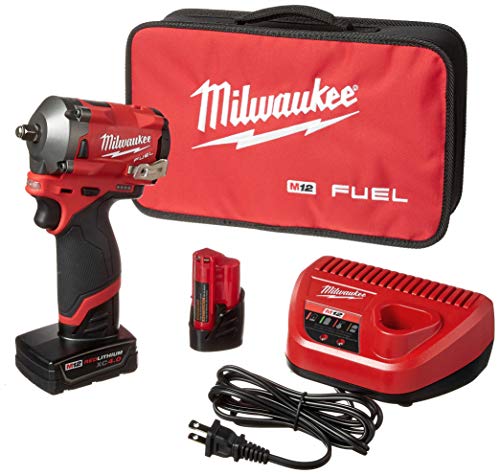
Milwaukee 2554-22 M12 FUEL Stubby 3/8 in. Impact Wrench Kit — Best Kit
The 2554-22 packages the M12 FUEL Stubby in 3/8-inch drive as a true kit, and its battery pairing is the thoughtful part: a compact 2 Ah pack for light, tight work and a 4 Ah pack for the voltage support that breakaway torque demands. It is the version of the Stubby most buyers should actually purchase.
Strengths
- Complete kit with two battery sizes matched to the work
- 3/8-inch drive is the compact automotive sweet spot
- Same FUEL Stubby design as the overall pick
Trade-offs
- 3/8-inch sockets may be a new set for 1/2-inch households
- Kit pricing reflects the flagship platform
- Lug-heavy users may still prefer the 1/2-inch model above
| Platform | Milwaukee M12 FUEL |
| Drive | 3/8 inch (verified listing) |
| Format | Kit, 2 Ah and 4 Ah batteries (verified listing) |
| Design | Stubby compact form |
Battery pairing is this kit’s quiet brilliance. Compact packs keep the tool short and light for engine-bay fasteners; the 4 Ah pack transforms the same tool on lug nuts and suspension bolts by holding voltage under peak load. Learning which pack suits which job — the extra sections of this guide cover it — turns one wrench into two tools’ worth of range.
As a platform entry it is equally well judged: the charger and batteries here power the entire M12 family, including the driver and inflator picks in this batch. If the Stubby concept appeals and you own no M12 gear, start with this box rather than assembling the same kit piecemeal at greater cost.
Best for: first-time M12 buyers and automotive DIYers who want one complete wrench kit / Not suited for: owners of deep 1/2-inch socket collections who rarely touch 3/8-inch hardware
Check on Amazon — check price on Amazon for the current listing.

DEWALT 12V MAX 3/8 Inch Impact Wrench Kit — Best for DEWALT Owners
DEWALT’s 12V MAX impact wrench kit gives the XTREME platform its compact automotive tool: a 3/8-inch wrench sold as a complete kit, so DEWALT owners can add socket work to the same batteries that run their DCF801 impact driver. Platform continuity is this pick’s headline, and for its audience that is the right headline.
Strengths
- Complete kit on the DEWALT 12V MAX battery family
- 3/8-inch drive sized for automotive fasteners
- Natural partner to the DCF801 driver in this batch’s driver guide
Trade-offs
- DEWALT’s 12V catalog is smaller than Milwaukee’s M12 range
- Listing title is terse — confirm kit contents on the product page
- Compact-class torque limits apply as they do to every pick here
| Platform | DEWALT 12V MAX |
| Drive | 3/8 inch (verified listing) |
| Format | Kit (verified listing) |
| Brand | DEWALT (verified listing) |
The value of this wrench is cumulative. Paired with the XTREME driver, it completes the compact fastening pair on one charger, and DEWALT’s ergonomics — the grip and balance its users prefer — carry over intact. For a home garage already running yellow 12 volt tools, that continuity outweighs small specification differences against rival wrenches.
It also suits DEWALT-curious buyers as a platform entry: a genuine kit, a mainstream drive size, and a brand with service everywhere. Check the current listing for the exact battery and charger contents before ordering, as kit packaging in this class is occasionally revised — the guidance this guide gives for every pick.
Best for: DEWALT 12V MAX owners adding automotive capability to their platform / Not suited for: buyers building the largest possible compact-tool collection
Check on Amazon — check price on Amazon for the current listing.

Makita WT03Z 12V max CXT 1/2 Inch Sq. Drive Impact Wrench, Tool Only — Best 1/2-Inch Alternative
The Makita WT03Z brings a full 1/2-inch square drive to the compact CXT platform, which makes it the natural wrench for Makita households whose socket sets live on the larger drive. Sold tool-only, it assumes — fairly — that its buyer already runs the DT03 driver and holds CXT batteries.
Strengths
- True 1/2-inch drive on a compact platform
- CXT slide batteries give balanced, stable handling
- Makita build quality and service network
Trade-offs
- Tool only — new buyers must add batteries and charger
- CXT is a compact-focused platform with fewer heavy siblings
- Less headline-grabbing than the Stubby designs
| Platform | Makita 12V max CXT |
| Drive | 1/2-inch square drive (verified listing) |
| Model | WT03Z (verified listing) |
| Format | Tool only |
Makita’s compact tools reward owners with refinement rather than spectacle, and the WT03Z follows the pattern: balanced in the hand, sensibly controlled, and sized for the automotive and maintenance fasteners that fill a normal week. The 1/2-inch drive is its decisive feature — no adapter stack wasting the compact advantage when the lug sockets come out.
It is the right buy inside an existing CXT kit and a questionable one outside it, which this guide states plainly because bare tools live or die on that distinction. CXT owners: this is your wrench. Everyone else: start with a kit pick and join a platform deliberately.
Best for: existing Makita CXT owners who need a 1/2-inch compact wrench / Not suited for: first-time buyers without CXT batteries, who should choose a kit
Check on Amazon — check price on Amazon for the current listing.

BOSCH PS82-02 12V Max EC Brushless 3/8 In. Impact Wrench Kit — Best Compact Brushless Kit
The Bosch PS82-02 applies the brand’s EC brushless technology to a 3/8-inch impact wrench kit, completing the compact fastening pair alongside the PS42 driver. It is the control-focused entry here — the wrench for fasteners that need judgment as much as force.
Strengths
- EC brushless efficiency and cool running
- Compact, precise handling for engine-bay and machinery work
- Shares Bosch 12V Max batteries with the PS41 and PS42 drivers
Trade-offs
- Bosch 12V Max catalog is narrower than M12
- Control-first tuning gives up some brute breakaway drama
- Kit contents are workmanlike rather than generous
| Platform | Bosch 12V Max |
| Model | PS82-02 (verified listing) |
| Motor | EC brushless |
| Drive | 3/8 inch (verified listing) |
| Format | Kit |
Where the Stubby sells maximum compact power, the Bosch sells placement: it gets onto fasteners in machinery, appliances and tight automotive corners and meters its force with unusual civility. Maintenance technicians who work around finished surfaces and delicate housings feel that difference immediately, and the brushless motor keeps the tool frugal through a day of intermittent use.
As a kit it also completes a coherent Bosch compact bench — driver, wrench, one battery family — at a total commitment below the flagship pairings. Bosch loyalists and precision-first buyers will not miss the Milwaukee’s extra drama; they will notice, daily, how little fuss this tool makes.
Best for: Bosch platform owners and maintenance work where control matters most / Not suited for: maximum breakaway seekers or the widest platform ambitions
Check on Amazon — check price on Amazon for the current listing.

Makita WT04R1 12V max CXT 1/4 Inch Impact Wrench Kit (2.0Ah) — Best Light-Duty Kit
The Makita WT04R1 kit closes this guide at the light-duty end: a 1/4-inch square-drive impact wrench on the CXT platform, complete with a 2.0Ah battery. It exists for the fasteners the other picks overpower — small machinery, equipment assembly, furniture-grade hardware and delicate mechanical work with sockets.
Strengths
- 1/4-inch drive suits small fasteners the big wrenches endanger
- Complete kit makes it a self-contained light-duty solution
- CXT balance and light weight for bench and assembly work
Trade-offs
- Not a lug-nut tool — respect the light-duty brief
- 1/4-inch square sockets are a specialty set for many owners
- Shares CXT’s compact-platform limits
| Platform | Makita 12V max CXT |
| Model | WT04R1 (verified listing) |
| Drive | 1/4-inch square drive (verified listing) |
| Format | Kit with 2.0Ah battery (verified listing) |
Every class needs its finesse pick, and this is the wrench guide’s. Assembly benches, small-engine and equipment shops, and maintenance roles built around small socket work get a tool that applies impact speed without impact violence — and because it arrives as a kit, it can join any bench as a specialist without disturbing the main platform choice.
Judge it strictly by its brief and it is excellent: the wrong tool for wheels, the right tool for the hundred smaller socket jobs that wheels distract us from. Buyers whose fastener world is mostly small will use this more than any other pick in the guide.
Best for: assembly, small machinery and equipment maintenance with small fasteners / Not suited for: automotive lug work or any job needing 3/8 or 1/2-inch drive
Check on Amazon — check price on Amazon for the current listing.
Comparison Table
Drive size and kit format separate these six more than brand does. Use the table to match the anvil to your socket set first, then read the review of the tool that fits it.
| Pick | Badge | Key spec | Best for | Link |
|---|---|---|---|---|
| Milwaukee M12 FUEL Stubby 1/2 Inch Impact Wrench (Bare Tool) | Best Overall | M12 FUEL Stubby, 1/2-inch drive, bare tool | M12 owners and home mechanics who want the strongest compact wrench for automotive work | Check on Amazon |
| Milwaukee 2554-22 M12 FUEL Stubby 3/8 in. Impact Wrench Kit | Best Kit | M12 FUEL Stubby, 3/8-inch, kit with 2 Ah and 4 Ah batteries | first-time M12 buyers and automotive DIYers who want one complete wrench kit | Check on Amazon |
| DEWALT 12V MAX 3/8 Inch Impact Wrench Kit | Best for DEWALT Owners | XTREME 12V MAX, 3/8-inch, complete kit | DEWALT 12V MAX owners adding automotive capability to their platform | Check on Amazon |
| Makita WT03Z 12V max CXT 1/2 Inch Sq. Drive Impact Wrench, Tool Only | Best 1/2-Inch Alternative | CXT platform, 1/2-inch square drive, tool only | existing Makita CXT owners who need a 1/2-inch compact wrench | Check on Amazon |
| BOSCH PS82-02 12V Max EC Brushless 3/8 In. Impact Wrench Kit | Best Compact Brushless Kit | 12V Max EC brushless, 3/8-inch, complete kit | Bosch platform owners and maintenance work where control matters most | Check on Amazon |
| Makita WT04R1 12V max CXT 1/4 Inch Impact Wrench Kit (2.0Ah) | Best Light-Duty Kit | CXT platform, 1/4-inch square drive, kit with 2.0Ah battery | assembly, small machinery and equipment maintenance with small fasteners | Check on Amazon |
How to Choose the Best 12 Volt Impact Wrench for Automotive and Assembly Work?
Choose the drive size from your fasteners. The 3/8-inch drive is the compact automotive standard: it covers the great majority of car fasteners, pairs with the deepest compact socket selection, and keeps the tool smallest. Choose 1/2-inch if lug nuts and larger hardware are the core job and your sockets already live on that drive. The 1/4-inch square-drive pick here serves light assembly and small machinery, where finesse beats force.
Understand what the class can and cannot break loose. In good condition, compact 12 volt wrenches handle lug nuts torqued to typical passenger-car specifications and the ordinary run of automotive and equipment bolts — the work that fills a home garage and a maintenance shop. Corroded, oversized or previously over-torqued hardware still belongs to a full-size high-torque wrench or a breaker bar first; the smart workflow is breaker bar for the first quarter-turn, compact wrench for the fast run-off.
Finally, weigh anvil style and modes. A friction-ring anvil swaps sockets with a push, ideal when one job cycles through sizes; a pin-detent anvil holds sockets more securely overhead at the cost of slower changes. Auto-shutoff or precision modes that stop the tool at snug protect threads and wheels during reassembly — use them, and finish every critical fastener with a torque wrench regardless of what any impact tool promises.
12 Volt Impact Wrench vs. Corded and Car-Jack-Kit Wrenches: What Is the Difference?
Three different tools hide behind similar names, and this guide’s picks are only the first. A 12 volt platform impact wrench — every pick here — is a professional cordless tool on a rechargeable battery system, built for daily automotive and maintenance work. Its power, durability and support are in a different league from the alternatives below.
A corded electric impact wrench plugs into household power and delivers strong, sustained torque for garage use at low cost; it is a legitimate choice for a fixed workshop, but the cord ends its usefulness at the vehicle in the driveway, let alone the roadside. A 12V cigarette-lighter impact wrench, usually bundled with electric car-jack kits, is an emergency tire-change accessory: slow, lightly built, and adequate for the occasional lug nut at the roadside — which is a real job, but not the job this guide’s picks are bought for.
Knowing which of the three you need prevents the classic disappointment of expecting platform-tool performance from an emergency accessory. If your work is regular, mechanical and varied, buy from this guide. If it is a once-a-year roadside tire change, the jack-kit wrench exists for you — and a torque wrench and a charged platform tool are still the better trunk companions.
How to Use a 12 Volt Impact Wrench Safely on Lug Nuts and Bolts?
Compact wrenches are forgiving tools, but wheels and suspension hardware punish sloppy habits. This sequence is how careful mechanics use them, in both directions.
- Break stubborn fasteners loose by hand first: a breaker bar for the initial quarter-turn protects both the fastener and the compact wrench from shock loads beyond its design.
- Fit the correct impact-rated socket fully onto the anvil — standard chrome sockets can crack under impact use — and confirm it seats on the friction ring or detent pin.
- Run fasteners off in short bursts, keeping the tool square to the bolt, and catch lug nuts before they drop and roll — a magnetic tray pays for itself in one job.
- Start every fastener by hand on reassembly, at least two full threads, so the wrench can never cross-thread a stud or bolt hole.
- Run fasteners down with the wrench only to snug, using an auto-shutoff or low mode where fitted, then stop.
- Finish with a torque wrench to the vehicle or equipment specification, in the correct star pattern for wheels. The impact wrench’s job is speed; the torque wrench’s job is truth.
Step six is non-negotiable and worth repeating: no impact wrench in this guide — or any guide — sets final torque. The compact 12 volt class makes the fast parts faster and the tight spaces reachable; the torque wrench still signs the work. Owners who build that habit get the full benefit of these tools with none of the wheel-off risks that give impact tools a bad name.
What Sockets and Accessories Does a 12 Volt Impact Wrench Need?
Start with impact-rated sockets in your drive size — non-negotiable, as this guide’s mistakes section explains — in the sizes your vehicles and equipment actually use. For most car owners that is a compact set covering the common lug and suspension sizes rather than a giant rail of rarely touched dimensions. A set that lives with the wrench, in the vehicle or the top of the toolbox, gets used; a set stored across the garage turns every job into a walk.
Add a torque wrench, because the pair is the real product. The compact wrench removes and runs down; the torque wrench signs. Owners who buy both together from the start build the correct habit immediately, and the torque wrench’s cost is trivial against one warped rotor or one wheel stud failure. A breaker bar completes the trio for the corroded first quarter-turn, and the three together — breaker, compact wrench, torque wrench — are the complete fastening kit this class was designed around.
Extensions and universal joints deserve a caution rather than a recommendation. Each joint in the drive line flexes under impact and consumes torque, and universal joints at an angle can bind or walk off fasteners. Use the shortest, straightest path to the fastener the space allows; the stubby designs in this guide exist precisely to make that possible more often than owners expect.
Finally, a small magnetic tray and a headlamp are the accessories veterans actually swear by. Lug nuts roll, clips drop, and engine bays are dark in exactly the corner the fastener occupies. None of this costs much, all of it saves the specific frustrations that make people dislike mechanical work, and together with the wrench it turns a dreaded job into a routine one.
How Does a 12 Volt Impact Wrench Handle Winter and Road Salt Conditions?
Cold changes every variable in this tool’s work. Batteries deliver less in deep cold, lubricants in the impact mechanism thicken, and the fasteners themselves — salted, corroded, thermally contracted — resist harder than at any other season. The compact class still performs, but winter is when its honest limits arrive earliest: keep batteries warm indoors until the job, expect the first fasteners of a frozen morning to be the hardest, and let the breaker bar lead more often than summer pride allows.
Road salt is the deeper enemy, because it converts ordinary fasteners into corroded ones on a schedule. The workflow this guide teaches — penetrating oil, patience, breaker bar first — matters most exactly when it is least pleasant to practice, kneeling in slush. Owners in salted regions also learn to run fasteners down with anti-seize judgment where the manufacturer permits it, so next winter’s removal is a job rather than an excavation.
The tool itself needs winter manners too: wipe salt spray and grit from the anvil and housing after wheel work, store the wrench dry and indoors rather than in a freezing trunk where its batteries age and its mechanism condenses moisture nightly, and bring it to room temperature before charging a cold-soaked battery, which lithium cells strongly prefer.
None of this disqualifies the class from winter duty — compact wrenches change winter tires across the snow belt every season, in driveways, at temperatures their spec sheets tolerate without complaint. It simply means winter rewards the prepared owner: warm batteries, clean tools, penetrating oil bought in autumn, and the humility to let hand tools start what the compact wrench finishes.
Common Buying Mistakes
Mistake 1: using chrome sockets on an impact wrench. Chrome sockets are hardened for hand use and can shatter under impact pulses. Impact-rated sockets are softer, thicker and built for exactly this tool — the set costs less than one damaged wheel or one injury.
Mistake 2: expecting compact torque to defeat corrosion. A rusted, seized fastener that ignores a 12 volt wrench is not a defective wrench; it is a job for penetrating oil, patience, a breaker bar or a full-size tool. Forcing the compact tool just overheats it.
Mistake 3: tightening wheels with the wrench alone. Impact-tightened lugs end up uneven and frequently over-torqued, warping rotors and stranding the next person with the flat. Snug with the wrench, finish with a torque wrench, every time.
Mistake 4: buying the wrong drive size for your sockets. Adapters exist, but they add length that defeats the compact purpose and flex that wastes torque. Match the anvil to the socket set you actually own, using the comparison table above.
Mistake 5: starting fasteners with the tool. An impact wrench can cross-thread a stud faster than a hand can react. Two threads by hand, every time, is the cheapest insurance in mechanical work.
Socket organization sounds trivial until you work from a compact wrench daily. These tools shine in quick, varied jobs — three sizes in ten minutes across one vehicle — and a socket rail or magnetic tray that keeps the common automotive sizes together is worth more than a second battery for most home mechanics. Keep the 3/8 or 1/2-inch set matched to your pick’s drive together as one kit, and the wrench stays the grab-and-go tool it was bought to be.
Battery choice matters more on a wrench than on a driver, because breakaway torque is a peak-demand job. The larger-capacity packs in each platform hold voltage better under that peak, so a wrench that feels marginal on a compact pack often feels transformed on the bigger one. If your kit includes both sizes, reserve the large pack for lug and suspension work and the compact pack for light assembly, and both the tool and the batteries will live longer.
Finally, store the wrench dry and the anvils clean. Road grit and brake dust work into friction rings and detents, and a wipedown after wheel work keeps socket changes crisp. Compact tools get carried everywhere and cleaned rarely; the owners who reverse that ratio are the ones whose ten-year-old tools still feel new.
Roadside readiness is a legitimate reason to own this class even for non-mechanics. A compact wrench, its matched lug socket, a charged battery and a torque wrench in the trunk convert a flat tire from a wrestling match with a cross wrench — on lugs some shop overtightened months ago — into a controlled ten-minute procedure. That scenario, more than any garage project, is why many owners buy the kit versions here and keep them in the vehicle permanently.
Fleet and shared-equipment buyers should note the platform discipline argument in reverse: a small business running one 12 volt family across its vans gets interchangeable batteries, one charger type, and tools any technician can pick up without a briefing. The wrenches in this guide were chosen from the four most supportable platforms for exactly that buyer, and the kit picks are the fleet-sensible configurations.
A note on refurbished and previous-generation versions of these wrenches, which circulate widely: the stubby concept has iterated quickly, and older or larger compact wrenches can be genuine bargains if their batteries match your platform. Verify the exact model against the manufacturer’s listing before buying — the discipline this guide applied to every pick — because compact wrench naming is a swamp of near-identical model numbers with meaningfully different sizes.
Lastly, respect the tool’s feedback. A compact wrench that suddenly slows, heats or sounds strained is reporting a fastener beyond its brief or a battery at its limit, and both reports are information, not defiance. Stop, reassess, reach for the breaker bar or the fresh battery, and the tool will live to work the next job — which is the entire philosophy of the compact class in one habit.
Rental and borrowing culture around this class is worth a paragraph, because compact wrenches are lent constantly and returned slowly. If you lend yours, lend it with its matched lug socket and one explicit sentence — snug only, torque wrench finishes — because the borrower’s most likely error is not damage to the tool but over-tightened wheels on their own car. The tool will come back fine either way; the friendship benefits from the sentence.
For motorcycle, ATV and small-engine owners, this class is arguably even more at home than in car work. The fasteners are smaller, the spaces tighter, and the torque demands sit squarely in compact territory, which is why the 3/8-inch picks and the light-duty Makita kit exist in this guide’s spread. Riders who maintain their own machines often find the compact wrench, not the driver, becomes the most-touched tool in the box.
And a closing note on noise and neighbors, since impact tools announce themselves: the compact class is meaningfully quieter than full-size wrenches, and its bursts are shorter, which matters in shared garages, apartment parking and early-morning driveway work. It will never be silent — impact is impact — but the difference between this class and a half-inch gun at 7 a.m. is the difference between a tool and a neighborhood event.
A short note on anvil care, because it is the maintenance item this class actually has: keep the friction ring or detent clean and very lightly oiled, and retire sockets that have rounded enough to rock on the anvil. A worn socket on a worn ring is how tools get blamed for slipping, and the fix costs a socket, not a wrench. Thirty seconds with a rag after dirty work keeps the connection — the literal point where all the tool’s work happens — honest for years.
Garage organization completes the picture: the wrench, its socket set, the torque wrench and the breaker bar should live within one arm’s reach of each other, because they are one tool in four bodies. Owners who store them together finish jobs in one session; owners who scatter them across benches and vehicles finish jobs eventually. The compact class rewards the together household disproportionately, since its whole promise is speed on small jobs — and small jobs are exactly the ones abandoned when setup takes longer than the work.
And the honest closing comparison for buyers cross-shopping this guide against its driver sibling: if your fasteners have screw heads, buy the driver first; if they have hex heads and nuts, buy the wrench first; if they have both — which is most real workshops, eventually — buy the kit from one platform and add the other tool bare when the work proves the need. The platforms in these two guides are the same four families precisely so that sequence works in either order, and that, more than any single pick, is the recommendation the pair of guides exists to make.
Final Recommendation
For most buyers, the Milwaukee M12 FUEL Stubby in 1/2-inch is the best 12 volt impact wrench to own: the class-defining compact design, serious breakaway ability for its size, and the deepest 12 volt platform behind it — with its 3/8-inch kit sibling the better buy if you want batteries and charger in one box. DEWALT’s 12V MAX kit serves yellow-platform owners, Makita offers both a 1/2-inch tool-only option for CXT owners and a light-duty 1/4-inch kit, and the Bosch PS82-02 kit brings brushless compactness to the Bosch 12V Max family.
Whichever you choose, pair it with impact-rated sockets and a torque wrench from day one. The wrench provides the speed and the reach; the other two provide the safety and the accuracy, and together they are the complete compact fastening setup.
Start with the top picks here: Check on Amazon Check on Amazon Check on Amazon.
Best 12 Volt Impact Driver Best 12 Volt Inflator Best 12 Volt Ice Chest Best 12 Volt Hammer Drill Best 12 Volt Batteries
Frequently Asked Questions
Can a 12 volt impact wrench remove lug nuts?
Yes, in normal conditions: the compact flagships here are built for passenger-car lug nuts torqued to typical specifications, and that ability is their core selling point. Rusted, damaged or heavily over-torqued lugs may still need a breaker bar for the first movement — which is technique, not failure — after which the compact wrench runs them off in seconds.
Should I choose 3/8-inch or 1/2-inch drive?
Match your sockets and your fasteners. The 3/8-inch drive is the compact automotive sweet spot and keeps the tool smallest; the 1/2-inch drive suits lug-focused work and larger hardware, and matches most existing socket collections. The comparison table above lists each pick’s drive so you can shortlist in one pass.
What is the difference between an impact wrench and an impact driver?
The anvil and the job. An impact driver uses a 1/4-inch hex collet for screwdriver bits and drives screws; an impact wrench uses a square drive for sockets and turns nuts and bolts. They are siblings, not substitutes — most mechanics own both on the same battery platform, which is why these two guides cross-reference each other.
Do I still need a torque wrench with a 12 volt impact wrench?
Yes, always, for wheels and any specified-torque fastener. Use the impact wrench to remove and to run down to snug, then set final torque with a torque wrench in the correct pattern. No impact tool measures torque accurately enough to sign off on a wheel.
Kit or bare tool for a first impact wrench?
A kit if it is your first tool on the platform — the Milwaukee 2554-22, DEWALT, Makita WT04R1 and Bosch PS82-02 picks here are kits. Bare tools like the Milwaukee 1/2-inch Stubby and Makita WT03Z make sense as additions for owners who already hold the platform’s batteries and charger.
Why is my 12 volt wrench struggling with a bolt it should handle?
Check the usual four: a standard chrome socket flexing or cracking, an adapter stack wasting torque, a nearly empty compact battery sagging under load, or a fastener that is corroded rather than merely tight. Fit a proper impact socket directly, charge or upsize the battery, and give seized hardware penetrating oil and a breaker bar’s first quarter-turn.


