Disclosure: airfryerkitchensupply.com is reader-supported. When you buy through links on our site, we may earn an affiliate commission at no extra cost to you.
Where to buy
Shopping for the best 12 volt heated motorcycle jacket means shopping mostly for liners — and that is a good thing, explained in the introduction below. Every product in this roundup was verified against live retailer data before earning a link, and because heated gear pricing swings hard with the seasons, each link exists so you can check the current price on Amazon and confirm your size on the day you actually buy.
- Gerbing Heated Jacket Liner – 12V Motorcycle — Best Overall: check price on Amazon.
- Gerbing 12V Heated Jacket Liner 2.0 — Best Premium Upgrade: check price on Amazon.
- Firstgear Gen4 Heated Jacket Liner — Best Value: check price on Amazon.
- California Heat 12 Volt Heated Jacket Liner-Powersport — Best for Powersports: check price on Amazon.
- California Heat Streetrider Outer Heated Jacket — Best Outer Jacket: check price on Amazon.
- Gerbing Heated Vest Liner – 12V Motorcycle — Best Vest Alternative: check price on Amazon.
The best 12 volt heated motorcycle jacket is, for most riders, not a jacket. It is a heated liner: a slim, wired garment worn under the armoured riding jacket you already own, powered by the motorcycle’s battery, turning whatever jacket you trust into heated gear. This surprises first-time shoppers, but the logic is unassailable. Your outer jacket carries the armour, the waterproofing and the abrasion resistance — the safety-critical, expensive engineering. Heat is comparatively simple, and it belongs in a layer that can move between your winter jacket, your touring jacket and next year’s jacket without re-buying the safety gear each time.
This roundup therefore leads with the four best heated jacket liners on the market, adds the one credible heated outer jacket for riders who genuinely want a single garment, and finishes with a heated vest for the substantial minority of riders whose core overheats long before their arms do. Every pick runs on a true 12 volt motorcycle system — fused harness at the battery, controller at the hip, heat for as long as the engine turns. There are no battery-pack jackets here pretending to be something else; battery heated jackets exist, but they belong to a different comparison with different physics.
Why does core heat matter so much on a motorcycle? Because your body rations blood flow when the core cools, sacrificing fingers and toes to protect the centre — which is why cold rides numb your hands even in good gloves. Warm the core with a heated liner and the body releases that rationing; hands and feet stay warmer partly because the liner exists, before any heated gloves enter the picture. Experienced winter riders buy the jacket liner first for exactly this reason, and add heated gloves second.
Power deserves a sentence up front. A jacket liner is the hungriest common heated garment, and it is the purchase that forces the alternator conversation: how much spare electrical capacity does your bike actually have? The buying guide below walks through that maths honestly, because a liner that flattens your battery at a fuel stop is worse than no liner at all. The good news is that most mid-size and touring motorcycles handle a liner comfortably, and controllers let you ration heat intelligently on smaller bikes.
Finally, a note on what these garments feel like, because first-time buyers consistently misjudge it: a good heated liner does not feel like standing in front of a fire. It feels like the cold simply failing to arrive — an absence of misery that, an hour into a January ride, reveals itself as the difference between a rider who is coping and a rider who is enjoying the road. That quiet transformation is what the six picks below are selling, at six different balances of price, features and fit.
In this guide
Quick Picks
Five of these six are heated liners worn under your existing riding jacket; one is a true heated outer jacket; one is a vest for riders who run warm. All run on the motorcycle’s 12 volt system, drawing power from the alternator for as long as the engine turns. Badges match the full reviews below.
- Gerbing Heated Jacket Liner – 12V Motorcycle — Best Overall. The reference heated liner: even full-torso and arm heat, the deepest system behind it, and the size range — including tall lengths — that fits the most riders. Check price on Amazon.
- Gerbing 12V Heated Jacket Liner 2.0 — Best Premium Upgrade. Gerbing’s updated generation of the classic liner — the pick for buyers who want the newest version of the benchmark rather than the benchmark itself. Check price on Amazon.
- Firstgear Gen4 Heated Jacket Liner — Best Value. The value route into genuine 12 volt core heat: Firstgear’s Gen4 liner delivers the essential experience without the benchmark’s price tag. Check price on Amazon.
- California Heat 12 Volt Heated Jacket Liner-Powersport — Best for Powersports. The crossover liner: California Heat’s Powersport line serves motorcyclists who also ride ATVs and snowmobiles, all from the same 12 volt idea. Check price on Amazon.
- California Heat Streetrider Outer Heated Jacket — Best Outer Jacket. The one true jacket in the roundup: a heated outer garment for riders who want a single piece of kit instead of a liner system. Check price on Amazon.
- Gerbing Heated Vest Liner – 12V Motorcycle — Best Vest Alternative. Core heat without heated arms: lower power draw, less bulk, and the right answer for riders whose arms overheat — or whose bikes are short on watts. Check price on Amazon.
How These Picks Were Chosen
Every garment here was verified against the retailer’s own product data before inclusion — brand, model, size run and power system all confirmed against a real, current listing. Heated clothing attracts sloppy listings and outright imitations, so any product whose own listing could not substantiate that it was a genuine 12 volt motorcycle garment was excluded rather than described hopefully.
Ranking rewarded the things that decide ownership satisfaction over years: evenness of heat across the torso and arms, quality of the wiring and connectors that get flexed thousands of times, controller options, and the depth of the surrounding system — because a jacket liner is rarely the last heated garment a rider buys, and the brand whose gloves, trousers and socks share your harness is the brand that saves you money later. Fit range mattered too: liners are sold in sizes and lengths, and brands offering tall and extended sizes serve riders the others ignore.
As throughout this series, no fixed prices and no fixed ratings appear in this article. Heated gear is seasonal to an extreme — the same liner occupies different price tiers in October and March — so each pick directs you to check the current price on Amazon when you shop, and the reviews concentrate on the durable differences that survive the sales calendar.
We also kept one honest distinction visible throughout: liner versus outer jacket versus vest are different garments solving different problems, and each pick’s verdict names the rider it serves and the rider it does not. The most expensive mistake in heated gear is not buying a bad garment; it is buying a good garment of the wrong type.
The 6 Best 12 Volt Heated Motorcycle Jacket Options

Gerbing Heated Jacket Liner – 12V Motorcycle — Best Overall
If the heated-gear industry has a default answer, this is it. Gerbing’s classic 12 volt jacket liner has been the core of more winter riding kits than any competitor, and its formula is mature: heating panels across the chest, back, arms and collar, wiring built to survive years of flexing, and integration with the brand’s glove liners through connectors at the sleeves, so one harness and one controller architecture run your whole upper body.
The size range is a quiet superpower. Beyond the standard run, the liner family includes long lengths for tall riders — the riders every other brand’s standard liner leaves with cold wrists and an exposed lower back. A heated liner that does not reach your wrists cannot warm the blood heading to your hands, so fit range is a heating feature, not a vanity metric.
Strengths
- Even, mature heat across torso, arms and collar
- Tall/long sizes fit riders other brands miss
- Gloves integrate through the sleeves into one system
Trade-offs
- Premium-tier pricing
- Controller is a separate purchase to budget for
- So popular that sizes sell out early in the season
| Specification | Detail |
|---|---|
| Power | 12 volt motorcycle battery harness |
| Type | Heated jacket liner (worn under riding jacket) |
| Sizes | Full run including long/tall lengths per listing family |
| System | Gerbing 12V ecosystem — gloves connect via sleeve wiring |
On the road, the Gerbing liner’s virtue is invisibility. The heat is simply there, evenly, for hour after hour, and the rider’s attention stays on the road instead of on a creeping chill. Riders stepping up from battery jackets notice the difference in kind, not degree: there is no runtime to manage, no output fade, no calculation at the fuel stop about whether the jacket will last to the destination. The alternator handles it, and the ride becomes about the ride.
As the centre of a system it has no equal in this roundup. Add Gerbing glove liners and they plug into the jacket’s sleeves; add a dual controller and hands and core get independent heat zones; add trousers later and the same harness philosophy extends. Buying this liner is buying into an architecture, and for riders who winter-ride every year, that architecture compounds in value. Check the current price on Amazon in your size — and buy early in the season, because the popular sizes genuinely do disappear.
Best for: most winter riders, especially tall riders and anyone building a full heated system / Not suited for: riders on very small bikes whose alternators cannot spare a jacket’s draw
Check on Amazon to see the current price and size or configuration options.
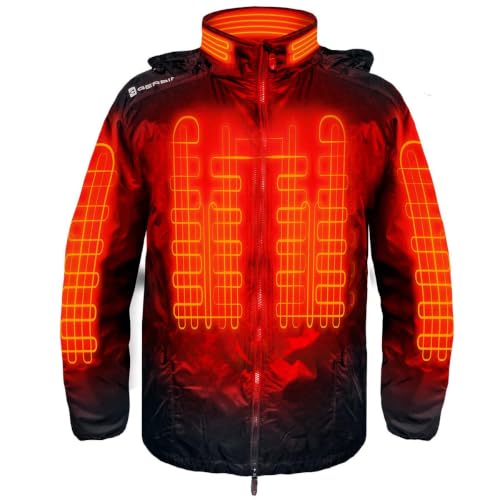
Gerbing 12V Heated Jacket Liner 2.0 — Best Premium Upgrade
The 2.0 is Gerbing’s newer-generation take on its own classic: the same 12 volt, bike-powered, full-torso heating concept, refreshed. For buyers, the practical question is not whether it works — the architecture is proven — but whether the updated garment’s refinements justify choosing it over the long-running original, which remains on sale alongside it.
Our honest answer: for riders buying their first liner and planning to keep it for many seasons, starting with the current generation is the natural choice. The ecosystem behind it is identical — same harness philosophy, same glove integration — so the decision is about the garment itself: its fit, finish and detailing as the company’s latest word on its own best idea.
Strengths
- Current-generation design from the category leader
- Full compatibility with the Gerbing 12V system
- Even core and arm heat with no runtime limits
Trade-offs
- Commands the top of the category’s price range
- Refinements are evolutionary, not revolutionary
- Original liner remains available and may suit budget buyers better
| Specification | Detail |
|---|---|
| Power | 12 volt motorcycle battery harness |
| Type | Heated jacket liner, updated 2.0 generation |
| System | Gerbing 12V ecosystem |
Think of the choice between this and the classic liner as the choice between the current model year and the proven previous one of the same motorcycle. Both will carry you through winter after winter; the newer one carries the small accumulations of feedback from a decade of riders. Fit and finish are where those accumulations usually show, and on a garment you wear against your base layer for six hours at a time, small comfort refinements are not trivial.
What does not change is the ownership pattern: fit the fused harness once, choose your controller, and the system disappears into your routine. Riders cross-shopping the two Gerbing liners should decide on fit and the day’s price gap — check both listings on Amazon — rather than on any fear that one is a lesser heater. Neither is.
Best for: first-time liner buyers who want the current generation of the benchmark / Not suited for: bargain hunters — the classic liner often undercuts it while heating just as well
Check on Amazon to see the current price and size or configuration options.

Firstgear Gen4 Heated Jacket Liner — Best Value
Firstgear has built its reputation on giving riders the essential version of premium gear at a friendlier price, and the Gen4 heated jacket liner is that philosophy in heated form. It is a true 12 volt, bike-powered liner — full stop, no battery compromises — aimed at riders who want core heat that lasts all day and are happy to forgo the last refinements of the category leaders to get it.
For the large group of riders whose winter problem is a cold commute or a chilly Sunday run rather than continental touring, that trade is well judged. The Gen4 covers the torso-and-arms job that transforms cold rides, and it leaves budget behind for the gloves, controller and other kit a complete winter setup needs.
Strengths
- Genuine unlimited 12 volt heat at a value tier
- Covers the essential torso and arm zones
- Leaves budget for the rest of the winter kit
Trade-offs
- Smaller ecosystem behind it than Gerbing’s
- Fewer size and length options
- Finish and detailing a step behind the leaders
| Specification | Detail |
|---|---|
| Power | 12 volt motorcycle battery harness |
| Type | Heated jacket liner (worn under riding jacket) |
| Colour | Black |
The Gen4’s review can be short because its proposition is simple, and simple propositions deserve direct verdicts: this liner heats your core properly, from bike power, for as long as you ride, and it costs less than the benchmark doing it. Riders who buy it report the same revelation as Gerbing owners — the cold failing to arrive, hands staying alive longer, rides extending deeper into winter. The heated-liner effect does not require a premium badge to work.
Where the savings show is in the margins: system depth if you later want heated everything, size range if you are tall or hard to fit, and the fine grain of materials and connectors. If none of those margins is where you live, the Gen4 is the smart money in this roundup. As always, check the current price on Amazon before deciding — the value case strengthens and weakens with the seasonal gap between it and the Gerbing liners.
Best for: commuters and value-focused riders who want real 12V core heat first / Not suited for: tall riders needing long sizes, or system builders planning heated everything
Check on Amazon to see the current price and size or configuration options.

California Heat 12 Volt Heated Jacket Liner-Powersport — Best for Powersports
California Heat approaches heated gear from the powersports world rather than the motorcycle-only world, and its 12 volt jacket liner reflects that: a garment designed to serve under a riding jacket on the bike, and just as happily under a snowmobile suit or ATV gear, anywhere a 12 volt system can feed it. For households whose winters span several machines, that crossover design is a genuine advantage rather than a marketing line.
The company is a long-standing American heated-clothing maker, and its liners carry that heritage: straightforward, durable construction, honest heat, and sizing that includes tall options in the liner family. It is the connoisseur’s alternative in this roundup — less famous than Gerbing, chosen deliberately by riders who know the category.
Strengths
- Designed for motorcycle, ATV and snowmobile crossover use
- Established specialist heated-clothing maker
- Durable, no-nonsense construction
Trade-offs
- Smaller dealer and accessory footprint than Gerbing
- Styling is functional rather than sleek
- Listings can be size-specific — check your exact size carefully
| Specification | Detail |
|---|---|
| Power | 12 volt vehicle electrical system |
| Type | Heated jacket liner — Powersport line |
| Use | Motorcycle, ATV and snowmobile crossover |
The crossover point deserves more weight than roundups usually give it. A snowmobile and a motorcycle present the same heating problem — a seated rider, wind, a 12 volt system — and a liner built for both saves the two-machine household from buying core heat twice. California Heat’s Powersport liner is the only pick here designed with that double life in mind, and riders who live it rate the garment accordingly.
On the motorcycle alone, it stands up as a full member of the wired class: unlimited heat, torso and arm coverage, system thinking behind it. Choose it over the Gerbing if the powersport crossover matters to you, or if its fit suits your build better in the sizes listed. Choose the Gerbing for ecosystem depth. Either way you are inside the small club of riders whose winters stopped being negotiations with the weather.
Best for: riders who split winter between motorcycle, ATV and snowmobile / Not suited for: riders who want the largest possible heated-garment ecosystem
Check on Amazon to see the current price and size or configuration options.

California Heat Streetrider Outer Heated Jacket — Best Outer Jacket
Some riders do not want a system. They want a jacket — one garment, on a hook, ready to wear — and the Streetrider is the credible answer: a true outer jacket with 12 volt heat built in, from the same California Heat stable as the Powersport liner above. It trades the liner philosophy’s flexibility for the outer jacket’s simplicity, and for a defined group of riders that trade is correct.
Who are they? Riders with one bike, one season of cold commuting, and no ambition to build a heated wardrobe; riders replacing a worn-out everyday jacket anyway; and riders whose other jackets are summer-weight and would never host a liner properly. For them, a heated outer jacket removes decisions instead of adding them.
Strengths
- One garment — no layering system to manage
- True 12 volt heat with no runtime ceiling
- Doubles as an ordinary everyday jacket
Trade-offs
- Cannot move its heat to another outer jacket
- Protection spec differs from a dedicated armoured jacket — check it against your standards
- Size-specific listings require care when ordering
| Specification | Detail |
|---|---|
| Power | 12 volt vehicle electrical system |
| Type | Heated OUTER jacket (not a liner) |
| Colour | Black |
The honest comparison is flexibility versus simplicity. A liner’s heat follows you between jackets and across years; the Streetrider’s heat lives in one garment, and when that garment is wrong for the day’s weather — too warm, not waterproof enough, wrong style — the heat stays home too. Riders must weigh how often that happens in their real riding life. For the one-jacket commuter, it may happen almost never, and then the Streetrider’s simplicity wins outright.
A safety note that applies to every outer jacket, heated or not: confirm the garment’s protective specification meets your own standards for armour and abrasion resistance before trusting it as your only riding jacket. Heat is a comfort feature; protection is the jacket’s first job, and no warmth justifies downgrading it. Judged as what it is — a heated everyday riding jacket from a specialist maker — the Streetrider earns its pick as this roundup’s outer-garment answer.
Best for: one-jacket riders who want heated simplicity without a liner system / Not suited for: riders with several jackets who want heat that moves between them
Check on Amazon to see the current price and size or configuration options.
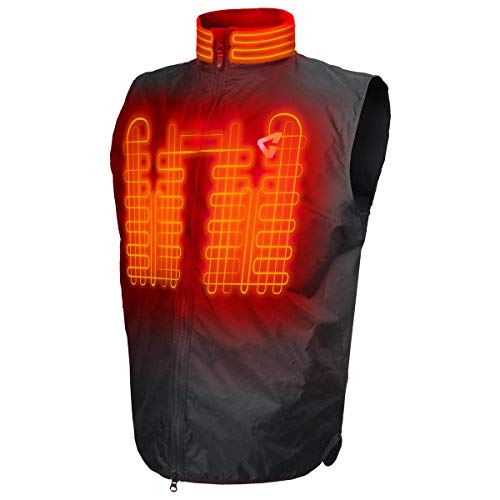
Gerbing Heated Vest Liner – 12V Motorcycle — Best Vest Alternative
Every category has a pick for the rider the main picks do not fit, and in heated gear that rider is real: the one whose core gets cold while their arms stay fine, who rides a small bike with a modest alternator, or who simply hates bulk under a jacket. The heated vest is their garment, and Gerbing’s vest liner is the benchmark version — chest and back heat, no sleeves, meaningfully lower power draw than any full liner here.
The vest is also the traditional first heated garment, and the traditional loaner: riders buy it to test whether heated gear suits them, discover the core-heat effect on their hands, and either graduate to a full liner or discover the vest was the answer all along. Both outcomes are wins, which is why the vest survives in every serious heated range.
Strengths
- Lowest power draw of any pick — suits small bikes
- Least bulk under a jacket
- Core heat still releases blood flow to hands and feet
Trade-offs
- Arms get no direct heat
- May be a stepping stone to a full liner
- Collar and arm coverage absent in deep cold
| Specification | Detail |
|---|---|
| Power | 12 volt motorcycle battery harness |
| Type | Heated VEST liner (no heated sleeves) |
| System | Gerbing 12V ecosystem |
The physiology from the introduction is the vest’s whole case: warm the core and the body stops rationing blood to the extremities. A vest delivers most of that effect for a fraction of a jacket liner’s watts, which is why it is the only responsible recommendation for riders on small-displacement bikes whose charging systems cannot spare a full liner’s draw. On such bikes the choice is not vest versus jacket; it is vest versus nothing, and the vest wins that comparison every cold morning.
For riders on bigger bikes, the vest is a preference call: if your arms genuinely run warm and your jacket fits close, the vest’s slimness is a daily pleasure. If there is any doubt, buy the full liner — cold arms cannot be fixed mid-ride, while a liner’s extra warmth can always be turned down. The controller, as ever, is the great negotiator between garment and weather.
Best for: small-bike riders, warm-armed riders, and heated-gear first-timers / Not suited for: riders whose arms and shoulders feel the cold as much as their core
Check on Amazon to see the current price and size or configuration options.
Comparison Table
| Pick | Badge | Key spec | Best for |
|---|---|---|---|
| Gerbing Heated Jacket Liner – 12V Motorcycle | Best Overall | 12V bike-powered heated jacket liner, full size run including tall lengths | most winter riders, especially tall riders and anyone building a full heated system |
| Gerbing 12V Heated Jacket Liner 2.0 | Best Premium Upgrade | Updated-generation 12V Gerbing liner | first-time liner buyers who want the current generation of the benchmark |
| Firstgear Gen4 Heated Jacket Liner | Best Value | 12V bike-powered heated jacket liner, Gen4 | commuters and value-focused riders who want real 12V core heat first |
| California Heat 12 Volt Heated Jacket Liner-Powersport | Best for Powersports | 12V heated jacket liner, Powersport line | riders who split winter between motorcycle, ATV and snowmobile |
| California Heat Streetrider Outer Heated Jacket | Best Outer Jacket | True heated outer jacket, 12V powered | one-jacket riders who want heated simplicity without a liner system |
| Gerbing Heated Vest Liner – 12V Motorcycle | Best Vest Alternative | 12V heated vest liner — core heat, lower draw | small-bike riders, warm-armed riders, and heated-gear first-timers |
How to Choose the Best 12 Volt Heated Motorcycle Jacket Setup for Your Bike
Start at the alternator, not the garment. Find your motorcycle’s spare electrical capacity — the watts left after the bike runs itself — from the owner’s manual, a service manual or a well-kept model forum. Then total the draw of everything you plan to run together: jacket liner, glove liners, any trousers, plus the accessories you already use. If the total fits inside the spare capacity with margin, shop freely. If it does not, your honest options are a vest instead of a jacket, disciplined controller use, or staged purchases — and the riders who face this are usually on small singles, older bikes, or machines already loaded with auxiliary lights.
Next, choose your garment type with the liner-versus-jacket question. Liners win for most riders: they preserve your existing jacket’s protection, move between jackets, and cost less than re-buying armour-grade outerwear. An outer heated jacket wins when your riding life genuinely uses one jacket. A vest wins on small bikes and warm-armed riders. There is no prestige order among the three — only fit between garment and life.
- Fit the liner close: heated panels must sit near the body, over a base layer only — a liner worn over a thick fleece heats the fleece.
- Size for your riding position: reach for the bars and check wrist and back coverage in the crouch, not standing in a shop.
- Budget the controller: a dual-zone controller for jacket plus gloves is the upgrade owners praise most.
- Stay in one ecosystem: harness and connector compatibility compounds across garments.
- Buy before the cold: heated gear sells out in the first cold snap, every year, in the common sizes first.
Finally, plan the system’s growth even if you buy one garment today. The harness you fit for a jacket liner is the same foundation gloves and trousers will use. Spending ten extra minutes routing it neatly, and choosing the brand whose range you would happily buy next year, turns today’s purchase into the first piece of a kit instead of a dead end.
How Much Power Does a Heated Jacket Liner Draw — and Can Your Bike Spare It?
A full heated jacket liner is the largest single load in typical heated kit, drawing substantially more than glove liners and comparable to a pair of auxiliary lights. Exact figures vary by brand, size and setting, and the manufacturer’s specification for your specific garment is the only number to plan around — which is why this article discusses the method rather than printing figures that would be wrong for half the readers’ bikes.
The method is simple arithmetic. Your bike produces a rated alternator output; the bike itself consumes a share for ignition, fuel injection, lights and instruments; the remainder is your budget. Heated gear on full power must fit inside that remainder with something to spare, because a battery that slowly discharges across a winter ride fails at the worst moment — engine off, far from home, in the cold that made you buy the gear. Controllers are the management tool: running a liner at a mid setting draws a mid share, and most riders, most of the time, need far less than maximum once their core is warm.
If your maths comes out tight, do not despair and do not cheat it. The vest pick in this roundup exists precisely for watt-poor bikes, heated gloves alone draw little, and a battery monitor or simple voltmeter on the dash turns guesswork into information. Riders who respect the arithmetic ride warm for decades; riders who ignore it meet the recovery truck once and then respect it forever.
How Should a Heated Liner Fit — and What Goes Around It?
Fit is a heating specification. A liner’s panels transfer heat best when they sit close against a thin base layer, with no air gaps at the chest and back and no bunching at the shoulders. In the shop, that means sizing by the maker’s chart over your actual base layer, then sitting on a bike — or mimicking the crouch — to check the two places standing fittings lie about: the wrists and the lower back. Sleeves must still cover your wrists with arms stretched to the bars, and the hem must still cover your back at full lean. A liner that passes standing and fails in the crouch will leave exactly the gaps the wind finds first.
Layering order is fixed by physics: skin, base layer, heated liner, protective jacket. Anything insulating placed between you and the liner steals the heat you paid for; anything placed over the liner but under the jacket is usually just bulk competing for room. The exception is the rider in extreme cold who adds a thin windproof layer over the liner to protect its heat from a leaky outer jacket — legitimate, and a sign the outer jacket, not the liner, is the weak link.
Two smaller fit notes from hard experience. First, the collar matters more than its size suggests: a heated collar seals the neck gap that funnels cold air down both the chest and the back, and riders consistently rate it among the liner’s most valuable panels. Second, connectors at the wrists for glove liners must sit where your glove gauntlets can cover them without pressure points; check that junction with gloves on, in the crouch, before the first cold ride rather than during it.
How to Set Up a 12 Volt Heated Jacket Liner System
A heated liner system has four parts — harness, controller, garment, and the rider’s habits. Setting it up properly takes under an hour, once, and the routine below is the one that prevents every common first-season complaint.
- Fit the fused battery harness: negative terminal disconnected first, ring terminals secured to the battery posts, fuse accessible, and the lead routed to your hip area clear of heat, steering and sharp edges. Cap the connector when it is not in use.
- Choose and mount the controller where your left hand can reach it without looking — clipped at the hip or mounted at the bars on a bracket. Independent zones for jacket and gloves are worth the small premium if you plan to add gloves.
- Dress in the right order: base layer, heated liner, then your armoured outer jacket. The liner must sit close to the body; thick mid-layers belong over the liner only if the design allows, and usually they belong in a pannier instead.
- Connect in sequence: harness to controller, controller to liner, and glove liners into the liner’s sleeve connectors if you run them. Confirm every connector is fully seated — intermittent heat is almost always a half-seated plug.
- Start the engine before turning the heat up. Heated gear is designed to run on alternator output; running it at a standstill on battery alone is how batteries die in car parks.
- Set heat lower than you think for the first ten minutes. Core heat builds and compounds; the classic beginner pattern — maximum immediately, then sweating, then switching off and freezing — is a settings error, not a gear failure.
- At fuel stops, unplug as you dismount and reconnect as you mount, every time, until it is muscle memory. The tether you forget is the one that reminds you at walking pace in front of an audience.
Set up this way, a heated liner stops being equipment and becomes weather independence: the forecast stops deciding your riding days. That, more than any single ride’s comfort, is what owners of every pick in this roundup say the money actually bought. Look after the system and it returns the favour for years — connectors kept clean and capped, the harness fuse checked each season, the liner stored hung rather than crushed in a pannier. Heated gear rarely wears out from use; it wears out from neglect between uses, and the riders with decade-old liners are simply the riders who store them properly.
Common Buying Mistakes
Buying a battery jacket for motorcycle touring
Battery heated jackets are fine garments for spectating and short hops, but their output and runtime cannot match a bike-powered liner on a long cold ride. If your rides are long, buy the system that drinks from the alternator.
Wearing the liner over thick layers
Heat panels work by proximity. A liner worn over a chunky fleece warms the fleece while your core stays cold, and the rider concludes the gear is weak. Base layer, liner, jacket — in that order.
Skipping the alternator maths
The jacket is the biggest heated load you will add. Ten minutes with your bike’s specifications prevents the flat-battery-at-a-fuel-stop story that every heated-gear forum tells each winter.
Buying the wrong size to save money
A heated liner must fit close and reach your wrists in the riding crouch. A bargain in the wrong size is not a bargain; it is a warm torso attached to cold arms and an exposed back.
Forgetting the controller in the budget
The liner is not the whole purchase. Harness and controller complete the system, and riders who budget only for the garment end up running it on/off at full power — the worst of all control strategies.
Final Recommendation
For most riders the answer is the classic Gerbing liner: the best 12 volt heated motorcycle jacket solution is a liner, and this is the liner the category is measured by — with the 2.0 as its current-generation alternative for buyers who prefer the newest version of the benchmark. Firstgear’s Gen4 takes the value crown honestly, California Heat serves the powersports crossover and the one-jacket rider, and the Gerbing vest covers small bikes and warm arms. Six picks, six distinct riders, no filler.
Whichever you choose, choose the system, not just the garment: fused harness, reachable controller, close fit, alternator maths done. Heated gear rewards the rider who sets it up once and properly, with years of winter roads that other riders simply do not get to ride.
One final consideration for riders new to heated gear: your first season’s settings will be wrong, and that is normal. Everyone starts by running too hot, then too cold, then finds the low, steady settings that actually work — usually lower than pride expects. Give yourself three or four cold rides to learn your own numbers before judging the garment, and write them down if your controller lacks markings. The riders who love their heated kit in year five are the ones who treated year one as calibration, not verdict.
Complete the kit with the companion guides in this series: Best 12 Volt Heated Glove Liner and its roundup sibling Best 12 Volt Heated Glove Liners for your hands, and for the support vehicle or the drive home, Best 12 Volt Heated Blanket For Camping, Best 12 Volt Heater and Best 12 Volt Heater Defroster.
Short on time? Start with these three: Gerbing Heated Jacket Liner – 12V Motorcycle, Gerbing 12V Heated Jacket Liner 2.0, Firstgear Gen4 Heated Jacket Liner. Each link goes to the live listing so you can check the current price on Amazon and confirm the size or configuration before you buy.
Frequently Asked Questions
Is a heated jacket liner better than a heated jacket?
For most motorcyclists, yes. A liner preserves your existing jacket’s armour and waterproofing, moves between jackets as seasons change, and costs less than buying protection-grade outerwear again. A heated outer jacket suits riders who genuinely live in one jacket and value single-garment simplicity over that flexibility.
Will a heated jacket liner drain my motorcycle battery?
Not while you ride, provided your bike’s spare alternator capacity covers the draw — the guide above shows how to check. The battery only suffers if you run the gear with the engine off, or if the total load exceeds what the charging system can replace. A controller and honest arithmetic prevent both.
Do I need a controller, or can I just plug the liner in?
You need a controller. Without one the liner runs at full power or nothing, which means alternating between sweating and freezing and drawing maximum current at all times. A controller lets you run the lowest comfortable setting, which is kinder to you and to your bike’s electrical budget.
Can I run heated gloves from the jacket liner?
Yes — that integration is a core design feature of the major systems. Glove liners connect at the jacket liner’s sleeves and draw through the same harness, ideally on their own controller zone so hands and core can be set independently. It is the neatest way to build a full heated upper body.
What should I wear under a heated jacket liner?
A single close-fitting base layer. The heating panels need proximity to your body to work efficiently, and bulky layers between skin and liner waste heat and add bunching. Your armoured jacket goes over the liner; extra insulation, if you carry it, is for stops, not for riding over the liner.
Are heated vests worth it, or should I go straight to a full liner?
Vests are worth it for the riders they suit: small bikes that cannot spare a full liner’s draw, riders whose arms run warm, and first-timers testing heated gear. If none of those describes you and your bike can power a liner, the full liner’s arm and collar heat is the more complete answer — and it can always be turned down, while a vest cannot be turned into sleeves. One more vest virtue worth knowing: it packs smallest, so touring riders with limited luggage sometimes choose it as the emergency layer that lives in a pannier all season, ready for the mountain pass that turns unexpectedly cold.


