Disclosure: airfryerkitchensupply.com is reader-supported. When you buy through links on our site, we may earn an affiliate commission at no extra cost to you.
Where to buy
Every product below was verified against Amazon’s own catalog data before this guide was written, so each linked item is a real, currently listed product that genuinely runs on 12-volt power. If you are looking for the best 12 volt grill for camping, tailgating, trucking, or RV life, start with the six verified picks below, and use the links here, in the reviews, and in the comparison table to check configuration and live availability.
- Green Mountain Grills Trek Prime 2.0 Portable WiFi Pellet Grill — Check the current price on Amazon
- Freedom Stoves Portable Pellet Grill – 12V and 120V Dual Power — Check the current price on Amazon
- RoadPro RPSL-335 12V Portable Frying Pan — Check the current price on Amazon
- RoadPro Portable Electric Lunchbox Stove 12V – RPSC-197 — Check the current price on Amazon
- Travel Time 12V Cooking Pan with Cover — Check the current price on Amazon
- Travel Time 12V Portable Stove with 5 Pans and Lids — Check the current price on Amazon
The best 12 volt grill is a category with exactly two honest halves, and this guide will keep them separate. The first half is real grills: portable pellet grills engineered to run from a 12-volt supply — a vehicle battery, an RV house bank, a portable power station — with the temperature control and cooking space of a proper grill. The second half is 12-volt cooking appliances: the frying pans, lunchbox stoves, and travel skillets that truckers and campers have cooked on for decades, which grill in the loose sense of ‘applies heat to food away from a kitchen’ and are sold, searched, and loved under this keyword.
What does not exist — and what this guide will not invent — is a full-size 12-volt electric grill that sears like a mains or gas grill from a cigarette-lighter socket. The physics forbids it: a 12-volt accessory circuit delivers a fraction of the power a household grill element draws, which is why the genuine 12-volt grills are pellet designs, whose electrical load is only a fan, an auger, and an igniter. Anyone promising you a plug-in 12-volt searing machine is selling the socket more than the steak.
The six picks below were each confirmed in Amazon’s catalog data before inclusion. Two are true pellet grills with 12-volt power. Four are the best-verified 12-volt cooking appliances in their formats — frying pan, lunchbox stove, cooking pan, and multi-pan travel stove — each reviewed as what it is, with its badge naming its actual job. Choose by the cooking you actually do at the roadside, and every pick here will feed you honestly.
In this guide
Quick Picks
In short: pellet grills for real grilling from a battery, 12-volt pans and stoves for real cooking in a cab. All six run on 12 volts for true — verified, labelled, and reviewed as what they are.
Green Mountain Grills Trek Prime 2.0 Portable WiFi Pellet Grill — Best Overall: A real portable pellet grill that runs on 12-volt power with WiFi control and a cover included per its listing — the complete answer when ‘grill’ means grill. Check the current price on Amazon
Freedom Stoves Portable Pellet Grill – 12V and 120V Dual Power — Best Dual Power: A portable pellet grill that runs on 12V or 120V power, with an 8.5-pound hopper and dual meat probes per its listing — one grill for the patio and the boondocks alike. Check the current price on Amazon
RoadPro RPSL-335 12V Portable Frying Pan — Best 12V Skillet: The classic 12-volt frying pan from the truck-stop cooking institution: plug it into the vehicle, and breakfast happens wherever the truck is parked. Check the current price on Amazon
RoadPro Portable Electric Lunchbox Stove 12V – RPSC-197 — Best Lunchbox Oven: The famous lunchbox stove: a 12-volt oven shaped like a lunchbox that warms food through while you drive or work, so a hot meal is waiting when you stop. Check the current price on Amazon
Travel Time 12V Cooking Pan with Cover — Best Cooking Pan: A 12-volt cooking pan with a cover, non-stick surface, and stay-cool handle per its listing — the tidier, lidded evolution of the classic truck frying pan. Check the current price on Amazon
Travel Time 12V Portable Stove with 5 Pans and Lids — Best for Meal Variety: A 12-volt portable stove rated at 150 watts with five pans and lids per its listing — a meal-prep system for the road, built around portioned cooking and warming. Check the current price on Amazon
How These Picks Were Chosen
Selection for this guide enforced one rule above all: the product had to genuinely run on 12-volt power, stated in its own listing and confirmed in Amazon’s catalog data before inclusion. That rule eliminated the many mains-powered portable grills that surface under this search term, and it shaped the honest structure of the final six — two true pellet grills whose 12-volt systems run their augers, fans, and controllers, and four 12-volt cooking appliances reviewed as what they are.
Within the pellet pair, the split is philosophy: single-purpose 12-volt enthusiasm versus dual-power flexibility. Within the appliances, each format gets one representative — frying pan, lunchbox stove, lidded cooking pan, multi-pan stove — because those formats, not brands, are what road cooks actually choose between. Duplicate formats were cut even when well reviewed elsewhere.
Specifications quoted — hopper capacity, probe count, wattage, pan count — come from the manufacturers’ own listings. Where a product’s nature could mislead — a warmer that does not fry, a pan that does not grill — the review says so in its first paragraph and in its verdict, because a buyer who understands their appliance keeps it, and a buyer who was oversold returns it.
Longevity evidence quietly shaped the appliance picks. Twelve-volt cooking gear lives through vibration, heat cycles, and daily handling that kitchen appliances never meet, so established road-cooking names with long production histories were favoured over novel listings with identical paper specifications. A frying pan that has been sold to truckers for decades has passed a durability examination no laboratory replicates.
Repairability closed the selection. Road cooking gear that cannot be re-fused, re-lidded, or re-panned by its owner becomes landfill at the first small failure, so preference went to designs whose consumable and wearable parts — fuses, lids, pans, probes — are ordinary, available things. The best road appliance is the one still cooking in its fifth season, and that outcome is decided by small parts long before it is decided by specifications.
The 6 Best 12 Volt Grills and Vehicle Cookers in Detail

Green Mountain Grills Trek Prime 2.0 Portable WiFi Pellet Grill — Best Overall
The Trek Prime 2.0 is what the top of this category looks like when it is done properly: a portable pellet grill from an established pellet-grill maker, with 12-volt power for off-grid use, WiFi control, and a cover included per its listing. It grills, smokes, and roasts with real temperature control, powered by a vehicle or RV battery system — no generator, no mains, no gas bottle.
Strengths
- Genuine pellet grilling and smoking, not a heated pan with ambitions
- 12V power suits vehicle, RV, and power-station cooking off-grid
- WiFi control brings set-and-monitor convenience to the campsite
Trade-offs
- Needs a substantial 12V source — a battery bank, not a casual socket while parked all day
- Pellets are a fuel to carry and keep dry, unlike a plug-in appliance
- Larger and heavier than every pan and stove in this guide
| Type | Portable pellet grill |
| Power | 12V (per listing) |
| Control | WiFi-enabled (per listing) |
| Included | Cover (per listing) |
Pellet grills are the one true-grill format 12 volts can honestly power, because electricity is not the heat source — wood pellets are. The 12-volt supply runs the auger that feeds the fire, the fan that stokes it, and the controller that holds temperature, all of which sip power compared with an electric element. That is why a Trek can smoke a brisket at a trailhead: the battery is the management, not the fuel. Understanding that single fact separates every realistic expectation in this category from the fantasy ones.
In use, the Trek behaves like the grill it is: set a temperature, let the controller work, and cook with the confidence of an oven and the flavour of wood fire. The WiFi layer is more useful than it sounds at a campsite, where the cook is also the swimmer, the angler, and the person who forgot the chairs. Pair it with a healthy battery bank or a running vehicle’s system, keep the pellets dry, and this is the only pick here that a barbecue enthusiast would recognise without explanation.
Best for: Campers, tailgaters, and RVers who want genuine grilling and smoking from a battery-based setup / Not suited for: Anyone wanting to cook from a dashboard socket while driving — this is a parked-up grill
Check the current price on Amazon

Freedom Stoves Portable Pellet Grill – 12V and 120V Dual Power — Best Dual Power
The Freedom Stoves grill solves the two-homes problem: at home it runs on ordinary 120-volt power; at the campsite, the lake, or the tailgate it runs on 12 volts. Its listing specifies an 8.5-pound pellet hopper and dual meat probes, which together describe a grill meant for real cooking sessions rather than demonstrations — fuel for a long cook, and temperature knowledge where it counts, inside the food.
Strengths
- Dual 12V/120V power — one grill for home and off-grid
- 8.5 lb hopper supports long, unattended cooks
- Dual meat probes give proper doneness data on two items at once
Trade-offs
- Dual-power versatility makes it a considered purchase versus single-purpose pans
- Like all pellet grills, it needs pellets kept dry and a real battery source on 12V
- Probes and cables are small parts to keep track of in a travelling kit
| Type | Portable pellet grill |
| Power | 12V and 120V dual power (per listing) |
| Hopper | 8.5 lb capacity (per listing) |
| Probes | Dual meat probes (per listing) |
Dual power changes the ownership maths of a portable grill. A 12V-only grill is a specialist that earns its storage space only on trips; a dual-power grill is the household’s second grill that also travels — earning its keep at home every week and justifying its place in the vehicle when the road calls. For RVers who live both lives in the same month, that flexibility is not a feature but the whole proposition.
The probes deserve their sentence. Pellet grilling’s promise is precision — low-and-slow cooks judged by internal temperature, not by hope — and dual probes extend that precision to the realistic case of two different items cooking at once. Combined with a hopper sized for hours rather than minutes, the Freedom Stoves package reads as a grill designed by people who actually cook outdoors. If the Trek above is the enthusiast’s portable, this is the pragmatist’s: equally real grilling, with a power supply for every postcode.
Best for: Owners who grill both off-grid and at home and want one grill that follows the power available / Not suited for: Minimalists who want the lightest possible road cooking kit
Check the current price on Amazon
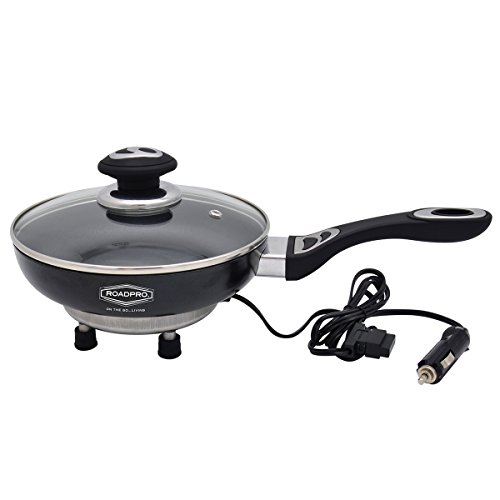
RoadPro RPSL-335 12V Portable Frying Pan — Best 12V Skillet
RoadPro’s 12-volt frying pan is the archetype of cab cooking: a portable electric frying pan that runs from the vehicle’s 12-volt system, made for the driver who wants a hot, self-cooked meal instead of another service-station sandwich. It will not smoke a brisket. It will fry eggs, brown burgers, crisp a quesadilla, and reheat last night’s leftovers into something worth eating — which, at mile 900, is the entire point.
Strengths
- Genuine frying from vehicle power — the core cab-cooking job
- RoadPro is the established name in 12V truck cooking gear
- Simple, single-purpose, and easy to clean at a rest stop sink
Trade-offs
- Cooking for one or two at a time — this is a personal pan
- Power draw demands respect: cook with the engine’s system in mind, not on a tired battery
- No temperature finesse — it is a hot pan, and the cook is the controller
| Type | 12V portable frying pan |
| Power | 12V vehicle (per listing) |
| Brand line | RoadPro RPSL-335 |
| Use | Vehicle and travel cooking |
Judge this pan by its native habitat and it is close to perfect. It lives in a cab or a camper, asks nothing but a 12-volt socket and a few minutes, and returns hot food with minimal washing up. Generations of drivers have built meal routines around exactly this class of appliance, and the RoadPro name on it matters because 12-volt cooking gear lives a hard life of vibration, temperature swings, and daily use that no-name versions often do not survive.
The disciplines are electrical and culinary. Electrically: a heating appliance is the heaviest load you will plug into a vehicle socket, so cook on a healthy system, ideally with the engine running or a strong auxiliary battery, and let the pan’s own fused plug do its job. Culinarily: thin foods, modest batches, and patience — a 12-volt pan heats gently compared with a stove, and the cooks who love it have adjusted their recipes to its rhythm rather than fighting it.
Best for: Truckers and road-trippers who want to actually fry — eggs, burgers, quesadillas — from the cab / Not suited for: Anyone expecting grill marks, smoking, or food for more than one or two people
Check the current price on Amazon

RoadPro Portable Electric Lunchbox Stove 12V – RPSC-197 — Best Lunchbox Oven
The RPSC-197 lunchbox stove is the most beloved appliance in truck cooking: a 12-volt oven in lunchbox form that heats food gradually while the vehicle works. Load it in the morning with leftovers, a frozen meal, or a foil-wrapped portion; plug it in; and by the break, lunch is hot. It does not fry and it does not grill — it does something arguably more valuable, which is make hot food coincide with a working day.
Strengths
- Set-and-forget warming that fits a working schedule
- Lunchbox format is compact, lidded, and travels without drama
- Heats real food — leftovers, frozen meals, foil parcels — not just snacks
Trade-offs
- Warming takes time measured in hours for frozen loads, not minutes
- No browning, no frying — texture is steamed and baked, not grilled
- Interior size suits one generous meal, not family catering
| Type | 12V lunchbox stove / food warmer |
| Power | 12V vehicle (per listing) |
| Brand line | RoadPro RPSC-197 |
| Use | Truck and travel food heating |
The lunchbox stove’s genius is temporal. Every other appliance in this guide cooks when you stop; this one cooks while you go, converting dead driving hours into meal preparation. Drivers plan around it — the morning load-up becomes a ritual, and the hot lunch it produces is cheaper, better, and more reliable than whatever the next exit offers. For workers on sites, boats, and long hauls, that rhythm is a quality-of-life upgrade out of proportion to the device’s simplicity.
Use it with its nature in mind. It warms and gently bakes; it does not sear, and raw meats that need thorough, fast cooking are not its brief — load it with food that reheats well or cooks gently and safely, use oven-safe containers or foil, and give frozen loads the hours they need. Treated as the appliance it is, the RPSC-197 has earned its decades-long reputation one hot lunch at a time. It is the easiest recommendation in this guide to a working driver.
Best for: Drivers who want a hot meal ready from leftovers, cans, or frozen portions while they work / Not suited for: Cooking raw food from scratch — this is a heater and slow warmer, not a fryer
Check the current price on Amazon

Travel Time 12V Cooking Pan with Cover — Best Cooking Pan
Travel Time’s 12V cooking pan refines the classic formula with the details vehicle cooking actually needs: a cover to keep heat in and splashes contained, a non-stick surface for the reality of washing up in a rest-stop sink, and a stay-cool handle per its listing, because the inside of a cab is no place to discover a hot handle. It is the frying pan concept, civilised.
Strengths
- Cover contains splashes and speeds cooking — important in a vehicle interior
- Non-stick surface suits minimal-water clean-up
- Stay-cool handle per listing suits the close quarters of cab cooking
Trade-offs
- Personal-size capacity, like all 12V pans
- Gentle 12V heat — browning takes patience
- One pan, one dish at a time; meal planning must be sequential
| Type | 12V cooking pan with cover |
| Surface | Non-stick (per listing) |
| Handle | Stay-cool (per listing) |
| Compatibility | Universal for most vehicles (per listing) |
The cover is the headline, and rightly. In a vehicle, an uncovered pan is a spatter hazard and a heat leak; a lidded pan cooks faster on the same gentle power, keeps the cab cleaner, and widens the menu to foods that steam and simmer as much as they fry. That widening matters on the road, where variety is the first casualty of travel cooking and the reason most cab kitchens are abandoned by week two.
As with the RoadPro pan, respect the electrical budget: a healthy 12-volt system, sensible cooking sessions, and no expectation that a socket is a stove ring. Within those rules, the Travel Time pan is the more liveable daily tool of the two — the one whose small civilities compound across a season of road meals. Drivers choosing between them are really choosing between the classic and the refined version of the same good idea.
Best for: Car and truck travellers who want a lidded pan for saucier, tidier vehicle cooking / Not suited for: Cooks feeding a group — this is a personal-size pan
Check the current price on Amazon

Travel Time 12V Portable Stove with 5 Pans and Lids — Best for Meal Variety
This Travel Time stove thinks in meals rather than dishes: a 12-volt base unit rated at 150 watts per its listing, supplied with five pans and lids, so portions and components can be cooked, warmed, and held in parallel. For the driver or camper who meal-preps — or feeds a partner from the passenger seat — it is the closest thing 12-volt cooking offers to a small kitchen system.
Strengths
- Five pans with lids enable real meal structure, not single-pan improvisation
- Stated 150W rating is honest 12V-class power — expectations can be set correctly
- Portioned format suits meal prep and reheating multiple items
Trade-offs
- A warmer-cooker’s temperament — gentle heat, longer times, no searing
- More pieces to wash, store, and keep track of than a single pan
- Total capacity is still road-scale: portions, not parties
| Type | 12V portable stove / food warmer |
| Power | 150W (per listing) |
| Included | 5 pans with lids (per listing) |
| Use | Car, truck, travel, work cooking (per listing) |
The five-pan format changes what road cooking can be. Instead of one pan used serially — protein, then vegetables, then sauce, each cooling while the next cooks — components hold together as a meal, and pre-portioned work lunches warm in their own pans through a shift. Owners who meal-prep at home will recognise the logic immediately, transplanted to a 12-volt base that lives in the vehicle. It is the most organisational product in this guide, and its fans are the organised.
The honest framing remains: 150 watts is 150 watts, and this is a gentle cooker-warmer whose virtues are patience and parallelism, not heat heroics. Raw ingredients that demand fierce, fast cooking belong to the pellet grills at the top of this guide or to a home kitchen. But for reheating with dignity, holding a meal’s components at readiness, and warming portions through a working day, this system does what no single pan can — and it does it from the same humble socket.
Best for: Road cooks who prep multiple portions or components and want a small system, not a single pan / Not suited for: Anyone wanting frying heat or grill function — this is a warmer-cooker system
Check the current price on Amazon
Comparison Table
Type is destiny in this category: pellet grills cook like grills, pans cook like pans, and warmers cook with time. Match the type to your road menu first, then compare within it.
| Pick | Badge | Key spec | Best for |
|---|---|---|---|
| Green Mountain Grills Trek Prime 2.0 Portable WiFi Pellet Grill | Best Overall | Portable pellet grill with 12V power, WiFi control, cover included per listing | Campers, tailgaters, and RVers who want genuine grilling and smoking from a battery-based setup |
| Freedom Stoves Portable Pellet Grill – 12V and 120V Dual Power | Best Dual Power | Pellet grill running on 12V or 120V, 8.5 lb hopper, dual meat probes per listing | Owners who grill both off-grid and at home and want one grill that follows the power available |
| RoadPro RPSL-335 12V Portable Frying Pan | Best 12V Skillet | 12V portable frying pan for vehicle cooking | Truckers and road-trippers who want to actually fry — eggs, burgers, quesadillas — from the cab |
| RoadPro Portable Electric Lunchbox Stove 12V – RPSC-197 | Best Lunchbox Oven | 12V lunchbox-style stove for heating food in trucks and travel | Drivers who want a hot meal ready from leftovers, cans, or frozen portions while they work |
| Travel Time 12V Cooking Pan with Cover | Best Cooking Pan | 12V cooking pan with cover, non-stick surface, stay-cool handle per listing | Car and truck travellers who want a lidded pan for saucier, tidier vehicle cooking |
| Travel Time 12V Portable Stove with 5 Pans and Lids | Best for Meal Variety | 12V portable stove, 150W, five pans with lids per listing | Road cooks who prep multiple portions or components and want a small system, not a single pan |
How to Choose a 12 Volt Grill: Start With the Physics
Every buying decision in this category flows from one number: power. A household electric grill draws well over a thousand watts. A vehicle’s 12-volt accessory socket is fused for a small fraction of that, and even a direct battery connection delivers 12-volt appliance power in the low hundreds of watts at most. Any product that promises mains-grill searing from a car socket is promising to break physics or the fuse — usually the fuse, repeatedly, until the buyer gives up.
That is why the genuine grills here burn pellets: the fuel carries the energy, and the modest electrical load — auger, fan, igniter, controller — is well within a battery bank’s gift. And it is why the honest appliances are pans and warmers: a few hundred watts will fry an egg, warm a lunchbox through a shift, and hold five portion pans at temperature, provided the cook’s expectations are set to the power available. Choose the format whose physics matches your menu, and 12-volt cooking stops being a disappointment genre.
- Real grilling, smoking, roasting: pellet grill on a battery bank
- Frying breakfast and simple meals in the cab: 12V frying pan
- A hot lunch ready at the break without cooking at the break: lunchbox stove
- Portioned meals and parallel warming: multi-pan stove
- Cooking at home and away with one unit: dual-power pellet grill
Finally, plan the power source as part of the purchase. Pellet grills want a house bank, a second battery, or a power station; socket appliances want a healthy vehicle system and sensible session lengths. The grill is half the system — the battery is the other half, and the neighbouring guides in this series cover it.
Can You Really Grill from a Car Battery?
Yes — with the pellet route, and with realistic session planning. A pellet grill’s electrical draw is modest and mostly intermittent (the igniter works hard briefly; the auger and fan sip thereafter), so a healthy vehicle battery or RV house bank supports hours of grilling. The sensible disciplines are to grill with the engine available to recharge, to monitor the battery rather than discovering its limit by silence, and to treat a dedicated auxiliary battery or power station as the grown-up solution for regular off-grid cooking.
Socket appliances ask a different discipline: session length. A frying pan or stove drawing continuously will flatten a starter battery left alone with it, so the road cook’s rules are engine running, auxiliary battery, or short sessions on a strong battery. None of this is onerous — it is the ordinary electrical hygiene of vehicle life, applied to dinner. Owners who practise it cook from 12 volts for years; owners who ignore it buy one jump start and learn.
What Can You Actually Cook on 12 Volt Power?
On the pellet grills: anything a grill cooks — burgers and steaks with real fire flavour, ribs and brisket low and slow, roast chicken, vegetables, pizza on a stone — because the cooking energy is wood, and only the management is electric. This is the complete answer, and it is why the pellet pair leads this guide despite costing more commitment than a pan.
On the appliances: the road canon. Fried eggs, bacon, burgers, and quesadillas from the pans; stews, leftovers, frozen meals, and foil parcels from the lunchbox and multi-pan stoves; hot sandwiches and warmed portions everywhere. The limits are browning intensity, batch size, and speed — all consequences of gentle wattage. Cooks who build their road menus inside those limits eat remarkably well; the truck-cooking tradition these products come from is decades of proof.
Power Stations and Auxiliary Batteries: The 12 Volt Cook’s Best Friend
Serious 12-volt cooks eventually separate cooking power from starting power, and the modern way to do it is a portable power station or a dedicated auxiliary battery. The arrangement is simple — the grill or appliance draws from the auxiliary source, the vehicle’s starter battery stays out of the kitchen entirely, and a gauge or the station’s own display turns battery anxiety into a number you can watch. For pellet grills especially, a power station is the natural partner: it delivers clean 12-volt output for hours of auger and fan duty, recharges from the vehicle while driving, and goes home to serve during outages.
Sizing follows the same honesty as everything in this guide. Add up what you intend to cook: a pellet grill’s modest continuous draw over a long smoke is a different budget from a frying pan’s short, heavy session, and both are knowable from the products’ own ratings before you buy anything. Buy the source for the longest cook you realistically plan, with margin, and the whole category’s one real anxiety — will the vehicle start afterwards — simply leaves the conversation. That peace is worth more at a remote trailhead than any feature printed on a grill’s box.
A Week of Road Meals That Actually Suit 12 Volt Cooking
The cooks who thrive on 12 volts plan menus the power can flatter. Breakfasts are the format’s home ground: eggs, bacon, and pancakes from the frying pan; porridge and reheated pastries from the warmers. Lunches belong to the lunchbox stove’s slow magic — yesterday’s chilli, a foil parcel of sausage and vegetables, a frozen portion loaded at dawn and perfect by noon. Dinners split by ambition: pan-fried quesadillas, burgers, and stir-fries on appliance nights; proper grilled and smoked food on the nights the pellet grill comes out and the battery bank earns its place.
The pattern underneath the menu is rhythm, not restriction. Warmers work while you drive, pans cook while you pause, and the grill performs when you camp — each format used at the hour it suits, none asked to impersonate another. Stock the vehicle kitchen accordingly: thin cuts, quick-cooking vegetables, tortillas and wraps that forgive any filling, sauces that rescue plain ingredients, and one or two celebration meals reserved for the grill. A week planned this way eats better than most travellers eat from restaurants, at a fraction of the cost and none of the detours.
How to Cook Safely on 12 Volt Power in a Vehicle
Twelve-volt cooking is safe and satisfying when the electrical and practical basics are respected. These steps apply across every appliance and grill in this guide.
- Start with the power audit: know whether you are cooking from a starter battery, an auxiliary battery, or a power station, and never cook a starter battery toward flat — keep the engine available or running for longer sessions.
- Use the fused plug or connection the appliance came with, and never uprate a fuse to stop it blowing; a blowing fuse is information about the circuit, not an inconvenience.
- Set up on a stable, heat-safe surface with the vehicle parked, ventilated, and the appliance where it cannot slide or be knocked — a cab is a kitchen only while the vehicle is still.
- For pellet grills, position downwind of the vehicle’s interior, keep pellets dry, and let the grill’s controller manage the fire rather than improvising around it.
- Cook in the format’s rhythm: thin foods and modest batches in pans, generous time for warmers, and a probe’s verdict — not the clock’s — for meats on the grill.
- Keep a small fire extinguisher rated for vehicle use within reach, as you would in any kitchen, and never leave any cooking appliance entirely unattended.
- After cooking, let appliances cool before stowing, clean pans while residue is warm and easy, and check the battery’s state before the next drive if the session was long.
The golden rule underneath all of it: the vehicle’s first job is transport. Cooking that compromises the battery’s ability to start the engine is a bad trade at any latitude — auxiliary power exists precisely so dinner and departure never compete.
Common Buying Mistakes
Twelve-volt cooking disappoints buyers in a handful of repeatable ways, nearly all of them expectation errors rather than product failures.
- Expecting socket power to sear like a stove. A 12V pan heats gently. Thin foods, preheated pans, and patience produce good results; thick steaks and impatience produce grey ones.
- Cooking a starter battery flat. Long sessions belong on auxiliary power or a running engine. A jump start costs more than any meal the pan ever cooked.
- Buying a warmer to fry, or a pan to roast. Each format in this guide does one job well. Match the appliance to the menu before the menu meets the road.
- Storing pellets where they can get damp. Pellet grills run on dry fuel. A swollen, dusty bag of pellets ruins cooks and augers alike — seal the bag, every time.
- Ignoring the fuse’s message. Repeated fuse failures mean the circuit and the appliance disagree. Investigate; never fit a bigger fuse and carry on.
- Cooking in a sealed, sleeping vehicle. Ventilation and attendance are not optional around any heat source. Park, ventilate, cook, and stay present.
Respect the wattage, feed the battery, and choose the format for the food — on those three rules, 12-volt cooking becomes one of road life’s genuine pleasures.
A seventh mistake is a failure of rehearsal: meeting a new appliance for the first time at a remote campsite, hungry, with the light going. Every product in this guide deserves one home trial — a cooked breakfast in the driveway, a warmed lunch in the yard — where its power draw, its timing, and its cleaning are learned without consequences. Road cooking’s veterans all served that apprenticeship; it is why their trailhead meals look effortless.
Final Recommendation
For real grilling from 12-volt power, the Green Mountain Grills Trek Prime 2.0 is the recommendation: a true portable pellet grill with WiFi control that cooks like a grill because it is one. The Freedom Stoves grill is its equal in the cooking and its superior in flexibility, running on mains at home and 12 volts away — the better buy for owners who live both lives.
For the cab-cooking tradition, choose by menu: the RoadPro frying pan for honest frying, the lunchbox stove for the hot lunch that cooks itself during the drive, the Travel Time pan for lidded tidiness, and the five-pan Travel Time stove for portioned meal systems. None of them is a grill, all of them are good at being what they are, and this guide has labelled them accordingly from the first line.
Power the habit properly with the neighbouring guides: Best 12 Volt Grill depends on Best 12 Volt Battery for the bank behind the grill, Best 12 Volt Gauge for keeping an eye on it, and Best 12 Volt Gate Opener for the property the cooking so often happens at. Campers building a full 12-volt kitchen may also want Best 12 Volt Gps Tracker For Car for the vehicle that carries it all.
Start with the three picks most readers end up choosing between: Green Mountain Grills Trek Prime 2.0 Portable WiFi Pellet Grill, Freedom Stoves Portable Pellet Grill – 12V and 120V Dual Power, RoadPro RPSL-335 12V Portable Frying Pan. Each one was verified for this guide, and each one links to its live listing so you can check the current price on Amazon before you decide.
Frequently Asked Questions
Is there a real grill that runs on 12 volts?
Yes — portable pellet grills. Their heat comes from wood pellets, while the 12-volt supply runs the auger, fan, and controller, which is a modest electrical load a battery bank handles easily. What does not exist is a full-power electric-element grill running from a car socket; the physics of 12-volt circuits forbids it.
Can I run a 12 volt grill from my cigarette lighter socket?
The pellet grills are better served by a direct battery connection, house bank, or power station than by a dashboard socket. The small pans and stoves are designed for socket use, within the socket’s fused limits and with sensible session lengths.
Will cooking on 12 volts flatten my car battery?
It can, if you cook for long periods from a starter battery with the engine off. The road rules are simple: engine running, auxiliary battery, or short sessions — and a gauge or monitor so the battery’s state is known rather than discovered.
What is the difference between the lunchbox stove and the frying pan?
Time and texture. The frying pan cooks actively when you stop — frying, browning, reheating quickly. The lunchbox stove warms food gradually while you drive or work, so a hot meal is ready at the break, with a baked or steamed texture rather than a fried one.
Are 12 volt cooking appliances safe in a vehicle?
Used as intended — parked, ventilated, attended, on a stable surface, with the correct fused connection — yes, and truckers have used them for decades. The unsafe patterns are cooking while driving, cooking in a sealed sleeping vehicle, and defeating fuses or wiring shortcuts.
How much food can a 12 volt pan or stove handle?
Road portions: one or two people per batch in the pans, a generous single meal in the lunchbox, and several portioned items in the five-pan stove. For groups, the pellet grills are the answer — their limitation is the battery bank, not the cooking surface.
Could I just use an inverter and a normal electric grill?
You could, and many do — but a household grill’s draw demands a large inverter and a serious battery bank, and the conversion losses mean the battery works harder than the grill does. The pellet grills in this guide exist because they reach real grilling with a fraction of the electrical budget. For occasional use an inverter works; for a cooking habit, it is the expensive way to make heat.
How long can a pellet grill run on one vehicle battery?
Pellet grills sip power once lit — the fan and auger are light loads — so a healthy battery supports many hours of cooking. The prudent pattern is still auxiliary power or a running engine for long smokes, with a gauge keeping the battery’s state visible rather than guessed.
Can I cook with 12 volt appliances while driving?
No — cooking belongs to parked vehicles, for reasons of spills, attention, and hot surfaces in a moving cab. The one exception in spirit is the lunchbox stove, which is designed to warm sealed food while the vehicle works; even it is loaded and unloaded only when stationary.


