Disclosure: airfryerkitchensupply.com is reader-supported. When you buy through links on our site, we may earn an affiliate commission at no extra cost to you.
Where to buy
Every battery set below was verified against Amazon’s own catalog data before this guide was written, so each linked product is a real, currently listed option. If you are choosing the best 12 volt golf cart batteries for a 48-volt cart that runs four 12-volt units — the most common modern configuration — start with the six verified picks below, and use the links here, in the reviews, and in the comparison table to check pack configuration and live availability.
- Trojan T1275 12 Volt 150 Ah Deep Cycle Battery – 4 Pack — Check the current price on Amazon
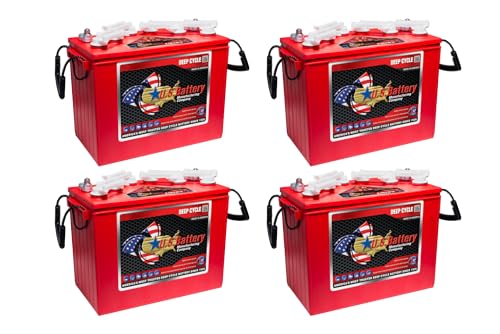
- US Battery US12VXC2 12 Volt 155 Ah Deep Cycle GC12 – Set of 4 — Check the current price on Amazon
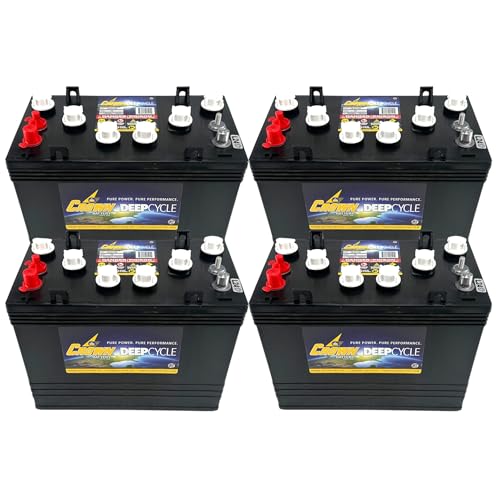
- Crown CR-GC150 12V 150Ah Deep-Cycle Batteries – Set of 4 — Check the current price on Amazon
- WOXABHSL 4 PCS 12V 100Ah LiFePO4 Lithium Battery — Check the current price on Amazon
- Enjoybot 12V 100Ah LiFePO4 Lithium Battery — Check the current price on Amazon
- GP 12.8V 100Ah LiFePO4 Group 24 Lithium Battery — Check the current price on Amazon
The best 12 volt golf cart batteries come in sets, and understanding why explains most of this market. A 48-volt golf cart needs 48 volts of battery however you build it: six 8-volt units, eight 6-volt units, or — the layout this guide covers — four 12-volt deep-cycle batteries wired in series. The four-by-twelve layout has become the default on many newer carts because the batteries are larger, the cabling is simpler, and replacement shopping is easier. If your cart’s battery tray holds four big blocks, you are in the right guide.
Within that layout there is one big decision — flooded lead-acid or lithium iron phosphate — and a handful of smaller ones. Flooded batteries from the established deep-cycle makers (Trojan, U.S. Battery, Crown) are the known quantity: heavy, water-topped, proven over decades, and replaced as a matched set on a cycle measured in years. Lithium blocks cost more per set, weigh a fraction as much, need no watering, and ask different questions of your charger. Both chemistries appear below, each represented by verified listings, and the guide is blunt about which ownership style each suits.
One rule governs everything that follows: replace cart batteries as a matched set. A series string is only as strong as its weakest battery, and dropping one new 12-volt block among three tired ones wastes the new battery and frustrates the owner. Every pick here is therefore a multi-battery set or a block sold for building a set, and every review is written about the set’s behaviour, not a single unit’s brochure.
In this guide
Quick Picks
The short version: flooded sets from the traditional makers for proven, lower-cost ownership; lithium blocks for owners who value light weight, no watering, and long service. All six picks are verified sets or set-building blocks.
Trojan T1275 12 Volt 150 Ah Deep Cycle Battery – 4 Pack — Best Overall: The reference flooded set: four Trojan T-1275 12-volt, 150-amp-hour deep-cycle batteries — the GC12 benchmark against which every other flooded option in this guide is measured. Check the current price on Amazon
US Battery US12VXC2 12 Volt 155 Ah Deep Cycle GC12 – Set of 4 — Best Flooded Alternative: U.S. Battery’s GC12 entry, rated at 155 amp-hours in a set of four, positioned by its own listing as a direct T-1275-class replacement — the other name cart veterans cross-shop against Trojan. Check the current price on Amazon
Crown CR-GC150 12V 150Ah Deep-Cycle Batteries – Set of 4 — Best Premium Flooded: Crown’s GC12 set, positioned in its listing as a premium long-life replacement — the flooded choice for owners who keep a cart for years and maintain it properly. Check the current price on Amazon
WOXABHSL 4 PCS 12V 100Ah LiFePO4 Lithium Battery — Best Lithium Blocks: Four 12-volt 100Ah lithium iron phosphate blocks with built-in battery management, for owners who want lithium’s weight and maintenance advantages while keeping the familiar four-block layout. Check the current price on Amazon
Enjoybot 12V 100Ah LiFePO4 Lithium Battery — Best Lithium for Deep Discharge: A 12-volt 100Ah LiFePO4 block with a 100A BMS and low-temperature charge protection per its listing, sold in multi-packs and rated for series use — the hard-working lithium building block. Check the current price on Amazon
GP 12.8V 100Ah LiFePO4 Group 24 Lithium Battery — Best Smart Lithium: A Group 24 lithium block with a smart 150A BMS, Bluetooth app monitoring, and low-temperature protection per its listing — the connected, compact option among the lithium picks. Check the current price on Amazon
How These Picks Were Chosen
Every set in this guide was confirmed in Amazon’s catalog data before inclusion, and the first filter was configuration: this keyword means four 12-volt batteries building a 48-volt cart pack, so 36-volt kits, single 48-volt packs, and 6-volt or 8-volt strings were excluded even when they appeared under the same search. The EZGO RXV guide in this series covers the conversion-kit route for that specific cart; this guide covers the four-block layout generally.
The second filter was set integrity. Cart batteries are replaced as matched sets, so listings were chosen as complete sets of four or as blocks explicitly sold for building series strings. Capacities, chemistries, and management features quoted in the reviews come from the manufacturers’ own listings — including the lithium blocks’ BMS ratings and low-temperature protections — and no cycle-life or lifespan figure appears here that a listing does not support in the guide’s own cautious wording.
Finally, the six were balanced across the real market: three flooded sets from the three established deep-cycle makers, and three lithium options representing the block conversion, the hard-working deep-discharge block, and the smart monitored block. Chemistry advocacy was left to the buying guide, where it belongs; the picks themselves simply had to be genuine, verified, and correctly configured.
Weight was recorded for every set as a selection factor, not a footnote: a flooded GC12 set is a two-person lift, and that fact shapes who should install it, how the cart handles, and how honestly a seller’s ‘easy replacement’ claim should be read. Sets whose listings left configuration ambiguous — unclear counts, unclear group size — were excluded regardless of price attractiveness, because a battery set is the last purchase that should arrive as a surprise.
One practical screen was applied to every listing: could a buyer determine, from the listing alone, exactly what would arrive — how many batteries, of what group size and capacity, with what management hardware? Sets that passed are in this guide. Sets that required detective work to establish their own configuration are not, because a purchase this heavy should never depend on a buyer’s guesswork.
The 6 Best 12 Volt Golf Cart Batteries in Detail

Trojan T1275 12 Volt 150 Ah Deep Cycle Battery – 4 Pack — Best Overall
If a golf cart mechanic is asked what a 12-volt cart battery is, the T-1275 is the shape of the answer. Trojan’s GC12 flooded deep-cycle battery — 12 volts, 150 amp-hours — has been the default fitment and replacement in this class for years, and this four-pack is the complete series set for a 48-volt cart. It is not the newest or lightest option here; it is the known one, and known counts heavily in batteries.
Strengths
- The benchmark GC12 flooded battery, with deep service knowledge everywhere carts are maintained
- Complete matched 4-pack for a 48V cart — no mixing ages or brands in the string
- Flooded construction is tolerant, well understood, and compatible with standard cart chargers
Trade-offs
- Heavy — a set of four flooded blocks is a serious lift in and out of the tray
- Needs periodic watering and terminal care to reach its service life
- Shorter cycle life than lithium if routinely deep-discharged
| Configuration | 4 x 12V in series (48V cart) |
| Capacity | 150 Ah class (per listing) |
| Chemistry | Flooded lead-acid deep cycle |
| Group | GC12 |
The case for the T-1275 set is the case for the mature technology. Every cart shop knows its watering rhythm, its charging profile, and its failure manners; every charger sold for these carts was designed around batteries like it. Owners who maintain the set — water after charging, keep terminals clean, avoid parking it discharged — are rewarded with years of predictable service and a replacement market that will exist as long as golf carts do.
The costs of that maturity are physical. Four flooded GC12 blocks make a set that two people should move, the watering ritual is real, and the set will not forgive chronic deep discharge the way lithium’s management electronics forgive it. Buyers at peace with a maintenance schedule should start here and stop shopping. Buyers who are not should keep reading — the second half of this list exists for them — but nobody should buy this set planning to neglect it.
Best for: Most 48V carts on the four-by-12V layout that need a proven flooded replacement set / Not suited for: Owners who want to escape watering, weight, and acid maintenance entirely
Check the current price on Amazon
US Battery US12VXC2 12 Volt 155 Ah Deep Cycle GC12 – Set of 4 — Best Flooded Alternative
U.S. Battery is the other half of the classic American deep-cycle duopoly, and the US12VXC2 is its GC12 contender: a 12-volt flooded battery rated at 155 amp-hours, sold here as a set of four, and described in its listing as a replacement for the T-1275 class. If the Trojan is the default, this is the connoisseur’s alternative — same format, same ownership style, marginally higher rated capacity.
Strengths
- 155 Ah rating edges the benchmark’s capacity class
- From one of the two most established deep-cycle makers in the cart world
- Drop-in GC12 format — same tray, same cables, same charger expectations
Trade-offs
- Same watering, weight, and terminal care as any flooded set
- Availability and local support vary more by region than the benchmark brand
- No advantage if your charger or routine is the actual weak point
| Configuration | Set of 4 x 12V (48V cart) |
| Capacity | 155 Ah class (per listing) |
| Chemistry | Flooded lead-acid deep cycle |
| Group | GC12 |
Choosing between the two classic flooded sets is less about a winner than about fit with your world. Rated capacity slightly favours the U.S. Battery; ubiquity slightly favours the Trojan. Cart professionals have maintained both for decades, parts and knowledge are everywhere for both, and an owner who waters and charges either set properly will get the service the chemistry offers. An owner who neglects either will get the same shortened life from both.
That is why this pick is framed as the alternative rather than the upset. If your local cart shop stocks and supports U.S. Battery, if the set is the one available when your old pack dies in season, or if the extra rated amp-hours suit a cart that works long days, this is a first-rank choice — not a consolation. Flooded shopping at this level is about buying a genuine set from a genuine maker and then doing the maintenance. Both halves of that sentence matter equally.
Best for: Owners who want a top-tier American flooded set with a touch more rated capacity than the benchmark / Not suited for: Anyone expecting a maintenance-free battery — this is a watered flooded set like the Trojan
Check the current price on Amazon
Crown CR-GC150 12V 150Ah Deep-Cycle Batteries – Set of 4 — Best Premium Flooded
Crown Battery built its reputation in industrial deep-cycle applications, and the CR-GC150 brings that lineage to the GC12 format: a 12-volt, 150-amp-hour flooded battery, sold as a set of four for golf carts, RVs, marine, and solar use, and positioned by its listing as a premium long-life option. This is the flooded pick for the owner who maintains meticulously and keeps score in years.
Strengths
- Industrial deep-cycle heritage behind the brand
- Premium long-life positioning within the flooded class
- GC12 format keeps the same fit and charger compatibility as the benchmark sets
Trade-offs
- Premium positioning within a chemistry that still needs watering and care
- Less universally stocked than the benchmark brand in some regions
- The premium only pays back if the cart and the maintenance both last
| Configuration | Set of 4 x 12V (48V cart) |
| Capacity | 150 Ah class (per listing) |
| Chemistry | Flooded lead-acid deep cycle |
| Positioning | Premium long-life GC12 replacement (per listing) |
Premium flooded batteries are a bet on ownership style. The chemistry’s ceiling is set by plate design, build quality, and — above all — the owner’s watering and charging discipline. Crown’s industrial background is the reason to believe its ceiling is high; your maintenance habits are the reason it will or will not be reached. For the owner who already keeps a battery log and a watering can on schedule, this set is the flooded endgame.
For everyone else, honesty applies: a neglected premium set dies on roughly the same schedule as a neglected standard set, and the premium buys little. This is also the pick that makes least sense for a cart approaching sale or retirement. But a well-kept cart in long-term family or course service, maintained by someone who enjoys doing it properly, is exactly the home the CR-GC150 was built for — and in that home it should out-serve the standard sets here.
Best for: Owners who want the premium tier of flooded ownership and keep carts for the long term / Not suited for: Budget replacements for a cart that may be sold or retired soon
Check the current price on Amazon

WOXABHSL 4 PCS 12V 100Ah LiFePO4 Lithium Battery — Best Lithium Blocks
This set answers the most common lithium question in the cart world: can I keep my four-block layout and just change chemistry? The WOXABHSL package is four 12-volt, 100Ah LiFePO4 batteries, each with a built-in 100A battery management system per its listing, sized to build a 48-volt series string in the space the flooded set occupied — at a fraction of the weight and with no watering, ever.
Strengths
- Four-block lithium conversion keeps tray layout and series wiring familiar
- Built-in BMS per block protects against the abuses that kill unprotected packs
- No watering, no acid, and a fraction of the flooded set’s weight
Trade-offs
- Charger compatibility must be confirmed — a lead-acid charger profile may not suit lithium
- 100Ah lithium and 150Ah flooded are not directly comparable on the label; usable capacity differs by chemistry
- Series lithium blocks need the maker’s series guidance followed exactly
| Configuration | 4 pcs 12V blocks |
| Capacity | 100Ah per block (per listing) |
| Chemistry | LiFePO4 with built-in 100A BMS (per listing) |
| Use cases | Golf cart, marine, RV, solar (per listing) |
The conversion case rests on usable capacity and weight. Lithium can be discharged far deeper than flooded lead-acid without damage, so a nominally smaller amp-hour figure delivers more real-world range than the label suggests — while the cart sheds well over a hundred pounds of battery, which the suspension, the hills, and the person lifting blocks all notice. Add zero watering and a much longer cycle life under deep discharge, and the ownership experience changes category, not just degree.
The homework is real, though. Your charger must have a lithium-appropriate profile or be replaced; the blocks must be wired and used within the maker’s series limits; and the cart’s battery gauge — if it is a voltage-based lead-acid gauge — will misread lithium’s flat curve, which is why the gauge guide in this series exists. Do that homework and this set is the modern answer. Skip it, and even excellent blocks will disappoint through no fault of their own.
Best for: Owners converting a four-by-12V cart to lithium while keeping the series-block layout / Not suited for: Owners unwilling to confirm charger compatibility with lithium before converting
Check the current price on Amazon

Enjoybot 12V 100Ah LiFePO4 Lithium Battery — Best Lithium for Deep Discharge
Enjoybot’s 12-volt 100Ah LiFePO4 is the utilitarian lithium block: built-in 100A management, low-temperature cut-off to protect the cells from cold charging, and explicit series capability in its listing for building higher-voltage strings. Sold in multi-packs, it suits the cart owner building a 48-volt lithium string block by block, and the listing’s mention of golf carts, LSVs, UTVs, and ATVs reflects how broadly this block gets used.
Strengths
- Low-temperature cut-off protects against the silent cell damage of cold charging
- Series-rated in its listing, suiting four-block 48V cart strings
- 100A BMS and deep-cycle design suit hard-working small EVs
Trade-offs
- Sold as battery hardware — charger, gauge, and cabling decisions remain yours
- Multi-pack listings require care to order the count your cart actually needs
- Like all lithium here, needs a lithium-appropriate charging profile
| Configuration | 12V block, multi-pack listing, series capable (per listing) |
| Capacity | 100Ah (per listing) |
| Chemistry | LiFePO4, 100A BMS (per listing) |
| Protection | Low-temperature cut-off (per listing) |
The low-temperature cut-off is the detail that earns this block its badge. Lithium cells charged below freezing can be permanently damaged without any visible sign, and carts live in unheated garages, barns, and cart sheds across the northern half of the country. A BMS that refuses the charge until the block warms is not a luxury feature in that world; it is the difference between a conversion that lasts and one that quietly fades in its second winter.
Beyond that, this is the flexible option: the same block serves a cart string, a trolling motor, or a solar bank, which suits owners whose 12-volt world extends beyond one vehicle. The corresponding duty is system design — nobody bundles your charger decision or your gauge recalibration into this box. Confident owners will find that liberating; owners who want a curated kit should look at the conversion-kit approach covered in the EZGO RXV guide in this series instead.
Best for: Carts and small electric vehicles that work hard, discharge deep, and live in cold climates / Not suited for: Owners who want a cart-specific kit with charger and monitor bundled — this is battery hardware
Check the current price on Amazon

GP 12.8V 100Ah LiFePO4 Group 24 Lithium Battery — Best Smart Lithium
The GP block brings the smart layer to 12-volt lithium: a Group 24-format LiFePO4 battery whose listing specifies a smart 150A BMS, Bluetooth mobile app monitoring, low-temperature protection, and flexible series-parallel expansion. For the owner who likes to see what each battery is doing — voltage, current, state — rather than trusting a single dash gauge, this is the pick that speaks that language.
Strengths
- Bluetooth app monitoring gives per-battery visibility no dash gauge matches
- Smart 150A BMS is the highest-rated management in this guide’s lithium picks
- Group 24 footprint is compact and widely compatible beyond carts
Trade-offs
- Group 24 is a smaller case than GC12 — confirm tray fit and total capacity for your cart’s range needs
- App-based monitoring only helps owners who will actually open the app
- Expansion configurations must follow the maker’s stated limits exactly
| Format | Group 24 |
| Capacity | 100Ah (per listing) |
| Chemistry | LiFePO4, smart 150A BMS (per listing) |
| Monitoring | Bluetooth mobile app (per listing) |
Visibility changes ownership. A cart on flooded batteries tells you its state through a hydrometer and hope; a cart on app-monitored lithium tells you each block’s voltage and behaviour from the seat. Imbalance — the quiet killer of series strings — becomes visible while it is still a maintenance item rather than a failure. For owners running multiple vehicles or a small fleet, that diagnostic layer alone can justify the smart premium.
The sizing conversation must be honest, though. Group 24 is a smaller case than the GC12 blocks the flooded sets use, and a four-block string of 100Ah lithium should be matched against your cart’s real range needs — remembering that lithium’s usable depth makes its effective range larger than the flooded comparison suggests, but not infinitely so. Measure your tray, count your miles, and let the app data from the first weeks confirm the match. Owners who do that get the most modern battery experience in this guide.
Best for: Owners who want per-battery visibility through an app and a smaller Group 24 footprint / Not suited for: Owners who want the largest flooded-style capacity class in a four-block set
Check the current price on Amazon
Comparison Table
Chemistry first — flooded for proven, maintained ownership; lithium for light, sealed, deep-discharge ownership — then confirm the set configuration matches your cart’s tray and voltage.
| Pick | Badge | Key spec | Best for |
|---|---|---|---|
| Trojan T1275 12 Volt 150 Ah Deep Cycle Battery – 4 Pack | Best Overall | Four 12V flooded deep-cycle batteries, 150 Ah class, GC12 group | Most 48V carts on the four-by-12V layout that need a proven flooded replacement set |
| US Battery US12VXC2 12 Volt 155 Ah Deep Cycle GC12 – Set of 4 | Best Flooded Alternative | Four 12V flooded batteries, 155 Ah class, GC12, T-1275 replacement class | Owners who want a top-tier American flooded set with a touch more rated capacity than the benchmark |
| Crown CR-GC150 12V 150Ah Deep-Cycle Batteries – Set of 4 | Best Premium Flooded | Four 12V flooded batteries, 150 Ah class, premium long-life GC12 positioning | Owners who want the premium tier of flooded ownership and keep carts for the long term |
| WOXABHSL 4 PCS 12V 100Ah LiFePO4 Lithium Battery | Best Lithium Blocks | Four 12V 100Ah LiFePO4 blocks, built-in 100A BMS per listing | Owners converting a four-by-12V cart to lithium while keeping the series-block layout |
| Enjoybot 12V 100Ah LiFePO4 Lithium Battery | Best Lithium for Deep Discharge | 12V 100Ah LiFePO4, 100A BMS, low-temperature cut-off per listing | Carts and small electric vehicles that work hard, discharge deep, and live in cold climates |
| GP 12.8V 100Ah LiFePO4 Group 24 Lithium Battery | Best Smart Lithium | Group 24 LiFePO4, smart 150A BMS, Bluetooth app, low-temp protection per listing | Owners who want per-battery visibility through an app and a smaller Group 24 footprint |
How to Choose 12 Volt Golf Cart Batteries: Flooded or Lithium?
Flooded lead-acid is the ownership style carts grew up with. The sets cost less to buy, every charger and mechanic understands them, and their weaknesses are honest ones: they are heavy, they need watering, their terminals corrode, and they dislike being left discharged. Owners who enjoy or at least accept a maintenance rhythm get dependable years from them, and the three flooded sets in this guide are the best expression of that bargain.
Lithium iron phosphate rewrites the routine. A lithium string weighs a fraction as much, never needs water, tolerates deep discharge that would shorten a flooded set’s life, and holds its voltage so steadily that carts often feel stronger late in a round. Its costs are a higher purchase price, a charger that must speak the right profile, and gauges calibrated for lead-acid that will misread it. Neither chemistry is ‘better’ — they are answers to different ownership personalities, and the most satisfied owners are the ones who chose for the owner they actually are.
- You maintain on schedule and value proven tech: flooded
- You want zero watering and maximum tolerance of deep discharge: lithium
- Your cart climbs hills or carries loads: lithium’s weight saving is felt daily
- Your charger is recent and lithium-capable, or you will replace it: lithium is open to you
- Your cart sits unused for months: flooded tolerates neglectful storage better with a maintainer; lithium prefers partial charge storage
Whichever chemistry wins, buy the whole set at once from one maker and one listing. A series string shares everything — charge, discharge, and fate — and mixed ages or brands guarantee the string performs at its weakest member’s level.
How Long Should a Set of Golf Cart Batteries Last?
Flooded sets live and die by depth of discharge and watering. A set discharged moderately, recharged promptly, and kept watered will serve for years of regular use; the same set run flat weekly and left dry can be finished in a fraction of that span. The single most damaging habit is parking the cart discharged — sulfation begins immediately and compounds. The second is letting plates expose to air through low water, which is why the watering ritual exists.
Lithium strings shift the failure modes rather than abolishing them. Cycle life under deep discharge is far longer, calendar life is generous, and the BMS prevents most abuse — but chronic storage at full charge in heat, or charging below freezing without low-temperature protection, will still age the pack early. The honest summary for both chemistries: batteries rarely die of old age; they die of routines. Choose the set whose routine you will actually perform.
What Size Are 12 Volt Golf Cart Batteries?
The flooded standard is the GC12 case — the footprint the T-1275 class defined — and most carts built for four 12-volt batteries have trays, hold-downs, and cable lengths arranged around it. The flooded sets in this guide share that format, which is what makes them drop-in replacements for one another. Always measure your tray and check terminal positions before ordering any set, because ‘fits most carts’ is not a dimension.
Lithium blocks vary more: some mimic the GC12 case, others — like the Group 24 pick here — use a smaller automotive-derived footprint that may need tray adaptation or spacers and offers easier handling in exchange. Smaller cases also change cable reach. None of this is difficult, but it should be planned at the kitchen table with a tape measure, not discovered with four batteries on the garage floor and a cart in pieces.
How to Water and Maintain a Flooded Cart Battery Set
Flooded maintenance is a small ritual with outsized consequences, and it is worth describing properly because so much flooded lifespan is decided here. Check the electrolyte monthly in warm weather or heavy use, and always after charging, when the level has stabilised. Add distilled water only — never tap water, whose minerals poison plates — filling to the maker’s indicator, typically just above the plates and below the filler neck. If plates are exposed before charging, add just enough to cover them, charge, then top up properly; filling a discharged battery to the line guarantees an overflow when charging raises the level.
The rest of the ritual is cleanliness and tightness. Terminals should be clean, firmly torqued, and protected against the corrosion that creeps from acid vapour; cables with green, swollen insulation are replaced, not cleaned and forgiven. Keep the battery tops dry and free of the conductive grime film that lets a pack slowly discharge itself across its own lids. None of this takes more than fifteen minutes a month, and it is the entire difference between the owner who gets the chemistry’s full service life and the owner who concludes, wrongly, that flooded batteries ‘only last a couple of years’.
What Are the Signs a Golf Cart Battery Set Is Reaching the End?
Sets rarely die in a single event; they retire by degrees, and the degrees are readable. Range shrinks first — the familiar loop that used to end with charge to spare now ends with the gauge worrying you. Hills that were unremarkable become negotiations. Charge times stretch, or the charger finishes suspiciously fast, which is the same symptom wearing a different coat: a set that accepts little energy because it can hold little energy. On flooded sets, a hydrometer tells the truth per battery — one block reading far below its siblings condemns the string, because the string can only perform at its weakest member’s level.
The decision point matters because a dying set damages its own replacement timeline. Owners who nurse a finished set through a season of jump-packs and mid-round failures often end up buying in a panic, in season, at whatever is on the shelf. Owners who read the signs a season early buy deliberately — chemistry reconsidered, charger checked, tray measured — and this guide exists for that second owner. When two of the signs above are present and a hydrometer or load test agrees, the set has told you its news. Believe it the first time.
How to Replace a Set of 12 Volt Golf Cart Batteries Safely
A battery swap is straightforward work with two real hazards — the weight of flooded blocks and the energy in a series string. Work methodically, photograph everything before touching it, and the job takes an afternoon.
- Photograph the existing wiring from several angles before disconnecting anything; series strings are easy to miswire and expensive to learn by error.
- Switch the cart off, set the tow/run switch to tow where fitted, and remove jewellery — a wrench across 48-volt terminals is a welding accident.
- Disconnect the main negative cable first, then the main positive, then the interconnecting cables, insulating each terminal as you free it.
- Remove hold-downs and lift the old batteries out with help or a lifting strap; flooded GC12 blocks are heavy enough to injure a back or crack a case if dropped.
- Clean the tray thoroughly, neutralise any acid residue, repair corrosion, and inspect every cable for damaged insulation or green, brittle terminals — replace doubtful cables now, not later.
- Set the new batteries in the tray in the photographed orientation, refit hold-downs snugly without crushing cases, and reconnect in reverse order: interconnects, main positive, main negative last.
- Torque terminals to a firm, clean contact, protect them against corrosion, and confirm total pack voltage at the main terminals matches the cart’s system before switching to run.
- Charge the new set fully before first use — flooded sets especially should start life from a full, equalised charge — and record the install date on each battery with a marker.
Dispose of the old set through the retailer’s or a recycler’s take-back scheme. Lead-acid batteries are among the most successfully recycled products in existence, and lithium packs have their own return channels — neither belongs anywhere else.
Common Buying Mistakes
Cart battery money is usually wasted in a handful of predictable ways. These are the mistakes this guide most wants to save you from.
- Replacing one battery instead of the set. A series string performs at its weakest battery. One new block among three tired ones is money spent to be disappointed.
- Parking the cart discharged. Recharge after use, every time. A discharged flooded set sulfates from the first day; no charger setting fully reverses it.
- Watering with tap water, or before charging. Distilled water only, added after charging (unless plates are exposed), to the maker’s level. Small ritual, large consequences.
- Converting to lithium on a lead-acid charger. Confirm the charger’s profile suits lithium or replace the charger. The blocks’ BMS is protection, not a charging strategy.
- Trusting the old dash gauge on lithium. Voltage-based lead-acid gauges misread lithium’s flat curve. Use the blocks’ app or a lithium-aware meter.
- Lifting flooded blocks alone. A GC12 set is a two-person or strap job. A cracked case or injured back costs more than any battery in this guide.
Buy the set, charge the set, maintain the set — the owners who internalise those three verbs stop shopping for batteries for years at a time.
Add a seventh, quieter error: never recording the install date. Batteries age on a calendar as much as on a cycle count, and the owner who can say ‘this set went in four springs ago’ diagnoses decline in seconds, while the owner guessing at a set’s age guesses at everything else too. A paint marker on each block at installation — date, and a number for position — is the cheapest diagnostic tool in the cart world, and it takes less than a minute.
Final Recommendation
Most owners should buy the Trojan T-1275 four-pack and stop thinking: it is the benchmark flooded set, understood by every charger and mechanic in the cart world, and it will serve exactly as well as the maintenance it receives. The U.S. Battery set is the equal-rank alternative with a touch more rated capacity, and the Crown set is the premium flooded choice for meticulous long-term keepers.
Owners converting to lithium should choose by style: the WOXABHSL four-block set for a straightforward layout-preserving conversion, the Enjoybot blocks for hard work and cold garages, and the GP Group 24 blocks for app-level visibility into every battery. Whichever chemistry you choose, replace as a set, charge correctly from day one, and let the routine — not the marketing — decide how long the set lives.
Two neighbouring guides complete the picture: Best 12 Volt Golf Cart Batteries sits beside Best 12 Volt Golf Cart Batteries For Ezgo Rxv for RXV owners weighing full conversion kits, and Best 12 Volt Gauge for the meter that tells the truth about whichever set you buy. Cart owners maintaining a whole property may also use Best 12 Volt Gate Opener and Best 12 Volt Battery for the other 12-volt systems in their lives.
Start with the three picks most readers end up choosing between: Trojan T1275 12 Volt 150 Ah Deep Cycle Battery – 4 Pack, US Battery US12VXC2 12 Volt 155 Ah Deep Cycle GC12 – Set of 4, Crown CR-GC150 12V 150Ah Deep-Cycle Batteries – Set of 4. Each one was verified for this guide, and each one links to its live listing so you can check the current price on Amazon before you decide.
Frequently Asked Questions
How many 12 volt batteries does a 48 volt golf cart use?
Four, wired in series: four 12-volt batteries multiply to the 48 volts the cart’s system needs. They should always be replaced together as a matched set, because the string performs only as well as its weakest battery.
Can I mix lithium and lead-acid batteries in one cart?
No. The two chemistries have different voltages under load, different charging needs, and different discharge behaviour. A series string must be one chemistry, one maker, one age — mixing guarantees poor performance and can create safety problems.
Are 100Ah lithium batteries weaker than 150Ah flooded ones?
Not in usable terms. Flooded batteries should only be discharged to about half their rating to protect their lifespan, while lithium can be used far more deeply. A 100Ah lithium block therefore delivers usable energy much closer to a 150Ah flooded block than the labels suggest.
Do I need a new charger when converting to lithium?
Usually, yes — or at least confirmation that your existing charger has a lithium-appropriate profile. Charging lithium on a aggressive lead-acid profile shortens its life and can trip its protection. Budget the charger question into any conversion.
How do I know my old set is really finished?
Symptoms are shortened range, sluggish hills, and long charge times, confirmed by testing: a rested pack voltage check and, for flooded sets, a hydrometer reading per battery. One battery far below its siblings condemns the set — replace all four.
How should new flooded batteries be watered?
With distilled water only, added after charging to the maker’s fill level, checking monthly in warm weather or heavy use. Plates must never sit exposed to air. Lithium sets need no watering at all — one of their genuine advantages.
Should I charge the cart after every use?
Yes — prompt recharging is the single best habit for flooded sets, which sulfate when left discharged, and it does lithium no harm either. Plug in when you park, let the charger finish its full cycle, and the set starts every day from its best state.
Can I leave the cart stored all winter on its batteries?
With preparation: flooded sets should be stored fully charged, watered, and on a maintainer or periodically recharged, since they self-discharge and a discharged battery can freeze. Lithium prefers storage at partial charge in a cool, dry place, disconnected per the maker’s guidance.
Can I use automotive starting batteries in a golf cart to save money?
No — starting batteries are built for brief, shallow bursts, and deep-cycle cart service destroys them quickly. The apparent saving becomes a second purchase within a season or two. Cart batteries must be deep-cycle designs, like every set in this guide.


