Disclosure: airfryerkitchensupply.com is reader-supported. When you buy through links on our site, we may earn an affiliate commission at no extra cost to you.
Where to buy
Every pick in this best 12 volt elec cooler shortlist is sold on Amazon, which is where stock, seller choice and delivery options for 12 volt gear change fastest. Use the links in this box for a first price check, then confirm the exact capacity and power cords included on the listing before you order — the same cooler name is sometimes sold in two sizes. If a pick is covered in prose only, that is because its listing could not be verified cleanly at review time, and the honest move is to search the model name on Amazon yourself rather than trust a stale link.
- Koolatron 12V Iceless Cooler & Warmer 18 Quart — Check price on Amazon
- Wagan EL6206 12V 6 Quart Personal Thermoelectric Cooler Warmer — Check price on Amazon
- Wagan EL6214 Personal Thermoelectric Cooler/Warmer 14 Liter — Check price on Amazon
- Igloo IE42 Roller Thermoelectric Cooler & Warmer — Check price on Amazon
- Igloo IE24 Thermoelectric Cooler & Warmer — Check price on Amazon
- Alpicool C15 Portable Car Freezer 16 Quart — Check price on Amazon
Finding the best 12 volt elec cooler starts with one honest fact: the words “electric cooler” cover two very different machines. Thermoelectric coolers are light, simple and affordable, but they only chill a set amount below the air around them, so a hot parked car defeats them. Compressor coolers cost more and weigh more, yet they hold a true set temperature like a household fridge, even in summer heat. This guide separates the two honestly instead of pretending one design wins everywhere.
The six picks below were chosen for real vehicle life: daily commuting, long highway drives, camping weekends, work trucks and family road trips. Five are thermoelectric models that sip power and travel light, and one is a compressor model included deliberately as the upgrade pick for anyone whose food safety actually depends on the temperature inside the box. Every linked model was verified against Amazon’s own catalogue data before it earned a link here.
Read the badges first. If you mostly carry drinks and sandwiches for a day, a thermoelectric pick will serve you well and leave money for the trip itself. If you carry insulin, raw meat for a campsite, or groceries through a hot afternoon of errands, skip straight to the compressor pick and the buying guide section on temperature, because no thermoelectric box — however well reviewed — can promise fridge temperatures in a hot vehicle.
In this guide
Quick Picks
Six coolers, six different jobs. The badges are consistent from this list through the full reviews, so you can jump straight to the model that matches your vehicle and your trip length.
Koolatron 12V Iceless Cooler & Warmer 18 Quart — Best Overall. The balanced thermoelectric pick: hard-sided, genuinely portable, big enough for a real day of food and drinks without taking over the back seat. — Check price on Amazon
Wagan EL6206 12V 6 Quart Personal Thermoelectric Cooler Warmer — Best Budget. A small personal cooler for one person’s lunch and drinks — the lowest-cost way into powered cooling, sized for a footwell or beside a seat. — Check price on Amazon
Wagan EL6214 Personal Thermoelectric Cooler/Warmer 14 Liter — Best for Long Drives. Fourteen litres of seat-friendly cooling with a shoulder-strap carry — the long-drive companion for two people and a day of motorway miles. — Check price on Amazon
Igloo IE42 Roller Thermoelectric Cooler & Warmer — Best Large Capacity. The big thermoelectric: room for a crowd’s drinks, on wheels with a telescoping handle, so its size does not punish you between car park and pitch. — Check price on Amazon
Igloo IE24 Thermoelectric Cooler & Warmer — Best for Errands and Daily Use. A 32-can everyday cooler with unusually honest listing numbers — it states its cooling and warming range outright — and AC/DC power for home and car. — Check price on Amazon
Alpicool C15 Portable Car Freezer 16 Quart — Best Compressor Upgrade. The step-up pick: a true compressor fridge-freezer with a stated temperature range down to freezer territory, for buyers whose cargo cannot gamble on ambient-relative cooling. — Check price on Amazon
How These Picks Were Chosen
Picks were chosen by matching verified Amazon catalogue listings to the jobs buyers actually describe: keeping drinks cold on a commute, holding a picnic through a hot day, living in a work truck all week, and protecting perishable food on multi-day trips. Capacity in the manufacturer’s own listing title, power options and cooling type were the first filters; anything that could not be verified was dropped or demoted to prose coverage.
Cooling type was weighted more heavily than brand. A thermoelectric cooler is a fan, a heat sink and a semiconductor plate — there is very little to break, but physics caps its performance. A compressor cooler is a small refrigerator, with a real thermostat and real temperature hold. We also favoured models that run on both 12 volt DC in the vehicle and AC power at home or in a hotel, because pre-chilling before departure is the single habit that most improves results with either design.
Finally, we checked the practical details listings sometimes bury: whether the lid opens fully between front seats, whether the cord is long enough to reach a rear cargo socket, and whether the unit doubles as a warmer in winter. A cooler that is technically excellent but impossible to place in your vehicle is not a good pick, so placement and footprint are discussed in every review below.
The 6 Best 12 Volt Electric Coolers
Each review states who the cooler suits, who should skip it, three strengths, three honest trade-offs, and the verified specifications from its listing. Prices are never printed here because they move too often — use the Amazon links to check the current price on the exact size you want.
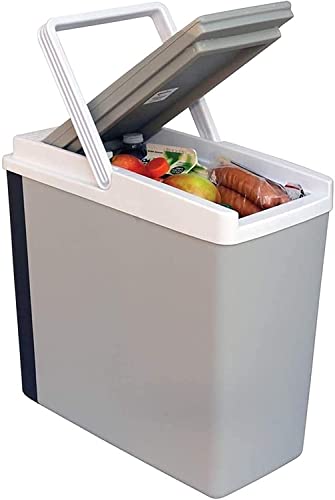
Koolatron 12V Iceless Cooler & Warmer 18 Quart — Best Overall
The Koolatron 18 quart is the cooler we would hand to the widest range of buyers. Its hard-sided shell protects food from being crushed by luggage, the capacity suits two to four people for a day trip, and the iceless design means you arrive with dry sandwiches instead of a floating lunch. It suits commuters, picnic families and boaters who want dependable cooling without compressor money.
Strengths
- Hard-sided shell protects contents and stacks safely in a loaded trunk
- 18 quart size hits the sweet spot between capacity and portability
- Cooler and warmer in one unit, useful across seasons
Trade-offs
- Thermoelectric cooling is relative to ambient air, not a set temperature
- Too large to sit comfortably between most front seats
- Fan runs whenever it is plugged in, so unplug it when parked for long periods
| Specification | Detail |
|---|---|
| Capacity | 18 quart |
| Power | 12V DC |
| Type | Thermoelectric cooler and warmer |
| Body | Hard-sided |
In daily use the Koolatron’s advantage is predictability. Load it with pre-chilled drinks, plug it in before you leave, and it holds that chill for the length of a drive far better than a passive box, because the fan keeps pulling heat out instead of letting the cold slowly leak away. The warmer mode is more than a gimmick in winter: it keeps a takeaway meal or a baby’s bottle at a pleasant temperature on the drive home.
The limit is the same one every thermoelectric model shares. On a very hot day, in a vehicle parked in the sun, the inside of this cooler will be cooler than the cabin but not fridge-cold. Plan around that physics — pre-chill, keep it out of direct sun, and open the lid briefly — and it performs exactly as a good thermoelectric cooler should. Buyers who understand that trade-off are consistently the happiest owners of this class of product.
Placement decides this cooler’s daily happiness more than any setting it has. Between the rear seats or across the boot, with its vents breathing and its lid opening fully, it simply works; wedged behind a driver’s seat with the lid trapped half-open, it becomes awkward enough that owners stop using it. Measure the intended spot once, including the swing of the lid and the reach of the cord, and the Koolatron rewards that minute of planning on every single trip it makes.
Best for: day trips, picnics and commuters who want a hard-sided iceless cooler / Not suited for: multi-day camping with raw meat in hot weather
Check the current price on Amazon

Wagan EL6206 12V 6 Quart Personal Thermoelectric Cooler Warmer — Best Budget
The Wagan EL6206 is a personal cooler in the literal sense: six quarts is one worker’s lunch, a few drinks and a snack, kept cool by the vehicle’s own power. It suits solo drivers, rideshare and delivery drivers between stops, and anyone whose “cooler” job is really a lunchbox job. Its small footprint is the feature — it tucks into spaces a family cooler cannot.
Strengths
- Compact footprint fits a footwell, floorboard or beside a seat
- Runs on 12 or 24 volt DC, suiting cars and larger trucks alike
- UL listed, a reassuring detail in budget powered gear
Trade-offs
- Six quarts is strictly one person’s food and drink
- Thermoelectric performance drops in a hot parked vehicle
- No AC option in the listing, so home pre-chilling needs a separate adapter
| Specification | Detail |
|---|---|
| Capacity | 6 quart / 6 litre |
| Power | 12/24V DC |
| Type | Thermoelectric cooler and warmer |
| Listing note | UL Listed |
Budget picks earn their place by doing one job without fuss, and that is the EL6206. Delivery and rideshare drivers in particular benefit: a cold drink and a fresh sandwich at hour six of a shift, without a petrol-station stop or a soggy ice bag. The warmer setting also keeps a hot lunch genuinely warm between a morning pickup and a midday break, which passive lunchboxes simply cannot do.
Be honest with yourself about capacity before ordering. Six quarts disappears fast once ice-free drinks, a sandwich box and fruit are inside, and there is no room for a second person’s food. If your trips regularly involve a passenger, step up to the 14 litre Wagan or the Koolatron instead. Bought for the solo job it is designed for, this is money well spent; bought as a family cooler, it will disappoint through no fault of its own.
Ownership running costs are essentially nil beyond the electricity it sips, and that is part of the thermoelectric appeal this model represents best. There is no ice to buy, no refrigerant to service and no filter to change — just a fan, a plate and a box that asks to be wiped clean occasionally. For buyers tired of the recurring small costs and mess of passive cooling, that simplicity compounds quietly into real satisfaction over a season of trips.
Best for: solo drivers and one-person lunches on the move / Not suited for: feeding a family or carrying a weekend of food
Check the current price on Amazon
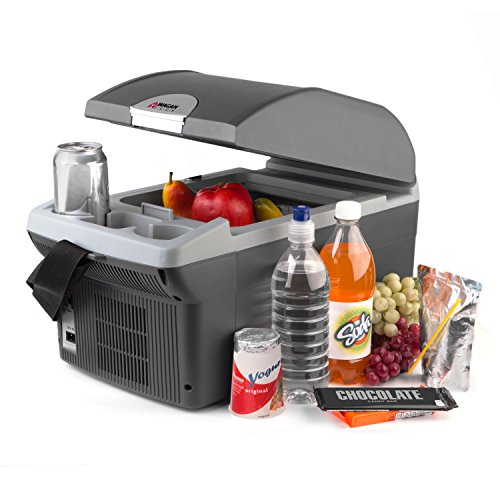
Wagan EL6214 Personal Thermoelectric Cooler/Warmer 14 Liter — Best for Long Drives
Long drives change what a cooler needs to be. It must sit within reach, open easily, survive eight hours of continuous running and keep two people fed and watered between fuel stops. The Wagan EL6214’s 14 litre capacity and personal-cooler shape are built for exactly that rhythm, and it has been a staple of this category for years for good reason.
Strengths
- 14 litre capacity serves two people for a full driving day
- 12/24V DC power suits cars, RVs and trucks
- Warmer mode keeps road food pleasant on winter drives
Trade-offs
- Thermoelectric ceiling applies — pre-chill everything for best results
- Seat-adjacent placement means measuring your space before ordering
- Continuous fan is audible in a quiet cabin at night
| Specification | Detail |
|---|---|
| Capacity | 14 litre |
| Power | 12/24V DC |
| Type | Thermoelectric cooler and warmer |
| Listing note | UL Listed |
The EL6214’s real talent is endurance behaviour. Thermoelectric plates are solid-state, with no compressor to cycle or fail, so a cooler like this simply runs, hour after hour, which is exactly what a long drive asks of it. Positioned on the rear seat or in the footwell behind the driver, it turns rest stops into a choice rather than a necessity, and that changes the feel of a long day on the road.
Two habits make it shine. First, load only pre-chilled items; a thermoelectric cooler maintains cold far better than it creates it. Second, give its fan vents breathing room — burying it under coats starves the heat sink and warms the interior. Follow those two rules and this modest box will still be keeping drinks properly cold at the end of a day that has exhausted the driver.
The warmer mode deserves one more practical note: it is at its best keeping already-hot food hot, not heating cold food through. Load a casserole or takeaway at serving temperature, switch to warm, and it arrives at serving temperature; load it cold and expect patience. Used with that understanding, the function turns this cooler into a winter tool as well as a summer one, doubling the months each year in which it earns its place in the car.
Best for: two-person road trips and long daily commutes / Not suited for: frozen food or precise temperature control
Check the current price on Amazon

Igloo IE42 Roller Thermoelectric Cooler & Warmer — Best Large Capacity
Some trips are not about two sandwiches — they are about a team, a family reunion or a full day at the lake with a dozen thirsty people. The Igloo IE42 answers with capacity rated at 59 cans and, just as importantly, wheels and a telescoping handle, because a loaded large cooler is heavy and carrying one any distance is where cheap big coolers fail their owners.
Strengths
- 59-can capacity covers groups, teams and big families
- Wheels and telescoping handle make a full load movable by one person
- Runs for car, truck, RV and home use per its listing
Trade-offs
- Loaded weight demands the wheels — plan where it will roll
- Takes serious cargo space; measure your boot or truck bed
- Thermoelectric limits still apply despite the size
| Specification | Detail |
|---|---|
| Capacity | Holds 59 cans (listing) |
| Power | 12V DC |
| Type | Thermoelectric cooler and warmer |
| Mobility | Wheels with telescoping handle |
The IE42 makes sense as an event cooler. At a sports tournament or a campsite it becomes the shared drinks station, plugged into the vehicle or a campsite supply, sparing everyone the melt-water and ice runs of a passive box this size. The roller design is not decoration: a cooler holding this much drink weighs as much as a checked suitcase, and the handle turns a two-person carry into a one-person stroll.
Its size cuts both ways. In a small hatchback it will consume the cargo area, and thermoelectric cooling across a large interior is slower to recover after the lid has been opened twenty times by thirsty children. Load it cold, park it in shade, and treat lid discipline as a group rule. For buyers whose trips genuinely run to this scale, it is the thermoelectric pick that fits; everyone else will be happier with the Koolatron’s smaller footprint.
Cleaning and care are five-minute jobs that protect the one moving part — the fan. A wipe of the interior after messy loads, an occasional check that the fan intake is free of fluff and crumbs, and dry storage with the lid ajar keep it performing as new. Owners who camp should also empty it the same evening rather than discovering a forgotten sandwich a week later, an experience this guide recommends avoiding exactly once in a lifetime, in someone else’s cooler.
Best for: group outings, teams and large families needing drink capacity / Not suited for: small cars or solo travellers
Check the current price on Amazon

Igloo IE24 Thermoelectric Cooler & Warmer — Best for Errands and Daily Use
The IE24 is the errand-runner of this list. Its listing is refreshingly specific: it holds 32 cans, cools to a stated amount below the surrounding air and warms to a stated temperature, and it runs on AC or DC power. That makes it the natural pick for grocery runs in summer, school-run drinks, and a garage-to-car routine where the cooler lives at home and travels when needed.
Strengths
- Listing states cooling and heating performance in plain numbers
- AC/DC power makes home pre-chilling and storage simple
- 32-can capacity suits family errands without roller size
Trade-offs
- The stated below-ambient cooling confirms the thermoelectric ceiling
- Mid-size shell still needs a planned spot in smaller vehicles
- Warmer mode demands the same ventilation clearance as cooling
| Specification | Detail |
|---|---|
| Capacity | Holds 32 cans (listing) |
| Power | AC/DC |
| Cooling | Cools 36°F below ambient (listing) |
| Heating | Heats to 136°F (listing) |
Those published numbers deserve respect because they set expectations correctly. Cooling a stated amount below ambient means a mild day gives you genuinely cold drinks, while a heatwave gives you cool ones — and a buyer who knows that in advance is a satisfied buyer. The warming figure matters in winter: keeping takeaway food or a casserole for a family visit at serving temperature on the drive over is a job this cooler does well.
The AC/DC flexibility is the everyday advantage. Keep it plugged in at home as overflow fridge space for drinks, then move it to the car for the grocery run, so cold items go from shelf to cooler to home fridge without a warm interval. That unbroken cold chain is worth more to food quality than any headline feature, and it is why this mid-priced model earns a daily-use badge rather than being a spare pick.
Compared with stepping up to a compressor, the honest question is frequency. If this cooler will work twenty days a year of picnics, matches and drives, its simplicity wins outright. If it will work two hundred days, carrying food whose safety matters, the compressor’s certainty repays its cost — which is why this guide keeps a compressor pick visible rather than pretending the question away. For the majority pattern of trips, though, the thermoelectric’s crown is deserved — and this mid-size Igloo is one of its most practical wearers.
Best for: grocery runs, family errands and home-to-car daily use / Not suited for: guaranteed fridge temperatures in extreme heat
Check the current price on Amazon

Alpicool C15 Portable Car Freezer 16 Quart — Best Compressor Upgrade
The Alpicool C15 is here because some loads are not negotiable. Medication, raw meat for a campsite, frozen food for a long transfer — these need a set temperature, held regardless of the weather, and only a compressor delivers that. The C15 packs that ability into a compact 16 quart body that still fits the vehicles the thermoelectric picks serve.
Strengths
- Compressor cooling holds a set temperature, stated range from freezer to fridge
- Runs on 12/24V DC in the vehicle and AC power at home
- Compact 16 quart size keeps the compressor upgrade portable
Trade-offs
- Heavier and pricier in its class than any thermoelectric pick
- Compressor needs ventilation space and a level-ish parking spot
- Draws more power parked — manage engine-off running time
| Specification | Detail |
|---|---|
| Capacity | 16 quart / 15 litre |
| Temperature range | -4°F to 68°F (listing) |
| Power | 12/24V DC and 100-240V AC |
| Type | Compressor fridge freezer |
The difference in use is night and day. Set the C15 to fridge temperature in the morning and it is at that temperature at noon in a hot car park, because the compressor simply works harder as conditions worsen — the opposite behaviour to a thermoelectric plate, which fades exactly when you need it most. Frozen goods stay frozen, which no other pick in this guide can promise, and that single ability justifies the upgrade for campers and anyone carrying temperature-sensitive medication.
The costs are real and worth stating. It weighs more, it needs its vents kept clear, and running it for many hours on a parked vehicle’s battery without protection can flatten that battery — a theme the buying guide returns to. Buyers who need certainty should accept those costs gladly; buyers who only chill drinks should save their money and choose a thermoelectric pick instead. Knowing which buyer you are is the whole decision.
Battery behaviour is the compressor owner’s one real discipline, and it is worth planning rather than discovering. In motion, the alternator makes the question disappear. Parked, the draw is modest but relentless, so the habits from the buying guide apply with force: shade, closed lid, sensible temperature, and a time limit you decide in advance. Owners who camp regularly solve it permanently with a leisure battery or power station, after which the C15 simply becomes the most trustworthy box in the vehicle.
Best for: campers, medication and any load that must hold a set temperature / Not suited for: buyers who only need drinks kept pleasantly cool
Check the current price on Amazon
Comparison Table
| Pick | Badge | Key spec | Best for |
|---|---|---|---|
| Koolatron 12V Iceless Cooler & Warmer 18 Quart | Best Overall | 18 qt thermoelectric, hard-sided | day trips, picnics and commuters who want a hard-sided iceless cooler |
| Wagan EL6206 12V 6 Quart Personal Thermoelectric Cooler Warmer | Best Budget | 6 qt personal thermoelectric | solo drivers and one-person lunches on the move |
| Wagan EL6214 Personal Thermoelectric Cooler/Warmer 14 Liter | Best for Long Drives | 14 L thermoelectric, 12/24V | two-person road trips and long daily commutes |
| Igloo IE42 Roller Thermoelectric Cooler & Warmer | Best Large Capacity | 59-can roller thermoelectric | group outings, teams and large families needing drink capacity |
| Igloo IE24 Thermoelectric Cooler & Warmer | Best for Errands and Daily Use | 32-can, AC/DC, stated temp range | grocery runs, family errands and home-to-car daily use |
| Alpicool C15 Portable Car Freezer 16 Quart | Best Compressor Upgrade | 16 qt compressor, -4°F to 68°F | campers, medication and any load that must hold a set temperature |
Read the table by cooling type first and capacity second. A large thermoelectric cooler still obeys ambient-relative physics, while the smallest compressor here holds a true temperature — capacity never compensates for the wrong cooling technology.
What is the difference between a thermoelectric and a compressor 12 volt cooler?
A thermoelectric cooler moves heat with a solid-state plate and a fan. It is light, simple, inexpensive and nearly silent in design terms, but its interior temperature is relative: it cools a fixed amount below the surrounding air. Park in hot sun and the interior warms with the cabin, even while the cooler is working perfectly. That is not a defect to be fixed by spending more within the same technology — it is the technology itself.
A compressor cooler is a miniature refrigerator. A refrigerant cycle and a thermostat hold the temperature you set, within its stated range, almost regardless of the weather outside. It costs more, weighs more and draws more power, but it can freeze, and it can be trusted with food safety in a way a thermoelectric box cannot. The choice is therefore about the job: drinks and sandwiches forgive thermoelectric limits; raw meat, dairy for days and medication do not.
- Choose thermoelectric for day trips, drinks, lunches and warmer duty in winter
- Choose compressor for multi-day camping, frozen goods and temperature-critical loads
- When in doubt, ask what happens if the load warms up — if the answer is ‘we throw it away’, buy the compressor
How much capacity do you actually need in a 12 volt electric cooler?
Capacity claims in quarts and cans are easy to inflate in your head, so translate them into your real load. A solo driver needs a lunch and three drinks — six quarts is plenty. Two people on a driving day need roughly double. A family picnic with food and drinks for four lands in the high teens of quarts, and group drink duty is where the 32-can and 59-can classes earn their space.
Oversizing has hidden costs. A big cooler eats cargo room, weighs more loaded, and its interior cools and recovers more slowly after opening because there is more air and more contents to manage. Undersizing is worse — a cooler packed so tightly that air cannot circulate cools unevenly. Aim for the size that holds your typical load at about three-quarters full, and remember that pre-chilled contents need no ice space at all, which is the quiet advantage of every powered cooler in this guide.
How do you power a 12 volt cooler without flattening your vehicle battery?
A running engine makes power a non-issue; a parked vehicle is where discipline matters. Thermoelectric coolers draw modestly but continuously, and a compressor draws more in bursts. Either can take a tired starter battery below cranking strength over a long parked stretch, especially in cold weather when batteries are weakest. The safe habits are simple: run the cooler while driving, unplug or limit it during long parked periods, and never leave any cooler running overnight on a starter battery you need in the morning.
Where listings offer AC power as well, use it. Pre-chill at home on mains power, transfer to the vehicle already cold, and let the drive maintain rather than create the cold. Campers who run a compressor for days typically add a separate leisure battery or a portable power station, keeping the starter battery out of the equation entirely — the buying guide’s most repeated piece of advice, because a flat battery is the one cooler problem that strands you.
How do you keep food safe in a 12 volt cooler on a hot day?
Food safety in a vehicle is a temperature-and-time discipline. The practical rules travel well from home hygiene: keep cold food properly cold, minimise the time it spends in the warm zone between fridge and destination, and when in doubt, throw it out. A thermoelectric cooler slows warming dramatically compared with a passive bag, especially loaded pre-chilled and kept shut and shaded — but on a hot day it is a delay, not a guarantee, and perishables for a picnic should be eaten first and not saved for tomorrow.
A compressor cooler changes the category of the promise: set to a fridge temperature, it holds that temperature, and food inside it obeys the same rules as food in your home fridge. That is why this guide keeps steering medication, raw meat and multi-day supplies toward the compressor pick. Whichever cooler you own, a small thermometer inside the box converts anxiety into information — the cheapest food-safety upgrade in the whole category, and the one experienced owners recommend first.
Thermoelectric or compressor — which makes the best 12 volt elec cooler?
Strip the choice to three questions. First: what is the worst thing that happens if this load warms up? If the answer is disappointment, buy thermoelectric; if it is waste, illness risk or a ruined trip, buy compressor. Second: how hot will the vehicle get, and for how long? Mild climates and short stops forgive thermoelectric limits; heatwaves and long parked afternoons expose them. Third: how many days a year will this cooler work? Occasional use favours the cheap, light, simple box; constant use amortises the compressor’s cost into pennies per trip.
Notice that brand does not appear in any of the three questions. Within the right technology, the picks in this guide are all defensible; across the wrong technology, no brand can rescue the physics. Decide the technology with the framework, then choose the model by capacity and features — in that order, every time, and this category will never disappoint you.
One last test separates informed buyers from hopeful ones, and you can run it in a shop or on the first day at home: load the cooler with the drinks your trips actually involve, at the temperature your fridge actually holds, and time how the interior feels at the end of a realistic drive — not a demonstration, a drive. Every claim in this category collapses into that single experience. The picks here were chosen to pass it in their respective classes, and the one that passes it for your load, your vehicle and your weather is, by the only definition that matters, the best 12 volt elec cooler for you.
How to Use a 12 Volt Electric Cooler for Best Results
Powered coolers reward a simple routine. Follow these steps and even a modest thermoelectric model will perform at the top of its class, while a compressor model will hold its set temperature with less work and less power draw.
- Pre-chill at home. If your model has AC power, run it indoors for an hour before loading; if not, load it with items that are already fridge-cold and let the vehicle do the rest.
- Load cold, load once. Put in pre-chilled food and drinks in one loading session, arranged so the items you need first are on top — every lid opening costs cold air.
- Position for airflow. Place the cooler out of direct sun with its fan or compressor vents unobstructed; never bury it under luggage or blankets while it runs.
- Plug in before you drive. Connect the 12 volt plug and confirm the fan or compressor is running before setting off, so the drive maintains cold instead of recovering it.
- Manage parked time. For stops under an hour, a closed, shaded cooler holds its temperature well unplugged; for longer stops, decide consciously whether the battery can afford continued running.
- Empty, dry and store open. After the trip, wipe the interior dry and store the cooler with the lid ajar so seals and plastic stay fresh for the next outing.
Two small habits separate happy owners from disappointed ones. First, treat the cooler as a cold keeper more than a cold maker — start everything cold and it will finish cold. Second, respect the vents: nearly every ‘my cooler stopped cooling’ story is a story about a fan or compressor suffocating under cargo. Give it air and shade and the physics works in your favour.
Seasonal storage deserves the same two minutes. Before the cooler goes into a cupboard or the garage for a month, empty it completely, wash the interior with a mild solution, dry it thoroughly with the lid open, and store it with the lid ajar and the cord loosely coiled beside it — never wrapped tight around the body, which stresses the cable at its ends. When the next trip comes, a cooler stored this way smells of nothing, starts instantly and needs no rescue operation involving baking soda and regret.
Finally, teach passengers the cooler’s one rule — open it with a plan. Most cold loss in vehicle coolers is not insulation failure; it is browsing. A cooler opened six times ‘to see what is in there’ on a hot drive can lose the advantage its technology bought. Put the trip’s drinks where everyone knows they are, announce the system once, and the box will hold its temperature like the appliance it is rather than the cupboard everyone treats it as.
Common Buying Mistakes
Buying thermoelectric for a freezer job. No thermoelectric cooler freezes, whatever the listing photos imply. If the load must stay frozen or at a set fridge temperature in hot weather, only the compressor class qualifies — buy the right technology first and compare models second.
Judging size by cans alone. Can counts assume a load of identical cylinders. Real food comes in tubs, bottles and boxes that pack less efficiently, so size up one step from the can count that seems to fit, or measure your usual load before ordering.
Leaving it running on a parked car overnight. Continuous draw plus a starter battery is a stranding waiting to happen. Unplug for long parked stretches, or power the cooler from a separate battery or power station when camping.
Blocking the vents with luggage. Both cooling technologies dump heat through vents and fans. A cooler packed tight against bags in a hot trunk loses performance dramatically — leave a hand’s width of air space around it.
Loading warm drinks and expecting fast chilling. Powered coolers maintain cold far better than they create it. Warm cans loaded at departure will still be merely cool hours later; start with cold stock or add a frozen bottle as a thermal helper in passive fashion.
Final Recommendation
If you buy one cooler from this page for general use, make it the Koolatron 18 quart: hard-sided, sensibly sized and honest thermoelectric value. Solo drivers should save money with the Wagan EL6206, long-distance pairs will live happily with the Wagan EL6214, and group organisers should go straight to the Igloo IE42’s wheeled capacity. The Igloo IE24 is the everyday errand specialist, at home as much as in the car.
And if your load cannot gamble — medication, raw food in summer, anything frozen — skip the thermoelectric debate entirely and buy the Alpicool C15. A compressor’s certainty is worth more than any saving once the temperature actually matters. Whichever you choose, pre-chill, shade it, give it air, and it will repay you every trip.
Start your shortlist here:
- Koolatron 12V Iceless Cooler & Warmer 18 Quart — Check price on Amazon
- Wagan EL6206 12V 6 Quart Personal Thermoelectric Cooler Warmer — Check price on Amazon
- Wagan EL6214 Personal Thermoelectric Cooler/Warmer 14 Liter — Check price on Amazon
Keep exploring the rest of this cluster: Best 12 Volt Electric Fridge Best 12 Volt Electric Blanket Best 12 Volt Electric Car Heater Best 12 Volt Elec Cooler Best 12 Volt Electric Blanket Auto
Frequently Asked Questions
Can a 12 volt electric cooler replace a fridge on a camping trip?
A compressor model can, within its stated temperature range — the Alpicool C15 in this guide is rated from freezer to fridge temperatures. A thermoelectric cooler cannot truly replace a fridge, because its interior follows the weather; it is a cold keeper for drinks and day food, not a food-safety appliance for multi-day raw supplies.
Will a 12 volt cooler drain my car battery?
It can if left running for many hours on a parked vehicle, especially an older battery. While driving, the alternator covers the draw easily. The safe pattern is to run the cooler on the move, unplug or limit it during long parked stops, and use a separate battery or power station for overnight camping power.
Why does my thermoelectric cooler feel warm on one side?
That warmth is the cooler working. A thermoelectric plate moves heat from the interior to an external heat sink, which a fan then blows away — the outside vent is supposed to feel warm. If the interior also warms, check that the vent is not blocked by luggage and that the cooler is out of direct sun.
Should I buy a cooler with a warmer function?
If you drive in cold weather, yes — the warmer mode keeps takeaway food, hot drinks in suitable containers and baby food at a pleasant temperature, and it costs nothing extra on most thermoelectric models here. It is a gentle warming function, not a cooking appliance, so load food already hot.
What size cooler fits between car seats or in a footwell?
Personal models around six quarts, like the Wagan EL6206, are designed for footwell and beside-seat placement. Fourteen-litre models usually need the rear seat or cargo area. Measure your intended space, including room for the power cord and vent clearance, before ordering any cooler larger than personal size.
Is it better to run a 12 volt cooler on AC power at home first?
Yes — pre-chilling is the highest-value habit with any powered cooler. An hour on mains power plus pre-chilled contents means the vehicle only has to maintain temperature, which thermoelectric models do well and compressors do effortlessly. Several picks here include AC power for exactly this routine.
Can I leave a 12 volt cooler plugged in at a campsite?
On a campsite mains hookup or a leisure battery, yes — that is standard practice, and several picks here accept AC power directly. On the vehicle’s starter battery alone, treat it as a timed activity rather than an overnight arrangement, and prefer shade and a closed lid. The cooler is rarely the problem; the power source is the plan that needs making.


