Disclosure: airfryerkitchensupply.com is reader-supported. When you buy through links on our site, we may earn an affiliate commission at no extra cost to you.
Where to buy
The fastest way to buy any pick in this best 12 volt dehumidifier guide is Amazon, where every verified model below is sold with current availability shown on its listing page. We do not print fixed prices in this guide because listings change too often for a printed number to stay honest; instead, each pick links straight to its product page so you can check price on Amazon at the moment you shop. Start with our top pick:
Ivation IVADM10 Thermo-Electric Dehumidifier (Best Overall) — Check on Amazon and check the current price on Amazon before you decide.
One honest warning before the list: there is no true compressor dehumidifier that runs natively on 12 volts. Every credible option in this category is either a small thermo-electric (Peltier) unit that can be powered from a vehicle system through its adapter or an inverter, or a renewable desiccant product that needs no power at all while it works and only uses electricity when you recharge it. Any listing that promises compressor-grade water removal from a cigarette-lighter socket is misleading you, and we left those claims out of this guide.
Introduction: what best 12 volt dehumidifier actually means in the real market
If you are shopping for the best 12 volt dehumidifier, the first thing to understand is what the phrase can and cannot deliver. A vehicle cabin, an RV bedroom, a boat cuddy or a stored car is a small, sealed space, and the moisture problem there is usually measured in ounces per day, not gallons. That is good news, because it means the small thermo-electric units and renewable desiccant products in this guide are genuinely sized for the job. It is also why sellers who dress a tiny Peltier box up with whole-house coverage claims should be ignored: physics sets the ceiling, and the honest products below are the ones whose stated capacity matches the small spaces a 12-volt system actually serves.
This guide covers both working styles. Thermo-electric models such as the Ivation and Pro Breeze units pull a modest amount of water into a small tank whenever power is available, which suits an RV on hookups or a boat on shore power. Renewable desiccant models such as the Eva-Dry and Zarpax absorb moisture silently with no wiring at all, then dry out again when you plug them in or microwave them, which suits a stored vehicle far better. Choosing between those two families is the real decision in this category, and the buying guide below walks through it in detail.
We verified every linked product against Amazon’s own catalog data for this site before including it, matched each model name to its confirmed listing, and only attached a purchase link where that match was certain. Where a specification appears in this article, it comes from the verified listing itself. We do not print prices or fixed review scores anywhere in the guide, because both change constantly; use the links to check price on Amazon when you are ready to buy.
In this guide
Quick Picks
Short on time? These are the six best 12 volt dehumidifier picks that survived our checks, each with a clear badge so you can match a model to your situation in seconds. Every badge used here is repeated at the top of that product’s full review further down, so the short list and the long reviews never contradict each other.
- Ivation IVADM10 Thermo-Electric Dehumidifier — Best Overall: The most vehicle-aware thermo-electric mini in the category, with a listing that names stored boats, RVs and antique cars outright. — Check on Amazon
- Pro Breeze Electric Mini Dehumidifier (2200 Cubic Feet) — Best for RV Living Spaces: The larger of the two Pro Breeze minis, sized for a 250 sq ft space, which makes it the better fit for an RV living area. — Check on Amazon
- Eva-Dry E-333 Wireless Mini Dehumidifier — Best for Storage With No Power: A cordless renewable desiccant unit that absorbs for weeks, then renews by plugging in — the classic answer for stored vehicles. — Check on Amazon
- Zarpax Reusable Car Dehumidifier Bag — Best for Cars Specifically: A rechargeable moisture-absorber bag shaped by the car use case — demisting windscreens and stopping in-car damp at the source. — Check on Amazon
- Pro Breeze Electric Mini Dehumidifier (17 oz) — Best Compact Electric: The smaller Pro Breeze, a 17 oz tank mini for spaces up to 215 sq ft — the tidy choice for a single small cabin or bathroom. — Check on Amazon
- Pure Enrichment PureDry Mini Dehumidifier — Best Tank Capacity in a Mini: A 27 oz tank mini that removes a stated 300 mL per day — fewer emptying trips than most minis in this class. — Check on Amazon
How These Picks Were Chosen
Our selection started with a simple filter: the product had to address moisture in a vehicle-sized space, and it had to be usable in a 12-volt context without unsafe improvisation. That ruled out full-size compressor dehumidifiers, which are excellent in a house but cannot run from a vehicle electrical system in any practical way, and it ruled out novelty gadgets with no verifiable listing. What remained were thermo-electric mini dehumidifiers with a documented track record in RVs, boats and small rooms, plus renewable desiccant products designed specifically for cars and enclosed storage.
From that pool we prioritised three things. First, honesty of stated capacity: a model that claims a realistic tank size and a realistic room size ranked above one with inflated coverage numbers. Second, the recharge or emptying routine, because a dehumidifier you hate maintaining is a dehumidifier you stop using. Third, fit for the way vehicles are actually used, including long storage periods with no power available at all. The six picks below are the result, and each badge reflects the job that model does best rather than a generic ranking.
The 6 Best 12 Volt Dehumidifier Picks, Reviewed in Detail

Ivation IVADM10 Thermo-Electric Dehumidifier — Best Overall
The Ivation IVADM10 suits the reader this whole category exists for: someone fighting damp in an RV, a boat cabin or a stored car who has occasional access to power and wants active water removal rather than passive absorption. It is a poor fit for anyone who needs to dry a large basement or who expects compressor performance.
Check on Amazon — check price on Amazon.
Strengths
- Thermo-electric design aimed at small enclosed spaces including boats, RVs and stored cars
- Active removal into a tank, so you can see exactly how much water it is pulling
- Compact footprint that tucks into a corner of a cabin or footwell
Trade-offs
- Needs mains-style power through its adapter, so in a vehicle it runs from shore power, a hookup or an inverter rather than directly from a lighter socket
- Peltier output is modest and falls further in cold weather
- Small tank needs regular emptying in very humid conditions
| Specification | Detail (as verified) |
|---|---|
| Type | Thermo-electric (Peltier) mini dehumidifier |
| Intended spaces (per listing) | Smaller rooms, cupboards, stored boats, RVs, antique cars |
| Power context | Adapter-powered; use on hookup, shore power or a suitable inverter in vehicle settings |
What lifts the IVADM10 to Best Overall is focus. Most mini dehumidifiers are marketed at bathrooms and closets, but Ivation explicitly built and described this one for the awkward spaces where moisture does real damage: a stored boat developing mildew, an RV that sits between trips, a classic car whose interior fogs and smells by spring. That matters because those are exactly the spaces a 12-volt shopper cares about, and the unit’s modest, honest sizing matches them.
In practice you would run this unit while the vehicle is connected to power — at a marina, on a campsite hookup, or in a garage — and let it pull the space down to a drier baseline before storage. Used that way it is a genuinely useful tool. Used with the engine off and no external power, no thermo-electric unit is the right answer, and the desiccant picks below exist precisely for that scenario.
Best for: RV, boat and stored-car owners who can run it on hookup or shore power / Not suited for: large rooms, or drying a vehicle with no external power available
Check on Amazon — check price on Amazon.
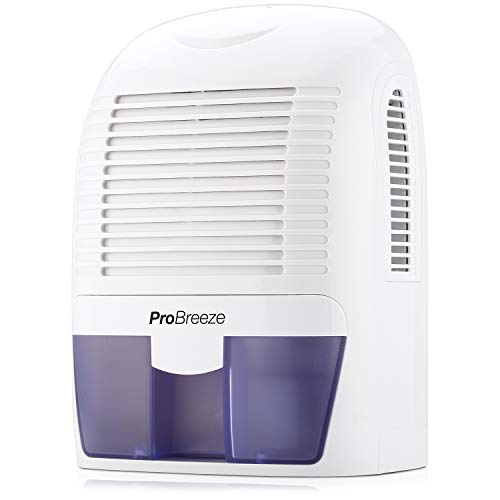
Pro Breeze Electric Mini Dehumidifier (2200 Cubic Feet) — Best for RV Living Spaces
This Pro Breeze suits RV owners whose moisture problem lives in the main cabin rather than a cupboard — cooking steam, shower humidity and overnight breathing in a small living space. It does not suit a stored, unpowered vehicle.
Check on Amazon — check price on Amazon.
Strengths
- Largest stated coverage of the thermo-electric picks here, at 2,200 cubic feet (250 sq ft)
- Simple one-button operation with auto shut-off when the tank fills
- Quiet Peltier operation that will not disturb sleep in a small cabin
Trade-offs
- Still a Peltier unit, so daily removal is measured in ounces, not pints
- Needs continuous power while it works, so it is a hookup tool, not a storage tool
- Tank is small relative to its coverage claim in very wet weather
| Specification | Detail (as verified) |
|---|---|
| Type | Thermo-electric (Peltier) mini dehumidifier |
| Stated coverage (per listing) | 2,200 cubic feet / 250 sq ft |
| Operation | Electric, compact and portable |
Pro Breeze built its name in this category on honest, simple minis, and the 2,200-cubic-feet model is the one to pick when the space is a room rather than a locker. In an RV that means the combined living and sleeping area of a mid-size trailer or motorhome, where it can take the edge off condensation on windows and walls during occupied trips.
Set expectations correctly and it performs its role well: run it during the day on hookup power, empty the tank as part of your evening routine, and treat it as condensation management rather than deep drying. If your RV sits in storage most of the year, skip to the renewable picks, which keep working with the batteries disconnected.
Best for: occupied RVs and small cabins on hookup power / Not suited for: unoccupied storage or whole-house drying
Check on Amazon — check price on Amazon.

Eva-Dry E-333 Wireless Mini Dehumidifier — Best for Storage With No Power
The E-333 suits anyone whose vehicle, safe or closet sits unpowered for weeks at a time. It asks for no wiring, makes no noise and cannot drain a battery. It does not suit anyone who needs fast, active drying after a leak or a soaking.
Check on Amazon — check price on Amazon.
Strengths
- Completely wireless in use — no drain on the vehicle battery at all
- Renewable silica gel design: plug it in to dry the crystals and use it again
- Silent, spill-free and safe around stored valuables and interiors
Trade-offs
- Absorption is slow and passive, so it prevents damp rather than reversing a soaking
- Small coverage per unit; larger spaces need two or more
- You must remember the renewal cycle or it quietly stops working once saturated
| Specification | Detail (as verified) |
|---|---|
| Type | Renewable wireless desiccant (silica gel) |
| Power in use | None — cordless |
| Renewal | Plug-in heating cycle restores the crystals |
The E-333 is the product that defines the renewable end of this category, and for stored vehicles it is arguably more useful than any powered unit on this page. A car in winter storage, a boat under a cover or an RV with its batteries disconnected cannot run a Peltier box, but it can sit with an E-333 on the seat quietly pulling the humidity down and protecting upholstery, electrics and trim from mildew.
The discipline it demands is a calendar habit: check the indicator window every few weeks and plug the unit in to renew it when the crystals change colour. Owners who build that habit get years of service from a single unit, which is why this design has stayed on the market so long while flashier gadgets have come and gone.
Best for: stored cars, boats, safes and closets with no power / Not suited for: active drying or large open spaces
Check on Amazon — check price on Amazon.

Zarpax Reusable Car Dehumidifier Bag — Best for Cars Specifically
The Zarpax bag suits daily-driven cars that fog up every morning and smell musty by winter. It lives on the dashboard or footwell and works passively. It does not suit RV-scale spaces or anyone wanting powered extraction.
Check on Amazon — check price on Amazon.
Strengths
- Designed specifically for cars, trucks, RVs and vans rather than adapted from a home product
- Reusable: recharge it and it goes back to work instead of going in the bin
- No power, no tank to spill, and it doubles as a demisting aid for the windscreen
Trade-offs
- Passive absorption only, so it manages everyday damp rather than drying a wet interior
- Needs periodic recharging, which is easy to forget in a busy routine
- One bag covers a car cabin; bigger vehicles need more than one
| Specification | Detail (as verified) |
|---|---|
| Type | Reusable desiccant moisture-absorber bag |
| Intended vehicles (per listing) | Car, truck, RV and van |
| Power in use | None |
Zarpax took the renewable desiccant idea and packaged it for the exact place most 12-volt shoppers hurt: the daily driver whose windscreen mists on the inside every cold morning. A bag on the dash absorbs the overnight moisture that would otherwise condense on the glass, and the interior stays fresher between valets.
It is the lowest-effort product in this guide. There is nothing to wire, nothing to empty and nothing to drain a battery, and when the bag eventually saturates you recharge it and put it back. For a commuter car it solves the actual problem; for a motorhome in storage, pair it with the Eva-Dry approach and use more than one absorber.
Best for: daily-driven cars with misting windscreens and musty cabins / Not suited for: drying out a soaked interior or large RV spaces
Check on Amazon — check price on Amazon.

Pro Breeze Electric Mini Dehumidifier (17 oz) — Best Compact Electric
This smaller Pro Breeze suits a single defined small space: an RV bathroom, a boat head, a campervan sleeping pod. It does not suit open-plan RV living areas, where its bigger sibling is the better match.
Check on Amazon — check price on Amazon.
Strengths
- Smallest electric footprint in the guide, easy to stow while travelling
- Stated 17 oz tank and up to 215 sq ft coverage keep expectations honest
- Energy-efficient, near-silent Peltier running
Trade-offs
- Smallest tank here, so humid weather means frequent emptying
- Coverage is genuinely small — do not stretch it across a whole motorhome
- Like all Peltier minis, output drops as temperatures fall
| Specification | Detail (as verified) |
|---|---|
| Type | Thermo-electric (Peltier) mini dehumidifier |
| Tank (per listing) | 17 oz |
| Stated coverage (per listing) | Up to 215 sq ft |
Think of this as the scalpel to its bigger sibling’s general-purpose knife. In a campervan or a small boat, space is the scarcest resource of all, and a dehumidifier that earns its shelf room has to be tiny. The 17 oz Pro Breeze is tiny, and for one small enclosed volume — the sleeping area of a van conversion is the classic case — its output is proportionate to the problem.
The honest limitation is throughput. It will hold a small, mostly sealed space at a comfortable humidity on hookup power, but it cannot rescue a large, leaky, people-filled cabin in a wet week. Buy it for the space it is sized for and it is one of the most sensible small purchases in this category.
Best for: campervans, boat heads and single small cabins / Not suited for: whole-RV or open-plan spaces
Check on Amazon — check price on Amazon.
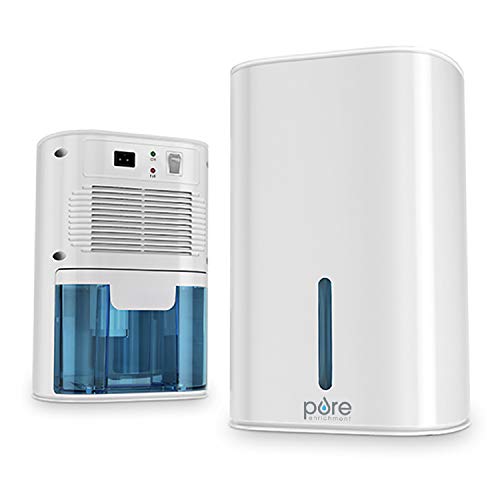
Pure Enrichment PureDry Mini Dehumidifier — Best Tank Capacity in a Mini
The PureDry suits someone who wants an electric mini but hates emptying tanks: its 27 oz reservoir is generous for the class. It suits the same small spaces as the other Peltier picks and shares their power requirements.
Check on Amazon — check price on Amazon.
Strengths
- 27 oz tank is large for a mini, stretching the interval between empties
- Stated removal of 300 mL per day gives a clear, comparable figure
- Compact design intended for small-space moisture reduction
Trade-offs
- Still adapter-powered, so vehicle use means hookup, shore power or an inverter
- Daily removal figure is a best-case rating, not a guarantee in cold weather
- Bigger tank makes it slightly bulkier than the smallest minis
| Specification | Detail (as verified) |
|---|---|
| Type | Thermo-electric (Peltier) mini dehumidifier |
| Tank (per listing) | 27 oz |
| Stated removal (per listing) | 300 mL per day |
Pure Enrichment’s contribution to this category is a practical one: tank capacity. Every Peltier mini fills its little reservoir and then switches off until someone empties it, and in a holiday-let RV or a boat visited weekly, that off-time is lost drying. A 27 oz tank simply keeps the unit working longer between visits.
Pair that with a clearly stated daily removal figure and you have the easiest mini here to plan around. It will not outperform physics — cold, dry air still limits what a Peltier element can condense — but as a set-and-check-weekly appliance for a small space on shore power, it is a thoughtful design.
Best for: small spaces visited weekly, where a bigger tank matters / Not suited for: unpowered storage or large areas
Check on Amazon — check price on Amazon.
Comparison Table
Use this table to compare the six picks side by side before reading the buying guide. The key spec column only repeats details confirmed from the verified listing title or the manufacturer’s stated specification, never guessed numbers.
| Pick | Badge | Key spec | Best for |
|---|---|---|---|
| Ivation IVADM10 Thermo-Electric Dehumidifier | Best Overall | Thermo-electric mini aimed at RVs, boats and stored cars | RV, boat and stored-car owners who can run it on hookup or shore power |
| Pro Breeze Electric Mini Dehumidifier (2200 Cubic Feet) | Best for RV Living Spaces | Peltier mini, stated 2,200 cu ft / 250 sq ft coverage | occupied RVs and small cabins on hookup power |
| Eva-Dry E-333 Wireless Mini Dehumidifier | Best for Storage With No Power | Cordless renewable silica-gel unit, plug-in renewal | stored cars, boats, safes and closets with no power |
| Zarpax Reusable Car Dehumidifier Bag | Best for Cars Specifically | Reusable car-specific desiccant bag, zero power in use | daily-driven cars with misting windscreens and musty cabins |
| Pro Breeze Electric Mini Dehumidifier (17 oz) | Best Compact Electric | Peltier mini, 17 oz tank, stated up to 215 sq ft | campervans, boat heads and single small cabins |
| Pure Enrichment PureDry Mini Dehumidifier | Best Tank Capacity in a Mini | Peltier mini, 27 oz tank, stated 300 mL/day removal | small spaces visited weekly, where a bigger tank matters |
What does ’12 volt’ really mean for a dehumidifier?
The honest answer is that 12 volts describes the environment, not the appliance. Vehicle electrical systems are built for lights, pumps and electronics, and a compressor dehumidifier’s motor load simply does not belong on them. That is why the real market for the best 12 volt dehumidifier splits into thermo-electric minis, which sip power and can run from an inverter or hookup adapter, and renewable desiccants, which sidestep power entirely while they absorb. Understanding that split is more valuable than any single product choice, because it tells you which family can possibly work in your situation before you spend anything.
It also tells you how to read listings critically. A mini that states a tank size, a daily removal figure and a modest room size is describing itself honestly. A listing that promises to dry a whole house from a USB socket is not. In this category, modest claims are a quality signal, and the picks in this guide were chosen partly because their stated numbers stayed believable.
Thermo-electric vs desiccant: which family fits your vehicle?
Thermo-electric units actively condense water into a tank whenever power flows. They are the right choice when the vehicle is occupied or connected: an RV on a campsite hookup, a boat on shore power, a van conversion with a mains inverter. Their weaknesses are cold weather, where the cold plate struggles to condense much moisture, and dependence on power, which rules them out for disconnected storage.
Renewable desiccants absorb passively and silently, then reset with a plug-in or microwave recharge. They are the right choice for storage, for gun safes and tool cabinets inside the vehicle, and for daily drivers with misting glass. Their weakness is speed: they prevent damp from building rather than drying a space that is already wet. Many experienced owners use both — an electric mini during trips, desiccants during storage — and that layered approach is usually the correct answer for an RV that lives both lives.
How much capacity do you actually need?
Match the tool to the volume. A car cabin is roughly a hundred cubic feet; a campervan sleeping area a few hundred; an RV living space perhaps fifteen hundred to two thousand. The stated coverage figures in the reviews above let you line a model up against your space without guesswork. Oversizing a Peltier mini wastes little, but undersizing one guarantees disappointment, because a unit that cannot keep up will run constantly and still leave condensation on the glass.
Also count your moisture sources honestly. Every sleeping person, every kettle and every wet jacket adds water to the air overnight. A couple touring in a small van in autumn is a heavier moisture load than a solo driver in summer, even in the same vehicle. If your use case sits at the wet end of the scale, choose the larger electric mini for occupied time and add desiccant capacity for storage rather than expecting one small box to do everything.
How to set up a 12 volt dehumidifier routine in a vehicle or RV
Setting up moisture control in a vehicle is less about installation and more about placement and routine. Follow these steps to get real results from any pick in this guide.
- Start dry: before placing any unit, ventilate the vehicle on a dry day, remove wet items, and wipe down existing condensation so you are maintaining a dry space rather than fighting a wet one.
- Place electric minis low and central in the space they serve, with a few inches of clear air around the intake and outlet, on a level surface where a full tank cannot spill while travelling.
- Place desiccant units where moist air settles and valuables live: on a car seat or dashboard for windscreen misting, inside the safe or locker you are protecting, and near the bed in a stored RV.
- Power electric units only from an appropriate source — campsite hookup, shore power, or an inverter sized for the load — and never leave a Peltier unit running for days from a starter battery with the engine off.
- Build the emptying and renewal habit into an existing routine: empty tanks when you dump the RV tanks, and recharge desiccant units on the same weekly or monthly day so saturation never sneaks up on you.
- Check the results monthly with a cheap hygrometer reading if you keep one in the vehicle; a stored space that holds a moderate, steady humidity is the goal, not the driest possible air.
If condensation keeps appearing on one particular window or wall panel, treat that as information: it usually marks the coldest surface and often a spot where ventilation is poorest. Moving the unit closer to that surface, or cracking a vent on dry days, does more than a bigger dehumidifier placed in the wrong corner.
How does a thermo-electric dehumidifier actually work?
A thermo-electric dehumidifier is built around a Peltier element — a semiconductor sandwich that gets cold on one face and warm on the other when current flows. Room air passes over the cold face, moisture condenses on it just as it does on a cold window, and the droplets run down into the tank. There is no compressor, no refrigerant and almost nothing to wear out, which is why these units are small, quiet and cheap to run. It is also why their ceiling is low: the amount of water a small cold plate can condense in a day is inherently modest, and it shrinks further when the air itself is cold and holds little moisture to begin with.
That physics explains the whole shape of this category. In a warm, humid RV in summer, a Peltier mini works at its best and its tank fills satisfyingly. In a freezing stored car in January, the same unit achieves little — not because it is broken, but because cold air carries almost no water for it to collect. This is the practical reason the guide pairs electric picks with desiccant picks: silica gel does not care about temperature in the same way, so the desiccants carry the winter while the electrics carry the summer. Owners who understand that seasonal hand-off stop being disappointed by either technology.
What about mould, smells and the damage damp actually does?
Moisture in a vehicle is never just about comfort. Given a few damp weeks, mould colonises headlining, seat foam and the backs of trim panels; musty smells soak into upholstery and become nearly impossible to remove fully; window seals and door cards swell and distort; and in the worst cases, damp reaches connectors and earth points and starts the slow electrical gremlins that make older vehicles miserable to diagnose. A stored classic or a good RV can lose more value to one damp winter than a dehumidifier costs many times over, which is why prevention in this category is such an easy economic case.
The sequence matters, though. Dehumidifiers prevent mould; they do not remediate it. If you already have visible mould or a strong established smell, clean first — remove and wash what can be removed, treat hard surfaces appropriately, and dry the vehicle thoroughly on ventilated days — and only then install the picks from this guide to hold the line. Readers who skip the cleaning step often conclude the product failed, when in fact it was asked to hold back a colony that was already established. Prevention tools do prevention work, and they do it very well when the starting point is clean and dry.
How do you power an electric mini from a vehicle system safely?
There are three legitimate routes, and one illegitimate one. The legitimate routes are a campsite or marina hookup feeding the unit’s own adapter, a properly installed mains inverter running from a leisure or house battery, and a portable power station with enough capacity for the hours you intend to run. All three share one feature: the energy comes from a source designed for sustained loads, and the vehicle’s starter battery is never involved. Fusing, cable sizing and ventilation for the inverter follow the same good practice as any 12V installation, and if that sentence sounds like work, a qualified auto electrician is money well spent.
The illegitimate route is the one that fills forums with flat-battery stories: leaving a Peltier unit plugged into a lighter socket for days on a parked car. Even a small continuous draw, multiplied by enough hours, empties a starter battery, and a starter battery deeply discharged is a battery whose life has been shortened even if it accepts a charge afterwards. If your situation is a parked, unpowered vehicle, the correct products are the desiccants in this guide — that is not a compromise, it is the technology actually designed for the job.
Which pick for which vehicle? A scenario guide
For the motorhome that tours: run the larger Pro Breeze in the living area on hookups, keep an Eva-Dry in the bedroom wardrobe, and leave a Zarpax-style bag in the cab for the driving days. For the boat: the Ivation on shore power during visits, desiccants aboard between them, and a hygrometer in the cabin to tell you whether the rhythm is working. For the stored classic car: two renewable units, one in the cabin and one in the boot, checked monthly, with the car aired on dry days whenever you visit. For the daily driver with misty glass: a single rechargeable bag, recharged on the same weekend rhythm as your shopping, solves the problem for most owners outright.
Notice what every scenario shares: the electric unit appears only where power is genuinely available, and the desiccants do the long, silent, unpowered work everywhere else. If your scenario is not listed, build it from that rule and the picks will choose themselves. The most expensive mistake in this category is not buying the wrong brand — it is buying the right brand of the wrong technology for a vehicle that sits unpowered eleven months a year.
Troubleshooting: when your vehicle dehumidifier seems to do nothing
Start with the tank or the gel, because nine ‘failures’ in ten are saturation in disguise. An electric mini whose tank is full has switched itself off and will sit there looking broken until it is emptied; a desiccant whose crystals are spent is a ornament with a power cord. Check those first, and check the indicator window on renewable units in good light, because the colour change can be subtle in a dark garage. If the unit is a Peltier model and the weather has turned cold, remember the physics from earlier in this guide: near-freezing air holds so little moisture that a modest daily collection is the correct result, not a malfunction.
Next, interrogate the space rather than the appliance. A dehumidifier fighting a leaking window seal, a blocked scuttle drain or a boot full of wet kit is losing a war of import versus export, and the fix is to stop the import: clear the drain, reseat the seal, remove the wet items to dry elsewhere. Finally, give any change a week before judging it. Vehicle moisture moves slowly — upholstery and foam release stored damp over days — so a routine that looks ineffective on day two is often clearly winning by day ten. Patience, in this category, is a diagnostic tool.
Accessories and habits that multiply a dehumidifier’s effect
A cheap hygrometer is the highest-value accessory in this entire category, because it converts moisture management from folklore into measurement. Place it where the problem lives — the sleeping area of the RV, the cabin of the stored car — and read it on your regular visits. You will learn your vehicle’s personal rhythm: how fast it climbs after rain, how low your current setup holds it, and whether a second desiccant is needed long before mould answers the question for you. Owners who measure almost never overbuy or underbuy; owners who guess do both in the same year.
The habits cost nothing and matter as much as the hardware. Wipe down shower and cooking condensation in an RV the same hour it forms rather than letting the dehumidifier inherit it. Hang wet gear outside the sleeping space or in a ventilated locker. Leave interior doors and lockers ajar in storage so no sealed pocket of air sits outside the desiccant’s reach. And when a dry, windy day arrives during storage, open everything for an hour — that single free ventilation session can remove more water than a week of any product in this guide, and it resets the baseline your dehumidifier then has to maintain.
How does humidity in a vehicle change across the seasons?
Spring and autumn are the deceptive seasons: mild days persuade owners that the damp problem has passed, while cold nights keep condensing moisture onto glass and metal exactly as winter did. An RV coming out of storage in spring often carries a winter’s worth of absorbed moisture in its foam and fabrics, which is why the first trips of the year smell musty even in good weather — the vehicle is drying itself into your holiday. A deliberate pre-season session, with the electric mini running on hookup and every locker open, pays that moisture debt in the driveway instead of across your first week away.
Summer reverses the problem for occupied vehicles: warm air holds far more water, every shower and kettle adds visibly to it, and the Peltier picks work at their annual best because there is so much moisture available to condense. This is the season to judge an electric unit’s true capacity and to empty its tank most often. Winter, as this guide has noted, belongs to the desiccants and to ventilation discipline. Reading the year this way — electric for the humid and occupied months, desiccant for the cold and empty ones, measurement throughout — turns dehumidification from a purchase into a calendar, and calendars are what actually keep vehicles dry.
Common Buying Mistakes
Expecting compressor performance from a 12-volt product
The most common disappointment in this category is a sizing fantasy. No product that belongs in a vehicle will dry a flooded carpet or a large basement. Buy for prevention and maintenance of small spaces, and hire or borrow a mains compressor unit for genuine water damage.
Running an electric mini off the starter battery
A Peltier unit left running in a parked car will flatten a starter battery long before it dries the cabin. Electric picks in this guide are hookup and inverter tools. For unpowered periods, the desiccant picks exist precisely so your battery does not pay for dry air.
Forgetting that desiccants saturate
A renewable unit that is never renewed is just a decoration. Silica gel stops absorbing once it is full, and the only symptom is the damp quietly returning. Tie recharging to a fixed routine and check indicator windows whenever you visit the vehicle.
Sealing a wet vehicle and walking away
Closing a damp RV or car up tight with a small dehumidifier inside asks the unit to remove water that better ventilation would have prevented. Always start from dry, fix leaks and blocked vents first, and let the dehumidifier maintain the result.
Final Recommendation
If you buy one product from this guide, make it the Ivation IVADM10: it is the thermo-electric mini most honestly aimed at vehicles, boats and stored cars, and on hookup power it actively removes the moisture that causes mildew and musty interiors. If your vehicle spends most of its life unpowered, reverse the order and start with the Eva-Dry E-333 or the Zarpax bag, which protect a stored interior without touching the battery at all.
For occupied RV living, the larger Pro Breeze is the cabin pick and its 17 oz sibling is the campervan pick, while the PureDry earns its place wherever a bigger tank means fewer interruptions. None of these products is magic; matched to the right space and routine, each of them does a real, measurable job.
Ready to buy? Start with Ivation IVADM10 Thermo-Electric Dehumidifier and Pro Breeze Electric Mini Dehumidifier (2200 Cubic Feet) — check price on Amazon for each and confirm the current listing details before ordering.
Related guides on this site: Best 12 Volt Dehumidifiers Best 12 Volt Desk Fans Best 12 Volt Digital Tire Inflator Best 12 Volt Drill Best 12 Volt Digital Media Player
Frequently Asked Questions
Can a dehumidifier really run on 12 volts?
Not in the compressor sense. Vehicle-friendly products are either small thermo-electric units powered through an adapter, hookup or inverter, or renewable desiccants that use no power while absorbing. Both families work well in vehicle-sized spaces when expectations match their stated capacity.
Will a mini dehumidifier stop my car windscreen misting?
A desiccant bag or renewable unit in the cabin reduces the overnight moisture that condenses on the glass, and most owners see a clear improvement. It will not fix a water leak or a cabin filter problem, so check for wet carpets and blocked drains if misting is severe.
How often do renewable dehumidifiers need recharging?
It depends on humidity and space size, but a typical cycle is a few weeks in damp conditions. Indicator windows on units like the Eva-Dry change colour as the crystals saturate, which tells you exactly when to plug in and renew them.
Is it safe to leave an electric mini running in an RV?
On a proper hookup with the unit on a level, clear surface, yes — that is its intended use, and auto shut-off stops it when the tank fills. The unsafe pattern is running one for long periods from a vehicle starter battery, which risks a flat battery rather than a fire.
Thermo-electric or desiccant for a boat?
Use shore-power electric drying while you are at the marina to pull the cabin down, then leave desiccant units aboard for the weeks between visits. That combination covers both the active and the storage phase of boat ownership.
Do I need more than one unit in a larger RV?
Quite possibly. Moisture control works per enclosed volume, so a separate small unit or desiccant in the bedroom or bathroom often outperforms one larger unit in the living area. Treat each sealed space as its own problem.


