Disclosure: airfryerkitchensupply.com is reader-supported. When you buy through links on our site, we may earn an affiliate commission at no extra cost to you.
Where to buy
Every machine in this guide to the best 12 volt dc coffee maker options was verified against the manufacturer listings in Amazon’s catalog data, and the spec boxes repeat only what those listings state — power source, battery size and coffee format. Check the current price on Amazon, and decide your format first — espresso shot, single honest mug or small drip pot shared between two — because in 12 volt coffee that one choice is effectively the whole purchase.
- CONQUECO Portable Coffee Machine, 12V Car Espresso Maker (Best Overall) — Check the current price on Amazon
- Dometic PerfectCoffee MC 052 Five Cup Coffee Maker, 12 V (Best True Drip Brewer) — Check the current price on Amazon
- HAWOK Portable Coffee Maker 12V Travel Espresso Machine, 8 oz (Best Simple Single Cup) — Check the current price on Amazon
- Portable Single Serve 12V Car Coffee Maker for Pods and Ground Coffee (Best Format Flexibility) — Check the current price on Amazon
- BougeRV 144Wh Portable Coffee Maker for K-Cup and Ground Coffee (Best for K-Cup and Off-Grid Crews) — Check the current price on Amazon
- Vagizm Portable Espresso Machine, 15000mAh, 12V/24V Car Ready (Best for Trucks and Big Batteries) — Check the current price on Amazon
The best 12 volt dc coffee maker is a lesson in physics wearing a product category’s clothes. Heating water is one of the most energy-hungry jobs in any kitchen, and a vehicle socket offers a modest slice of power — so every successful 12 volt coffee machine is a design built around that constraint. The modern answer, and the shape of most picks in this guide, is the self-heating portable espresso machine: heat a small volume of water fast, push it through coffee under pressure, and hand the driver a real cup in minutes. The traditional answer, a true 12 volt drip brewer, still exists for purists and pours a small pot the slow way. Both are ranked here, honestly labelled and judged by their own standards, because they serve different mornings, different vehicles and different drinkers — and a guide that graded a drip pot on espresso speed, or an espresso machine on pot volume, would mislead everyone who trusted it.
Set the expectation that governs everything below, and set it firmly: nobody is running a café from a cigarette lighter, and every honest product in this category begins by admitting it. Servings are single cups and small pots, and anyone who tells you otherwise is selling something. Brew cycles are measured against socket wattage, not kitchen wattage, and patience is a specification too. And the smartest machines cheat the constraint entirely with built-in batteries — heating from stored energy, then sipping the 12 volt supply to recharge between stops, which is why battery capacity in milliamp-hours is the spec that separates the serious portable espresso machines from the toys.
This guide ranks six verified machines across the three honest formats: battery-equipped espresso makers for speed and freedom, a socket-only single-cup machine for simplicity, a dual-format single-serve for pod and grounds households, a 144Wh K-Cup machine for American road kits, and the Dometic drip brewer for traditionalists. Each was matched against live catalog data before it earned a link, and each review states plainly who should skip it — because in a category this constrained, the wrong format is a worse purchase than a modest machine in the right one.
In this guide
Quick Picks
Six verified machines in three honest formats: the CONQUECO and Vagizm battery espresso makers, a HAWOK socket-only single cup, a flexible pods-and-grounds single-serve, BougeRV’s 144Wh K-Cup machine, and Dometic’s true 12 volt drip pot.
- CONQUECO Portable Coffee Machine, 12V Car Espresso Maker — Best Overall. The balanced champion of the modern format: a self-heating 12 volt espresso maker with a built-in battery and USB recharging, heating in about three minutes per its listing.
- Dometic PerfectCoffee MC 052 Five Cup Coffee Maker, 12 V — Best True Drip Brewer. The traditionalist: a genuine 12 volt drip coffee maker with a five-cup pot, from a mobile and marine equipment specialist — filter coffee, the old way, from a vehicle socket.
- HAWOK Portable Coffee Maker 12V Travel Espresso Machine, 8 oz — Best Simple Single Cup. A socket-only 12V travel espresso machine sized to a single 8 oz cup — no battery to manage, no charging routine, just vehicle power and one honest serving.
- Portable Single Serve 12V Car Coffee Maker for Pods and Ground Coffee — Best Format Flexibility. A 12V single-serve that takes both pods and ground coffee with a reusable filter included, brewing in a stated six to eight minutes — the household-splitter compromise.
- BougeRV 144Wh Portable Coffee Maker for K-Cup and Ground Coffee — Best for K-Cup and Off-Grid Crews. A 144Wh cordless coffee platform from the 12V fridge people, compatible with K-Cup and ground coffee, with AC/DC charging — basecamp coffee for small crews.
- Vagizm Portable Espresso Machine, 15000mAh, 12V/24V Car Ready — Best for Trucks and Big Batteries. The spec leader: a self-heating espresso machine with the largest battery here at 15000mAh, an LCD, USB-C charging and explicit 12V/24V car readiness.
How These Picks Were Chosen
Every machine here was verified by searching its exact model in Amazon’s product catalog through the retailer’s data feed and matching the returned title — power source, battery capacity and format — against the machine we intended to recommend. Only confident matches received links. Coffee listings are especially loose with the phrase “12 volt,” applying it to socket-powered, battery-with-car-charging and tool-battery machines alike; the spec boxes in this guide separate those power stories precisely, because they change how the machine fits your vehicle.
Ranking weighed the coffee outcome first: a genuinely hot, properly extracted cup, delivered in a time a rest stop allows. Then the energy story — battery capacity where fitted, recharge routes, and what the machine asks of your vehicle — because a coffee maker that endangers a starting battery is a bad appliance however good the coffee. Format honesty closed the assessment: espresso machines were judged as espresso machines and drip brewers as drip brewers, with no credit given for pretending to be the other.
One adjacent answer is deliberately discussed but not ranked as a pick: the tool-battery coffee maker, exemplified by Makita’s DCM501Z for its 18V LXT and 12V max CXT packs (verified in the same catalog data). For tradespeople already carrying those batteries it can be the smartest vehicle coffee answer of all — but it is not a 12 volt DC socket machine, so it appears in the buying guide as the labelled alternative it is, not in the ranked six.
The 6 Best 12 Volt DC Coffee Makers, Reviewed
Each review states the drinker and the journey the machine suits, three genuine strengths, three honest trade-offs, and a clear verdict. Spec boxes repeat only what the verified listing states, in the listing language, without embellishment.

CONQUECO Portable Coffee Machine, 12V Car Espresso Maker — Best Overall
The CONQUECO is what most people picturing a 12 volt coffee maker in this decade actually want. The verified listing describes a portable coffee machine for travel — a 12 volt car espresso maker with a battery for camping, small and electric, heating in about three minutes, rechargeable by USB. That combination — self-heating, battery-buffered, vehicle-rechargeable — is the design that finally made vehicle coffee good: the battery does the violent work of heating, the socket refills the battery gently, and the driver gets espresso-style coffee at any stop.
Strengths
- Self-heating with a built-in battery, so it brews at a picnic table as happily as in the cab
- Fast heating by 12 volt standards — about three minutes per the listing
- USB recharging tops it up from power banks, laptops and the vehicle alike
Trade-offs
- Espresso-format servings are small for drinkers raised on large drip mugs
- Battery endurance is finite — heavy users must mind the recharge rhythm
- Capsule and grounds formats are espresso-style, not a paper-filter basket
| Power | 12V vehicle power plus built-in rechargeable battery (per listing) |
| Heating | Self-heating, about 3 minutes (per listing) |
| Charging | USB rechargeable (per listing) |
The ownership experience is the argument. There is no kettle, no stove, no separate water run: stop, fill, press, drink. Because the battery carries the heating load, the machine also escapes the vehicle — it works at a tent door, on a tailgate, at a workbench — and the 12 volt connection becomes a refuelling detail rather than a leash. For commuters, campers and sales-route drivers who measure stops in minutes, this is the format that fits the life.
Its limits are the format’s limits, stated plainly: the cup is an espresso serving, and drinkers who want a tall mug should either embrace the double shot or choose the drip and single-serve picks below. Judge it as the best execution of the modern answer, and it wins this guide on the strength of being the machine most buyers will use most often.
Best for: drivers and campers who want real coffee fast at any stop, in or out of the vehicle / Not suited for: large-mug drip drinkers, or groups expecting a pot
Check the current price on Amazon
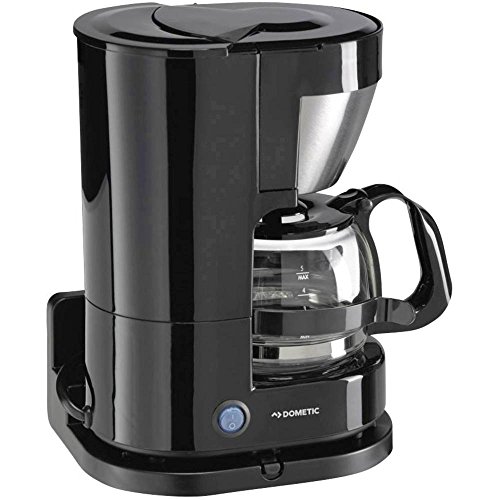
Dometic PerfectCoffee MC 052 Five Cup Coffee Maker, 12 V — Best True Drip Brewer
Everything else in this guide is an espresso machine wearing travel clothes; the Dometic is a coffee maker. The verified listing describes the PerfectCoffee MC 052 as a five cup coffee maker running on 12 V, from a brand whose business is vehicle and marine equipment. It brews drip coffee into a small pot, serves two people like adults, and asks in return the two things 12 volt drip has always asked: time, and respect for the battery.
Strengths
- Real drip brewing — the only true filter-coffee pot among the verified picks
- Five-cup capacity serves two proper mugs instead of sequential shots
- Mobile-equipment brand with a deep vehicle and marine catalog behind it
Trade-offs
- Drip from a socket is slow, and the draw is sustained — brew while driving or on a strong system
- A pot format needs padded, level stowing in a moving vehicle
- No battery: it brews only where vehicle power reaches
| Power | 12 V vehicle power (per listing) |
| Capacity | Five cups (per listing) |
| Format | Drip coffee maker |
Choose the Dometic for the ritual and the result: measured grounds, a pot brewing, two mugs poured. On a boat, in an RV galley, or in a truck cab parked for the night on a healthy auxiliary system, that ritual is the difference between coffee as fuel and coffee as a pleasure. The brand matters here — Dometic equips half the RV world, and its 12 volt appliances are designed by people who understand vehicle electrics rather than kitchen marketers borrowing them.
The discipline is power. Heating a pot of water is the heaviest sustained job in this category, so the pattern is brew under way, or brew on shore-supported or auxiliary power, and never leave it pulling on a lone starting battery while you nap. Observed, that rule costs nothing; ignored, it costs a jump start. Within it, the MC 052 is the most civilised machine in this guide.
Best for: RV, boat and truck travellers who drink filter coffee and brew for two / Not suited for: solo espresso drinkers, or anyone brewing parked on a single starting battery
Check the current price on Amazon

HAWOK Portable Coffee Maker 12V Travel Espresso Machine, 8 oz — Best Simple Single Cup
The HAWOK strips the format to its essentials. The verified listing describes a portable coffee maker and 12V travel espresso machine in a single cup, 8 oz size. No internal battery, no app, no modes — it draws from the vehicle and makes one proper-sized cup. That 8 oz serving deserves emphasis: it answers the common espresso-machine complaint — the thimble-sized shot — with a serving that matches a small mug.
Strengths
- 8 oz single cup matches a real small mug better than a short shot
- Socket-only design means nothing to charge, ever — it is ready when the vehicle is
- Simple format with few parts to lose, break or clean on the road
Trade-offs
- One cup per cycle: passengers queue
- No battery, so no brewing away from the vehicle
- Espresso-style extraction, not drip flavour, despite the mug-sized serving
| Power | 12V (per listing) |
| Capacity | Single cup, 8 oz (per listing) |
| Format | Travel espresso machine |
The HAWOK buyer is a solo operator: the commuter with a thermos habit to replace, the delivery driver whose break is a layby, the one-person camp. For that pattern, the battery machines’ freedom is wasted and their charging routine is pure overhead, while the HAWOK simply lives in the vehicle and works on demand. Simplicity is a feature in a moving vehicle, and this is the simplest verified machine in the guide.
Spend the savings on good coffee and a decent travel mug, run it while the engine or a healthy system supports the draw, and it will quietly become the most-used appliance in the car. It is not the flexible champion — it is the dependable specialist, and specialists age well.
Best for: solo drivers who want one proper cup with zero charging routine / Not suited for: couples, groups, or brewing away from the vehicle
Check the current price on Amazon

Portable Single Serve 12V Car Coffee Maker for Pods and Ground Coffee — Best Format Flexibility
Format wars end more coffee purchases than bad machines do, and this single-serve is the peace treaty. The verified listing describes a portable single serve 12V car coffee maker for pods and ground coffee, with a reusable filter and a fast brew of six to eight minutes. Pods for the weekday dash, grounds for the weekend trip, one machine that refuses to take sides.
Strengths
- Pods and ground coffee in one machine — no format lock-in
- Reusable filter included, cutting pod cost and trip trash
- Stated 6–8 minute brew is brisk for socket-powered drip-style coffee
Trade-offs
- Single serve only; a pot for two is two cycles
- Generic brand — support and spares are a step below the named makers
- Pod and grounds cups differ in strength; expect a brief learning curve
| Power | 12V car power (per listing) |
| Formats | Pods and ground coffee, reusable filter (per listing) |
| Brew time | 6–8 minutes (per listing) |
The honest way to read the brew-time claim is as a category compliment: six to eight minutes for a full mug-sized coffee from socket power is what competent 12 volt heating looks like, because the bottleneck is watts, not engineering effort. Within that physics, this machine spends its budget on the thing owners feel daily — choice. The pod people and the grounds people in one household, one vehicle or one crew stop arguing, and the reusable filter keeps the grounds people from subsidising the pod people.
It is the generalist of the guide: not the fastest, not the longest-legged off-grid, not the most prestigious badge — but the one that fits the most routines without asking anyone to change theirs. Fleets, families and shared vehicles should start here.
Best for: households and crews split between pods and fresh grounds / Not suited for: espresso purists, or anyone brewing for a group at once
Check the current price on Amazon

BougeRV 144Wh Portable Coffee Maker for K-Cup and Ground Coffee — Best for K-Cup and Off-Grid Crews
BougeRV built its name on 12 volt vehicle fridges, and this coffee maker applies the same off-grid logic at larger scale. The verified listing describes a 144Wh portable coffee maker compatible with K-Cup and ground coffee, a cordless machine with an 18V 8Ah battery and AC/DC power, aimed at travel, camping, outdoor, jobsite, RV and home use. The K-Cup compatibility is the North American headline: it drinks from the pod ecosystem most offices and gloveboxes already stock.
Strengths
- 144Wh stored energy is a serious reserve for repeated brewing off-grid
- K-Cup plus ground coffee covers the dominant US pod format and fresh grounds
- AC/DC charging refills it at home, on hookups, or from the vehicle between stops
Trade-offs
- 144Wh means camp-kit size — this is not a cupholder appliance
- K-Cup convenience carries per-cup cost and pod waste
- Crew-scale machine is overkill for a solo commuter cup
| Energy | 144Wh, 18V 8Ah battery (per listing) |
| Formats | K-Cup and ground coffee (per listing) |
| Power options | AC/DC (per listing) |
Think of the BougeRV as infrastructure rather than gadget: charge it on AC before departure, brew for a small crew at the site or the lake, top it from the vehicle on the drive home. In an RV or camp kitchen already running BougeRV refrigeration, it slots into an existing ecosystem of chargers and habits, and its capacity turns coffee from a rationed treat into a standing service.
The buyers it does not suit are the minimalist solo drivers, for whom the CONQUECO or HAWOK delivers the same cup with a third of the bulk. Match the machine to the crew size and the claim checks out: for two to four coffee drinkers away from mains power, this is the most capable verified option in the guide.
Best for: campers, anglers, jobsites and RV crews brewing for two to four people / Not suited for: solo commuters or anyone counting every litre of storage
Check the current price on Amazon

Vagizm Portable Espresso Machine, 15000mAh, 12V/24V Car Ready — Best for Trucks and Big Batteries
The Vagizm closes the list with the strongest paper specification in the verified set. Its listing describes a portable espresso machine, self-heating, with a 15000mAh battery, LCD display and USB-C charging, explicitly 12V/24V car ready for camping, RV, hiking and office use. The dual-voltage readiness is the detail professionals will notice first: commercial truck cabs and many marine systems do not offer a plain 12 volt accessory world, and this machine was designed for both.
Strengths
- 15000mAh battery is the largest reserve among the verified picks
- 12V/24V readiness covers cars and commercial trucks alike
- LCD display shows battery state plainly before you commit to a stop
Trade-offs
- Newer generic brand; long-term spares and support are less proven than Dometic or BougeRV
- Feature-rich electronics want gentler handling than a basic socket machine
- Espresso servings remain espresso servings, however large the battery
| Battery | 15000mAh (per listing) |
| Pressure | 20 bar (per listing) |
| Charging | USB-C; 12V/24V car ready (per listing) |
| Display | LCD (per listing) |
Battery size is destiny in this category, because every heated cup is paid from the same account, and the Vagizm holds the largest account here. Multi-cup days, two-driver cabs and long off-grid stops are where that reserve converts from specification to experience — and the LCD keeps the account honest, so the machine never dies mid-ritual without warning. The 24 volt readiness widens its world to the trucks where coffee money is spent most seriously.
The caution is provenance, not performance: a newer brand asks you to keep paperwork and treat the unit kindly, in exchange for specifications the established names charge more to match. For value-driven professionals — especially 24 volt truck drivers — that is a trade worth making with eyes open.
Best for: truck drivers including 24V cabs, and heavy daily users who burn battery capacity / Not suited for: brand-loyal buyers who prioritise proven long-term support over specification
Check the current price on Amazon
Comparison Table
Format first, battery capacity second, badge a distant last: the table compares the six on the axes that decide whether a machine fits your mornings.
| Pick | Badge | Key spec | Best for |
|---|---|---|---|
| CONQUECO Portable Coffee Machine, 12V Car Espresso Maker | Best Overall | Self-heating espresso, battery + 12V, USB | drivers and campers who want real coffee fast at any stop, in or out of the vehicle |
| Dometic PerfectCoffee MC 052 Five Cup Coffee Maker, 12 V | Best True Drip Brewer | True 12V drip, five-cup pot | RV, boat and truck travellers who drink filter coffee and brew for two |
| HAWOK Portable Coffee Maker 12V Travel Espresso Machine, 8 oz | Best Simple Single Cup | 12V socket only, single 8 oz cup | solo drivers who want one proper cup with zero charging routine |
| Portable Single Serve 12V Car Coffee Maker for Pods and Ground Coffee | Best Format Flexibility | 12V single serve, pods + grounds | households and crews split between pods and fresh grounds |
| BougeRV 144Wh Portable Coffee Maker for K-Cup and Ground Coffee | Best for K-Cup and Off-Grid Crews | 144Wh battery, K-Cup + grounds, AC/DC | campers, anglers, jobsites and RV crews brewing for two to four people |
| Vagizm Portable Espresso Machine, 15000mAh, 12V/24V Car Ready | Best for Trucks and Big Batteries | 15000mAh, 12V/24V ready, LCD, USB-C | truck drivers including 24V cabs, and heavy daily users who burn battery capacity |
How to Choose the Best 12 Volt DC Coffee Maker for Your Mornings
Choose the format before the machine, because the format is the experience. Espresso machines — most of this guide — deliver a short, strong, fast cup and travel beautifully. Single-serve drip-style machines deliver a familiar mug at a slower pace. The true drip pot delivers the ritual and serves two. Drinkers who buy across those lines spend their ownership converting, diluting and compromising; drinkers who buy inside their line wonder what the fuss was about.
Battery or socket: the energy decision
A built-in battery buys freedom and speed — heat comes from stored energy, so cups are fast and the machine works away from the vehicle — at the cost of a charging routine and a finite cup count. Socket-only machines are simpler and immortal but leashed, and they draw hard while they brew. The middle path chosen by several picks here is both: battery for brewing, socket for recharging. Whichever you choose, never let any coffee maker be the load that flattens a starting battery — brew while driving, on an auxiliary system, or from the machine’s own battery, in that order of preference.
Read battery capacity like a fuel gauge
On battery machines, milliamp-hours are cups in the bank, roughly speaking: heating water dominates consumption, so larger packs mean more heated cups between charges and less mid-trip anxiety. The spread in this guide — from compact packs to 13500–15000mAh-class reserves and a 144Wh platform — is the real product differentiation. Match it to your longest day between charging opportunities, not your average one.
The tool-battery alternative, honestly labelled
If your truck already carries a power-tool platform, a tool-battery coffee maker — Makita’s DCM501Z, verified in the same catalog data, runs on 18V LXT and 12V max CXT packs and is sold tool-only — can be the smartest purchase in this whole category: no socket draw, no new ecosystem, jobsite build. It is excluded from the ranked picks only because it is not a 12 volt DC socket machine. Everyone else should ignore it completely; buying into a battery platform for one coffee maker is poor arithmetic.
How to Make Good Coffee in a Vehicle, Step by Step
The machine is half the cup. The other half is a routine that respects water, temperature and motion.
- Start with the water. Vehicle coffee fails on stale tank water more than on machines. Fill from a fresh source, and if the vehicle has a stored-water system, keep a dedicated drinking-water bottle for coffee.
- Brew parked and level, or not at all. Espresso machines forgive a layby; drip pots demand a level, stable surface. Never brew loose in a moving vehicle — hot water and corners are enemies, and every pick here works fast enough at a stop.
- Mind the power order. Battery machines first, engine-running socket brewing second, parked-on-the-starter-battery never. If the machine has a battery, arrive with it charged and let the drive refill it.
- Dose like you mean it. Espresso formats punish sloppy dosing with sour or bitter cups. Use the capsule or basket as designed, keep grounds fresh and sealed against cab humidity, and descale on the maker’s schedule — vehicle water is often hard water.
- Clean at the stop, not at home. Knock out grounds, rinse the cup path, and leave the machine dry and open for a minute. Coffee oils go rancid in a warm cab faster than in a kitchen, and yesterday’s residue is tomorrow’s flavour.
- Stow for the road you actually drive. Machines live low, padded and latched, with capsules and beans in a sealed box. A coffee kit that survives corrugations is a coffee kit that gets used for years.
Follow that routine and the gap between vehicle coffee and home coffee narrows to the view — which, from a cab at sunrise, usually favours the vehicle.
12 Volt Coffee vs the Alternatives: Inverter, Kettle and Café
The honest comparisons deserve a hearing. A household espresso machine on a big inverter makes café coffee and consumes café infrastructure — inverter capacity, battery bank, storage space — to do it; in a large RV with a serious electrical system it is a legitimate luxury, and everywhere else it is a parade of equipment in search of a cup. A 12 volt kettle plus a pour-over cone is the minimalist rival: cheap, repairable, and genuinely good, at the cost of a manual ritual some mornings welcome and others resent. The café at the services beats every machine here on the cup and loses on price, timing, detours and the days the road has no café.
The machines in this guide win their niche by collapsing the distance between wanting coffee and drinking it: no detour, no inverter, no stove, no kettle Tetris. That niche — the rest stop, the trailhead, the early site start, the ferry queue — is where most vehicle coffee is actually drunk, and it is why this odd little category keeps growing while the physics stays exactly as unforgiving as ever.
Road Coffee Economics: What the Machine Really Replaces
Do the honest comparison nobody prints. A service-station coffee habit costs a working driver a meaningful sum every single week, bought at detour prices, at detour quality, on the detour schedule — the exit you did not plan, the queue you did not need, the cup that tastes of the machine it came from. A 12 volt coffee maker collapses that entire economy into groceries: beans, grounds or capsules bought at supermarket prices, brewed at the stop you chose for better reasons. The machine pays for itself in a span of weeks for a daily driver, and after that the coffee is close to free and noticeably better, which is a rare combination in vehicle equipment.
The softer savings matter as much. Coffee at the stop you chose means the stop stays short and restorative instead of becoming an expedition. The early start becomes bearable without the first-exit pilgrimage. The passenger asleep in the back stays asleep. Drivers who switch rarely describe the money first; they describe control — of the morning, of the route, of the quality of the one small ritual that starts the working day. The machine is inexpensive. The control is the actual product.
None of this argues against café coffee, which remains one of the better ideas civilisation has produced. It argues for owning the default. When the default cup is yours — hot, fresh, at your stop, at grocery cost — the café becomes what it should be: an occasional pleasure chosen on purpose, not a daily tax paid under duress to a machine at a motorway exit.
Care and Descaling: Keeping a Small Machine Honest
Vehicle coffee machines live harder lives than kitchen ones: vibration, temperature swings, and water from sources of wildly varying hardness. A small care rhythm keeps the cup tasting like the first month. Empty and rinse the water path after trips rather than before the next one, because standing water in a warm vehicle grows flavours nobody ordered. Leave the machine open to dry when it will sit, and store it low and padded so the road does not reassemble it for you.
Descaling is the maintenance item owners skip and machines remember. Mineral scale insulates heating elements, slows brew times and eventually strangles small pumps — and vehicle water, drawn from campsite taps and marina hoses, is often the hardest water a machine will ever meet. Follow the maker descaling guidance on a calendar rhythm if you travel often, sooner if brew times stretch or the cup tastes thin. It takes minutes and returns the machine to its specification.
Batteries deserve the same respect as the coffee. Recharge after use rather than storing the machine flat, keep it out of the worst cab heat when parked for weeks, and treat the stated capacity as a budget to manage, not a surprise to discover. A cared-for machine in this category is a five-year appliance; a neglected one is a one-season gadget, and the difference is entirely in these small, unglamorous habits.
Coffee for Two: Brewing for a Passenger Without Losing the Morning
Most of this guide quietly assumes one drinker, and most vehicles carry two. Brewing for a passenger reorganises the format decision in ways worth spelling out. Sequential single cups are fine when the second drinker is patient and the stop is long; they become a small domestic negotiation when the stop is a fuel station and the clock is running. The machines that handle two gracefully are the ones with either a pot — the Dometic pours twice from one cycle — or a battery deep enough that the second cup costs no thought, which is where the large-reserve picks earn their capacity.
There is also a division-of-labour trick experienced road couples swear by: the driver drives, the passenger brews. A battery machine that works anywhere in the vehicle, rather than tethered to the front socket, turns the passenger seat into a small café that operates at cruising speed, safely, with the machine stowed between services. That single workflow is the strongest argument for the battery format in a two-person vehicle, and it never appears on a specification sheet.
However you organise it, agree the format before the trip rather than renegotiating at every stop. Two drinkers with different drinks — one espresso, one long coffee — are the exact household the dual-format single-serve was built for, and recognising yourselves in that description now is cheaper than discovering it at a rainy layby in November.
Common Buying Mistakes
Buying espresso when you drink drip, or the reverse
The format mistake outnumbers every other disappointment in this category combined. A beautiful espresso machine will not make your mug of filter coffee, and a drip pot will not make your morning shot. Name your drink first; the shortlist writes itself.
Ignoring the battery arithmetic
On battery machines, capacity is cups. Buying the smallest pack for a two-driver, all-day routine guarantees the dead-machine afternoon. Size for the longest day between charges, and treat USB recharging speed as part of the specification, not a footnote.
Brewing parked on the starting battery
Socket-powered brewing is a heavy, sustained draw. On a lone starting battery it is a jump-start appointment with extra steps. Brew while driving, from an auxiliary system, or from a battery-equipped machine — the three safe patterns this guide repeats because the tow-truck stories never stop arriving.
Chasing pressure numbers
Pump pressure claims are the category’s vanity metric. Water temperature, dose consistency and freshness decide the cup; a modest machine with fresh grounds beats a headline-pressure machine on stale capsules every morning of the week.
Final Recommendation
The short version: the CONQUECO is the best 12 volt dc coffee maker for most people — fast, self-heating, battery-buffered, free to brew anywhere from cab to campsite, and honest about the espresso format it serves instead of pretending to be a diner pot. Take the Dometic if your heart belongs to drip coffee and your travels include a passenger, the HAWOK for one simple socket-powered cup, the pods-and-grounds single-serve for split households, the BougeRV for K-Cup crews off-grid, and the Vagizm if your cab runs 24 volts or your days burn battery capacity.
Complete the road kit around it: the meals come from Best 12 Volt Crock Pot, the cold storage from Best 12 Volt Compressor Fridge, and the morning ritual pairs naturally with Best 12 Volt Coffee Maker For Truckers for the professional-driver angle. Campers should compare the camping cut in Best 12 Volt Coffee Maker For Camping, and anyone weighing the boating version will find it in Best 12 Volt Coffee Makers For Boats.
Whichever machine you choose, respect the two laws of the category — format first, always, and never let coffee flatten the battery that starts your morning — keep the water fresh, the machine descaled and the battery charged, and the smallest kitchen on the road will reward you out of all proportion to its size, one honest cup at a time, at every stop the road gives you.
Frequently Asked Questions
Can a 12 volt coffee maker make real espresso?
The battery-equipped machines in this guide are genuine pump espresso makers that heat their own water and extract under pressure — the cup is a real espresso serving, not a coffee-flavoured approximation. What 12 volt physics limits is serving size and back-to-back volume, not extraction quality. Drinkers who want long coffees should look at the single-serve and drip picks instead of diluting shots and blaming the machine.
How many cups can a battery coffee maker make per charge?
It scales with battery capacity, which is why this guide treats milliamp-hours as the headline spec: compact packs suit a cup or two between charges, the 13500–15000mAh class covers a multi-cup day, and the 144Wh BougeRV platform serves small crews. Starting water temperature matters too — cold water costs more energy per cup than room-temperature water.
Will a 12 volt coffee maker drain my car battery?
A socket-powered machine brewing is a heavy sustained draw, so the safe patterns are brewing while driving, brewing on an auxiliary battery system, or using a battery-equipped machine whose own pack takes the hit and recharges gently. Follow those and coffee never threatens your starting battery. Ignore them on a parked car and yes, a long brew session can flatten a weak battery.
What is the difference between 12V espresso machines and a 12V drip maker?
Espresso machines heat a small volume quickly and force it through fine coffee under pressure, producing a short strong cup in minutes. A drip maker heats a pot of water and passes it through a filter basket by gravity, producing mugs of filter coffee slowly. The Dometic in this guide is the drip representative; everything else ranked here is espresso or single-serve. Choose by the drink you actually drink.
Can I use a normal home coffee maker with an inverter in the car?
With a sufficiently large inverter and battery system, yes — and large RVs do. For most vehicles the inverter, wiring and battery upgrades cost far more than a purpose-built 12 volt machine, and the household appliance still has to survive road vibration and storage. The 12 volt machines exist precisely to skip that infrastructure; the inverter route makes sense only when the electrical system already exists for other reasons.
How long does a 12 volt coffee maker take to brew?
It depends on the format, and the listings in this guide state their own figures: the self-heating espresso machines work in a few minutes per cup, the single-serve drip-style machine states six to eight minutes, and a true drip pot is the slowest of all because it must heat the most water from the least power. Judge every claim against physics — heating water is the bottleneck, and any 12 volt machine promising instant full pots is describing a product that does not exist.
Are pod machines worth it in a vehicle?
For many drivers, yes: pods remove measuring, grinding and most cleanup, which is why the K-Cup BougeRV and the pods-and-grounds single-serve earn their places here. The costs are per-cup price and waste, softened by reusable filters where supported. Purists will always prefer fresh grounds — and the dual-format machines mean nobody has to win that argument permanently.


