Disclosure: airfryerkitchensupply.com is reader-supported. When you buy through links on our site, we may earn an affiliate commission at no extra cost to you.
Where to buy
Every pick in this guide to the best 12 volt compressor was verified against Amazon’s own catalog data before it earned a place here, and the model names, pressure ratings and power connections quoted below come from the manufacturers’ own listings. The VIAIR 88P is the pick for most drivers, the GSPSCN dual-cylinder inflator covers trucks and large tires, and the EPAuto 12V digital inflator is the honest budget option. Digital convenience is served by the VIAIR EVC88P and the AstroAI AIRUN H, while the Slime 40050 keeps things purely analog. Check the current price on Amazon for each one, and confirm whether a given listing ships with battery clamps or only a cigarette-lighter plug — that single detail decides where the compressor can actually run.
Introduction
The best 12 volt compressor is the one that gets a soft tire back to pressure at the roadside without drama, and the category splits cleanly into two families that look similar in photos but behave very differently in use. The first family plugs into a cigarette-lighter socket and is built for topping up car tires: light, cheap, tidy, and limited by the roughly 10 to 15 amps a dashboard socket can supply. The second family clamps directly onto the battery terminals, draws far more current, and moves enough air to handle truck, SUV and off-road tires in a reasonable time. Confusing the two is the most common buying mistake in this category, because a socket-powered pump asked to inflate four large tires will do it slowly, get hot, and sometimes blow the vehicle’s accessory fuse in the attempt.
So this guide is organized around honest distinctions rather than headline pressure numbers. A 150 PSI maximum rating sounds impressive, but passenger tires live between roughly 30 and 40 PSI, and what actually matters is airflow at working pressure, duty cycle (how long the pump can run before it needs to rest), hose and cord reach, and whether the gauge reads accurately enough to trust. Every pick below was verified through Amazon’s catalog data, and the reviews state plainly which family each machine belongs to, what size tire it can realistically service, and where its limits sit. Choose by the largest tire you genuinely need to inflate and how often you expect to do it, and every pick here will do its stated job well.
In this guide
Quick Picks
- Best Overall: VIAIR 88P — a battery-clamp compressor rated to 120 PSI and for tires up to 33 inches, from the brand that defines this category.
- Best Budget: EPAuto 12V DC Digital Inflator — a simple socket-powered digital pump that covers routine car tire top-ups for very little money.
- Best for Trucks and Large Tires: GSPSCN Heavy Duty Dual-Cylinder Inflator — twin cylinders and a 150 PSI ceiling for pickups, RVs and SUVs.
- Best Digital Controls: VIAIR EVC88P — preset your target pressure on a digital display and it shuts off automatically when it gets there.
- Best for Everyday Cars: AstroAI AIRUN H — auto shut-off, a digital gauge and an LED light for night-time top-ups, on a 9.8-foot cord.
- Best Simple Analog: Slime 40050 — a dial gauge, a long hose and an LED light, with no screens or presets to manage.
How These Picks Were Chosen
We started from the two power families described above and required at least two battery-clamp machines and at least two socket-powered machines, because a guide that only lists one kind quietly fails half its readers. Every candidate then had to be verifiable in Amazon’s catalog data under its exact model name — no rebadged lookalikes, no listings whose titles could not confirm the power connection and pressure class we were claiming for them. Models that failed that check were dropped, however good their reputation.
We also deliberately included one purely analog machine and one entry-level budget machine, because real buyers are not all enthusiasts. Some readers want the most capable pump their money can buy; others want the cheapest pump that will reliably handle a monthly top-up, and a guide that ignores the second group pushes them toward gas-station air machines and neglected tires. Every pick here had to be the right answer for somebody specific, and each review names that somebody in its verdict line — if the verdict does not describe you, that pick is not yours, however strong it is.
Within each family we weighted airflow honesty over headline PSI. A compact pump claiming a very high maximum pressure but taking a quarter of an hour on one car tire is a top-up tool, and we describe it as one. We also weighted gauge type (analog dial versus digital with auto shut-off), total reach from power source to the farthest tire, and whether the kit includes the adapters — ball needles, presta adapters, spare fuses — that decide whether the pump is useful the day you open it. Finally, we favored established names with long-running listings, because a 12 volt compressor is emergency equipment: it sits in a trunk for months and must work the one night it is needed.
The 6 Best 12 Volt Compressors

VIAIR 88P — Best Overall
The VIAIR 88P is the compressor that experienced drivers recommend to each other, and it earns that status by doing the fundamentals properly. It connects straight to the battery with clamps rather than sipping power through the dashboard socket, which is why it can honestly claim a 120 PSI ceiling and suitability for tires up to 33 inches — the size fitted to most trucks, SUVs and Jeeps. If your vehicle wears anything bigger than a compact car tire, this is where the list effectively starts.
Strengths
- Battery-clamp power delivers real airflow instead of socket-limited trickle inflation.
- Rated for tires up to 33 inches, which covers most trucks, SUVs and off-road vehicles.
- Comes from VIAIR, the specialist brand whose model line defines this category.
Trade-offs
- Clamping to the battery means opening the hood and running the engine while you inflate.
- No digital preset or auto shut-off, so you watch the gauge and stop it yourself.
- Heavier and bulkier than socket-powered pumps, so it takes more trunk space.
Key specs: 12V battery-clamp power connection; up to 120 PSI; rated for tires up to 33 inches; portable compressor kit for cars, trucks, SUVs, Jeeps and RVs.
In practice, the 88P’s advantage shows up on the second, third and fourth tires. Small socket pumps slow down as they heat up; the 88P’s direct battery feed and sturdier motor hold their pace far better across a full set. The analog gauge is easy to read and the whole unit feels like workshop equipment rather than a glovebox gadget. It is more compressor than a sedan owner strictly needs, but it is the one on this list that never has to apologize for the size of tire in front of it.
Best for: truck, SUV and Jeep owners who want one compressor that handles every tire they own. / Not suited for: drivers who only top up small car tires and want the smallest, cheapest thing that works.
Check the current price on Amazon
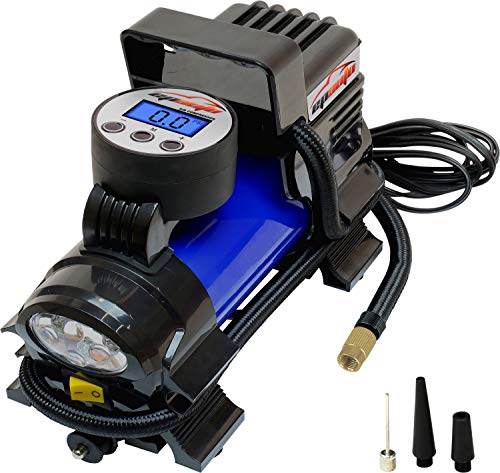
EPAuto 12V DC Digital Inflator — Best Budget
The EPAuto is the opposite philosophy: a compact, socket-powered digital pump that assumes your tires are ordinary car tires and your need is the monthly top-up plus the occasional slow leak. It plugs into the cigarette-lighter outlet, presents a digital readout, and handles the 30-to-40 PSI world of passenger cars without fuss. For the price of a tank of fuel it removes the gas-station air hose from your life, which for many drivers is the entire point.
Strengths
- Very low cost for a digital-gauge 12V inflator from a long-running listing.
- Socket power means no opening the hood and no battery clamps to manage.
- Compact enough to live permanently in a trunk corner or under a seat.
Trade-offs
- Socket current limits airflow, so large tires are slow and four-at-once jobs test its duty cycle.
- Built for top-ups, not for reseating beads or inflating from fully flat on big rubber.
- The lightweight build does not feel as durable as the VIAIR machines.
Key specs: 12V DC cigarette-lighter power; digital tire inflator display; portable air compressor pump format for passenger vehicles.
The honest way to judge the EPAuto is by the job it was designed for. Keeping four sedan tires at placard pressure takes a minute or two per tire, and at that task it is entirely adequate and noticeably more convenient than a service-station hose you have to pay to activate. Ask it to rescue a fully flat truck tire and it will try — slowly, hotly, and with a real chance of blowing the accessory fuse. Buy it for the car it matches and it is one of the best-value tools on this page.
Best for: sedan and hatchback owners who want cheap, simple monthly top-ups. / Not suited for: truck owners or anyone inflating oversize tires from flat.
Check the current price on Amazon

GSPSCN Heavy Duty Dual-Cylinder Inflator — Best for Trucks and Large Tires
Where single-cylinder pumps wheeze, the GSPSCN doubles the hardware: two cylinders working together to move roughly twice the air, in a metal-bodied pump rated to 150 PSI. It is aimed squarely at the vehicles socket pumps cannot serve — pickups, RVs, SUVs, vans and campers — and it includes adapters for air beds and balls as a sideline. If your tire sidewalls carry load-range ratings and your pressures run high, this is the budget-friendly way to fill them.
Strengths
- Dual-cylinder design moves far more air than single-cylinder rivals, cutting inflation time.
- 150 PSI ceiling covers high-pressure truck and RV tires.
- Metal body shrugs off the heat that warps plastic pumps during long runs.
Trade-offs
- High current draw means battery clamps and a running engine are mandatory, not optional.
- Bigger and heavier than anything else here; it is kit you store, not kit you forget in a glovebox.
- Analog-style operation lacks the set-and-forget shut-off of the digital picks.
Key specs: 12V heavy-duty metal pump; dual cylinders; up to 150 PSI; adapters for cars, RVs, pickup trucks, SUVs, vans, campers, air beds and balls.
The dual-cylinder layout matters most at the pressures trucks actually run. A small pump’s flow collapses as pressure climbs toward 60 or 80 PSI; twin cylinders keep pushing, so the last ten pounds take minutes rather than forever. The trade is pure convenience — this is a machine you deploy deliberately, with the hood up and the engine idling. For RV owners who check six tires before every trip, that trade is obviously worth it. For a commuter topping up a compact car, it is overkill wearing a bargain disguise.
Best for: pickup, RV and large-SUV owners who inflate big, high-pressure tires regularly. / Not suited for: small-car drivers who want a tiny socket-powered top-up pump.
Check the current price on Amazon

VIAIR EVC88P — Best Digital Controls
The EVC88P takes VIAIR’s compressor credibility and adds the feature that changes how a pump feels to use: a digital display where you preset the target pressure, after which the machine inflates and shuts itself off when it gets there. That sounds like a small thing until you have crouched beside a tire in the rain watching a needle crawl. Set 35, press start, and stand back up — the compressor does the crouching for you.
Strengths
- Digital preset with automatic shut-off delivers accurate, repeatable pressures.
- 120 PSI ceiling matches the capability class of the strongest pumps here.
- VIAIR build quality underneath the modern controls.
Trade-offs
- Costs more than the analog VIAIR 88P while serving a similar tire range.
- Electronics add a failure point that purely mechanical pumps do not have.
- Still a deliberate-use tool, not the smallest thing to stash in a small car.
Key specs: digital 12V tire inflator; up to 120 PSI; preset target pressure with auto shut-off.
Accurate pressure is a safety and economy feature, not a luxury: a few PSI low costs fuel and tire life, a few high costs grip and ride. The EVC88P’s preset system makes the correct pressure the default outcome instead of an estimate, which is why it suits drivers who maintain several vehicles or who share the pump with family members of varying patience. It does not replace the 88P’s brute simplicity for trail use, but for driveway maintenance it is the most pleasant machine on this list to operate.
Best for: drivers who maintain tire pressure carefully and value set-and-forget accuracy. / Not suited for: minimalists who prefer a purely mechanical pump with nothing to configure.
Check the current price on Amazon

AstroAI AIRUN H — Best for Everyday Cars
The AIRUN H is the friendly face of the socket-powered family: a yellow, compact inflator with a digital gauge, automatic shut-off and an LED light, on a 9.8-foot cord that reaches all four tires of a typical car from one socket. It is designed for the realities of ordinary ownership — a low tire noticed at night, in a parking lot, by someone who has never used a compressor before — and every part of it is arranged to make that moment uneventful.
Strengths
- Auto shut-off with digital gauge makes correct pressure nearly foolproof.
- Built-in LED light turns night-time inflation from guesswork into a non-event.
- 9.8-foot cord reaches around a typical car without repositioning the pump.
Trade-offs
- Socket power limits it to car and light-duty tires; big rubber is slow going.
- Plastic-bodied construction is a step below the metal heavy-duty pumps.
- Corded only, so the vehicle must be present and powered for every use.
Key specs: 12V DC power; auto shut-off with digital pressure gauge; LED light; 9.8 ft cord; for car, motorcycle and bicycle tires.
What the AIRUN H understands is that most tire emergencies are small: a few PSI lost to a cold snap, a slow bead leak, a warning light on the dashboard the night before a trip. For those, speed of setup beats speed of inflation, and this pump goes from trunk to tire in under a minute with a light to work by. It will not rescue a flat truck tire gracefully, and it does not pretend to. As the dedicated compressor of a family car, it is sized and priced exactly right.
Best for: everyday car owners who want an easy, light-equipped top-up pump. / Not suited for: owners of large trucks or anyone airing down and up off-road.
Check the current price on Amazon

Slime 40050 — Best Simple Analog
Slime built its name on tire repair, and the 40050 is its straightforward inflator: an analog 100 PSI dial gauge, a long hose, an LED light, and a claimed inflation time of about eight minutes for a standard tire. There is no screen to crack, no preset to program and no menu to learn — you connect it, watch the dial, and stop at your number. For drivers who distrust electronics in emergency kit, that simplicity is the feature.
Strengths
- Analog dial gauge is readable at a glance and immune to screen failures.
- Long hose and LED light make roadside use practical in the dark.
- From Slime, a brand built entirely around tire care and repair.
Trade-offs
- No auto shut-off, so accuracy depends on your attention to the dial.
- Slower than the digital picks on a standard tire.
- Socket-class power, so large or high-pressure tires are beyond its brief.
Key specs: 12V power; analog 100 PSI dial gauge; LED light; long hose; approximately 8-minute standard tire inflation.
The analog dial has one underappreciated virtue: it shows pressure continuously while you work, including the small drop when you disconnect the chuck, so experienced users learn to compensate by eye. The 40050 also pairs naturally with the sealant and plug kits Slime is known for, making it a sensible center of a budget flat-tire kit. It is the least capable pump here on paper and still entirely sufficient for the car tires it was built for — a reminder that matching the tool to the vehicle matters more than the spec sheet.
Best for: drivers who prefer simple, repairable, screen-free tools. / Not suited for: anyone wanting preset accuracy or fast inflation of large tires.
Check the current price on Amazon
Comparison Table
| Pick | Badge | Key spec | Best for |
|---|---|---|---|
| VIAIR 88P | Best Overall | Battery clamps, 120 PSI, tires to 33 in | Trucks, SUVs, Jeeps |
| EPAuto Digital | Best Budget | Socket power, digital display | Cheap car top-ups |
| GSPSCN Dual-Cylinder | Best for Trucks and Large Tires | Twin cylinders, 150 PSI, metal body | Pickups, RVs, high-pressure tires |
| VIAIR EVC88P | Best Digital Controls | Digital preset, auto shut-off, 120 PSI | Careful pressure maintenance |
| AstroAI AIRUN H | Best for Everyday Cars | Auto shut-off, LED light, 9.8 ft cord | Family cars, night use |
| Slime 40050 | Best Simple Analog | Analog 100 PSI dial, LED light | Screen-free simplicity |
Duty Cycle, Airflow and the Specs That Actually Matter
Compressor listings compete on the numbers that are easiest to print, not the numbers that decide your experience at the roadside, so it is worth learning to read past them. Maximum pressure is the most abused figure in the category. It tells you the highest pressure the pump can eventually reach against a closed or nearly closed load — a laboratory bragging right. Your tires need 30 to 40 PSI if you drive a car, perhaps 50 to 80 if you drive a loaded truck, and every pump in this guide clears those bars. What separates them is how fast they deliver air at those working pressures, and that is governed by cylinder size, cylinder count, motor power and cooling.
Airflow ratings, where brands publish them, are usually quoted at zero pressure — free air delivery — which flatters small pumps. As the tire fills and back-pressure rises, a small pump’s output falls away sharply while a larger pump keeps pushing. This is why two pumps with identical maximum PSI can differ by a factor of three in real inflation time, and why the dual cylinders of the GSPSCN matter more than its pressure ceiling. When you compare listings, treat any time claim for a standard tire — several of the picks here publish one — as a more honest guide than the PSI figure, and treat both as approximations that assume a healthy battery and a cool pump.
Duty cycle is the third spec and the one most often buried. It describes how long the pump can run continuously before it must rest to cool: a common pattern is ten minutes of work followed by a rest period. Duty cycle decides whether inflating four tires is one continuous job or a sequence of work-and-wait intervals, and exceeding it is the leading cause of early pump death, ahead of any manufacturing defect. Heat is the enemy of every small compressor, because the motor and cylinder are packed into a casing with minimal airflow. A metal body, like the GSPSCN’s, sheds that heat better than plastic, which is one reason heavy-duty pumps look the way they do. If your use case involves several large tires in a row — an RV, a dually, a trailer plus its tow vehicle — duty cycle should be the first specification you look for and the one you are least willing to compromise on.
Two smaller specifications round out a wise purchase. The first is total reach: the power cord and air hose together must span from the power source to the farthest valve stem, and on long vehicles that distance is greater than many compact pumps offer. The second is the chuck design. Screw-on chucks seal reliably and are kind to valve stems; quick-clip chucks are faster but can leak on angled stems. Neither is wrong, but if your wheels have tight spoke patterns or dual rear wheels, the chuck style can decide whether the pump is usable at all. Read the listing for these details before you buy, because they never appear in the headline.
How to Choose a 12 Volt Compressor
Start with the power question, because it decides everything else. Look at your vehicle’s largest tire and its recommended pressure, both printed on the driver-door placard. If the vehicle is a car or small crossover running pressures in the low-to-mid 30s, a socket-powered pump like the AstroAI AIRUN H or the EPAuto will serve you for years. If you run a truck, a large SUV, an RV or any tire over about 31 inches, skip the socket class entirely and buy a battery-clamp machine such as the VIAIR 88P or the GSPSCN dual-cylinder — the smaller pumps will technically inflate those tires, but slowly enough and hotly enough that you will stop trusting them.
Next, ignore maximum PSI as a comparison number and think in terms of airflow at working pressure. Every pump here can eventually reach pressures far above what a car tire needs; the meaningful difference is how many minutes it takes to add ten pounds to your actual tire, and how the pump’s duty cycle limits back-to-back work. A pump rated for ten minutes of continuous running needs a cool-down before the next tire, which turns a four-tire job into a half-hour project. If you maintain several vehicles or air up after off-road trips, duty cycle and cylinder count matter more than any other specification.
Gauge choice is the third decision. Analog dials are simple, durable and always on, but you must watch them and stop the pump yourself, and parallax makes small readings approximate. Digital gauges with auto shut-off, like those on the VIAIR EVC88P and the AIRUN H, trade a little mechanical simplicity for repeatable accuracy: set the placard pressure and every tire ends up identical, which is what you want for even tire wear and predictable handling. Whichever you choose, verify the pump’s gauge once against a quality handheld gauge and note any offset — gauges on budget pumps can read a couple of PSI proud or shy.
Finally, measure the reach. The pump sits at the power source — the dashboard socket or the battery — and its cord plus hose must reach the farthest tire valve with slack to work comfortably. Cars are easy; long trucks and RVs are not, and an extension of the air hose is a better solution than stretching a power cord, because long 12V power runs lose voltage and slow the pump. Check also what the kit includes: a storage case, spare fuses, a ball needle and a bicycle adapter turn a tire pump into a general inflation station for the whole household.
What Size Compressor Do You Need for Truck and RV Tires?
Truck and RV tires break the assumptions that car compressors are built on, in three ways. First, pressures run higher: load-range tires commonly call for 50 to 80 PSI rather than the low 30s, and pump airflow falls steeply as target pressure rises, so a pump that feels brisk on a car feels asthmatic on a dually. Second, air volume is simply larger — a tall, wide tire can hold several times the air of a compact car tire, so the same pump takes proportionally longer even before pressure effects. Third, there are often more tires: six on a dually, plus a spare that everyone forgets until it is needed and found flat.
The practical answer is a battery-clamp, metal-bodied pump with either a respected single-cylinder design like the VIAIR 88P, rated for tires up to 33 inches, or a dual-cylinder unit like the GSPSCN for the biggest rubber. Budget your time honestly: even good portable pumps need several minutes per large tire, and duty-cycle rests stretch a full RV set into a planned maintenance session rather than a roadside quickie. That is fine — RV tire pressure is a pre-trip checklist item, checked cold in the driveway — but it means the tiny socket pump in the glovebox is a false economy for this class of vehicle. Buy the pump your largest tire demands, and every smaller tire becomes easy.
Cigarette Plug or Battery Clamps: Which Power Connection Is Right for You?
Because the power connection shapes everything about a 12 volt compressor, it deserves a direct comparison before you spend money. A cigarette-lighter plug is the convenience option. You stay in or beside the cabin, the connection takes two seconds, and the pump is inherently limited to the 10 to 15 amps the socket circuit can supply — which in turn limits it to car-sized tires and top-up duty. That limitation is also a protection: the vehicle’s fuse stands guard over the wiring, and the worst realistic outcome of overuse is a blown fuse rather than a damaged pump or vehicle. For apartment dwellers and commuters whose vehicles live in parking structures, socket power is often the only practical option, since popping the hood and idling is not always welcome.
Battery clamps are the capability option. Drawing directly from the battery — with the engine running, so the alternator carries the load — a clamp pump can pull two or three times the current of a socket pump, and that current becomes airflow. This is the only way portable 12V machines inflate 33-inch tires, high-pressure load-range rubber or a full set of RV tires in tolerable time. The costs are real but modest: you open the hood, you observe polarity, you keep the leads clear of belts and fans, and you store a slightly larger machine. Drivers who tow, off-road or maintain work trucks generally accept that trade without a second thought, because the alternative is a pump that cannot do the job at all.
There is also a middle path worth knowing about: some households keep one of each. A small socket pump lives in the family car for top-ups, while a clamp pump lives in the truck or RV kit for serious work. Given that the budget picks in this guide cost little, that two-pump strategy is cheaper than one premium machine and matches each tool to its task. What you should not do is improvise adapters between the families — running a clamp pump from a socket via an adapter invites blown fuses and hot wiring, and running a socket pump from clamps gains it nothing. Buy the connection your tires require, and the rest of the decision becomes easy.
How to Use a 12 Volt Compressor Safely
Using a portable compressor well is mostly about heat, current and patience. Follow these steps and the pump will live longer while your tires end up at the right pressure.
- Park on level ground, check the placard pressure on the driver-door jamb, and confirm the tire is cold — pressure readings climb as tires warm.
- For battery-clamp pumps, connect red to positive and black to negative with the engine running; the alternator’s output keeps voltage up and protects the battery during a long inflation. For socket pumps, start the engine too, and never exceed the socket’s fuse rating.
- Thread the air chuck onto the valve stem firmly or clamp it straight, so air goes into the tire rather than hissing past the seal.
- Run the pump in intervals that respect its duty cycle — if the manual suggests ten minutes on, rest it before the next tire, and never leave a running pump unattended.
- On digital models, set the target and let auto shut-off stop the pump; on analog models, stop slightly above target to allow for the small loss when disconnecting.
- Verify final pressure with a separate gauge once the tire has settled, then replace the valve cap — it keeps dirt out of the valve core.
- Let the pump cool before packing it away; the cylinder head gets genuinely hot, and melting a storage bag onto it is a common and avoidable injury to the kit.
Two safety notes deserve emphasis. First, a compressor is a top-up and emergency tool, not a repair: if a tire loses pressure quickly, has visible damage, or has been driven flat, the tire needs professional inspection, not more air. Second, never use a small pump to attempt bead seating on a deflated tire that has come off the rim — that job needs a sudden blast of air that portable compressors cannot deliver, and it belongs in a tire shop.
How to Store and Maintain a Portable Compressor
A portable compressor is insurance equipment: it must work after months of neglect, in the dark, in bad weather. A little deliberate care keeps that promise. Store the pump in its case with its full kit — adapters, spare fuse, and instructions — because a pump separated from its chuck adapters is only half a tool. Keep the case somewhere reachable rather than buried under cargo; the night you need it, you will be tired and in a hurry. Every few months, run the pump briefly and check a tire you were going to check anyway. That small habit confirms the pump still works, keeps seals exercised, and turns pressure maintenance into a routine instead of an emergency response.
Heat management during use is the main maintenance act. Respect the duty cycle, let the unit cool before repacking it, and never wrap a hot hose tightly around a hot cylinder head. Keep the air filter, where one is fitted, clean — a clogged intake makes the motor work harder and hotter for less air. Inspect the power cord and hose periodically for cracks and chafing, especially where they flex near the pump body, and check the chuck’s rubber seal, which is the part most likely to age out first. On clamp models, keep the clamp jaws clean of corrosion so they bite the battery terminals properly. None of this takes more than minutes a year, and it is the difference between a pump that serves a decade and one that fails on its third emergency.
Common Buying Mistakes
The first mistake is buying by maximum PSI. A 150 PSI headline on a tiny pump does not make it a truck pump; airflow and duty cycle decide real capability, and both collapse on undersized machines long before the pressure ceiling matters. The second mistake is the reverse: buying a heavy-duty battery-clamp pump for a small car, then never using it because setting it up feels like a production. The best compressor is the one matched closely enough to your vehicle that using it is boring.
The third mistake is ignoring the fuse question. Socket-powered pumps draw close to what many accessory sockets are fused for, and running one on a marginal circuit pops fuses at the worst moment — usually beside a soft tire. Know where your vehicle’s fuse box is and carry spares if your pump is socket-powered. The fourth mistake is trusting the built-in gauge blindly forever: check it against a known-good gauge a few times a year, because a pump that reads three pounds high maintains your tires three pounds low, quietly costing fuel and tread life. The fifth is storing the pump without its adapters and instructions, then discovering at the roadside that the chuck does not fit or the fuse you need is the one you removed. Keep the kit complete, in its case, in the vehicle.
Final Recommendation
For most drivers who want one compressor that simply works on everything they own, the VIAIR 88P is the buy: battery-clamp power, a 120 PSI ceiling, and a 33-inch tire rating that covers the vast majority of vehicles on the road. Truck and RV owners inflating big, high-pressure tires should step up to the GSPSCN dual-cylinder, while drivers who prize accuracy and convenience will be happiest with the preset-and-forget VIAIR EVC88P. Car owners on a budget are well served by the EPAuto for top-ups, the AstroAI AIRUN H adds a light and auto shut-off for everyday ease, and the Slime 40050 remains the pick for anyone who wants a gauge with a needle and nothing else. Whichever you choose, check price on Amazon, confirm the power connection in the listing matches your vehicle, and then actually use it once in the driveway — a compressor you have practiced with is worth two you have not.
One last piece of advice applies to every pick on this page: the right time to learn your compressor is a quiet afternoon, not a dark roadside. Unbox it, connect it, top up all four tires, and time the job. You will learn its duty cycle, its gauge offset and its reach, and you will confirm the kit is complete while a replacement is still easy to arrange. That fifteen-minute rehearsal converts an unfamiliar gadget into trusted equipment, and it is the cheapest reliability upgrade in this entire category.
Shopping for a specific job rather than general duty? These companion guides go deeper: Best 12 Volt Compressor For Offroad Tires Jeep, Best 12 Volt Compressor Fridge, Best 12 Volt Cooler, Best 12 Volt Cooker, and Best 12 Volt Compact Spotlight.
Frequently Asked Questions
Can a 12 volt compressor run from a cigarette lighter socket?
Yes, if it was designed for it. Socket-powered models like the EPAuto and the AstroAI AIRUN H draw within the roughly 10 to 15 amps a typical accessory socket provides. Battery-clamp models draw more than a socket can safely supply and must connect directly to the battery — never adapt a clamp pump to a socket plug, because the fuse will blow or the wiring will overheat.
How long does a 12 volt compressor take to inflate a tire?
It depends on tire size and how flat it is. Topping up a car tire by a few PSI takes one to three minutes with most pumps here. Inflating a standard car tire from flat takes roughly six to twelve minutes depending on the model, and large truck tires take longer still, plus duty-cycle rests. Dual-cylinder and battery-clamp pumps are meaningfully faster than compact socket pumps on every tire. Remember that inflation slows as pressure rises: the first twenty pounds go in quickly, and the last ten to your target pressure are the slow part, which is why patience near the end of the job is normal and not a sign of a failing pump.
Will a 12 volt compressor drain my car battery?
It can if you run it for a long session with the engine off, which is why the standard advice is to idle the engine while inflating. With the engine running, the alternator supplies the power and the battery is protected. Short top-ups with the engine off are harmless, but a four-tire session on a clamp-style pump should always be done with the engine on.
What PSI should I set my compressor to?
The pressure printed on the driver-door placard, not the maximum pressure molded into the tire sidewall. The sidewall number is a limit, not a target. Check and adjust pressures cold, before driving, because a warm tire reads several PSI higher and will end up underinflated once it cools.
Is a digital or analog gauge better on a portable compressor?
Digital gauges with auto shut-off are easier and more repeatable — set the number and the pump stops there. Analog dials are simpler and tougher, with nothing electronic to fail, but they require you to watch and stop the pump, and small dials are harder to read precisely. Either is acceptable if you verify it occasionally against a separate handheld gauge.
Can I use a 12 volt compressor for air mattresses and sports balls?
For balls and small inflatables, yes — most kits include needle and nozzle adapters, and the GSPSCN explicitly lists air beds among its uses. Large air mattresses are a weaker fit: they need high volume at very low pressure, which a tire pump delivers slowly, and running a pump for very long stretches overheats it. A dedicated low-pressure inflator is the better tool for big air beds.


