Disclosure: airfryerkitchensupply.com is reader-supported. When you buy through links on our site, we may earn an affiliate commission at no extra cost to you.
Where to buy
Every battery in this guide to the best 12 volt battery for atv use was verified against Amazon’s own catalog data before it was included, so each linked model is a real, currently listed product in the size and chemistry its listing states. Use the links in this box, in the Quick Picks, and in each review to check live availability, and check the current price on Amazon rather than trusting any figure quoted elsewhere. Before ordering, confirm your ATV’s specified battery size — most take a YTX12-BS or YTX14-BS class battery, but the owner’s manual is the authority.
- Mighty Max YTX14-BS AGM Battery (12Ah, 200 CCA) — Check the current price on Amazon
- Mighty Max YTX12-BS AGM Battery (10Ah, 180 CCA) — Check the current price on Amazon
- Forgetyo YTX14-BS Lithium Battery (8Ah, 600 CCA) — Check the current price on Amazon
- Antigravity ATX12HD Lithium Powersports Battery — Check the current price on Amazon
- TYKOOL YTX14-BS Lithium Battery (8Ah, 480 CCA) — Check the current price on Amazon
- KEMIMOTO Lithium Battery YTX14-BS (6Ah, with Fit Spacers) — Check the current price on Amazon
The best 12 volt battery for atv riding is the one that still cranks eagerly on a cold morning, at the far end of a trail, after the machine has sat for three weeks. ATV batteries live a harder life than car batteries: they are small, they vibrate constantly, they get splashed, tilted, and frozen, and they are often left for long stretches between rides on machines that may have a small parasitic draw. Almost every ATV battery failure story is really a story about one of those stresses being ignored at purchase time.
The market splits into two chemistries. Sealed AGM batteries in the classic YTX sizes are the proven default: inexpensive, tolerant of any standard charger, and available everywhere. Lithium iron phosphate (LiFePO4) powersports batteries are the modern challenger: dramatically lighter, far stronger cranking for their size, and much longer-lived, at a higher price and with two honest caveats — they should not be charged below freezing, and they ask for a lithium-compatible charger to be filled properly. The six picks below include the best of both, because the right answer genuinely depends on how and where you ride.
Fitment comes before chemistry. The YTX14-BS is the most common ATV size class, with the YTX12-BS close behind; the picks below are built around those sizes, and several of the lithium models are cross-compatible with both. A battery with impressive numbers in the wrong case size is a paperweight, so the buying guide section walks through confirming your size, your terminal orientation, and your cold-cranking needs before you spend anything.
One more framing note: cranking amps are the headline number in this category, but they are not the whole story. Reserve capacity matters for winches and lights, vibration resistance matters for rough trails, and storage behavior matters for seasonal machines. Each review below weighs all of those, not just the biggest number on the label.
And a note on expectations: no battery in this guide will fix a machine with a failing charging system, a corroded ground strap, or a starter on its way out. If your ATV has killed two batteries in a season, the third battery is not the repair — the diagnosis is. The how-to section includes the two-minute charging check that separates a battery problem from a machine problem, and it is worth doing before any purchase.
In this guide
Quick Picks
Six verified ATV batteries in the common YTX sizes: two proven AGM defaults for everyday machines, and four lithium options ranging from value to premium for riders who want more.
- Best Overall — Mighty Max YTX14-BS AGM Battery (12Ah, 200 CCA): The proven default: a 12Ah, 200 CCA AGM in the most common ATV size, at a price that makes replacement painless. Check price on Amazon
- Best Budget — Mighty Max YTX12-BS AGM Battery (10Ah, 180 CCA): The smaller YTX12-BS size at the lowest cost in this guide, for mid-size machines and spare-battery duty. Check price on Amazon
- Best Lithium — Forgetyo YTX14-BS Lithium Battery (8Ah, 600 CCA): Six hundred cranking amps from an 8Ah lithium in the YTX14-BS size: the strongest starter in this guide. Check price on Amazon
- Best Premium — Antigravity ATX12HD Lithium Powersports Battery: The premium powersports lithium from the category’s best-known specialist brand, cross-sized for YTX12 and YTX14 applications. Check price on Amazon
- Best for Cold Starts — TYKOOL YTX14-BS Lithium Battery (8Ah, 480 CCA): 480 CCA and cross-fitment across YTX14-BS, YTX14H, and GYZ16H sizes, with ATV and snowmobile use named outright. Check price on Amazon
- Best Fit Flexibility — KEMIMOTO Lithium Battery YTX14-BS (6Ah, with Fit Spacers): A pre-charged 6Ah lithium with five EVA fit spacers, solving the loose-fit problem that plagues universal lithium swaps. Check price on Amazon
How These Picks Were Chosen
Every pick was verified through the Creators API against Amazon’s live catalog: the brand, model, size class, capacity, and cranking figures in each review come from the listing title the API returned, and only API-confirmed models carry a purchase link. Where a listing states a CCA figure, we quote it; where it does not, the review says so rather than borrowing a number from elsewhere.
Selection then weighed what decides ATV service in the real world: correct YTX size-class fitment, cranking performance for cold starts, vibration tolerance, weight, storage behavior for seasonal machines, and charging requirements — including the lithium caveats, which are stated plainly in the relevant reviews rather than footnoted.
A note on how to read the cranking numbers: CCA is measured by a standard test, but manufacturers of small powersports batteries are not all equally conservative in applying it, and two of our six listings state no CCA at all. We therefore treat claimed figures as class indicators — the lithium picks claim multiples of the AGM figures, and field experience supports the direction of that claim — rather than as laboratory rankings to be split by tens of amps.
- Fitment: YTX12-BS / YTX14-BS size class and terminal layout for common ATVs
- Cranking performance (CCA where the listing states it) for reliable cold starts
- Chemistry: AGM for price and charger simplicity, LiFePO4 for weight and cranking strength
- Vibration and spill resistance for trail use
- Storage behavior: self-discharge for machines that sit between rides
- Verified listing: brand, model, and size confirmed in Amazon catalog data
The 6 Best 12 Volt Battery for ATV Picks

Mighty Max YTX14-BS AGM Battery (12Ah, 200 CCA) — Best Overall
For the majority of ATVs, the correct purchase is boring, and this is it. The YTX14-BS is the most widely specified ATV battery size, and Mighty Max’s version delivers 12Ah and 200 CCA in a sealed, maintenance-free AGM case that any standard charger can maintain. It suits the utility quad that works year-round, the trail machine ridden monthly, and the owner who wants a battery that asks for nothing but a top-up charge now and then.
Strengths
- Correct size and honest specs for the largest number of ATVs
- AGM construction: sealed, spill-proof, and vibration-tolerant
- Works with every standard 12V charger and maintainer
Trade-offs
- Heavier than any lithium option in this guide, sometimes by a factor of three
- 200 CCA is adequate, not generous, for the coldest starts on big-bore machines
- Lead-acid storage rules apply: store it charged or lose capacity
| Specification | Detail |
|---|---|
| Size class | YTX14-BS |
| Capacity | 12Ah |
| Cranking | 200 CCA (per API listing title) |
| Chemistry | SLA AGM, maintenance-free |
The case for this battery is the case for the default. It fits, it cranks, it tolerates the charging equipment you already own, and if it ever does die far from home, its size class is the one every parts store stocks. Utility ATV ownership is full of consumables; the battery should be the least interesting of them, and this one is.
Its limits show at the edges of the envelope. A big-bore machine with a winch, heated grips, and lights, started at dawn in deep cold, is asking more than 200 CCA and 12Ah comfortably give, and that rider should look at the lithium picks below, whose cranking figures are two to three times higher. Likewise, a machine stored for six months at a time will test any lead-acid battery’s storage behavior.
Treat it as its chemistry demands — a smart maintainer during long storage, terminals kept clean and tight — and it will return several seasons of unremarkable service. In ATV batteries, unremarkable is a compliment.
One practical tip: when replacing, photograph the old battery’s terminal orientation before removal. The YTX14-BS layout is standard, but a two-minute photo prevents the classic mistake of discovering reversed cables only after the new battery is bolted in.
Best for: Most ATVs and most riders: the dependable, inexpensive default / Not suited for: Extreme-cold starting on big-bore machines, or riders chasing minimum weight
Check the current price on Amazon
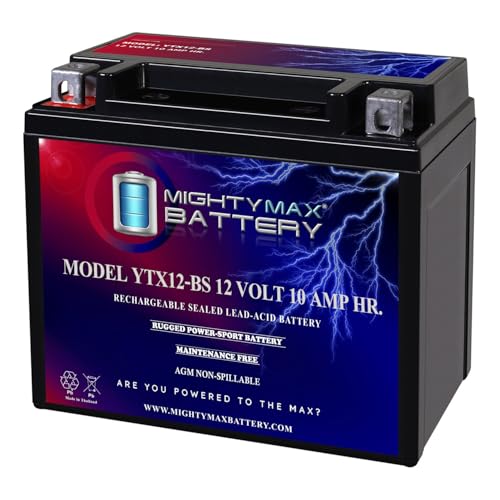
Mighty Max YTX12-BS AGM Battery (10Ah, 180 CCA) — Best Budget
Machines specified for the YTX12-BS — a large class of mid-size ATVs — get their budget answer here: 10Ah and 180 CCA in a sealed AGM case. It also makes sense as a carried spare for groups running several machines, and as the rational choice for an older ATV whose remaining life does not justify a premium battery. What it is not is an upgrade for a YTX14-BS machine: fitting the smaller size to save money trades away cranking margin you will miss on the coldest morning of the year.
Strengths
- Lowest cost in this guide; painless to replace or carry as a spare
- Sealed AGM: no acid, no maintenance, mounts in any position
- Correct, honest specs for the YTX12-BS machine class
Trade-offs
- Least cranking and capacity of the AGM picks
- Same lead-acid weight penalty, with less energy to show for it
- Not a substitute size for machines specified for YTX14-BS
| Specification | Detail |
|---|---|
| Size class | YTX12-BS |
| Capacity | 10Ah |
| Cranking | 180 CCA (per API listing title) |
| Chemistry | SLA AGM, maintenance-free |
Budget batteries earn suspicion in this category, so it is worth saying what this one is: a commodity AGM from a high-volume battery brand, in a standard size, with standard specifications. There is no magic in it, and there does not need to be. For a machine in regular use, started in temperate conditions, it does the whole job.
The riders who should not buy it are those at the margins: deep-cold starts, winch-heavy work, long storage. Each of those stresses consumes margin, and this battery starts with the least margin in the guide. Spend the small difference on the YTX14-BS class or on lithium if your riding lives at those margins.
As a spare, though, it is genuinely smart money. A charged YTX12-BS on the shelf has rescued more riding weekends than any premium battery ever will, because the best battery in an emergency is the one that exists.
Keep it on a maintainer if it is serving as a spare; a spare stored flat is not a spare, it is a second problem waiting for the same weekend.
Best for: YTX12-BS machines, older ATVs, and carried spares on a budget / Not suited for: YTX14-BS machines, deep-cold starting, or winch-heavy work
Check the current price on Amazon

Forgetyo YTX14-BS Lithium Battery (8Ah, 600 CCA) — Best Lithium
The Forgetyo is the lithium pick for riders whose problem is starting, full stop. Its listing claims 600 CCA — three times the AGM default’s figure — in the standard YTX14-BS footprint, and explicitly names ATV and 4-wheeler use. Big-bore machines, cold climates, and high-compression engines that make an AGM grunt are exactly its home ground. The 8Ah capacity is smaller on paper than the AGM’s 12Ah, which matters for long winching sessions, not for starting.
Strengths
- 600 CCA: strongest cranking figure in this guide by a wide margin
- A fraction of the AGM’s weight in the same footprint
- Lithium storage behavior: holds charge for months between rides
Trade-offs
- 8Ah capacity is modest for sustained winch or accessory loads
- Must not be charged below freezing; needs a lithium-compatible charger for proper filling
- Higher up-front cost than the AGM picks
| Specification | Detail |
|---|---|
| Size class | YTX14-BS |
| Capacity | 8Ah |
| Cranking | 600 CCA (per API listing title) |
| Chemistry | LiFePO4 |
Cranking is where lithium embarrasses lead-acid. A LiFePO4 pack delivers its current with far less voltage sag, so the starter spins faster and the engine fires sooner, and it does so at a fraction of the weight. On a cold morning with a big single-cylinder engine, the difference between 200 and 600 cranking amps is the difference between a ritual and a button press.
The honest caveats are about charging, not starting. Do not charge a lithium battery below freezing — bring it indoors or warm it first — and use a charger with a lithium profile, because a lead-acid charger’s desulfation pulses and float behavior are not designed for it. Riders in very cold climates who charge outdoors should weigh those habits before switching; riders who garage their machines will never notice them.
Capacity deserves a clear word too. Eight amp-hours starts an ATV dozens of times, but a winch is a starter-motor-class load that runs for minutes, and repeated long winch pulls are where the smaller lithium capacity shows. Occasional winch users will never care; recovery-heavy riders should pair this battery with realistic expectations, or run the winch with the engine running, as they should with any battery.
For the rider whose ATV lives outdoors, sits between rides, and must start first press in January, this is the most convincing battery in the guide.
Best for: Cold starts, big-bore machines, and riders tired of storage-related no-starts / Not suited for: Sustained winching on capacity alone, or below-freezing charging routines
Check the current price on Amazon

Antigravity ATX12HD Lithium Powersports Battery — Best Premium
Antigravity built its name on lithium powersports batteries, and the ATX12HD is its heavy-duty entry sized across the YTX12 and YTX14 classes that cover most ATVs. This is the pick for the rider who wants the lithium benefits — weight, cranking, longevity — from the specialist brand with the deepest track record in the niche, and who is willing to pay the premium that positioning carries. Note that its listing title does not state a CCA figure, so we do not quote one; its reputation rests on the brand’s powersports focus rather than a headline number here.
Strengths
- Specialist lithium powersports brand with a long track record in the niche
- Cross-size fitment covers both common ATV battery classes
- Lithium weight and storage advantages over any AGM
Trade-offs
- Premium pricing is the highest tier in this guide
- Listing title states no CCA figure; buyers comparing on that number alone should look at the Forgetyo or TYKOOL
- Same lithium charging rules: no charging below freezing, lithium-profile charger preferred
| Specification | Detail |
|---|---|
| Size class | YTX12 / YTX12-BS / YTX14 / YTX14-BS cross-fit (per API listing title) |
| Chemistry | Lithium (LiFePO4) powersports |
What the premium buys is mostly confidence and refinement: a brand whose entire business is this exact product category, mature battery management electronics, and a support channel that understands powersports charging systems. On a machine that represents a significant investment, or one that must start reliably far from help, that confidence is a legitimate thing to purchase.
It is also the pick for riders who keep machines for a long time. Lithium longevity is the category’s big economic argument — one lithium battery commonly outlasts two or three AGM replacements — and the argument is strongest from the manufacturer most likely to still be supporting the product years from now.
The counterpoint is honest: on specifications visible in the listing, rivals in this guide claim bigger cranking numbers for less money. If your decision is a spreadsheet, this is not your battery. If your decision is “the best-supported lithium from the specialist,” it is.
Fitment across both YTX classes also makes it the convenient choice for households running several machines of different sizes: one battery model can serve as the spare for all of them.
Best for: Premium buyers, long-term owners, and multi-machine households / Not suited for: Spec-sheet shoppers comparing cranking amps per dollar
Check the current price on Amazon

TYKOOL YTX14-BS Lithium Battery (8Ah, 480 CCA) — Best for Cold Starts
The TYKOOL is the cold-start specialist’s alternative: 480 CCA — well over double the AGM default — with cross-fitment spanning the YTX14-BS, YTX14H, and GYZ16H sizes, and a listing that names ATV, UTV, and snowmobile use. Snowmobile naming matters: it signals the manufacturer expects this battery to be bought for winter starting, which is precisely the duty that exposes weak batteries.
Strengths
- 480 CCA delivers confident winter starting with margin to spare
- Widest size cross-fitment in this guide, including GYZ16H
- Lithium weight saving and storage behavior
Trade-offs
- 8Ah capacity, like the Forgetyo, is starting-first rather than winch-first
- No charging below freezing; cold-climate owners must charge indoors
- Less established brand than the Antigravity or Mighty Max names
| Specification | Detail |
|---|---|
| Size class | YTX14-BS / YTX14H / GYZ16H cross-fit (per API listing title) |
| Capacity | 8Ah |
| Cranking | 480 CCA (per API listing title) |
| Chemistry | LiFePO4 |
Positioned against the Forgetyo, the TYKOOL trades a slice of claimed cranking power for broader fitment, and for many buyers that is the right trade: the GYZ16H and YTX14H sizes cover machines the standard YTX14-BS does not, and 480 CCA remains an enormous figure next to any AGM in this size class. Cold starting is a threshold problem — enough cranking, delivered without sag, fires the engine — and both lithium picks clear the threshold with room to spare.
Winter riders should still respect the lithium charging rule, which cuts the other way in cold climates: the battery that starts best in January must be charged in a space above freezing. In practice that means the battery comes indoors or the charger lives in a heated garage, a small habit change that winter riders in this guide’s audience usually already make for their machines.
Vibration and trail abuse are handled by the chemistry’s construction — no liquid, no plates to shed — and the weight saving, while small in absolute terms, sits high on many ATVs where it is most noticeable.
Buy it if your size is one of the three it covers and your winters are the problem. It is a focused tool for exactly that job.
Best for: Winter riders and owners of YTX14H or GYZ16H machines / Not suited for: Riders who must charge outdoors below freezing, or winch-heavy use
Check the current price on Amazon

KEMIMOTO Lithium Battery YTX14-BS (6Ah, with Fit Spacers) — Best Fit Flexibility
KEMIMOTO’s battery answers a practical annoyance: lithium batteries are often smaller than the lead-acid box they replace, and a battery that rattles in its tray on a trail machine is a battery damaging itself. The included set of five EVA spacers pads the pack to a snug fit across the YTX14-BS and YTX9-BS classes it covers. At 6Ah it is the smallest capacity in this guide, aimed at starting and light accessory duty on small and mid-size machines, and it arrives pre-charged, ready to install.
Strengths
- Included spacers solve lithium’s loose-fit problem properly
- Pre-charged and ready to install out of the box
- Featherweight even by lithium standards; ideal for small machines
Trade-offs
- 6Ah is the least capacity here; not for winches or heavy accessory loads
- Listing title states no CCA figure, so cranking comparisons rest on class, not a quoted number
- Same lithium charging rules as the other lithium picks
| Specification | Detail |
|---|---|
| Size class | YTX14-BS / YTX9-BS (per API listing title) |
| Capacity | 6Ah |
| Chemistry | LiFePO4 |
| Included | 5 universal-fit EVA spacers (per API listing title) |
| State | Pre-charged |
Judge this battery on the problem it solves. KEMIMOTO is an ATV and UTV accessories brand, and it shows: the spacer kit is the detail of a company that has watched customers stuff foam and cardboard around undersized lithium batteries and decided to just include the right parts. A snug battery is a reliable battery, because vibration is cumulative damage.
The capacity honesty matters too. Six amp-hours is a starting battery for small and mid-size machines, full stop. On a 250–450cc ATV ridden recreationally, that is genuinely all you need, and the weight saving is at its most proportionally dramatic. On a big utility machine with a winch, it is the wrong battery, and the guide’s other lithium picks exist for that rider.
Pre-charged arrival is a small thing that removes a real friction: no overnight wait before the first ride, and no temptation to install a half-charged battery and immediately judge it harshly.
For the small-machine owner who wants lithium’s benefits with the fitment problem pre-solved, this is the most thoughtfully packaged pick in the guide.
Best for: Small and mid-size ATVs, and anyone replacing an odd-size battery / Not suited for: Big-bore machines, winch duty, or heavy accessory loads
Check the current price on Amazon
Comparison Table
Cranking figures below are quoted only where the listing itself states them. Capacity matters for accessories and winches; cranking matters for starting; fitment matters before either of those considerations.
| Pick | Badge | Key spec | Best for |
|---|---|---|---|
| Mighty Max YTX14-BS AGM Battery (12Ah, 200 CCA) | Best Overall | 12Ah AGM, 200 CCA, YTX14-BS size | Most ATVs and most riders: the dependable, inexpensive default |
| Mighty Max YTX12-BS AGM Battery (10Ah, 180 CCA) | Best Budget | 10Ah AGM, 180 CCA, YTX12-BS size | YTX12-BS machines, older ATVs, and carried spares on a budget |
| Forgetyo YTX14-BS Lithium Battery (8Ah, 600 CCA) | Best Lithium | 8Ah LiFePO4, 600 CCA, YTX14-BS size | Cold starts, big-bore machines, and riders tired of storage-related no-starts |
| Antigravity ATX12HD Lithium Powersports Battery | Best Premium | LiFePO4 powersports, YTX12/YTX14 cross-fit | Premium buyers, long-term owners, and multi-machine households |
| TYKOOL YTX14-BS Lithium Battery (8Ah, 480 CCA) | Best for Cold Starts | 8Ah LiFePO4, 480 CCA, multi-size cross-fit | Winter riders and owners of YTX14H or GYZ16H machines |
| KEMIMOTO Lithium Battery YTX14-BS (6Ah, with Fit Spacers) | Best Fit Flexibility | 6Ah LiFePO4, pre-charged, 5 EVA spacers included | Small and mid-size ATVs, and anyone replacing an odd-size battery |
How to Choose a 12 Volt Battery for Your ATV
Start with the size your machine specifies. Check the owner’s manual or the label on the old battery: most ATVs take a YTX14-BS or YTX12-BS class battery, some take YTX14H or GYZ16H variants, and the case dimensions and terminal positions must match, not merely resemble. Every pick in this guide is organized by size class for this reason. A battery that almost fits will vibrate, chafe, and eventually fail in ways that get blamed on the battery rather than the fit.
Next, be honest about your hardest start. A machine started weekly in mild weather needs nothing special. A machine started at dawn in winter, or a big-bore engine with high compression, needs cranking margin — and that is where lithium’s two-to-three-times cranking advantage stops being a luxury. Then consider your accessories: a winch changes the calculation from cranking to capacity, and long winch sessions favor the larger AGM or engine-running winching regardless of chemistry.
- Confirm size class and terminal orientation from the manual or old battery first
- Cold climates and big-bore engines: prioritize cranking amps (lithium excels)
- Winch users: prioritize capacity and run the winch with the engine running
- Seasonal machines: prioritize low self-discharge (lithium) or budget a maintainer (AGM)
- Lithium owners: plan for a lithium-profile charger and no charging below freezing
- Vibration kills: whatever you buy, mount it snugly — spacers or foam are not optional on trails
Finally, price the whole system, not the battery. An AGM plus the maintainer you may already own can be the cheapest path; a lithium plus a lithium charger costs more up front and then typically outlasts two AGM replacements. Both are rational; the irrational purchase is the one that ignores fitment, climate, or charging.
AGM vs Lithium on an ATV: The Real Differences
Weight is the obvious one: a lithium powersports battery commonly weighs a third or less of the AGM it replaces. On an ATV the saving is a few pounds, felt most on small machines and least on big utility quads. Cranking is the dramatic one: lithium delivers current with minimal voltage sag, so starters spin harder, especially cold. Longevity is the economic one: lithium packs are typically rated for many more cycles and years than the two-to-four seasons a hard-used AGM delivers.
AGM’s advantages are real and worth stating without apology: it costs far less, it charges from anything, it tolerates being charged in a freezing garage, and if it dies, every town has a replacement. Lithium’s constraints are equally real: no charging below freezing, a preference for lithium-profile chargers, and a higher price that only pays back across years of ownership. Riders who keep machines long and ride in the cold-but-charge-indoors pattern are lithium’s ideal customer; riders who charge outdoors in winter and replace machines often are AGM’s.
There is a middle behavior worth copying from experienced owners of both chemistries: whichever you choose, keep the battery on the machine’s side. Tight terminals, clean connections, a secure mount, and a charge state that never sits at the bottom — those habits are chemistry-neutral, and they account for more real-world reliability than the AGM-versus-lithium decision itself. The battery you maintain beats the battery you merely bought, every season.
Winches, Lights, and Accessory Loads
Accessories are where ATV battery choices get complicated, because they pull in opposite directions. A winch is essentially a starter motor that runs for minutes: it rewards capacity and stiff voltage delivery, and it should be run with the engine running so the charging system carries part of the load. Riders who winch regularly and at length are the one group for whom the smaller lithium packs’ 6–8Ah capacity is a genuine limitation, and for whom the 12Ah AGM — or disciplined engine-running winching on any battery — is the honest answer.
Lights, heated grips, and electronics pull the other way: modest, steady draws that reward usable capacity and punish a battery that is already tired. LED light bars have made this easier than it used to be — a modern bar draws a fraction of what halogen work lights drew — but the arithmetic still applies on a small battery. Add your steady accessory draw, multiply by the hours you run it with the engine off, and keep the result well inside the battery’s capacity. Engine-off accessory use is the quiet killer of ATV batteries, because it feels harmless one evening at a time.
The practical synthesis: starting is a cranking problem, accessories are a capacity problem, and most ATVs mostly have the first problem. Buy for your dominant problem, and if both are real, buy the battery that solves starting first and manage accessories with the engine running.
Making an ATV Battery Survive Storage
More ATV batteries die in storage than on trails. The killers are self-discharge plus parasitic draw: a machine that sits for two months can pull a small battery down to a level that permanently damages lead-acid chemistry. The defenses are simple. Disconnect the battery or use a maintainer for AGM; store lithium at partial-to-full charge, where it can sit for months almost untouched. Keep terminals clean, because a corroded connection mimics a dead battery perfectly. And before the first ride of the season, charge fully and load-test your confidence with a deliberate start at home, not at the trailhead.
Climate sharpens the point. A battery stored in a freezing shed self-discharges slowly but cranks weakly when asked; a battery stored in a hot shed self-discharges fast and ages faster. The ideal is the boring one: cool, dry, charged, and disconnected. It is also worth labeling the battery with its purchase date — a two-minute habit that ends all arguments, two seasons later, about how old the battery actually is.
Matching the Picks to Common ATV Scenarios
The year-round utility quad — farm work, plowing, chores — is the Mighty Max YTX14-BS AGM‘s home: cheap, tough, charger-agnostic, and replaced without drama when its years are done. The cold-climate trail machine that must start at a trailhead in January belongs to the Forgetyo lithium or the TYKOOL, whose cranking figures turn winter starting from a hope into a routine. The premium long-term machine — the ATV you intend to own for a decade — is where the Antigravity ATX12HD makes its case, amortizing its price across years of service.
The small recreational machine, the 250–450cc quad ridden on weekends, is the KEMIMOTO’s scenario: light, pre-charged, padded to fit, and never asked to do more than start a modest engine and run its lights. And the older machine being kept alive on a budget, or the group that wants a shelf spare, is the YTX12-BS Mighty Max’s job. Notice that every scenario names the rider’s pattern before the product; that order is what makes the purchase right.
If your scenario is not listed, interpolate honestly: find the pick whose stated strengths match your hardest condition — coldest start, longest storage, heaviest accessory load — and buy for that condition, not for the average day.
How to Replace an ATV Battery Safely
Battery replacement on an ATV is a fifteen-minute job with basic tools. The order of operations matters for safety, because a wrench bridging the positive terminal to the frame is a genuine hazard even at 12 volts.
Before you start, assemble what the job actually needs: the correct-size battery, a wrench that fits the terminal bolts without slop, a wire brush or terminal cleaner, dielectric grease, any spacers or foam the new pack requires, and a multimeter if you want to verify the charging system afterwards. Having the maintainer or charger ready matters too — a new battery should begin its life fully charged, not at whatever charge it shipped with.
- Park on level ground, ignition off, and locate the battery — usually under the seat or a side panel. Photograph the cable routing and terminal orientation before touching anything.
- Remove the negative (black) cable first, then the positive (red). This order means a slipped wrench on the positive terminal cannot short against the frame while the negative is still connected.
- Unstrap the old battery and lift it out. Check the tray for corrosion, cracked hold-downs, and chafed cable insulation; clean and repair now, while it is accessible.
- If the new battery is a smaller lithium pack, fit the supplied spacers or closed-cell foam so it sits snugly with no movement in any direction; trail vibration punishes a loose battery.
- Set the new battery in, connect positive first, then negative — the reverse of removal — and tighten terminals firmly without over-torquing small posts.
- Apply a thin smear of dielectric grease or terminal protectant to discourage corrosion, refit the hold-down strap and covers, and confirm the cables cannot chafe on the frame or seat.
- Start the machine and let it idle; check that it charges (a multimeter across the terminals should show a clear rise in voltage with the engine running) before you declare the job done.
- Charge the new battery fully on the correct charger profile — lithium profile for LiFePO4, standard for AGM — before its first storage period, and recycle the old battery at any parts store.
That final charging-system check catches the other classic misdiagnosis: the “bad new battery” that is actually a machine not charging. Two minutes with a multimeter separates a battery problem from a stator or regulator problem, and saves a return that helps no one.
Common Buying Mistakes
Buying by amp-hours alone. ATV batteries are starting batteries first. Cranking performance and fitment decide whether the machine starts; capacity decides how long accessories run. A high-capacity battery in the wrong size or with weak cranking is the wrong battery.
Fitting the smaller size to save money. A YTX12-BS in a YTX14-BS machine gives up cranking margin exactly where you need it. Size is specified for a reason; match it.
Charging lithium below freezing. Charging a LiFePO4 battery in sub-freezing temperatures damages it. Bring it indoors or warm it first — the one lithium rule that cannot be negotiated.
Leaving a loose lithium battery to rattle. Lithium packs are often smaller than the tray. Unpadded, they vibrate themselves to death. Use the spacers; that is what they are for.
Storing an AGM discharged. A lead-acid battery left flat over winter is usually a battery replaced in spring. Maintainer or disconnect — pick one, every time.
Skipping the charging-system check. Repeated dead batteries on one machine usually mean the machine is not charging. Test the system before blaming or replacing another battery.
Final Recommendation
For most ATV owners, the Mighty Max YTX14-BS AGM remains the recommendation: correct size, honest specifications, trivial cost, and no new habits required. Riders whose problem is cold starting should go straight to the Forgetyo or TYKOOL lithiums and their multiples of cranking power; long-term premium owners, to the Antigravity; small-machine owners who want lithium without the fitment fuss, to the KEMIMOTO; and budget or spare-battery buyers with YTX12-BS machines, to the smaller Mighty Max.
The same verified approach to 12-volt power runs through the rest of this batch: high-output starting batteries are pushed to their limit in Best 12 Volt Battery For Drag Racing, truck fitment is worked through in Best 12 Volt Battery For Chevy Silverado, and the deep-cycle side of the family is covered in Best 12 Volt Battery For Camping and Best 12 Volt Battery For A Kayak. Match the size, respect the chemistry, and the battery becomes the least interesting part of your ride — which is the goal.
One last word of buying discipline: purchase the battery before you need it. ATV batteries are overwhelmingly bought in a panic, on the morning of a ride, at whatever the nearest shop stocks. Bought calmly, in the right size and chemistry for your riding, the same money buys a battery that lasts twice as long. The picks above are all verified and available to order; the best time to use that is a quiet weekday, not a desperate Saturday.
Frequently Asked Questions
What size battery does my ATV take?
Most ATVs use a YTX14-BS or YTX12-BS class battery, but sizes vary by model and year, and a few machines use related variants. Check the owner’s manual or the label on the existing battery, and match case size and terminal orientation, not just voltage.
Is a lithium battery worth it on an ATV?
For riders who keep machines for years, ride in the cold, or fight storage-related no-starts, yes: lithium cranks far harder, weighs a third as much, and holds charge in storage. For a machine charged outdoors below freezing or replaced often, AGM remains the practical choice.
Can I charge a lithium ATV battery with my regular charger?
Use a charger with a lithium (LiFePO4) profile. Some standard chargers are safe on their basic mode, but desulfation pulses and lead-acid float behavior are not designed for lithium. And never charge lithium below freezing.
Why does my ATV battery die every winter?
Usually storage, not quality: self-discharge plus the machine’s own parasitic draw flattens a lead-acid battery, and a flat lead-acid battery loses capacity permanently. A maintainer, a disconnected terminal, or lithium chemistry each solve it for good.
How many CCA does an ATV battery need?
Enough to crank your engine in your coldest typical conditions with a comfortable margin to spare. The AGM picks here offer 180–200 CCA, adequate for most machines in most climates; the lithium picks claim 480–600 CCA, which transforms big-bore and deep-cold starting.
Can I use a bigger battery than specified?
Only if it physically fits, the terminals align, and it can be secured against vibration. A larger case that rattles is worse than the correct size. Lithium packs in the same class, with spacers, are the safer way to change characteristics without changing size.


