Disclosure: airfryerkitchensupply.com is reader-supported. When you buy through links on our site, we may earn an affiliate commission at no extra cost to you.
Where to buy
A 12 volt air compressor is the tool that turns a flat tire from a ruined day into a ten-minute delay — but the category splits sharply in two. Glovebox inflators plug into a cigarette lighter socket and top up car tires; serious 12 volt compressors clamp straight to the battery, move real air volume, and inflate truck, SUV and off-road tires without cooking themselves. Every pick below was verified against the retailer’s own product data, and each spec box sticks to what the listing states. Check the current price on Amazon, and match the compressor’s power connection to how you actually intend to use it — that single decision predicts satisfaction better than any other specification in this guide.
- VIAIR 88P Portable Air Compressor Kit (Best Overall) — Check the current price on Amazon
- VIAIR 400P Portable Air Compressor (Best for Trucks and SUVs) — Check the current price on Amazon
- EPAuto 12V DC Portable Air Compressor Pump (Best Budget) — Check the current price on Amazon
- AstroAI AIRUN H Tire Inflator (Best for Beginners) — Check the current price on Amazon
- GSPSCN Heavy Duty Dual Cylinder Tire Inflator (Best Fast Inflation) — Check the current price on Amazon
- ARB CKMP12 Portable Air Compressor (Best Premium Off-Road) — Check the current price on Amazon
Finding the best 12 volt auto air compressor starts with an honest question: what tires, how often, and how far from help? A commuter who tops up sedan tires monthly needs a different machine from a driver who airs down on a trail and must refill four large off-road tires at the trailhead. The market serves both, but it labels both with the same heroic maximum-PSI numbers, which is why this guide ranks by airflow, duty cycle and power connection — the three specifications that actually decide whether a compressor finishes the job.
The six picks below span the honest range of the category: a battery-clamp all-rounder that has anchored this segment for years, a high-flow truck unit, a genuinely cheap glovebox inflator that knows its limits, a beginner-friendly automatic model, a dual-cylinder speed play, and the premium off-road compressor that expedition drivers swear by. All six run from a vehicle’s 12 volt system; none requires a wall outlet or a separate battery. One more framing note: this guide treats compressors as tire tools. The same 12 volt ecosystem powers everything from ATV spreaders to cab heaters elsewhere on this site, but air compressors are judged here on the single job of filling tires well — the adapters for balls and air beds that most of them include are a bonus, never the brief.
In this guide
Quick Picks
- Best Overall — VIAIR 88P Portable Air Compressor Kit. Battery-clamp power, up to 120 PSI, and the build quality of a brand that makes compressors for a living. The default recommendation for cars and light trucks. Check the current price on Amazon
- Best for Trucks and SUVs — VIAIR 400P Portable Air Compressor. 150 PSI with 2.30 CFM of flow — the number that matters for big tires. Built for repeated truck and SUV work, not occasional top-ups. Check the current price on Amazon
- Best Budget — EPAuto 12V DC Portable Air Compressor Pump. A digital inflator that plugs into the cabin socket and handles car tires at the lowest cost of entry here. Know its limits and it will not disappoint. Check the current price on Amazon
- Best for Beginners — AstroAI AIRUN H Tire Inflator. Set the target pressure, press start, and it stops itself — with a digital gauge and LED light for night use. The friendliest first compressor. Check the current price on Amazon
- Best Fast Inflation — GSPSCN Heavy Duty Dual Cylinder Tire Inflator. Twin cylinders and a metal body move air quickly — up to 150 PSI for larger tires — for drivers who inflate often and hate waiting. Check the current price on Amazon
- Best Premium Off-Road — ARB CKMP12 Portable Air Compressor. A high-performance 12V compressor from the off-road equipment world, built for airing up after trails and for the duty cycles that kill lesser units. Check the current price on Amazon
How These Picks Were Chosen
Each product was verified through the retailer’s product data before inclusion: brand, model, power connection, stated maximum pressure and stated airflow where the listing provides it. Products that could not be confirmed were excluded. The ranking then weighed four things. Airflow first — cubic feet per minute is what fills tires, while maximum PSI is mostly a headline. Duty cycle second — how long the unit can run before it must rest, which decides whether four big tires are one job or an afternoon. Power connection third — cigarette-socket units are capped by the socket’s fuse, typically limiting them to car tires, while battery-clamp units draw what they need for truck work. Build fourth — metal pump bodies and proper cooling survive the category’s real enemy, which is heat.
No prices or star ratings appear in this guide. Compressor prices shift with sales seasons, and a printed figure would date instantly; check the current price on Amazon through the links. What does not change is the physics below, which will still be true of whatever model replaces these in five years. A note on method, for readers comparing guides: the picks here were ranked as tire tools for vehicles, not as general inflators — a distinction that quietly reshuffles many roundups. Units that split their design budget across mattress pumps, battery packs and novelty features were passed over in favor of machines that spend it on the pump, the motor and the cooling, because tires are the job this keyword asks about.
The 6 Best 12 Volt Auto Air Compressors

VIAIR 88P Portable Air Compressor Kit — Best Overall
The 88P is the compressor mechanics recommend when asked for one unit that simply works: it clamps directly to the battery — the correct power source for real inflation work — delivers up to 120 PSI, and comes from a manufacturer whose entire business is 12 volt air. That battery connection is the whole point. Freed from the cigarette socket’s fuse limit, the 88P sustains the current draw that car-tire inflation actually requires, and it does so in a compact kit that lives happily in a trunk or under a seat.
Strengths
- Direct battery-clamp power avoids the socket fuse ceiling that limits glovebox inflators
- Up to 120 PSI covers car, SUV and light-truck tires with margin
- Specialist brand with a long track record in exactly this category
Trade-offs
- Battery clamps mean opening the hood — less casual than a cabin-socket plug
- Airflow suits car and light-truck tires; repeated 35-inch off-road refills are the 400P’s job
- Analog-style operation lacks the set-and-forget automatic shut-off of beginner models
| Spec | Detail |
|---|---|
| Max pressure | Up to 120 PSI (listing-stated) |
| Power | 12V, direct battery clamps |
| Use case | Car and truck tires |
Who should buy the 88P? Anyone whose inflation needs are real but not extreme: monthly pressure maintenance on a household’s cars, a spare-tire refill at the roadside, bicycle and trailer tires in between. It is also the right gift-class compressor — substantial enough to matter, simple enough to use. Its ceiling is volume, not pressure: airing up four oversized tires from trail pressure will take patience and rest breaks, which is precisely the gap the next pick fills.
Best for: most drivers who want one dependable compressor for cars and light trucks / Not suited for: frequent airing-up of large off-road tires — Check the current price on Amazon

VIAIR 400P Portable Air Compressor — Best for Trucks and SUVs
The 400P is the step up that truck owners actually need: 150 PSI maximum and — the figure that matters — 2.30 CFM of airflow, roughly the output class required to refill full-size truck and SUV tires in reasonable time, repeatedly. Where glovebox units labor on a single large tire, the 400P is specified for the work: bigger motor, serious cooling, and a kit built around battery power and long reach.
Strengths
- 2.30 CFM airflow (listing-stated) refills large tires in genuinely useful time
- 150 PSI ceiling covers high-pressure truck and trailer tires
- Built for repeated duty rather than occasional top-ups
Trade-offs
- Costs meaningfully more than car-focused inflators
- Larger and heavier kit to store in the vehicle
- Overkill for a compact-car commuter
| Spec | Detail |
|---|---|
| Max pressure | 150 PSI (listing-stated) |
| Airflow | 2.30 CFM (listing-stated) |
| Power | 12V, battery connection |
| Use case | Truck, SUV, Jeep and RV tires |
The buying logic here is duty cycle honesty. A compressor’s real specification is not whether it can reach a pressure once, but whether it can do the fourth tire at the same speed as the first. The 400P’s class of machine — high flow, real cooling, battery power — is what “yes” looks like. If your vehicle wears large tires, tows, or leaves pavement, this is the tier to buy, and buying below it is how people end up owning two compressors: the cheap one and the replacement.
Best for: full-size trucks, SUVs, towing and regular large-tire work / Not suited for: small-car owners who only top up monthly — Check the current price on Amazon
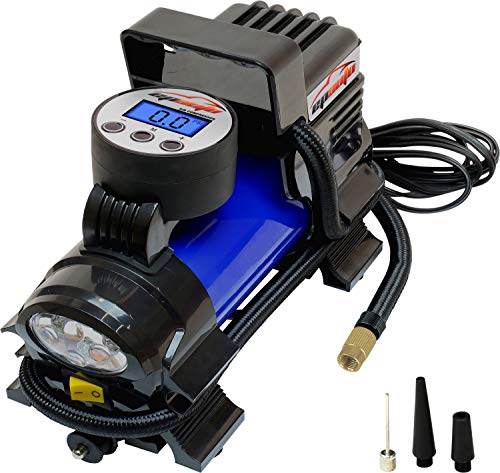
EPAuto 12V DC Portable Air Compressor Pump — Best Budget
The EPAuto is the glovebox inflator done honestly: a compact digital unit that plugs into the cabin’s 12V socket, shows the pressure on a screen, and handles the ordinary work of car ownership — the monthly top-up, the slow leak nursed to the tire shop, the bicycle and ball duty in between. It is the cheapest pick here by a wide margin, and its limitations are the limitations of its power source, not of its honesty.
Strengths
- Lowest cost of entry in this roundup
- Digital display makes pressure setting straightforward
- Cabin-socket power is maximally convenient for car tires
Trade-offs
- Socket power caps its output — large truck tires are slow work
- Duty cycle suits top-ups, not four-tire refills from low pressure
- Light-duty build compared with the metal-bodied picks
| Spec | Detail |
|---|---|
| Power | 12V DC, cigarette lighter socket |
| Display | Digital tire pressure readout |
| Use case | Car tire inflation and top-ups |
The right way to judge the EPAuto is against the alternative most drivers actually face: the gas-station air pump, with its queue, its cost per use and its gauge of unknown accuracy. Against that baseline, a socket inflator in the glovebox pays for itself in a season of monthly checks, and it will handle a genuinely flat car tire — slowly, with rest breaks — in a pinch. Buy it knowing it is a top-up tool with emergency capability, not a truck compressor, and it will meet every expectation you set for it.
Best for: car owners wanting cheap, convenient pressure maintenance / Not suited for: trucks, large tires, or frequent multi-tire refills — Check the current price on Amazon

AstroAI AIRUN H Tire Inflator — Best for Beginners
The AIRUN H removes the two things that intimidate first-time users: guessing and watching. Set the target pressure on the digital gauge, attach the chuck, and the inflator runs to the number and shuts itself off. An LED light covers the nighttime case, which is when flats disproportionately happen. For a new driver, a less mechanical family member, or anyone who simply wants the task automated, this is the friendliest machine in the guide.
Strengths
- Preset pressure with automatic shut-off — no over-inflation, no babysitting
- Digital gauge reads clearly day or night, with an LED work light
- 12V DC socket power keeps setup to a single plug
Trade-offs
- Socket power limits it to car and light SUV tires
- Not the tool for repeated large-tire or off-road refills
- Electronics-first design favors convenience over field-serviceability
| Spec | Detail |
|---|---|
| Power | 12V DC |
| Control | Digital gauge, auto shut-off at preset pressure |
| Extras | LED light |
| Use case | Car tires, top-ups, beginner-friendly inflation |
There is a safety argument for the automatic design that deserves stating plainly: the most common home-inflation errors are over-inflation from inattention and under-inflation from a misread gauge, and a preset-and-stop machine prevents both. Experienced hands may find the automation unnecessary; for the household member who inflates tires twice a year and thinks about it never, it is the difference between correct pressure and approximate pressure, every time.
Best for: beginners, new drivers and anyone who wants set-and-forget inflation / Not suited for: large tires or heavy-duty repeated use — Check the current price on Amazon

GSPSCN Heavy Duty Dual Cylinder Tire Inflator — Best Fast Inflation
Two cylinders move roughly twice the air of one, and the GSPSCN’s twin-cylinder, metal-bodied design is built around that simple advantage: up to 150 PSI with inflation speed the listing itself leads with. It connects for serious work and suits drivers who inflate often — larger vehicles, trailers, households with several cars — and who feel every minute a single-cylinder unit spends droning beside a tire.
Strengths
- Dual-cylinder pump moves air fast — shorter waits per tire
- Metal body sheds heat better than plastic housings
- Up to 150 PSI covers truck and trailer tires
Trade-offs
- Heavier and louder than single-cylinder glovebox units
- Speed advantage matters little for a monthly two-PSI top-up
- Draws real current — battery connection and a running engine are the sensible setup
| Spec | Detail |
|---|---|
| Pump | Dual cylinder, metal body |
| Max pressure | 150 PSI (listing-stated) |
| Power | 12V |
| Use case | Fast inflation for cars, SUVs and larger tires |
Speed in a compressor is really about heat management wearing a friendlier name. Moving more air per minute means finishing before heat soak forces a rest, which is why the metal body matters as much as the second cylinder. Drivers who air down for sand, gravel or snow and refill at the pavement will feel this pick’s advantage on the first outing; drivers topping up a sedan will not, and should save their money for the tiers above it in this list.
Best for: frequent inflaters, larger vehicles, air-down/air-up driving / Not suited for: occasional top-ups where speed is irrelevant — Check the current price on Amazon

ARB CKMP12 Portable Air Compressor — Best Premium Off-Road
ARB builds equipment for remote off-road travel, where a compressor failure is not an inconvenience but a logistics problem, and the CKMP12 is that philosophy in a portable 12V unit: high performance and high output, designed for the airing-up ritual at the end of a trail and for the duty cycles that come with big tires at low pressures. It is the premium pick, and its premium buys sustained performance rather than features.
Strengths
- High-output design built for repeated large-tire refills
- Off-road-proven brand engineering for harsh conditions
- Portable format — no permanent onboard installation required
Trade-offs
- The most expensive approach in this roundup
- Capability far exceeds pavement-only needs
- Serious kit to store if it only ever tops up a sedan
| Spec | Detail |
|---|---|
| Power | 12V |
| Design | High performance, high output portable compressor |
| Use case | Off-road tire inflation, demanding duty cycles |
The CKMP12 buyer is not comparison-shopping against glovebox inflators; they are deciding whether to trust a day’s remote travel to their compressor. In that frame, the relevant specification is the one this class of machine is engineered around — output sustained across four large tires, in heat, at altitude, on a battery that also has to start the engine afterward. Buy it for trails and expeditions; admire it from a distance if your tires never leave asphalt.
Best for: off-road drivers, overlanders and large-tire vehicles far from services / Not suited for: pavement-only drivers, for whom it is money parked in the trunk — Check the current price on Amazon
Comparison Table
| Pick | Badge | Key spec | Best for |
|---|---|---|---|
| VIAIR 88P | Best Overall | 120 PSI, battery clamps | Cars and light trucks |
| VIAIR 400P | Best for Trucks and SUVs | 150 PSI, 2.30 CFM | Large tires, repeated duty |
| EPAuto 12V DC Pump | Best Budget | Socket power, digital display | Cheap car top-ups |
| AstroAI AIRUN H | Best for Beginners | Preset pressure, auto shut-off | Set-and-forget inflation |
| GSPSCN Dual Cylinder | Best Fast Inflation | Twin cylinders, 150 PSI | Speed on larger tires |
| ARB CKMP12 | Best Premium Off-Road | High-output portable | Trails and expeditions |
How to Choose a 12 Volt Auto Air Compressor
Airflow fills tires; PSI is just the ceiling
The most misread specification in this category is maximum pressure. Nearly every unit claims 100–150 PSI, and nearly every car tire needs 30–40. What separates a three-minute fill from a fifteen-minute ordeal is airflow — CFM — and the honesty to notice that many listings do not state it at all. When a listing does state flow, as the 400P’s 2.30 CFM does, it is telling you the machine’s class. When it does not, assume glovebox class: fine for top-ups, slow for refills. Match the flow class to your largest tire and your patience, in that order.
The power connection is a specification, not a detail
A cigarette lighter socket is fused — commonly at a level that caps a compressor’s draw well below what truck tires demand. Socket-powered inflators are therefore car tools by physics, whatever their PSI headline says. Battery-clamp compressors draw from the source directly and sustain real work. Neither is “better” in the abstract: the socket unit wins on convenience for a sedan; the clamp unit wins on capability for everything else. The mistake is buying one while needing the other.
Duty cycle: the fourth-tire test
Small compressors generate heat faster than they shed it, so they are rated for limited continuous running followed by rest. A unit that inflates one tire cheerfully may need a long cool-down before the second — acceptable for a top-up, miserable at a trailhead with four aired-down tires. If your use involves multiple large tires in one session, duty cycle and cooling (metal bodies, finned cylinders, high-flow designs) outrank every other feature, including price.
Gauges lie politely; verify independently
Built-in gauges — analog and digital alike — are approximate, and pressure read while the pump is running reads high because it includes the hose’s dynamic pressure. The working habit that keeps tires honest: inflate slightly past target with the compressor’s gauge, stop the pump, and check with a decent standalone gauge, adjusting down to the door-jamb figure. Monthly checks at the correct pressure are worth more fuel and tire life than any compressor upgrade.
Noise and session comfort are real specifications
They appear on no box, but they decide whether the monthly habit survives. A loud compressor used in a quiet driveway at dawn, or one whose vibration makes it walk across the concrete, teaches its owner to postpone the session — and postponed sessions are how tires end up chronically soft. Twin-cylinder and larger units are not quiet, but they finish sooner; small units drone longer at a pitch many people find harder to tolerate. If you maintain several vehicles, weigh total session time and noise as seriously as flow, because the compressor you enjoy using is the one that gets used.
How to Use a 12 Volt Compressor Correctly
- Start the engine. A running engine holds system voltage up, so the compressor runs at full speed and the battery is not drained by the session.
- Connect power first, then the chuck. For clamp models, red to positive, black to a ground point; for socket models, plug in before attaching to the valve.
- Attach the chuck squarely. A cocked chuck leaks air and reads wrong. Thread-on chucks seal best for long fills; lever chucks are faster for top-ups.
- Inflate in the compressor’s duty rhythm. Work tire by tire, and give small units their rest between tires rather than one heroic continuous run.
- Stop, then measure. Check final pressure with the pump off — ideally with a standalone gauge — and set all four tires to the vehicle maker’s door-jamb specification, not the tire sidewall maximum.
- Do not forget the spare. A spare at half pressure is a second flat waiting to happen. Check it whenever you check the road tires.
- Store it dry and complete. Coil the hose without kinks, keep the adapters with the unit, and store it where it will be in the car that needs it.
One safety note belongs in every compressor guide: a tire that loses air repeatedly has a leak, and a compressor is a way to reach a tire shop, not a repair. If you are inflating the same tire weekly, the compressor has done its diagnostic job — the tire needs professional attention. The same logic applies to damaged tires: a bulging sidewall, a cut, or a tire that has been driven on while flat is not a candidate for reinflation at all, however capable the compressor. Air is the last thing such a tire needs; replacement is the first.
Reading the Box: What Compressor Numbers Actually Mean
Compressor packaging speaks a dialect worth translating before you shop. Maximum PSI is the pressure the pump can eventually reach against a closed or nearly closed load — a ceiling, not a working rate, and nearly irrelevant to tires that live at a quarter of that figure. CFM, cubic feet per minute, is the volume of air moved, and it is the honest speed number; note that flow falls as pressure rises, so a CFM figure quoted at zero pressure flatters every unit, and figures quoted at a working pressure like 90 PSI are the conservative ones. When only one flow number exists, compare units by class rather than decimals.
Duty cycle is expressed as minutes on versus minutes off, or as a percentage, and it is a thermal budget: a unit rated for ten minutes of running needs its rest before the next ten, and ignoring the budget does not void a warranty so much as it shortens a life. Amp draw tells you the power story — socket circuits cap out at modest amperage, so any unit claiming serious performance on serious tires while quoting a small draw is describing top-up duty, whatever its PSI headline says. Hose and cord length together define the working radius: the machine must reach the farthest tire from the power source with slack, and on a long truck that arithmetic eliminates more glovebox units than any performance figure.
Finally, treat “inflates a tire in X minutes” claims as comparisons within a brand’s own line rather than across brands, because the tire size and starting pressure behind the claim are rarely stated. The transferable discipline is the one this guide has used throughout: class first (socket or clamp, single or twin cylinder, stated flow or none), then features. A compressor bought by class fits its job for years; a compressor bought by headline numbers fits the advertisement.
The Physics of Aired-Down Tires, and Why Trail Drivers Care About CFM
Airing down — deliberately dropping tire pressure for traction on sand, rock and snow — multiplies the air a compressor must replace. A large off-road tire at trail pressure may need several times the air volume of a sedan tire’s monthly top-up, delivered four times in a row, often in heat that is already taxing the compressor. This is the use case that separates the category’s classes most brutally, and it explains the otherwise puzzling price spread between a glovebox inflator and a high-output portable: they are not the same tool at different qualities, they are different tools that share a power plug.
It also explains the experienced trail driver’s setup habits: engine running, hood open for cooling airflow, tires filled in a rotation that gives each the compressor’s full attention, and a realistic schedule that treats airing up as part of the trail day rather than an errand after it. If that paragraph describes your driving, the 400P, the GSPSCN and the CKMP12 are your shortlist. If it describes a life you are considering, buy for the life you have and upgrade when the trails actually start — compressors hold their usefulness for years, and the glovebox unit you outgrow remains a fine second unit for the other car.
Matching the Compressor to the Vehicle: A Class-by-Class Walkthrough
The sedan and hatchback case is the simplest: tires in the 30–35 PSI range, modest volumes, top-ups measured in a few PSI a month. Any pick in this guide handles it, and the decision turns on convenience — socket power and automatic shut-off for the set-and-forget owner, battery clamps for the owner who also wants trailer and bicycle duty at full speed. The mistake in this class is overbuying: a high-output off-road compressor serving a compact car is money and trunk space committed to a capability that will never be used.
The crossover and mid-size SUV case adds volume. Tires are larger, pressures similar, and the family use pattern — road trips, a trailer occasionally, a spare that must be right — rewards stepping up to a battery-clamp unit like the 88P. Socket inflators still work here, but their fills stretch long enough that owners stop doing them, and a maintenance habit abandoned is worse than a slower tool. Buy the unit whose session length you will actually tolerate monthly.
The full-size truck and large SUV case is where the category’s physics bite. Tire volumes are large, pressures run higher, towing adds trailer tires to the session, and the fourth-tire test stops being theoretical. This is 400P and GSPSCN territory: stated airflow, metal construction, battery power, and duty cycles designed for repetition. Owners in this class who buy glovebox inflators reliably buy twice.
The off-road case adds the air-down cycle described earlier, plus environment: dust, heat, vibration, and distance from any alternative. Output sustained across four large tires is the entry requirement, and the CKMP12’s class — engineered for expedition use — is the honest answer. The farm and ATV case, finally, is a hybrid: moderate tires, dirty conditions, and long storage between uses, which argues for simple, robust mid-tier units and a storage routine that keeps connectors clean. Across all five classes the pattern is the same: the tire size and the session shape choose the compressor, and every other consideration is secondary.
How 12 Volt Compressors Die, and How to Not Kill Yours
Heat is the executioner in almost every compressor death. The pump compresses air, compression makes heat, and the small motors in portable units have limited ability to shed it. The death spiral is consistent: an owner asks for a long continuous run — four tires, from low, on a hot day — the motor’s insulation cooks a little, efficiency drops, the next run takes longer and gets hotter, and one day the unit hums without pumping or simply stops. Every protection against this is behavioral: respect duty cycles, rest between tires, shade the unit during long sessions, and never leave it running unattended against a closed or blocked chuck.
The second killer is electrical abuse. A compressor run on a weak battery at low voltage draws more current to do the same work and overheats its motor from the inside — one more reason the engine-running rule exists. Corroded clamps and frayed leads create the same low-voltage condition at the connection. Inspect the power cord the way you would inspect a jumper cable: if the insulation is cracked or the clamps are green, the compressor is being starved, and its slowness is a symptom, not a personality trait.
The third killer is storage. Compressors live in trunks and truck beds, where they are crushed under cargo, soaked by a leaking bottle, and baked through summers. The units that survive are stored in their cases, dry, with hoses coiled loosely rather than kinked — a kinked hose eventually cracks, and a cracked hose turns a good pump into a noisy ornament. None of this maintenance costs money; all of it is the difference between a two-year tool and a ten-year one. The picks in this guide are built to reward that care — the specialist makers especially — but no build quality survives being run hot, starved of voltage and stored wet all at once.
Tire Pressure as a Maintenance System, Not an Emergency
The deepest misunderstanding about portable compressors is that they are emergency equipment. Emergencies are their least common use. Their real work is the monthly ritual that keeps tires at specification — because tires lose roughly a pound of pressure a month to permeation alone, and more when temperatures fall, a vehicle checked “whenever” is a vehicle running under-inflated most of the year. Under-inflation is not a minor sin: it lengthens braking distances, heats the tire’s shoulders and shortens its life, wastes fuel on every mile, and degrades the handling the vehicle’s engineers tuned at the correct pressure. The compressor in the trunk is the tool that makes the correct habit cheaper than the lazy one.
Build the habit around the machine’s strengths. Check pressures cold, in the morning, before the car moves — pressure rises with driving heat and a “hot” reading invites the error of bleeding air down to spec, leaving the tire under-inflated when cold. Work around the car in a fixed order so none is missed, include the spare, and note any tire that needs noticeably more air than its siblings: that tire is announcing a leak while it is still cheap to fix. Seasonal transitions deserve a dedicated check, because a cold snap drops every tire at once and a compressor session in the driveway beats discovering it via the dashboard warning on the first icy morning.
This framing also settles the buying question better than any spec sheet. A compressor bought as emergency insurance can be the cheapest unit that might work once; a compressor bought as a maintenance system will be used fifty times a year for a decade, and should be bought for session comfort — speed, noise, gauge honesty, shut-off convenience — because those are what determine whether the habit survives. The picks above were ranked with that arithmetic in mind, which is why the dependable mid-tier, not the bargain basement, takes the overall badge.
Common Buying Mistakes
Shopping by maximum PSI
A 150 PSI glovebox inflator is not stronger than a 120 PSI battery-clamp compressor; it is slower with a bigger number on the box. Airflow and duty cycle decide real performance — PSI only sets the ceiling you will rarely touch.
Buying socket power for truck tires
The socket’s fuse caps the tool. Truck and large SUV tires on a socket inflator mean long runs, hot motors and rest breaks. If the tires are big, the power must come from the battery.
Trusting the running gauge
Pressure read mid-inflation is inflated by the act of inflating. Owners who set pressure by the running gauge systematically under-fill their tires. Stop the pump, then measure.
Ignoring the spare and the duty cycle
The two oversights meet at the worst moment: a flat spare discovered roadside, and a small compressor asked for two full tires back to back. Check the spare monthly and respect the rest intervals — both are free.
Leaving the compressor in the garage
A compressor’s value is entirely locational. The best unit in the world helps not at all from a shelf at home; the humblest glovebox unit, riding in the trunk, is a rescue. Buy the one you will actually carry.
Forgetting that tires age out of the habit
Owners calibrate their routine to a healthy set of tires and miss the season when one tire starts losing air twice as fast as the rest. That change in appetite is information: a nail, a bead leak, a failing valve stem. The compressor makes the pattern visible — log what each tire takes each month, even roughly, and the odd one will identify itself while the fix is still small.
Final Recommendation
Most drivers should buy the VIAIR 88P: battery-clamp power, honest output and a specialist pedigree make it the one-compressor answer for cars and light trucks. Truck, SUV and towing duty points to the VIAIR 400P and its 2.30 CFM flow. On a strict budget, the EPAuto covers car top-ups honorably; beginners and new drivers get the kindest experience from the AstroAI AIRUN H’s automatic shut-off. Frequent large-tire work rewards the GSPSCN’s twin cylinders, and serious off-road travel justifies the ARB CKMP12.
A compressor is only as good as the electrical system feeding it, so if your battery is aging, the Best 12 Volt Auto Batteries and Best 12 Volt Auto Battery guides cover the replacement decision. Farm and ATV owners will find the same 12 volt logic at work in the Best 12 Volt Atv Spreader For Farm Use roundup, and cold-climate drivers should see the honest limits set out in the Best 12 Volt Auto Heater guide before winter.
Frequently Asked Questions
Can a 12 volt compressor inflate a completely flat tire?
Yes, within its class limits: a car tire from flat is a normal job for any pick here, though socket-powered units will take longer and may need a rest midway. A large truck tire from flat is battery-clamp territory. If the tire has come off the bead, however, a portable compressor usually cannot reseat it — that is a tire-shop job.
Should the engine be running while I use the compressor?
Yes, as a rule. The alternator holds voltage up so the compressor runs at full speed, and the session does not draw down the battery you need for starting. It matters most for clamp-powered units doing long fills.
Why does my compressor get hot and shut off?
That is thermal protection doing its job. Small compressors have duty cycles — limited run time followed by rest — and exceeding them triggers a shut-off or simply cooks the motor over time. Work tire by tire with pauses, keep the unit out of direct sun during long sessions, and size the tool to the tires if it happens often.
What pressure should I inflate to — the tire sidewall or the door jamb?
The vehicle manufacturer’s door-jamb specification, always. The sidewall number is the tire’s maximum, not a recommendation. Correct pressure is set cold, before driving, and checked monthly — which is the entire reason to own the compressor.
How long do 12 volt compressors last?
Years, when matched to their duty. Units die early from being asked to do the class above their design — truck tires on a glovebox inflator — and from heat abuse. A compressor used within its class, rested as directed and stored dry, is a long-service tool; the picks from specialist makers are built with exactly that expectation.
Can I use a 12 volt compressor for air mattresses and sports gear?
For small items, yes, with the included nozzle adapters — but tire compressors are high-pressure, low-volume tools, the opposite of what a big air mattress wants. They will fill one slowly. Dedicated inflator pumps exist for high-volume duty; the compressor’s adapters are a convenience, not its purpose.
Analog gauge or digital gauge — which should I trust?
Neither, absolutely — both are approximations, and digital readouts feel more precise than they are. The practical answer is to treat the built-in gauge as a guide while inflating and a standalone pencil or dial gauge as the referee when you stop. What matters is consistency: use the same referee every month, set pressures cold, and your tires will live at the specification even if the absolute number is off by a hair.
Is a dual-power AC/DC inflator better than a pure 12 volt compressor?
It is more flexible, not stronger. Dual-power units that also run from a wall outlet are convenient for garage top-ups, but their 12 volt performance is typically glovebox class. If your real need is truck tires or trail refills, a dedicated battery-clamp compressor outperforms them; if your need is a sedan in a garage, the wall option is a genuine convenience. Choose by the hardest job, not the longest feature list.


