Disclosure: airfryerkitchensupply.com is reader-supported. When you buy through links on our site, we may earn an affiliate commission at no extra cost to you.
Where to buy
Every pump in this guide to the best 12 volt air pump was verified against Amazon’s own catalog data before this guide was written, so each linked model is a real, currently listed 12 volt product. Use the links in this box, in the Quick Picks, in each review, and in the Final Recommendation to check price on Amazon and confirm live availability. One caution that applies to this whole category: many pumps are sold in lookalike 12V, rechargeable, and AC versions, so confirm the listing you land on is the 12 volt DC model before ordering.
- VIAIR 88P Portable Air Compressor Kit — Check the current price on Amazon
- Intex 66636 Quick-Fill 12V DC Electric Pump — Check the current price on Amazon
- EPAuto 12V DC Portable Air Compressor Pump — Check the current price on Amazon
- AstroAI AIRUN H Tire Inflator — Check the current price on Amazon
- AIRHEAD AHP-12H 12V Air Pump — Check the current price on Amazon
- BLACK+DECKER BDINF20C Tire Inflator / Air Pump for Inflatables — Check the current price on Amazon
The One Thing to Understand Before Buying Any 12 Volt Air Pump
Searching for the best 12 volt air pump lands you in a category that is secretly two categories wearing one name. The first family is the high-pressure tire inflator: a small piston compressor that plugs into your car’s 12 volt socket and pushes air at high pressure and low volume, built to force air into a tire that resists it. The second family is the high-volume inflatable pump: a fan-driven blower that moves a large amount of air at very low pressure, built to fill air mattresses, pool floats, rafts, and towable tubes quickly. Both run on 12 volts. Both are called air pumps. And each is genuinely bad at the other family’s job.
This is not a pedantic distinction — it is the single most common source of disappointment in this category. A tire inflator connected to a queen air mattress will run for a very long time, get hot, and possibly shut itself down, because it is trying to fill a bathtub through a straw. A high-volume mattress pump connected to a car tire will do essentially nothing at all, because the tire’s pressure laughs at the pump’s gentle breeze. So this guide does something most roundups do not: it picks the best 12 volt air pump in each family, tells you plainly which family each pick belongs to, and includes one deliberate dual-purpose model for buyers who truly need both jobs done by one tool.
The good news is that 12 volt power itself is a great standard to build around. Every car, truck, SUV, boat, and RV already carries a 12 volt system, the accessory socket is universal, and a pump that lives in the vehicle is a pump that is actually there on the day a tire goes soft at a rest stop or the air mattress comes out at the campsite. Choose the right family for your main job, keep the pump in the vehicle, and it will quietly pay for itself in saved hassle.
In this guide
Quick Picks
- Best Overall for Tires: VIAIR 88P Portable Air Compressor Kit — the benchmark 12V tire compressor, rated up to 120 PSI and sized for tires up to 33 inches on cars, trucks, SUVs, Jeeps, and RVs. Check the current price on Amazon
- Best for Air Mattresses and Inflatables: Intex 66636 Quick-Fill 12V DC Electric Pump — the classic high-volume car-socket pump from the biggest name in air beds. Check the current price on Amazon
- Best Budget Tire Inflator: EPAuto 12V DC Portable Air Compressor Pump — a budget-tier digital tire inflator that covers the emergency top-up job for very little money. Check the current price on Amazon
- Best Tire Inflator With Auto Shut-Off: AstroAI AIRUN H Tire Inflator — 12V DC inflator with auto shut-off, a digital pressure gauge, and an LED light for night-time use. Check the current price on Amazon
- Best for Boats and Towables: AIRHEAD AHP-12H 12V Air Pump — a corded 12 volt high-volume pump from a watersports brand, built for tubes, rafts, and boats. Check the current price on Amazon
- Best Dual-Purpose: BLACK+DECKER BDINF20C — an inflator with an inflatables mode and three power options: wall outlet, 12V car adapter, and cordless 20V MAX battery (battery sold separately). Check the current price on Amazon
How These Picks Were Chosen
We began by splitting the field into the two families described above and judging each pump only against its own family’s standards. Tire inflators were judged on pressure capability, inflation speed on a real car tire, gauge accuracy features such as auto shut-off, cord and hose length, and duty cycle. High-volume pumps were judged on airflow, nozzle fit across common valves, inflate/deflate capability, and how the motor tolerates a large mattress or tube. Comparing a tire inflator’s PSI against a mattress pump’s litres per minute would be meaningless, so we never did.
Every candidate then went through catalog verification: the product name and model were cross-checked against Amazon’s data through the Creators API, and only models whose API-returned listing confirms the product and its 12 volt power earned links here. Specifications quoted in the mini spec boxes — pressure ratings, power modes, airflow claims — come from those verified manufacturer listings, not from roundups or guesswork. Where a listing does not state a number, we do not print one.
We also weighted staying power. A 12 volt pump is emergency equipment as much as it is a convenience: it sits in a trunk or a boat locker for months and must work on the one day it is needed. Brands with a long track record in exactly this niche — VIAIR in vehicle compressors, Intex in air beds, AIRHEAD in watersports — earned trust that a no-name pump with a slightly better spec sheet did not. Budget picks are included honestly at the budget tier, with their limitations stated, because a cheap pump that works twice a year is still better than a glovebox with nothing in it.
Finally, we excluded anything that was not genuinely 12 volt powered. Rechargeable-only pumps with no 12V option, AC-only inflators, and pumps whose “12 volt” claim turned out to describe only a charging cable did not make the cut. If a pick offers additional power modes, that is listed as the bonus it is.
One more filter deserves mention: honesty of positioning. This category is full of pumps whose marketing implies they can do everything — tires, mattresses, boats, balls — with one small motor. Physics disagrees, and we treated do-everything claims from single-mode pumps as a warning sign rather than a feature. The picks that remain are the ones whose stated job matches their design, plus the one dual-purpose model that was genuinely engineered for both. That filter removed more candidates than any other, and it is the filter we would most recommend you apply yourself when browsing beyond this guide.
The 6 Best 12 Volt Air Pumps

VIAIR 88P Portable Air Compressor Kit — Best Overall for Tires
The VIAIR 88P is what a 12 volt tire compressor is supposed to be. VIAIR builds compressors for the automotive and off-road world rather than dabbling in it, and the 88P is its portable staple: a 12 volt kit whose listing rates it up to 120 PSI and for tires up to 33 inches across cars, trucks, SUVs, Jeeps, and RVs. Where bargain inflators feel like toys, the 88P feels like equipment — and for a tool you will trust on a dark shoulder with a soft tire, that difference is the product.
Strengths
- Serious pressure capability for the class, covering everything from car tires to light-truck and RV tires
- Built by a specialist compressor brand with a long record in vehicle air systems
- Kit format travels well and keeps the compressor and its leads together in the vehicle
Trade-offs
- It is a tire compressor, full stop — it is the wrong tool for air mattresses and big inflatables
- Premium-tier positioning within the 12V compressor class
- Like all piston compressors, it needs cooling rests on long, multi-tire sessions
Key specs (from the manufacturer’s listing)
- Power: 12V DC vehicle power
- Delivers up to 120 PSI
- For tires up to 33 inches; cars, trucks, SUVs, Jeeps, RVs
In practice, the 88P’s virtues are speed and composure. It brings a low car tire back to spec in the time a bargain inflator is still clearing its throat, and it does not sound or feel like it is destroying itself in the process. Owners of trucks and SUVs with larger tires will notice the gap most: small inflators struggle and overheat as tire volume grows, while the 88P was sized for exactly those vehicles. Keep it in the vehicle, check your pressures monthly with it, and the one genuine emergency it eventually handles will feel almost routine.
Best for: drivers — especially truck, SUV, Jeep, and RV owners — who want one serious 12V tire compressor. / Not suited for: inflating air mattresses, rafts, or pool toys.
Check the current price on Amazon

Intex 66636 Quick-Fill 12V DC Electric Pump — Best for Air Mattresses and Inflatables
On the high-volume side of the category, the Intex 66636 is the reference design: a compact fan pump that plugs into the car’s 12 volt socket and moves a large volume of air at the gentle pressure inflatables want. Intex sells more air mattresses than anyone, and this pump’s nozzles are made for the valves on those beds — but the nozzle set covers the common run of floats, tubes, and camping pads too.
Strengths
- High-volume airflow fills air beds and floats in minutes, not the long haul a tire inflator needs
- Pure 12V DC design: plug into the vehicle socket and go, no adapters or batteries
- Inflates and deflates, so pack-up is as fast as setup
Trade-offs
- Cannot inflate tires at all — its low pressure is by design, not a flaw, but buyers must understand it
- No AC mode, so indoor mattress inflation needs a separate converter or an AC/DC model
- Small fan motors are loud for their size
The 66636 is the pump we point to when someone says their “air pump” failed them on a camping trip and it turns out they were using a tire inflator on a queen bed. Matched to the right job, it is quick, simple, and proven over years of production. If your inflating life is mostly mattresses and summer floats, this — or its AC/DC sibling — is the correct half of the category to buy from.
Best for: air mattresses, camping beds, pool floats, and general inflatables at the car or campsite. / Not suited for: tires, sports balls needing real pressure, or any high-pressure job.
Check the current price on Amazon
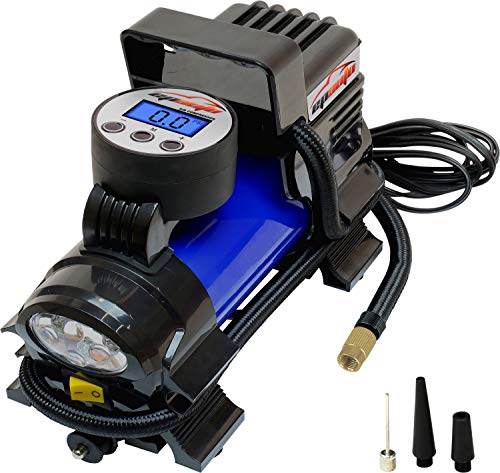
EPAuto 12V DC Portable Air Compressor Pump — Best Budget Tire Inflator
The EPAuto is the budget-tier answer to the VIAIR: a 12V DC digital tire inflator that covers the essential job — topping up car tires and handling the occasional soft-tire emergency — at a budget-tier cost. It will not match the 88P’s speed or build, and it is not meant to. It is meant to be the inflator that is cheap enough that every car in the household can carry one.
Strengths
- Budget-tier cost makes it easy to equip multiple vehicles
- Digital format takes the guesswork out of reaching the target pressure
- Compact enough for a glove box or a corner of the trunk
Trade-offs
- Slower than premium compressors, and large truck tires test its patience and duty cycle
- Budget-tier build quality throughout; treat it as occasional-use equipment
- Tires only — the same high-pressure limitation as every inflator in its family
The honest way to frame the EPAuto is as insurance. Most of its life will be spent sitting in the trunk, and on the one morning a tire is visibly low, it turns a tow-truck problem or a sketchy drive to the gas station into a ten-minute fix in your own driveway. Drivers who check pressures monthly and run larger vehicles should step up to the VIAIR; drivers who mainly want an emergency fallback are rationally served here.
Best for: budget-conscious drivers who want an emergency tire inflator in every car. / Not suited for: frequent use, large truck tires, or inflatables.
Check the current price on Amazon

AstroAI AIRUN H Tire Inflator — Best Tire Inflator With Auto Shut-Off
The AstroAI AIRUN H adds the two features that make a tire inflator pleasant rather than merely functional: auto shut-off at a set pressure, and a digital pressure gauge paired with an LED light. Set the target, attach the chuck, and the pump stops itself at the right pressure — which removes the crouch-and-squint routine of checking a dial every twenty seconds, and prevents the over-inflation that shortens tire life.
Strengths
- Auto shut-off with a digital gauge makes correct pressure a set-and-forget task
- LED light is genuinely useful for the night-time and early-morning inflations that emergencies prefer
- 12V DC power with a long cord (the listing notes a 9.8 ft cord) reaches all four corners of most cars
Trade-offs
- Mid-tier speed: fine for car and motorcycle tires, slower on large truck rubber
- Digital features add complexity a pure mechanical inflator does not have
- Tire-family tool only; not for mattresses or big inflatables
Key specs (from the manufacturer’s listing)
- Power: 12V DC
- Auto shut-off with digital pressure gauge and LED light
- For car, motorcycle, and bike tires
The AIRUN H is the pick for the driver who actually maintains pressures monthly rather than only in emergencies, because auto shut-off turns a chore into a two-minute habit. It is also the kindest inflator to lend: a family member who has never inflated a tire can set the number from the door-jamb sticker and let the pump do the thinking. That usability, more than raw speed, is what earns it a place beside the VIAIR.
Best for: regular pressure maintenance and drivers who value auto shut-off convenience. / Not suited for: heavy truck use or any inflatable bigger than a ball.
Check the current price on Amazon

AIRHEAD AHP-12H 12V Air Pump — Best for Boats and Towables
AIRHEAD builds watersports gear, and the AHP-12H is its corded 12 volt high-volume pump for the world of tubes, rafts, and towables. On the water, 12 volt power comes from the boat’s own system, and a pump that lives on board means tubes inflate at the sandbar instead of on the dock. The AHP-12H’s yellow-and-black housing is built to be found quickly in a gear locker and used with wet hands.
Strengths
- High-volume output sized for towable tubes and rafts, the biggest inflatables most people own
- From a watersports specialist, with fittings aimed at boat and tube valves
- Corded 12V power draws from the boat or tow vehicle — no batteries to manage
Trade-offs
- Volume pump, not a pressure pump: firming a high-pressure towable or SUP fully may need a second stage (see the towables guide linked below)
- Marine environments are hard on any electric pump; it needs dry storage between uses
- Not a tire tool in any sense
If your inflating happens around water, the AHP-12H is the natural citizen of that world in a way a mattress pump is not: the brand’s whole catalogue assumes Boston valves, big tubes, and boat batteries. We cover the pressure side of towables — and AIRHEAD’s own high-pressure models — in depth in our dedicated guide to the Best 12 Volt Air Pumps For Boat Towables.
Best for: boaters, towable tubes, rafts, and large water inflatables. / Not suited for: tires, or high-pressure inflatables used entirely on their own.
Check the current price on Amazon

BLACK+DECKER BDINF20C Tire Inflator — Best Dual-Purpose
The BDINF20C is the honest exception to the two-families rule: a single unit designed as both a tire inflator and an air pump for inflatables, with three power modes — a wall outlet, a 12V car adapter, and a cordless 20V MAX battery that is sold separately. For a household that wants one box in the garage that handles the car tires, the air mattress, and the pool floats, this is the design that actually attempts all three.
Strengths
- Two tools in one: high-pressure inflator mode plus a high-volume inflatables mode
- Three power options, including cordless operation for households already on the 20V MAX platform
- Wall-outlet power makes it a garage tool, not just a vehicle tool
Trade-offs
- The cordless battery is sold separately, so the true cost of the full setup is higher than the unit alone
- A dual-purpose tool is a compromise: a dedicated VIAIR inflates tires better, a dedicated Intex fills mattresses faster
- More modes mean more to learn and more to go wrong than a single-purpose pump
The BDINF20C makes the most sense for the one-car, one-garage household that inflates a bit of everything a few times a year and values consolidation over peak performance in any single job. If you already own BLACK+DECKER 20V MAX batteries, its case gets stronger still. If your needs are heavily weighted to one family — weekly tire checks on a truck, or a fleet of camping mattresses — buy the specialist instead.
Best for: households wanting one inflator for tires and inflatables, especially 20V MAX owners. / Not suited for: buyers who need best-in-class performance at a single job.
Check the current price on Amazon
A word on kits and bundles, since this category loves them. Several pumps here are sold as kits — the VIAIR 88P is explicitly a kit — and the kit format is worth preferring when the price gap is small, because the carry case is not a luxury: it is what keeps the pump, its hose, its chuck, and its nozzles in one place in a trunk that gets rearranged weekly. A pump whose parts scatter is a pump that fails on the day it is needed, one missing nozzle at a time. If you buy a bare pump, give it a home immediately — a small tote or zip bag that lives in the vehicle — and put every adapter it came with inside before the first trip.
Comparison Table
| Pick | Badge | Key spec | Best for |
|---|---|---|---|
| VIAIR 88P | Best Overall for Tires | Up to 120 PSI, tires up to 33 in | Serious tire inflation, trucks/RVs |
| Intex 66636 Quick-Fill | Best for Inflatables | 12V DC high-volume fan pump | Air mattresses, floats, camping |
| EPAuto 12V Inflator | Best Budget Tire Inflator | 12V DC digital inflator | Emergency top-ups on a budget |
| AstroAI AIRUN H | Best With Auto Shut-Off | Auto shut-off, digital gauge, LED | Monthly pressure maintenance |
| AIRHEAD AHP-12H | Best for Boats and Towables | 12V high-volume watersports pump | Tubes, rafts, boat inflatables |
| BLACK+DECKER BDINF20C | Best Dual-Purpose | AC / 12V / 20V MAX, two modes | One tool for tires and inflatables |
How to Choose the Right 12 Volt Air Pump
Decide the family first, using your most frequent job as the anchor. If the pump will mostly serve tires, buy a tire inflator and accept that mattresses are not its job. If it will mostly serve mattresses, floats, and tubes, buy a high-volume pump and accept that tires are not its job. The dual-purpose BLACK+DECKER is the exception for genuinely mixed, light-duty use. Buyers who do both jobs often and seriously should own one of each — together, a good inflator and a good volume pump cost less than the frustration of abusing one tool at both tasks.
Within the tire family, choose by vehicle. Car and motorcycle tires forgive almost any inflator. Truck, SUV, and RV tires — bigger volume, sometimes higher pressures — reward the VIAIR’s capability and punish budget inflators with long, hot runs. Auto shut-off is the feature that most improves daily life, because it converts inflation into a set-and-walk-away task and guarantees consistent pressures, which is where tire life and fuel economy are actually won.
Within the volume family, choose by valve and volume. Match the pump brand to your biggest inflatable’s brand when possible, for nozzle fit. Then match airflow to the largest item: a single twin mattress forgives a small pump; a four-person towable or a queen raised bed rewards the strongest airflow you can get, used in stages with cooling rests.
Check the power details before ordering, every time. Confirm the pump plugs into a 12 volt socket rather than requiring alligator clips to the battery (clips are fine, but know what you are getting), confirm the cord length reaches your rear tires or your boat’s stern, and confirm whether any battery shown in photos is included or sold separately. These three checks prevent most of the returns in this category.
Finally, think about where the pump will live. A pump stored in the vehicle helps you; a pump stored in a garage cupboard helps you only at home. Tire inflators especially earn their keep in the trunk, the boat locker, or the RV bay — buy with the storage spot in mind, and size the pump to fit it.
Pressure vs Volume: A Two-Minute Physics Refresher
Pressure, measured in PSI, is how hard the air pushes. Volume, measured in litres per minute or cubic feet per minute, is how much air moves. A car tire needs modest volume at real pressure — roughly car-tire pressures are dozens of PSI — because the tire casing resists expansion. An air mattress needs the opposite: a room-sized volume of air at barely more than atmospheric pressure; its valves are wide because the air should flow like water from a tap, not like a jet from a needle. Pump designers pick one end of this trade-off: a piston squeezing small puffs hard, or a fan sweeping large scoops gently. No clever marketing changes the physics, which is why this guide refuses to crown a single winner across both jobs — and why the most useful question in the whole category is not “which pump is best?” but “which job do I actually have?”
That question leads to a practical skill: reading a pump listing like an engineer instead of like a shopper. For a tire inflator, look past the maximum PSI — almost any inflator can eventually touch a big number into a tiny volume — and look for evidence of real work capacity: the vehicle and tire sizes the maker names, the cord length, and whether auto shut-off suggests a maker confident in its gauge. For a volume pump, look for airflow stated in litres per minute and for the items the maker names: a listing that says “air mattresses, kayaks, boats” is telling you the nozzle set and the motor were planned for big chambers, while a listing that only shows pool rings is telling you the opposite. In both families, the verified listing titles in this guide are worth reading word for word, because they are the manufacturer’s own claims — and where a claim is absent, as with pumps that state no airflow at all, treat the silence as information too. A maker who has a good number prints it.
How to Use a 12 Volt Air Pump Safely and Well
For tires: park on level ground, check the target pressure on the driver’s door-jamb sticker (not the number moulded on the tire, which is a maximum, not a recommendation), remove the valve cap, and attach the chuck firmly so air does not hiss past it. Run the pump with the engine on if your battery is old or you are doing all four tires. Check progress with the pump’s gauge or, better, a standalone gauge, and stop at the target — then re-check after a minute, because air settles. Work in the shade when you can; a tire inflated hot will read low the next cold morning, which is normal physics, not a leak.
For inflatables: choose the nozzle that seals best, inflate in stages on the largest items with short cooling rests for the pump, and stop at firm-with-a-little-give rather than drum-tight. Keep the pump’s intake clear of sand, grass, and bedding, all of which strangle airflow and cook motors. When deflating, let the pump do the work rather than kneeling on the mattress to force air out, which stresses seams.
For both families: never leave a running pump unattended, keep cords out of walkways and water, and let a hot pump cool before stowing it against fabric or plastic gear. A pump that smells hot is telling you to rest it — listen.
When a 12 Volt Pump Is the Wrong Purchase
Honesty about the category’s edges saves returns. If your inflating happens almost entirely at home — guest mattresses, pool floats in the backyard — an AC pump or an AC/DC model will serve you better than a pure 12V pump, because wall power is faster to reach and does not involve the car at all. If your tire work is heavy and frequent — a worksite truck, a trailer fleet, air tools — no 12 volt portable is the right tool; that is workshop compressor territory, and a portable will die young trying. If you inflate far from any vehicle — backcountry camps, walk-in beaches — a rechargeable or battery pump, or even a good double-action hand pump for smaller items, beats dragging a cord across a field. And if your only inflatable is a bicycle, a floor pump with a proper gauge is cheaper, quieter, and more accurate than anything in this guide. The 12 volt pump’s kingdom is the vehicle and its orbit: the driveway, the campsite beside the car, the boat, the RV. Inside that kingdom it is close to unbeatable; outside it, buy the tool that lives where the work is.
Common Buying Mistakes
The defining mistake of this category is buying across families: the tire inflator bought for mattresses, the mattress pump bought for tires. Both purchases end in returns or in a cooked motor. Read the family split at the top of this guide and buy inside your family.
The second mistake is trusting a headline PSI number as a quality score. For tires, what matters is how the inflator performs at real tire pressures on your vehicle’s tire size, and whether it can do four tires without a long rest. For inflatables, PSI is nearly irrelevant; airflow and nozzle fit decide everything.
The third mistake is ignoring cord and hose reach. A pump that cannot reach the rear tires from the socket, or the far chamber of a big towable, is a pump you will fight every time. Measure your worst case before ordering.
The fourth mistake is forgetting the battery question on dual-mode and rechargeable models. “Cordless” in a headline sometimes means the battery is a separate purchase. The BDINF20C is explicit that its 20V MAX battery is sold separately — other listings are less clear, so verify.
The fifth mistake is storing the pump where it cannot help you. An inflator in a garage drawer does nothing for a soft tire two towns away. Vehicle tools belong in vehicles.
Four Buyers, Four Right Answers
The commuter who just wants insurance. Your tires lose pressure slowly, your commute is long, and your real fear is the dashboard warning light on a rainy Monday. You do not need the fastest pump; you need a pump that is in the car and works. The EPAuto covers you at a budget-tier cost, and the AstroAI AIRUN H covers you more comfortably with auto shut-off. Either beats the expensive option of a tow or a ruined tire driven flat to the station.
The truck or RV owner. Your tires are bigger, your pressures are higher, and cheap inflators will surrender halfway through the second tire. Buy the VIAIR 88P first and skip the upgrade path entirely — in this category, buying the capable tool once is cheaper than buying the weak tool twice. Check your pressures before every long tow or trip, when the tires are cold, and the pump becomes part of the departure routine rather than an emergency measure.
The camper and float-trip household. Your air is mattresses, pads, river tubes, and the occasional kiddie pool. Skip the tire family entirely and buy volume: the Intex 66636 for car-based camping, or step to an AC/DC model if the same mattress hosts guests at home. Your pump’s worst enemy is sand in the intake, so store it in a bag and brush it off after beach days.
The boater. Your pump lives in a harsher world: humidity, spray, and big towables that take real volume. The AIRHEAD AHP-12H is built for that world, and our Best 12 Volt Air Pumps For Boat Towables guide goes deeper on the high-pressure second stage that firm towables and paddle boards need. Whatever you buy, rinse-season storage matters: bring the pump home for winter, dry, and it will greet you working in spring.
Final Recommendation
If your main job is tires, buy the VIAIR 88P and be done: it is the serious 12 volt compressor in this guide, and it will out-work and out-last the budget options. Check the current price on Amazon. If your main job is mattresses and inflatables, the Intex 66636 is the proven answer on the volume side. Check the current price on Amazon. Drivers who want auto shut-off convenience should take the AstroAI AIRUN H, budget buyers the EPAuto, boaters the AIRHEAD AHP-12H, and genuinely mixed households the BLACK+DECKER BDINF20C. Whatever you buy, buy it for the job you actually have — that single decision matters more than every spec in this guide combined. Round out your 12 volt kit with our guides to the Best 12 Volt Air Mattress Pump, the Best 12 Volt Air Pump For Inflatables, and the Best 12 Volt Appliances.
Plugs, Clips, Cords, and Gauges: The Hardware Details That Matter
Most 12 volt pumps connect one of two ways. The cigarette-lighter plug is the convenient default: every vehicle has the socket, connection takes two seconds, and the circuit is fused for accessories. Its limit is current — very powerful compressors can draw more than a socket circuit happily supplies. That is why the strongest vehicle compressors sometimes use alligator clips straight onto the battery terminals instead: clips deliver full current with no fuse bottleneck, at the cost of opening the hood and minding polarity. Neither system is better in the abstract; plugs suit inflators and volume pumps perfectly, while clips appear on heavy-duty compressors doing truck work. Know which your chosen pump uses, and if it is clips, confirm your battery terminals are accessible — some modern vehicles bury them under covers.
Cord and hose length decide whether a pump is a pleasure or a wrestling match. For a tire inflator, add up the distance from the socket to the farthest tire, then add slack for routing around the car; a pump that barely reaches forces you to move the car or stretch the cord across paintwork. AstroAI’s listing for the AIRUN H calls out its 9.8 ft cord for a reason — reach is a feature. For volume pumps, the hose matters less than the cord, because the inflatable usually comes to the pump; still, a boat pump that cannot reach from the boat’s socket to the stern swim platform will annoy you every single outing.
Gauges deserve a sceptical eye. The gauge on any pump in this class is a guide, not a laboratory instrument, and analogue dials on vibrating pumps are especially approximate. The workflow that produces correct pressures is simple: use the pump’s gauge or auto shut-off to get close, then verify with a decent standalone gauge — the pencil or digital type that lives in the same glove box. For inflatables there is no gauge worth trusting at all; your hand is the instrument. A mattress or tube is right when it feels firm with a little give, and no number on a blower pump changes that.
Care, Storage, and Getting Years Out of a Small Pump
These pumps fail from neglect more often than from work. The intake filter or vent is the first checkpoint: fan pumps inhale whatever is near the floor — sand at the beach, grass at the campsite, dust in the garage — and a clogged intake both slows inflation and overheats the motor. Brush the intake clean after dirty jobs and run the pump briefly with the nozzle off to clear it. Piston inflators suffer most from heat-cycling abuse: four big tires back to back with no rest, repeatedly, is how windings age early. Build rests into big jobs and the same pump lasts for years.
Storage rules are simple. Keep the pump dry — a boat locker pump should come home or live in a sealed box, because marine air corrodes contacts and switch gear. Coil cords loosely; tight wrapping around the housing cracks cable insulation at the entry point, which is the most common electrical failure in the category. Store nozzles and chucks with the pump, in the same bag or box, because a pump separated from its fittings is dead weight. And once or twice a year, actually run the thing: inflate something, confirm it works, check the plug contacts for corrosion. Emergency equipment that is tested on a calm Saturday does not surprise you on a wet Tuesday night.
One more habit separates long-lived pumps from short-lived ones: put the pump away cool. After a hard session, let it sit in open air for a few minutes before it goes into a closed trunk box or a plastic bin. Trapping a hot motor in an insulated space bakes it in its own heat, and the cumulative effect over a summer of camping trips is real.
Frequently Asked Questions
What is the difference between a 12 volt tire inflator and a 12 volt air pump for inflatables?
Design and physics. A tire inflator is a small piston compressor making high pressure at low volume, for tires. An inflatable pump is a fan blower making high volume at low pressure, for mattresses, floats, and tubes. Each is poor at the other’s job, so buy for your main task — or choose a dual-purpose model like the BLACK+DECKER BDINF20C for light mixed use.
Can a 12 volt air pump run off a wall outlet?
Some can. Dual-power models run on AC directly, and the BDINF20C in this guide offers wall outlet, 12V car, and battery modes. Pure 12V models need an AC-to-12V converter to work indoors. Check the verified listing title for the power options before assuming.
Will using a 12 volt pump drain my car battery?
A single tire top-up or mattress inflation takes minutes and is safe on a healthy battery. For long sessions — four large tires, several big inflatables — run the engine, especially if the battery is old. That removes any risk of a no-start afterwards.
How long can I run a 12 volt pump continuously?
It varies by model and job size. Small pumps heat up on big jobs, so work in stages: a few minutes of running, a short rest, then continue. If the housing gets very hot or the note of the motor changes, stop and let it cool — heat is what shortens these pumps’ lives.
Do I need auto shut-off on a tire inflator?
It is the most useful convenience feature in the family. You set the target pressure from the door-jamb sticker, and the pump stops there — no crouching by the gauge and no accidental over-inflation. Occasional users can live without it; anyone who checks pressures monthly will love it.
Can one pump really do both tires and air mattresses?
Yes, if it is designed for both, with a high-pressure mode and a high-volume mode — the BDINF20C is the verified example in this guide. Single-mode pumps cannot cross over usefully, no matter what the headline numbers suggest.


