Disclosure: airfryerkitchensupply.com is reader-supported. When you buy through links on our site, we may earn an affiliate commission at no extra cost to you.
Where to buy
Every pick in this guide to the best 12 volt air conditioner is sold on Amazon, and Amazon is the right place to buy in this category for one specific reason: 12V air conditioning is a young, fast-moving niche full of optimistic listings, and the verified listings below — checked through the Creators API on 2026-11-20 — state their real BTU ratings, power draws and installation type in the open, where you can compare them before money moves. Rooftop units are freight-sized purchases and portable units are battery-ecosystem purchases, so read the installation and power notes in each review before ordering, and use the links to check the current price on Amazon rather than trusting any number printed anywhere else, including in older reviews.
- Zero Breeze Mark 3 Portable Air Conditioner, 5280 BTU — Best Overall: Check the current price on Amazon
- Cybertake S2 Pro Portable Camping Air Conditioner, 5100 BTU — Best Vehicle-Power Flexibility: Check the current price on Amazon
- Zero Breeze Mark 2 Portable Air Conditioner, 2300 BTU — Best Compact for Tents: Check the current price on Amazon
- Aspligo 12V Rooftop RV Air Conditioner, 9000 BTU with Heat — Best Rooftop Value: Check the current price on Amazon
- Gidrox 10000 BTU 12V DC RV Air Conditioner with APP Remote — Best Rooftop Features: Check the current price on Amazon
- Dometic RTX 1000 Air Conditioner, 12V — Best Premium Brand: Check the current price on Amazon
The best 12 volt air conditioner is a product that should not exist by the old rules of air conditioning — a real compressor-driven cooler that runs from a vehicle’s 12V electrical system instead of mains power — and yet it does, because van life, overlanding, truck camping and off-grid cabins created a demand that evaporative coolers and fans could never satisfy. Let us be precise about what “real” means in the first hundred words: every pick in this guide is a vapour-compression air conditioner, the same refrigeration cycle as a household unit, sized and powered for 12V DC. None of them is a swamp cooler, a fan with an ice tray, or a “personal air cooler” USB gadget, and we excluded those categories deliberately, however loudly their listings use the words air conditioner.
The honest physics comes next, because 12V cooling is a game of budgets. A household window unit draws its power from an effectively limitless grid; a 12V unit draws from a battery bank that you must size, charge and protect. The portable picks here cool tents, cabs and small sleeping spaces with a few hundred watts; the rooftop picks cool whole van and RV interiors and draw proportionally more. Either way, the air conditioner is only half the purchase — the other half is the battery and charging system behind it, and this guide treats that system as part of the product, with a full section on power budgeting below.
The market splits cleanly into two families, and the six picks span both. Portable units (Zero Breeze, Cybertake) sit inside the space, exhaust through a hose, and move between vehicles, tents and rooms. Rooftop units (Aspligo, Gidrox, Dometic) mount permanently in a standard roof cutout, free up interior space, and cool larger volumes. Every model was verified through the Amazon Creators API on the airfryerkitchensupply.com install, so BTU figures, heating claims and power modes below come from the live listings. Choose your family first; the model choice inside it is the easy part.
In this guide
Quick Picks
Zero Breeze Mark 3 Portable Air Conditioner, 5280 BTU — Best Overall. The portable benchmark: 5280 BTU of real compressor cooling in a lightweight, battery-ready unit built for camping, RVs and trucks — the strongest all-round answer in 12V cooling. Check the current price on Amazon
Cybertake S2 Pro Portable Camping Air Conditioner, 5100 BTU — Best Vehicle-Power Flexibility. The power omnivore: 5100 BTU cooling plus heating, running on 48V DC, 12–24V vehicle power or ordinary wall power — the most flexible portable in the roundup. Check the current price on Amazon
Zero Breeze Mark 2 Portable Air Conditioner, 2300 BTU — Best Compact for Tents. The original tent air conditioner, refined: 2300 BTU of real cooling in the most compact, carry-friendly format here — sized for tents and personal sleeping spaces. Check the current price on Amazon
Aspligo 12V Rooftop RV Air Conditioner, 9000 BTU with Heat — Best Rooftop Value. Permanent cooling at a value position: a 9000 BTU 12V rooftop unit with heating, built for RVs, motorhomes, trucks and trailers — and for parking-AC duty with the engine off. Check the current price on Amazon
Gidrox 10000 BTU 12V DC RV Air Conditioner with APP Remote — Best Rooftop Features. The connected rooftop: 10000 BTU of 12V cooling with app remote control, low-consumption tuning and quiet operation for camper vans and trucks. Check the current price on Amazon
Dometic RTX 1000 Air Conditioner, 12V — Best Premium Brand. The legacy benchmark: Dometic’s 12V parking cooler with Eco mode and turbo cooling, built for campers, RVs, trucks and buses — the support network money can buy. Check the current price on Amazon
How These Picks Were Chosen
The first filter was refrigeration honesty: compressor-driven cooling with a stated BTU rating, verified in the listing. Evaporative coolers, thermoelectric gadgets and misting fans were excluded regardless of marketing language, because a buyer searching for a 12 volt air conditioner is searching for temperature drop, and only a compressor delivers it in humid weather, at altitude, and inside a sun-baked vehicle.
The second filter was genuine 12V operation: the unit must run from a 12V DC supply as a primary mode — directly, through its battery system, or through a vehicle power mode — rather than merely offering a car adapter as an accessory for a mains product. We then weighted cooling capacity against power draw (the efficiency ratio that decides battery life), installation burden, noise claims, and brand support, because a rooftop unit is a hole in your roof and a multi-year commitment, not a disposable gadget.
We also insisted on spread. A guide that recommended six rooftop units would fail tent campers; six portables would fail RV owners. The final six therefore include the strongest portable all-rounder, a vehicle-power specialist, a compact tent unit, two rooftop values at different capability points, and the premium brand benchmark — so that whichever 12V life you actually live, one review below is written for it.
The 6 Best 12 Volt Air Conditioners

Zero Breeze Mark 3 Portable Air Conditioner, 5280 BTU — Best Overall
The Mark 3 is where portable battery air conditioning grew up. Its 5280 BTU rating is roughly double the first generation of tent air conditioners, and that number changes the use case: this is no longer a unit that merely takes the edge off a tent, but one that can hold a small sleeping space, a truck cab or a camper interior at a genuinely comfortable temperature through a hot night. It suits campers, van travellers and truck drivers who need cooling that moves with them. It does not suit anyone expecting it to cool a house room like a mains window unit — the physics section of this guide explains why, and the house-specific companion guide handles that case separately.
Strengths
- 5280 BTU is the strongest portable cooling in this roundup, from a verified listing
- Battery-ready design integrates with its own battery system for cordless runtime
- Lightweight, movable format serves tent, RV, truck and small-room duties in one unit
Trade-offs
- Battery is part of a system purchase; full cordless runtime is an ecosystem cost, not a single box
- Like all portables, it needs its exhaust hose vented outside the cooled space to work properly
- Premium positioning within the portable class
| Cooling | 5280 BTU compressor |
| Format | Portable, battery-ready |
| Use | Camping, RV, truck, outdoor, small spaces |
The Mark 3’s real achievement is thermal headroom. Smaller portables run at their limit all night and lose ground whenever the night stays hot; a unit with capacity in reserve cycles, rests, and holds temperature — which is both more comfortable and, counterintuitively, often easier on total energy across a night. In a tent or a van sleeping area, the difference between “cooler than outside” and “actually cool” is the difference between a gadget and a good night’s sleep, and this is the portable that reliably delivers the second.
Ownership centres on the battery system. Run from a vehicle or a power station, the Mark 3 is straightforward; run cordless, its dedicated batteries define your runtime, and buyers should plan capacity for the hottest night, not the average one. Zero Breeze has iterated this product line longer than any rival in the portable class, and the maturity shows in the details — hose fittings, drainage handling and controls that assume real outdoor use rather than a trade-show booth.
Best for: campers, van travellers and truck drivers who want the strongest portable cooling available / Not suited for: buyers expecting mains-window-unit performance in a full-size room
Check the current price on Amazon
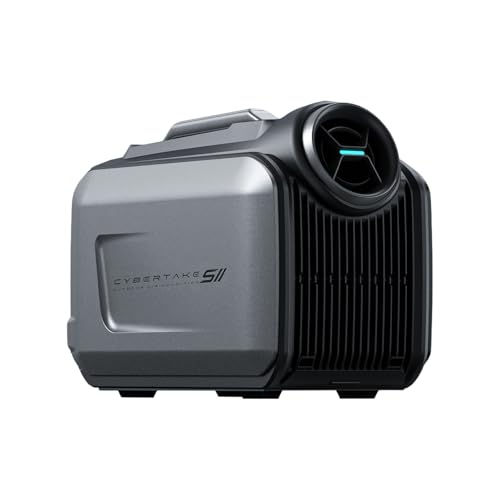
Cybertake S2 Pro Portable Camping Air Conditioner, 5100 BTU — Best Vehicle-Power Flexibility
The Cybertake S2 Pro makes a different bet from Zero Breeze: instead of an ecosystem, universality. Its three-way power — 48V DC, 12–24V vehicle supply, and 100–240V wall power — means the same unit cools a tent from the car at a festival, a cabin from a power station, and a spare room from the wall at home, and it heats as well as cools, with 6100 BTU of heating against 5100 BTU of cooling. It suits buyers whose cooling needs wander between vehicle and building. It is a newer brand than the incumbents, and buyers who weight decade-long parts support above flexibility should weigh that honestly.
Strengths
- Three-way power covers vehicle, DC system and wall outlet with one unit
- Heating as well as cooling makes it a four-season purchase
- Efficiency framing — up to 8 hours on 1 kWh in the listing — suits power-station owners
Trade-offs
- Newer brand: shorter support track record than Zero Breeze or Dometic
- Heating capacity is shoulder-season help, not a winter furnace replacement
- Portable format still needs exhaust venting discipline to perform
| Cooling / Heating | 5100 BTU / 6100 BTU |
| Power | 48V DC, 12–24V vehicle, 100–240V wall |
| Use | Tent, camping, RV |
Flexibility sounds like a spec-sheet virtue until you live the alternative: a battery-ecosystem portable is superb inside its ecosystem and awkward outside it. The S2 Pro’s vehicle mode is the headline for this keyword — plug into the 12–24V supply you already have, with no proprietary battery purchase standing between you and a cool night — and its wall mode quietly doubles its value at home, where it can serve as a spot cooler for a home office or a guest room between trips.
The heating mode deserves its honest framing: in a tent or small van, a few thousand BTU of heat transforms autumn camping, taking the space from raw to comfortable in the evening and morning. It will not heat a house or a large RV in deep winter, and Cybertake’s efficiency claims, like all such claims, assume favourable conditions. As an all-season, all-power-source portable, though, nothing else in this roundup covers as many lives with one purchase.
Best for: buyers who split time between vehicle trips and home use, across seasons / Not suited for: buyers who prioritise the longest-established brand support above flexibility
Check the current price on Amazon

Zero Breeze Mark 2 Portable Air Conditioner, 2300 BTU — Best Compact for Tents
The Mark 2 is the unit that created this category, and its 2300 BTU rating tells you its true job: personal-space cooling. In a two-person tent, a roof-top tent, a truck bed cap or a tiny sleeping berth, 2300 BTU of compressor cooling is transformative — it drops temperature and, just as importantly, strips humidity, which is what makes hot nights unbearable. It suits tent campers and minimalists whose cooled volume is genuinely small. It does not suit van conversions with real interior volume, where its output will run flat-out and still lose; those buyers need the Mark 3 or a rooftop unit.
Strengths
- Most compact and portable serious cooling in the roundup
- Real compressor refrigeration — dehumidifies as well as cools, unlike evaporative gadgets
- Mature, widely understood product with a deep accessory and battery ecosystem
Trade-offs
- 2300 BTU is honestly sized for tents and berths, not rooms or large vans
- Superseded in output by the Mark 3; buy it for size, not power
- Battery runtime planning is still on the owner
| Cooling | 2300 BTU compressor |
| Format | Compact portable |
| Use | Tents, roof-top tents, small berths, pet spaces |
Small cooling, correctly aimed, beats big cooling badly aimed — that is the Mark 2’s whole philosophy, and in its element it is vindicated nightly. A tent has almost no thermal mass and a tiny air volume; a modest compressor that exhausts properly and blows directly across the sleeping area produces a pool of cool, dry air exactly where bodies are. Owners who understand that — and who close the tent, shade it where possible, and start the unit before the interior heat-soaks — report the kind of sleep that changes camping from endurance to pleasure.
The failure mode is expectation, not engineering: put a Mark 2 in a big high-roof van in full sun and it will labour heroically and inadequately, because no 2300 BTU unit wins that fight. Read the badge literally — Best Compact for Tents — and it is one of the easiest recommendations in this guide. Read it as a general air conditioner and you will join the reviewers who bought the wrong tool for their volume.
Best for: tent and roof-top-tent campers cooling a genuinely small sleeping space / Not suited for: van conversions and rooms with real interior volume
Check the current price on Amazon

Aspligo 12V Rooftop RV Air Conditioner, 9000 BTU with Heat — Best Rooftop Value
The Aspligo represents the rooftop revolution in this category: a proper 9000 BTU air conditioner that runs on 12V DC, mounts in the roof, and cools (and heats) an RV, motorhome, truck cab or trailer without a generator or shore power. Its “parking AC” heritage — cooling a parked truck from its batteries — is exactly the use case spreading through the van and RV world. It suits owners ready for a permanent installation who want the capability without paying the premium-brand toll. It does not suit renters, tent campers or anyone unwilling to cut or use a roof opening.
Strengths
- 9000 BTU of rooftop cooling on pure 12V DC — no inverter or generator required
- Heating included extends it beyond summer duty
- Frees all interior space compared with portable units and their hoses
Trade-offs
- Permanent roof installation is a real project with sealing and wiring to match
- Draws serious current: demands a properly sized battery bank and cabling
- Value-brand support network is thinner than Dometic’s
| Cooling | 9000 BTU, 12V DC rooftop |
| Heating | Included |
| Fit | RV, motorhome, truck, trailer |
The case for rooftop 12V units starts with efficiency of the whole system. A portable inside the space fights its own exhaust and occupies the floor; a rooftop unit draws outside air across its condenser where it belongs, delivers cooled air from the ceiling where it falls naturally, and leaves every cubic inch of living space to the living. For vans and RVs that spend weeks off-grid, the Aspligo’s direct-DC design also skips the inverter losses that an AC-powered unit imposes on every watt-hour your solar harvests.
The installation and electrical demands are the honest price, and this guide will not minimise them: heavy-gauge cabling, correct fusing, a battery bank sized for hours of high draw, and a roof seal you would trust in a storm. Buyers comfortable with that project get a capability that simply did not exist at this positioning a few years ago. Buyers who are not should stay portable — the Mark 3 will make them happier than a half-finished roof install.
Best for: RV, van and truck owners ready for a permanent 12V rooftop installation / Not suited for: renters, tent campers and anyone avoiding roof work
Check the current price on Amazon

Gidrox 10000 BTU 12V DC RV Air Conditioner with APP Remote — Best Rooftop Features
Gidrox’s rooftop unit is the features-forward entry in the 12V rooftop class: 10000 BTU of cooling, battery-powered DC operation with low-consumption tuning, an app remote for control from the bed or the driver’s seat, and an explicit quiet-operation design brief. This cooling-only version suits camper vans and trucks in warm climates and owners who manage their rig from a phone. Buyers in mixed climates who want rooftop heating in the same hole should note this version is cooling only — the line includes a heater variant, and the plural-focused companion guide in this series covers it.
Strengths
- App remote control is a genuine daily convenience in a lived-in van
- Low-power-consumption tuning stretches a battery bank further per night
- 10000 BTU is the strongest rooftop cooling capacity in this roundup
Trade-offs
- This version is cooling only — no heating for shoulder seasons
- App-dependent features assume a phone-centric owner
- Newer brand in the rooftop space than the legacy RV names
| Cooling | 10000 BTU, 12V DC rooftop |
| Control | APP remote |
| Use | Camper van, truck, RV |
App control sounds like garnish until you have lived with a rooftop unit: the control panel is on the ceiling, you are in bed, and the temperature wants adjusting at 3 a.m. Gidrox’s app remote — plus the ability to pre-cool the van before returning from a hike — is the kind of feature that quietly becomes non-negotiable. Combined with the low-consumption tuning, which matters more to real battery life than headline BTU, this is the rooftop unit aimed most squarely at full-time van life rather than weekend duty.
The cooling-only specification is the deliberate trade. In the Sun Belt and for summer-focused travellers it is no trade at all — heating comes from the vehicle’s own systems or a separate heater — but four-season owners should choose a heat-equipped rooftop instead. Within its brief, the Gidrox is the most thoughtfully featured 12V rooftop here.
Best for: van lifers and camper owners who value app control and efficient, quiet cooling / Not suited for: four-season owners who need heating from the same roof unit
Check the current price on Amazon
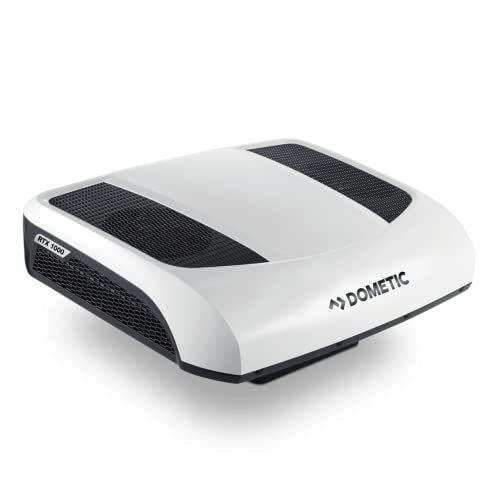
Dometic RTX 1000 Air Conditioner, 12V — Best Premium Brand
Dometic is the name the RV and trucking industries have trusted for mobile cooling for decades, and the RTX 1000 is its 12V rooftop parking cooler: an efficient unit with an Eco mode for stretching battery life, a turbo cooling mode for pulling a heat-soaked cab down quickly, and a design brief centred on long parked runtime — the listing speaks to up to 12 hours of running time in favourable configurations. It suits truck drivers, fleets and RV owners for whom dealer support and proven engineering outrank spec-sheet maximalism. It does not chase the highest BTU number here, and buyers cooling large interiors in extreme heat should compare capacities carefully.
Strengths
- Dometic dealer and parts support — the deepest in mobile cooling
- Eco and turbo modes map intelligently onto real parked-cooling life
- Engineering maturity from the truck parking-cooler world, where failure is not an option
Trade-offs
- Premium positioning is the highest in this roundup
- Capacity is tuned for cabs and moderate spaces rather than maximum BTU bragging
- Full performance still depends on a properly sized battery installation
| Format | 12V rooftop parking air conditioner |
| Modes | Eco mode, turbo cooling |
| Use | Camper, RV, truck, bus |
The RTX line earned its reputation in the hardest school in this category: commercial truck cabs, where a driver’s legal rest depends on the cooler and the truck’s batteries must still start the engine in the morning. That heritage shows in the RTX 1000’s priorities — battery protection thinking, an eco mode that treats watt-hours as the precious resource they are, and build quality aimed at vibration, weather and years. For an owner cutting a hole in a roof they intend to keep for a decade, that provenance is a rational thing to pay for.
Set against the value rooftops, the Dometic counters raw capacity with refinement and support; set against the portables, it offers permanence and silence inside the space. It is the pick for the buyer who asks not “what is the biggest number?” but “what will still be working, and serviceable, in year seven?” — a question this category’s newer brands cannot yet answer as convincingly.
Best for: truck, RV and camper owners who prioritise proven engineering and support / Not suited for: buyers maximising BTU per dollar regardless of brand depth
Check the current price on Amazon
Comparison Table
| Pick | Badge | Key spec | Best for |
|---|---|---|---|
| Zero Breeze Mark 3 Portable Air Conditioner, 5280 BTU | Best Overall | 5280 BTU compressor cooling, battery-ready portable, for camping, RV, truck | Most buyers: the strongest portable 12V-class cooling in a movable unit |
| Cybertake S2 Pro Portable Camping Air Conditioner, 5100 BTU | Best Vehicle-Power Flexibility | 5100 BTU cooling / 6100 BTU heating, 3-way power: 48V DC, 12-24V vehicle, 100-240V wall | Buyers who want one unit for vehicle, campsite and home wall power |
| Zero Breeze Mark 2 Portable Air Conditioner, 2300 BTU | Best Compact for Tents | 2300 BTU compressor cooling, compact portable format | Tent campers and small sleeping spaces where size and weight rule |
| Aspligo 12V Rooftop RV Air Conditioner, 9000 BTU with Heat | Best Rooftop Value | 9000 BTU 12V DC rooftop, with heat, for RV, motorhome, truck, trailer | RV and van owners wanting permanent rooftop cooling without a premium badge price |
| Gidrox 10000 BTU 12V DC RV Air Conditioner with APP Remote | Best Rooftop Features | 10000 BTU 12V DC rooftop, battery powered, low consumption, app remote, cooling only | Van and camper owners who want app control and quiet, efficient rooftop cooling |
| Dometic RTX 1000 Air Conditioner, 12V | Best Premium Brand | 12V rooftop parking cooler, Eco mode, turbo cooling, up to 12 hours running time claim | Truck and RV owners who buy brand, support and proven parking-cooler engineering |
How to Choose a 12 Volt Air Conditioner
Start with volume, because volume decides everything. Measure the space you actually sleep in — not the whole vehicle if doors close off a berth — and be honest about sun exposure. A shaded tent, a white van and a black truck cab in Arizona are three different planets wearing the same square footage. As a working frame: a few thousand BTU serves tents and berths; the 5000 BTU class serves small van sleeping areas; 9000–10000 BTU rooftops serve full van and small RV interiors. Oversizing wastes battery; undersizing wastes the whole purchase, because an undersized unit runs at maximum forever and still loses.
Portable or rooftop?
Portables win on flexibility: no installation, multiple vehicles, home use between trips, and easy resale. Rooftops win on performance per watt, interior space, noise placement and security — nothing to steal, nothing to trip over, nothing exhausting through a cracked window. The dividing line is commitment: if the vehicle is a dedicated camper you will keep for years, rooftop economics and comfort win; if cooling must move between a car, a tent and a spare room, portable is the only sane answer.
Efficiency is battery life
In 12V cooling, the spec that rules your life is watts per hour of comfortable sleep, not headline BTU. Two units with the same cooling capacity can differ meaningfully in draw, and across an eight-hour night that difference is the size of a battery. Read listings for power consumption in their efficient modes, favour units with eco or variable-speed behaviour over single-speed designs, and treat any runtime claim as a best case to be discounted, not a promise to be planned on.
The Power Budget: Sizing Batteries and Charging for 12V Cooling
Here is the arithmetic every 12V air conditioner owner must do once, honestly, before buying. Take the unit’s typical running draw in watts, multiply by the hours you want to run it, and that is the energy you must store — then remember that a battery bank should not be drained to empty, so usable capacity is a fraction of nameplate capacity, especially for lead-acid. A portable drawing a few hundred watts across a night needs a power station or auxiliary battery in the serious hundreds of watt-hours at minimum; a rooftop unit drawing several times that needs a proper lithium house bank, and the charging — alternator, solar or shore — to refill it daily.
Three rules keep systems healthy. First, protect the starting battery: vehicle-integrated units and smart controllers that cut off before the starter battery is endangered exist for a reason, and a cool night is not worth a dead truck in the morning. Second, cable for the current: 12V systems move large amperages, and undersized wiring wastes energy as heat and starves the unit. Third, plan the refill before the spend — solar that replaces only half of a night’s cooling is a countdown to a hot third night, not a system. The owners who love 12V cooling did this maths; the owners who review-bomb it mostly did not.
A worked example makes the arithmetic concrete without naming prices. Suppose a portable unit averages a few hundred watts across a night of cycling — compressors cycle, so average draw sits well below peak draw on any night that is not extreme. Eight hours at that average is a few thousand watt-hours at most, and in mild weather far less. A mid-size lithium power station covers a mild night; a hot night wants either a bigger station, a vehicle house battery, or the discipline of pre-cooling and eco mode. Rooftop owners should run the same sum with their unit’s higher draw and will land, correctly, on a house bank measured in kilowatt-hours and a charging plan to match. The numbers are not frightening once written down — they are only frightening when discovered at midnight.
How to Set Up a 12V Air Conditioner for a Full Night’s Cooling
Setup decides whether the same unit feels miraculous or mediocre, so treat the first night as a system test rather than a verdict.
- Vent the exhaust properly: a portable with its hose kinked, crushed or venting into the same space is cooling with one hand tied behind its back.
- Pre-cool before bed: start the unit while the space is still being loaded or cooked in, so it fights the heat-soak early instead of at midnight.
- Close and shade: curtains, reflective window covers and a closed door to uncooled space multiply any unit’s effective capacity for free.
- Aim airflow at the sleepers, not the ceiling: in small spaces, a directed stream of cool, dry air across the bed outperforms raw temperature numbers.
- Manage condensate: know where your unit’s water goes before the first humid night teaches you at 2 a.m.
For rooftop installations, add two disciplines: commission the unit in daylight with a full battery and watch a complete cycle, and re-check the roof seal after the first serious rain. Both take an hour; both are cheaper than learning the same lessons on the road.
Noise, Vibration and Sleeping Next to a Compressor
Every unit in this guide contains a compressor and fans, and every one of them makes sound; the question is what kind and where it sits relative to your pillow. Portable units put the machinery inside the space with you, which is why their designers chase low-speed night modes — and why placement matters: a portable at the foot of the bed, on a mat rather than a hard floor, exhausting cleanly, is a murmur; the same unit on bare plywood beside your head is a roommate. Rooftop units move the compressor outside the living envelope, which is their quietest advantage, but they couple vibration into the roof structure, so mounting quality — correct torque, intact gaskets, no loose panels — decides whether you hear a hum or a buzz.
Light sleepers should weight this section heavily and raw BTU lightly. A slightly less powerful unit you can sleep beside beats a powerhouse that keeps you awake enjoying its specifications. In practice: favour units with genuine low-speed or sleep modes, test any new unit for a nap before committing to a two-week trip, and remember that a unit sized generously for the space can loaf at low speed, while an undersized unit screams at maximum all night. Oversizing modestly is, among its other virtues, a noise strategy.
Maintaining a 12V Air Conditioner Across Seasons
These units live harder lives than household air conditioners — vibration, dust, road grit, storage in cold garages — and a small maintenance rhythm keeps them honest. Monthly in season: clean or rinse the intake filters, since a clogged filter is the silent thief of both cooling and efficiency; check that condensate drains run free; and run the unit even on mild weeks, because compressors and seals prefer exercise to idleness. Seasonally: inspect portable hoses and seals for cracks, check rooftop seals and mounting hardware, and clean the outdoor-side coils of dust and cottonwood fluff with soft air or a gentle brush.
Storage is where batteries and units part company in care. The unit itself wants a dry, covered rest; the battery system wants the lithium routine described in the power section — neither flat nor forgotten, refreshed periodically, and kept from deep cold where possible. Do those unglamorous things and a 12V air conditioner is a five-to-ten-year appliance. Skip them and the same unit becomes a two-season disappointment. The difference is rarely the brand; it is almost always the owner.
Common Buying Mistakes
Mistake 1: Buying an evaporative cooler and expecting air conditioning. Swamp coolers add humidity and fail precisely when the weather is humid. If the listing has no compressor and no real BTU rating, it is not the product this guide is about.
Mistake 2: Sizing by vehicle size instead of sleeping-space size. Cool the berth, not the bus. Closing off the sleeping area lets a smaller, thriftier unit win — and saves the battery for more nights.
Mistake 3: Ignoring the battery bank in the budget. The air conditioner is half the system. A unit bought without the storage and charging to feed it is a very expensive fan with a compressor it cannot run.
Mistake 4: Planning on the manufacturer’s best-case runtime. Runtime claims assume mild nights and full, healthy batteries. Plan on a healthy discount from any headline figure and you will sleep cool; plan on the headline and you will wake up warm.
Mistake 5: Letting a portable’s exhaust heat the room it cools. Exhaust air must leave the cooled envelope. A hose dangling inside the tent is a heater competing with your air conditioner.
Final Recommendation
Most buyers should start with the Zero Breeze Mark 3: it is the strongest portable expression of 12V cooling, movable across every vehicle and tent you own, and backed by the most mature product line in its class. Buyers on a tighter budget who are cooling a tent rather than a van should not feel they are settling with the Mark 2 — in a small tent the smaller unit is not the lesser tool, merely the correctly sized one, and the money saved buys battery capacity, which this category rewards more than raw cooling output. If your cooling life splits between vehicle and home, the Cybertake S2 Pro’s three-way power and heating make it the flexible alternative; if your space is a tent and your pack weight matters, the Mark 2 remains the compact answer. Owners ready to commit to a roof should choose between the Aspligo’s value and heat, the Gidrox’s app-driven efficiency, and the Dometic RTX 1000’s proven, supported engineering.
Whichever pick earns your money, spend equal thought on the battery system behind it and the setup discipline in front of it. 12V air conditioning rewards planners with something close to magic — a genuinely cool, dry sleeping space anywhere a vehicle can park — and punishes impulse buyers with warm nights and flat batteries. Plan like the first group and this category will feel like the future arriving early.
- Zero Breeze Mark 3 Portable Air Conditioner, 5280 BTU — Best Overall: Check the current price on Amazon
- Cybertake S2 Pro Portable Camping Air Conditioner, 5100 BTU — Best Vehicle-Power Flexibility: Check the current price on Amazon
- Zero Breeze Mark 2 Portable Air Conditioner, 2300 BTU — Best Compact for Tents: Check the current price on Amazon
- Aspligo 12V Rooftop RV Air Conditioner, 9000 BTU with Heat — Best Rooftop Value: Check the current price on Amazon
- Gidrox 10000 BTU 12V DC RV Air Conditioner with APP Remote — Best Rooftop Features: Check the current price on Amazon
- Dometic RTX 1000 Air Conditioner, 12V — Best Premium Brand: Check the current price on Amazon
Keep exploring the same cluster: Best 12 Volt Air Conditioner For House Best 12 Volt Air Conditioner For Sprinter Best 12 Volt Air Conditioners Best 12 Volt Air Compressor With Battery Operated
Frequently Asked Questions
Can a 12 volt air conditioner really cool, or is it just a fan?
The units in this guide really cool: they are compressor-driven refrigerators for air, with verified BTU ratings. What they cannot do is match a mains window unit’s capacity — they are sized for tents, cabs, berths and van interiors, and inside those volumes the cooling and dehumidification are unmistakably real.
How long will a 12V air conditioner run on battery?
It depends entirely on the unit’s draw and your bank’s usable capacity — from a few hours for a portable on a modest power station to a full night or more for an efficient unit on a proper lithium house bank. Do the watt-hour arithmetic in our power budget section before buying.
Will a 12V air conditioner drain my starting battery?
It can, if wired naively and run without protection. Sensible installations use a house battery or a controller with low-voltage cut-off so the starter battery is never the cooling budget. Protect the start, always. This is doubly true for cars and trucks that sit for days between uses: a small parasitic draw that a daily driver never notices becomes a no-start on a vehicle that was parked at an airport for a week, so long-parking owners should disconnect or switch off the cooling circuit entirely between trips.
Is a rooftop or portable 12V air conditioner better?
Rooftop is better for a dedicated camper kept for years: more efficient, quieter inside, and no floor space lost. Portable is better for everyone else: multiple vehicles, tents, renters and home use between trips.
Do 12V air conditioners also dehumidify?
Yes. Compressor cooling inherently condenses moisture from the air, and in humid climates that drying effect is often as valuable as the temperature drop for sleep quality. It is also the sharpest line between a real 12V air conditioner and an evaporative cooler: the evaporative gadget adds moisture to the air and stops working when the air is already wet, while the compressor unit removes moisture and works hardest exactly when the night feels worst. If your summers are humid, that single distinction should decide your purchase.
How is a 12V unit different from running a normal portable AC on an inverter?
An inverter route works, but pays a conversion tax on every watt — the inverter itself consumes power turning DC into AC, and household portables are neither sized nor built for vehicle vibration and space. A native 12V unit skips the conversion, integrates with battery protection, and is designed for the volumes vehicles actually contain. For a permanent vehicle installation, native DC is the efficient answer; the inverter route makes sense mainly for occasional use of a unit you already own.


