Disclosure: airfryerkitchensupply.com is reader-supported. When you buy through links on our site, we may earn an affiliate commission at no extra cost to you.
Where to buy
Every pick in this guide to the best 12 volt 7ah battery options is sold on Amazon, and that is where we recommend buying, because the 7Ah size is a fitment minefield disguised as a commodity: the same nominal capacity appears in two case heights, with two terminal widths, and in listings that blur 7Ah and 7.2Ah. Confirm the dimensions and terminal style on the listing against the battery you are replacing before ordering. All six picks were verified against Amazon’s catalog through the Creators API on 2026-11-20, and each is a genuine 12V 7Ah-class sealed lead acid battery from a recognisable maker.
- ExpertPower EXP1270 12V 7Ah SLA Battery F1 — Best Overall: Check the current price on Amazon
- Casil CA1270 12V 7Ah SLA AGM Battery F1 — Best for Alarm and Security: Check the current price on Amazon
- Mighty Max Battery ML7-12 12V 7.2Ah SLA F1 Battery — Best Value Single: Check the current price on Amazon
- Energizer EN7-12 12V 7Ah SLA AGM Battery — Best Recognised Brand: Check the current price on Amazon
- Miady 12V 7Ah Rechargeable Sealed Lead Acid Battery 2-Pack — Best Two-Pack for Paired Devices: Check the current price on Amazon
- SEFEPODER 12V 7Ah Rechargeable Sealed Lead Acid Battery 2-Pack F1 — Best F1 Two-Pack Alternative: Check the current price on Amazon
The best 12 volt 7ah battery is the one that matches your device, because this size is the universal donor of the small standby world. The same basic block, about 151 millimetres long, 65 wide and 94 to 100 tall, powers UPS units, alarm panels, ride-on toys, deer feeders, fish finders, emergency lights and mobility aids, and it does all of those jobs with no maintenance and no drama when it is healthy. When it is not, the symptoms are oddly diverse, a UPS that beeps and dies in minutes, a ride-on toy that fades halfway across the garden, a feeder that misses its morning cycle, and the cure in every case is the battery in this guide.
Two honest complications shape the shortlist. The first is that the industry sells this case as both 7Ah and 7.2Ah depending on the discharge rate used for the rating, so a battery labelled 7.2Ah is not meaningfully bigger than one labelled 7Ah; they are the same physical class and interchangeable where the case matches. The second is terminal width: F1 and F2 spades both appear in this size, and while ride-on toys and UPS harnesses vary, alarm and feeder equipment has its own habits. Every pick below names its terminal where the listing states it, and the buying guide shows you how to check yours in thirty seconds.
Within those constraints, the differences that remain are the ones worth paying for: construction consistency, honest labelling, pack formats that suit multi-battery devices, and brands with enough volume in this size that next year’s replacement will be the same battery again. The six picks cover the single replacement, the alarm-focused swap, the recognised consumer brand, and the two-packs that ride-on toys and paired-battery devices genuinely need.
Key Takeaways
- 7Ah and 7.2Ah labels describe the same physical battery class; shop by case dimensions and terminal width, not by the decimal.
- F1 and F2 terminals both live in this size and they are not interchangeable without adapters you should avoid.
- Two-battery devices always get both batteries replaced together, which is why matched two-packs are a technical product, not a bulk gimmick.
- Standardising on one reference model across your devices turns every future replacement into a simple reorder.
In this guide
Quick Picks
ExpertPower EXP1270 12V 7Ah SLA Battery F1 — Best Overall. One listing that names alarm, UPS and ride-on service in a single breath, with the F1 terminals most of those devices expect, from a brand built on this size class. Check the current price on Amazon
Casil CA1270 12V 7Ah SLA AGM Battery F1 — Best for Alarm and Security. The most completely cross-referenced listing in this guide: UB1270, NP7-12 and PS-1270 replacements named outright, with the F1 terminal width spelled out to the thousandth. Check the current price on Amazon
Mighty Max Battery ML7-12 12V 7.2Ah SLA F1 Battery — Best Value Single. The value anchor of the 7Ah class: standard case, F1 terminal, and a 7.2Ah label that reflects rating convention rather than a different battery. Check the current price on Amazon
Energizer EN7-12 12V 7Ah SLA AGM Battery — Best Recognised Brand. A household-name battery whose listing does something rare: it names the actual devices it replaces, from Razor scooters to specific APC and CyberPower UPS models. Check the current price on Amazon
Miady 12V 7Ah Rechargeable Sealed Lead Acid Battery 2-Pack — Best Two-Pack for Paired Devices. Two matched batteries for the large class of devices, ride-on toys above all, that run a pair in series or parallel and should always have both replaced together. Check the current price on Amazon
SEFEPODER 12V 7Ah Rechargeable Sealed Lead Acid Battery 2-Pack F1 — Best F1 Two-Pack Alternative. A second verified two-pack option, this one stating F1 terminals in the title, for buyers whose paired device or two separate devices both take the common terminal. Check the current price on Amazon
How These Picks Were Chosen
Verification ran through the Creators API on 2026-11-20: listings had to confirm 12V, 7Ah-class capacity and sealed lead acid construction, and ASINs were recorded from API responses. Listings that hid the terminal style entirely, blurred the capacity, or belonged to no identifiable maker were cut, however attractive their presentation.
Surviving batteries were weighed on terminal correctness for the common use cases, case dimensions against the standard footprint, brand depth in this exact size, and pack format. Multi-packs were included deliberately rather than as filler, because a large share of 7Ah devices, ride-on toys above all, take two batteries wired together, and replacing one of a pair is poor practice. No prices or fixed ratings are printed in this guide; both change constantly, so judge value on the day via the check-price links.
Pack formats were treated as a first-class selection criterion in this guide rather than as merchandising. The reason is the device census: ride-on toys, a defining application of this size, overwhelmingly use paired batteries, and a shortlist of six singles would have failed the size’s largest user group. Two of the six picks are therefore pairs, chosen from different makers so that availability, terminal preference or brand trust can steer the choice without ever steering it toward the single-battery mistake.
The 6 Best 12 Volt 7Ah Batteries
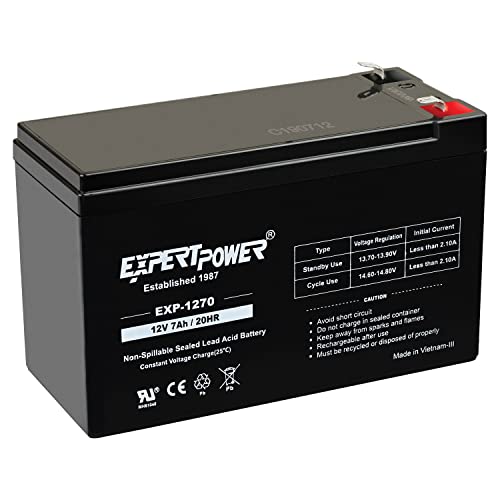
ExpertPower EXP1270 12V 7Ah SLA Battery F1 — Best Overall
The EXP1270 is the default answer when a 7Ah battery comes out of almost anything. Its listing explicitly spans ADT alarm replacement, UPS backup and ride-on toys, which between them account for most of the 7Ah fleet, and its F1 terminals match the majority of harnesses. It suits the owner who wants one known-good reference battery for the house’s assorted standby devices. If your device takes F2 terminals or a paired set, the picks below cover those cases more precisely.
Strengths
- Listing spans alarm, UPS and ride-on applications explicitly
- F1 terminals match most standby harnesses in this size
- Reference model for the 7Ah class from a high-volume SLA brand
Trade-offs
- Single battery, so paired devices need two or a two-pack
- Utility presentation rather than retail packaging
- Check case height variant against taller UPS compartments
| Voltage | 12V |
| Capacity | 7Ah |
| Chemistry | Sealed lead acid |
| Terminals | F1 |
| Applications | Alarm, UPS, ride-on toys (per listing) |
Reference products earn their status by being boring in the right ways, and the EXP1270 is the 7Ah class’s reference: standard case, standard terminals, a listing that tells you exactly which jobs it is for, and volumes large enough that consistency is a business necessity for its maker. In a size where anonymous listings routinely blur capacity and terminals, that clarity is a functional feature, because the cost of a wrong 7Ah battery is never the battery; it is the second week of a dead UPS or a disappointed child while the return ships.
Fit it, date it, and note the device it serves. Owners with several 7Ah devices do well to standardise on this model across them, which turns future replacements into a single reorder and makes a shelf spare genuinely universal.
Best for: The widest range of 7Ah replacements: alarm, UPS, ride-on and standby / Not suited for: devices wired for F2 terminals
Check the current price on Amazon

Casil CA1270 12V 7Ah SLA AGM Battery F1 — Best for Alarm and Security
Buy the CA1270 when the battery leaving your alarm panel, access control box or security device carries one of the classic part numbers, UB1270 above all, and you want the manufacturer to confirm the match rather than infer it yourself. Casil prints the cross-references and the exact F1 terminal width in the listing, which removes the two commonest ordering errors in one stroke. General users are equally well served, but alarm and security owners get the most from this pick’s precision.
Strengths
- Names UB1270, NP7-12 and PS-1270 cross-references in the listing
- States F1 terminal width numerically, removing terminal guesswork
- VRLA AGM construction, maintenance-free in panel service
Trade-offs
- Alarm-focused presentation gives less ride-on and toy detail
- Single-battery format only
- Specialist brand is less familiar to general buyers
| Voltage | 12V |
| Capacity | 7Ah |
| Chemistry | SLA AGM, VRLA |
| Terminals | F1, 0.187 in (per listing) |
| Cross-references | UB1270, UB1270R, NP7-12, PS-1270 F1 (per listing) |
Cross-reference quality is an underrated virtue in standby batteries because the industry’s part-number thicket is where purchases go wrong. A UB1270 pulled from a panel might be replaced by any of a dozen listings claiming compatibility, but Casil’s approach, printing the replaced models and the terminal dimension in the title itself, is the listing equivalent of a firm handshake. For a component buried in a cabinet for four years, that certainty at purchase time is worth more than marginal specification differences.
The CA1270 also illustrates the right way to shop this whole category: match the part number, match the terminal, match the case, and only then compare brands. Follow that order and the 7Ah replacement becomes the ten-minute job it should be.
Best for: Alarm panels and security devices cross-referenced to UB1270 or PS-1270 / Not suited for: buyers who need a factory multi-pack
Check the current price on Amazon
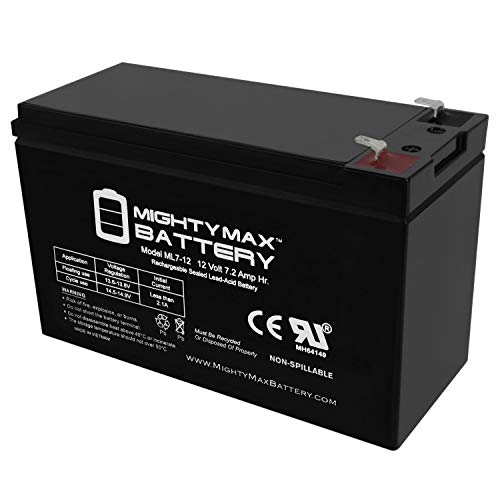
Mighty Max Battery ML7-12 12V 7.2Ah SLA F1 Battery — Best Value Single
The ML7-12 suits the owner maintaining several standby devices on a budget, or facing a routine replacement where the device matters more than the battery’s badge. Its 7.2Ah rating deserves a word of reassurance: at the discharge rates used for these labels, 7 and 7.2Ah describe the same physical battery class, and the ML7-12 is interchangeable with 7Ah units where case and terminals match. It is not the pick for buyers who want the deepest cross-reference documentation; it is the pick for buyers who want the standard job done economically.
Strengths
- Standard case and F1 terminal cover the mainstream fitments
- 7.2Ah rating is the same physical class as 7Ah listings
- Value positioning suits multi-device households
Trade-offs
- Documentation is thinner than the alarm-specialist picks
- Plan on the standard rather than extended replacement interval
- Single pack, so paired devices need two units ordered
| Voltage | 12V |
| Capacity | 7.2Ah |
| Chemistry | SLA |
| Terminals | F1 |
| Format | Pack of 1 |
Mighty Max’s position in this market is the dependable commodity, and the ML7-12 is a fair representative: the fundamentals are correct, the dimensions are published, and the price positioning, which you will check on the day, reflects a brand that competes on volume in exactly this size. For the many 7Ah replacements that are pure routine, a garage UPS, a feeder, a seldom-used emergency light, that is a rational allocation of money.
The ownership note is the same as for all value SLA: date it and replace on schedule rather than on failure. A value battery replaced on time outperforms a premium battery left in service two years too long, every single time.
Best for: Cost-conscious single replacements across UPS, alarm and general standby / Not suited for: documented commercial systems needing deep cross-reference data
Check the current price on Amazon

Energizer EN7-12 12V 7Ah SLA AGM Battery — Best Recognised Brand
The EN7-12 suits the buyer whose device appears in its own listing, which is a longer and more useful list than most: Razor ride-on scooters, APC Smart UPS units, a Solex alarm application, a Trophy deer feeder and a named CyberPower model. If your device is on that list, the fitment question is answered by the manufacturer, and the familiar brand handles the trust question. Buyers with unlisted devices should confirm dimensions and terminals in the usual way.
Strengths
- Listing names specific scooters, UPS models, alarm and feeder applications
- Recognised consumer battery brand
- AGM sealed construction for maintenance-free service
Trade-offs
- Device list, while useful, does not cover every 7Ah application
- Brand familiarity is the premium here, not different chemistry
- Confirm terminal style for unlisted devices before ordering
| Voltage | 12V |
| Capacity | 7 amp hour |
| Chemistry | Sealed lead acid AGM |
| Model | EN7-12 |
| Named fits | Razor scooter/E90, APC Smart UPS, Solex alarm, Trophy feeder, CyberPower CP600LCD (per listing) |
Device-specific listings deserve credit because they transfer the fitment risk from buyer to manufacturer. Most 7Ah listings speak in generic application words; Energizer’s names products, which means a Razor owner or a CyberPower owner can order with a confidence that generic listings cannot offer. Combined with a global brand’s distribution freshness, which matters for a chemistry that ages on the shelf, the EN7-12 is the low-anxiety pick of this guide.
If your device is not named, treat this as a standard 7Ah AGM and do the standard checks: case dimensions, terminal width, polarity orientation. The brand earns consideration, but the tape measure still has the final word.
Best for: Ride-on scooters, named UPS models and feeders listed by the manufacturer / Not suited for: devices not covered by standard 7Ah fitment checks
Check the current price on Amazon

Miady 12V 7Ah Rechargeable Sealed Lead Acid Battery 2-Pack — Best Two-Pack for Paired Devices
The Miady two-pack exists for a specific and very common machine layout: the ride-on toy, mobility device or UPS that holds two 7Ah batteries and depends on both. Replacing only the weaker of a pair leaves the new battery dragged down by the old one, a false economy every experienced owner learns once. This pack replaces both together, matched in age and batch. Single-battery device owners can treat the second unit as a spare, with the storage discipline described in our 5Ah guide: cool storage and periodic top-ups.
Strengths
- Matched pair suits two-battery devices correctly
- Replaces both batteries together, avoiding old-plus-new mismatch
- Second battery doubles as a spare for single-battery homes
Trade-offs
- Paired replacement costs more today than the single battery you think you need
- A stored spare still ages and needs periodic charging
- Check your device’s wiring arrangement before assuming a pair fits
| Voltage | 12V per battery |
| Capacity | 7Ah per battery |
| Chemistry | Rechargeable sealed lead acid |
| Pack | 2 batteries |
| Primary use | Paired-battery devices, ride-on toys |
The paired-battery rule is absolute enough to state flatly: in a two-battery device, replace both, always. Series pairs are limited by the weaker battery, parallel pairs share load unevenly with a weak partner, and in both arrangements the new battery’s life is shortened by the old one’s company. A two-pack is therefore not a bulk discount gimmick but the technically correct product for a large share of this size class, and Miady’s pack serves it in the standard format.
Before ordering, open the device and confirm it really holds two of this case size, and photograph the wiring, because series and parallel arrangements look similar at a glance and must be replicated exactly. Replace both batteries, reconnect as photographed, and the device returns to its original runtime rather than half of it.
Best for: Ride-on toys and devices wired for two 7Ah batteries / Not suited for: single-battery devices whose owners will neglect the spare
Check the current price on Amazon

SEFEPODER 12V 7Ah Rechargeable Sealed Lead Acid Battery 2-Pack F1 — Best F1 Two-Pack Alternative
The SEFEPODER pack suits the same paired-device logic as the Miady above, with the added reassurance that the listing states F1 terminals outright. It also suits the two-device household, an alarm panel and a feeder, a UPS and an emergency light, where both batteries are due together and a matched order simplifies the calendar. Buyers who need F2 terminals should look elsewhere in this guide and confirm carefully, because this pack’s stated fitment is F1.
Strengths
- F1 terminals stated in the listing title
- Two matched batteries for paired devices or two-device homes
- Standard 7Ah format across both units
Trade-offs
- Lesser-known brand than the established names above
- F1-only fitment excludes F2 devices
- Same storage discipline applies if one unit becomes a spare
| Voltage | 12 Volt |
| Capacity | 7Ah per battery |
| Chemistry | Rechargeable sealed lead acid (SLA) |
| Terminals | F1 (per listing) |
| Pack | 2 batteries |
Having two verified two-packs in this guide is deliberate: paired-device owners are numerous, brands stock out, and a second credible option keeps the correct buying behaviour, replace both together, available when the first is not. SEFEPODER’s listing earns its place by stating the two facts that matter, capacity class and terminal style, without burying either, and the batteries themselves are the standard format the class expects.
Apply the same ownership rules as any pair: fit both at once, date both, and replace both next time. A matched pair ageing together is the entire point, and splitting them later for different devices throws the advantage away.
Best for: Paired devices and two-device homes needing confirmed F1 fitment / Not suited for: devices wired for F2 terminals
Check the current price on Amazon
Comparison Table
| Pick | Badge | Key spec | Best for |
|---|---|---|---|
| ExpertPower EXP1270 12V 7Ah SLA Battery F1 | Best Overall | 12V 7Ah SLA, F1 terminals | The widest range of 7Ah replacements: alarm, UPS, ride-on and standby |
| Casil CA1270 12V 7Ah SLA AGM Battery F1 | Best for Alarm and Security | 12V 7Ah AGM VRLA, F1 0.187 in, replaces UB1270 | Alarm panels and security devices cross-referenced to UB1270 or PS-1270 |
| Mighty Max Battery ML7-12 12V 7.2Ah SLA F1 Battery | Best Value Single | 12V 7.2Ah SLA, F1 terminal | Cost-conscious single replacements across UPS, alarm and general standby |
| Energizer EN7-12 12V 7Ah SLA AGM Battery | Best Recognised Brand | 12V 7Ah SLA AGM, EN7-12 | Ride-on scooters, named UPS models and feeders listed by the manufacturer |
| Miady 12V 7Ah Rechargeable Sealed Lead Acid Battery 2-Pack | Best Two-Pack for Paired Devices | 12V 7Ah SLA, 2-pack | Ride-on toys and devices wired for two 7Ah batteries |
| SEFEPODER 12V 7Ah Rechargeable Sealed Lead Acid Battery 2-Pack F1 | Best F1 Two-Pack Alternative | 12V 7Ah SLA, 2-pack, F1 terminals | Paired devices and two-device homes needing confirmed F1 fitment |
How to Choose a 12 Volt 7Ah Battery
Work through fitment in a fixed order and this purchase becomes foolproof. First, capacity class: confirm the old battery is a 7Ah-class unit, remembering that 7.2Ah labels describe the same physical class. Second, case dimensions: the standard footprint is roughly 151 by 65 millimetres with height varying between about 94 and 100 millimetres depending on terminal inclusion, and taller UPS compartments and shallow alarm cabinets care about those few millimetres. Third, terminals: F1 at 0.187 inch or F2 at 0.250 inch, checked with a ruler or by comparing the spade against the connector. Fourth, polarity orientation, because mirrored layouts exist and short cables forgive nothing.
Then decide single or pair with complete honesty about the device. Two-battery devices get two batteries; the two-packs in this guide exist because that rule is so often broken and so reliably regretted. Single-battery devices in critical service, a monitored alarm above all, justify the better-documented picks, while routine devices can be served well by the value options. Brand depth in this exact size is a legitimate tiebreaker, because a maker selling large volumes of 7Ah blocks maintains the consistency that standby service rewards.
Finally, plan the replacement cycle at purchase time. A 7Ah battery in float service typically serves three to five years, less in hot locations or cycling duty such as ride-on toys, where two to three hard seasons is a fair expectation. Writing the date on the case and setting a reminder converts every future failure-in-service into a scheduled ten-minute swap, which is the real difference between owners who curse these batteries and owners who never think about them.
7Ah vs 7.2Ah, F1 vs F2: The Two Confusions That Cause Returns
The 7 versus 7.2 amp-hour puzzle is a rating-convention artefact. Capacity is measured at a stated discharge rate, and small differences in the test produce the two labels for what is physically the same class of battery. Treat them as interchangeable wherever case and terminals match, and do not pay a premium for the 0.2, because in service, in a UPS at standby or a toy at play, the difference is inside the noise of temperature and age.
The F1 versus F2 question, by contrast, is physical and unforgiving: the spade widths genuinely differ, connectors genuinely fit one and strain on the other, and adapters inside devices are a compromise to avoid rather than a solution to seek. Thirty seconds with the old battery in hand settles it. Measure the spade, read the listing, and order the match; every pick in this guide states its terminal where the manufacturer publishes it, and where a listing is silent, that silence is itself a reason to choose a different listing.
How to Replace a 7Ah Battery in a UPS, Toy or Panel
The replacement rhythm is the same across this battery’s many homes: record the wiring, respect polarity, and verify operation under load afterwards, because a standby battery that is never tested has only been assumed, not proven. The steps below are written generically for the class; device manuals govern anything model-specific, and mains-powered devices such as UPS units should be switched off and unplugged before opening.
The 7Ah Battery’s Many Jobs, and What Each Job Demands
It clarifies this purchase to walk the size’s main workplaces, because each stresses the battery differently. In a UPS, the battery floats for years and discharges rarely but critically; calendar life and honest capacity rule, and the reference singles in this guide are the natural picks. In an alarm panel, the same float life applies with lower discharge demand, and cross-reference certainty, the Casil’s speciality, rules. In a ride-on toy, the battery cycles hard, seasonally, and is stored badly by default; pairs, charging discipline and realistic two-to-three-season expectations rule.
Feeders and fish finders occupy the cycling middle: regular modest discharges, outdoor temperatures, and owners who notice failure as a missed feeding or a dead screen at dawn. Here the brand-backed singles earn their keep, and a spare in rotation is cheap insurance. Emergency lighting and exit signage are float service with legal weight behind them in commercial settings, where documentation and scheduled replacement are not preferences but compliance.
The thread connecting every workplace is that the battery is a consumable inside a system, and the system’s reliability is set by the owner’s calendar more than by the battery’s brand. Choose the pick matched to your workplace from this guide, then run the calendar: date it, test it under load periodically, replace it on schedule. That rhythm, applied to any pick here, delivers the reliability the device was bought for.
Charging a 7Ah Battery Outside Its Device
Many 7Ah batteries are charged by their host device, but owners of toys, feeders and portable equipment often charge the bare battery, and that job has its own rules. The charger should be a smart unit intended for small sealed lead acid batteries, delivering roughly half an amp to two amps; an automotive charger, even a good one, is oversized for this class unless it has a genuine small-battery mode, and its minimum detection thresholds may not even recognise a 7Ah battery as present. A dedicated small SLA charger or a dual-voltage smart charger from our charger guide, on its low setting, is the correct tool.
Charge at room temperature where possible, on a non-flammable surface, with the battery upright and its terminals clear of tools and clutter. A full charge from empty takes the better part of a day at gentle rates, and patience here is battery life: fast charging small sealed batteries trades lifespan for hours every single time. When the charger reports full, the battery can rest; for storage, return to the charger monthly or keep it on a maintainer.
Never charge a battery that is swollen, cracked, leaking or hot at rest, and never attempt to charge a battery that has been frozen solid until it has thawed fully and been inspected. These are replacement cases, not charging challenges, and the modest price of this size class makes the safe decision the cheap one as well.
How to Swap a 12V 7Ah Battery Safely, Step by Step
You need basic hand tools, a marker, and about fifteen minutes per device. Keep the old battery beside the new one until the swap is verified, and never let a tool bridge the two terminals.
- Switch the device off and, for mains-connected equipment such as a UPS, unplug it and wait a few minutes before opening the battery compartment.
- Photograph the battery in place: terminal positions, red and black lead routing, and, in two-battery devices, the series or parallel links between batteries.
- Remove the black (negative) connector first, then the red (positive), easing spade connectors straight off without prying against the case.
- Lift the old battery out and compare it with the new one side by side: label, case dimensions, terminal width and polarity layout must all match before proceeding.
- Set the new battery in place and reconnect red to positive first, then black to negative, pushing each connector fully home and tug-testing both.
- In two-battery devices, replace both batteries and replicate the photographed wiring exactly, including any series link or parallel arrangement.
- Write the install date on the case, close the device, power it on, and run a real test: a UPS self-test or brief mains removal, a short ride for a toy, a manual cycle for a feeder.
- Recycle the old battery through a retailer or collection point, and set a calendar reminder for the expected replacement interval for that device’s duty.
If the device still misbehaves with a verified new battery, suspect the device, not the battery: UPS charging circuits, toy wiring looms and feeder timers all age too. Testing the new battery in a second device, where possible, separates the two suspects in minutes.
Troubleshooting: When a New 7Ah Battery ‘Doesn’t Work’
Begin with the unglamorous checks, because they resolve most cases. Is the battery actually charged? New batteries ship partially charged and a device fitted with one may behave weakly until it has had a full charge in the device or on a charger. Are the connectors fully home and on the correct terminals, with polarity matching the photographs you took? Is the terminal width right, or is an F1 connector skating on an F2 spade, making contact only sometimes and under no load?
If the basics pass, separate battery from device. Measure the battery’s resting voltage after a charge and a few hours’ rest: a healthy 12V sealed battery sits around 12.7 to 13 volts. Then load it, in the device or with a known load, and watch whether voltage collapses, which indicates a genuinely weak battery, or holds, which indicts the device. Device-side suspects are aged and specific: UPS charging circuits, toy wiring and switches, feeder timers and motors, alarm panel chargers.
Only after that separation should a return enter the picture, and the evidence you have gathered, resting voltage, behaviour under load, a second device’s verdict, makes that conversation short and successful when the battery truly is at fault. Most of the time, though, the methodical owner discovers the fault was a connector, a charger or a calendar, and the new battery they doubted serves its full term.
Shelf Life, Storage and the Spare-Battery Strategy
A spare 7Ah battery is a genuinely useful household asset, this size serves so many devices, but only under storage discipline. Sealed lead acid self-discharges at a few percent per month at room temperature, faster when warm, and a battery stored below half charge sulfates steadily. The spare therefore lives in a cool place, gets a top-up charge every three months or sits on a small maintainer, and carries its purchase date on its case like every working battery in this guide.
Rotation beats reservation. When a device battery reaches mid-life, swapping in the stored spare and moving the older battery to lighter duty evens the fleet’s ageing and guarantees the spare is proven rather than presumed. A spare discovered dead on the day it is needed is worse than no spare, because it consumed the planning that would have produced a fresh battery.
Judge the strategy by device criticality. For an alarm panel or a UPS protecting real work, a maintained spare converts a failure into a ten-minute swap and earns its shelf space. For a feeder or a toy, the same money may be better held until needed, since those failures are inconveniences rather than events. Either way, the decision should be made deliberately, which is the closest thing this category has to a universal rule.
The 7Ah Battery and the Second-Hand Device Market
A surprising number of 7Ah batteries are bought for devices their owners acquired second-hand: the UPS from an office clearance, the ride-on toy from a neighbour, the feeder from a yard sale. These purchases share a pattern worth recognising, because the device’s price usually reflects a dead battery the seller may not even know about, and the buyer’s first job is to separate a genuinely faulty device from a sound one wearing an expired consumable. A fresh, verified battery from this guide is the diagnostic tool as much as the cure: fit it, charge fully, and the device’s true condition announces itself within a day.
This is also where the size’s standardisation pays its second dividend. Because the format is universal, the second-hand buyer is never hostage to a discontinued proprietary pack; the battery that revives a fifteen-year-old UPS is on the same shelf as the one that revives this year’s toy. Few technology categories offer that continuity, and it quietly underwrites a whole ecosystem of reuse that benefits everyone except the sellers of new devices.
The buying discipline for second-hand revivals mirrors the rest of this guide with one addition: verify the device’s charger before investing in the battery. A UPS whose charging circuit has failed will present exactly like a dead battery and will mistreat the new one identically. One charge cycle observed, voltage rising, charger settling, device passing its self-test, is worth more than any listing description, and it takes a day of patience rather than any money at all.
The 7Ah Battery in Solar and Off-Grid Mini-Systems
One more workplace deserves its own section because it is growing fastest: the miniature off-grid system. A small solar panel, a charge controller and a 7Ah battery make a complete power station for a garden, a gate, a chicken coop door, a weather station or a shed light, and thousands of such systems run on exactly this battery because its size matches a day of modest loads and a panel you can mount on a fence post. In this service the battery cycles gently and daily, the duty where lead acid’s calendar is measured in a few years and where the owner’s one job is depth discipline.
The design rules are simple and worth stating for the many owners improvising these systems. Size the panel to refill a day’s use with margin, keep the battery’s routine discharge shallow, a lighting load that takes a fifth of capacity nightly will be served for years, and use a controller with a low-voltage disconnect so an unusual load or a week of storms cannot drag the battery into the deep discharge that kills it. A battery protected by its controller is a battery that survives its owner’s optimism.
When the system outgrows the battery, and successful mini-systems usually do, the honest upgrades are a second battery in parallel, charged and dated with the first as this guide’s pair discipline describes, or a step to the 8Ah class and beyond covered in our companion guide. What does not work is asking the single 7Ah harder. It will comply for a while, quietly, and then present the bill all at once, which is this chemistry’s way in every application from a child’s toy to a telephone exchange.
Common Buying Mistakes
Replacing one battery of a pair. The old battery limits and then shortens the life of the new one in both series and parallel arrangements. Paired devices get paired replacements, without exception.
Ordering by capacity alone. Case height variants and two terminal widths hide inside the 7Ah label. The battery that does not fit or does not connect is not a bargain at any price.
Paying extra for 7.2Ah over 7Ah. Same physical class, different rating convention. Spend the difference on a better-documented listing or a second battery for the pair instead.
Never load-testing after a swap. A UPS that has not run its self-test and a toy that has not been ridden are unverified repairs. Test under load while the return window is open.
Leaving ride-on toy batteries discharged between seasons. Toys stored flat over winter return with sulfated batteries in spring. Charge fully before storage and top up periodically, or budget for the two-pack every year.
Final Recommendation
For a single general replacement, the ExpertPower EXP1270 is the reference buy. Alarm owners should take the Casil CA1270 for its cross-reference certainty, device owners whose equipment Energizer names should take the EN7-12, and paired-device owners should choose between the Miady and SEFEPODER two-packs and replace both batteries together. The Mighty Max ML7-12 covers the value end honestly. Related guides: Best 12 Volt 7ah Sealed Lead Battery, Best 12 Volt 5ah Battery For Home Alarm System, Best 12 Volt 8ah Battery, Best 12 Volt 6 Volt Charger.
Start your shortlist here: ExpertPower EXP1270 12V 7Ah SLA Battery F1 (Check the current price on Amazon), Casil CA1270 12V 7Ah SLA AGM Battery F1 (Check the current price on Amazon), and Energizer EN7-12 12V 7Ah SLA AGM Battery (Check the current price on Amazon).
Frequently Asked Questions
Are 7Ah and 7.2Ah batteries interchangeable?
In this size class, yes, where case dimensions and terminals match. The two figures come from different discharge-rate conventions for rating the same physical battery class, and the in-service difference is negligible. Always confirm the case and terminal fitment rather than shopping by the decimal.
How long does a 12V 7Ah battery last in a UPS?
Expect roughly three to five years in standby float service at room temperature, less in warm closets or server corners. Runtime in an outage depends on the load: a 7Ah UPS battery supports modest loads for minutes to tens of minutes, and an aged battery delivers a fraction of that, which is why scheduled replacement matters.
Why does my ride-on toy need two batteries replaced at once?
Because the pair works as one system. In series, the weaker battery limits voltage and is over-discharged; in parallel, it drags its partner down. Replacing one guarantees a repeat failure on a short fuse. Two-packs exist precisely for this, and both picks are represented in this guide.
What is the difference between F1 and F2 terminals on a 7Ah battery?
Spade width: F1 is 0.187 inch, F2 is 0.250 inch. Device harnesses are built for one or the other. Measure the old battery’s spade or check the device documentation, and match the listing’s stated terminal exactly.
Can a 7Ah battery replace a 9Ah battery, or the other way round?
Only if the case physically fits and the device tolerates it, which is uncommon, because 9Ah versions usually use a taller or larger case. Electrically the device would work, with runtime scaled to capacity, but fitment and charging time usually rule the swap out. Replace like with like unless you have verified the compartment accepts the other size.
How should I store a spare 7Ah battery?
Cool, dry, and charged. Sealed lead acid self-discharges slowly and sulfates if stored flat, so top the spare up every few months with a small smart maintainer and rotate it into service rather than holding it indefinitely.


