Disclosure: airfryerkitchensupply.com is reader-supported. When you buy through links on our site, we may earn an affiliate commission at no extra cost to you.
Where to Buy
Every inverter in this guide is sold through Amazon, and every model name and ASIN below was cross-checked against Amazon’s catalog data before we wrote a word about it. Use the Check on Amazon links in the Quick Picks, the individual reviews, and the Final Recommendation to see live availability and check the current price on Amazon — we do not print static prices, because inverter pricing moves too often for a printed number to stay honest. If a model shows as unavailable, the buying-guide sections below will help you pick a substitute in the same class without guessing.
Start with our top three: BELTTT 2000W Pure Sine Wave Inverter, Renogy P2 2000W Pure Sine Wave Inverter, Bestek 2000W Pure Sine Wave Inverter.
Finding the best 12 volt 2000 watt inverter sounds simple until you open the listings: dozens of near-identical silver boxes, surge ratings doing most of the talking, and waveform claims buried in the fine print. The 2000 watt class is the sweet spot of 12 volt power — big enough to run a microwave, a coffee maker, a power-tool charger, or a small fridge from a vehicle or battery bank, small enough that a healthy deep-cycle battery can feed it without exotic cabling. But only if the unit is a true pure sine wave design and you wire it like you mean it.
This guide cuts the class down to six verified pure sine wave models. We explain what 2000 watts really demands from a 12 volt battery (the current draw surprises most first-time buyers), how to read surge ratings without being fooled, and which features — remote switches, LCD metering, USB-C fast charging, transfer-friendly outlets — are worth paying for in an RV, work truck, boat, or off-grid cabin. If your loads include anything with a motor, a compressor, or sensitive electronics, read the waveform section before you buy anything.
A note on how to use the guide: the Quick Picks are the whole answer if you are in a hurry, and each badge names the job that pick does best. The full reviews explain the reasoning, the buying-guide sections teach you to judge any model in the class — including ones released after this guide — and the installation walkthrough is worth reading before your inverter arrives, because the cables and fuse it calls for are rarely in the box. Nothing here requires brand loyalty; it requires matching a verified specification to your own load list.
In this guide
Quick Picks
Short on time? These are the six best 12 volt 2000 watt inverter options we would actually buy, each matched to a different job. Every pick below was verified against Amazon’s own catalog data before it earned a place here, and every linked pick lets you check the current price on Amazon rather than trusting a number printed in an article.
- BELTTT 2000W Pure Sine Wave Inverter — Best Overall: A balanced 2000W pure sine wave unit with an LCD display, dual AC outlets including a 20A outlet, and a 4000W surge rating that covers most RV and truck loads. — Check on Amazon
- Renogy P2 2000W Pure Sine Wave Inverter — Best for Solar and Off-Grid: Renogy’s P2 pairs 2000W pure sine wave output with the solar ecosystem most off-grid builds already use, making it the natural pick for battery-bank systems. — Check on Amazon
- Bestek 2000W Pure Sine Wave Inverter — Best for Modern USB Loads: Three AC outlets plus PD 3.0 USB-C and QC 18W fast charging make the Bestek the best 2000W pick for cabins and vans full of phones, tablets, and laptops. — Check on Amazon
- LANDERPOW 2000W Pure Sine Wave Inverter — Best with Remote Control: A 2000W pure sine wave inverter with 4000W surge and a remote control, aimed at permanent installs where the unit itself is out of arm’s reach. — Check on Amazon
- ALLWEI 2000W Pure Sine Wave Inverter — Best Budget: The value pick of the class: honest 2000W pure sine wave output and 4000W peak for RV, truck, solar, and camping use without paying for extras you may not need. — Check on Amazon
- EFFORTWAY 2000W Pure Sine Wave Inverter — Best Wired Remote and Display: An LCD display plus a wired remote control make the EFFORTWAY the pick for buyers who want both metering and control away from the unit. — Check on Amazon
How These Picks Were Chosen
We started from Amazon’s catalog data for the 12 volt 2000 watt class and verified every model in this guide against it — name, wattage class, and waveform — before writing. Anything sold as ‘2000W’ that turned out to be a peak rating rather than continuous output was excluded, as was every modified sine wave unit: at 2000 watts you are powering real appliances, and modified sine output runs motors hot, buzzes through audio gear, and can damage some power supplies. Pure sine wave only was a hard filter, not a preference.
From the verified pool we picked for coverage, not duplication: one all-rounder, one solar-ecosystem unit, one USB-forward model, two remote-control installs with different control styles, and one honest budget option. We also weighted the unglamorous specifications — surge headroom for motor starting, low-voltage shutdown to protect batteries, display feedback, and outlet count — because those determine daily satisfaction long after the unboxing. Prices were deliberately excluded; check the current price on Amazon for any pick that fits your build.
Finally, we sanity-checked the class against real load physics rather than listing copy. Any model whose surge rating, protection set, or outlet configuration contradicted its stated role — a ‘camping’ inverter with no low-voltage protection, a ‘solar’ inverter with no tolerance for charging-voltage swings — was cut. What survived is a short list where each model is genuinely the best answer to a slightly different question, which is how a six-pick guide should work.
The 6 Best 12 Volt 2000 Watt Inverter Options, Reviewed

BELTTT 2000W Pure Sine Wave Inverter — Best Overall
Check the current price on Amazon
The BELTTT 2000W is the inverter we would hand to most people asking this exact question. It converts 12V DC to 120V AC at a full 2000 watts continuous with a 4000 watt surge ceiling, outputs a clean pure sine wave that is safe for laptops, CPAP machines, and variable-speed tools, and shows you what it is doing on an LCD display instead of leaving you to guess from a single LED. One of its AC outlets is a 20-amp style receptacle, which matters more than it sounds: high-draw appliances with 20A plugs exist in the RV world, and adapters are a poor substitute.
Strengths
- Full 2000W continuous pure sine wave output with 4000W surge headroom
- LCD display shows input voltage and load so problems are visible early
- Includes a 20A AC outlet alongside the standard outlet — rare at this size
Trade-offs
- Cooling fans are audible under sustained heavy load
- Like every 2000W unit, it needs short, thick battery cables you may have to buy separately
- No built-in transfer switch, so RV shore-power changeover is manual
| Spec | Detail |
|---|---|
| Output | 2000W continuous / 4000W surge |
| Waveform | Pure sine wave |
| Input | 12V DC |
| Display | LCD voltage/load display |
| Outlets | Dual AC, including 20A outlet |
In practice, the display is the feature owners end up valuing most. A 2000 watt load pulls roughly 180 amps from a 12 volt battery once conversion losses are counted, and watching the input voltage sag in real time tells you whether your battery bank is healthy, your cables are too thin, or you are simply asking too much. That feedback loop prevents the classic beginner failure: blaming the inverter for shutdowns that are really a wiring problem. Pair this unit with 2/0 AWG cables kept as short as possible and a fuse at the battery, and it will run a residential microwave, a drip coffee maker, or a circular saw without drama.
Ownership details are reassuringly ordinary: the unit wakes with a soft ramp rather than a thump, the fan stages up with load instead of running flat-out at idle, and the display backlight is readable in a dim battery bay without being a night-light in a sleeping cabin. The 20A outlet also future-proofs the purchase — if a future appliance arrives with a 20A plug, you will not be shopping for adapters or a new inverter. Of the six, this is the one with the fewest ‘I wish it had…’ notes after a season of use.
Best for: RV and truck owners who want one dependable all-rounder / Not suited for: buyers who need an automatic transfer switch for shore power

Renogy P2 2000W Pure Sine Wave Inverter — Best for Solar and Off-Grid
Check the current price on Amazon
If your inverter is one piece of a solar system rather than a standalone gadget, the Renogy P2 2000W is the pick built for that life. Renogy designs it to sit downstream of its charge controllers and battery banks, and the unit’s protection set — low-voltage alarm and shutdown, over-voltage protection, overload and short-circuit protection, and a cooling fan that responds to load and temperature — reads like a checklist written by people who have watched inverters die in the field. It is a 12V DC to 120V AC pure sine wave unit aimed squarely at RV, truck, and home off-grid use.
Strengths
- Protection suite tuned for battery-bank and solar duty
- Pure sine wave output safe for sensitive electronics and motor loads
- Backed by a solar-focused brand with a deep accessory ecosystem
Trade-offs
- Remote control functionality is more basic than some rivals
- Heavier-duty builds may prefer the 3000W class instead
- Terminal layout rewards careful, planned installation over quick swaps
| Spec | Detail |
|---|---|
| Output | 2000W continuous pure sine wave |
| Input | 12V DC |
| Use case | RV, truck, off-grid solar |
| Protections | Low/high voltage, overload, short circuit, over-temperature |
The honest way to judge this inverter is by the system around it. A 2000 watt inverter on a single small battery is a disappointment waiting to happen; the same inverter on a properly sized lithium or AGM bank with a matched charge controller is a quiet workhorse. The P2’s low-voltage shutdown protects expensive batteries from being dragged below safe depth of discharge, which is exactly the failure mode that kills first off-grid builds. If you are assembling a Renogy-based system, staying inside one ecosystem also simplifies troubleshooting — one support channel knows every component in the chain.
One underappreciated detail is how the P2 behaves at the edges of the day in a solar system. As the bank charges and voltage rises, then falls again under evening loads, the inverter simply tracks it, alarming only when the bank genuinely reaches the low-voltage threshold you would want respected. That predictability matters when the system runs unattended — a cabin that sits empty all week should shut down politely rather than drag batteries into damage. Owners building a first serious off-grid system consistently underestimate how much they will value boring reliability over novelty features.
Best for: solar and off-grid builders who want ecosystem coherence / Not suited for: buyers who only need occasional in-car AC power
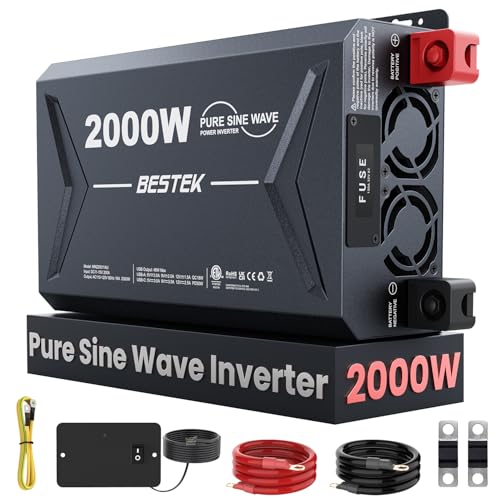
Bestek 2000W Pure Sine Wave Inverter — Best for Modern USB Loads
Check the current price on Amazon
Most 2000 watt inverters treat USB as an afterthought — a single slow port you use once and forget. The Bestek 2000W is the exception. Alongside three AC outlets and a 4000 watt surge rating, it builds in USB-C Power Delivery 3.0 and QC 18W fast charging, so a modern laptop, tablet, and phone can charge at full speed directly from the inverter without a tangle of wall adapters occupying the AC outlets. A remote control is included, which matters when the inverter lives in a cabinet or under a bed, as it usually does in a van build.
Strengths
- USB-C PD 3.0 and QC 18W fast charging built in
- Three AC outlets — one more than most 2000W rivals
- Included remote for cabinet and under-bed installs
Trade-offs
- Fast-charge ports share the unit’s thermal budget under max AC load
- No LCD metering as detailed as the BELTTT’s display
- Brand support is thinner than Renogy’s solar ecosystem
| Spec | Detail |
|---|---|
| Output | 2000W continuous / 4000W surge |
| Waveform | Pure sine wave |
| AC outlets | 3 |
| USB | USB-C PD 3.0, QC 18W |
| Control | Remote included |
Think about how a 2000 watt inverter is actually used in a camper van: the AC side runs a kettle or a hair dryer for a few minutes a day, while the DC-side charging of devices runs for hours. The Bestek is shaped around that reality. Keeping device charging on efficient native USB circuits instead of converting DC to AC and back to DC through a wall wart also wastes less battery — a small but real range extender for your battery bank over a long weekend. For a work truck that doubles as a mobile office, this is the most thoughtfully equipped pick in the class.
The remote deserves a second mention because of where these units end up living: screwed to a cabinet wall behind stored gear. Being able to kill the inverter from the doorway — and therefore actually doing it, every time — protects the battery bank from idle drain more effectively than any low-standby specification. The USB-C port also earns its keep with modern laptops that sip power all day; running them natively instead of through an AC brick measurably stretches a small bank across a work weekend.
Best for: vanlifers and mobile workers charging lots of USB-C gear / Not suited for: buyers who want detailed LCD power metering

LANDERPOW 2000W Pure Sine Wave Inverter — Best with Remote Control
Check the current price on Amazon
Permanent installs create a simple problem: the inverter belongs near the battery, bolted down with short cables, and you belong somewhere else — in the driver’s seat, at the dinette, in bed. The LANDERPOW 2000W solves it the straightforward way, with a remote control that lets you switch the unit on and off from where you actually live. The inverter itself is a full-specification 2000 watt pure sine wave design with a 4000 watt surge rating, suitable for the usual RV and off-grid load list.
Strengths
- Remote control suits hidden, permanent installations
- Full 2000W continuous / 4000W surge pure sine output
- Clean fit for RV, truck, and solar backup roles
Trade-offs
- Fewer convenience ports than the Bestek
- Display and metering are basic compared with the BELTTT
- Newer brand with a shorter track record than Renogy or Bestek
| Spec | Detail |
|---|---|
| Output | 2000W continuous / 4000W surge |
| Waveform | Pure sine wave |
| Input | 12V DC to 110V AC |
| Control | Remote control included |
Why does remote switching matter beyond convenience? Because an inverter left on idles. Even with no AC load, a 2000 watt inverter sips standby current around the clock, and over days of storage that sip flattens batteries. A remote you actually use — because it is mounted where you pass every day — is a battery-protection device in disguise. If your install plan puts the inverter in a locked battery bay or under a fixed bed, put this model on your shortlist and mount the remote by the door.
Judge this model by a single question: how far is the inverter from where you sit? In a travel trailer with the battery bay at the front and the bed at the back, the remote stops being a luxury the first cold night you want the inverter off without going outside. The core electrical specification matches the rest of the guide, so the purchase decision is really about install geometry. Measure yours before ordering; if the run is short and the unit stays reachable, save the money and take the budget pick instead.
Best for: permanent RV and cabin installs with the inverter tucked away / Not suited for: occasional users who clamp on and off per trip

ALLWEI 2000W Pure Sine Wave Inverter — Best Budget
Check the current price on Amazon
Not every buyer needs USB-C Power Delivery or a color display. If your requirement is simply clean 2000 watt AC power from a 12 volt battery at the lowest sensible cost, the ALLWEI 2000W is the budget pick that does not cut the corners that matter. It is a pure sine wave unit — the one specification we refuse to compromise on in this class — with a 4000 watt peak for motor starting, and it is marketed for the standard RV, truck, solar, and camping roles.
Strengths
- Pure sine wave output at a budget-tier position in the class
- 4000W peak handles motor and compressor starting surges
- Simple, focused design with little to go wrong
Trade-offs
- Fewer outlets and convenience features than pricier picks
- Metering and display feedback are minimal
- Budget brands mean you should keep the manual and test early
| Spec | Detail |
|---|---|
| Output | 2000W continuous / 4000W peak |
| Waveform | Pure sine wave |
| Input | 12V DC to 120V AC |
| Use case | RV, truck, solar, camping |
The right way to save money on an inverter is to skip features, not waveform or wiring. Spend what the ALLWEI saves you on proper cables and a proper fuse — the unglamorous parts that determine whether any 2000 watt inverter performs or disappoints. Test the unit under your biggest real load within the return window: run the microwave, start the fridge, listen for fan behavior and watch for voltage alarms. A budget inverter that passes your own loads is a good inverter; one that fails goes back while returning is still easy.
There is a discipline worth copying from budget-inverter owners who are happy with them: they test early and test honestly. Within the first week, run your three heaviest real loads, one at a time, and note fan noise, voltage sag, and any alarms. Every inverter in this guide should pass that test; a budget unit that does has earned its place, and one that does not can still go back. That first-week ritual converts the budget gamble into a verified purchase, which is the entire point of shopping this way.
Best for: budget builds that still demand pure sine wave output / Not suited for: buyers who want rich displays and fast-charge USB

EFFORTWAY 2000W Pure Sine Wave Inverter — Best Wired Remote and Display
Check the current price on Amazon
The EFFORTWAY 2000W combines the two convenience features that usually force a choice: an LCD display on the unit for real metering, and a wired remote so you can run the inverter from the living space of the RV or cabin. Output is 2000 watts continuous pure sine wave with a 4000 watt peak, in line with the rest of this guide, so the decision here is purely about control and visibility — and for installed systems, those are the things you interact with every single day.
Strengths
- LCD display for voltage and load visibility
- Wired remote — no wireless pairing or batteries to manage
- Full 2000W / 4000W pure sine specification
Trade-offs
- Wired remote means routing a cable through the install
- USB offering is unremarkable next to the Bestek
- Less established brand than Renogy
| Spec | Detail |
|---|---|
| Output | 2000W continuous / 4000W peak |
| Waveform | Pure sine wave |
| Display | LCD |
| Control | Wired remote control |
A wired remote sounds old-fashioned until you have owned a wireless one with a flat coin cell at the exact moment you need it. In a fixed installation, a cable is a feature: it works every time, and the panel becomes part of the vehicle’s switch layout. Combined with the display’s feedback on battery voltage, this is the most ‘installed appliance’ feeling unit in the group — the one that behaves least like a gadget and most like infrastructure. Choose it for builds you intend to keep for years.
The wired remote panel also changes how passengers interact with the system. In a family RV, a clearly mounted panel with a display teaches everyone — including teenagers — that AC power is a managed resource, not an infinite wall outlet. You will find loads get switched off voluntarily when the battery voltage is visible across the room. It is a small human-factors advantage, but over a long trip it shows up as real amp-hours saved and a fridge that is still cold on the last morning.
Best for: long-term installed systems that want metering plus remote control / Not suited for: portable, trip-by-trip users
Comparison Table
| Pick | Badge | Key Spec | Best For |
|---|---|---|---|
| BELTTT 2000W Pure Sine Wave Inverter | Best Overall | 2000W / 4000W surge, LCD display | RV and truck owners who want one dependable all-rounder |
| Renogy P2 2000W Pure Sine Wave Inverter | Best for Solar and Off-Grid | 2000W pure sine, solar-system protections | solar and off-grid builders who want ecosystem coherence |
| Bestek 2000W Pure Sine Wave Inverter | Best for Modern USB Loads | 2000W, 3 AC outlets, USB-C PD 3.0 | vanlifers and mobile workers charging lots of USB-C gear |
| LANDERPOW 2000W Pure Sine Wave Inverter | Best with Remote Control | 2000W / 4000W surge, remote control | permanent RV and cabin installs with the inverter tucked away |
| ALLWEI 2000W Pure Sine Wave Inverter | Best Budget | 2000W pure sine, 4000W peak, value tier | budget builds that still demand pure sine wave output |
| EFFORTWAY 2000W Pure Sine Wave Inverter | Best Wired Remote and Display | 2000W, LCD display, wired remote | long-term installed systems that want metering plus remote control |
How to Choose a 12 Volt 2000 Watt Inverter
Start with the load list, not the inverter. Add up the running watts of everything you might run at once — not everything you own, everything simultaneous. A microwave (1,000–1,500W) plus anything else meaningful already crowds a 2000W ceiling, so the real question is discipline: one big load at a time, or step up a class. Then check starting surge: fridge compressors, well pumps, and power tools can demand two to three times their running watts for a fraction of a second, which is what the 4000W surge rating on these units is for.
Second, do the battery math honestly. Watts are watts: 2,000 watts of AC output means roughly 2,300 watts of DC input after conversion losses, and 2,300 watts at 12 volts is around 190 amps. That is starter-motor current, sustained. It dictates everything downstream — cable gauge, fuse size, and how long a battery bank lasts. A single 100Ah lead-acid battery discharged at that rate gives up only a fraction of its nameplate capacity; lithium handles the draw far better. If the math shocks you, your loads are smaller than you think or your inverter should be too.
Third, decide which conveniences are actually load-bearing in your install. A remote control matters if the inverter is buried; an LCD matters if you manage battery health manually; USB-C PD matters if the van is your office. Pay for the ones matched to your layout and skip the rest — that is exactly how the picks above are organized.
Pure Sine Wave vs Modified Sine Wave: Why It Is Not Close at 2000W
A pure sine wave inverter reproduces the smooth waveform of household AC. A modified sine wave inverter approximates it with steps, and the difference is not audiophile trivia. Induction motors — fridges, fans, pumps, compressors — run hotter and louder on stepped power and can fail early. Some laptop bricks, CPAP machines, laser printers, and variable-speed tools misbehave or refuse to start. Audio equipment hums. At the 300 watt level, modified sine is a defensible budget shortcut for chargers and lights. At 2000 watts, where the entire point is running real appliances, it is a false economy, which is why every pick in this guide is pure sine wave.
One related trap: ‘peak power’ marketing. Some listings headline the surge number as if it were the continuous rating. Every unit here is rated 2000 watts continuous with surge on top — verify that ordering (continuous first, surge second) on any model you consider outside this list.
Cables, Fusing, and the Install That Makes or Breaks It
More 2000 watt inverters are ‘defective’ because of wiring than because of electronics. Keep battery cables as short as physically possible — ideally under a few feet — and use the gauge the manual specifies for that length, typically 2/0 AWG class for full-power runs at 12 volts. Undersized or long cables drop voltage under load, the inverter sees low input voltage, and it shuts down mid-microwave to protect itself. The owner concludes the inverter is junk; the inverter was the only honest component in the chain.
Fuse the positive cable at the battery end, sized to protect the cable, and mount the inverter somewhere ventilated — a 2000 watt unit sheds real heat at full load. Connect the chassis ground as the manual directs. None of this is optional decoration; it is the difference between a system that runs a kettle without complaint and one that alarms every morning.
What 2000 Watts Can and Cannot Run: A Reality Table in Words
Can run comfortably, one at a time: a countertop microwave, a drip coffee maker or espresso machine, a hair dryer on a lower setting, an electric kettle (watch the wattage — many are 1,500W), a toaster oven in short bursts, power-tool battery chargers, a circular saw or angle grinder for intermittent cuts, a laptop-and-monitor office, a TV and game console together, and a residential fridge cycling normally (its running draw is small; only its startup surge is large).
Can run, but plan around it: two medium loads together, such as a fridge plus a TV, or a coffee maker plus lights and chargers. The arithmetic is unforgiving — add the running watts, keep the total under roughly 80 percent of the inverter’s continuous rating for sustained use, and remember the battery current climbs past 100 amps long before you reach the ceiling.
Cannot run, so stop trying: a household electric water heater, a full-size electric range or oven, a central air conditioner, a large window air conditioner alongside anything else, an electric clothes dryer, or a welder of any serious size. These belong to the 3000–5000 watt classes or to shore power and generators. Naming them here saves you the most expensive lesson in this category: buying a 2000 watt inverter for a 4000 watt job and discovering it on the first hot day.
Sizing the Battery Bank Behind a 2000 Watt Inverter
The inverter is the visible purchase; the battery bank is the actual power plant. Work backwards from your biggest daily loads. A microwave used for ten minutes at 1,200 watts consumes about 200 watt-hours. A fridge in a warm RV might consume 800–1,200 watt-hours across a day. Add lights, device charging, and a TV evening, and a realistic modest RV day lands between 1,500 and 2,500 watt-hours — before anyone touches a hair dryer. Your bank must store that much usable energy, plus a reserve for a cloudy or lazy day.
Chemistry changes the arithmetic. Lead-acid and AGM batteries should not be drawn below about half their rated capacity in regular service, so a ‘100Ah’ AGM bank is really a 50Ah (roughly 600 watt-hour) resource, and its voltage sags hard under inverter loads near 200 amps, shrinking that further. Lithium iron phosphate (LiFePO4) banks can use 80–90 percent of their rating and hold voltage under load, which is why a single 100Ah lithium battery often outperforms two 100Ah AGMs behind a 2000 watt inverter despite the smaller nameplate total. If you are buying batteries and an inverter in the same season, buy the inverter for your loads and the lithium bank for your sanity.
Recharging is the third leg. Every watt-hour you spend must be replaced by the alternator through a DC-DC charger, by solar, or by shore power. A 2000 watt inverter paired with a tiny charger is a system that works beautifully for exactly one day. Match the recharge path to the daily budget above, and the system becomes boring in the best possible way.
Living With the Inverter: Noise, Heat, and Daily Habits
Two ownership realities surprise first-time buyers. The first is fan noise: at loads above roughly half capacity, every unit in this class moves serious air, and in a small RV that is audible. Mount the inverter outside the sleeping space if you can, and prefer models whose fans are load-controlled — all six picks behave this way — so light evening loads stay quiet. The second is heat: a 2000 watt inverter at full output converts roughly 200-plus watts of your battery into warmth. That is a small space heater bolted to your battery bay, and it is why ventilation clearances in the manual are requirements, not suggestions.
Build three habits and the system will serve for years. Switch the inverter off when no AC load is needed — idle draw is a slow leak in the battery budget. Glance at the input voltage under your heaviest load once a month; a creeping sag is an early warning of a loosening connection or an aging battery, caught while it is still cheap. And keep the air intake clear of the stored clutter that migrates toward any flat surface in a vehicle. Inverters rarely die suddenly; they report their problems in advance to owners who look.
How to Install and Use a 2000 Watt Inverter Safely
Installation is a one-afternoon job if you respect the current involved. Work methodically and treat the battery bank as the high-energy source it is.
- Plan the location first: within a short cable run of the battery, on a solid mounting surface, with airflow around the cooling fins and fan, and out of any space where fuel vapor or battery gas can collect.
- Size and cut cables before connecting anything: measure the real route, keep both cables as short and equal as practical, and use the gauge the manual specifies for full load at that length.
- Install the fuse holder in the positive cable close to the battery terminal, but leave the fuse out until the wiring is complete.
- Connect the negative cable first, then the positive, with the inverter switched off. Torque the terminals firmly — a loose lug at 190 amps becomes a heater.
- Add the chassis ground per the manual, then fit the fuse and switch the inverter on with no load attached. Confirm the display shows healthy battery voltage.
- Test progressively: a lamp, then a charger, then your largest appliance alone. Watch input voltage under load; a collapse toward the low-voltage alarm means cables, connections, or battery capacity need attention.
- Wire the remote if your model has one, mounting the panel where you will actually use it daily — by the door or the bed, not beside the inverter.
In daily use, the rules are simple: one heavy load at a time, switch the inverter off when it is not needed, and investigate any low-voltage alarm instead of restarting and hoping. An inverter that alarms is reporting a system problem, and it is almost always cheaper to fix the system than to replace either the inverter or the batteries it was protecting.
Common Buying Mistakes
Buying on the surge number. A ‘4000W inverter’ that runs 2000W continuous is a 2000W inverter. Shop by the continuous rating and treat surge as motor-starting headroom only.
Starving it with thin cables. The single most common failure in this class. Long, thin cables guarantee low-voltage shutdowns under load no matter how good the inverter is.
Expecting a small battery to act like a wall outlet. At full output this class draws around 190 amps. One tired starter battery cannot sustain that; size the bank for the job or shrink the loads.
Running modified sine wave to save money. At 2000W you are feeding motors and electronics that genuinely care about waveform. The savings are small and the risks are not.
Leaving the inverter on 24/7 in storage. Idle draw is small per hour and enormous per month. Use the remote, use the switch, or fit a battery disconnect.
Final Recommendation
For most buyers, the BELTTT 2000W is the answer: full pure sine output, a genuinely useful display, and that rare 20A outlet. Solar builders should take the Renogy P2 for its system manners, and van-based workers the Bestek for its USB-C fast charging. If the inverter will live out of reach, choose between the LANDERPOW and the EFFORTWAY by whether you want simple remote switching or remote plus metering, and if the budget is the whole story, the ALLWEI keeps the one specification that matters — pure sine wave — intact.
Whichever you choose, budget as much attention for cables, fusing, and battery capacity as for the inverter itself. In this class, the install is half the product.
Shop the picks: BELTTT 2000W Pure Sine Wave Inverter · Renogy P2 2000W Pure Sine Wave Inverter · Bestek 2000W Pure Sine Wave Inverter · LANDERPOW 2000W Pure Sine Wave Inverter · ALLWEI 2000W Pure Sine Wave Inverter · EFFORTWAY 2000W Pure Sine Wave Inverter
Keep researching the cluster: Best 12 Volt 24 Inch Tv Best 12 Volt 25 Amp Battery Charger Best 12 Volt 3 Stage Battery Charger Best 12 Volt 36 Cell Solar Panel
Frequently Asked Questions
How long will a 2000 watt inverter run on a 100Ah battery?
It depends entirely on the load. At a modest 500 watt load, a healthy 100Ah lithium battery can deliver roughly two hours; at the full 2000 watts, expect well under half an hour, and a lead-acid battery will give up much sooner because high discharge rates shrink its usable capacity. The inverter size sets the ceiling, not the runtime — runtime is bought with battery amp-hours.
Can a 2000 watt inverter run a microwave?
Yes, most countertop microwaves draw 1,000 to 1,500 watts and sit comfortably in this class, provided the battery bank and cabling can sustain roughly 150-plus amps without the voltage collapsing. Run the microwave on its own rather than alongside other heavy loads.
What size fuse and cable does a 2000 watt 12V inverter need?
Follow the manual for your exact model, but the physics points one way: full output means around 190 amps of input current, so installs typically use a fuse in the 200-amp class protecting short, heavy cables in the 2/0 AWG class. The fuse protects the cable, and it belongs close to the battery.
Will a 2000 watt inverter drain my vehicle battery overnight if left on?
It can. Even with no AC load, an idling inverter draws standby current, and over a night — or worse, a week of parking — that flattens a starter battery. Switch it off when unused, use the remote if your model has one, and never leave it powering loads unattended on a starting battery.
Is pure sine wave really necessary for a fridge or CPAP?
For a fridge, strongly recommended: compressor motors run cooler, quieter, and longer-lived on clean sine power. For a CPAP, treat pure sine as required unless the machine’s manufacturer explicitly approves modified sine — many do not, and some heated-humidifier models are damaged by stepped power.
Can I run a 2000 watt inverter from a car alternator while driving?
You can run modest loads that way, but a stock alternator and starter battery are not a 2000 watt power plant. Sustained heavy draws at idle overheat alternators and murder batteries. This class belongs on a proper deep-cycle or lithium house bank, with the alternator recharging it through a suitable DC-DC charger. If you only need power while driving — a laptop, a tool charger, a small cooler — a far smaller inverter does that job safely and cheaply, and the 2000 watt class can wait until you have the house bank to feed it.


