Disclosure: airfryerkitchensupply.com is reader-supported. When you buy through links on our site, we may earn an affiliate commission at no extra cost to you.
Where to buy
A 10 amp hour battery is a small, specific thing: roughly 120 watt-hours in a case you can carry in one hand, built for fish finders, ride-on toys, small solar setups, alarm and UPS backup, and light marine electronics. Every pick below was verified against the retailer’s own product data before it earned a link, and the spec boxes stick to what each verified listing actually states — chemistry, capacity, terminal or BMS details — rather than repeating marketing copy. Check the current price on Amazon, and check your device’s terminal type and maximum current draw before you check anything else, because in this size class those two details decide whether a battery works at all.
- NERMAK 12V 10Ah LiFePO4 Deep Cycle Battery (Best Overall) — Check the current price on Amazon
- Mighty Max ML10-12 12V 10Ah SLA AGM Battery (Best Lead-Acid Classic) — Check the current price on Amazon
- GOLDENMATE 12V 10Ah LiFePO4 Battery (Best for Boats and Wet Use) — Check the current price on Amazon
- CYCLENBATT 12V 10Ah LiFePO4 Battery (Best Certified Pick) — Check the current price on Amazon
- Nermak 2 Pack 12V 10Ah LiFePO4 Battery (Best Twin Pack) — Check the current price on Amazon
- Mighty Max YTX12-BS 12V 10Ah AGM Motorcycle Battery (Best for Motorcycles) — Check the current price on Amazon
The search for the best 12 volt 10 amp hour small battery used to be simple, because there was effectively one product: a sealed lead-acid brick, sold under a dozen labels, that weighed about as much as a gallon of milk and lasted two or three seasons if you treated it kindly. That market has split in two. Lithium iron phosphate (LiFePO4) versions of the same 10Ah case now exist alongside the lead-acid originals, at a similar shelf position, with a fraction of the weight, a built-in battery management system, and cycle-life claims measured in thousands rather than hundreds. Choosing well in 2026 means choosing a chemistry first and a brand second.
That split matters because the two chemistries behave differently in exactly the situations small batteries live in. Lead-acid gives up only about half its nameplate capacity before voltage sag hurts performance, hates being stored discharged, and needs a simple, dumb charger. LiFePO4 delivers nearly all of its 10 amp hours at a steady voltage, tolerates deep discharge, recharges fast, and protects itself with electronics — but it needs a charger that speaks its language, it will refuse to charge below freezing on better-protected models, and its flat discharge curve makes cheap voltage-based fuel gauges lie to you. Neither is universally better. The right answer depends on the device, the duty cycle, and how the battery spends its winters.
This guide ranks six verified 10Ah options across both chemistries: the lithium all-rounder most buyers should start with, the lead-acid original that still wins on simplicity and charger compatibility, a waterproof lithium for boats and kayaks, a certified lithium for buyers who want paperwork behind the claims, a twin pack for two-battery jobs, and a dedicated motorcycle AGM for riders who landed here looking for starting power rather than deep-cycle storage. Each review states plainly who the battery suits, where it falls short, and what its verified listing does and does not promise.
In this guide
Quick Picks
Six verified 10Ah batteries: three lithium singles, a lithium twin pack, the classic lead-acid brick, and a motorcycle AGM for starting duty.
- NERMAK 12V 10Ah LiFePO4 Deep Cycle Battery — Best Overall. The lithium default: a lightweight 10Ah LiFePO4 with a built-in 10A BMS, aimed squarely at fish finders, ride-on toys, lighting and small solar. — check price on Amazon
- Mighty Max ML10-12 12V 10Ah SLA AGM Battery — Best Lead-Acid Classic. The original small-battery brick: a sealed AGM 10Ah with F2 terminals that drops into thousands of existing devices and charges on any basic 12V charger. — check price on Amazon
- GOLDENMATE 12V 10Ah LiFePO4 Battery — Best for Boats and Wet Use. A lithium 10Ah with a stated IP67 waterproof sealing and built-in BMS — the pick for kayaks, small boats and anywhere spray is part of the job. — check price on Amazon
- CYCLENBATT 12V 10Ah LiFePO4 Battery — Best Certified Pick. The paperwork pick: a stated UL-certified 10Ah lithium with IP67 sealing and a 10A BMS, aimed at buyers who want certification behind the claims. — check price on Amazon
- Nermak 2 Pack 12V 10Ah LiFePO4 Battery — Best Twin Pack. Two matched 10Ah lithium batteries in one box — for 24V series toys and scooters, parallel runtime builds, or simply having the spare already on the shelf. — check price on Amazon
- Mighty Max YTX12-BS 12V 10Ah AGM Motorcycle Battery — Best for Motorcycles. A different animal wearing the same 10Ah label: a maintenance-free AGM starter battery in the common YTX12-BS motorcycle size, rated for cranking duty. — check price on Amazon
How These Picks Were Chosen
Every battery in this guide was verified against the retailer’s product data for this site before it was shortlisted, and only listings whose stated specifications matched the job — a true 12 volt, 10 amp hour class battery in the correct chemistry and form — were eligible for a link. Listings with vague capacity claims, mismatched terminal types, or cycle and certification claims that could not be tied to the verified product data were dropped rather than repeated.
The shortlist was then balanced deliberately across the real market, not padded with near-duplicates. A guide that recommended six interchangeable lithium bricks would be useless, so the six slots cover the decisions buyers actually face: lithium versus lead-acid, single versus matched pair, dry versus waterproofed, general-purpose versus certified, and deep-cycle versus starting duty.
- Verified identity: the listing’s stated chemistry, voltage and capacity match the 12V 10Ah brief, confirmed in the product data.
- Usable capacity, not just nameplate: how much of the 10Ah you can actually spend, given the chemistry’s healthy discharge depth.
- Protection: for lithium picks, a built-in BMS with a stated current rating; for lead-acid, sealed maintenance-free construction.
- Terminal and form fit: the physical details — F2 terminals, standard case, motorcycle size code — that decide whether the battery fits your device at all.
- Honest positioning: each pick’s badge reflects a real distinction in its verified listing, not a shuffled superlative.
Where a claim appears in a spec box in this guide, it is a stated figure from the verified listing, labeled as stated. Where listings were silent — exact dimensions on some models, for example — the guide says what to measure rather than inventing a number.
The 6 Best 12 Volt 10 Amp Hour Small Batteries

NERMAK 12V 10Ah LiFePO4 Deep Cycle Battery — Best Overall
This is the battery most people searching this keyword actually want, whether they know it yet or not. If your 10Ah battery powers a fish finder, a child’s ride-on toy, LED lighting, a small solar or wind setup, or a gate or camera load — in other words, a steady, modest draw that runs for hours — the NERMAK’s lithium chemistry serves that job better than lead-acid in almost every measurable way. It suits owners who recharge after each use and want the battery to still be healthy several seasons from now. It is a poor fit for engine starting, for high-surge motors, and for anyone whose existing charger has no lithium mode and no budget to replace it.
Strengths
- LiFePO4 chemistry delivers nearly the full 10Ah at a steady voltage, so electronics run longer and brighter than on an equal-rated lead-acid brick
- Built-in 10A BMS guards against overcharge, over-discharge, over-current and short circuits without any external hardware
- Far lighter than a lead-acid 10Ah, which matters in kayaks, portable fish finder rigs and ride-on toys a child has to be lifted into
Trade-offs
- The 10A BMS caps continuous draw at about 10 amps — fine for electronics, useless for starting engines or running hungry motors
- Needs a lithium-compatible charger for best results; an old lead-acid-only charger may undercharge it or never properly finish the cycle
- Costs more up front than the lead-acid equivalent, with the payback arriving over years of cycle life rather than at the till
| Chemistry | Lithium iron phosphate (LiFePO4) |
| Capacity | 12V 10Ah (stated) |
| Protection | Built-in 10A BMS (stated) |
| Cycle life | 2000+ cycles (stated) |
| Stated uses | Solar/wind power, lighting, Power Wheels, ride-on toys, fish finders |
The honest way to compare this battery with the lead-acid pick below is usable energy, not nameplate energy. A 10Ah sealed lead-acid battery discharged to the 50 percent depth that keeps it healthy gives you roughly 5 usable amp hours, and its voltage slides downward the whole way, so a fish finder’s screen dims and a ride-on toy slows noticeably long before the battery is technically empty. The NERMAK can be drawn down far deeper without the same lifespan penalty, and it holds its voltage on a plateau until it is nearly spent. In practice, for the same 10Ah printed on the case, the lithium battery commonly delivers close to double the useful runtime in electronics duty. That, more than the weight saving, is why it takes the top spot.
The 10A BMS deserves a clear-eyed paragraph, because it is both the battery’s safety net and its ceiling. Ten amps at 12 volts is 120 watts: plenty for fish finders, lights, small pumps, fans, and ride-on toys, and nowhere near enough for a starter motor or a large trolling motor. If your load ever spikes past the limit, the BMS will cut output to protect the cells, which looks to the user like a dead battery until the load is removed. Check your device’s draw honestly before buying. Within its ceiling, though, the protection is genuinely valuable in a size class where batteries get shorted in tackle boxes, left on chargers, and stored in hot garages — the BMS quietly prevents the three or four most common ways small batteries die early.
Check the current price on Amazon
Best for: Fish finders, ride-on toys, lighting and small solar owners who want maximum usable runtime and minimum weight / Not suited for: Engine starting, high-surge motors, or setups locked to a lead-acid-only charger

Mighty Max ML10-12 12V 10Ah SLA AGM Battery — Best Lead-Acid Classic
The ML10-12 is the battery this entire size class was built around, and it remains the right answer for a specific, common job: replacing the battery inside equipment that was designed for lead-acid. UPS units, alarm panels, emergency lighting, older ride-on toys, and mobility and medical-adjacent devices often expect lead-acid weight, lead-acid voltage behavior, and lead-acid charging. If your device manual names a 12V 10Ah SLA replacement, or your existing charger is a simple lead-acid maintainer, this is your battery. It is the wrong choice for new portable builds where weight and deep discharge matter, and it should never be asked to start an engine.
Strengths
- Universal fit: the standard small SLA footprint with F2 terminals matches an enormous installed base of devices and battery trays
- Works with the basic lead-acid chargers and maintainers most households already own — no lithium mode required
- Sealed AGM construction is spill-proof, maintenance-free and tolerant of being mounted in any orientation
Trade-offs
- Only about half the nameplate capacity is comfortably usable if you want the battery to last; deep discharges shorten its life quickly
- Noticeably heavy for its energy — the weight penalty is real in kayaks, portable rigs and anything a child carries
- Shorter service life than lithium in cycling duty; expect replacement in a few seasons of regular deep use
| Chemistry | Sealed lead-acid, AGM |
| Capacity | 12 volt 10 amp hour (stated) |
| Terminals | F2 (stated) |
| Construction | Rechargeable, maintenance-free SLA |
There is a temptation, in a market excited about lithium, to treat the lead-acid brick as obsolete. It is not — it is specialized. Its virtues are compatibility and predictability. The charging profile is the one every inexpensive maintainer on the market was built to deliver. Its discharge curve is the one older device electronics were designed around. Its F2 terminals are the ones already wired into your UPS, your alarm panel and your emergency light. When the job is ‘make the existing thing work again, tonight, with the charger in the garage,’ the ML10-12 does it without a single compatibility question, and its low shelf price means a replacement is a minor expense rather than a project.
Where buyers go wrong with this battery is asking it to do lithium’s job. Dragged down to empty on a fish finder every weekend, stored discharged over winter, or cycled daily in a solar toy, an SLA 10Ah will fade within a season or two — not because it is badly made, but because that duty cycle is outside what lead-acid chemistry tolerates. The buying rule is simple: if the battery lives in a device that sips power, floats on a charger, or only occasionally dips into its reserves, the ML10-12 is excellent value. If the battery will be emptied hard and often, pay for lithium once instead of paying for lead-acid repeatedly.
Check the current price on Amazon
Best for: Drop-in SLA replacements for UPS, alarm, emergency lighting and legacy devices with lead-acid chargers / Not suited for: Weight-sensitive portable builds or daily deep-cycle duty
GOLDENMATE 12V 10Ah LiFePO4 Battery — Best for Boats and Wet Use
Choose the GOLDENMATE when your small battery lives where water lives: a kayak fish finder setup, a jon boat’s electronics battery, a dock or deck lighting run, a camping power box that rides in an open truck bed. Its verified listing states an IP67 waterproof sealing, which is the detail that separates it from the other lithium picks here. It suits marine and outdoor users who also want lithium’s deep usable capacity and long stated cycle life. It is overkill for a dry indoor UPS shelf, and like every 10Ah lithium here, its BMS current ceiling rules out engine starting and heavy motor loads.
Strengths
- Stated IP67 waterproofing addresses the number one killer of small marine batteries — water intrusion at the case and terminals
- Stated 5000+ deep cycle rating is the highest cycle claim among the verified picks in this guide
- Built-in BMS plus lithium’s flat discharge curve means steady power for fish finders and lights right up to the end of the charge
Trade-offs
- Waterproofing claims still deserve respect rather than faith: rinse terminals, dry the battery for storage, and do not submerge it as a habit
- Premium positioning within the 10Ah lithium tier — dry indoor users pay for sealing they will never use
- Same lithium charger requirement and BMS current ceiling as the rest of the lithium field
| Chemistry | Lithium iron phosphate (LiFePO4) |
| Capacity | 12V 10Ah (stated) |
| Sealing | IP67 waterproof (stated) |
| Cycle life | 5000+ deep cycles (stated) |
| Protection | Built-in BMS (stated) |
Small batteries die in boats for boring reasons. Spray works into a case seam. A terminal corrodes under a film of salt. A battery sits in a damp hull compartment through a wet week and quietly degrades. A stated IP67 sealing — immersion-resistant by the standard’s definition, and certainly spray- and splash-proof in real use — attacks exactly those failure modes, and it is why this battery, rather than a generic lithium brick, is the marine recommendation. Pair it with tinned marine wiring, dielectric grease on the terminals, and a proper lithium-capable charger back at the dock, and you have addressed the full chain of small-boat battery failures rather than just the capacity question.
The stated cycle figure also deserves context rather than blind celebration. Cycle claims across this category are made under differing test conditions, and no buyer will verify 5000 cycles at home. What the number usefully signals is design intent: this battery is built and marketed for deep, frequent cycling, which is precisely the fish finder and lighting duty cycle. Even if real-world life lands at a fraction of the claim, it will outlast a lead-acid brick in the same service by a wide margin, while weighing far less in a kayak where every pound changes how the hull sits in the water.
Check the current price on Amazon
Best for: Kayak and small-boat electronics, dock lighting, and outdoor power boxes exposed to spray / Not suited for: Dry indoor backup duty where waterproofing adds cost without benefit

CYCLENBATT 12V 10Ah LiFePO4 Battery — Best Certified Pick
The CYCLENBATT is for the buyer who reads spec sheets skeptically and asks a fair question: which of these small lithium batteries has any third-party certification at all? Its verified listing states UL certification, alongside IP67 waterproofing and a 10A BMS, and it names ham radio and UPS duty among its uses — a hint that it is aimed at careful, technical buyers. It suits fish finder, marine, solar, Power Wheels and radio users who want lithium performance with a certification claim they can check. If certification means nothing to you, the Best Overall pick covers the same jobs; if you need starting power, look at the motorcycle pick instead.
Strengths
- Stated UL certification is a meaningful differentiator in a category where most small lithium batteries carry no third-party safety listing
- Combines the full modern checklist in one case: LiFePO4 chemistry, 10A BMS protection, stated IP67 sealing, lightweight build
- Stated 5000+ cycle rating and a stated long service-life design goal suit fit-and-forget installations like ham radio backup
Trade-offs
- Certification and sealing put it at the premium end of the 10Ah class; purely price-driven buyers have cheaper verified options in this guide
- The 10A BMS ceiling is the joint-lowest current headroom here — audit any load that surges, such as pumps, before committing
- As with all small lithium, a compatible charger is part of the real purchase, not an optional extra
| Chemistry | Lithium iron phosphate (LiFePO4) |
| Capacity | 12V 10Ah (stated) |
| Certification | UL certified (stated) |
| Sealing | IP67 waterproof (stated) |
| Protection | 10A BMS (stated) |
Certification matters more in lithium batteries than in almost any other small consumer product, because the failure mode being guarded against — a cell or protection-board fault inside a sealed plastic case — is one the buyer cannot inspect for. A stated UL certification does not make a battery immortal, and buyers should verify the claim on the listing as they would any spec. But its presence signals a manufacturer willing to submit the product to an outside lab, and in a field of anonymous small lithium bricks, that willingness is real information. For a battery that will live in a boat, a child’s ride-on toy, or a home radio shack, it is information worth paying a modest premium for.
In daily use the CYCLENBATT behaves like the other good lithium picks here: full usable capacity, flat voltage, fast recharge, and protection electronics watching the limits. Its stated application list is telling — ham radio operators are exactly the users who run a small battery for hours at modest draw, float it for emergency backup, and notice voltage behavior carefully. If your use rhymes with theirs — long, gentle, reliability-obsessed — this is the most defensible 10Ah lithium in the guide. If your use is a twice-a-year toy, the premium is harder to justify and the simpler picks will serve you just as well.
Check the current price on Amazon
Best for: Ham radio, UPS and marine users who want a stated third-party certification behind their lithium battery / Not suited for: Bargain-first buyers or any load with surges beyond the 10A BMS ceiling
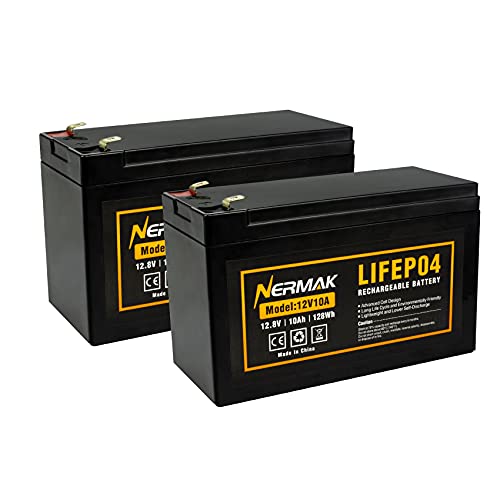
Nermak 2 Pack 12V 10Ah LiFePO4 Battery — Best Twin Pack
Plenty of small-battery jobs are secretly two-battery jobs. Many larger ride-on toys and scooters wire a pair of 12V batteries in series for 24V. Anglers run two fish finder batteries so one is always charged. Small solar setups parallel a pair for runtime. The Nermak twin pack serves all of those buyers with two same-model, same-age lithium batteries — and matched age matters, because batteries wired together should start life together. It suits anyone whose device tray or project plainly takes two. Single-battery buyers should take the single Best Overall pick instead of paying for a second battery that will age on a shelf.
Strengths
- Matched pair from the same production family: the correct way to build series or parallel small-battery setups
- Each battery carries its own built-in 10A BMS, so protection travels with the unit whichever way you wire the pair
- Lithium’s light weight compounds in pairs — a two-battery toy or rig loses twice the lead weight compared with SLA twins
Trade-offs
- Series and parallel wiring of lithium batteries must follow the manufacturer’s guidance exactly; a twin pack is not permission to improvise wiring
- Two batteries need charging discipline — a rotation habit or a charger routine that keeps the pair balanced in use
- If one battery of a wired pair is later replaced alone, the age mismatch problem returns; pairs should be replaced as pairs
| Chemistry | Lithium iron phosphate (LiFePO4) |
| Capacity | 2 x 12V 10Ah (stated) |
| Protection | Built-in 10A BMS per battery (stated) |
| Cycle life | 2000+ cycles (stated) |
| Stated uses | Solar/wind power, scooters, lighting, Power Wheels, fish finders |
The most common small-battery wiring mistake is mixing: a new battery paired with a tired one, or two batteries of different brands and ages sharing a series string. In series, the weakest battery limits the whole string and gets worked hardest, so it weakens faster — a death spiral that buyers then blame on the new battery. A factory twin pack sidesteps the entire problem at the moment of purchase. Both units share chemistry, capacity, BMS behavior and birthday. For 24V ride-on toys and scooters especially, where the pair is the product, buying the pair as a pair is simply the correct maintenance move, and this pack exists precisely for that buyer.
Used in parallel instead, the two batteries double your runtime at 12V while each works at half the current — a gentler life for both, and a tidy way to run a fish finder and lights all day from batteries that still fit in a small hatch. Used as a rotation — one in the device, one on the charger — they eliminate downtime entirely. Whichever pattern fits your life, keep the pair together through their service life, charge them on the same routine, and retire them together. That discipline, more than any spec on the box, is what makes twin-pack ownership satisfying instead of finicky.
Check the current price on Amazon
Best for: 24V series ride-on toys and scooters, parallel runtime builds, and rotation setups that need a matched spare / Not suited for: Single-battery devices, where the second battery only ages in storage
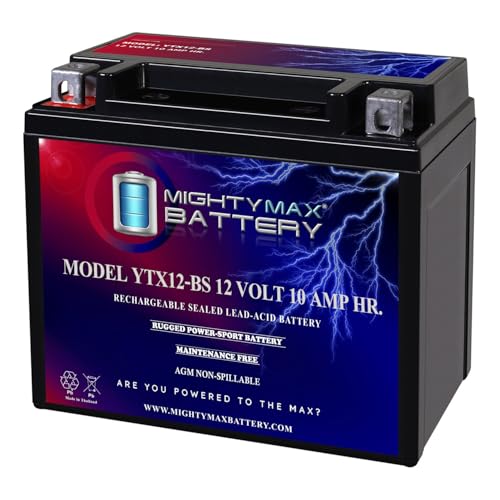
Mighty Max YTX12-BS 12V 10Ah AGM Motorcycle Battery — Best for Motorcycles
This pick exists because a meaningful share of people searching for a 12 volt 10 amp hour battery are not shopping for deep-cycle storage at all — they are shopping for a motorcycle battery, and the YTX12-BS is one of the most common fitments in motorcycling. If your bike’s manual or old battery says YTX12-BS, this is the verified replacement in this guide: a sealed, maintenance-free AGM built to deliver a short, violent burst of cranking current, then recharge from the bike’s charging system. It does not suit fish finders, toys or solar storage — starter batteries are damaged by deep discharge — and deep-cycle buyers should pick from the five batteries above instead.
Strengths
- Built for cranking: the verified listing states 180 CCA, the number that actually decides whether a starter motor turns on a cold morning
- Sealed AGM construction is spill-proof and maintenance-free — no filling, no venting, no acid checks through the season
- A standard, widely cross-referenced motorcycle size, so fitment against your bike’s battery box is easy to confirm before ordering
Trade-offs
- Starter chemistry hates deep discharge; using it as a deep-cycle battery will shorten its life dramatically
- Fitment is exact-size or nothing — close is not close enough in a motorcycle battery box, so verify your model code first
- Like all lead-acid, it self-discharges in storage and wants a maintainer over winter to survive to spring
| Chemistry | SLA AGM, maintenance-free |
| Capacity | 12 volt 10 AH (stated) |
| Cranking | 180 CCA (stated) |
| Size code | YTX12-BS (stated) |
| Duty | Motorcycle starting |
The 10Ah figure on a motorcycle battery and the 10Ah figure on a deep-cycle battery are answers to different questions. On the deep-cycle batteries above, amp hours describe how long a gentle load can run. On this YTX12-BS, the amp hour figure is almost incidental — the battery’s real job is measured in cold cranking amps, the ability to dump a huge current for a few seconds without its voltage collapsing. Its plates are built thin and numerous for surface area and burst power, which is the exact opposite of deep-cycle construction. Understanding that distinction is the whole ballgame when two products share a capacity label: match the battery to the duty, not to the number.
In service, the ownership routine is simple and unforgiving. Keep it charged — a battery that sits discharged sulfates, and sulfation is what actually kills most motorcycle batteries over winter, not cold itself. A small maintainer through the off-season, clean tight terminals, and a check that your bike’s charging system is healthy will see a battery like this through several seasons. Let it sit flat in a cold garage from November to March and you will be shopping again in spring, wondering why these batteries ‘never last.’ They last fine. They just insist on being stored charged.
Check the current price on Amazon
Best for: Motorcycle owners replacing a YTX12-BS battery who need verified cranking performance in a sealed AGM case / Not suited for: Deep-cycle storage, fish finders, toys, solar or any duty that drains a battery deeply
Comparison Table
| Pick | Badge | Key spec | Best for |
|---|---|---|---|
| NERMAK 12V 10Ah LiFePO4 Deep Cycle Battery | Best Overall | LiFePO4, 10Ah, built-in 10A BMS | Fish finders, ride-on toys, lighting and small solar owners who want maximum usable runtime and minimum weight |
| Mighty Max ML10-12 12V 10Ah SLA AGM Battery | Best Lead-Acid Classic | SLA AGM, 10Ah, F2 terminals | Drop-in SLA replacements for UPS, alarm, emergency lighting and legacy devices with lead-acid chargers |
| GOLDENMATE 12V 10Ah LiFePO4 Battery | Best for Boats and Wet Use | LiFePO4, 10Ah, IP67 waterproof (stated) | Kayak and small-boat electronics, dock lighting, and outdoor power boxes exposed to spray |
| CYCLENBATT 12V 10Ah LiFePO4 Battery | Best Certified Pick | LiFePO4, 10Ah, UL certified (stated), 10A BMS | Ham radio, UPS and marine users who want a stated third-party certification behind their lithium battery |
| Nermak 2 Pack 12V 10Ah LiFePO4 Battery | Best Twin Pack | LiFePO4, 2 x 10Ah, 10A BMS each | 24V series ride-on toys and scooters, parallel runtime builds, and rotation setups that need a matched spare |
| Mighty Max YTX12-BS 12V 10Ah AGM Motorcycle Battery | Best for Motorcycles | AGM, 10Ah, 180 CCA (stated), YTX12-BS size | Motorcycle owners replacing a YTX12-BS battery who need verified cranking performance in a sealed AGM case |
How to Choose a 12 Volt 10 Amp Hour Small Battery
Start with duty, because duty chooses chemistry. Ask what the battery will actually do all day. If it will run electronics for hours — a fish finder, lights, a toy, a small pump on a timer — that is deep-cycle duty, and the usable-capacity math favors lithium strongly. If it will sit on float in a UPS or alarm panel and only occasionally deliver backup power, lead-acid’s simplicity and charger compatibility argue for the classic brick. If it will crank an engine, neither deep-cycle answer applies: you need a starter battery rated in cranking amps, like the motorcycle pick in this guide.
Next, audit the current draw. Add up what your devices pull, in amps, at 12 volts. Small electronics are gentle: most fish finders draw around an amp or less, LED lighting a few amps, ride-on toys several amps with surges. Lithium picks in this class carry BMS limits around 10 amps, so a load that surges — a pump starting, a toy climbing a hill with a heavy rider — needs headroom thinking, not just average-draw thinking. If your honest peak draw approaches the BMS ceiling, step up a battery size rather than hoping the protection board is feeling generous.
Terminals and fit come before chemistry debates
Small batteries fail purchases at the connector more often than at the chemistry. The lead-acid standard in this class is the F2 spade terminal; some devices use F1, some use ring terminals on threaded posts, and motorcycle batteries use their own bolted lugs in an exact-size case. Measure your old battery, photograph its terminals, and compare against the listing before ordering. A battery that is electrically perfect and physically wrong is just a return shipment waiting to happen.
Budget tiers, honestly framed
This keyword carries no price ceiling, so think in tiers rather than dollars. The budget tier is lead-acid: lowest purchase cost, highest replacement frequency in cycling duty. The mid tier is mainstream LiFePO4, which costs more once and then outlasts several lead-acid replacements while delivering more usable energy every single cycle. The premium tier adds sealing and certification — waterproof cases, third-party safety listings — which are worth paying for in marine and household-backup roles and wasted in a dry, occasional-use toy. Total cost of ownership, counted over the years you will own the device, usually reverses the shelf-price ranking for anyone who cycles the battery weekly.
Lithium vs Lead-Acid at 10Ah: The Differences That Actually Matter
Weight is the difference you feel first. A lithium 10Ah typically weighs a small fraction of its lead-acid equivalent, and in a kayak, a portable fish finder bag, or a ride-on toy that an adult lifts in and out of a car, that difference is not a luxury — it changes how the whole setup handles. In a stationary UPS, the same difference is worth almost nothing. Weight is a use-case spec, not a universal virtue.
Voltage behavior is the difference you notice second. Lead-acid voltage declines steadily as it discharges, so lights dim and motors slow progressively — annoying, but also a rough built-in fuel gauge. LiFePO4 holds a near-flat voltage until it is almost empty, then falls off a cliff, with the BMS cutting output at the limit. Your electronics will run at full performance far longer on lithium, but they will stop abruptly, and a simple voltage meter will tell you ‘fine, fine, fine, empty.’ Plan runtimes by amp-hour math rather than by watching the voltmeter.
Charging is the difference that costs money if you ignore it. Lead-acid wants a slow, simple charge and a float. Lithium wants a charger with the correct voltage profile and no old-fashioned desulfation pulses or equalization modes, which can damage it. If you already own a modern multi-mode charger with a lithium setting, the switch is free. If your charger is a decade-old lead-acid maintainer, budget for a lithium-capable charger as part of the lithium purchase — the honest total cost of switching chemistries includes it.
Temperature is the final divider. Lead-acid loses capacity in the cold but will still accept a charge. Many lithium BMS boards refuse charging below freezing to protect the cells, which is correct behavior that surprises owners who store a boat or toy in an unheated space and plug in on a frosty morning. If your battery must charge in genuine cold, either bring it indoors to charge, choose a model whose listing states low-temperature charge protection behavior you can plan around, or stay with lead-acid for that specific job.
How to Replace and Set Up a Small 12V Battery Safely
Swapping a small 12V battery is a ten-minute job that rewards ten minutes of preparation. The steps below apply to the deep-cycle and backup batteries in this guide; motorcycle owners should also consult their bike’s manual for model-specific access and terminal order.
- Power the device fully off and unplug its charger. Photograph the existing wiring before touching it — terminal colors, connector positions, and which wire lands where.
- Remove the negative (black, marked −) connection first, then the positive (red, marked +). This order prevents a short if your tool touches the case or frame while loosening the positive terminal.
- Lift the old battery out and compare it side by side with the new one: case size, terminal type and orientation, and polarity position. Confirm the match before connecting anything.
- Set the new battery in place and connect positive first, then negative — the reverse of removal. Snug the connections firmly; loose terminals are the leading cause of ‘bad new battery’ complaints.
- If you have switched chemistry — lead-acid out, lithium in, or the reverse — change the charger or its mode to match the new battery before the first charge. Never let an old lead-acid charger’s equalize or desulfate mode run on a lithium battery.
- Charge the new battery fully before first use, then run the device and confirm normal operation. For lithium, note the runtime on this first full cycle as your personal baseline for spotting future fade.
- Recycle the old battery through a retailer or municipal program. Lead-acid batteries are among the most successfully recycled products in the world, and lithium batteries should never enter household trash.
For storage, the two chemistries part ways. Lead-acid wants to be stored fully charged, on a maintainer, and checked through the off-season. Lithium prefers storage at a partial charge in a cool, dry place, with a top-up every few months rather than a permanent float. Following the storage rule for the chemistry you own is worth more service life than any brand difference in this guide.
Common Buying Mistakes
Buying by amp hours alone
The 10Ah label hides chemistry, duty type and usable capacity. A starter battery, an SLA brick and a LiFePO4 pack can all say 10Ah while being built for completely different jobs. Decide duty first, then chemistry, then brand — in that order.
Ignoring the BMS current ceiling on lithium
A 10A BMS will cut power to any load that surges past it, and the sudden shutdown looks exactly like a defective battery. Add up peak draws, not just running draws, and size the battery so the ceiling is never the plan.
Charging lithium with a lead-acid-only charger
Old chargers with desulfation pulses or equalization modes can damage lithium batteries, and basic lead-acid profiles may never charge one properly. The charger is part of the chemistry switch; budget and plan for it.
Mixing old and new batteries in pairs
In series or parallel pairs, the weakest battery drags the set down and ages fastest. Replace wired pairs together, with matched models — which is exactly why the twin pack in this guide exists.
Storing any battery discharged
A lead-acid battery stored flat sulfates; a lithium battery stored empty can drop below its protection threshold. Whatever you own, put it away charged appropriately for its chemistry and check it through the off-season.
Final Recommendation
If you only read one paragraph, read this one. For most buyers, the NERMAK 12V 10Ah LiFePO4 is the best 12 volt 10 amp hour small battery: it delivers close to double the usable energy of a lead-acid brick at a fraction of the weight, with protection electronics built in. Choose the Mighty Max ML10-12 instead when the job is a drop-in lead-acid replacement in existing equipment. Take the GOLDENMATE for boats and kayaks, the CYCLENBATT when certification matters, the Nermak twin pack for two-battery devices, and the Mighty Max YTX12-BS if what you actually need is a motorcycle starter battery. Check the current price on Amazon for the pick that matches your duty, and confirm terminals and charger compatibility before you order.
Building a small power system rather than replacing one battery? The cluster continues with Best 12 Volt 12 Amp Batteries for the next capacity step up, and Best 12 Volt 12 Volt Agm Battery if your project is moving to full-size AGM storage. If your small battery will live under a solar panel, Best 12 Volt 160 Watt Solar Panel covers the panel class that pairs naturally with batteries of this size, and Best 12 Volt 2 Bank Marine Battery Charger is the charging companion for two-battery boat setups.
Frequently Asked Questions
How long will a 12V 10Ah battery run my fish finder?
Do the amp-hour math with your fish finder’s draw. A typical small fish finder drawing about 1 amp will run roughly 8 to 9 hours on a lithium 10Ah used deeply, and roughly 4 to 5 hours on a lead-acid 10Ah kept within its healthy discharge range. Larger screens with high brightness draw more and shorten both figures, so check your unit’s stated current draw and divide 10 by it for the optimistic ceiling, then discount by chemistry as above.
Can I replace a lead-acid 10Ah battery with a lithium 10Ah directly?
Physically, usually yes — the cases are similar and the voltage is compatible with 12V devices. Electrically, two checks matter: your charger must have a lithium-appropriate profile, and your load’s peak draw must stay under the lithium battery’s BMS limit. If both check out, the swap is one of the easiest upgrades in small power, with more usable runtime and far less weight.
What charger do I need for a 12V 10Ah LiFePO4 battery?
A charger with a lithium or LiFePO4 mode and an output suited to the battery’s size — small batteries charge happily at modest currents, and slower is gentler. Avoid chargers with desulfation or equalization modes for lead-acid unless those modes can be fully disabled. When in doubt, use the charger the battery’s manufacturer recommends for the model.
Why does my new lithium battery shut off suddenly instead of fading?
That is the BMS doing its job. Lithium holds a flat voltage until nearly empty, so there is little warning fade; when the protection board reaches its low-voltage limit, it disconnects the load to protect the cells. Recharge promptly, and treat the first full runtime you measured as your planning number so the cutoff never surprises you in the field.
Can a 10Ah battery start a car or motorcycle?
A deep-cycle 10Ah battery, no — it is not built for cranking current, and lithium versions will simply have their BMS disconnect. A dedicated starter battery in this capacity class, like the YTX12-BS motorcycle pick in this guide, is built for exactly that burst duty on the motorcycles it fits. Cars need far larger starter batteries. Match the battery to the duty, not the amp-hour label.
How should I store a small 12V battery over winter?
Lead-acid: fully charged, ideally on a maintainer, checked monthly. Lithium: at a partial charge, in a cool dry place, topped up every few months, and brought to room temperature before charging if it has been sitting in the cold. Both chemistries die young when stored discharged, so the storage routine matters more than the brand on the case.


