Disclosure: airfryerkitchensupply.com is reader-supported. When you buy through links on our site, we may earn an affiliate commission at no extra cost to you.
Where to buy
Every machine below is sold on Amazon, and each pick links to its verified listing so you can check the current price on Amazon. We do not print prices — they move too often to stay honest — and every model was matched against Amazon’s product data feed for this site before it earned a link.
- Cuisinart Brew Central DCC-1200 — check the current price on Amazon
- Ninja CE251 Programmable Brewer — check the current price on Amazon
- KRUPS 12-Cup Programmable Thermal — check the current price on Amazon
- Cuisinart PerfecTemp Thermal DCC-3400 — check the current price on Amazon
- KitchenAid KCM1208 Drip Coffee Maker — check the current price on Amazon
- Mr. Coffee Easy Measure 12-Cup — check the current price on Amazon
Shopping for the best 12 cup programable drip coffee makers — yes, the internet’s favorite misspelling included — means shopping for one feature above all: the timer. A programmable drip machine is a promise that coffee will exist at the minute your household needs it, brewed from water and grounds you loaded the night before. Everything else in this guide is in service of that promise: how reliably the clock keeps its appointment, how the coffee tastes after waiting for you, and how gracefully the machine handles the small pots and schedule changes of real life.
Here is the honest framing before the picks. Programmability is only as good as the brewing underneath it — a timer attached to a weak heater produces punctual, sour coffee. So this guide judges its six machines as brewers first and schedulers second: brew temperature, distribution, small-batch behavior and carafe strategy all count, and then we grade the programming itself — auto-start reliability, clock sanity, strength and small-pot logic, and what happens when the power blips at 3 a.m.
All six machines were verified product feed attached to this site, matched brand-and-model to live Amazon listings. The set spans the classic programmable archetypes: Cuisinart’s two long-running designs (glass and thermal), Ninja’s household system, KRUPS’ strength-focused thermal, KitchenAid’s design-led programmable, and Mr. Coffee’s beginner-friendly teacher.
In this guide
Quick Picks
Six programmable 12-cup machines graded as brewers first and timers second. Badges name the schedule each one serves best.
- Cuisinart Brew Central DCC-1200 — Best Overall Programmable: The archetype: 24-hour auto-start, a real 1–4 cup mode, brew pause and a dripless carafe — the programmable machine against which the category is measured. — Check on Amazon
- Ninja CE251 Programmable Brewer — Best for Family Schedules: Family-grade scheduling: 24-hour delay brew, Classic and Rich profiles for different drinkers, a mid-size batch function, and a removable reservoir that makes night-before setup painless. — Check on Amazon
- KRUPS 12-Cup Programmable Thermal — Best Programmable Thermal: The scheduled slow morning, solved: 24-hour programming into a thermal carafe, with three brew strengths — coffee that is ready when you wake and still right when you finally sit down. — Check on Amazon
- Cuisinart PerfecTemp Thermal DCC-3400 — Best Temperature-Focused Programmable: Cuisinart’s temperature-first programmable: a hotter, more accurate brew into a double-wall stainless carafe, with full auto-start and strength control. — Check on Amazon
- KitchenAid KCM1208 Drip Coffee Maker — Best Design Programmable: The programmable you buy with your eyes open: a 29-hole spiral showerhead, a programmable warming plate, and the best industrial design in the category. — Check on Amazon
- Mr. Coffee Easy Measure 12-Cup — Best Programmable for Beginners: Programming plus training wheels: auto-start for the schedule, and a color-coded dosing system so the pot the timer brews is the pot you meant to make. — Check on Amazon
How These Picks Were Chosen
We shortlisted the programmable 12-cup drip machines leading this category on Amazon and verified each feed — no link without a certain brand-and-model match to a live listing.
Criteria: (1) brew quality independent of the timer — temperature and showerhead distribution; (2) programming depth and reliability — auto-start, clock behavior, battery or memory resilience where offered, and how many steps stand between you and a set timer; (3) holding strategy — because programmed coffee, by definition, waits for its drinker, the carafe question matters more here than in any other guide; (4) small-pot logic — 1–4 cup and small-batch modes for the household’s off-peak brews; and (5) interface sanity at 6 a.m. Badges name the scheduling job each machine does best.
The 6 Best 12 Cup Programable Drip Coffee Makers

Cuisinart Brew Central DCC-1200 — Best Overall Programmable
The DCC-1200 is for households that want the proven programmable: set it at night, wake to the pot, and trust a design with years of production behind it. Its 1–4 cup setting makes it the rare big machine that respects small pots. It does not suit thermal-carafe households, and its dial-era interface will feel familiar rather than futuristic.
Strengths
- Complete, dependable 24-hour programmability
- 1–4 cup setting genuinely improves small scheduled pots
- Best-in-class carafe pour: dripless spout, ergonomic handle
Trade-offs
- Glass carafe and plate: programmed coffee that waits too long cooks slowly
- Traditional styling and interface
- Charcoal filters are a recurring consumable if you use them
| Capacity | 12-cup glass carafe |
| Programming | 24-hour auto-start, auto-off |
| Small batch | 1–4 cup setting |
| Carafe | Dripless spout design |
The Brew Central is what ‘programmable coffee maker’ has meant for a generation, and its endurance is the review: the programming is complete without being clever — set the brew time, and the machine’s whole career is keeping that appointment. The supporting details are the ones scheduled households feel: a carafe that pours the first groggy cup without dribbling down its side, a brew-pause that tolerates the impatient first pour, and a 1–4 cup mode that adjusts flow so a small scheduled pot for an early riser extracts like a full one. Brew quality is the brand’s reliable mainstream standard — properly hot, even, forgiving of ordinary coffee and ordinary dosing. The compromises are the glass-carafe ones: coffee programmed for 6:30 and drunk at 8:00 has spent ninety minutes on a plate, and no timer can fix that physics (our thermal picks exist for exactly that household). Buy the DCC-1200 when the pot is drunk promptly by people on a schedule, and it will be the most dependable appliance relationship in the kitchen.
One scheduling craft: program for the minute the first cup is poured, not the minute the alarm rings. A pot that finishes five minutes before you reach the kitchen is at its peak; a pot that finishes as you wake spends its best minutes waiting while you find your glasses.
Best for: scheduled households drinking the pot promptly at wake-up / Not suited for: households whose coffee waits an hour or more

Ninja CE251 Programmable Brewer — Best for Family Schedules
The CE251 suits the household whose schedule is a shared resource — multiple risers, one pot, no patience for setup friction. Loading it the night before is genuinely easy, which is why its programming gets used instead of abandoned. It does not suit thermal households, and like all glass-plate machines its coffee should be drunk within the hour of brewing.
Strengths
- Night-before setup is the easiest here thanks to the removable reservoir
- Rich profile covers the strong-coffee drinker in a Classic household
- Mid-size batch mode handles the in-between pots
Trade-offs
- Glass and plate holding limits the programmed pot’s patience
- Full-size footprint
- No thermal variant in this line
| Capacity | 12-cup glass carafe |
| Programming | 24-hour programmable |
| Profiles | Classic and Rich |
| Reservoir | Removable |
Programmable machines live or die on setup friction, because a timer that is annoying to load becomes a timer nobody loads. The CE251’s removable reservoir is therefore a programming feature, not just a convenience: filling at the sink, at counter height, the night before, is the difference between a household ritual that sticks and one that quietly stops in week three. The brew profiles add household diplomacy — program the pot on Rich when the strong-coffee drinker rises first, Classic when the house drinks it milder — and the mid-size batch function covers the weekend’s second, smaller pot without a mode hunt. The clean-cycle prompt protects the whole arrangement from the slow sabotage of scale. Against the Cuisinart classic it trades a measure of heritage and carafe craft for easier setup and profile flexibility; against the thermal picks it concedes the long hold. For the classic family pattern — pot brewed at a set time, drunk within the hour by several people — it is the most livable programmable here.
Household rule that makes any programmable sing: the person who finishes the pot loads the next one. It takes ninety seconds, it happens while the kitchen is already in coffee mode, and it means the timer is never discovered unloaded at 6 a.m. — the only true failure mode of this entire category.
Best for: multi-riser families wanting frictionless night-before setup / Not suited for: slow-morning households whose pot must wait

KRUPS 12-Cup Programmable Thermal — Best Programmable Thermal
The KRUPS is for the household whose wake-up time and coffee time are not the same: program the pot for the alarm, drink it across the next two hours from a thermal carafe that never cooks it. Three strength settings cover the household’s range. It does not suit glass-carafe traditionalists, and its thermal carafe wants hand care.
Strengths
- Programmability plus thermal holding — the combination this category needs most
- Three brew strengths for household range
- No plate: the pot waits without degrading
Trade-offs
- Thermal carafe hides the level and wants hand washing
- Interface is functional rather than delightful
- Less aftermarket parts culture than Cuisinart or Ninja
| Capacity | 12-cup |
| Carafe | Thermal |
| Programming | 24-hour programmable |
| Strengths | 3 brew strength settings |
Every programmable machine faces the same physics problem: the coffee is brewed when the clock says, but drunk when life allows. Glass-and-plate machines solve it by cooking the coffee slowly. The KRUPS solves it properly — brew on schedule into a thermal carafe, and the pot holds its temperature and its flavor on insulation alone, so the 6:30 pot is still a pleasure at 8:30. The three-strength control is the second half of the design: scheduled households rarely agree on strength, and a programmed pot is a compromise by definition, so giving the household a real range to compromise within matters. KRUPS’ European drip heritage shows in a brew that leans clean and balanced. The ownership notes are thermal’s standard ones, plus one programming habit: because the carafe holds coffee so patiently, households forget pots in it — rinse it the same day, every day, or tomorrow’s programmed pot will pour through yesterday’s residue. For the staggered household, this is the most logically complete machine in the guide.
Use the strength settings seasonally: the middle setting for the everyday pot, the strongest for the mornings when the pot will be diluted by milk, guests or a second top-up of hot water — a small sophistication that scheduled households come to rely on.
Best for: staggered households wanting scheduled coffee that waits gracefully / Not suited for: glass-carafe fans or same-minute drinkers

Cuisinart PerfecTemp Thermal DCC-3400 — Best Temperature-Focused Programmable
The DCC-3400 suits the scheduled household that also cares about extraction quality — the PerfecTemp system aims the brew at proper temperature, and the thermal carafe protects the result. It fits slow and staggered mornings. It does not suit anyone wanting a see-through carafe, and it is a premium step above basic programmables.
Strengths
- PerfecTemp heating targets proper brewing temperature
- Thermal carafe holding without a plate
- Full Cuisinart programmability with strength control and 1–4 cup logic
Trade-offs
- Premium tier within the programmable class
- Steel carafe hides the level; hand care required
- Lid channels need a rinse routine
| Capacity | 12-cup |
| Carafe | Double-wall stainless thermal |
| Heating | PerfecTemp |
| Programming | Fully programmable |
If the KRUPS is the logical programmable thermal, the DCC-3400 is the connoisseur’s: its reason to exist is the temperature of the water at the moment it meets the grounds. Cuisinart’s PerfecTemp design brews hotter than the brand’s basic lines — into the window where extraction completes instead of stalling — and in a scheduled household that matters doubly, because programmed coffee has no one awake to compensate for a weak brew. The rest of the machine is the brand’s mature programmable pattern executed in a thermal chassis: auto-start, strength control, small-pot adjustment, and a double-wall carafe that holds the result with the patience described throughout this guide. Compared head-to-head with the KRUPS, the choice is emphasis: KRUPS leads with its strength range and straightforward value in the combination; the Cuisinart leads with brew temperature and the brand’s support ecosystem. Households that have tasted the sour edge of an under-heated programmable — the most common disappointment in this category — should start their shortlist here.
Preheat the carafe before a programmed brew by loading the machine the night before and leaving the carafe rinsed with hot water at setup time on cold mornings — or accept a small heat tax on the first pot of winter. Thermal veterans build the habit; it is worth several degrees in the final cup.
Best for: quality-focused scheduled households with slow mornings / Not suited for: budget buyers or glass-carafe households

KitchenAid KCM1208 Drip Coffee Maker — Best Design Programmable
The KCM1208 is for the design-conscious scheduled household: full auto-start practicality, but the machine’s soul is distribution — the spiral showerhead that saturates a 12-cup basket evenly — and a presence that upgrades the counter. It does not suit thermal households or bargain hunters, and its plate programming takes one careful setup session.
Strengths
- Spiral showerhead gives scheduled pots even extraction
- Programmable warming plate matches hold to your window
- Design and finish above the category standard
Trade-offs
- Plate-based holding still degrades coffee past the hour
- Premium-for-mainstream price
- Settings reward an initial careful read
| Capacity | 12-cup |
| Showerhead | Spiral, 29-hole |
| Programming | Auto-start; programmable warming plate |
| Design | KitchenAid appliance line |
Scheduled coffee has a hidden quality problem: nobody is watching it brew, so the machine’s distribution has to be right unattended. KitchenAid’s spiral showerhead is the best answer in this guide — 29 holes raining across the whole basket means the 6 a.m. pot extracts as evenly as a supervised one. Layer on full programmability and a warming plate whose temperature and hold time can themselves be programmed — set the plate to your household’s true drinking window instead of a factory default — and the KCM1208 becomes the most thoughtfully scheduled glass-carafe machine here. It remains a plate machine, with the plate’s physics: program the hold honestly and drink within it. The design premium is real but not empty; this is the rare programmable that looks like it belongs in a considered kitchen rather than a break room. Households choosing between it and the Cuisinart classic are choosing between distribution-and-design and heritage-and-simplicity — both defensible, neither wrong.
The plate programming deserves the ten minutes it takes to set up well: a lower hold temperature for a longer window preserves more flavor than a hotter plate for a shorter one, for most households’ actual drinking patterns. Experiment once, in daylight, and the machine will quietly do the right thing every morning after.
Best for: design-conscious scheduled households wanting even extraction / Not suited for: thermal households or strict budgets
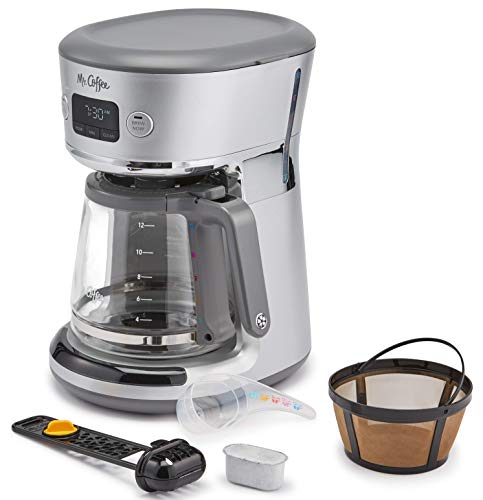
Mr. Coffee Easy Measure 12-Cup — Best Programmable for Beginners
The Easy Measure is the first programmable for households that have been burning toast in this category — inconsistent doses, forgotten setup, pots that vary by who loaded them. Its color-matching system fixes the human side of programming. It does not suit experienced households with an established routine, and its build is mainstream.
Strengths
- Dosing system makes the programmed pot consistent whoever loads it
- Full auto-start at a mainstream tier
- Reusable filter ends the paper errand
Trade-offs
- Guidance is redundant for experienced brewers
- Mainstream brew performance and materials
- Reusable filter needs rinsing after each pot
| Capacity | 12-cup |
| Programming | Programmable auto-start |
| Dosing | Easy Measure color-coded marks |
| Filter | Gold-tone reusable included |
A timer automates when coffee brews; it does nothing about what was loaded. The most common programmable disappointment — ‘the coffee was ready, it just wasn’t good’ — is a dosing failure wearing a scheduling costume. The Easy Measure is built on that diagnosis: its reservoir marks and scoop counts share a color code, so the person loading at 10 p.m., tired and distracted, produces the same ratio as the person who calibrated the pot on a rested Sunday. Around that system sits a competent mainstream programmable with the expected auto-start and a reusable filter that removes the paper supply from the ritual entirely. Brew quality is the honest category middle; the machine’s contribution is that the middle is reached every day, by every member of the household, including guests. For a first programmable — or a household whose current one’s results depend on who loaded it — that consistency is worth more than a degree of brew temperature. Graduates can move up the guide later with their habits already formed.
Teach the household the color, not the numbers: ‘fill to the blue line, blue scoops’ survives tired evenings and visiting relatives in a way that grams and tablespoons never will. The system is the manual, printed on the machine itself.
Best for: beginners and multi-loader households needing consistent scheduled pots / Not suited for: experienced households with a set routine
Comparison Table
| Pick | Badge | Key spec | Best for |
|---|---|---|---|
| Cuisinart Brew Central DCC-1200 | Best Overall Programmable | 12-cup programmable, 1–4 cup mode | scheduled households drinking the pot promptly at wake-up |
| Ninja CE251 Programmable Brewer | Best for Family Schedules | 12-cup programmable, removable reservoir | multi-riser families wanting frictionless night-before setup |
| KRUPS 12-Cup Programmable Thermal | Best Programmable Thermal | 12-cup programmable thermal, 3 strengths | staggered households wanting scheduled coffee that waits gracefully |
| Cuisinart PerfecTemp Thermal DCC-3400 | Best Temperature-Focused Programmable | 12-cup thermal, PerfecTemp heating | quality-focused scheduled households with slow mornings |
| KitchenAid KCM1208 Drip Coffee Maker | Best Design Programmable | 12-cup programmable, spiral showerhead | design-conscious scheduled households wanting even extraction |
| Mr. Coffee Easy Measure 12-Cup | Best Programmable for Beginners | 12-cup programmable, color-coded dosing | beginners and multi-loader households needing consistent scheduled pots |
Use the table to compare roles at a glance, then read the full review of any pick you are seriously considering — the trade-offs matter more than the headline spec.
How to Choose a 12 Cup Programmable Drip Coffee Maker
Programmable machines are bought for a minute of the day. Make sure the other twenty-three hours and fifty-nine minutes work too, by judging in this order: brewer first, holder second, timer third.
First, the Brewer Under the Timer
Strip the clock away mentally and ask what remains: a heater that reaches proper temperature, a showerhead that covers the basket, a small-pot mode that respects shallow beds. The picks in this guide were chosen because their answers survive that stripping. A programmable machine that brews badly is not a convenience; it is a device for producing disappointing coffee at a precise time, and its timer will be abandoned within a month — the universal fate of programming attached to a bad pot.
Second, How the Coffee Waits
Programmed coffee waits by definition — the only question is how gracefully. If your household drinks within the hour, glass and a plate are fine and cheaper. If your mornings stagger across two or three hours, a thermal carafe (KRUPS, Cuisinart DCC-3400) is not a luxury but the difference between the second cup tasting brewed and tasting stored. Match the holder to the household’s real gap between brewing and drinking; it is the most consequential choice in this guide.
Third, the Timer Itself
Grade the programming on four things: how many steps set it (fewer wins at 10 p.m.), whether the clock is legible at arm’s length in a dark kitchen, what happens after a power flicker (does the machine remember, or does it blink and forget the appointment?), and whether small-pot and strength settings can be part of the programmed brew rather than manual-only extras. None of these appear in headline marketing; all of them appear in your life every morning.
Loading the Night Before: The Ritual That Decides Everything
A programmable machine’s coffee is made at loading time, not at brew time. Fresh cold water, measured grounds, a clean carafe seated properly, the timer confirmed — ninety seconds, done half-asleep, and it determines tomorrow’s pot entirely. Two disciplines matter most. First, load in the evening, not the morning before: grounds sitting in a warm kitchen for eighteen hours stale noticeably, while overnight is the accepted window. Second, make loading the job of whoever finishes the current pot, while hands and kitchen are already in coffee mode. Households that ritualize loading never experience the category’s only true failure — the 6 a.m. discovery of an empty machine and a blinking clock.
Programmable vs Smart and Connected Brewers
Shoppers sometimes ask why this guide contains no app-controlled or voice-assistant machines. The honest answer: at 12 cups, connectivity adds cost and a new failure surface (accounts, updates, Wi-Fi drops) to a job a clock chip has done reliably for decades. A timer set once on the machine works during internet outages, power flickers and app redesigns. If your home is deeply invested in a smart ecosystem and voice control genuinely fits your mornings, connected models exist and brew comparably — but buy them as a lifestyle choice, not as a coffee upgrade, because the coffee itself does not improve with an app.
The 45-Minute Rule: Programming Meets Coffee Chemistry
Every recommendation in this guide bends around one piece of chemistry: brewed coffee peaks within minutes and declines measurably after about half an hour of holding, faster on a hot plate, slower in a thermal carafe, never backwards. Programming does not repeal this; it relocates it. The craft of owning a programmable machine is arranging for the decline to happen while the coffee is being drunk rather than while it waits. That is why we program for pour time, why thermal carafes dominate the staggered household, and why the household that brews at 5:30 for a 7:30 drinker should not buy a timer at all — it should buy a machine the drinker starts on arrival, or a single-serve for the early riser and a pot for the rest. Knowing the 45-minute rule converts the whole category from marketing into scheduling: your machine’s job is to place a fresh pot inside your household’s real drinking window, and every feature in this guide is either helping that placement or decorating it.
Weekday and Weekend: Programming Two Different Lives
Most households live two coffee lives: the weekday, which is scheduled to the minute, and the weekend, which is not. Programmable machines serve the weekday natively, but the weekend deserves a deliberate mode too. Leave the timer off on Friday night; brew manually on Saturday, slightly stronger, and drink it fresh in the order it was made rather than in the order people surface. If your machine allows only one programmed time, the weekday owns it — weekends are for the manual override, which every pick here handles with a plain brew button. Households with two distinct weekday schedules (a 5 a.m. shift worker and a 7:30 office riser) face the real test: the honest solutions are a small programmed pot for the first riser using the 1–4 cup mode, or a thermal machine programmed once whose carafe serves both risers across the gap. Both patterns work; what does not work is one glass pot programmed for the first riser and plate-cooked for two hours until the second. The machines in this guide were graded partly on how gracefully they handle exactly this two-life reality.
What the Timer Cannot Fix: A Candid List
Programming is a powerful feature with a precise boundary, and naming the boundary prevents most disappointment. A timer cannot improve stale beans, rescue chlorinated water, correct a wild dose, or descale a heating path. It cannot make a glass carafe patient or a weak heater hot. What it can do is remove the human’s least reliable step — being awake, upright and coordinated at the moment coffee should start — and that turns out to be the step most households actually fail. Buy a programmable machine for that removal, on top of a brewer you would happily own without the clock, and the feature will feel like magic for years. Buy it as a substitute for the brewer underneath, and it will feel like a gimmick by the second month. Every pick in this guide was chosen to be worth owning if its clock were removed tomorrow; the clock is the bonus, not the product.
Clock Literacy: Reading a Programmable Machine’s Interface
It sounds trivial until you are doing it at midnight: setting a brew time on an unfamiliar interface, in a dark kitchen, with a household asleep. The interfaces in this guide divide into the dial-and-button school (Cuisinart’s classic pattern — deliberate, tactile, hard to mis-set) and the modern panel school (Ninja’s — legible, direct, with the program status visible at a glance). Both work; the failure mode is the machine whose program state is ambiguous, where a tired owner cannot tell whether the timer is armed. When you set up any machine here, perform the midnight test once: lights low, set the timer, and confirm you can verify it is armed without the manual. If you can, the machine will serve you for years. If you cannot, tape a two-line cheat note inside the cabinet door — households have done this forever, and it beats a missed pot every time.
Guests, Holidays and the Programmed Pot
The programmed pot has a social superpower: it lets the host sleep. For guest weekends, load the machine after dinner, set it for the earliest riser’s plausible hour, and let the house wake to coffee that nobody had to make — the single most appreciated hospitality trick a kitchen offers. Size the pot to the house, use the strength setting a notch up for a crowd that will add milk and conversation, and put mugs and the machine’s simple instructions where guests can self-serve. Hosts who do this discover the programmed machine is not really a weekday appliance at all; it is the household’s way of being hospitable before anyone is awake enough to be hospitable on purpose. It is also the strongest argument for the 12-cup size in this entire series of guides: guests are the one demand that never arrives in 1–4 cup quantities.
A Word on Auto-Off and Household Safety
Programmable machines pair naturally with auto-off, and the pairing deserves explicit praise: the same household that wants coffee brewed before it wakes is the household that leaves for work in a rush, and a plate that switches itself off removes a whole category of low-grade worry from the morning. Check that your machine’s auto-off window matches your life — too short and it abandons a slow weekend pot; too long and it is decoration. Thermal machines sidestep the question entirely by having nothing to switch off, which staggered households count among insulation’s quieter virtues. Whichever design you choose, treat the first week as a configuration project: clock, program, strength, small-pot logic and auto-off, set once in daylight, and the machine will repay the hour with years of unconsidered reliability.
Energy and the Programmed Pot
A programmed machine sips standby power for its clock — a trivial amount, but nonzero, and worth an honest sentence in a guide that prices everything else honestly. The brew itself uses the same energy as any electric pot; the plate, if the pot waits, is where a programmed machine’s energy quietly accumulates across a morning. Thermal-carafe programmables (the KRUPS and the DCC-3400 here) end their energy story at the end of the brew, which is one more small argument for insulation in the staggered household. None of this should decide a purchase — the sums are small — but households that care will find the thermal programmable is also the energy-considered programmable, and the alignment of taste and efficiency in that design is not a coincidence.
The one energy habit that does matter is also a flavor habit: do not reheat a finished pot by running it back through the machine or leaving it on the plate for hours. Both waste energy to produce worse coffee. Brew the right amount at the right time — which is, after all, the entire skill this category exists to automate.
And if the household’s schedule collapses for a season — a new baby, a shift change, a long holiday, a house full of guests keeping entirely different hours — let the machine rest rather than fighting it. A programmable brewer used manually for a month loses nothing at all; the timer will be there, patient and blinking steadily, when the household’s routine eventually settles back into its familiar early-morning rhythm and the programmed pot becomes, once again, the quiet foundation the whole weekday is built around.
How to Set Up and Program Your Coffee Maker
Set a programmable machine up once, properly, and it will keep its appointments for years:
- Set the clock first, in daylight. Every programmed brew is only as accurate as the clock beneath it. Set it when you unbox, and re-check it after any long power outage.
- Flush two water-only cycles. New-machine taste has no place in a pot brewed while you sleep — you will not be there to notice it, only to drink it.
- Calibrate the dose before automating it. Brew three manual pots across a weekend, settle the household’s dose and strength setting, and only then hand the recipe to the timer.
- Program for pour time, not wake time. Set the brew to finish a few minutes before the first cup is actually poured, so the pot is at its peak when it meets the household.
- Load nightly with fresh water and grounds. Evening loading, morning brewing. Check the carafe is seated and the lid is right — a mis-seated carafe defeats the brew-pause valve and makes a countertop flood, the one dramatic failure this category offers.
- Test the small-pot program. If your machine lets the 1–4 cup mode join the timer, program one small early pot and one full later pot across a weekend and learn what your machine allows. Schedules have more options than most owners discover.
- Put descaling on the calendar. Quarterly. A scaled programmable brews slowly, which means it also brews late — scale steals both flavor and punctuality.
Care for Programmable Machines: Clocks, Scale and Seals
Programmable machines add electronics to the usual coffee-maker care, and the additions are simple. Keep the clock honest after outages. Treat the control panel kindly — wet, coffee-ground fingers on membrane buttons age them fastest, so set the timer with dry hands at night rather than mid-brew in the morning. The brew-pause valve under the basket is the mechanical part that matters most: rinse the basket area weekly so the spring valve seals properly, because a valve held open by grounds is how programmed pots end up on counters instead of in carafes. Descale quarterly without exception — in a programmable machine, scale does not just cool the brew, it delays it, and a household organized around a 6:30 pot notices a machine that finishes at 6:47. Troubleshooting: Problem: the timer brewed but the pot is half size → the carafe was not seated and the pause valve held back the flow; reseat and check the valve. Problem: coffee is ready but weak → the dose was loaded by a tired person; adopt a measuring system. Problem: clock blinking, appointment lost → power flicker; reset promptly and consider it your reminder to check the carafe seating too.
Common Buying Mistakes
Programmable machines fail socially more often than mechanically. The patterns:
- Loading in the morning for the next day. Grounds loaded eighteen hours early stale in the basket. The program window is overnight, not all day.
- Programming for the alarm instead of the pour. A pot finished at wake-up sits while you dress. Program it to finish when the first cup is poured.
- Ignoring the carafe seating. The one dramatic failure in this category — a countertop of coffee — is a mis-seated carafe defeating the pause valve. Check it nightly.
- Buying the timer, skipping the brewer. Punctual bad coffee is still bad coffee. Judge the machine under the clock first.
- Letting the pot wait on the plate for hours. If your mornings stagger, you needed a thermal machine. The plate’s patience is about forty-five minutes.
- Never descaling, then blaming the clock. A scaled machine brews late and sour. The timer was innocent; the heating path was not.
Load nightly, program for the pour, descale quarterly — a programmable machine on those three habits is the most reliable servant in the kitchen.
Final Recommendation
The Cuisinart DCC-1200 is our best overall programmable: proven, complete, with the category’s best small-pot mode. The Ninja CE251 wins family setup friction; the KRUPS Programmable Thermal and Cuisinart DCC-3400 win the staggered morning, on strength range and brew temperature respectively. The KitchenAid KCM1208 is the design pick, and the Mr. Coffee Easy Measure is the beginner’s guarantee of a consistent pot.
Compare the wider 12-cup field and the thermal specialists in the companion guides:
- Best Overall Programmable: Cuisinart Brew Central DCC-1200
- Best for Family Schedules: Ninja CE251 Programmable Brewer
- Best Programmable Thermal: KRUPS 12-Cup Programmable Thermal
- Best Temperature-Focused Programmable: Cuisinart PerfecTemp Thermal DCC-3400
- Best Design Programmable: KitchenAid KCM1208 Drip Coffee Maker
- Best Programmable for Beginners: Mr. Coffee Easy Measure 12-Cup
Best 12 Cup Programmable Drip Coffee Makers Best 12 Cup Coffee Makers Best 12 Cup Thermal Coffee Makers Best 10 12 Cup Coffee Makers Best 12 Cup Electric Coffee Makers
Frequently Asked Questions
How does a programmable coffee maker work?
You load water and grounds ahead of time and set a brew time on the machine’s clock. At the appointed time the machine heats and brews automatically, so the pot is ready when you are. The coffee is only as fresh as the loading — evening setup for a morning brew is the standard rhythm.
Does coffee lose quality when it is programmed the night before?
Slightly, if you load carelessly. Grounds loaded in the evening and brewed in the morning are within the accepted window; grounds loaded a full day ahead stale noticeably. Water should always be fresh at loading. The bigger quality factor is how long the finished pot waits — thermal carafes protect it best.
What happens to the timer if the power goes out?
On most machines the clock and program are lost and the display blinks until reset — the appointment is missed. Some models have limited backup behavior, but the safe habit is to check the clock after any outage, the same as any kitchen clock.
Can I program a small pot, or only a full 12 cups?
On machines with a 1–4 cup or small-batch mode that can be combined with the timer — the Cuisinart DCC-1200 is the classic example — yes. The small-pot mode matters because it adjusts flow for a shallow bed; programming a small pot without it brews weak coffee on schedule.
Is a programmable thermal coffee maker worth it?
For staggered households, it is the most worthwhile upgrade in this category: the pot brews on time and then waits without a plate cooking it. If everyone drinks within minutes of brewing, glass and a plate do the same job for less.
Why did my programmed coffee maker overflow onto the counter?
Almost always the carafe was not seated squarely, so the brew-pause valve under the basket stayed closed and the basket filled until it spilled. Seat the carafe firmly every night and rinse the basket valve area weekly so it moves freely.


