Disclosure: airfryerkitchensupply.com is reader-supported. When you buy through links on our site, we may earn an affiliate commission at no extra cost to you.
Where to buy
Every pump in this guide to the best 115 volt variable speed pool pump was verified against live Amazon listing data through our site’s Creators API connection. One market truth shapes the whole list: true variable-speed pumps wired for 115V are a small niche, because most variable-speed pool pumps are built for 230V. The genuine 115V and dual-voltage 115V/230V variable-speed models below — the CHOOSMO 1.5 HP, the VIVOHOME 2.0 HP and 1.5 HP variable-speed models, the Doheny’s Pool Pro and the Vidapool 2 HP — are the verified options, and we include one clearly labelled dual-speed Aquastrong as a budget alternative for buyers whose real need is two speeds rather than full programmability. Check the current price on Amazon, and confirm the voltage setting and inlet size in the listing before you order.
Introduction: Variable Speed on a Household Circuit, Explained Honestly
If you are shopping for the best 115 volt variable speed pool pump, your pool’s pump pad is wired for standard household voltage — common on above-ground pools, older inground installations and many replacement situations where running a new 230V line would cost more than the pump. Variable speed matters because of simple physics: a pump motor’s power draw falls dramatically as speed drops, so running long hours at low speed for filtration costs a fraction of running short hours at full blast, while still turning the water over. That is the entire economic case, and it is a strong one for a pump that runs every day of the season.
Here is the complication this guide will not hide from you. The pool industry builds most variable-speed pumps for 230V, and many listings that appear under a 115V search are actually single-speed or dual-speed pumps, or 230V-only variable models. We verified each pick’s listing text directly: the variable-speed picks below state 115V or dual 115V/230V operation in their verified titles, and the one dual-speed model is labelled as exactly that, in its badge, its review and the comparison table. If a pump’s speed cannot be programmed across a range, we do not call it variable speed, however the search results dressed it up.
Finally, sizing honesty. Horsepower claims in this category are optimistic across the industry, and a 115V circuit caps how much motor you can feed anyway. Judge these pumps by their stated flow, your pool’s volume and plumbing size, and the speeds you will actually run — not by the biggest HP number on the page. A correctly sized variable-speed pump loafing at low RPM for long, quiet hours is the goal; an oversized pump throttled awkwardly is money spent to defeat the point.
In this guide
Quick Picks
- Best Overall: CHOOSMO 1.5 HP Variable Speed Pool Pump — A dual-voltage 115V/230V variable-speed pump with a programmable 1000–3450 RPM range, app and digital panel control, and self-priming design for inground and above-ground pools.
- Best for Larger 115V Pools: VIVOHOME 2.0HP 115V Variable Speed Pool Pump — A 2.0HP 115V variable-speed, self-priming pump with 1.5-inch and 2-inch inlet options and a strainer basket, described as energy saving for in/above-ground pools.
- Best Mid-Size Value: VIVOHOME 1.5HP 115V Variable Speed Pool Pump — The 1.5HP sibling: 115V variable speed, self-priming, 1.5-inch and 2-inch inlets with strainer basket — the right-sized variable option for most 115V pools.
- Best for Above-Ground Pools: Doheny’s Pool Pro Variable Speed Pump — A 1.5 HP variable-speed pump for above-ground pools, dual 115V/230V, with 3 speed settings, a control panel and smart Wi-Fi control per its listing.
- Best High-Flow Option: Vidapool Variable Speed Pool Pump 2 HP — A 2 HP, 115V variable-speed pump listing a very high 10140 GPH flow figure, with filter basket, for in/above-ground pools.
- Best Budget Alternative — Dual Speed, Not Variable: Aquastrong 1.5HP Dual Speed Pool Pump with Timer — A 1.5HP 115V dual-speed pump with timer and 4795 GPH stated flow — included honestly as the budget step-speed alternative, not a variable-speed pump.
How These Picks Were Chosen
We verified candidates through Amazon’s product data and dropped any pump whose listing did not state 115V or dual-voltage operation for a variable-speed model, any 230V-only variable pump that a search had surfaced misleadingly, and any model whose speed description was too vague to confirm. Survivors were judged on voltage truth first, then on programmability — how many speeds or what RPM range you can actually set — then on stated flow, inlet sizing for common plumbing, self-priming behaviour and control style, from onboard panels to app control.
We also weighted ownership realities: a pool pump lives outdoors, runs thousands of hours and dies by seals, bearings and electronics in that order. Basket size matters because a clogged basket starves the pump. A timer or programmable schedule matters because the energy saving only happens if the low-speed hours actually get run, every day, without you remembering. And where a listing offered both a variable-speed and a confusingly similar dual-speed sibling, we said so, because that mix-up is the most common buying error in this exact niche.
No pump here will rescue undersized plumbing or a neglected filter, and we make no energy-savings promise in numbers — savings depend on your current pump, your run hours and your electricity arrangements. What variable speed reliably delivers is the ability to filter longer, quieter and at lower motor load, and that is the basis on which these picks were ranked.
The 6 Best 115 Volt Variable Speed Pool Pumps, Reviewed

CHOOSMO 1.5 HP Variable Speed Pool Pump — Best Overall
The CHOOSMO is the most complete answer to this exact keyword: a true variable-speed pump that runs on 115V today and can be switched to 230V if your pad is ever rewired. Its listing states a programmable 1000–3450 RPM range, app plus digital control panel operation, self-priming design and suitability for inground and above-ground pools — the full feature set, in the voltage you actually have. It suits owners replacing a single-speed 115V pump who want the real variable-speed experience rather than a compromise.
Strengths
- True programmable variable speed (1000–3450 RPM per the listing), not fixed speed steps
- Dual voltage 115V/230V protects the purchase if the pump pad is rewired later
- App and digital panel control make daily low-speed schedules easy to set and keep
Trade-offs
- Premium tier within this group — the full feature set costs more than the step-speed alternatives
- App control is one more account; the onboard panel covers essentials if you skip it
- Verify your plumbing inlet size against the listing before ordering adapters
| Spec | Detail (from the verified listing) |
|---|---|
| Speed range (listing) | Programmable 1000–3450 RPM |
| Voltage (listing) | Dual voltage 115V/230V |
| Flow (listing) | 5070 GPH |
| Controls (listing) | App and digital control panel; self-priming |
Programmability is what separates variable speed from marketing. A range you can set in RPM lets you find the lowest speed that still skims properly, runs your cleaner and keeps the chlorinator happy, then lock that in as the daily default with a short high-speed window for vacuuming and backwashing. The CHOOSMO’s stated range reaches low enough for genuinely gentle filtration and high enough for full cleaning duties, and having both an app and a physical panel matters more than it sounds: pads get wet, phones stay indoors, and a pump you cannot adjust at the pad is a pump whose schedule never gets tuned after week one.
Commission it properly. Prime the pump fully before first start, program a long low-speed filtration block plus a shorter high-speed block, then check skimming action and filter pressure after a day and trim the low speed up or down in small steps. Keep the strainer basket emptied on a rhythm — variable-speed pumps are quiet, so the audible cue of a struggling pump disappears, and a packed basket can starve the pump silently. Before winter or any long shutdown, follow the manual’s drain procedure; freeze damage does not care how efficient the motor is.
Best for: 115V pool owners who want genuine programmable variable speed with a 230V future option / Not suited for: buyers who only need simple on/off replacement and will never program a schedule
Check on Amazon — check the current price on Amazon and confirm the exact configuration in the listing before you order.

VIVOHOME 2.0HP 115V Variable Speed Pool Pump — Best for Larger 115V Pools
If your 115V pool is on the larger side — a big above-ground or a modest inground with generous plumbing — the VIVOHOME 2.0HP is the higher-output variable-speed option wired for your circuit. Its listing states 115V variable-speed operation, self-priming design and both 1.5-inch and 2-inch inlet compatibility with a strainer basket, which covers the two plumbing sizes you are most likely to find at an older pad. It suits owners whose current single-speed pump is loud, hungry and due for replacement.
Strengths
- Higher-output 2.0HP class for larger pools on a 115V circuit
- Dual inlet sizing (1.5-inch and 2-inch per the listing) eases retrofit plumbing
- Self-priming design with strainer basket suits typical replacement installs
Trade-offs
- A second VIVOHOME listing (B0GVCBNZQ5) describes a near-identical DOE-labelled variant — confirm which listing you are buying
- 2.0HP on 115V draws heavily; your circuit and breaker must be up to it — check the manual’s requirements
- Fewer control details are stated than the CHOOSMO; expect onboard rather than app-first control
| Spec | Detail (from the verified listing) |
|---|---|
| Output class (listing) | 2.0HP |
| Voltage (listing) | 115V variable speed |
| Inlets (listing) | 1.5-inch and 2-inch, with strainer basket |
| Design (listing) | Self-priming, energy saving |
Output headroom matters when a pool has features to feed: a suction cleaner that needs a minimum flow, a heater that will not fire below its flow switch threshold, or long plumbing runs that eat pressure. A 2HP-class variable pump lets you meet those thresholds at part speed instead of running a smaller pump flat out, which is where the efficiency and the quiet both live. The caution is electrical: motor size on a 115V circuit is a real constraint, so treat the manual’s circuit requirements as part of the product, and if your pad circuit is shared or marginal, have an electrician confirm it before the pump arrives, not after it trips.
Match unions and inlet size before the old pump comes out, and photograph the existing plumbing and wiring — retrofits go smoothly when the new pump’s port heights are compared against the old one’s measurements in advance. Run the highest speed only for the hours that need it; the entire point of this pump is the low-speed default. Clean the basket weekly in leaf season, and inspect the lid O-ring each time: a tired O-ring is the classic cause of a self-priming pump that mysteriously loses prime overnight.
Best for: larger pools on 115V power that need real flow headroom at part speed / Not suited for: small above-ground pools, where its output and circuit draw are more than the job needs
Check on Amazon — check the current price on Amazon and confirm the exact configuration in the listing before you order.

VIVOHOME 1.5HP 115V Variable Speed Pool Pump — Best Mid-Size Value
Most 115V pools do not need a 2HP pump, and oversizing wastes the very efficiency variable speed exists to deliver. The 1.5HP VIVOHOME states the same variable-speed, self-priming, dual-inlet package in the size class that matches typical above-ground and smaller inground pools. A near-identical DOE-labelled variant exists under a separate listing (B0GVC5PRC6); the two appear to be listing variants of the same pump family, so choose by the listing in front of you and do not pay a premium for the duplicate.
Strengths
- Right-sized 1.5HP class for the typical 115V pool, with true variable speed
- Self-priming with strainer basket and both common inlet sizes
- Same pump family as the DOE-labelled variant listing, giving buying flexibility
Trade-offs
- Duplicate variant listings make comparison shopping confusing — verify model details carefully
- Control and scheduling detail in the listing is thinner than the premium CHOOSMO
- Like all 115V pumps, maximum flow is capped by the circuit; manage expectations for big water features
| Spec | Detail (from the verified listing) |
|---|---|
| Output class (listing) | 1.5HP |
| Voltage (listing) | 115V variable speed |
| Inlets (listing) | 1.5-inch and 2-inch, with strainer basket |
| Design (listing) | Self-priming, energy saving |
Right-sizing is the quiet skill in pool equipment. A variable-speed pump earns its keep in the long low-speed block, and a 1.5HP unit reaches a given pool’s needed low-speed flow while loafing, where a bigger unit may hunt below its happy range and a smaller one must spin faster and louder for the same turnover. For the average 115V pool — the replacement market this keyword serves — this size class is the sweet spot, and the dual inlet sizing removes the most common retrofit friction. The duplicate-listing situation is worth one more mention: it is a quirk of this marketplace, not a quality signal either way, so judge the listing’s stated specs and seller, and keep your order confirmation.
Set the schedule around turnover, not habit: calculate your pool volume, pick a low speed that turns the water over across a long daily block, and add a short higher-speed window for skimming and cleaning. Recheck after a week — if the surface is not clearing or the cleaner is lazy, nudge the speed up slightly rather than doubling run time at a speed that is not working. Keep the pump pad clear of mulch and leaf dams, because airflow around the motor is its cooling, and a buried pump runs hot however efficient its drive is.
Best for: typical above-ground and smaller inground pools on 115V power / Not suited for: large pools or feature-heavy pools that need the 2HP class’s headroom
Check on Amazon — check the current price on Amazon and confirm the exact configuration in the listing before you order.

Doheny’s Pool Pro Variable Speed Pump — Best for Above-Ground Pools
Doheny’s is a pool-supply name rather than a marketplace brand, and this Pool Pro model is aimed squarely at the above-ground market: its listing describes a 1.5 HP variable-speed pump for above-ground pools, dual voltage, with three speed settings, an easy control panel and smart Wi-Fi control. Three well-chosen speeds cover most above-ground routines — gentle filtration, normal circulation, and full power for vacuuming — without the complexity of full RPM programming.
Strengths
- Purpose-built for above-ground pools, the core 115V audience
- Dual 115V/230V with Wi-Fi control plus an onboard panel
- Three speed settings simplify the schedule decision for non-technical owners
Trade-offs
- Three set speeds are less flexible than a continuous RPM range
- Above-ground focus means inground owners should confirm suitability for their setup
- Newer listing — long-term field history is thinner than legacy brands
| Spec | Detail (from the verified listing) |
|---|---|
| Output class (listing) | 1.5 HP |
| Voltage (listing) | 115V/230V |
| Speeds (listing) | 3 speed settings |
| Controls (listing) | Control panel and smart Wi-Fi control |
There is a real argument that three speeds beat infinite speeds for most owners: the schedule gets set once, in plain language, and actually stays set. Filtration speed for the long daily block, a mid speed for running a suction cleaner, top speed for vacuum-to-waste and backwash — that trio covers an above-ground season. Wi-Fi control earns its place here for a mundane reason: above-ground pads sit behind the pool, often at the far end of the yard, and a pump you can check and adjust from the house is a pump whose schedule survives the summer. Dual voltage quietly future-proofs the purchase if the yard’s electrical ever gets upgraded.
Above-ground plumbing is often flexible hose rather than rigid PVC, and it deserves respect at install: support the pump on a solid, level base, keep hose runs as straight as the layout allows, and use proper unions so the pump can come out for winter storage where your climate demands it. Wi-Fi at a distant pad can be marginal — test signal strength at the pump location before relying on app control, and confirm the onboard panel alone can run your full schedule if the connection drops.
Best for: above-ground pool owners who want simple, app-friendly variable speed / Not suited for: owners who want continuous RPM programming and fine speed tuning
Check on Amazon — check the current price on Amazon and confirm the exact configuration in the listing before you order.

Vidapool Variable Speed Pool Pump 2 HP — Best High-Flow Option
The Vidapool is the flow maximalist’s pick: its listing states 2 HP, 115V variable-speed operation and a headline flow of 10140 GPH with a filter basket, aimed at in/above-ground pools. Treat that flow figure the way you should treat all pool-pump flow claims — as a best-case number at minimal resistance, not what your plumbing will deliver — but even discounted, this is the high-output end of the verified 115V variable-speed market, for larger pools and owners replacing a thirsty high-flow single-speed unit.
Strengths
- Highest stated flow in this guide for big pools on 115V
- True variable-speed design with filter basket included in the description
- 2 HP class gives headroom for cleaners and longer plumbing runs
Trade-offs
- Headline GPH is a low-resistance figure; your real flow depends on your plumbing’s resistance curve
- High output on 115V means heavy circuit draw — verify your breaker and wiring first
- Marketplace brand with a thinner support footprint than pool-supply names
| Spec | Detail (from the verified listing) |
|---|---|
| Output class (listing) | 2 HP |
| Voltage (listing) | 115V |
| Flow (listing) | 10140 GPH |
| Design (listing) | Variable speed, with filter basket |
Flow claims need a translator. A pump’s delivered flow falls as plumbing resistance rises — every elbow, valve, filter and heater adds resistance — so the number that matters is flow at your system’s resistance, which no listing can know. What a high headline figure does tell you is where the pump sits in its maker’s range and that its motor and wet end are sized for volume. If your pool is genuinely large for a 115V installation, or your old pump’s flow was the reason the cleaner never worked, this class is the honest place to shop — paired with a realistic expectation that your gauge readings, not the box, will tell you the truth after install.
Commission with instruments, not impressions: note filter pressure at each speed after install, and use those baselines all season — a rising pressure trend at the same speed means the filter needs cleaning, and a falling one can mean a suction leak or a clogged basket. Keep the electrical side conservative: a dedicated, correctly rated circuit, weatherproof connections, and no shared loads. High-output pumps punish marginal wiring faster than small ones do.
Best for: larger 115V pools needing maximum available flow from a variable-speed pump / Not suited for: small pools, marginal circuits, or buyers who take headline GPH literally
Check on Amazon — check the current price on Amazon and confirm the exact configuration in the listing before you order.
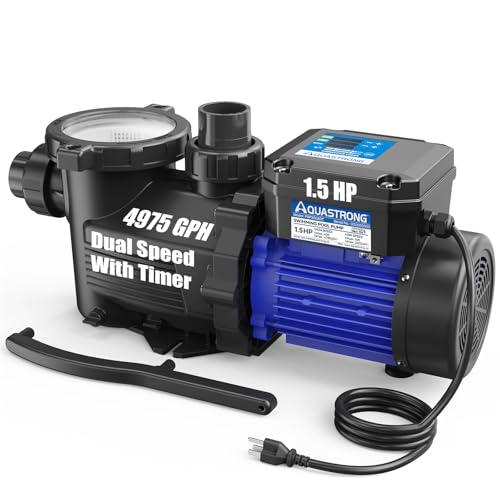
Aquastrong 1.5HP Dual Speed Pool Pump with Timer — Best Budget Alternative — Dual Speed, Not Variable
This pick comes with its label in its badge: the Aquastrong is a dual-speed pump, not a variable-speed one. It offers two speeds and a timer on 115V, with a stated 4795 GPH flow, self-priming design and an in/above-ground brief. Why include it? Because for a meaningful share of buyers, the practical benefit they want — long quiet hours at low speed instead of full-blast filtration — is mostly delivered by a good low speed plus a timer, at a budget tier the true variable pumps do not reach. Buy it with open eyes and it is a sensible purchase; buy it believing it is programmable variable speed and you will be disappointed.
Strengths
- Two speeds plus a timer capture much of the low-speed benefit at a budget tier
- 115V-native, self-priming, sized for in/above-ground replacement work
- Simple controls — nothing to program beyond speed choice and timer
Trade-offs
- Not variable speed: two fixed speeds, no RPM programming or app schedules
- Its dual-speed sibling listings (including a 2HP version) make careful listing-checking essential
- Low speed is a fixed compromise — it may not match your cleaner’s ideal flow
| Spec | Detail (from the verified listing) |
|---|---|
| Output class (listing) | 1.5HP |
| Voltage (listing) | 115V |
| Speeds (listing) | Dual speed with timer |
| Flow (listing) | 4795 GPH |
The physics that makes variable speed save energy also rewards any sustained low-speed running: filtration hours at the Aquastrong’s low speed will use far less power than the same hours at full speed, and the water will be filtered more gently and quietly. What you surrender versus the true variable picks is optimisation — the ability to dial the exact lowest workable speed — and refinement, like app schedules and soft RPM ramps. For an above-ground pool with simple plumbing, that surrender is often worth the saving. For an inground pool with a heater, cleaner and features to coordinate, it usually is not, and the CHOOSMO or VIVOHOME picks earn their premium.
Let the timer do the work: set the long low-speed block once, reserve high speed for vacuuming and after heavy use, and resist running high ‘just in case’ — that habit quietly returns you to single-speed running costs. As with every pick here, keep the basket clean and the lid O-ring supple, and confirm at order time that the listing in your cart is the 1.5HP dual-speed timer model, since this brand sells several lookalike variants side by side.
Best for: budget-conscious 115V owners whose real need is low-speed hours plus a timer / Not suited for: anyone who specifically needs programmable variable speed — choose the picks above
Check on Amazon — check the current price on Amazon and confirm the exact configuration in the listing before you order.
Comparison Table
| Pick | Badge | Key spec | Best for |
|---|---|---|---|
| CHOOSMO 1.5 HP Variable Speed Pool Pump | Best Overall | Programmable 1000–3450 RPM, dual 115V/230V, 5070 GPH | 115V pool owners who want genuine programmable variable speed with a 230V future option |
| VIVOHOME 2.0HP 115V Variable Speed Pool Pump | Best for Larger 115V Pools | 2.0HP, 115V variable speed, 1.5/2-inch inlets | larger pools on 115V power that need real flow headroom at part speed |
| VIVOHOME 1.5HP 115V Variable Speed Pool Pump | Best Mid-Size Value | 1.5HP, 115V variable speed, 1.5/2-inch inlets | typical above-ground and smaller inground pools on 115V power |
| Doheny’s Pool Pro Variable Speed Pump | Best for Above-Ground Pools | 1.5 HP, 3 speeds, dual voltage, Wi-Fi control | above-ground pool owners who want simple, app-friendly variable speed |
| Vidapool Variable Speed Pool Pump 2 HP | Best High-Flow Option | 2 HP, 115V variable speed, 10140 GPH headline flow | larger 115V pools needing maximum available flow from a variable-speed pump |
| Aquastrong 1.5HP Dual Speed Pool Pump with Timer | Best Budget Alternative — Dual Speed, Not Variable | 1.5HP dual speed with timer, 115V, 4795 GPH | budget-conscious 115V owners whose real need is low-speed hours plus a timer |
How to Choose the Best 115 Volt Variable Speed Pool Pump
Start by confirming that variable speed is what you are actually buying. In this niche, search results mix four different animals: true programmable variable-speed pumps, dual-voltage variable pumps that include 115V, fixed dual-speed pumps, and 230V-only variable pumps that should not be in your results at all. Read the listing’s own voltage and speed language — as we did for every pick here — and treat any vagueness as a no. The badge on our Aquastrong pick shows the honest way to handle the budget alternative: labelled for what it is.
Size by turnover, not horsepower theatre. Work out your pool’s volume, decide how many hours you are willing to run, and you have the flow you need; then check that the pump’s plumbing connections match your pad — 1.5-inch and 2-inch are the common sizes, and several picks here accept both. Oversizing a variable pump is less harmful than oversizing a single-speed one, because you can turn it down, but it still costs more to buy and can hunt awkwardly at the bottom of its range on small pools.
Weigh controls by who will actually use them. Full RPM programming rewards tinkerers and pools with mixed duties. Three set speeds suit owners who want the schedule decided in plain language. A dual-speed pump with a timer suits a simple above-ground setup. All three philosophies appear in this guide, and none is ‘wrong’ — the wrong choice is the control style you will abandon by July, leaving the pump on one full-speed setting and the savings unrealised.
Finally, respect the circuit. A 115V pump — especially in the 2HP class — is a serious electrical load on a household circuit. Check the manual’s stated requirements, use a dedicated circuit where the manual calls for one, keep connections weatherproof and GFCI-protected as local code requires, and involve an electrician when anything about the existing pad wiring is a guess. Water and electricity share a pad here; ‘probably fine’ is not a standard.
Why Variable Speed Saves Energy: The Pump Affinity Idea in Plain Language
Pool pumps obey a forgiving piece of physics: flow falls in proportion to speed, but power draw falls much faster — roughly with the cube of speed. Halve the speed and you move about half the water per hour while drawing a small fraction of the power. Run twice as long at half speed and you have moved the same water for dramatically less energy, with quieter operation and gentler wear as by-products. That single idea is the entire case for variable speed, and it is why the long, low daily block is the schedule pattern every pick in this guide is built around.
Two honest caveats keep the idea useful rather than magical. First, some pool equipment has minimum flow needs — heaters, salt chlorinators and suction cleaners each have thresholds — so your low speed is set by the neediest device in the loop, not by the pump’s minimum. Second, savings are relative to what you replace: swapping a modern dual-speed routine for variable speed saves less than retiring an ancient single-speed pump that ran flat out. Judge the upgrade against your own current setup, and let quieter days and longer equipment life count in the decision alongside the meter.
How to Install and Program a 115V Variable Speed Pump
A careful Saturday-morning swap, done in this order, avoids nearly every common failure:
If any step — especially wiring — exceeds your confidence, stop and call a pool technician or electrician. A pump installed safely a week later beats a pump installed bravely today.
- Kill power at the breaker and verify it is off; photograph the existing wiring and plumbing before touching anything
- Compare port heights and inlet sizes between old and new pumps, and dry-fit unions and adapters before cutting any pipe
- Set the new pump on a solid, level base, plumb it with unions so it can be removed later, and keep suction runs as straight as the layout allows
- Wire exactly per the manual, set the voltage selector if the pump is dual-voltage, and confirm GFCI protection is in place
- Fill the strainer housing with water, seat the lid O-ring, start the pump and check for suction leaks — bubbles in the basket mean air is getting in
- Program the schedule: a long low-speed filtration block, a higher-speed window for cleaning duties, then verify skimming, cleaner behaviour and filter pressure over the next day and trim speeds in small steps
Budget Tiers for 115V Pool Pumps, Without the Fantasy
Budget tier here is the dual-speed-with-timer class: most of the low-speed benefit, none of the programming, and a purchase that makes sense for simple pools. Mid-range buys true variable speed in the common 1.5HP size — the VIVOHOME and Doheny’s territory — and it is where most 115V owners should shop first. The premium end adds full RPM programming, app control and dual-voltage flexibility, which pay off on larger or feature-carrying pools and for owners who genuinely tune schedules. Across all tiers, remember the pump is one part of a system that includes your filter, plumbing and circuit; the cheapest system is the correctly sized one you install once and then leave alone to run its quiet daily schedule.
Common Buying Mistakes
Buying a 230V-only variable pump for a 115V pad. It happens constantly through sloppy search results. Verify the listing’s own voltage statement, and prefer dual-voltage models when there is any doubt.
Calling a dual-speed pump ‘variable speed’ in your own head. Two speeds plus a timer is a good budget tool — our Aquastrong pick — but it cannot be programmed across a range. Buy the capability you actually need, labelled honestly.
Sizing by horsepower instead of turnover. Work out your pool volume and needed flow. An oversized pump on a small pool wastes money and can overwhelm a modest filter.
Running high speed all day out of habit. The savings live in the long low-speed block. A variable pump parked at full speed is an expensive single-speed pump.
Ignoring the circuit. Big 115V motors are serious loads. Undersized or shared circuits cause trips, voltage sag and shortened motor life. Verify before you install.
Starving the pump with a clogged basket. Quiet variable pumps hide the sound cues of a struggling pump. Empty the basket on a schedule, not when you notice a problem.
Final Recommendation
If you buy one pump from this guide, make it the CHOOSMO 1.5 HP: it is the most complete true variable-speed answer that runs on your 115V circuit today and survives a future rewire to 230V. Larger pools should look at the VIVOHOME 2.0HP or the Vidapool for flow headroom, typical pools at the right-sized VIVOHOME 1.5HP, above-ground owners at the Doheny’s Pool Pro, and budget buyers — with the distinction fully understood — at the dual-speed Aquastrong and its timer.
Whichever you choose, the pump is only half the purchase; the schedule is the other half. Program the long low-speed block on day one, verify it against your skimmer and cleaner, and then let the quiet hours do the work all season.
Keep reading in this series: Best 115 Volt Welders Best 115 Volt Window Air Conditioner Best 12 24 Volt Battery Charger Best Variable Speed Pool Pump Best 115 Volt Pool Pump Best Above Ground Pool Pump
Running Costs and Noise: Living With a Variable Speed Pump
The daily experience of a variable speed pump is defined less by its specification than by its schedule’s quiet majority. A conventional single-speed pump makes its presence known every hour it runs: a yard dominated by motor hum, a pad you shout over, neighbours who know your filtration timetable by ear. A variable pump at filtration speed changes the social physics of a pool. Conversations happen beside a running pump. Evening swims stop competing with machinery. That calm is not a soft benefit to apologise for — for many owners it is the upgrade they would pay for again even if the meter never noticed, and it is why the CHOOSMO 1.5 HP and the Doheny’s Pool Pro both emphasise app and panel control: a schedule you can adjust from the house is a schedule that stays tuned to real life, including the party weekend and the heatwave week.
Running costs follow the same shape as the noise: they are decided by the hours at the bottom of the range. Every hour moved from full speed to a properly chosen low speed is an hour bought at a small fraction of the power, and the cumulative effect across a season of daily running dwarfs any difference in purchase price between the picks in this guide. That is the honest way to compare the VIVOHOME 1.5HP against its 2HP sibling — not by their tags, but by the schedule each will actually run in your pool. A pump that must run its low hours faster because it is undersized can cost more to live with than a larger pump loafing, and a pump so oversized that its minimum stable speed still churns the pool wastes the difference the other way. The sizing conversation in the buying guide is therefore not pedantry; it is the running-cost decision, made once, in advance.
Wear follows speed too. Bearings, seals and motor electronics all live easier at lower RPM, and the soft ramps of a variable drive are gentler than the daily full-voltage slam of a single-speed start. None of that makes a pump immortal — seals still age, baskets still crack in the sun, and a lightning strike respects no brand — but a machine that spends ninety percent of its life unhurried is playing a longer game than one that sprints every hour it works. Keep the pad drained, shaded where possible and clear of sprinkler overspray, and the electronics that make variable speed possible will repay the courtesy.
Troubleshooting a 115V Variable Speed Installation
Most problems in the first month are installation echoes, not product failures, and they announce themselves in a short list of symptoms. If the pump loses prime overnight, look for air entering on the suction side: the lid O-ring is the first suspect, then union joints and any valve stem that weeps. A smear of silicone lubricant on a cleaned O-ring cures the majority of cases; a cracked lid or a warped basket is the rest. If flow disappoints at a given speed, resist the urge to simply live at maximum — check the filter’s pressure against the baseline you recorded at commissioning, because a loaded filter is the most common thief of flow in any pool, at any voltage.
Electrical symptoms deserve respect and a methodical response. A breaker that trips at start-up on a 2HP-class 115V pump is reporting a circuit at its limit or a failing breaker, not a moody pump: verify what else shares the circuit, confirm the manual’s requirements, and involve an electrician rather than swapping parts hopefully. A pump that runs but whose controls behave erratically in a distant yard may simply be at the edge of Wi-Fi range — the Vidapool 2 HP class of install benefits from confirming signal at the pad before blaming the drive. And a pump that is suddenly loud after a quiet season is usually telling you about its basket, its bearings or debris in the impeller, in roughly that order of likelihood. Work the list from the cheap end, keep the manual open, and remember that a variable speed pump’s quiet is diagnostic gold: any new noise is information, arriving early, while it is still inexpensive.
Quick reference for returning readers: the VIVOHOME 2.0HP and the Vidapool 2 HP serve larger 115V pools, the Aquastrong dual-speed serves budget buyers who understand its label, and the two all-rounders remain the CHOOSMO 1.5 HP and the VIVOHOME 1.5HP. Check the current price on Amazon and confirm inlet size and voltage configuration in the listing before you order.
Frequently Asked Questions
Are there really variable speed pool pumps that run on 115V?
Yes, but they are a niche inside a 230V-dominated category, which is why this guide verified voltage from each listing’s own text. The CHOOSMO, both VIVOHOME variable models, the Doheny’s Pool Pro and the Vidapool all state 115V or dual 115V/230V variable-speed operation. Expect the range to keep growing as above-ground and replacement demand grows, but today, careful listing-reading is the price of admission.
What is the difference between variable speed and dual speed?
A variable-speed pump can be set across a range — by RPM or by several programmable speeds — so you can find the lowest speed that still runs your equipment. A dual-speed pump offers exactly two fixed speeds, high and low, usually with a timer. Dual speed captures much of the energy benefit for simple pools at a lower cost, which is why one is included here, clearly labelled; variable speed adds optimisation and control.
Will a variable speed pump work with my heater and suction cleaner?
Yes, provided your programmed speeds respect each device’s minimum flow. Heaters and salt systems have flow switches that will not operate below a threshold, and suction cleaners need enough flow to move. The usual solution is a schedule with a low filtration speed plus a higher-speed window during which the cleaner and heater do their work. Commission the system by testing each device at your chosen speeds, not by assuming the numbers transfer from your old pump.
Can I replace a 230V pump with a 115V model, or the reverse?
Only by matching the pump to the circuit that actually exists at the pad, or by having the circuit changed by an electrician. Dual-voltage pumps like the CHOOSMO and Doheny’s in this guide can be configured for either supply, which is the safe way to straddle a present 115V pad and a possible future rewire. Never wire a pump to a voltage it is not set and rated for, and never ‘adapt’ with improvised plugs.
How much quieter is a variable speed pump, really?
At low filtration speeds, dramatically quieter — most of a pump’s noise is motor and water velocity, and both fall steeply with RPM. Owners commonly describe being able to hold a conversation beside a pump that previously dominated the yard. At full speed for vacuuming, expect noise comparable to a conventional pump; the difference is that full speed becomes the exception in your schedule, not the rule.
What size variable speed pump does my pool need?
Start from volume and turnover: decide your pool’s gallons and how many hours you want a full turnover to take, and that gives a target flow. Then match the pump’s realistic flow at your plumbing’s resistance, its inlet size to your pipes, and its speed range to your equipment’s minimum flows. For most 115V above-ground and smaller inground pools the 1.5HP class in this guide is the sweet spot; genuinely large pools are the case for the 2HP picks.


