Disclosure: airfryerkitchensupply.com is reader-supported. When you buy through links on our site, we may earn an affiliate commission at no extra cost to you.
Where to buy
Every pick in this guide is sold through Amazon, where you can check the current price on Amazon and confirm exactly what is in the box — gun, ground clamp, wire sample and any helmet bundles vary by listing. Welders are heavy and freight-unfriendly, so a retailer with painless returns matters if a machine arrives damaged or turns out to be the wrong process for your work. Every model below was verified as a current listing during our research, and every one runs on a standard household circuit.
- Hobart Handler 140EZ — Check on Amazon
- Lincoln Electric Easy MIG 140 — Check on Amazon
- Lincoln Electric Weld-Pak 90i MIG — Check on Amazon
- YESWELDER 135A MIG Welder — Check on Amazon
- Forney Easy Weld 140 FC — Check on Amazon
- Hobart Handler 210MVP — Check on Amazon
Shopping for the best 110 volt wire feed welder means shopping inside a hard physical limit, and it is better to meet that limit honestly now than at the workbench later. A household circuit gives a welder roughly the same power budget as a hair dryer, so every machine in this class — whether the listing says 110V, 115V or 120V, which are all the same outlet — tops out at welding mild steel around 3/16 to 1/4 inch thick in a single pass, depending on process and technique. That ceiling covers the overwhelming majority of home welding: trailer repairs, gate hinges, exhaust work, mower decks, farm fixes, furniture frames and automotive sheet metal. It does not cover structural fabrication in thick plate, and no setting, wire or optimism changes that.
Within the ceiling, the class splits by temperament. Transformer machines from Lincoln and Hobart are heavy, simple and famously durable, with tapped or smooth voltage control and decades of parts support. Inverter machines — Lincoln’s 90i line, the YESWELDER and the modern Forney units — are dramatically lighter, sip power more efficiently, and increasingly offer synergic controls that set wire speed from the voltage you choose, which flattens the learning curve for beginners. Process splits the class again: gas-shielded MIG gives the cleanest beads and least cleanup, flux-core wire needs no gas bottle and works outdoors in wind, and the multi-process machines add lift TIG and stick for occasional jobs. This guide labels every pick by process so you know exactly what you are buying.
One warning that applies to the whole category: the internet is full of no-name welders advertising implausible amperage from a household plug. Amps out cannot exceed what the circuit puts in for long, and duty cycle — how many minutes in ten the machine can weld at a given output — is where inflated claims collapse. Every pick here comes from a maker whose ratings have a track record, whose consumables are standard, and whose machines can be serviced. That filter removed more products than any other rule in this guide.
In this guide
Quick Picks
The six picks in one view: two benchmark 140-amp machines, two featherweight inverters, one flux-core specialist and one dual-voltage upgrade for buyers who may wire a 230V outlet later.
- Hobart Handler 140EZ — Best Overall: A 120V, 30–140A machine with two-knob EZ setup, spool-gun readiness and the build quality Hobart is known for. Check on Amazon
- Lincoln Electric Easy MIG 140 — Best for Beginners: A transformer-based 115V, 30–140A classic — forgiving, simple and supported everywhere welding supplies are sold. Check on Amazon
- Lincoln Electric Weld-Pak 90i MIG — Best Portable: A 120V inverter machine in a protective metal case with a shoulder strap, made for small jobs wherever they happen. Check on Amazon
- YESWELDER 135A MIG Welder — Best Value 3-in-1: A 110V synergic machine covering flux-core MIG, lift TIG and stick, with a clear digital display at a budget-tier position. Check on Amazon
- Forney Easy Weld 140 FC — Best Flux-Core Simplicity: A 140-amp, 120V flux-core-only machine with no gas to buy, store or run out of mid-repair. Check on Amazon
- Hobart Handler 210MVP — Best Upgrade Path: A dual-voltage 115/230V machine that starts on your household outlet today and unlocks far more capacity if you add a 230V circuit later. Check on Amazon
How These Picks Were Chosen
Every pick was verified against Amazon’s own catalogue data through the Creators API on the day of research: brand, model, input voltage and process match the manufacturer’s current listing. That verification step mattered more here than in most categories, because welder listings are notorious for headline amperage that the fine print walks back. Machines whose own listings could not confirm a household-voltage input and a wire-feed process were excluded rather than repeated from secondary sources.
Judging criteria, in order: honest output and duty cycle for the class; process fit — whether the machine does gas MIG, flux-core, or both, and whether that matches the work beginners and home shops actually do; wire-drive quality, because a cast, well-aligned drive assembly feeds wire smoothly while a flimsy one bird-nests your spool and ruins your afternoon; consumables standardisation, favouring machines that take common tips, liners and guns; and maker support — parts, manuals and a service network that will exist in five years. Weight and portability broke ties, because a welder that lives where the work is gets used, and one that lives under a bench mostly does not.
One notable absence, stated plainly: Miller’s Millermatic line is the other benchmark name in this class, but the API returned only replacement guns and parts for it during research, not a verifiable machine listing, so no Miller machine appears below. That is a verification gap, not a judgement on the machines — if you are cross-shopping, the Millermatic family is the obvious additional stop, bought from a welding supplier who can confirm the exact model.
The 6 Best 110 Volt Wire Feed Welders
Ordered by how most buyers should consider them: the best all-round machine first, then the beginner and portability picks, the value and flux-core specialists, and finally the dual-voltage upgrade.

Hobart Handler 140EZ — Best Overall
The Handler 140EZ is what a household-voltage wire welder looks like when a serious maker designs it for people who are not welders by trade. It is a 120V machine with a 30–140A output range, runs flux-core wire (and is spool-gun ready, which opens the door to aluminium work with the right setup), and its EZ mode collapses setup to two knob turns: set the material thickness and weld. Hobart states it welds from 24-gauge sheet up to 3/16 inch steel — a realistic, honest range for this class. At 53 lb it is portable in the carry-it-to-the-trailer sense, not the carry-it-all-day sense, and its infinite voltage control lets experienced users fine-tune beyond the EZ presets.
Check the current price on Amazon
Strengths
- EZ two-knob setup genuinely shortens the path from unboxing to a sound first bead
- Spool-gun ready — a real aluminium upgrade path most rivals in this class lack
- Hobart build quality and parts support are proven over decades
Trade-offs
- 53 lb is luggable, not light — inverter rivals weigh a third as much
- Flux-core focus means messier beads and more cleanup than gas MIG
- Spool gun for aluminium is an extra purchase, not included
| Specification | Detail |
|---|---|
| Input | 120V |
| Output range | 30–140A |
| Process | Flux-core wire feed; spool gun ready |
| Stated capacity | 24-gauge to 3/16 in mild steel |
| Control | EZ mode, two-knob setup; infinite voltage control |
| Weight | 53 lb |
The EZ concept deserves respect rather than suspicion. The classic beginner failure with a wire welder is not bad hand technique — it is bad settings: wire speed mismatched to voltage produces either a sputtering, porous mess or a wire that stubs and pushes the gun back. A mode that ties the two together from a thickness setting removes the most common cause of ugly first welds, and the fact that the machine still exposes full manual control means it does not become a ceiling later. You learn on rails, then step off them.
Who should skip it? Buyers who know they want gas-shielded MIG as their primary process — for autobody sheet metal and visible fabrication, gas MIG’s cleaner bead and lower cleanup are worth building around, and the Lincoln below or a gas-capable setup serves better. Buyers who will weld mostly outdoors in wind, or who want the lightest possible machine for fence-line work, should also look further down this list. For the broad middle — home shop, farm and trailer work by someone who welds monthly, not daily — the 140EZ is the most complete answer in the class.
Best for: home shops and farm repairs in sheet to 3/16 in steel, especially newer welders / Not suited for: buyers committed to gas MIG as their main process, or anyone needing a truly lightweight field machine

Lincoln Electric Easy MIG 140 — Best for Beginners
The Easy MIG 140 is the traditional end of the class: a transformer-based, 115V wire-feed welder with a 30–140 amp output, capable of both flux-cored and gas-shielded MIG welding. Transformer machines are heavier and less feature-rich than inverters, and in exchange they offer a soft, forgiving arc, very few electronics to fail, and a service story measured in decades — any welding supply counter in the country knows this machine’s family on sight. For a beginner, the forgiving arc is the headline: this design tolerates imperfect settings and technique better than most, which means more of your early welds hold and fewer end up ground out.
Check the current price on Amazon
Strengths
- Does both flux-core and gas MIG — buy a bottle when you are ready, not before
- Transformer arc is forgiving for learners and hard to kill
- Lincoln’s support, manuals and consumables availability are the class benchmark
Trade-offs
- Transformer weight makes it a shop machine, not a field machine
- No synergic hand-holding — you learn settings the traditional way, from the chart
- Older design lacks the digital displays and presets of inverter rivals
| Specification | Detail |
|---|---|
| Input | 115V |
| Output range | 30–140A |
| Process | Flux-cored / gas MIG wire feed |
| Design | Transformer |
| Model | K2697-1 |
There is a real argument that beginners learn faster on a machine like this than on a fully synergic one. The door chart gives you starting settings for each wire and thickness; you dial them in, weld, look at the bead, and adjust one variable at a time. That loop — setting, bead, diagnosis, correction — is the actual skill of welding, and a machine that does it for you can postpone learning it. The Easy MIG’s simplicity forces the loop while its forgiving arc keeps the loop encouraging rather than punishing. Pair it with a decent auto-darkening helmet and a grinder, and it is a complete welding education for the price of the machine.
The honest caveats are weight and era. You will not carry this machine up a ladder or toss it in the truck for a fence repair without thinking about it, and its control layout belongs to an earlier generation. Neither matters in a fixed home shop, which is where this machine belongs. Buyers who split time between shop and field should weigh the 90i below; buyers who want one machine to learn on and keep for twenty years have found it.
Best for: beginners and home shops wanting one durable machine for both flux-core and gas MIG / Not suited for: field work, ladder work, or buyers who want synergic presets and digital readouts

Lincoln Electric Weld-Pak 90i MIG — Best Portable
The 90i MIG is Lincoln’s inverter answer to a simple question: what is the least welder you can carry to a small job and still make a sound weld? It is a 120V machine in a protective metal case with a shoulder strap, weighing a fraction of the transformer picks, and it runs both MIG and flux-core wire. Its sibling, the 90i FC, is flux-core only and is described by Lincoln as welding steel up to 1/4 inch — treat that as a best-case figure for careful work in ideal conditions rather than a routine expectation, as with every machine in this class. The MIG version’s dual-process flexibility makes it the better buy of the two for most people.
Check the current price on Amazon
Strengths
- Genuinely portable — shoulder strap, metal case, inverter weight
- Runs MIG and flux-core, so one small machine covers indoor and outdoor jobs
- Lincoln backing and documentation, unlike the no-name inverter crowd
Trade-offs
- 90-amp class output is the lowest here — thin-to-medium steel is its world
- Small machine, small duty cycle: long seams need patience and rest breaks
- Not the tool for repeated 3/16 in work; that is 140-amp territory
| Specification | Detail |
|---|---|
| Input | 120V |
| Process | MIG and flux-core wire feed |
| Design | Inverter |
| Format | Protective metal case, shoulder strap |
| Model | K5256-1 |
Portability changes behaviour, and behaviour is half of ownership. A welder that takes thirty seconds to carry to a broken gate hinge gets used the day the hinge breaks; a welder that needs a cart, a clear bench and an extension cord turns the same job into a weekend project that may never happen. The 90i’s case-and-strap format is designed around that reality — it is a grab-and-go repair tool for the long tail of small steel jobs around a house, farm or smallholding: brackets, frames, furniture, gates, exhaust hangers, mower parts.
Respect its envelope and it will not disappoint. Thin and medium steel, short beads, intermittent work — that is the design brief. Ask it to run long seams in thick material and the duty cycle will stop you, repeatedly, by design. Buyers whose typical job is a trailer frame or a thick repair should step up to a 140-amp pick; buyers whose typical job is everything else small and steel will find this the most-used welder they own.
Best for: mobile small repairs, gates, brackets and thin-to-medium steel anywhere on the property / Not suited for: long seams, thick material, or production-paced work

YESWELDER 135A MIG Welder — Best Value 3-in-1
YESWELDER built its name by putting inverter features into price tiers the legacy brands do not contest, and the 135A is the clearest example: a 110V machine offering gasless flux-core MIG, lift TIG and stick in one box, with synergic control and a clear digital display. For a beginner, synergic control is the draw — choose the process and material thickness and the machine proposes wire speed and voltage together, which removes the two-knob guessing game. As a budget-tier machine it will not match Hobart or Lincoln for drive-assembly refinement or decades-long parts depth, and this guide will not pretend otherwise; what it offers is the widest process coverage per dollar in the class, from a maker with an established direct-support channel.
Check the current price on Amazon
Strengths
- Three processes in one 110V machine — MIG, lift TIG and stick
- Synergic control plus a readable display makes setup approachable
- Budget-tier positioning undercuts the legacy brands substantially
Trade-offs
- Fit, finish and drive refinement sit a class below Hobart and Lincoln
- Long-term parts and service depth is thinner than the legacy networks
- TIG here is lift-start and DC — fine for steel, not an aluminium TIG solution
| Specification | Detail |
|---|---|
| Input | 110V |
| Output | 135A class |
| Processes | Flux-core MIG, lift TIG, stick |
| Control | Synergic control, digital display |
| Design | Inverter |
The right way to judge this machine is by who it serves. A first-time welder with a fixed, modest budget faces a choice: a stripped legacy machine that does one process well, or a feature-rich machine like this that does three processes adequately and lets them discover which they actually enjoy. Discovery has real value — many buyers learn they prefer stick for outdoor farm repairs, or that TIG’s control suits their fabrication instincts, and a 3-in-1 lets that discovery happen without a second purchase. The digital display and synergic setup lower the odds that the machine sits unused after two frustrating sessions, which is the true failure mode of budget welding gear.
Calibrate expectations on refinement. Wire feeding on budget inverters can be fussier with cheap wire, the gun and leads are built to a price, and if the machine fails in year six the repair path is murkier than Lincoln’s. Buy good wire, keep the liner clean, and treat the machine as the capable tool it is rather than a lifetime heirloom. At its tier, it is the value pick of this guide by a clear margin — check the current price on Amazon, since this segment’s pricing moves often.
Best for: first-time welders and budget buyers who want to try MIG, TIG and stick in one machine / Not suited for: buyers who prioritise lifetime parts support and drive-assembly refinement

Forney Easy Weld 140 FC — Best Flux-Core Simplicity
The Forney Easy Weld 140 FC strips the wire-feed concept to its essentials: a 140-amp, 120-volt flux-cored welder, no gas required, no bottle to buy, rent, refill or store. Flux-core wire carries its own shielding in the wire itself, which is why this process shrugs off outdoor wind that would blow a MIG gas shield away — and why it suits the repair work this machine is aimed at: farm equipment, fences, trailers and steel that lives outside. Forney is a long-established American welding brand, and the Easy Weld line is its straightforward home range. What you give up versus gas MIG is bead appearance and cleanup: flux-core leaves slag to chip and more spatter to grind.
Check the current price on Amazon
Strengths
- No gas bottle, regulator or refills — the running-cost story is simply wire
- Flux-core process works outdoors in wind where gas MIG struggles
- Simple, focused machine from an established welding brand
Trade-offs
- Flux-core only — no path to gas MIG’s cleaner beads on this machine
- Slag cleanup and spatter are part of every job
- Less suited to thin, visible autobody work than a gas MIG setup
| Specification | Detail |
|---|---|
| Input | 120V |
| Output | 140 amp class |
| Process | Flux-cored wire feed (gasless) |
| Brand line | Forney Easy Weld |
There is a underrated virtue in a machine that does one thing. Every control on the 140 FC exists for flux-core welding; there is no gas solenoid, no polarity swap for process changes, no bottle logistics in the background of every job. For the buyer whose welding is 90% outdoor repair — and in farm and rural use that is a common, honest profile — the simplicity is not a limitation but a match. The machine also dodges a quiet budget trap: gas MIG’s true cost includes the bottle, and buyers who skip it end up running flux-core in a MIG machine anyway, having paid for hardware they do not use.
Choose it with eyes open about finish. If your projects are visible — furniture, railings, automotive panels — flux-core’s cleanup tax is paid on every piece, and a gas-capable pick serves you better. If your projects are functional and outdoors, the tax is a wire brush and thirty seconds. Forney also sells a multi-process sibling, the Easy Weld 140 MP, for buyers who like the brand but want MIG, TIG and stick coverage; within this guide’s flux-core brief, the dedicated FC machine is the cleaner recommendation.
Best for: outdoor and farm repair welding where gas is impractical and simplicity wins / Not suited for: visible fabrication, autobody work, or buyers who want a gas MIG path
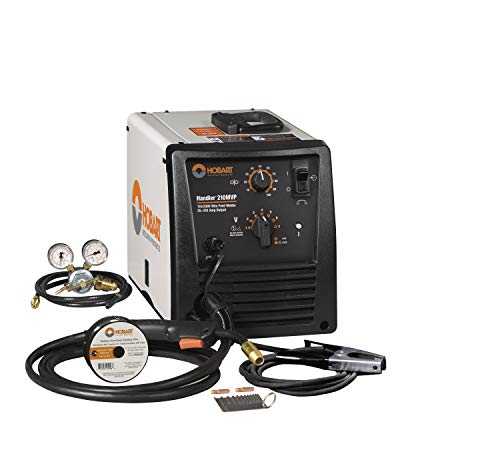
Hobart Handler 210MVP — Best Upgrade Path
The 210MVP is the pick for the buyer who suspects — correctly — that their ambitions will outgrow a household circuit. It is a dual-voltage machine: Hobart’s MVP plug system lets it run on 115V today as a capable wire-feed welder, and on 230V later with substantially more output on tap, from the same box. On 115V it behaves like the other 140-class machines in this guide; the reason to buy it is the second half of its life, when an electrician adds a 230V outlet and the machine unlocks the thickness range that household voltage physically cannot reach. It is the only pick here that does not need replacing when your work grows.
Check the current price on Amazon
Strengths
- Dual-voltage MVP plug: household outlet now, 230V capacity later
- Full-size Hobart build, drive and support — a long-term machine
- Avoids the buy-twice trap for buyers planning a shop upgrade
Trade-offs
- You pay for capacity you cannot use until a 230V circuit exists
- Bigger and heavier than the household-only picks
- On 115V alone, it offers little over the cheaper 140EZ for the same jobs
| Specification | Detail |
|---|---|
| Input | 115/230V dual voltage (MVP plug) |
| Process | Wire feed MIG / flux-core |
| Phase | Single-phase |
| Brand line | Hobart Handler |
Frame the decision as a timeline. If a 230V outlet is a genuine plan — a shop build, a panel upgrade, a move — the 210MVP converts that future electrical work into an instant welder upgrade, and its cost premium over the 140EZ is smaller than the cost of a second machine. If no 230V circuit will ever exist, the premium buys nothing and the honest recommendation is the 140EZ or the Lincoln. This is the rare case where the more expensive machine is the frugal choice, but only for buyers whose plans are real rather than aspirational.
On household power, expect full 140-class behaviour with Hobart’s usual manners: a stable arc, a proper drive assembly and settings that behave as the chart promises. The machine’s size is the daily reminder of the bargain — it occupies more bench and asks more of your back than the inverters here. Buyers who weld in one fixed shop will not care; buyers who carry their welder to the work should look at the 90i and YESWELDER picks instead.
Best for: buyers with a real plan to add a 230V circuit who want one machine for both eras / Not suited for: buyers who will never wire 230V, or who need portability
Comparison Table
Process and upgrade path separate these six more than amperage does — every machine here lives under the same household-power ceiling today. Match the process to your work first.
| Pick | Badge | Key spec | Best for |
|---|---|---|---|
| Hobart Handler 140EZ | Best Overall | 120V, 30–140A, spool-gun ready | home shops and farm repairs in sheet to 3/16 in steel, especially newer welders |
| Lincoln Electric Easy MIG 140 | Best for Beginners | 115V transformer, 30–140A, MIG + flux-core | beginners and home shops wanting one durable machine for both flux-core and gas MIG |
| Lincoln Electric Weld-Pak 90i MIG | Best Portable | 120V inverter, shoulder-strap case | mobile small repairs, gates, brackets and thin-to-medium steel anywhere on the property |
| YESWELDER 135A MIG Welder | Best Value 3-in-1 | 110V, MIG/TIG/stick, synergic | first-time welders and budget buyers who want to try MIG, TIG and stick in one machine |
| Forney Easy Weld 140 FC | Best Flux-Core Simplicity | 120V, 140A, flux-core only | outdoor and farm repair welding where gas is impractical and simplicity wins |
| Hobart Handler 210MVP | Best Upgrade Path | 115/230V dual voltage | buyers with a real plan to add a 230V circuit who want one machine for both eras |
How to Choose a 110 Volt Wire Feed Welder: Start With Process
Gas MIG versus flux-core is the decision everything else hangs on. Gas-shielded MIG — solid wire plus a bottle of shielding gas — produces the cleanest beads, the least spatter and the easiest learning curve on thin sheet, which is why autobody and visible fabrication default to it. Its weaknesses are logistics and weather: the bottle costs money, runs out, and its gas shield blows away outdoors. Flux-core wire needs no bottle because the shielding is inside the wire; it welds happily in wind, bites well on less-than-perfect metal, and pays for it with slag, spatter and cleanup on every joint. Most home welders eventually use both; your first machine should be chosen for the work you will do in the next year, not the work you imagine in five.
Multi-process machines complicate the choice in a useful way. Stick welding remains the fallback for thick, dirty or awkward outdoor work, and lift TIG offers control on thin steel that MIG cannot match — but each added process is hardware and money. A dedicated wire machine (Hobart 140EZ, Forney 140 FC) spends its whole budget on the one process; a 3-in-1 (YESWELDER) spreads it. Neither answer is wrong; the mistake is buying coverage you will never use while starving the process you use weekly of drive quality and duty cycle.
Amperage, Duty Cycle and the Household Circuit
Read welder specifications in this order: duty cycle first, amperage second. A machine rated to weld at a given output for only a small fraction of a ten-minute cycle will spend your long seams sitting in thermal shutdown, while a machine with a stronger duty cycle at the same headline amps keeps working. On household voltage the practical ceiling is consistent across brands — plan on quality single-pass welds up to about 3/16 inch, with 1/4 inch achievable by flux-core in favourable conditions, good fit-up and honest technique, ideally with multiple passes on anything structural. Listings that promise far more from the same outlet are describing the power supply’s dreams, not the arc’s reality.
The circuit itself is part of the welder. These machines want a 20-amp household circuit with little else on it; a shared circuit feeding a compressor, heater or freezer will trip breakers and starve the arc, and long thin extension cords cause the voltage sag that makes welds cold and porous. If you must use an extension cord, use the shortest, heaviest-gauge one you own and treat it as a temporary concession. Many frustrating ‘bad welder’ stories are actually bad power stories, and they are the cheapest problem in welding to fix.
Wire, Drive Systems and Consumables: Where Quality Hides
A wire welder is a wire-delivery system with an arc attached. The drive assembly — motor, drive rolls, guides and liner — decides whether wire feeds at a perfectly steady rate or surges and stalls, and the bead tells the difference instantly. This is the component where legacy brands earn their premium: aligned, well-supported drives feed smoothly for years, while flimsy ones bird-nest spools and chew liners. When comparing machines, weight is a crude but honest proxy — transformers and real drive hardware are heavy, and a suspiciously light full-size machine has saved money somewhere you will eventually find.
Consumables decide running costs and sanity. Standardise on machines that take common contact tips, nozzles and liners, keep spares of the tip size you use, and buy decent wire — bargain wire with inconsistent diameter and winding is the single cheapest way to make a good welder feed badly. Match wire to work: smaller-diameter wire for thin sheet and household circuits, flux-core for outdoor and dirty steel, solid wire with gas for clean indoor fabrication. Store wire dry; rusty wire feeds like sandpaper and welds like it too.
How to Set Up a Wire Feed Welder and Lay Your First Beads
Setup is a sequence, and doing it in order is what separates a calm first session from a frustrating one. Work through these steps on scrap of the same thickness as your real project before touching the project itself.
- Make the space safe: clear flammables well beyond the work area, ventilate, put on a proper auto-darkening helmet, gloves and natural-fibre clothing, and keep a fire extinguisher within reach — welding sparks travel further than beginners expect.
- Prepare the metal: grind or brush the joint area back to bright steel. Mill scale, paint, rust and galvanising all poison welds and some produce genuinely hazardous fumes; clean metal is the cheapest quality upgrade in welding.
- Load the wire correctly: mount the spool so it unwinds smoothly, feed the wire through the guides and drive rolls with the correct groove for its diameter, set drive tension until the wire feeds without slipping but a stalled roll does not shred it, and thread the liner and gun.
- Set polarity and starting settings: flux-core and gas MIG use opposite polarities on most machines — follow the door chart for your process, then set voltage and wire speed from the same chart for your wire and thickness.
- Attach the work clamp to clean metal as close to the joint as practical; a clamp on paint or rust is a weak, wandering arc waiting to happen.
- Run test beads on scrap: listen for the steady sizzle of a correct arc, watch the puddle rather than the arc itself, and adjust one variable at a time — wire speed first for most beginner faults — until beads come out flat, even and fused at the edges.
- Weld the project in short sections, letting the machine rest within its duty cycle, then chip slag (flux-core), inspect for fusion and cracks, and grind only for appearance — grinding cannot rescue a cold, unfused joint.
End every session by coiling leads loosely, closing the gas valve if fitted, and noting the settings that worked in a notebook or on tape on the machine. Welding skill compounds quietly; the notebook is how you keep the gains.
Troubleshooting the Five Faults Every Beginner Meets
Problem: the arc sputters and the wire stubs into the work → wire speed is usually too high for the voltage, or the work clamp connection is poor. Clean the clamp point, then reduce wire speed or raise voltage slightly and retest on scrap. Problem: the wire burns back to the tip repeatedly → wire speed is too low, the tip is worn or the wrong size, or the liner is kinked; replace the tip first because it is cheap and often guilty. Problem: beads sit tall and ropey with no fusion at the edges → the joint is too cold: raise voltage, slow your travel, and confirm you are not welding through paint or scale.
Problem: porosity — tiny holes peppering the bead → shielding has failed. With gas MIG, check the bottle, flow and wind; with flux-core, check polarity and wire condition, and slow down so the slag system can do its work. Problem: the machine stops mid-job and will not restart for several minutes → that is the duty cycle enforcing itself, not a breakdown. Let it cool, shorten your weld segments, and if it happens constantly, your work has outgrown the machine’s class — the honest fix is rest discipline or a higher-duty machine, not a defeated thermal switch.
Safety Gear and the True Starting Cost of Wire Welding
A welder’s price is not a welding budget, and planning the difference in advance is what separates a first month of welding from a first month of shopping trips. The non-negotiables: an auto-darkening helmet of decent quality — the single most important learning tool in the kit, because a beginner who can see the puddle clearly learns in days what a beginner squinting through a poor lens learns in months; welding gloves; natural-fibre clothing and sleeves, since synthetic fabrics melt; and a grinder with flap discs and a wire wheel, because preparation and cleanup are half the craft. Add a welding cart or a planned bench spot, spare contact tips in your wire’s size, and a second spool of wire so a finished spool never ends a Saturday.
None of this needs to arrive at once, and the legacy-brand machines in this guide hold their value well enough that buying the welder first and the kit across a month is a rational sequence. What should not be deferred is the helmet: every other shortcut in welding is recoverable, and that one is paid for in eye strain, bad beads and abandoned learning. Budget the machine, the helmet and the grinder as one purchase in your head, whichever order the parcels arrive in, and the class’s real entry price — still modest for a capability that lasts decades — will never surprise you.
Common Buying Mistakes
Most returns and regrets in this category come from the same short list of buying errors rather than from defective machines.
- Believing headline amperage over duty cycle: the machine that welds longest at useful output beats the machine with the biggest number on the box.
- Buying gas MIG and never buying gas: you end up running flux-core in a machine whose premium features you are not using — or not welding at all.
- Ignoring the circuit: a shared 15-amp circuit and a long thin extension cord will make any welder in this guide seem broken.
- Skipping the helmet budget: a poor helmet makes learning miserable and unsafe; budget for a decent auto-darkening helmet from the start.
- Choosing by process count alone: three mediocre processes lose to one good one if that one is your actual work.
- Expecting thick-plate capacity: household voltage sets a real ceiling near 3/16–1/4 inch; planning structural thick work means planning a 230V machine.
Final Recommendation
For most buyers, the Hobart Handler 140EZ is the answer: honest capacity, genuinely helpful setup, a spool-gun upgrade path and support that will outlast the purchase. Beginners who want to learn settings properly should take the Lincoln Easy MIG 140 and its forgiving transformer arc; buyers who weld wherever things break should take the little Lincoln 90i MIG and its shoulder strap. The YESWELDER 135A is the value route into three processes, the Forney 140 FC is the purist’s outdoor repair tool, and the Hobart 210MVP is the one machine here that grows with a future 230V shop. Every one of them will weld the work this class exists for — the differences are temperament, not competence.
Whichever you choose, spend the first hour on scrap, on a clean circuit, with the door chart open. That hour teaches more than any specification sheet, and it is the difference between a welder you own and a welder you use.
- Hobart Handler 140EZ — Check on Amazon
- Lincoln Electric Easy MIG 140 — Check on Amazon
- Lincoln Electric Weld-Pak 90i MIG — Check on Amazon
Keep exploring the same cluster before you decide: Best 110 Volt Winches Best 115 Volt Air Conditioner Best 110 Volt Window Air Conditioner Best 115 Volt Air Conditioner With Heat
Frequently Asked Questions
Are 110V, 115V and 120V welders all the same thing?
Yes. North American household power is nominally 120V, and manufacturers label the same input class 110V, 115V or 120V by convention. Any machine under any of those labels plugs into the same standard outlet; what matters is the machine’s output range, duty cycle and the capacity of the circuit you plug it into.
How thick can a 110 volt wire feed welder actually weld?
Realistically, quality single-pass welds up to about 3/16 inch in mild steel, with 1/4 inch possible using flux-core wire, good fit-up and multi-pass technique on non-critical work. Hobart’s stated range for the 140EZ — 24-gauge to 3/16 inch — is the honest shape of the whole class. Structural or repeated thick-plate work needs a 230V machine.
Flux-core or gas MIG for a first welder?
Choose by workplace. Indoors, on clean and thinner steel, gas MIG gives cleaner beads and an easier learning curve. Outdoors, on farm steel and in wind, flux-core wins because it needs no gas shield and no bottle. Many buyers start flux-core for its simplicity and add gas later — machines like the Lincoln Easy MIG 140 support both, so the decision can evolve.
Do I need a special outlet or circuit for a 110 volt welder?
You need a healthy 20-amp household circuit with little else running on it, and the shortest practical cord run. A shared or overloaded circuit trips breakers and starves the arc, producing cold, porous welds that look like machine faults. If your panel can spare a dedicated circuit for the welding corner, it is money well spent.
Can a 110 volt welder weld aluminium?
Yes, with the right setup: aluminium wire is too soft to push through a standard gun liner, so a spool gun is the practical route — which is why the Hobart 140EZ’s spool-gun readiness matters. DC lift TIG on multi-process machines like the YESWELDER is for steel, not aluminium; aluminium TIG requires AC output, which lives in a different machine class.
Why does my new welder keep stopping mid-weld?
Almost always the duty cycle: the machine has reached its thermal limit for its ten-minute cycle and is protecting itself. Shorten weld segments, let it cool with the fan running, and check that vents are unobstructed. If it happens constantly on modest work, confirm the circuit is not sagging under load before suspecting the machine.


