Disclosure: airfryerkitchensupply.com is reader-supported. When you buy through links on our site, we may earn an affiliate commission at no extra cost to you.
Where to buy
All six picks in this guide are sold through Amazon, where you can check the current price on Amazon and confirm the chassis dimensions against your window before ordering — at this size class, fit is not a detail. These are the heaviest window units a household circuit can run, so a retailer with straightforward returns matters if the unit arrives damaged or the window opening turns out smaller than measured. Every model below was verified as a current listing during our research, and every one runs on a standard 115V household outlet rather than a 230V line.
- LG 14,000 BTU Window Air Conditioner — Check on Amazon
- Whirlpool 15,000 BTU Window Air Conditioner — Check on Amazon
- Amana 15,000 BTU Window Air Conditioner — Check on Amazon
- Friedrich Chill Premier 14,000 BTU Window Unit — Check on Amazon
- LG 12,000 BTU Dual Inverter Window AC — Check on Amazon
- Frigidaire 12,000 BTU Smart Window Air Conditioner — Check on Amazon
Finding the best 110 volt window air conditioner for large rooms starts with the honest ceiling of the whole idea: on a household circuit — labelled 110V, 115V or 120V depending on the brand, all the same outlet — window cooling tops out at about 15,000 BTU. That is enough for a genuinely large room: the manufacturers in this guide state coverage of 700 sq ft for their biggest household-voltage models, and LG states up to 800 sq ft for its 14,000 BTU unit under favourable conditions. If your space is larger than that, or an open-plan floor with a kitchen’s heat load at one end, the truthful answer is that no single household-voltage window unit will hold it on the worst afternoons — you need a second unit, a 230V model on a dedicated circuit, or a different cooling architecture entirely.
Within the ceiling, though, large-room buyers are well served. The picks below are the strongest verified household-voltage machines: two 15,000 BTU flagships from Whirlpool and Amana, two 14,000 BTU units from LG and Friedrich, and two 12,000 BTU models — an LG dual inverter and the Frigidaire smart unit — that suit large-but-not-huge rooms and run more gently doing it. Each pick states its manufacturer’s coverage figure from its own listing, so the matching of machine to room is arithmetic, not hope.
Large-room cooling also punishes the two classic mistakes harder than small rooms do. Undersize here and the unit runs at maximum from noon to midnight, never quite arriving, wearing itself out in the attempt; oversize and the short-cycling humidity problem arrives with a bigger, more expensive machine. And the physical side matters more: these are the heaviest window units made for homes, they draw the most current a household circuit will give, and installation is a planned two-person operation, not an impulse. The guide sections below treat sizing, circuits and installation with the seriousness this class demands.
In this guide
Quick Picks
The six picks in one view: the strongest household-voltage coolers you can buy, from the 15,000 BTU maximum down to the efficient 12,000 BTU options for large-but-manageable rooms.
- LG 14,000 BTU Window Air Conditioner — Best Overall for Large Rooms: 115V, remote control, three speeds and auto restart, with coverage stated up to 700–800 sq ft. Check on Amazon
- Whirlpool 15,000 BTU Window Air Conditioner — Best Maximum Cooling: The biggest cooling capacity on a 115V outlet in this guide, with dehumidifier mode, remote and 24-hour timer for rooms up to 700 sq ft. Check on Amazon
- Amana 15,000 BTU Window Air Conditioner — Best 15,000 BTU Alternative: A second full-power 115V option with three speeds, timer, auto restart and digital display for rooms up to 700 sq ft class spaces. Check on Amazon
- Friedrich Chill Premier 14,000 BTU Window Unit — Best Premium Build: A 115V cooling-only unit from the premium end of the window market, for buyers who prioritise build and refinement. Check on Amazon
- LG 12,000 BTU Dual Inverter Window AC — Best Efficiency: Dual-inverter, ENERGY STAR, ultra-quiet operation with up to 35% energy savings claimed, for rooms up to 550 sq ft. Check on Amazon
- Frigidaire 12,000 BTU Smart Window Air Conditioner — Best Value: Wi-Fi, eco mode and three fan speeds for up to 550 sq ft — the sensible ceiling for most large rooms. Check on Amazon
How These Picks Were Chosen
Every pick was verified against Amazon’s own catalogue data through the Creators API on the day of research: brand, model, BTU rating, voltage and stated coverage match each manufacturer’s current listing. Verification mattered doubly in this class, because large-room searches are polluted with 230V units wearing household-voltage keywords. Any model whose own listing did not confirm 115V-class operation was excluded — a 230V unit is not a disappointing purchase, it is an unusable one, since it will not even plug into a household outlet.
Judging criteria, in order: genuine coverage — the manufacturer’s stated square footage, treated conservatively, since a large room gives a weak unit nowhere to hide; circuit realism, favouring machines whose draw a healthy household circuit can actually sustain alongside normal life; dehumidification behaviour, because large rooms hold large volumes of humid air and cooling without drying is half a job; installation practicality at this weight; and control quality for spaces that are often the home’s main living area, where scheduling and remote control get used daily. Brand support weighed heavily too — a failed 15,000 BTU unit in July is a heavy, urgent problem, and the makers here all have real service networks.
One framing note: coverage figures are manufacturer statements under favourable assumptions — standard ceilings, average insulation, moderate sun. A 700 sq ft room with a wall of west-facing glass and a vaulted ceiling is not the 700 sq ft of the brochure. The buying guide below shows how to adjust, and when the honest answer is two units instead of one.
The 6 Best 110 Volt Window Air Conditioners for Large Rooms
Ordered from the strongest all-round large-room machine down to the efficient 12,000 BTU options — which are the right answer for more ‘large’ rooms than buyers expect.

LG 14,000 BTU Window Air Conditioner — Best Overall for Large Rooms
LG’s 14,000 BTU unit is the centre of gravity for this category: a 115V machine with remote control, three cooling and fan speeds, auto restart and electronic controls, with coverage stated at 700 sq ft and LG’s listing speaking of rooms up to 800 sq ft. That rating sits in the sweet spot for genuinely large living rooms, great rooms and open-plan spaces that a 12,000 BTU unit leaves a few degrees short on the worst afternoons. LG’s window units are also consistently among the quieter conventional-compressor designs, which matters when the cooled room is the room the household actually lives in.
Check the current price on Amazon
Strengths
- 14,000 BTU on a household circuit — near the maximum this voltage class allows
- Stated coverage of 700 sq ft and beyond covers true great-room territory
- Remote, three speeds, auto restart and electronic controls — the full feature set
Trade-offs
- Conventional compressor; the dual-inverter pick runs cheaper at part load
- A heavy, full-size chassis — two-person installation, solid sill required
- Too much machine for a merely medium room, where it will short-cycle
| Specification | Detail |
|---|---|
| Cooling capacity | 14,000 BTU |
| Input | 115V |
| Stated coverage | 700 sq ft (listing notes rooms up to 800 sq ft) |
| Controls | Electronic, remote control |
| Fan speeds | 3 cooling / fan speeds |
| Feature | Auto restart |
The case for 14,000 BTU over 12,000 is the worst-afternoon test. Most summer days, a 12,000 BTU unit holds a 600 sq ft room adequately; the days that define whether you love or regret the purchase are the 95-degree afternoons with sun loading the glass and the whole household home. That is precisely where the extra capacity earns its keep — the unit reaches temperature and cycles instead of running at its limit for six hours. Buyers whose large room is shaded, well insulated or in a mild climate can honestly step down to the 12,000 BTU picks and bank the savings; buyers in hot climates with solar load should not.
Installation deserves a sentence of respect: at this size the unit is a serious lift with its weight biased to the outer half. Fit the support hardware, use two people, and seal the frame thoroughly — a 14,000 BTU unit leaking around its chassis throws away the capacity of a small bedroom unit in warm air infiltration alone.
Best for: living rooms, great rooms and open-plan spaces around 550–750 sq ft / Not suited for: medium rooms, weak sills, or circuits already heavily loaded

Whirlpool 15,000 BTU Window Air Conditioner — Best Maximum Cooling
If the question is simply ‘what is the most cooling I can plug into a household outlet’, this Whirlpool is the answer in this guide: 15,000 BTU on 115V, stated for rooms up to 700 sq ft, with a dehumidifier mode, remote control, auto restart and a 24-hour timer. Whirlpool positions it for living rooms, bedrooms and kitchens — the inclusion of kitchens in the listing is telling, because cooking heat is exactly the load that pushes large open-plan spaces past what a 12,000 BTU unit can hold. For the biggest rooms this voltage class can serve, this is the maximum-effort machine.
Check the current price on Amazon
Strengths
- 15,000 BTU is the household-voltage ceiling — nothing on this outlet cools harder
- Dehumidifier mode tackles the muggy days when temperature alone is not the problem
- Remote, timer and auto restart cover the full convenience set
Trade-offs
- The heaviest draw in the guide — it wants a circuit with real spare capacity
- Maximum size and weight make installation and seasonal storage serious work
- In a room under ~600 sq ft it is oversize, with the clamminess that follows
| Specification | Detail |
|---|---|
| Cooling capacity | 15,000 BTU |
| Input | 115V |
| Stated coverage | Up to 700 sq ft |
| Controls | Remote control |
| Modes | Dehumidifier, 24-hour timer, auto restart |
Buy this machine for the right reason: a room whose measured area, sun exposure and occupancy genuinely defeat the 12,000–14,000 BTU class. In that room, the Whirlpool’s extra capacity converts directly into comfort — it pulls the space down in the late afternoon instead of merely slowing the warm-up, and its dehumidifier mode handles the shoulder-season days when the air is wet but not hot. Owners of merely large rooms should resist the maximum on principle: capacity you do not need buys noise, weight, circuit strain and short-cycling, and costs more to purchase and to run.
The circuit conversation is unavoidable here. A 15,000 BTU unit on a household circuit is operating near the top of what that circuit offers; plug it into an outlet whose circuit also feeds the kitchen or a home office full of equipment and you will meet the breaker. The installation section below explains how to check — do it before the unit arrives, not with it sitting in the hallway.
Best for: the largest single rooms a home offers — up to about 700 sq ft with real heat load / Not suited for: rooms under 600 sq ft, shared circuits, or anyone who cannot manage a two-person install

Amana 15,000 BTU Window Air Conditioner — Best 15,000 BTU Alternative
Amana’s 15,000 BTU unit gives the maximum-capacity class a second credible name: 115V operation, remote control, a 24-hour timer, three speeds, auto restart and a digital display, positioned for bedrooms, kitchens and living rooms in the same up-to-700 sq ft territory as the Whirlpool. Amana’s HVAC heritage is in whole-home systems, and its window units carry that brand’s straightforward, controls-you-can-read-at-a-glance approach. For buyers whose window dimensions, retailer preference or simple brand trust point away from the Whirlpool, this is the like-for-like alternative rather than a step down.
Check the current price on Amazon
Strengths
- Full 15,000 BTU capacity on a household outlet, matching the class maximum
- Digital display and three-speed control are clear and unfussy
- Timer and auto restart cover the set-and-forget basics
Trade-offs
- Same class realities: heavy chassis, heavy circuit draw, two-person install
- No smart/Wi-Fi layer — remote control only
- Amana’s window-unit retail presence is smaller than Whirlpool’s or LG’s
| Specification | Detail |
|---|---|
| Cooling capacity | 15,000 BTU |
| Input | 115V |
| Controls | Remote control, digital display |
| Fan speeds | 3 |
| Modes | 24-hour timer, auto restart |
Choosing between the two 15,000 BTU picks is a matter of details rather than capability: both cool the same class of room from the same class of outlet. Read the chassis dimensions against your window — at this size, an inch of width decides whether the unit fits at all — and weigh the Whirlpool’s dehumidifier mode against the Amana’s display and control layout. Either machine, correctly fitted into a room that genuinely needs it, delivers the strongest cooling a household circuit allows.
One caution applies to both maximum-capacity picks: they sit at the top of the household-voltage envelope, so everything around them — circuit, sill, sealing, drainage — has to be right. A 15,000 BTU unit installed carelessly underperforms a 12,000 BTU unit installed well, and costs more for the privilege.
Best for: maximum-capacity buyers whose window or brand preference favours Amana / Not suited for: smart-home buyers, or any room that does not genuinely need 15,000 BTU

Friedrich Chill Premier 14,000 BTU Window Unit — Best Premium Build
Friedrich is the connoisseur’s name in window cooling — the brand commercial and premium residential buyers specify when the unit is expected to run for many seasons — and the Chill Premier 14,000 BTU brings that positioning to a 115V, cooling-only window unit. The listing is terse by the standards of this guide, and this review will not invent specifications Friedrich does not state; what the brand sells, and what its pricing tier reflects, is build quality, component grade and refinement rather than a longer feature list. For a large room in a home you plan to stay in, installed once and expected to work every summer, that trade has a real constituency.
Check the current price on Amazon
Strengths
- Premium-tier build and component quality from a specialist cooling brand
- 14,000 BTU on 115V covers the large-room class without the 15,000 BTU circuit strain
- Cooling-only focus — no paying for heat features in a cooling appliance
Trade-offs
- Premium positioning within its capacity class
- The verified listing states few features — confirm the exact configuration on Amazon before ordering
- Friedrich’s dealer network is thinner in some regions than LG’s or Frigidaire’s
| Specification | Detail |
|---|---|
| Cooling capacity | 14,000 BTU |
| Input | 115V |
| Type | Cooling only, window unit |
| Line | Friedrich Chill Premier |
The premium-build argument is a lifecycle argument. A window unit’s enemies are corrosion on the outdoor coil, fan bearings, and controls baked by sun and seasons of storage. Premium makers spend money exactly there — coatings, bearings, cabinet steel — and the payoff appears in years six through twelve rather than in the first summer’s feature comparison. If your pattern is to buy once and run a unit until it dies of old age, Friedrich’s proposition is coherent. If you move often, rent, or treat window units as consumables, the same money buys more capacity or more features elsewhere in this guide.
Because the verified listing is spare, treat the Amazon product page as the specification of record — dimensions, controls and kit contents — and check the current price on Amazon before committing. What is not in doubt is the class: 14,000 BTU, household voltage, large-room coverage from the segment’s premium name.
Best for: long-term owners who prioritise build quality and longevity in a large room / Not suited for: feature-per-dollar buyers, renters, or anyone who needs smart controls
LG 12,000 BTU Dual Inverter Window AC — Best Efficiency for Large Rooms
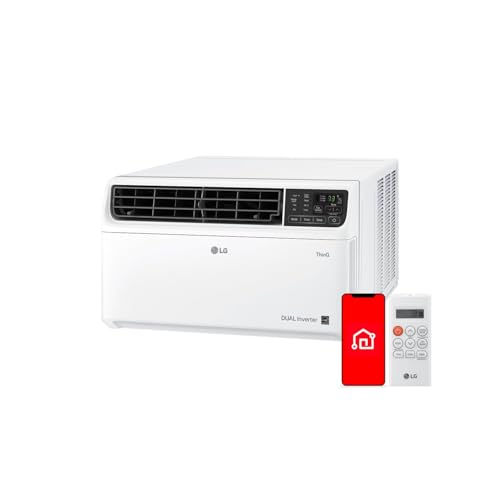
Not every large room needs maximum capacity — a well-insulated 500 sq ft living room needs sustained, efficient cooling more than it needs brute force — and that is this LG’s brief: a 12,000 BTU dual-inverter window unit on 115V, ENERGY STAR rated, with ultra-quiet operation, Wi-Fi and voice control, and up to 35% energy savings claimed by LG, for rooms up to 550 sq ft. The dual-inverter compressor holds temperature by running continuously at low power rather than cycling, which in a main living space means steadier comfort, lower bills across a long season, and noise low enough that conversation and television never compete with the machine.
Check the current price on Amazon
Strengths
- Dual-inverter efficiency and ENERGY STAR rating — the cheapest big-room cooling to run
- Ultra-quiet maintenance operation suits living rooms and media rooms
- Full smart layer with ThinQ and voice control
Trade-offs
- 12,000 BTU is the ceiling — a sun-loaded 650 sq ft room will outrun it
- Premium pricing within the 12,000 BTU class
- Inverter electronics cost more to repair out of warranty
| Specification | Detail |
|---|---|
| Cooling capacity | 12,000 BTU |
| Input | 115V |
| Stated coverage | Up to 550 sq ft |
| Compressor | Dual inverter |
| Rating | ENERGY STAR |
| Claimed saving | Up to 35% energy savings (manufacturer) |
The honest way to choose between this and the 14,000–15,000 BTU picks is to interrogate your room rather than your ambitions. Measure it, note the glass and the sun, and be truthful about insulation. If the arithmetic lands at or under roughly 550 sq ft of ordinary load, the inverter gives you the better summer: equal comfort on all but the most extreme afternoons, better comfort on every ordinary one because of its steady-state behaviour, and a smaller electricity bill as a by-product. If the arithmetic lands above that, no efficiency figure rescues an undersized machine — take the capacity picks above and accept their running costs.
There is also a circuit kindness to inverter operation: the soft, variable draw avoids the hard start-up surge of a big conventional compressor, which on older wiring can be the difference between a unit that runs and a unit that dims the house twice an hour.
Best for: large rooms up to about 550 sq ft that run long hours and value quiet, efficient cooling / Not suited for: rooms above its coverage, or buyers whose heat load is dominated by sun and glass

Frigidaire 12,000 BTU Smart Window Air Conditioner — Best Value for Large Rooms
The Frigidaire closes the guide as the value anchor of the large-room class: 12,000 BTU, Wi-Fi smart control, remote, eco mode and three fan speeds, covering up to 550 sq ft, from the category’s most established name and at the friendliest tier of the big-room machines. For the large number of ‘large rooms’ that are really 400–550 sq ft living rooms and master suites, this is the complete answer without paying for capacity or premium build that the room cannot use. Its smart layer — scheduling and remote start — is the version households keep using, and Frigidaire’s parts and service presence is the deepest safety net in window cooling.
Check the current price on Amazon
Strengths
- Complete smart feature set at the value end of the large-room class
- 550 sq ft coverage matches the majority of genuinely large rooms
- Frigidaire support depth — parts and service everywhere
Trade-offs
- Conventional compressor — noisier and thirstier at part load than the LG inverter
- Not enough machine for 650–700 sq ft rooms with real heat load
- Full-size weight; two-person installation as with all picks here
| Specification | Detail |
|---|---|
| Cooling capacity | 12,000 BTU |
| Stated coverage | Up to 550 sq ft |
| Controls | Wi-Fi smart control, remote control |
| Fan speeds | 3 |
| Modes | Eco mode |
Value here does not mean compromised — it means the specification matches the common case precisely. Most large-room buyers overestimate their square footage or their heat load, and the market happily sells them a class up. Measure honestly and this Frigidaire covers the majority of real living rooms with features the premium picks charge more to match. The money saved against the 15,000 BTU class also buys the things that make any unit perform: proper support hardware, sealing materials, and if needed an electrician’s visit to give the unit a healthy circuit.
Step up from this pick only on evidence: a measured room above its coverage, a demonstrated failure of a 12,000 BTU unit in the same space, or solar load you can feel through the glass at 4 p.m. Absent that evidence, this is where the smart money in the category sits.
Best for: large rooms of roughly 400–550 sq ft wanting full smart features at a value tier / Not suited for: true great rooms above 600 sq ft, or efficiency-first buyers
Comparison Table
Capacity classes first: 12,000 BTU serves up to about 550 sq ft, 14,000–15,000 BTU serves the 700 sq ft class. Choose the smallest class that honestly covers your room and heat load.
| Pick | Badge | Key spec | Best for |
|---|---|---|---|
| LG 14,000 BTU Window Air Conditioner | Best Overall for Large Rooms | 14,000 BTU 115V, up to 700 sq ft | living rooms, great rooms and open-plan spaces around 550–750 sq ft |
| Whirlpool 15,000 BTU Window Air Conditioner | Best Maximum Cooling | 15,000 BTU 115V, up to 700 sq ft, dehumidifier | the largest single rooms a home offers — up to about 700 sq ft with real heat load |
| Amana 15,000 BTU Window Air Conditioner | Best 15,000 BTU Alternative | 15,000 BTU 115V, digital display, 3 speeds | maximum-capacity buyers whose window or brand preference favours Amana |
| Friedrich Chill Premier 14,000 BTU Window Unit | Best Premium Build | 14,000 BTU 115V, cooling only | long-term owners who prioritise build quality and longevity in a large room |
| LG 12,000 BTU Dual Inverter Window AC | Best Efficiency | 12,000 BTU dual inverter, ENERGY STAR | large rooms up to about 550 sq ft that run long hours and value quiet, efficient cooling |
| Frigidaire 12,000 BTU Smart Window Air Conditioner | Best Value | 12,000 BTU, Wi-Fi, up to 550 sq ft | large rooms of roughly 400–550 sq ft wanting full smart features at a value tier |
How to Choose the Best 110 Volt Window Air Conditioner for Large Rooms: The Real Sizing Method
Start with measured area — length times width, honestly, including any open-plan area the air can wander into, because the unit cools the connected volume, not the room on the floor plan. Apply the standard starting point of roughly 20 BTU per square foot, then adjust with discipline: add about 10% for a kitchen’s cooking load in the same space, add for a wall of afternoon glass, add for ceilings above standard height and for regular occupancy above two people; subtract a little for a shaded, well-insulated room. Compare the result with each manufacturer’s stated coverage — and treat the stated coverage as the favourable-case figure it is. A computed need of 13,500 BTU is a 14,000–15,000 BTU purchase, not a hopeful 12,000.
Know when the answer is ‘not one unit’. A connected space beyond roughly 750–800 sq ft, an L-shaped plan where air cannot circulate to the far leg, or a room whose glass load overwhelms the arithmetic will defeat any single household-voltage machine. Two smaller units at opposite ends cool such spaces better, dehumidify better and give redundancy in a heat wave — at the cost of a second window and a second circuit to feed. That trade is unfashionable in a ‘best single unit’ guide and correct in real houses; this guide’s job is to say so.
The Circuit Question: Feeding a 14,000–15,000 BTU Unit
Large window units are the biggest sustained loads most household circuits ever carry, and the circuit check is part of the purchase. Identify which circuit feeds the intended outlet — flip breakers or use a tester — and list what else lives on it. A 15,000 BTU unit sharing a circuit with a microwave, a refrigerator and a home office is a breaker-trip schedule, not a cooling plan. Ideally the unit gets a circuit with little or nothing else of consequence on it; if your home cannot offer that, an electrician adding a dedicated household-voltage circuit is a normal, worthwhile job — and still far simpler than the 230V alternative.
Two rules are absolute. Never run these units from a power strip, a surge bar or a light-duty extension cord; if an extension is unavoidable for a short period, it must be a heavy appliance-rated cord, as short as possible, fully uncoiled. And never ‘solve’ breaker trips by fitting a larger breaker — the breaker protects the wiring in the wall, and oversizing it converts an electrical mismatch into a fire risk. Trips are information: the circuit is telling you the load does not fit, and the answers are a different circuit or a smaller unit.
Installation at This Size: Supports, Sealing and Drainage
Installation is where large-room cooling is won or lost, because the units are heavy, the chassis are wide, and the performance penalty for air leaks scales with capacity. Work through it as a planned project, ideally with the unit’s manual open and a helper who has done their share of the reading.
- Verify the opening twice: measure width and height of the window opening and compare with the unit’s stated requirements, including the side-panel reach. At this class, an inch decides fit — discover it now, not with the unit in your arms.
- Fit support hardware first: install the manufacturer-supplied or a rated aftermarket support bracket to the sill or exterior wall before lifting the unit. A 14,000–15,000 BTU chassis should never rest on the window frame alone.
- Lift as a two-person job: clear the route, agree the sequence, keep the unit supported at every second, and slide it into the opening and onto its supports in one rehearsed motion. Set it down only where the plan says.
- Secure and level: fasten the chassis to the frame per the manual and set the slight outward tilt the manufacturer specifies so condensate drains outside. A level-looking unit that drips indoors is tilted wrong, not broken.
- Seal the perimeter completely: extend the side panels, then foam and weatherstrip every remaining gap around the chassis and sash. On a unit this size, an unsealed inch is a meaningful fraction of a small room’s cooling leaking back in as hot air.
- Plug in directly and test under load: wall outlet only, then run the unit at full cooling for twenty minutes with the room’s normal other loads running. Confirm cold air, outside drainage, no abnormal vibration and a breaker that holds.
- Configure for the season: set schedules and eco behaviour, pair the app if fitted, and start the filter-cleaning habit — large units move large air volumes and load their filters accordingly.
If the window, the sill or your own lifting confidence fails any of these steps, professional installation is not an indulgence at this size — it is the difference between a machine that performs for a decade and one damaged in its first hour. Many retailers and local HVAC firms fit window units; for a 15,000 BTU chassis, the fee is small against the risk.
Dehumidification: The Large Room’s Hidden Half-Job
Large rooms hold large volumes of air, and in humid climates the moisture in that air is half the discomfort. A correctly sized unit dehumidifies as a by-product of cooling: warm room air crossing the cold coil drops its water, which drains outside. This is why runtime matters — a unit that satisfies the thermostat in ten-minute bursts never runs long enough to dry the room, which is the oversizing trap described throughout this guide. It is also why the Whirlpool’s dedicated dehumidifier mode is a real feature rather than a brochure line: on muggy shoulder-season days it dries without overcooling.
Practical consequences follow. In humid regions, prefer the smaller adequate unit over the larger marginal one; use lower fan speeds on humid evenings to lengthen coil contact; and keep interior doors managed so the unit is drying the space it can actually serve rather than an entire floor’s worth of air drifting in. If a room still feels clammy with the temperature correct, the answer is almost never ‘more BTU’ — it is longer, steadier runtime, which is precisely what the inverter pick in this guide is built to deliver.
One Big Unit or Two Smaller Ones: The Worked Comparison
Because the large-room decision so often ends here, it deserves a direct comparison rather than a passing mention. One big unit — a 14,000 or 15,000 BTU machine — concentrates everything: one window, one circuit, one installation, one appliance to maintain, and cooling power that arrives from a single point. Its weaknesses are distribution and singleness: the far end of a long or bent room depends on air mixing to arrive, and if the unit fails in a heat wave, the room has no cooling at all. Its cost profile is simple, and for a squarish room with the unit well placed, it is the right answer most of the time.
Two smaller units — say two 8,000 BTU machines at opposite ends — invert every term. Cooling arrives from two points, so distribution is inherently better and each end of the room has its own thermostat’s judgement; a failure halves your cooling instead of ending it; and on mild days one unit can carry the room while the other rests, which is an efficient pattern no single big machine can imitate. The costs are equally real: two windows given up, two circuits to feed, two installations to seal and two filters to clean, and a higher combined purchase in most cases. The deciding factors are plan shape and window availability — an L-shaped or very long room with windows at both ends is the two-unit case study; a squarish great room with one good window is the big unit’s. Neither answer is a compromise; each is the correct engineering for a different floor plan, and choosing by the plan rather than by habit is the whole of the wisdom here.
Common Buying Mistakes
Large-room purchases fail in predictable ways, and the pattern is usually ambition outrunning measurement.
- Buying a 230V unit by mistake: large-room search results are full of them. Confirm 115V-class operation on the model’s own listing — a 230V unit will not plug into your outlet at all.
- Assuming maximum is safest: a 15,000 BTU unit in a 500 sq ft room short-cycles, under-dehumidifies and strains the circuit. Biggest is only best when the room demands it.
- Skipping the circuit check: discovering the shared-circuit problem with the unit already in the window turns a cooling purchase into an electrical project under time pressure.
- Resting the chassis on the frame: at this weight, support brackets are structural, not optional. A sagging unit drains wrong, leaks air and stresses the window.
- Expecting one unit to cool a floor: beyond roughly 800 connected square feet, or around an L-shaped plan, the honest answer is two units or a different system.
- Ignoring drainage: the slight outward tilt and a clear drain path are what keep condensate outside. Indoor dripping is an installation fault, not bad luck.
Ceiling Height, Insulation and the Adjustments People Skip
Two rooms of identical floor area can be different cooling problems, and the difference usually lives above head height and inside the walls. A vaulted or cathedral ceiling multiplies the air volume the unit must condition while adding a stratified layer of hot air exactly where nobody sits — such rooms routinely need a class more capacity than their square footage suggests, plus a ceiling fan running to push the cooled air’s benefit downward. Insulation works the other way with equal force: a large room in a modern, tight, shaded house can behave like a room two-thirds its size in a leaky older one, which is why this guide treats manufacturers’ coverage figures as favourable-case statements rather than promises. The practical method is to start with the measured area, then honestly grade the room — glass, ceiling, insulation, exposure — and let a bad grade move you up a class while a good grade lets you enjoy the smaller machine’s manners. Skipping the grading step is how identical floor plans end up with opposite reviews of the same unit.
Final Recommendation
For the classic large living room, the LG 14,000 BTU is the balanced answer: near-maximum capacity, civilised manners and the full control set. When the room genuinely defeats that class — measured area at the top of the range, real sun and kitchen load — the Whirlpool 15,000 BTU is the strongest cooling a household outlet can deliver, with the Amana as its like-for-like alternative. Buyers who value build and longevity over features should take the Friedrich; buyers whose ‘large room’ honestly measures under 550 sq ft should take the LG dual inverter for efficiency or the Frigidaire for value, and enjoy the better summer that correct sizing buys.
Measure the room, check the circuit, plan the installation — in this class, preparation is not a preliminary to the purchase. It is most of the purchase.
- LG 14,000 BTU Window Air Conditioner — Check on Amazon
- Whirlpool 15,000 BTU Window Air Conditioner — Check on Amazon
- Amana 15,000 BTU Window Air Conditioner — Check on Amazon
Keep exploring the same cluster before you decide: Best 110 Volt Window Air Conditioner Best 115 Volt 12000 Btu Window Air Conditioner Best 115 Volt Air Conditioner Best 110 Volt Window Air Heat
Frequently Asked Questions
What is the largest window air conditioner that runs on a household outlet?
About 15,000 BTU. The Whirlpool and Amana picks in this guide deliver 15,000 BTU on 115V and state coverage up to 700 sq ft. Above that class, window units move to 230V dedicated circuits. If your space needs more than a 15,000 BTU unit can give, the realistic options are a second unit, a 230V installation, or a mini-split system.
Can one window unit cool an open-plan living and kitchen area?
It depends on the connected area and heat load. An open-plan space of 600–700 sq ft with moderate sun is within reach of the 14,000–15,000 BTU picks, remembering that cooking adds real heat. Beyond roughly 800 sq ft of connected space, or where the plan bends so air cannot circulate, a single unit will leave the far end warm — two smaller units serve such plans better.
Will a 15,000 BTU unit trip my breaker?
It can, if the circuit is shared with other heavy loads. These units draw near the top of what a household circuit offers. Give the unit a circuit with little else on it, plug it directly into the wall, and test it under full load with the room’s usual appliances running. Repeated trips mean the circuit does not fit the load — the fix is a different circuit or an electrician, never a larger breaker.
Is a 14,000 BTU unit much louder than a 12,000?
Somewhat, at full power — bigger fans move more air. In practice the difference that matters is duty: a correctly sized larger unit cycles off, while an undersized smaller unit runs at maximum continuously. The quietest large-room experience in this guide is the LG dual inverter, which holds temperature at low, steady power instead of cycling.
My large room is cool near the unit and warm across the room. What helps?
Air distribution, not more capacity. Aim the louvers along the room’s long axis, keep the unit’s intake and outlet unobstructed, and run a ceiling fan or a small circulation fan to mix the air. If the far zone is a separate leg of an L-shaped plan, that is the two-unit situation described in the buying guide — no louver setting fixes a corner the air cannot turn.
Should I remove a large window unit for winter?
If you can manage the lift safely with help, yes — indoor storage protects the unit and lets you seal the window properly. If removal is impractical, clean the filter, run the fan to dry the internals, and fit a proper exterior cover and interior seal. What matters is keeping weather and pests out of a chassis that connects your room to the outside.


