Disclosure: airfryerkitchensupply.com is reader-supported. When you buy through links on our site, we may earn an affiliate commission at no extra cost to you.
Where to buy
Every product below was verified against Amazon’s catalogue before inclusion. The Check the current price on Amazon is the strongest true-tankless candidate, the Check the current price on Amazon is its thermostatic rival, and the Check the current price on Amazon is the mini-tank alternative that this guide recommends without embarrassment where the arithmetic demands it. The remaining verified options are the Check the current price on Amazon, the Check the current price on Amazon and the Check the current price on Amazon. Read the introduction before ordering anything: whether a 110 volt tankless shower works for you is decided by your inlet water temperature and your shower head’s flow, and this guide gives you the arithmetic to know — in your own bathroom, with your own numbers — before you spend.
Introduction
Here is the whole truth about the best 110 volt tankless water heater for shower, in one paragraph of arithmetic. A 120 volt circuit delivers at most about 3.5 kilowatts to a water heater. Heating water takes a fixed amount of energy: at a flow of one gallon per minute, 3.5 kilowatts raises the water roughly 24 degrees Fahrenheit. A comfortable shower runs at about 100–105°F. So a 120V tankless shower works when your incoming water is already around 78–82°F or warmer and your shower head flows at about a gallon a minute — conditions found in warm climates, in summer, in RVs and cabins fed by sun-warmed lines, and in booster setups where the unit tops up water the house system already heated. With cold northern groundwater at 45°F and a standard shower head flowing twice that rate, the same heater delivers water in the 60s — a punishment, not a shower — and no brand, badge or review can change that, because it is not a product limitation. It is arithmetic.
This guide is written for the people inside the working envelope, and for the people who need to know they are outside it before they spend money. Inside it — the Florida bathroom, the Texas cabin, the workshop shower fed from a warm line, the distant shower boosted at the point of use — these little heaters genuinely work, and the picks below are ranked for exactly that duty: control quality first, because a shower is ten continuous minutes of temperature judgement; power second, because every watt is rise; and honesty throughout. Outside the envelope, the guide’s sixth pick is the answer we actually recommend: a 7-gallon mini-tank that stores its way around the arithmetic, clearly labelled as not tankless, because serving the reader beats serving the keyword.
Two installation facts, repeated from the companion guide because they decide purchases: these heaters need a dedicated circuit in the 30-amp class installed by an electrician — ‘110 volt’ does not mean a wall socket — and a low-flow shower head is not an accessory to this project but half of it. Every pick was verified against Amazon’s catalogue, specifications come from the listings, and where a listing omits a key figure, the review says so and tells you to verify before ordering. That is the standard this marginal, much-lied-about category deserves.
In this guide
Quick Picks
Stiebel Eltron DHX 3.5 Trend Tankless Water Heater (3.5kW, 120V) — Best Chance of a Real Shower. Self-modulating 3.5kW — holds temperature as shower flow varies. Best for: warm-climate, low-flow showers and booster-fed showers. Check the current price on Amazon
Rheem 3.5kW Thermostatic Point-of-Use Tankless Heater (120V) — Best Temperature Discipline. Thermostatic set-temperature control at full class power. Best for: booster-fed and warm-climate showers where a set temperature matters. Check the current price on Amazon
Eemax SPEX3512 FlowCo Point-of-Use Heater (3.5kW, 120V) — Best Value Attempt. Full 3.5kW at a value position for the warm-climate low-flow setup. Best for: budget-first warm-climate or rv showers with a low-flow head. Check the current price on Amazon
Eemax EEM12004 Point-of-Use Tankless Water Heater (4kW) — Most Power on Paper. A listed 4kW point-of-use unit — verify its voltage and breaker spec on the listing. Best for: buyers chasing every available watt for a marginal shower setup. Check the current price on Amazon
Stiebel Eltron Mini 3.5-1 Tankless Water Heater — Best Proven Alternative. The long-running Mini line at 3.5-class power. Best for: warm-climate and booster showers where a proven compact unit is preferred. Check the current price on Amazon
Bosch Tronic 3000 T ES8 Mini-Tank Water Heater, 7-Gallon — The Honest Alternative. 7 gallons of stored hot water: full flow instantly, for a short shower. Best for: a single short, low-flow shower where tankless arithmetic fails. Check the current price on Amazon
How These Picks Were Chosen
We started from the physics and worked backward. Candidates had to be true tankless units in the 120V class at the maximum power the voltage allows, verified against Amazon’s catalogue through the Creators API, with specifications taken from the listings themselves. We ranked for shower duty specifically: control behaviour under varying flow first — self-modulating and thermostatic units hold a shower’s temperature; basic units drift — then power, then activation behaviour at low flow, then the maker’s record in this niche. One deliberate exception closes the list: a verified mini-tank, included and clearly labelled because for a large class of shower patterns it is the correct 120V answer, and a guide that hid it to protect the keyword’s purity would be failing its readers. We print no prices and no fixed ratings — both change constantly — so check the current price on Amazon and current owner feedback through the links, and confirm the electrical specification of any unit whose listing is brief.
The 6 Best 110 Volt Tankless Water Heaters for Showers

Stiebel Eltron DHX 3.5 Trend Tankless Water Heater (3.5kW, 120V) — Best Chance of a Real Shower
If any 120 volt tankless heater can run a shower, it is this one — and the reason is its control, not its power, since its power is the same 3.5kW ceiling as everything here. A shower is a varying load: the user adjusts the mixer, the flow breathes, and a basic heater’s temperature swings in answer. The Trend’s self-modulating control throttles power continuously to hold the set temperature, which is the difference between a shower that is merely warm and a shower that stays where you set it. In the conditions where 120V showering works at all — warm inlet water, a low-flow head, sensible expectations — this is the unit that works best.
Strengths
- Self-modulation holds temperature through a shower’s varying flow
- Full 3.5kW class power
- Published electrical requirements make planning honest
Trade-offs
- Still bound by physics: cold inlet water defeats it as a sole source
- Dedicated 30A circuit required
- Premium tier of the class
Key specs (verified from the listing)
- Power: 3.5 kW, 120V (stated in the listing)
- Electrical: 30A breaker, 29.2A draw (as listed)
- Control: Self-modulating
- Role: Point-of-use tankless
Let us be precise about the winning scenario, because this pick only makes sense inside it. Fit a low-flow shower head in the region of one gallon per minute. Start with inlet water in the mid-70s Fahrenheit or warmer — a southern climate, a warm season, or a feed already tempered by the house system. The Trend’s 3.5kW then adds its roughly 24°F at that flow, delivering water at or near a comfortable shower temperature, and its modulation keeps it there while you adjust the mixer. Step outside that scenario — northern groundwater in January, a rain head flowing two gallons a minute — and no control system can rescue the arithmetic, a truth this guide states rather than apologises for. Inside the scenario, this is as good as 120 volt showering gets.
Best for: warm-climate, low-flow showers and booster-fed showers / Not suited for: Cold-climate homes expecting a normal shower from cold inlet water alone.

Rheem 3.5kW Thermostatic Point-of-Use Tankless Heater (120V) — Best Temperature Discipline
Rheem’s thermostatic entry earns its badge for showers specifically because a shower is where temperature discipline is felt on skin for ten continuous minutes. Set the outlet temperature and the unit works to hold it, rather than delivering whatever the flow dictates. In the booster configuration — this unit lifting water already warmed by the house system — or in warm-inlet conditions with a low-flow head, that discipline turns a marginal setup into a comfortable one, backed by a mainstream maker’s support network.
Strengths
- Thermostatic control targets a set outlet temperature
- Full 3.5kW class output
- Mainstream brand support
Trade-offs
- Control cannot add power the circuit does not supply
- Dedicated circuit installation applies
- Verify full specifications on the listing at purchase
Key specs (verified from the listing)
- Power: 3.5 kW
- Voltage: 120V (stated in the listing)
- Control: Thermostatic
- Role: Point-of-use tankless
The booster role deserves emphasis, because it is how many of these units actually succeed at showers in real homes. Fed with water that is already warm — from the main heater’s line, arriving at the distant shower finally stripped of its pipe losses — a 3.5kW thermostatic unit needs only to replace the degrees lost in transit and hold the result steady. That is a job well inside its budget, in any climate, at sensible shower flows. Judged as a sole source from cold water it is a warm-climate, low-flow proposition like everything here; judged as a booster it is a genuinely complete answer to the distant-shower problem, and Rheem’s thermostatic behaviour is precisely the trait that role rewards.
Best for: booster-fed and warm-climate showers where a set temperature matters / Not suited for: Anyone whose inlet water is cold and whose shower head flows freely.

Eemax SPEX3512 FlowCo Point-of-Use Heater (3.5kW, 120V) — Best Value Attempt
The FlowCo 3.5kW is the value way into a 120V shower attempt: the same power ceiling as the flagships, in Eemax’s straightforward point-of-use package. In the narrow scenario where this works — warm inlet, low-flow head, a user who accepts showering at the gentler end of hot — the heat it makes is the same heat the expensive units make. What the savings cost is manners: as you adjust the shower mixer, a basic control lets the temperature wander more than the modulating and thermostatic picks above, and you compensate by hand.
Strengths
- Full class power at the value tier
- Simple, proven point-of-use design from a specialist maker
- Compact under-counter or utility-space mounting
Trade-offs
- Temperature drift with flow changes
- Same dedicated-circuit requirement as the flagships
- The scenario limits apply with full force
Key specs (verified from the listing)
- Power: 3.5 kilowatt
- Voltage: 120 volt (stated in the listing)
- Series: FlowCo
- Role: Electric point-of-use water heater
There is a respectable tradition behind this pick: the RV, cabin and warm-climate outdoor shower, where water arrives warm from sun-heated lines or a southern well, the head flows gently, and the shower’s job is refreshment rather than a steaming soak. In that tradition the FlowCo’s proposition — full power, simple controls, specialist maker, value price — is exactly fitted. The buyer this pick must warn is the one importing it into a cold-climate bathroom with a rain head and January expectations; the machine will be blamed for arithmetic it never concealed. Match it to its tradition and it is the smart buy of the shower list; the savings over the flagship are better spent on the low-flow head that makes the whole setup work.
Best for: budget-first warm-climate or rv showers with a low-flow head / Not suited for: Users who will hate temperature drift as they adjust the mixer.

Eemax EEM12004 Point-of-Use Tankless Water Heater (4kW) — Most Power on Paper
The EEM12004 appears on this list with its paperwork showing: its listing states a 4kW point-of-use tankless heater — the highest power figure in this roundup — but does not state its voltage in the title, in a class where that detail decides everything. Eemax builds point-of-use units across voltages, so the correct treatment is transparency: this is a candidate for buyers who want the maximum available heat and are willing to confirm, on the listing and with the manufacturer if needed, that the unit’s voltage and breaker requirements match a 120V installation before ordering.
Strengths
- Highest listed power in this guide — every watt matters at the margin
- Point-of-use form from the specialist maker
- A genuine option where 3.5kW falls just short
Trade-offs
- Voltage not stated in the listing title — verification is mandatory, not optional
- If its supply requirements exceed your circuit plans, it is not a 110V pick at all
- Shower physics still govern whatever its rating
Key specs (verified from the listing)
- Power: 4 kW (as listed)
- Type: Electric tankless, point of use
- Colour: Blue
Half a kilowatt, if the specifications confirm it is delivered on your supply, is not nothing in this class: at a gallon per minute it is worth roughly another three to four degrees of rise, and marginal shower setups are decided by exactly such margins. That is the honest case for including this unit — flagged, not hidden. The equally honest condition is that a buyer must do the verification the listing’s brevity demands: voltage, breaker size, wire requirements, activation flow. A purchase made on the assumption that a point-of-use Eemax must be the voltage you want is a purchase made on a guess, and water heaters punish guesses with return shipping. Verify first, and if the numbers confirm a 120V-compatible installation, this is the maximum-heat route through a marginal scenario.
Best for: buyers chasing every available watt for a marginal shower setup / Not suited for: Anyone unwilling to verify specifications carefully before purchase.

Stiebel Eltron Mini 3.5-1 Tankless Water Heater — Best Proven Alternative
The Mini 3.5-1 brings Stiebel Eltron’s long-running Mini series to the shower question at full 3.5-class power: a compact, proven point-of-use unit from the maker that defines this niche. Against the Trend flagship it offers the older, simpler proposition — the same heat budget, spent with less electronic refinement — and for the booster role and the warm-climate low-flow shower, that proposition remains sound. Its listing is brief on specifications, so the electrical details need confirming at purchase, as its review states openly.
Strengths
- Proven Mini-series design with a long service history
- Full class power in the smallest form
- Specialist maker’s point-of-use focus
Trade-offs
- Simpler control than the modulating Trend
- Listing brevity requires specification checks
- Scenario limits are the class’s limits
Key specs (verified from the listing)
- Series: Mini 3.5-1
- Type: Tankless electric water heater
- Role: Point-of-use
Proven designs earn their place in marginal applications for a subtle reason: their behaviour is known. A Mini at a shower is a understood quantity among installers — its activation, its manners at varying flow, its service needs — and in a setup that lives at the edge of physics, predictability is a feature. Pair it with the low-flow head, feed it warm or tempered water, and it delivers the same honest shower as everything at this power level, with the confidence of a design that has been doing point-of-use work for years. The flagship Trend is the better machine in refinement; the Mini is the better-known one. Buyers who value the second quality — and installers often do — will find this the comfortable pick.
Best for: warm-climate and booster showers where a proven compact unit is preferred / Not suited for: Cold-climate sole-source showers — see the verdict in the review.
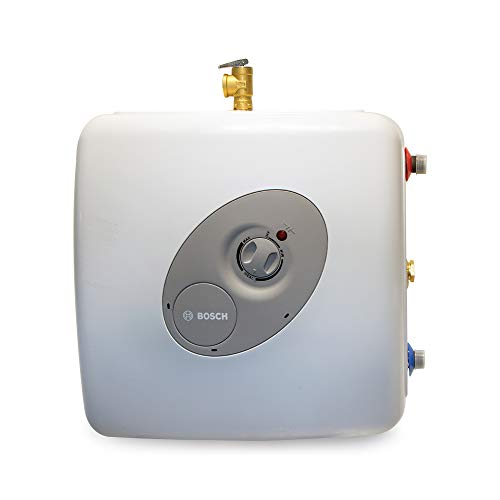
Bosch Tronic 3000 T ES8 Mini-Tank Water Heater, 7-Gallon — The Honest Alternative
This pick is not a tankless heater, and it is on this list precisely because honesty requires it. When the tankless arithmetic fails — inlet too cold, shower too long — a 7-gallon mini-tank at the shower is often the correct 120V answer: it stores hot water made slowly, then delivers it at full shower flow instantly. Seven gallons, mixed down with cold at the shower valve, stretches to a genuinely workable short shower at a low-flow head — a real shower, at real temperature, in climates where no 3.5kW tankless can promise one. Then it needs recovery time, which is its honest price.
Strengths
- Delivers stored hot water at full flow — no temperature-rise ceiling at the tap
- Simple point-of-use installation compared with a dedicated tankless circuit
- Bosch Tronic line is a mainstream, supported product family
Trade-offs
- Finite store: long or consecutive showers exhaust it
- Standby energy loss, as with any tank
- It is a tank — the opposite of the endless-supply idea
Key specs (verified from the listing)
- Type: Electric mini-tank water heater — NOT tankless
- Capacity: 7 gallon (ES8)
- Mounting: Shelf, wall or floor (as listed)
- Role: Point-of-use stored hot water
The mini-tank reframes the problem from power to storage, and for one specific pattern — one person, one short shower, at a low-flow head, with hours between uses — storage wins. A cabin, a workshop shower, an in-law suite used on weekends: the tank quietly keeps its seven gallons ready all week for the cost of modest standby loss, and the shower itself is indistinguishable from a normal one until the store fades. The failure mode is equally clear: a family bathroom’s morning queue would empty it and leave the third shower cold, which is why this is a badge for a pattern, not a universal recommendation. Judge your pattern honestly against it. Where the pattern fits, this unglamorous tank is the most satisfying ‘110 volt shower’ on the page — by declining to be tankless at all.
Best for: a single short, low-flow shower where tankless arithmetic fails / Not suited for: Long showers or back-to-back users — the store runs out.
Comparison Table
| Pick | Badge | Key spec | Best for |
|---|---|---|---|
| Stiebel Eltron DHX 3.5 Trend Tankless Water Heater (3.5kW, 120V) | Best Chance of a Real Shower | Self-modulating 3.5kW — holds temperature as shower flow varies | Warm-climate, low-flow showers and booster-fed showers |
| Rheem 3.5kW Thermostatic Point-of-Use Tankless Heater (120V) | Best Temperature Discipline | Thermostatic set-temperature control at full class power | Booster-fed and warm-climate showers where a set temperature matters |
| Eemax SPEX3512 FlowCo Point-of-Use Heater (3.5kW, 120V) | Best Value Attempt | Full 3.5kW at a value position for the warm-climate low-flow setup | Budget-first warm-climate or RV showers with a low-flow head |
| Eemax EEM12004 Point-of-Use Tankless Water Heater (4kW) | Most Power on Paper | A listed 4kW point-of-use unit — verify its voltage and breaker spec on the listing | Buyers chasing every available watt for a marginal shower setup |
| Stiebel Eltron Mini 3.5-1 Tankless Water Heater | Best Proven Alternative | The long-running Mini line at 3.5-class power | Warm-climate and booster showers where a proven compact unit is preferred |
| Bosch Tronic 3000 T ES8 Mini-Tank Water Heater, 7-Gallon | The Honest Alternative | 7 gallons of stored hot water: full flow instantly, for a short shower | A single short, low-flow shower where tankless arithmetic fails |
How to Choose a 110 Volt Tankless Heater for a Shower (the Arithmetic First)
Step zero: measure your inlet temperature in the coldest month. Everything follows from this number. Run the cold tap for two minutes and measure it. In the warm-climate range — high 70s and above — a 3.5kW unit and a low-flow head give a real shower. In the 60s, you are in booster territory: the unit can only succeed topping up pre-warmed water. In the 40s and 50s, stop shopping tankless for this shower and buy the mini-tank or a 240V solution; the guide’s honesty is worth more than any unit’s marketing.
Choose the shower head as part of the heater. At one gallon per minute, 3.5kW buys roughly 24°F of rise; at a gallon and a half, roughly 16°F; at two gallons, about 12°F. The head’s flow rate is therefore not a detail — it is a third of the heating system. Fit the lowest-flow head your household will accept, and know that modern low-flow heads with air-induction and good spray engineering feel far better than their numbers suggest.
Prefer modulating or thermostatic control for showers. A shower’s flow varies as the user adjusts the mixer, and basic heaters answer variation with temperature swings the user feels immediately. Self-modulating and thermostatic units — the top two picks — spend their fixed power budget intelligently, holding the set temperature. At a hand sink this refinement is a luxury; in a shower it is the product.
Consider the booster configuration seriously. If the shower is distant from the main water heater, a point-of-use tankless on its feed line replaces the heat lost in the pipe run and ends the wait, while the main system does the heavy lifting. In booster duty the 3.5kW budget is ample in any climate, and this is the configuration with the happiest owners in the entire category. It needs the feed to arrive warm — if the line delivers cold for the first minute, the booster cannot fix the first minute, only everything after.
Budget the dedicated circuit. A 30-amp-class dedicated 120V circuit, professionally installed, is part of every true-tankless purchase here. Compare total installed cost — unit plus circuit — against the mini-tank alternative, whose installation is typically simpler, before deciding the technology. The comparison surprises many buyers.
Plan for hard water. A shower is a high-use fixture by point-of-use standards, and scale builds on elements in proportion to use. Fit isolation valves, note the descaling interval, and in very hard water weigh the mini-tank’s simpler maintenance honestly against tankless efficiency.
How to Set Up a 110 Volt Tankless Shower That Actually Works
Step 1 — Verify your scenario with real numbers. Measure the coldest inlet temperature and your shower head’s true flow (a bucket and a stopwatch: gallons collected in a minute). Do the rise sum from the guide. If the numbers fail, change the plan now — mini-tank, booster configuration, or a lower-flow head — while changing it is still free.
Step 2 — Fit the low-flow head first. Install and live with the new head for a week on your existing hot water. If the household accepts its feel, the project proceeds on solid ground; if not, you have learned the cheapest possible lesson and the mini-tank route remains open.
Step 3 — Have the dedicated circuit installed. An electrician runs the circuit the manufacturer specifies — 30-amp class for these units — to the heater’s position, which is typically in the bathroom’s vanity, a utility closet or adjacent to the shower’s plumbing. Licensed work, to code, with the bathroom’s moisture environment respected in every fitting.
Step 4 — Mount, plumb and fill before power. Mount the unit per the manual, plumb it into the shower’s hot feed with isolation valves, flush the lines, and run water through until air-free before energising. Dry firing destroys elements in seconds; water first, power second, at installation and after every service, without exception.
Step 5 — Set the temperature for showering, not for bragging. Set the outlet to your actual showering temperature so the shower mixer runs mostly-hot: this maximises the flow the heater can sustain at temperature and minimises scald risk from a unit with no tank of blended water behind it. Test at the head, at real flow, with a thermometer if you are being careful — and being careful is the theme of this entire installation.
Step 6 — Shower like the system is designed. Let the low-flow head do its engineering, avoid running other hot fixtures simultaneously on the same unit, and in booster setups allow the feed a moment to arrive warm before judging the temperature. Note the descaling date in your calendar before the first shower, not after the first lukewarm one.
Common Buying Mistakes
Buying before measuring the inlet temperature. The single decision that determines success, skipped by nearly every disappointed owner. Two minutes with a thermometer in the coldest month is the cheapest research in home improvement.
Keeping a high-flow rain head. A two-gallon rain shower halves the heater’s temperature rise and converts a workable setup into a tepid one. The head is part of the heating system; change it or change the plan.
Expecting the unit to fix a cold first minute in booster duty. A booster replaces heat lost in transit once warm water arrives; it cannot pre-warm a cold line’s first slug. Set expectations — and the shower’s first seconds — accordingly.
Skipping the dedicated circuit in the budget. The unit’s price is not the project’s price. Buyers who discover the electrician’s bill after delivery own an uninstalled heater and a grievance; buyers who budget it own a working shower.
Setting the outlet temperature to maximum. A hotter setting does not create more hot water — it spends the same rise at lower flow and adds scald risk. Set for the shower you take, not the number you can reach.
Blaming the heater for hard-water fade. A shower-duty unit in hard water scales steadily. Descale on schedule and performance persists; ignore it and the best unit here will fade like the worst.
The Booster Configuration, Explained: How Most 120V Showers Actually Succeed
Read enough owner reports of 120V tankless showers and a pattern emerges: the delighted owners, in every climate including cold ones, are disproportionately running their units as boosters. The configuration is simple. The shower’s hot feed still comes from the home’s main water heater, but it travels a long pipe run, arriving late and having shed degrees into the walls on the way. The point-of-use tankless unit sits at the bathroom, senses the arriving water, and adds exactly the heat the journey cost — a few degrees, well inside its budget even at full shower flow — while also trimming the wait for anyone downstream of its position.
The physics of why this works so well is the mirror of why sole-source fails. Sole-source duty asks 3.5kW for the entire rise from groundwater to shower temperature at full flow: an impossible sum in the cold. Booster duty asks it for the transit loss only — single-digit degrees — which it supplies at any flow the shower demands, in January, in Minnesota. The unit’s control quality becomes the star: thermostatic and modulating units hold the shower at the set point as the feed’s temperature stabilises, ending the familiar distant-shower experience of a shower that starts cold, overshoots, then settles. If your home has a main heater and a far shower, this is the configuration to price first; the sole-source romance is for the cabin, the RV and the warm-climate bathroom where no main heater exists to boost.
RV, Cabin and Outdoor Showers: the Sole-Source Heartland
The places where 120V tankless showers succeed as sole sources share a profile worth recognising, because if your situation matches it, you can buy with confidence. The inlet water is warm — from southern groundwater, from sun-exposed supply lines, from a dark storage tank that has spent the day absorbing heat. The shower head is a water-miser by design, as RV and cabin heads are, flowing around a gallon a minute or less. The shower itself is a refreshment ritual — rinse, wash, rinse — rather than a fifteen-minute steam. And the electrical supply, while only 120V, is real: a proper circuit, not a campsite pedestal shared with an air conditioner.
In that heartland, the picks at the top of this list perform the quiet miracle their owners report: endless hot-enough water from a box the size of a hardback book, with no tank to drain, freeze or wait for. The further your situation drifts from the profile — colder water, greedier head, longer showers, shared circuits — the more firmly the guide steers you to the booster configuration or the mini-tank. Matching the technology to the territory is not a disclaimer. It is the entire content of expertise in this category, and it is why this guide measures twice and sells once.
Troubleshooting: 110 Volt Shower Problems and Fixes
Problem: The shower is warm but never hot. → The rise sum is short by a few degrees. In order: reduce the head’s flow, raise the unit’s set point toward its useful maximum, and check the inlet temperature against your coldest-month measurement — a setup that worked in September can fail honestly in January. If the gap is large, the fix is structural: booster feed or mini-tank, not a replacement tankless.
Problem: Temperature swings during the shower. → Flow variation meeting basic control. Hold the mixer steady once set, confirm no other fixture on the same feed is opening and closing, and accept that the modulating and thermostatic picks exist precisely because this problem is real. Persistent swings on a modulating unit suggest scale or a sensor issue — descale, then consult the manual.
Problem: The shower starts hot, then fades. → On a tankless, fading means the feed changed — in booster setups, the arriving water’s temperature is still stabilising — or the unit is at its limit and flow has crept up. On the mini-tank pick, fading is the store emptying: shorten the shower, lower the head’s flow, or accept the recovery interval as the product’s stated price.
Problem: The breaker trips mid-shower. → The circuit is not what the installation requires — shared, undersized or faulty. Stop using the unit until an electrician verifies the circuit against the manufacturer’s specification. A heater that trips protection is reporting an installation problem in the only language it has.
Problem: Output has declined over the season. → Scale, until proven otherwise, and shower duty accelerates it. Descale per the manual, check the inlet screen, and calendar the interval properly this time — in hard water, descaling is not maintenance trivia but the difference between a five-year unit and a one-year unit.
Four Real Bathrooms, Scored Honestly
The Florida condo bathroom. Groundwater arrives warm all year, the building’s bathrooms are compact, and the owner fits a low-flow head as part of the project. Verdict: sole-source tankless works, and the Trend or the Rheem will hold a genuinely comfortable shower. This is the scenario the category’s advertising photographs, and for once the photograph is accurate.
The Minnesota farmhouse’s far bathroom. Winter groundwater in the 40s, a long pipe run from a basement heater, a family that likes its showers hot and unhurried. Verdict: sole-source tankless fails by thirty degrees and no purchase fixes it. A booster unit at the bathroom, however, transforms the existing shower — ending the wait and the temperature sag — and is one of the best-value upgrades available to that house. Same product, opposite verdicts, decided entirely by configuration.
The Texas workshop with a shower for end-of-day cleanups. The supply line runs through a sun-baked wall cavity, the head is a water-miser, and showers are five functional minutes. Verdict: sole-source works for most of the year, with the FlowCo as the value-fitted pick, and the honest caveat that a still January morning may deliver a brisk rather than steaming shower. The owner who knows that in advance is satisfied; the owner promised otherwise is a return waiting to happen.
The Vermont cabin used on ski weekends. The shower serves one or two people, briefly, after days on the mountain, and the building sits cold between visits. Verdict: the mini-tank is the connoisseur’s answer — no dependence on inlet temperature at the tap, a real hot shower for its short duration, and a store that reheats while the wood stove does its own work. Tankless would demand a dedicated circuit and still bow to the inlet water; the tank simply stores its way past the argument.
Score your own bathroom against these four before you shop. The pattern to notice is that the verdicts are rarely about the heaters — the same three tankless units pass in Florida, fail as sole sources in Minnesota, and star as boosters in the same Minnesota house. Configuration and climate are the product. The box is just how you buy them.
Final Recommendation
If your numbers work — warm inlet, low-flow head, or a booster feed — buy the Stiebel Eltron DHX 3.5 Trend and enjoy the best shower 120 volts can honestly make; choose the Rheem thermostatic if set-temperature discipline matters more, or the Eemax FlowCo to keep the budget lean in a warm-climate setup. If your numbers do not work, believe them, and buy the Bosch ES8 mini-tank for a short real shower, or price a 240V installation for a full one. The worst purchase in this category is a good heater bought for an impossible bathroom — and after this guide, it is also the most avoidable.
Related guides in this series: Best 110 Volt Tankless Water Heater Best 110 Volt Spa Best 110 Volt Space Heater Best 110 Volt Stackable Washer Dryer
Frequently Asked Questions
Can a 110 volt tankless heater really run a shower?
Yes, inside a specific envelope: inlet water around the high 70s Fahrenheit or warmer, a shower head flowing about a gallon per minute, or a booster setup where the unit tops up pre-warmed water. Outside that envelope — cold groundwater and a standard head — the arithmetic cannot reach shower temperature, and a mini-tank or 240V unit is the honest answer.
What shower head do I need for a 120V tankless shower?
The lowest-flow head your household will happily use — around one gallon per minute is the working target. At that flow a 3.5kW heater adds roughly 24°F; every extra half-gallon per minute costs you several degrees of that rise.
What is a booster setup and why does it work better?
The point-of-use unit is installed on the shower’s hot feed from the main water heater, replacing only the heat lost in the pipe run — a few degrees instead of the whole rise from cold. That small ask fits the 3.5kW budget at any shower flow and in any climate, which is why booster owners are the happiest in this category.
Will a mini-tank give a better shower than a 120V tankless?
For one short shower, often yes: stored hot water arrives at full flow and full temperature with no rise ceiling, in any climate. Its limits are the store — seven gallons in the pick here — and the recovery time after. Back-to-back or long showers belong to tankless-in-booster-duty or to a larger system.
Does a 120V shower heater need an electrician?
Yes. These units draw around 30 amps and require a dedicated circuit installed to the manufacturer’s specification and local code. Factor that cost into the project from the start — it is shared by every true tankless option and is the mini-tank’s main comparative advantage.
Why does my 120V shower run colder in winter?
Because your inlet water is colder, and the heater’s rise is fixed: the same 24°F added to 45°F groundwater gives a very different shower from the same rise added to 75°F summer water. Seasonal failure of a marginal setup is physics announcing itself, and the cures are the booster configuration, a lower-flow head, or stored hot water.
Can I use one of these for an RV shower?
RVs are the sole-source heartland: warm-fed lines, miserly shower heads and short showers match the technology well. Confirm the RV’s electrical system can dedicate the required circuit — a heater of this class alongside an air conditioner on a limited pedestal supply is a breaker negotiation, so plan the loads together.
Is a 120V tankless shower safe from scalding?
Set the unit’s outlet to your actual showering temperature rather than its maximum, as the setup section advises, and the scald risk is low — there is no tank of superheated water behind the tap. Homes with children or elderly users should favour the thermostatic and modulating picks, whose whole purpose is holding a set temperature steady, and should test the delivered temperature at the head before first use, as with any water-heating change.


