Disclosure: airfryerkitchensupply.com is reader-supported. When you buy through links on our site, we may earn an affiliate commission at no extra cost to you.
Where to buy
Every receptacle in this guide to the best 110 volt receptacle options is a current Amazon listing, verified through Amazon’s own product data before we wrote a word about it. Start with the ELEGRP GFCI Outlet 20 Amp if you want the best all-round protected receptacle with self-testing and tamper resistance, the ANKO GFCI Outlet 20 Amp if you want a UL-listed, weather-resistant GFCI with its wall plate included, the ELECTECK GFCI Outlets 15 Amp 5-Pack if you are protecting several rooms on a budget, the ELEGRP USB Outlet 15 Amp if you want charging built into the wall, the TOPGREENER USB Wall Outlet if dual USB-C charging is the priority, and the ELEGRP 20 Amp USB Outlet with 3 USB Ports if you need a 20-amp circuit receptacle with the strongest USB section here. Check the current price on Amazon for the model you choose, and confirm the amperage, tamper-resistance, and listing marks on the product page before ordering — in this category, those three details are the difference between a code-friendly install and a return.
Introduction: what actually makes one 110 volt receptacle better than another
A receptacle is the cheapest electrical device in your house and the one you touch most often every single day — which is exactly why the best 110 volt receptacle is worth choosing deliberately instead of grabbing whatever happens to be in the bargain bin. Every receptacle in this guide handles the same household voltage; what separates them is protection, safety engineering, and honesty of specification. The modern receptacle is not just two slots in a wall. In the rooms where water and electricity share a countertop, it is a GFCI — a ground-fault circuit interrupter that watches the current leaving and returning and cuts power in a fraction of a second when it detects current leaking somewhere it should not, such as through a person. In bedrooms and living areas, it is increasingly a charging station, with USB ports that retire the drawer full of wall warts. And everywhere children live, it should be tamper-resistant, with internal shutters that refuse foreign objects.
This guide covers the two families that matter for a modern upgrade: GFCI receptacles for kitchens, bathrooms, garages, laundry rooms, and outdoor locations, and USB receptacles for the charging-heavy rooms. Every pick is verified through Amazon’s product data, and our spec boxes report exactly what each manufacturer’s listing states — amperage, tamper resistance, weather resistance, self-test capability, and certification marks. Read those boxes carefully, because this category has a quiet trap: several budget multi-packs are non-tamper-resistant, which makes them a poor or even non-compliant choice in many dwelling locations under current electrical codes. We flag that plainly on the picks it affects rather than letting a low price tier paper over it.
Two ground rules before the picks. First: receptacle replacement is beginner-accessible electrical work only if you respect the ritual — power off at the breaker, verified off with a tester, one wire at a time — and our how-to section walks it in full. If your wiring is old, aluminum, knob-and-tube, or simply confusing, the correct purchase is an electrician, and no receptacle guide should pretend otherwise. Second: know your circuit’s amperage before you buy. A 20-amp receptacle on a 15-amp circuit is a code problem; a 15-amp receptacle on a 20-amp kitchen circuit undersells the circuit. The buying guide below shows you how to tell what you have in two minutes.
A special word for older homes: if your walls still carry two-prong ungrounded receptacles, this guide’s devices are not a drop-in answer. A GFCI receptacle can legally replace a two-prong outlet in many jurisdictions and provides shock protection without a ground wire — it must be labeled “No Equipment Ground,” and it does not create a true ground for surge protectors or sensitive electronics — but the rules and the labeling matter, and homes of that vintage often hide wiring that deserves a professional’s eyes before any device is chosen. Treat the two-prong discovery as a consultation trigger, not a shopping filter.
In this guide
Quick Picks
- Best Overall — ELEGRP GFCI Outlet 20 Amp: self-testing GFCI with tamper resistance and a slim body that fits crowded boxes, for kitchens and bathrooms. Check the current price on Amazon
- Best for Kitchens and Outdoors — ANKO GFCI Outlet 20 Amp: UL-listed, tamper-resistant, and weather-resistant with wall plate and screws included. Check the current price on Amazon
- Best Value Multi-Pack — ELECTECK GFCI Outlets 15 Amp, 5-Pack: ETL-listed GFCI protection with LED indicators at a per-outlet tier nothing else here matches — with one honest caveat on tamper resistance, detailed below. Check the current price on Amazon
- Best USB Receptacle — ELEGRP USB Outlet 15 Amp: 21W of USB-A and USB-C charging built into a tamper-resistant receptacle, wall plate included. Check the current price on Amazon
- Best for USB-C Charging — TOPGREENER 4.2A USB Wall Outlet: dual Type-C and Type-A ports, 21W total, UL-listed, in a two-pack with screwless plates. Check the current price on Amazon
- Best 20-Amp USB Receptacle — ELEGRP 20 Amp USB Outlet, 3 Ports: a 20-amp tamper-resistant receptacle with dual USB-C plus USB-A for kitchens and workshops that charge everything. Check the current price on Amazon
How These Picks Were Chosen
We verified every receptacle through Amazon’s product data feed for this site, matching each model and ASIN against the manufacturer’s own listing. Inclusion required the listing to state its amperage, its protection type, and its certification plainly. For GFCI picks we required self-test capability or a clearly stated test function and an LED status indicator; for USB picks we required tamper resistance and a stated total USB wattage, because unmarked USB sections are where this category hides its weakest engineering. We balanced the list across the real upgrade paths: a flagship GFCI, a weather-resistant GFCI for harsher locations, a value multi-pack for whole-home projects, and three USB receptacles at escalating capability.
Certification marks deserve their own sentence in this category. UL and ETL listings both indicate testing by a nationally recognized laboratory to the applicable standard; both appear among our picks, and we name each pick’s mark as its listing states it. What we excluded: receptacles with no stated certification, receptacles whose listings blur the line between “GFCI outlet” and “GFCI-looking outlet,” and smart/Wi-Fi receptacles — a legitimate niche, but one whose apps and accounts deserve their own guide rather than a line here.
Finally, an honesty note about tamper resistance. Current US electrical code requires tamper-resistant receptacles in most new and renovated dwelling locations, and they are simply a good idea anywhere children spend time. Where a pick in this guide is non-tamper-resistant — one is, and it is the budget multi-pack — we say so in its review, in its trade-offs, and again in the buying guide, and we steer it toward the locations and users where that limitation matters least. Price should never be allowed to hide a safety specification.
The 6 Best 110 Volt Receptacle Picks

ELEGRP GFCI Outlet 20 Amp — Best Overall
The ELEGRP 20-amp GFCI is the receptacle we would install in our own kitchens: a self-testing ground-fault receptacle with tamper-resistant shutters, an LED status indicator, and a thinner-than-standard body that matters more than any headline feature — old electrical boxes are crowded, and a slim GFCI is the difference between an install that seats cleanly and one that fights you for twenty minutes. Self-testing is the feature to insist on in modern GFCIs: the device checks its own protection circuit automatically and signals failure with its indicator, replacing the monthly manual test that approximately nobody in history has performed monthly.
Strengths
- Self-test GFCI protection with LED status — protection that verifies itself instead of relying on your memory
- Tamper-resistant shutters make it suitable for any room in the house, including children’s spaces
- Slim body fits older, crowded boxes that reject chunkier GFCI designs
Trade-offs
- 20-amp configuration: correct for 20-amp kitchen and bath circuits, but it must not be installed on a 15-amp circuit — check yours first
- No weather-resistance rating stated, so covered outdoor locations should take the ANKO below
- Single-unit purchase; whole-home projects will find better per-outlet economics in multi-packs
Key specs (from the manufacturer’s listing)
- Type: GFCI receptacle, self-test
- Rating: 20 amp
- Safety: tamper resistant (TR), LED indicator
- Design: thinner/slim profile
Buy the ELEGRP for the classic GFCI locations — kitchen counters, bathroom vanities, laundry, garage — on 20-amp circuits, which describes most modern kitchen and bath wiring. Its 15-amp sibling from the same line (same self-test design, same slim body) is the correct twin for 15-amp circuits, and the pair of them cover a whole home’s worth of protected locations with one consistent look and one consistent install experience.
Best for: kitchens, bathrooms, and any 20-amp circuit needing modern GFCI protection / Not suited for: 15-amp circuits, or outdoor locations needing a weather-resistant rating
Check the current price on Amazon
ANKO GFCI Outlet 20 Amp — Best for Kitchens and Outdoors
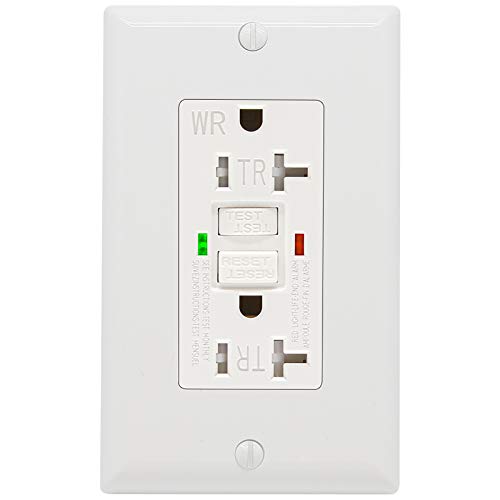
The ANKO is the GFCI for the locations that are hard on hardware: it is UL listed, tamper-resistant, and weather-resistant, and it arrives with its decorator wall plate and screws in the box — a small completeness that single-outlet buyers appreciate at 9 p.m. mid-project. Weather resistance is the differentiator: receptacles in garages, covered porches, workshops, and damp basements live in humidity that corrodes ordinary devices, and a WR-rated GFCI is built with that exposure in mind. Pair it with an in-use outdoor cover where the location demands one, and it is the most location-proof pick in this guide.
Strengths
- UL listing plus tamper resistance plus weather resistance — the complete safety trio in one device
- Wall plate and screws included; nothing else to buy for a standard install
- LED indicator makes protection status legible at a glance
Trade-offs
- 20-amp only in this configuration — same circuit-check discipline as the ELEGRP applies
- Weather resistance is not waterproofing: outdoor installs still need the correct covered or in-use box and cover
- Decorator style may not match older toggle-style plates elsewhere in a vintage home
Key specs (from the manufacturer’s listing)
- Type: GFCI receptacle with LED indicator
- Rating: 20 amp
- Certification: UL listed
- Safety: tamper-resistant, weather-resistant
- Included: decorator wall plate and screws
Choose the ANKO for garages, workshops, covered outdoor locations, and hard-working kitchens — anywhere the environment is damp, dusty, or demanding — and for any install where you want the certification conversation to be as short as possible. Indoor, dry, 15-amp locations are better served by the slimmer or cheaper picks; the ANKO’s talents are aimed at the map’s wet edges.
Best for: garages, workshops, covered porches, and damp locations / Not suited for: 15-amp circuits, or fully exposed locations without a proper in-use cover
Check the current price on Amazon

ELECTECK GFCI Outlets 15 Amp, 5-Pack — Best Value Multi-Pack
The ELECTECK five-pack is how a whole kitchen’s worth of GFCI protection becomes a modest project instead of a major one: ETL-listed 15-amp GFCI receptacles with LED indicators and a slim design, at a per-outlet cost that undercuts every single-unit pick here. For landlords refreshing a rental, renovators protecting several rooms at once, or homeowners replacing a generation of worn outlets, the economics are genuinely compelling. Now the honesty this pick requires: these are non-tamper-resistant receptacles. In homes with young children, and in jurisdictions enforcing current code on renovations, that is a real limitation — weigh it before the price seduces you, and consider this pack for adult households, workshops, and locations where tamper resistance is not the deciding spec.
Strengths
- Best per-outlet economics in this guide for multi-room GFCI projects
- ETL-listed with LED status indicators and a slim, easy-fitting body
- 15-amp rating matches the most common household circuits
Trade-offs
- Non-tamper-resistant: not the right choice for homes with small children or code-sensitive renovations
- No weather-resistance rating stated; keep it indoors and dry
- Multi-pack value only materializes if you actually have several locations to protect
Key specs (from the manufacturer’s listing)
- Type: GFCI receptacle with LED indicator
- Rating: 15 amp
- Certification: ETL listed
- Safety: non-tamper resistant (stated plainly — see review)
- Pack size: 5
- Design: slim profile
Buy the ELECTECK pack with eyes open and it is a smart purchase: GFCI protection is the safety feature that saves lives in wet locations, and this pack spreads it across a home at a tier that removes budget as an excuse. Skip it — firmly — for nurseries, playrooms, and any home where toddlers explore outlets, and take one of the tamper-resistant picks instead. The ELEGRP 15-amp self-test model is the natural upgrade path when the budget allows one room at a time.
Best for: multi-room GFCI upgrades in adult households, rentals, and workshops / Not suited for: homes with young children or installs where tamper resistance is required
Check the current price on Amazon
ELEGRP USB Outlet 15 Amp — Best USB Receptacle
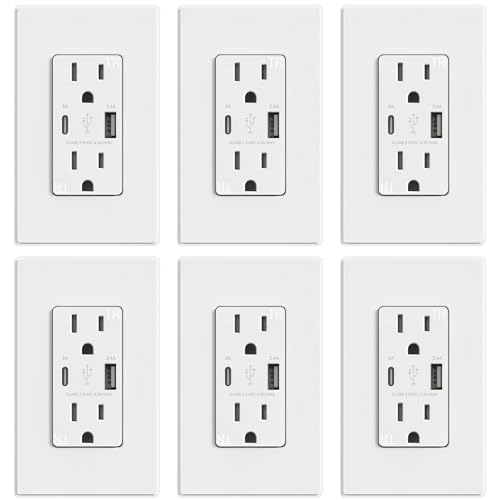
The bedside and kitchen-counter charging mess — two wall warts fighting for two slots — is what USB receptacles exist to end. ELEGRP’s 15-amp model builds 21W of combined USB charging (Type-A and Type-C ports) into a tamper-resistant receptacle, with the wall plate included. Twenty-one watts is honest, useful power: it fast-charges phones and keeps tablets happy, and because the USB section lives in the wall, both AC slots stay free for the lamp and the alarm clock that were always supposed to live there. ELEGRP’s GFCI engineering carries over to this line’s build quality, which is why it anchors our USB picks.
Strengths
- USB-A plus USB-C at 21W covers phones, tablets, e-readers, and accessories without wall warts
- Tamper-resistant receptacle section — the safety spec is not traded away for the charging feature
- Wall plate included and a standard depth that fits most boxes
Trade-offs
- 21W shared across ports will not fast-charge two hungry devices at once, and it is not a laptop power supply
- No GFCI protection — this is a dry-location receptacle for bedrooms and living areas, not a bathroom device
- USB standards evolve faster than walls do; today’s ports are a decade-scale compromise, not a future-proof one
Key specs (from the manufacturer’s listing)
- Type: receptacle with USB charging
- Rating: 15 amp, tamper resistant
- USB: Type-A and Type-C ports, 21W total
- Included: wall plate
Install the ELEGRP USB where devices sleep: bedside tables, the kitchen command corner, the entryway shelf, the home office. Two or three of these placed with intent will quietly delete most of a household’s charger clutter. For a household that charges laptops over USB-C at full speed, treat this as the phone-and-tablet solution and keep the laptop on its own high-wattage charger — or read the TOPGREENER and 20-amp ELEGRP reviews below for the stronger USB sections in this guide.
Best for: bedrooms, kitchens, and entryways drowning in chargers / Not suited for: wet locations, or buyers expecting full-speed laptop charging from the wall
Check the current price on Amazon

TOPGREENER 4.2A USB Wall Outlet — Best for USB-C Charging
TOPGREENER is one of the names that built the USB-receptacle category, and this two-pack is its representative here: a 15-amp tamper-resistant receptacle with dual Type-C and Type-A charging at 4.2A (21W) total, UL listed, with screwless wall plates included. The dual-C arrangement is the modern detail — households increasingly own more USB-C devices than A — and the two-pack format matches how these actually get installed: one at each bedside, or bedside plus kitchen. TOPGREENER also sells a six-pack of the same device for whole-home projects, which tells you the intended scale of the upgrade.
Strengths
- Dual USB-C plus USB-A matches the current device mix better than A-heavy rivals
- UL-listed with tamper-resistant shutters and screwless plates for a clean finished look
- Two-pack (and larger) formats suit real installation patterns
Trade-offs
- 21W total is shared: two devices charge politely, not rapidly, together
- No GFCI protection — dry locations only
- Screwless plates look modern, which can clash in a room full of traditional screwed plates
Key specs (from the manufacturer’s listing)
- Type: receptacle with USB charging
- Rating: 15 amp, tamper resistant, residential grade
- USB: dual Type-C and Type-A, 4.2A / 21W total
- Certification: UL listed
- Pack: 2, screwless wall plates included
Choose the TOPGREENER when USB-C is your household’s present tense — phones, earbuds, tablets, and accessories that all speak C — and when a matched pair of installs is the plan. It is the design-conscious pick: the screwless plates finish like the rest of a renovated room. Buyers needing a single outlet, or 20-amp circuits, should look at the ELEGRP models bracketing it in this guide.
Best for: USB-C households, bedside pairs, and renovated rooms / Not suited for: wet locations or high-wattage laptop charging
Check the current price on Amazon

ELEGRP 20 Amp USB Outlet with 3 USB Ports — Best 20-Amp USB Receptacle
The strongest charging station in this guide is also a full 20-amp receptacle: ELEGRP’s three-port model pairs a 20-amp tamper-resistant duplex with dual USB-C plus a USB-A port, for the kitchen counters, workshops, and family charging hubs where a 15-amp device would undersell the circuit. Twenty-amp receptacles have the T-slot neutral that accepts both 15- and 20-amp plugs, and they belong on 20-amp circuits — the standard for modern kitchens — where this unit lets a coffee maker and three charging devices share one location without a power strip in sight.
Strengths
- Three USB ports (dual C plus A) — the most simultaneous charging in this guide
- True 20-amp receptacle suits kitchen and workshop circuits as installed
- Tamper-resistant, with wall plate included
Trade-offs
- Must go on a 20-amp circuit; installing it on 15-amp wiring is a code violation, full stop
- The USB section is deeper than a plain receptacle — very shallow old boxes may not accept it
- No GFCI protection in the device itself; kitchen counter locations may still require GFCI protection from the breaker or an upstream device
Key specs (from the manufacturer’s listing)
- Type: receptacle with USB charging
- Rating: 20 amp, tamper resistant (TR)
- USB: 3 ports — dual USB-C plus USB-A
- Certification: UL listed (per the manufacturer’s listing)
- Included: wall plate
Buy the ELEGRP 20-amp USB for the household charging hub: the kitchen counter where everyone’s devices land, the workshop bench, the family room media wall. It is the pick that ends the power-strip era in a room. Just honor its one firm rule — verify the circuit is genuinely 20-amp (breaker and wire gauge) before it goes in, a two-minute check our buying guide explains.
Best for: kitchen charging hubs, workshops, and 20-amp circuits with heavy device traffic / Not suited for: 15-amp circuits, shallow boxes, or locations needing built-in GFCI
Check the current price on Amazon
Comparison Table
| Pick | Badge | Key spec | Best for |
|---|---|---|---|
| ELEGRP GFCI 20 Amp | Best Overall | Self-test GFCI, 20A, tamper resistant, slim | Kitchens and bathrooms |
| ANKO GFCI 20 Amp | Best for Kitchens and Outdoors | UL listed, TR + weather resistant, plate included | Garages and damp locations |
| ELECTECK GFCI 5-Pack | Best Value Multi-Pack | 15A GFCI, ETL listed, 5-pack, non-TR | Multi-room upgrades on a budget |
| ELEGRP USB Outlet 15A | Best USB Receptacle | 21W USB-A + USB-C, TR, plate included | Bedsides and charging corners |
| TOPGREENER USB Outlet | Best for USB-C Charging | Dual USB-C + A, 21W, UL listed, 2-pack | USB-C households |
| ELEGRP USB 20 Amp 3-Port | Best 20-Amp USB Receptacle | 20A TR, dual USB-C + A | Kitchen charging hubs |
How to Choose a 110 Volt Receptacle
Step 1: Identify the location’s job. Wet and damp locations (kitchen counters, bathrooms, laundry, garage, outdoors) need GFCI protection — full stop. Dry living locations need tamper resistance if children are present, and benefit from USB if devices charge there. Some locations need both ideas at once; in kitchens, GFCI protection can come from the breaker or an upstream GFCI receptacle feeding a downstream USB receptacle, an arrangement an electrician can set up correctly.
Step 2: Learn your circuit’s amperage. Read the breaker handle in your panel first: 15 or 20. Then confirm with the wire itself if you open a box — 14-gauge wire means 15 amps, 12-gauge means 20. The rule that keeps you code-clean: a 20-amp receptacle (with the T-shaped neutral slot) may only be installed on a 20-amp circuit. Fifteen-amp receptacles are permitted on 20-amp circuits in most residential cases because multiple receptacles share the load, but a single dedicated 20-amp appliance location deserves the true 20-amp device.
Step 3: Decide GFCI placement like an electrician. One GFCI device protects everything downstream of it on the same circuit when wired through its LOAD terminals — which is why one GFCI in the first bathroom can protect the second. That economy is real, but so is its confusion cost: a tripped GFCI in the garage can silently kill the bathroom outlet it protects. For most homes, a GFCI at each wet location (our flagship picks) trades a little money for a lot of legibility.
Step 4: Read the three safety letters. TR means tamper-resistant shutters — required in most new dwelling work and wise anywhere children visit. WR means weather-resistant construction for damp and outdoor locations. And the certification mark — UL or ETL — means a recognized lab tested the device. A receptacle missing all three is not a bargain at any price; it is an unknown plugged into your wall forever.
Step 5: Size USB honestly. Wall USB is for phones, tablets, and accessories: 21W-class sections (our 15-amp picks) charge one device quickly or two politely. Laptops that sip 45–100W over USB-C still want their own chargers. Buy wall USB to delete clutter, not to replace high-wattage charging, and you will be delighted instead of disappointed.
How to Replace a Receptacle Safely, Step by Step
Step 1: Kill the power and prove it dead. Switch off the breaker feeding the receptacle. Then test the outlet with a plug-in tester or a lamp you have just confirmed works elsewhere — and test again after removing the cover, touching your non-contact voltage tester to each terminal. Electricity forgives nothing; the proof step is the whole ritual.
Step 2: Photograph the existing wiring before touching it. One phone photo of which wire lands on which terminal is worth an hour of regret. Note especially on a GFCI whether wires land on LINE (always) and LOAD (only if downstream outlets are protected through this device).
Step 3: Move one wire at a time. Black (hot) to the brass screw, white (neutral) to the silver screw, bare or green (ground) to the green screw. Prefer the side screws over push-in back connections — screw terminals hold better over decades of heating and cooling. If the old device was back-wired, this upgrade is your chance to do it the durable way.
Step 4: Fold, seat, and level. Fold the wires in an accordion behind the device, seat the receptacle without pinching insulation, snug the mounting screws, and fit the plate. Slim-body GFCIs like the ELEGRP earn their keep exactly here, in shallow, crowded boxes.
Step 5: Restore power and test the protection. Breaker on. On a GFCI, press TEST — it should trip with a click and the indicator should respond — then RESET. Plug in your tester or lamp and confirm normal operation. For USB models, charge a phone for two minutes and confirm the port is live.
Step 6: Label the breaker. Write the room and location on the panel directory while you remember. The next person to do this job — possibly future you, in the dark, during an outage — says thanks.
Problem: the new GFCI trips instantly and will not reset. → Usually a LINE/LOAD reversal or a genuine ground fault downstream. Power off, re-check your photo and the terminal labels, and if the wiring is correct, the device may be reporting a real fault — that is its job, and an electrician is the next step, not a non-GFCI replacement.
Problem: the receptacle works but the cover plate will not sit flat. → The device is not seated evenly or a wire is trapped behind it. Power off, re-fold the wires, and re-seat. Forcing a plate over a stressed device cracks plates and loosens terminals over time.
Problem: you find aluminum branch wiring or cloth-insulated conductors. → Stop and call an electrician. Aluminum wiring requires specific devices and techniques (CO/ALR-rated devices and proper terminations), and degraded cloth insulation is a hazard that a receptacle swap cannot fix. Knowing where DIY ends is part of doing DIY well.
GFCI, AFCI, and Dual-Function: Which Protection Goes Where
Modern electrical safety has three layers, and confusing them is the most common conceptual error in this category. GFCI (ground-fault) protection — the subject of half this guide — guards people against shock by watching for current leaking out of the intended path, as through water or a body. It belongs in wet locations. AFCI (arc-fault) protection guards the house against fire by recognizing the electrical signature of damaged, arcing wiring — a frayed cord behind a sofa, a nail through a cable in a wall — and it is required in most living areas and bedrooms under current code. AFCI protection usually comes from the breaker, though AFCI receptacles exist for the first outlet of a circuit. Dual-function breakers and devices combine both protections, and they are increasingly the clean answer in kitchens, where a circuit can need shock protection at the counter and arc protection for everything else. The practical takeaway for a receptacle shopper: buying a GFCI receptacle does not give you arc protection, and an AFCI breaker does not give you ground-fault protection at the sink. Map the protection to the hazard — water means GFCI, wiring age and living spaces argue for AFCI, and a conversation with an electrician about dual-function breakers is worth having in any home old enough to have a receptacle worth replacing.
Receptacle Grades: Why One Outlet Costs Three Times Another
Receptacles are sold in grades, and the differences are mechanical rather than magical. Residential grade — most of this guide — uses adequate contacts and housing for normal home duty at the friendliest tiers. Commercial or specification grade devices use heavier contacts, stronger nylon faces, and more robust internal springs; they survive thousands more plug insertions and grip plugs firmly for decades, which is why schools, offices, and workshops spec them. Hospital grade adds still stricter grip and grounding requirements for medical facilities and is overkill — though harmless — in a home. Where does grade matter for a homeowner? In the receptacles that see daily plug cycling: the kitchen counter where the kettle migrates, the workshop, the vacuum’s favorite outlet, the gaming desk. A receptacle that grips loosely is not merely annoying in daily use; a loose contact heats under load, and heat at a connection is how electrical fires start. If a receptacle in your home no longer holds a plug snugly — if cords fall out under their own weight — that device is at end of life regardless of grade, and replacing it with a quality unit from this guide is one of the highest-value ten-dollar-class fixes in home maintenance.
Planning a Whole-Home Receptacle Refresh
Few homeowners replace one receptacle; the first swap reveals how tired the rest are. A sane refresh order follows risk, not geography. First, the wet locations: every kitchen counter, bathroom, laundry, and garage receptacle gets modern GFCI protection — the ELEGRP and ANKO picks — because shock risk concentrates where water lives. Second, the safety defects: any receptacle that is cracked, loose-gripping, discolored, warm in use, or two-prong ungrounded anywhere in the house jumps the queue ahead of all cosmetic work. Third, the children’s rooms get tamper-resistant devices throughout if they do not have them. Fourth, the charging hubs get USB receptacles — bedsides, kitchen command corner, entry — which is where the ELEGRP and TOPGREENER USB picks transform daily friction. Last, the cosmetic pass: matched plates and consistent device colors in the rooms guests see. Budget the project in that order and even a partial refresh buys most of the safety. Buy devices a room at a time rather than a house at a time if cash flow matters — the per-outlet economics of the multi-packs help, but a finished bathroom beats five started rooms. And photograph every box you open; a whole-home project generates a wiring atlas of your house that future you, mid-renovation, will treasure.
Outdoor Receptacles Are a System, Not a Device
The ANKO pick carries a weather-resistant rating, but outdoors, the receptacle is only one layer of a system, and the other layers decide whether the install lasts. The box must be weatherproof and sealed where cables enter. The cover must match the duty: a flat cover that only protects when nothing is plugged in suits a receptacle used twice a year, while an in-use (bubble) cover — which closes over cords in place — is the correct choice anywhere a plug lives outdoors, from holiday lights to a pond pump. The GFCI protection can live in the device, upstream, or at the breaker, but it must exist; outdoor circuits and water are the original reason the technology was mandated. Finally, orientation and drip loops matter: cords should droop below the outlet so rain runs off rather than in, and receptacles under eaves outlive receptacles in open walls by years. Buyers who treat the outdoor outlet as a system get a decade from it; buyers who screw a WR device into a rusty box under a flat cover get a season and a nuisance-trip mystery. The device is the cheapest layer of the five — spend accordingly on the other four.
Common Buying Mistakes
Installing a 20-amp receptacle on a 15-amp circuit. The T-slot invites a 20-amp plug that the wiring cannot safely feed. Match device to breaker and wire gauge — the two-minute check in our buying guide.
Buying non-tamper-resistant outlets for a home with children. The savings are small and the shutter is the entire point. Our budget pack is labeled non-TR in three places in this guide because this mistake is so easy to make by price alone.
Assuming a USB receptacle replaces a GFCI in a wet location. It does not. Bathrooms and kitchen counters need ground-fault protection; if you want USB there too, the protection must come from a GFCI breaker or an upstream GFCI device, arranged correctly.
Choosing smart receptacles for every room. Wi-Fi outlets are delightful in two or three strategic spots and an account-management burden in twenty. Buy connected features where automation earns them.
Reusing a cracked, loose, or heat-discolored receptacle “one more year.” A receptacle that no longer grips a plug firmly is a heating element in waiting. Replacement is cheap, quick, and — with the steps above — well within a careful homeowner’s reach.
Final Recommendation
For protected locations, the default answer is the ELEGRP GFCI 20 Amp (or its 15-amp sibling on 15-amp circuits): self-testing, tamper-resistant, and slim enough for old boxes. Damp and outdoor-adjacent locations belong to the ANKO GFCI, multi-room projects in adult households to the ELECTECK 5-Pack with its tamper-resistance caveat understood. For charging, take the ELEGRP USB 15 Amp as the general answer, the TOPGREENER for USB-C-heavy households, and the ELEGRP 20 Amp 3-Port for a true kitchen charging hub. Check price on Amazon, verify amperage and safety marks on the listing, and check your breaker before the package arrives.
Receptacles are one stop on a whole-home electrical refresh. Readers planning theirs will also want our guides to the Best 110 Volt Smoke Det for the other wall-and-ceiling safety device every home needs, the Best 110 Volt Portable Battery Back for what to plug into these receptacles when the power fails, the Best 110 Volt Led Floodlight for the outdoor end of the same circuits, and the Best 110 Volt Led Light Strips for the low-voltage-looking lighting that still starts at a receptacle.
However many you replace, finish the job properly: test every GFCI with its own button on install day, note the install date on the inside of each wall plate in pencil, and add a yearly calendar reminder to walk the house pressing TEST buttons each spring without fail. Receptacles are fit-and-forget devices right up until they are not, and that one-minute annual ritual is the difference.
Frequently Asked Questions
What is the difference between a 15-amp and a 20-amp receptacle?
Capacity and slot shape. A 20-amp receptacle has a T-shaped neutral slot that accepts both 15-amp and 20-amp plugs, and it may only be installed on a 20-amp circuit with 12-gauge wire. A 15-amp receptacle accepts only 15-amp plugs. The breaker and wire in your wall decide which you may install — never the other way around.
Where does my home actually need GFCI receptacles?
Anywhere water and electricity can meet: kitchen countertops, bathrooms, laundry rooms, garages, unfinished basements, and all outdoor locations are the standard list under modern codes. If a receptacle is within reach of a sink, tub, or the outdoors, GFCI protection belongs there — from the device itself or from an upstream GFCI or breaker.
Are tamper-resistant receptacles really necessary?
They are required in most new and renovated dwelling locations under current US code, and the reasoning is simple: the internal shutters only open when both slots are pressed evenly by a plug, which defeats the fork, key, and paperclip experiments of childhood. In any home where children live or visit, treat TR as non-negotiable — every pick in this guide except the clearly flagged budget pack has it. The shutters cost the user nothing in daily life: a normal plug, pressed evenly, opens them without any noticeable extra effort, which is exactly what a good safety feature should feel like — invisible until the moment it matters.
Can I replace a receptacle myself, or do I need an electrician?
A like-for-like swap on modern copper wiring is a standard homeowner task when done with the safety ritual in our how-to: breaker off, proven dead, one wire at a time, screws torqued, protection tested. Call an electrician for aluminum wiring, damaged or cloth insulation, boxes with mystery extra wires, any panel work, and any situation where the photo of the old wiring does not make sense to you.
Do USB receptacles charge as fast as the adapter that came with my phone?
For most phones, a 21W wall USB section is comparable to a standard fast-charge adapter — one device at a time. It will not match a high-wattage laptop charger, and two devices sharing the section split the power. Think of wall USB as always-available, clutter-free charging rather than maximum-speed charging, and it will never disappoint you.
My new GFCI keeps tripping. Is it defective?
Occasionally, but usually it is doing its job — reporting a ground fault you did not know you had: a damp appliance, a nicked cable, moisture in an outdoor box, or an appliance with aging insulation leaking small currents. Diagnose by unplugging everything on the circuit and restoring loads one at a time. If it trips with nothing plugged in and the wiring is verified correct, suspect the device or a fault in the walls, and bring in an electrician rather than swapping in a non-GFCI outlet to silence it — the trip is the message, not the problem.
How do I know if my GFCI is still protecting me?
Press its TEST button: it should trip, cutting power, and RESET should restore it. Self-testing models like our ELEGRP pick run this check automatically and use their LED to report status — green or lit for normal on most designs, red or dark for trouble, per the device’s legend. A GFCI that will not trip on TEST, or will not reset, has finished its service and should be replaced, not ignored.


