Disclosure: airfryerkitchensupply.com is reader-supported. When you buy through links on our site, we may earn an affiliate commission at no extra cost to you.
Where to buy
Every converter linked below was verified against Amazon’s own catalog data, with its step-down function and wattage confirmed in the manufacturer’s own listing. The BESTEK Universal Travel Adapter Voltage Converter (250W) is the all-round pick, the BESTEK 300W Converter suits Europe-focused trips, and the Super Electro Step Down Converter and LINGPEI Travel Converter cover outlet layout and compactness. Hair-dryer duty belongs to the TREVOLTY 2000W Converter and the BESTEK 2000W European Converter. Check the current price on Amazon for each — and read the converter-versus-adapter section below before buying anything, because it decides whether you need a converter at all.
Introduction
The best 110 220 travel volt converter exists to solve a problem that is half electrical and half educational. The electrical half: most of the world runs on 220-240V power, North American devices expect 110-120V, and plugging the second into the first without conversion is a brief and expensive experiment. The educational half: most modern travel electronics — phone chargers, laptop bricks, camera chargers — are already dual-voltage and need only a plug adapter, not a converter at all. The travelers who genuinely need a converter are carrying something with a motor or a heating element designed for 110V only: a hair dryer, a curling iron, a garment steamer, certain older or simpler devices. This guide serves them, honestly, and tells everyone else how to recognize that they can travel lighter.
Within the converter category there are two families, and confusing them is the classic travel mistake. Low-wattage converters — the 250W and 300W class — are built for electronics and small personal devices, and they are compact, cool-running and safe within their rating. High-wattage converters — the 2000W class — exist for resistive heating appliances like hair dryers, trading size and heat for the ability to feed the one device class that truly needs them. Neither family is a smaller or larger version of the other’s job; they are different tools, and using a hair dryer on an electronics converter, or expecting a dryer converter to be kind to sensitive electronics, ends the same way in both directions.
All six picks were verified through Amazon’s catalog data, with wattage class and step-down direction confirmed from the manufacturers’ own listings. Note the direction: everything here steps foreign 220V down to the 110V your North American devices expect. If your journey runs the other way — bringing 220V devices to North America — you want a step-up transformer instead, and our companion guide to full-size converters covers that ground.
In this guide
Quick Picks
- Best Overall: BESTEK Universal Travel Adapter Voltage Converter (250W) — step-down conversion plus worldwide plug adapters, 3 AC outlets and 4 USB ports with PD 20W.
- Best for Europe Trips: BESTEK 300W Voltage Converter — a Europe-focused step-down unit with USB-C PD 20W and five universal plug options.
- Best Outlet Layout: Super Electro Step Down Voltage Converter — 3 AC outlets and 4 USB ports (2 USB-A, 2 USB-C) with EU/UK/AU adapters.
- Best Compact: LINGPEI International Travel Adapter Voltage Converter — step-down conversion for phones, laptops and curling irons across 200+ countries.
- Best for Hair Dryers: TREVOLTY 2000W Voltage Converter — high-wattage conversion for dryers, with 3 AC outlets and USB charging.
- Best High-Wattage Alternative: BESTEK 2000W European Travel Converter — 2000W for hair dryers and curling irons on European trips, from the category’s established brand.
How These Picks Were Chosen
Verification targeted the two facts travelers get wrong: direction and wattage. Each pick was confirmed through Amazon’s product catalog data as a step-down converter — 220V in, 110V out — with its wattage class stated in the manufacturer’s own listing. The marketplace blurs converters and mere plug adapters relentlessly, sometimes in the same product title, so any listing whose conversion function could not be confirmed was excluded, however travel-friendly it looked.
Selection criteria after that were the ones that decide a trip’s electrical happiness. Wattage class coverage came first, deliberately split between electronics-class units (250-300W) and heating-appliance units (2000W), because those are the two real jobs. Plug coverage followed — which regional adapters are included, and whether the set matches the destinations travelers actually visit. USB provision mattered next, since a converter that also fast-charges the phones directly removes a second device from the bag. Finally, brand depth: BESTEK anchors this guide because it has sold travel converters for years and its instructions take the electronics-versus-heating distinction seriously, which is the surest sign of a maker that understands its own product.
One rule governed everything: no pick is presented as universal. Each review states its wattage class and its proper loads in plain language, and the buying guide repeats the matching rules until they are impossible to miss. In this category, the honest sentence is the product.
The 6 Best 110/220 Travel Volt Converters

BESTEK Universal Travel Adapter Voltage Converter (250W) — Best Overall
The BESTEK Universal is the travel converter most people should buy, because it is really three products fused sensibly: a 250W step-down converter (220V to 110V) for the devices that need conversion, a worldwide plug adapter set covering EU, UK, AU, US and India patterns, and a charging hub with 3 AC outlets and 4 USB ports including PD 20W fast charging. On a real trip that fusion is the point — one object in the bag handles the curling iron that needs conversion, the laptop that needs only a plug, and the phones that need USB, all from a single foreign wall outlet, which in older hotels is sometimes the only outlet there is.
Strengths
- Converter, worldwide adapter set and USB hub in one unit — the complete travel power station.
- 250W electronics-class conversion is the right size for personal devices and small appliances within rating.
- BESTEK’s category experience shows in clear load guidance — a safety feature in itself.
Trade-offs
- 250W is an electronics ceiling: hair dryers and other heating appliances belong on the 2000W picks.
- One fused unit means one point of failure for all your charging; some travelers split the risk with a spare adapter.
- Universal designs are slightly bulkier than single-region specialists.
| Spec | Verified detail |
|---|---|
| Conversion | 220V to 110V step down, 250W |
| Outlets | 3 AC outlets |
| USB | 4 USB ports, PD 20W |
| Plug adapters | EU / UK / AU / US / India worldwide set |
The ownership story here is the hotel-room evening: one outlet by the desk, three travelers’ worth of devices, and a single unit that sorts them — phones on USB, the dual-voltage laptop straight through, the one 110V-only device on the converted outlet. That is travel power done right, and it is why this unit, rather than any higher-wattage rival, leads the guide: most travelers’ real loads are exactly its class. Buy the 2000W picks for the dryer if you must bring one; buy this for everything else, and consider leaving the dryer at home in favor of the hotel’s — the guide’s buying section makes that case in full.
Best for: most international travelers with mixed electronics and one small 110V-only device. / Not suited for: hair dryers or any heating appliance above its 250W class.
Check the current price on Amazon

BESTEK 300W Voltage Converter (US to Europe) — Best for Europe Trips
The 300W BESTEK narrows the universal brief to the most-traveled routes: a step-down converter for US-to-Europe travel with USB-C PD 20W charging and a set of five universal plug options spanning EU, UK, AU, JP and India/South Africa patterns. The extra 50W of class headroom over the 250W model is modest but real for travelers whose “small device” runs warm — a steamer’s smaller sibling, a powered accessory — and the Europe-first framing suits the itineraries most North American travelers actually fly: one converter, every plug the trip can produce, no adapters bought in airports at airport prices.
Strengths
- 300W electronics class with modern USB-C PD 20W fast charging.
- Five plug patterns cover Europe and the common onward destinations in one set.
- Same trusted brand and load guidance as the Best Overall pick.
Trade-offs
- Still an electronics converter — the hair dryer rule applies unchanged.
- Travelers to a single country may prefer a smaller dedicated adapter-plus-converter.
- Two BESTEK electronics picks in one guide is deliberate; compare their plug sets against your itinerary and choose once.
| Spec | Verified detail |
|---|---|
| Conversion | 220V to 110V step down, 300W |
| USB | USB with PD 20W |
| Plug adapters | EU / UK / AU / JP / India / South Africa options |
| Focus | US to Europe travel |
Choose between this and the Universal above by itinerary and by load list, not by the small wattage difference. The Universal’s broader hub design suits the traveler who becomes the group’s charging station; this 300W unit suits the traveler whose route is Europe with possible onward legs and whose devices are their own. Both embody the same philosophy — convert only what needs converting, adapt the rest, charge everything from one outlet — and both will outlast the trip that bought them by a decade of journeys. That durability of relevance is what a travel converter purchase should aim at.
Best for: Europe-focused travelers wanting one converter for the whole route. / Not suited for: heating appliances, or single-country minimalists.
Check the current price on Amazon

Super Electro Step Down Voltage Converter — Best Outlet Layout
The Super Electro competes on the furniture of travel power: a step-down converter (220V to 110V) with 3 AC outlets and 4 USB ports split evenly between USB-A and USB-C, plus EU, UK and AU plug adapters. That USB split is its signature — traveling parties increasingly carry a mix of legacy and modern cables, and a hub that fast-charges both generations without dongle archaeology earns its place in the bag. For couples and families whose nightly charging census is long, outlet layout is not a detail; it is the product.
Strengths
- Balanced USB-A and USB-C provision serves mixed-generation device bags.
- 3 AC outlets plus conversion covers the typical hotel-room loadout.
- EU/UK/AU adapter set matches the most common long-haul routes.
Trade-offs
- Confirm its wattage class on the listing against your largest load before ordering — layout is its pitch, not capacity.
- Brand depth is thinner than BESTEK’s in this category.
- Like all electronics-class converters, heating appliances are out of bounds.
| Spec | Verified detail |
|---|---|
| Conversion | 220V to 110V step down |
| Outlets | 3 AC outlets |
| USB | 4 ports: 2 USB-A, 2 USB-C |
| Plug adapters | EU / UK / AU |
The honest way to place this pick is as the group’s charging station. One traveler with one phone needs none of this; two travelers with phones, watches, earbuds, a camera and a tablet need exactly this, and they need it to work from the one reachable outlet in a Lisbon apartment or a London hotel room. Within its electronics class it will also carry the small converted load — the 110V-only device that justified a converter at all — making it the single-unit answer for device-heavy parties. Check the wattage, respect the class, and it will quietly become the most borrowed object in your travel kit.
Best for: couples and families with many devices on EU/UK/AU routes. / Not suited for: heating appliances or travelers who prize the smallest possible kit.
Check the current price on Amazon

LINGPEI International Travel Adapter Voltage Converter — Best Compact
The LINGPEI is the minimalist’s converter: an international travel adapter with step-down conversion (220V to 110V) explicitly aimed at cell phones, laptops and curling irons, covering the US-to-UK, Europe, Australia and 200-plus-country routes. Its pitch is subtraction — the traveler who carries little, converts the one or two small devices that need it, and refuses to pack a hub. For that traveler, a compact converter that covers the world’s plug geography without a fistful of separate adapters is the correct tool, and the explicit mention of curling irons in its own listing signals it was designed with the classic converter use case in mind.
Strengths
- Compact, single-unit answer for the light-packing traveler.
- Broad country coverage across UK, Europe, Australia and beyond.
- Personal-device focus — phones, laptops, curling irons — matches the real converter workload.
Trade-offs
- Verify its wattage rating against your specific device; compact converters are electronics-class tools.
- Fewer outlets and USB ports than the hub-style picks — by design, and a real limit for groups.
- Brand depth is the thinnest on this list; the BESTEK picks are the conservative alternative.
| Spec | Verified detail |
|---|---|
| Conversion | 220V to 110V step down |
| Coverage | UK, Europe, Australia, 200+ countries |
| Positioned for | Cell phones, laptops, curling irons |
Compact picks live or die on honesty about their class, so let us be precise: this is the converter for the traveler whose 110V-only device is small — the curling iron on its lower settings, the personal appliance within rating — and whose electronics are otherwise dual-voltage and need only the adapter function it also provides. That describes a great many real travelers, and for them the hub picks above are luggage spent on other people’s problems. Pack this, check your one device’s wattage against its rating before departure, and travel light with a clear conscience.
Best for: solo, light-packing travelers with one small 110V-only device. / Not suited for: groups, device-heavy charging needs, or high-wattage appliances.
Check the current price on Amazon
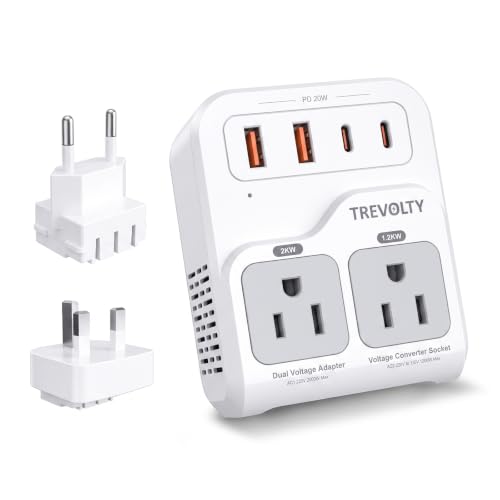
TREVOLTY 2000W Voltage Converter — Best for Hair Dryers
Now the other family. The TREVOLTY is a 2000W converter (220V to 110V) built for the load the electronics class cannot touch: the hair dryer, with a converter-adapter combination design offering 3 AC outlets and USB-A and USB-C charging with PD 20W, and Type C and G plug coverage for European travel. Two thousand watts is dryer territory — a typical travel or home dryer draws well into four figures — and a converter in this class is a different animal: larger, warmer in operation, and intended for short, attended bursts of heating-appliance use rather than all-night electronics duty.
Strengths
- 2000W class feeds hair dryers and similar resistive heating appliances within rating.
- Still includes USB charging with PD 20W, so it can serve as the trip’s single power unit.
- Type C and G plugs cover the core European destinations for its stated purpose.
Trade-offs
- High-wattage converters are for heating appliances; sensitive electronics belong on the electronics-class picks.
- Bigger and heavier than the 250-300W units — a real luggage cost, paid for one appliance.
- Respect the continuous-use guidance: dryer sessions are minutes, not hours.
| Spec | Verified detail |
|---|---|
| Conversion | 220V to 110V, 2000W |
| Outlets | 3 AC |
| USB | 2 USB-A, 2 USB-C, PD 20W |
| Plugs | Type C / G |
| Positioned for | Hair dryers |
The strategic question this pick poses is whether the dryer should travel at all. Hotels overwhelmingly provide one; dual-voltage travel dryers exist precisely to retire this problem; and every gram of a 2000W converter is a gram spent serving a single appliance. But travelers with specific hair needs, long stays in rentals without amenities, or professional reasons to use their own dryer are real, and for them this class of converter is not a luxury — it is the only safe way to run that dryer abroad. If that is you, the TREVOLTY’s combination of dryer-class power with modern USB charging makes it the one-unit answer. Buy it for the dryer, use its USB for the phones, and leave the electronics converter at home.
Best for: travelers who genuinely need their own 110V hair dryer abroad. / Not suited for: sensitive electronics as a primary diet, or light packers.
Check the current price on Amazon

BESTEK 2000W European Travel Converter — Best High-Wattage Alternative
BESTEK’s own entry in the dryer class gives high-wattage buyers the established-brand option: a 2000W travel voltage converter for Europe, positioned for hair dryers, curling irons and phones, with 2 USB ports. The pairing with the TREVOLTY is deliberate — this is the guide’s second verified 2000W route, and the choice between them is the familiar one between a feature-richer newer entrant and the category’s incumbent name, whose manuals and load guidance have been refined across years of travelers. Either is a rational purchase; the brand-loyal and the cautious will land here.
Strengths
- 2000W dryer-class conversion from the travel converter category’s reference brand.
- USB charging included for the phone side of the trip.
- Europe-focused plug coverage matches the classic use case.
Trade-offs
- Same class rules as the TREVOLTY: heating appliances yes, delicate electronics as a staple no.
- Fewer outlets than the TREVOLTY’s layout; compare against your device census.
- The luggage weight of the 2000W class is unavoidable in either brand.
| Spec | Verified detail |
|---|---|
| Conversion | 220V to 110V, 2000W |
| USB | 2 USB ports |
| Positioned for | Hair dryer, curling iron, phone |
| Focus | European travel |
There is a reassurance in buying the heavy, safety-relevant tool from the maker whose name is on half the category, and in a product class that mediates between foreign mains power and a heating appliance, reassurance is a legitimate specification. BESTEK’s long presence also means its guidance — what to plug in, what never to plug in, how long to run — has been tested by an enormous installed base of travelers. If your decision framework is “the dryer must work, safely, every morning of a month in Europe,” this is the conservative summit of that requirement, and the pick we would hand a traveler who asked us to choose for them.
Best for: brand-conscious travelers needing dryer-class power in Europe. / Not suited for: electronics-first travelers or minimalists.
Check the current price on Amazon
Comparison Table
| Pick | Badge | Key spec | Best for |
|---|---|---|---|
| BESTEK Universal 250W | Best Overall | 250W step-down, worldwide plugs, 4 USB | Most travelers |
| BESTEK 300W | Best for Europe Trips | 300W step-down, PD 20W, 5 plug options | Europe itineraries |
| Super Electro | Best Outlet Layout | 3 AC, 2 USB-A + 2 USB-C | Device-heavy parties |
| LINGPEI | Best Compact | Step-down, 200+ countries | Light packers |
| TREVOLTY 2000W | Best for Hair Dryers | 2000W, 3 AC, PD 20W USB | Dryer devotees |
| BESTEK 2000W | Best High-Wattage Alternative | 2000W, Europe focus | Brand-first dryer users |
How to Choose a Travel Volt Converter
Step zero is discovering whether you need a converter at all. Read the fine print on every charger and device you plan to pack: if its input reads “100-240V,” it is dual-voltage and needs only a plug adapter — which the hub picks in this guide also provide. Phones, laptops, tablets, cameras and most modern personal electronics are dual-voltage. The devices that strand travelers are the 110V-only minority: many hair dryers and styling tools, some older electronics, and simple motor or heating appliances. Your converter purchase should be sized by that minority list and nothing else.
Step one is matching the class. Electronics and small devices live in the 250-300W class: cool, compact, safe within rating. Heating appliances — dryers above all — live in the 2000W class, and the rule that keeps travelers out of trouble is never to cross the streams: no dryer on an electronics converter, even “just to test it,” and no delicate electronics as the steady diet of a dryer converter. A useful safety habit across both classes is the half rule: keep continuous loads comfortably below the converter’s rating rather than at its edge, and treat the rating as a ceiling for brief peaks, not a cruising altitude.
Step two is the plug geography. Converters in this guide bundle adapters for the common systems — Type C across continental Europe, Type G in the UK and Ireland, Type I in Australia, and others — but “worldwide” sets differ in their corners. Lay your itinerary against the included set before departure; the time to discover a missing Swiss or Italian variant is at your kitchen table, not at midnight in a Milanese apartment.
Step three is deciding the dryer’s fate with clear eyes. The hierarchy of wisdom runs: use the hotel’s dryer; or pack a dual-voltage travel dryer; or, if your own dryer is genuinely non-negotiable, pack a 2000W-class converter and accept its weight as the price of that loyalty. What the hierarchy forbids is the improvised fourth option — a dryer on an undersized converter — which converts luggage savings into a smoke alarm’s aria. Budget in that order and the electrical side of any trip becomes the least interesting part of it, which is exactly what travel power should be.
How to Travel With a Converter Safely
Before departure, run the home test: assemble the converter, its adapters and every device you intend to use with it, and confirm plugs fit, adapters seat firmly, and you know which outlet on the unit is the converted one — on hub-style units, not every socket necessarily passes through the converter, and the manual’s diagram is the authority. Label if you must; midnight in a foreign hotel room is no time for electrical archaeology.
On the trip, a few disciplines keep you safe. Plug the converter into the wall first, then connect devices. Run heating appliances attended and briefly, on the converter class built for them, and let both cool before packing. Never daisy-chain a converter into a power strip to multiply outlets for high loads — the hub picks exist precisely to give you outlets honestly. And respect the device’s own label over any fellow traveler’s folklore: the input specification printed on your appliance outranks every anecdote ever told in a hostel kitchen.
One more pattern deserves naming because it is the most common converter story of all: the dual-voltage device destroyed by a converter it never needed, or by being plugged directly into 220V through a bare adapter by a traveler who confused the two tools. Adapter and converter are different objects with different jobs. If you remember one sentence from this guide, make it this: an adapter changes the shape of the plug; a converter changes the voltage — and only the second one stands between a 110V-only device and a 220V wall.
Common Buying Mistakes
The category-defining mistake is confusing an adapter with a converter and plugging a 110V-only device into 220V power. The device loses, instantly and permanently.
Second is running a hair dryer on an electronics-class converter. The wattage classes exist because the loads are different species; respect the 250-300W ceiling.
Third is buying a converter for devices that are already dual-voltage — luggage and money spent solving a problem the charger’s label says you do not have. Read the labels first.
Fourth is assuming every outlet on a hub unit is converted. Check the manual’s diagram for which sockets are converted and which are pass-through.
Fifth is forgetting the return direction. These picks step foreign power down for North American devices; 220V devices visiting North America need step-up equipment instead — see the transformer guide linked below.
Final Recommendation
For most travelers, the BESTEK Universal 250W is the best 110 220 travel volt converter: conversion, worldwide plugs and USB charging in one proven unit. Europe-focused travelers can choose the BESTEK 300W with equal confidence, and dryer loyalists should go straight to the TREVOLTY 2000W or BESTEK 2000W class and never improvise. For the opposite voltage direction and heavier stationary loads, see our guide to the Best 110 220 Volt Converter, and for the rest of the journey’s power kit, the Best 110 12 Volt Inverter and Best 110 12 Volt Cooler.
The Hair Dryer Problem, Solved Properly
It is worth dwelling on the dryer, because it generates more converter confusion — and more ruined appliances — than every other device combined. The physics are stark: a hair dryer is a fan blowing across a heating element, and the element alone commonly draws more power than an entire electronics-class converter can supply. There is no technique, adapter or optimism that changes this; there are only three legitimate solutions, and this guide has now named them all. Use the accommodation’s dryer, which exists in the overwhelming majority of hotels and most rentals. Carry a dual-voltage travel dryer, a modest appliance engineered from birth to run on either system with a switch or automatic sensing. Or carry a 2000W-class converter, accepting its size as the fare for using your own full-power dryer abroad.
What makes the problem persistent is that the failure mode is seductive: a dryer on an undersized converter may actually run — weakly, briefly, while the converter overheats toward its failure. Travelers interpret those thirty seconds as proof the combination works, right up until it does not, usually mid-trip and mid-morning. The same logic applies in miniature to curling irons and steamers on converters below their rating: “it turned on” is not a safety standard. Read the wattage on the appliance, compare it honestly to the converter’s class, keep a margin rather than a hope, and the dryer problem simply never occurs. It is the least glamorous advice in travel, and the most valuable per word in this entire guide.
Plug Types Around the World: A Traveler’s Field Guide
Converters handle voltage; geography handles shape, and a working knowledge of the world’s plug families turns the adapter sets bundled with these picks from a bag of mysteries into a system. Type C — two round pins — is continental Europe’s lingua franca, accepted from Lisbon to Warsaw, with close cousins complicating Switzerland (Type J) and Italy (Type L) in older buildings. Type G — three rectangular pins, fused plug, switched outlets — rules the UK, Ireland and a swath of Commonwealth and Gulf destinations, and it is the bulkiest adapter in any kit. Type I serves Australia, New Zealand and China with angled flat pins. Type A and B are home: North America and Japan, the latter ungrounded and at 100V, a reminder that voltage oddities are not only a 220V story.
The practical disciplines follow from the map. First, multi-country itineraries need the set, not the single adapter — the traveler crossing from London to Paris to Rome meets three systems in a week, which is why the hub picks in this guide bundle families rather than singles. Second, adapters stack badly: a converter plugged through two loose adapters into a worn outlet is a wobbly, heat-prone tower, and the correct response to a loose fit is a better-fitting single adapter, not tape and optimism. Third, the grounded question matters for the few devices that use a ground pin; most travel electronics are two-pin and indifferent, but the traveler with a grounded appliance should confirm their adapter path preserves it. Master the map and the electrical side of travel becomes what it should be — a solved problem you stop thinking about by the second trip.
What Converters Cannot Do: Frequency, Motors and Medical Devices
Honesty about limits is this guide’s recurring theme, and three deserve their own section. The first is frequency: converters change voltage, not the 50Hz or 60Hz rhythm of the supply. Most electronics are indifferent, but devices that derive timing or speed directly from the mains — some clocks, turntables, and certain motor-driven appliances — will run at the wrong speed abroad even at the right voltage. The second is motors generally: motor loads are harder on converters than their wattage suggests, because starting currents surge and waveform quality matters; the conservative pattern is to keep motor devices well inside a converter’s rating and to prefer dual-voltage versions of anything with a motor that must travel.
The third deserves emphasis rather than brevity: medical devices. Equipment like CPAP machines is commonly dual-voltage in its power supply — check the brick’s label, which is usually reassuring — but anything life-supporting or therapy-critical should be planned with its manufacturer’s travel guidance, not with a marketplace converter chosen by wattage arithmetic. Airlines, manufacturers and travel clinics all publish device-specific advice, and the stakes of that category of luggage justify using it. A converter is a wonderful servant for the ordinary devices of travel; for the extraordinary ones, let it be one component in a plan its maker has blessed, never the whole plan.
Carrying a Converter Through the Trip: Packing, Heat and Hotel Reality
The lived experience of travel power has a texture that specifications omit, and seasoned travelers plan around it. Converters — especially the 2000W class — generate heat in use and should cool before they are packed against clothing; a converter zipped hot into a suitcase is a converter aging early and a wardrobe smelling of warm electronics. Cable discipline matters more abroad than at home: foreign outlets hide behind furniture, sit at floor level, or perch singly in bathrooms, so the hub-style picks earn their keep by turning one badly placed outlet into a charging station on the nightstand — while a short-corded single converter may spend the trip dangling from a wall behind a wardrobe, charging nothing but the carpet’s dust.
Hotel reality also argues for the fused, protected designs this guide favors: wiring quality varies enormously across the world’s guesthouses, and a converter with its own protection is a calmer intermediary between your devices and an unknown electrical past than a bare adapter ever is. Finally, pack the converter where security and your hands can reach it — in the carry-on, with the devices it serves — because the traveler whose power kit is in a checked bag, in a delayed bag, in another country, has a story rather than a charged phone. These are small wisdoms, but travel is a game of small wisdoms compounded, and power is the one that touches every device you brought to enjoy the trip.
A Short History of Why the World Has Two Voltages (and Why It Is Not Changing)
Travelers occasionally ask why this problem exists at all, and the answer explains why a converter belongs in the permanent travel kit rather than on a someday list. The divide is a fossil of the industry’s first decades: North America’s early systems standardized around 110-120V, while Europe rebuilt its grids after the war at 220-240V, which transmits power more efficiently over distance and suits smaller wiring. Each side’s appliance fleet then grew up inside its own standard, and the installed base — billions of outlets, devices and habits — made convergence economically unthinkable. The plug shapes multiplied for the same historical reasons, region by region, standard by standard.
The practical moral is that the two-voltage world is not a temporary inconvenience awaiting a fix; it is the permanent geography of electricity, as fixed as the side of the road each country drives on. Travelers who accept that — who own a good converter and adapter set the way they own a good suitcase, as durable infrastructure for a lifetime of trips — stop re-solving the problem on every departure. That is the deepest sense in which the picks in this guide should be bought: not for one holiday, but as the last travel power purchase the ordinary traveler needs to make, chosen once, correctly, against the wattage classes and plug families their journeys will actually meet.
Frequently Asked Questions
What is the difference between a travel adapter and a voltage converter?
An adapter only changes the plug’s shape so it fits a foreign outlet — the voltage reaching your device is unchanged. A converter actually transforms the voltage, stepping 220V down to the 110V that North American-only devices require. Dual-voltage devices need only the adapter; 110V-only devices need the converter.
How do I know if my device is dual-voltage?
Read the input specification on the device or its charger. “100-240V” (or a similar wide range) means dual-voltage and safe worldwide with a simple adapter. A label reading only “110V” or “120V” means the device needs a converter abroad.
Can I run my hair dryer on a 250W travel converter?
No. Hair dryers typically draw well over 1,000W — many times an electronics-class converter’s rating. Running one risks destroying the converter, the dryer, or both. Dryers require a 2000W-class converter like the TREVOLTY or BESTEK picks in this guide, or better, a dual-voltage travel dryer.
Will a travel converter work for my laptop?
Almost certainly unnecessarily: laptop chargers are virtually always dual-voltage (100-240V) and need only a plug adapter. The hub-style picks here include adapters and USB charging, so they still serve the laptop — just through their adapter function rather than conversion.
Can I use these converters continuously, all day?
Electronics-class converters are built for ordinary charging and device duty within their rating, but the wise pattern is to keep sustained loads comfortably below the maximum rating and to give any converter airflow. High-wattage dryer-class units are for short, attended sessions, not continuous service.
Do I need a different converter for each country?
No — the converter itself is the same everywhere; what changes by country is the plug shape, handled by the adapter sets bundled with these picks. Check your specific itinerary against the included plug types, including known variants like Switzerland and Italy, before you depart.
Should I buy the converter before the trip or at the destination?
Before, almost without exception. Buying at home gives you the verified listings in this guide, time to read your devices’ labels, and the chance to run the home test — converter, adapters and devices assembled and proven — while a return is still easy. Destination purchases invert every advantage: unfamiliar brands, airport or tourist pricing, no verification, and a first test conducted at midnight in a foreign hotel room with a dead phone. The single exception is the traveler whose need emerges mid-trip, for whom a local purchase beats a ruined appliance — but even they should apply this guide’s rules on the spot: confirm it is a converter and not an adapter, match the wattage class to the device, and keep the load comfortably inside the rating.
What should I do if my device gets hot or the converter smells warm?
Stop, unplug, and diagnose before using the combination again. Warmth during legitimate high-wattage work — a dryer session on a 2000W unit — is expected physics; heat, smell or discoloration at modest loads is information that something is mismatched: a device drawing more than its label suggests, a load above the converter’s class, a loose adapter connection heating at its contact points, or a converter whose ventilation is blocked by luggage. Work through that list in order, reseat every connection, confirm the wattage arithmetic with fresh eyes, and only resume when the cause is identified. Electrical heat is a messenger with perfect attendance; the travelers who stay safe are the ones who always take the meeting.
Can I use a travel converter on a cruise ship or train?
Often, with two checks. Cruise cabins and sleeper trains increasingly provide a mix of outlet types and sometimes both voltages, and some cruise lines restrict or prohibit certain converter and heating-appliance combinations in cabins for fire-safety reasons — the line’s own policy, checked before sailing, outranks any guide. Where converters are permitted, the same rules apply as ashore: match the class to the device, keep loads inside the rating, and run heating appliances attended. When in doubt, the dual-voltage versions of your devices plus a simple adapter remain the configuration no policy has ever objected to.
Is it worth paying more for a well-known converter brand?
In this category, brand buys two concrete things: instructions that take the load classes seriously — the single best predictor of a traveler’s safety with the product — and a support channel that exists after the trip. The picks in this guide weight those things heavily, which is why an established name anchors both wattage classes. A lesser-known unit with honest ratings and clear guidance can serve perfectly well, and several picks here are exactly that; what no traveler should buy is the converter whose listing cannot state its own class plainly. In a product that mediates between your appliances and foreign mains power, clarity is the feature everything else stands on.
One last check before any trip?
Run the home test described in this guide — converter, adapters and every device assembled and proven — a week before departure, while fixes are still easy.


