Disclosure: airfryerkitchensupply.com is reader-supported. When you buy through links on our site, we may earn an affiliate commission at no extra cost to you.
Where to buy
Every pick in this guide to the best 1.5 volt aa rechargeable batteries is sold on Amazon, and that is where we recommend buying. One warning belongs at the point of purchase: these cells need their own type of charger. Several picks below include the correct charger in the box, and those kits are the safest way to start. If you buy cells alone, confirm you own or order the matching lithium AA charger, because a standard NiMH charger must never be used on them.
- EBL Rechargeable AA Lithium Batteries with Charging Box, AIR V Series 8-Pack — Best Overall: Check the current price on Amazon
- Kratax 1.5V AA Lithium Rechargeable Batteries 4-Pack, 3500mWh — Best High Capacity: Check the current price on Amazon
- PHILIPS Rechargeable Lithium AA Batteries 8-Pack with Fast Charger, 3600mWh — Best Brand-Name Kit: Check the current price on Amazon
- POWEROWL 1.5V Rechargeable Lithium AA Batteries with Charger 8-Pack, 3600mWh — Best Value Kit: Check the current price on Amazon
- EBL Rechargeable Lithium AA Batteries with Charger 16-Pack — Best for Whole House: Check the current price on Amazon
- Kratax AA Lithium Rechargeable Batteries 12-Pack with Fast Charger, 3500mWh — Best Fast-Charge Kit: Check the current price on Amazon
Capacity in this category is stated in milliwatt-hours (mWh), not the milliamp-hours used for NiMH cells, because the internal lithium cell runs at a higher voltage that is regulated down to 1.5 volts. Every pick below quotes its listing’s mWh figure so you can compare like with like inside this category.
Introduction
The best 1.5 volt aa rechargeable batteries exist because of a quiet frustration with the rechargeable AA most of us grew up with. Nickel-metal hydride cells are nominally 1.2 volts, and plenty of devices notice: camera flashes recycle slowly, some game controllers and toys lose their edge early, certain flashlights dim, and a few picky devices report low battery almost immediately on a freshly charged NiMH cell. The 1.5 volt rechargeable AA solves this with a small feat of engineering: inside the AA can sits a lithium cell and a regulator that delivers a constant 1.5 volts, the same output as a fresh alkaline, until the charge is nearly spent.
That constant voltage is the whole point, and it changes how devices behave. Instead of the long, fading decline of an alkaline or NiMH cell, a 1.5 volt rechargeable holds its output flat and then stops, which devices with voltage-sensitive electronics experience as full power followed by a clean end. For high-drain gear like camera flashes, motorised toys, game controllers, wireless microphones and the outdoor cameras these listings repeatedly name, that behaviour is worth real money. For a television remote, it is mostly wasted, and this guide will say plainly where these cells earn their premium and where they do not.
The category has rules that differ from NiMH, and ignoring them is how buyers get hurt or disappointed. These cells must be charged with their own dedicated chargers; a NiMH charger cannot charge them and must never be asked to. Their capacity is quoted in milliwatt-hours, and comparing an mWh figure directly against a NiMH mAh figure misleads. And because the regulator holds voltage flat, battery gauges in devices may show full until shortly before the cell stops, which is normal for the technology, not a defect.
Every pick below was verified individually, and the list is built around complete, honest products: cells from the category’s established makers, kits that include the correct charger, and capacities stated in the listings themselves. We have favoured kits for first-time buyers, because the charger question is the one that trips people up, and a kit removes it. Where a pick is cells-only, the review says so and names what else you need.
In this guide
Quick Picks
Six verified ways into constant-voltage AA power, from a complete premium kit to a whole-house sixteen-pack. If you are new to this format, start with a kit; the reviews explain why.
- EBL Rechargeable AA Lithium Batteries with Charging Box, AIR V Series 8-Pack — Best Overall: EBL’s complete system: 3,000 mWh cells with their own charging box, constant 1.5 volts and a 1,600-cycle listing rating. Check the current price on Amazon
- Kratax 1.5V AA Lithium Rechargeable Batteries 4-Pack, 3500mWh — Best High Capacity: The capacity leader among cells-only packs: 3,500 mWh, 3A output capability and fast charging, charger not included. Check the current price on Amazon
- PHILIPS Rechargeable Lithium AA Batteries 8-Pack with Fast Charger, 3600mWh — Best Brand-Name Kit: A global brand’s entry: 3,600 mWh cells with a fast charger included and up to 1,200 cycles in the listing. Check the current price on Amazon
- POWEROWL 1.5V Rechargeable Lithium AA Batteries with Charger 8-Pack, 3600mWh — Best Value Kit: The same headline 3,600 mWh class as the premium kit, with charger included, from a value-focused rechargeable brand. Check the current price on Amazon
- EBL Rechargeable Lithium AA Batteries with Charger 16-Pack — Best for Whole House: Sixteen 3,000 mWh cells with charger, for households converting every hungry device to constant-voltage rechargeables at once. Check the current price on Amazon
- Kratax AA Lithium Rechargeable Batteries 12-Pack with Fast Charger, 3500mWh — Best Fast-Charge Kit: Kratax’s high-capacity cells as a complete system: twelve 3,500 mWh cells with a fast charger the listing rates at two hours. Check the current price on Amazon
Every pick here delivers the same constant 1.5 volts; what you are choosing between is capacity, charger inclusion and pack scale. That is a refreshingly honest set of differences, and the reviews keep them in that order.
How These Picks Were Chosen
We verified each pick individually through the manufacturer’s product data for this site, confirming ASIN, exact title, stated capacity in milliwatt-hours and, critically, whether a charger was included. In this category a listing that hides its charger requirements is a listing that creates unhappy buyers, so clarity about what is in the box was a selection criterion in itself, not a detail.
Ranking weighed constant-voltage performance first: all six picks are regulated lithium AA cells delivering a stated constant 1.5 volt output, because that is the technology the keyword asks for. Stated capacity in mWh came second, read as the makers’ own figures for comparison within the category. Charger inclusion and charge speed came third, because a first-time buyer’s experience is defined by whether the system works out of the box. Brand accountability ran through everything: the list favours makers with a real presence in rechargeable batteries over anonymous labels.
We excluded cells whose listings blurred the line between rechargeable lithium AA and ordinary non-rechargeable lithium AA, two products that share shelf space and confuse buyers constantly. Every pick here is genuinely rechargeable, and where a maker’s range includes both types, the review names the rechargeable product precisely.
The 6 Best 1.5 Volt AA Rechargeable Batteries
Each review states the pick’s capacity as its listing states it, says clearly whether a charger is included, and names the devices the cell suits. If you read only one thing per review, read the charger line: it is the difference between a system that works tonight and a parcel that starts an argument.

EBL Rechargeable AA Lithium Batteries with Charging Box, AIR V Series 8-Pack — Best Overall
EBL is one of the most established names in consumer rechargeable batteries, and this AIR V series kit is the most complete answer to this keyword we verified: eight rechargeable lithium AA cells rated at 3,000 mWh, supplied with their own charging box, delivering a constant 1.5 volts, with the listing citing up to 1,600 cycles. The charging box matters more than any single figure, because it makes the system self-contained: the cells charge in the case made for them, and the case is their storage, which keeps a set together instead of scattered through drawers.
The listing names Blink outdoor cameras as a headline use, and that is a genuinely apt one: outdoor cameras are voltage-sensitive, live in the cold, and eat batteries in a way that makes single-use cells expensive and NiMH cells sluggish. Constant 1.5 volt output keeps such cameras performing as designed, and a rechargeable system turns a recurring battery bill into an occasional charging session. Game controllers, flashes and motorised toys benefit the same way.
The honest costs are the format’s usual ones. The upfront price of a kit exceeds a pack of alkalines by a wide margin, and the economics need repeated use to pay back. The flat discharge curve also means a device’s battery gauge may read full until near the end. For devices you feed weekly, neither point is a real objection; for a drawer of remotes, buy alkalines or NiMH and save the premium.
Strengths
- Complete system: cells and their charging box in one purchase
- 3,000 mWh capacity with constant 1.5 V output
- Listing cites up to 1,600 cycles from an established battery brand
Trade-offs
- Kit costs far more upfront than disposable cells
- Flat discharge curve gives little warning before the cell stops
- Charging box is proprietary to this cell type: no NiMH mixing
| Output | Constant 1.5 V |
| Capacity | 3,000 mWh (per listing title) |
| Size | AA |
| Cycles | Up to 1,600 (per listing title) |
| Charger | Charging box included |
Best for: Outdoor cameras, controllers and high-drain devices fed regularly / Not suited for: Occasional-use remotes and clocks
Check the current price on Amazon

Kratax 1.5V AA Lithium Rechargeable Batteries 4-Pack, 3500mWh — Best High Capacity
Kratax has built its range specifically around 1.5 volt rechargeable lithium cells, and this four-pack is its high-capacity statement: 3,500 mWh per cell, an output capability the listing states at 3A, constant voltage output, up to 1,600 cycles, and fast charging support. The 3A figure deserves attention, because current capability, not just energy capacity, is what high-drain devices like camera flashes actually demand; a cell that can deliver current without its regulator sagging keeps a flash recycling fast to the end of the charge.
This is a cells-only purchase, and the listing says so plainly: charger not included. That makes it the right pick for a buyer who already owns a compatible Kratax or equivalent lithium AA charger and wants the strongest cells in the system, and the wrong pick for a first-time buyer who would open the box and discover the system is incomplete. Read the badge on this one literally: best high capacity, for people already equipped.
Four cells is also a deliberate size: one device set, typically a flash, a controller pair or a microphone pair. Households standardising a whole camera fleet will want the larger Kratax kits further down this list. As a targeted upgrade for one hard-working device, though, this pack’s combination of capacity and current capability is the strongest we verified.
Strengths
- 3,500 mWh stated capacity, the highest among cells-only picks
- 3A output capability suits flashes and other high-drain gear
- Up to 1,600 cycles with fast-charge support
Trade-offs
- Charger not included: a system cost for new buyers
- Four-pack serves one device set, not a household
- Premium per-cell pricing at the top of the range
| Output | Constant 1.5 V |
| Capacity | 3,500 mWh (per listing title) |
| Max output | 3A (per listing title) |
| Charger | Not included |
Best for: Equipped owners upgrading flashes and high-drain devices / Not suited for: First-time buyers without a lithium AA charger
Check the current price on Amazon

PHILIPS Rechargeable Lithium AA Batteries 8-Pack with Fast Charger, 3600mWh — Best Brand-Name Kit
Some buyers want this technology from a name they have bought for decades, and Philips is the global brand that has stepped into the category most completely. This kit pairs eight rechargeable lithium AA cells rated at 3,600 mWh, the highest stated capacity among our kit picks, with a fast charger in the box, and the listing cites up to 1,200 cycles. On paper it is the strongest complete system here; in the hand it is also the most conventional purchase, from a brand with ordinary retail accountability behind it.
The fast charger inclusion matters for the devices these cells serve. Camera and controller households do not plan battery changes days ahead; they discover flat cells before an event. A kit that returns a set of cells to service quickly, in the charger designed for them, is the difference between a rechargeable system that gets used and one that gets abandoned for disposables at the first inconvenience.
The cycle figure is the one place the Philips kit cedes ground: up to 1,200 cycles against the 1,600 cited by EBL and Kratax listings. Read as makers’ claims, the gap suggests the Philips cells trade a little longevity for their capacity. For most households, either figure exceeds what the devices themselves will live through, but buyers optimising for maximum years should weigh it.
Strengths
- Highest stated kit capacity at 3,600 mWh
- Fast charger included: complete system out of the box
- Global brand accountability behind the product
Trade-offs
- Cycle claim of 1,200 trails the 1,600 cited by rivals
- Premium brand pricing
- Flat discharge gives devices little low-battery warning
| Output | Constant 1.5 V |
| Capacity | 3,600 mWh (per listing title) |
| Cycles | Up to 1,200 (per listing title) |
| Charger | Fast charger included |
Best for: Brand-conscious buyers wanting a complete high-capacity kit / Not suited for: Buyers optimising purely for maximum cycle life
Check the current price on Amazon

POWEROWL 1.5V Rechargeable Lithium AA Batteries with Charger 8-Pack, 3600mWh — Best Value Kit
POWEROWL has made its name in rechargeable batteries at the value end, and this kit applies that formula to the 1.5 volt lithium AA format: eight cells at a stated 3,600 mWh with the charger included, aimed in the listing at Blink outdoor cameras and similar hungry devices. The specification matches the premium kit above almost line for line, which makes this the pick for buyers who shop the specification sheet rather than the badge.
Value in this category has to be judged as a system, and the included charger is what makes the arithmetic work: a cheap cells-only pack that forces a separate charger purchase is rarely cheap by the time the system works. Here the box contains the working system, and the per-cell cost across eight cells and a charger undercuts the brand-name route to the same capacity class.
The trade-offs are the value tier’s usual ones. Long-term support, listing polish and multi-year track record all sit a step behind EBL or Philips, and the listing gives less detail on cycle expectations than its rivals. For a household feeding cameras and controllers today, those are acceptable exchanges; for a buyer standardising a house for a decade, the established brands argue their case above.
Strengths
- 3,600 mWh class capacity with charger included
- Strong system value against brand-name kits
- Aimed at outdoor cameras and other hungry devices
Trade-offs
- Thinner long-term track record than EBL or Philips
- Listing gives less cycle-life detail than rivals
- Support and documentation a step behind premium brands
| Output | Constant 1.5 V |
| Capacity | 3,600 mWh (per listing title) |
| Size | AA |
| Charger | Included |
Best for: Value-focused households feeding cameras and controllers / Not suited for: Buyers wanting a decade-long brand relationship
Check the current price on Amazon
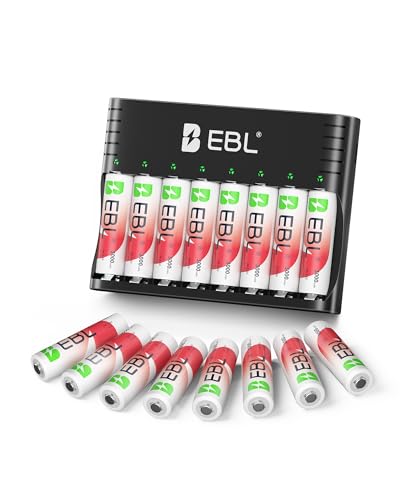
EBL Rechargeable Lithium AA Batteries with Charger 16-Pack — Best for Whole House
Some households do not have a battery problem; they have a battery system problem, with cameras, controllers, flashes, toys and microphones all drinking from the same drawer of mixed disposables. This sixteen-pack of EBL’s 3,000 mWh rechargeable lithium AA cells, with charger included and the same up to 1,600-cycle listing rating as its smaller sibling, is the conversion kit for that house: enough cells to equip the whole fleet at once and begin the rotation of charged spares that makes a rechargeable system feel effortless.
Scale changes the economics of this format completely. A single kit for one camera takes many cycles to repay its cost against disposables; a household system displaces disposable purchases across half a dozen devices at once, and the charger, the one fixed cost, is shared by all of them. The 3,000 mWh capacity sits a step below the 3,600 mWh kits, a difference most devices will never notice, traded for EBL’s cycle rating and the pack’s scale.
The commitment is the caveat: sixteen cells is a system, and a system needs a charging habit and a labelled home for charged and spent cells. Households that will not keep that small discipline should buy a smaller kit and succeed with it, rather than a fleet kit that dissolves into the same drawer chaos it was bought to replace.
Strengths
- Sixteen cells equip a whole device fleet at once
- Charger included; fixed cost shared across many devices
- Up to 1,600-cycle listing rating from EBL
Trade-offs
- 3,000 mWh capacity is a step below the 3,600 mWh kits
- Largest upfront commitment on this list
- Needs a charging routine and labelled storage to work well
| Output | Constant 1.5 V |
| Capacity | 3,000 mWh (per listing title) |
| Pack | 16 cells |
| Charger | Included |
Best for: Households converting many devices to rechargeables at once / Not suited for: Single-device buyers
Check the current price on Amazon
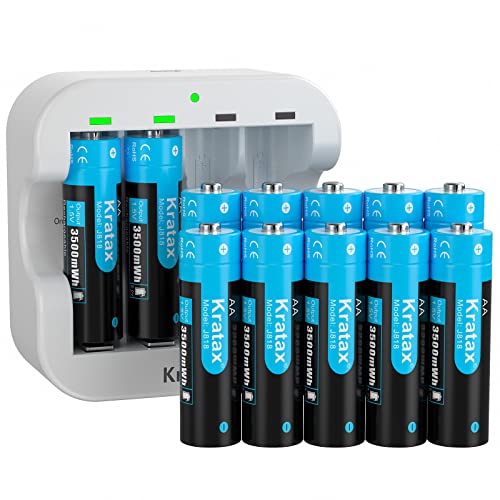
Kratax AA Lithium Rechargeable Batteries 12-Pack with Fast Charger, 3500mWh — Best Fast-Charge Kit
This kit takes the high-capacity Kratax cells from our second pick and completes them as a system: twelve 3,500 mWh cells plus a fast charger that the listing describes as a two-hour charger, with constant output and up to 1,600 cycles. For working devices, photographers, streamers and anyone whose gear earns money or anchors an event, charge speed is not a luxury: it is the property that decides whether rechargeables survive contact with a real schedule.
Twelve cells is the working photographer’s classic rotation: a set in the flashes, a set charged, a set in the charger. The 3A-class output behaviour of these cells keeps flash recycle times short, and the constant voltage means the last shot of a charge behaves like the first, which is precisely what event work needs and what fading alkalines cannot give.
The kit is the premium end of Kratax’s range and priced like it, and its fast charging is a system property: the speed lives in the pairing of these cells with this charger, not in any charger you already own. Buy it as the integrated system it is, and it is the most capable working kit on this list; buy the cells alone expecting the same speed from other hardware, and you have misunderstood the product.
Strengths
- 3,500 mWh cells with a two-hour fast charger in one system
- Twelve-cell rotation suits working flashes and devices
- Up to 1,600 cycles with constant 1.5 V output
Trade-offs
- Premium pricing for the complete Kratax system
- Fast-charge speed depends on the included charger pairing
- Overkill for casual household use
| Output | Constant 1.5 V |
| Capacity | 3,500 mWh (per listing title) |
| Pack | 12 cells |
| Charger | Fast charger included (2-hour per listing) |
Best for: Photographers and heavy users who need fast turnaround / Not suited for: Casual buyers with one or two devices
Check the current price on Amazon
Comparison Table
All six picks deliver a regulated constant 1.5 volts; they differ in stated capacity, charger inclusion and scale. The table keeps those three differences front and centre, because they, not voltage, are what you are actually choosing.
| Pick | Badge | Key spec | Best for |
|---|---|---|---|
| EBL Rechargeable AA Lithium Batteries with Charging Box, AIR V Series 8-Pack | Best Overall | 1.5 V constant, 3,000 mWh, charger included | Outdoor cameras, controllers and high-drain devices fed regularly |
| Kratax 1.5V AA Lithium Rechargeable Batteries 4-Pack, 3500mWh | Best High Capacity | 1.5 V constant, 3,500 mWh, 3A output | Equipped owners upgrading flashes and high-drain devices |
| PHILIPS Rechargeable Lithium AA Batteries 8-Pack with Fast Charger, 3600mWh | Best Brand-Name Kit | 1.5 V constant, 3,600 mWh, charger included | Brand-conscious buyers wanting a complete high-capacity kit |
| POWEROWL 1.5V Rechargeable Lithium AA Batteries with Charger 8-Pack, 3600mWh | Best Value Kit | 1.5 V constant, 3,600 mWh, charger included | Value-focused households feeding cameras and controllers |
| EBL Rechargeable Lithium AA Batteries with Charger 16-Pack | Best for Whole House | 1.5 V constant, 3,000 mWh, 16-pack with charger | Households converting many devices to rechargeables at once |
| Kratax AA Lithium Rechargeable Batteries 12-Pack with Fast Charger, 3500mWh | Best Fast-Charge Kit | 1.5 V constant, 3,500 mWh, fast-charge kit | Photographers and heavy users who need fast turnaround |
New to the format? Choose a kit row, any kit row, over a cells-only row, because the charger is not an accessory in this category; it is half the product. Already equipped? The Kratax cells-only pack is your capacity upgrade, and the table shows exactly what it asks you to bring.
How to Choose the Best 1.5 Volt AA Rechargeable Batteries
Decide first whether you need this technology at all. Constant 1.5 volt rechargeables earn their premium in devices that are voltage-sensitive or current-hungry: camera flashes, outdoor cameras, game controllers, motorised toys, wireless microphones, better flashlights. In those devices the flat output curve is a genuine performance upgrade over both alkalines and NiMH. In low-drain devices, remotes, clocks, and anything that sips power for months, the premium buys nothing and NiMH or alkaline remains the sensible cell.
Second, buy the system, not the cell. Your first purchase in this format should include the dedicated charger, full stop. Cells-only packs are second purchases for equipped owners. Check the listing for the words that confirm a charger is in the box, and treat any ambiguity as a no. The chargers for these cells are not interchangeable with NiMH chargers, and using the wrong one is the category’s one genuine hazard.
Third, compare capacity inside the category’s own units. These cells state capacity in milliwatt-hours; figures between 3,000 and 3,700 mWh cover the credible range we verified. Do not compare an mWh number against a NiMH cell’s mAh number directly, and be suspicious of any listing whose mWh figure towers over the established makers’ figures, because the physical can is the same size for everyone and physics keeps the honest range narrow.
- Reserve these cells for voltage-sensitive, high-drain devices
- Make your first purchase a kit with the dedicated charger included
- Never charge these cells in a NiMH charger
- Compare mWh only against mWh inside this category
- Keep a charged spare set: flat discharge means little warning before a cell stops
1.5 Volt Rechargeable vs NiMH: Which AA Should You Standardise On?
The honest answer is both, for different drawers. NiMH remains the better default for the general household fleet: cheaper per cell, charged by inexpensive chargers, gentle in its decline so devices warn you before dying, and entirely adequate for the majority of AA duty. Its 1.2 volt nominal output is a real limitation only where devices are designed tightly around 1.5 volts or demand high current at full voltage.
The 1.5 volt rechargeable is a specialist that outperforms the generalist exactly where specialism matters. Constant voltage keeps flashes fast, cameras awake and controllers crisp for the whole charge. The price of that performance is system cost, a dedicated charger, and a discharge curve that ends abruptly. Households that standardise by device class, NiMH for the many, 1.5 volt lithium for the demanding few, get the best of both technologies and the worst of neither.
Living With the Flat Discharge Curve
Every technology has a behaviour you must manage, and for these cells it is the ending. A regulated cell shows a device a healthy 1.5 volts until its internal charge is nearly gone, so battery meters that estimate remaining life from voltage are effectively blind with this format. Devices may run at full performance and then stop, which surprises users raised on the long fade of an alkaline.
The management is simple and becomes habit quickly: rotate sets, keep a charged spare set wherever the devices live, and swap on schedule for critical uses rather than waiting for symptoms. Photographers already work this way with camera batteries; applying the same discipline to AA devices turns the format’s one quirk into a non-issue, and the performance across the rest of the charge more than pays for the routine.
How to Charge and Use 1.5 Volt AA Rechargeable Batteries Correctly
Using this format well is mostly about respecting that it is a separate system from every other AA in your house. The steps below cover the first charge, the storage habits that keep sets organised, and the one rule that must never be broken. Follow them and these cells are among the most satisfying batteries you will own; blur the systems together and they are among the most frustrating.
Step 1: Charge only in the dedicated charger
Place the cells in the charger made for 1.5 volt lithium AA cells, the one from your kit or the cell maker’s own charger. Never put these cells in a NiMH or NiCd charger, and never put NiMH cells in the lithium AA charger. If two charger types live in your house, label them; the cells look identical to every other AA at a glance.
Step 2: Give new cells a full first charge
Charge a new set completely before first use, even if the cells arrive with partial charge. A full first charge sets your rotation baseline and ensures the first device session shows the format at its proper performance, which is the experience that decides whether a household adopts the system.
Step 3: Store sets together, charged
Keep each set in its case or a labelled box, charged, with its siblings. These cells are bought in device-sized sets, and a set that stays together ages evenly and is always ready. Loose cells in a mixed drawer are how systems dissolve and how the wrong cell ends up in the wrong charger.
Step 4: Rotate on schedule for critical devices
For cameras, flashes and event gear, swap in a charged set before the important session rather than waiting for the working set to stop. The flat discharge curve gives little warning, and a rotation habit converts that quirk into a non-event.
Step 5: Recharge promptly after use
Do not leave spent lithium rechargeable cells sitting flat for months. Recharge them within a reasonable time and store them charged. Like all lithium-based cells, they prefer being stored with charge rather than empty, and a charged spare set is the household’s insurance policy.
Step 6: Retire cells that behave oddly
A cell that heats during charging, charges suspiciously fast, or runs for a fraction of its siblings’ time has reached its end. Stop using it, keep it separate, and recycle it through a battery collection point. Retiring one cell from a set and continuing with matched replacements keeps the system healthy.
Problem: a device reports low battery immediately with freshly charged cells. First, confirm the cells are genuinely charged and correctly seated; second, check whether the device is one of the minority that measures capacity in a way that conflicts with regulated cells. If the device works at full performance despite the warning, the gauge, not the cell, is confused, which is a known behaviour with this format.
Problem: a cell stops abruptly mid-session. That is the flat discharge curve arriving at its end, not a failure. Swap in the charged spare set and recharge the spent set. If a cell stops far sooner than its siblings repeatedly, it is aging out and should be retired from the set.
Common Buying Mistakes
Charging them in a NiMH charger
The category’s cardinal error. These cells contain lithium cells with electronics and require their dedicated charger. A NiMH charger cannot charge them correctly and must never be tried. The reverse error, NiMH cells in a lithium AA charger, is equally wrong. Label your chargers.
Comparing mWh against mAh
A 3,500 mWh lithium AA and a 2,500 mAh NiMH AA are not measured in the same currency, because their internal voltages differ. Cross-unit comparisons produce confident nonsense. Compare within the format, and judge across formats by device behaviour instead.
Buying cells-only as a first purchase
A first-time buyer who saves money on a cells-only pack owns batteries they cannot charge. Kits exist precisely to prevent this. The charger is half the system; buy it first, and let cells-only packs be the second purchase they are designed to be.
Feeding remotes and clocks with them
Constant-voltage premium cells in a device that runs a year on an alkaline are money parked in the wrong drawer. Reserve this format for devices that reward it, and let cheap cells do cheap work.
Waiting for a low-battery warning that may not come
Devices estimate remaining charge from voltage, and regulated cells hold voltage until the end. Planning around warnings with this format leads to mid-session stops. Rotate sets on schedule and keep charged spares, and the behaviour stops mattering.
Inside a 1.5 Volt Rechargeable AA: Why the Electronics Matter
A 1.5 volt rechargeable AA is best understood as a tiny power supply rather than a simple cell. The can contains a lithium cell, a voltage regulator and protection electronics, working together to present the outside world with a steady 1.5 volts. That is why these cells cost more than NiMH, why they need a dedicated charger that communicates with that system correctly, and why they behave so differently in a device: the output is managed, not merely chemical.
The electronics explain the category’s quirks as a set. The flat discharge curve is the regulator doing its job. The abrupt ending is the regulator reaching the end of the internal cell’s charge. The battery-gauge confusion is a device trying to estimate a managed output with methods designed for unmanaged chemistry. None of these are faults; they are the signatures of the technology, and a buyer who understands the mechanism stops being surprised by any of them.
It also explains why brand accountability matters more here than in simple cells. A NiMH cell is chemistry in a can; a regulated AA is chemistry plus circuitry, and the quality of that circuitry decides safety and consistency. The makers in this guide publish their capacities, cycle ratings and charger requirements openly, which is the behaviour of companies engineering a system rather than relabelling a commodity.
Cost Per Cycle: The Real Economics of Constant Voltage
The honest way to price this format is per cycle, not per cell. A kit that looks expensive on the shelf divides its cost across every charge its cells will ever take, and the listings in this guide cite ratings up to 1,200 and 1,600 cycles. Even if a household realises only a fraction of a rated life, a working set of cells in a camera or a flash displaces its purchase price in single-use batteries quickly, and then keeps displacing it, month after month, for years. The relevant comparison is never the price of one rechargeable against one alkaline; it is the price of the system against the stream of alkalines the device would otherwise consume across the same years.
The economics invert in low-drain devices, which is why this guide keeps returning to allocation. A remote that uses one alkaline a year would need a human lifetime to repay a rechargeable system, and the cells would age out on the shelf long before their cycles did. Cost per cycle only rewards devices that actually cycle. The households that save the most with this format are the ones with a short list of hungry devices and the discipline to feed only those from the rechargeable fleet, while the gentle fleet stays on bulk single-use cells bought at bulk prices.
There is also a cost that never appears in the arithmetic: the cost of the flat battery at the wrong moment. The camera that dies during the one weekend the house is empty, the flash that fades at the one family event of the year. A rotation of charged rechargeable sets is, among other things, insurance against that cost, bought once and held for years. Households that have paid the uninsured price once tend to stop asking whether the system is worth it, and start asking why they waited.
A Note on Mixing Cells From Different Packs
One habit quietly undermines more rechargeable systems than any other: topping up a device with whatever cell is nearest, regardless of its age, brand or pack. Cells in the same device share one job and one fate. A fresh cell set beside a tired one does not average out; the device performs closer to the tired cell’s level, and the tired cell is driven hardest by every session. The visible result is a device that never quite delivers the constant-voltage promise, and the invisible result is good cells aging early in bad company.
The fix is the set discipline this guide keeps recommending, stated once more in its smallest form: cells travel in the sets they were bought in, get fitted together, charged together and retired together. If one cell of a set fails early, replace the device’s working set and move the survivors to a less demanding device or the spares box. It feels wasteful the first time and obvious every time after, because the devices simply start behaving the way the reviews said they would.
Final Recommendation
Start with the EBL AIR V kit if you want the most complete, balanced system from the category’s most established rechargeable brand, or the Philips kit if brand familiarity and the highest stated capacity matter more. The POWEROWL kit delivers the same capacity class for less, the sixteen-pack EBL converts a whole house, and equipped owners should look to the Kratax cells for capacity or the Kratax fast-charge kit for working turnaround.
Whichever system you choose, the ownership rules are the same: dedicated charger only, sets kept together, charged spares on hand. Readers comparing the wider rechargeable shelf will find our companion guides below, including the general 1.5 volt rechargeable roundup and the charger-focused guide for this format.
Quick recap of the picks, for readers who scrolled straight to the verdict:
- EBL Rechargeable AA Lithium Batteries with Charging Box, AIR V Series 8-Pack — Best Overall: Check the current price on Amazon
- Kratax 1.5V AA Lithium Rechargeable Batteries 4-Pack, 3500mWh — Best High Capacity: Check the current price on Amazon
- PHILIPS Rechargeable Lithium AA Batteries 8-Pack with Fast Charger, 3600mWh — Best Brand-Name Kit: Check the current price on Amazon
- POWEROWL 1.5V Rechargeable Lithium AA Batteries with Charger 8-Pack, 3600mWh — Best Value Kit: Check the current price on Amazon
- EBL Rechargeable Lithium AA Batteries with Charger 16-Pack — Best for Whole House: Check the current price on Amazon
- Kratax AA Lithium Rechargeable Batteries 12-Pack with Fast Charger, 3500mWh — Best Fast-Charge Kit: Check the current price on Amazon
- Best 1.5 Volt Rechargeable Batteries
- Best 1.5 Volt Battery Charges
- Best 1.5 Volt Battery
- Best 1.2 Volt Rechargeable Batteries For Solar Lights
- Best 1.5 Volt And 9 Volt Battery Tester
- Best 1 2 Aa Battery 3.6 Volt
Frequently Asked Questions
Are 1.5 volt AA rechargeable batteries really 1.5 volts?
Yes, in the way that matters to your device. Inside each cell, a lithium cell running at a higher internal voltage is regulated down to a constant 1.5 volt output, which the device sees for essentially the whole charge. That regulated output is the defining feature of the format and the reason voltage-sensitive devices perform better on them.
Can I charge 1.5 volt rechargeable AA batteries in my normal charger?
No. A normal NiMH charger cannot charge them and must not be used. These cells require the dedicated charger made for 1.5 volt lithium AA cells, which is why most picks in this guide are kits with the charger included. The two charger types should be labelled and kept apart.
What does mWh mean, and how does it compare to mAh?
Milliwatt-hours measure total energy, while milliamp-hours measure charge at a particular voltage. Because these cells regulate from a higher internal voltage, makers state capacity in mWh. Compare mWh figures against other 1.5 volt rechargeables, not against NiMH mAh figures, which are a different unit for a different system.
Why did my device show full battery and then stop suddenly?
That is the regulated discharge curve working as designed. The cell holds 1.5 volts until its charge is nearly exhausted, so a voltage-based gauge cannot estimate what remains. The fix is procedural: rotate sets on schedule and keep charged spares, rather than relying on the gauge.
Which devices benefit most from 1.5 volt rechargeable AA batteries?
High-drain and voltage-sensitive devices: camera flashes, outdoor security cameras, game controllers, motorised toys, wireless microphones and strong flashlights. Low-drain devices like remotes and clocks gain nothing meaningful and are better served by alkaline or NiMH cells.
How many times can these batteries be recharged?
The listings for the picks here cite figures up to 1,200 or 1,600 cycles depending on the maker. Treat those as the makers’ own ratings for comparison within the category. In household terms, either figure represents years of regular use for the devices these cells are bought to feed.


