Where to buy
Check the latest price, availability and delivery on Amazon. Orders are placed on Amazon. We may earn a commission from qualifying purchases.
- Best overall: Aheaplus 8FT Closet Organizer System with 6 Drawers — Check on Amazon
- Easy Track OK1460 Deluxe Starter Closet Kit, 4–8 Ft — Check on Amazon
- ClosetMaid SuiteSymphony 25-Inch Starter Kit, Pure White — Check on Amazon
- Armocity 96-Inch Closet System with 3 Drawers — Check on Amazon
See 2 more Amazon options
- VIPEK V5 Portable Closet Wardrobe — Check on Amazon
- Rubbermaid Configurations Deluxe Custom Closet Kit, 4–8 Ft, Titanium — Check on Amazon
Read the full guide ↓
Disclosure: As an Amazon Associate, airfryerkitchensupply.com earns from qualifying purchases. Links to Amazon on this page are affiliate links; they cost you nothing extra. Listing details such as price and availability change often, so check the current Amazon listing before you buy.
Seven hundred dollars is a serious closet budget anywhere, but in an apartment it answers a different question than it does in a house you own. A homeowner asks what the money buys. A renter has to ask two questions first. The permission question: what does this system ask of the building — a freestanding frame that touches nothing, a pair of anti-tip anchors, or a steel rail screwed into studs along the whole back wall? And the tenancy question: everything you install will be uninstalled on a date printed in your lease, so how long will you actually use it, and what is it worth on the day you hand back the keys? The honest ceiling has not moved — a professionally designed and installed closet sits well above this budget, and $700 is still the top of the self-installed kit market on Amazon. But in a rental, the smart spend is usually well under that ceiling, and one of the six systems below asks nothing of the building at all.
So this guide re-judges the six best closet systems under $700 through the lease. If you are on a long tenancy with written permission to drill, we would still begin with the Aheaplus 8-foot system — six real drawers and a complete wall (check price on Amazon) — because over a long tenancy its completeness earns its place at the upper end of this guide. For everyone else the order of business changes: the freestanding VIPEK V5 is the only system here you own outright, and the Rubbermaid wire kit is the one wall system designed to come back off the wall. Below you will find a quick picks table, detailed notes on each of the six, the lease test applied system by system, how tenancy length changes the value, a moving-day audit, the mistakes renters make most in this tier, and answers to the questions that come up again and again.
In this guide
Quick Picks
Short on time, or comparing several options at once? Each row below names a renter type and the product that suits it, with a link to the listing. Note the installation column as you read: at this budget, what a system asks of your landlord matters as much as what it holds.
| Buyer type | Pick | Why it stands out | Link |
|---|---|---|---|
| Best overall, long lease | Aheaplus 8FT Closet Organizer System with 6 Drawers | Six wooden drawers, four rods and a shoe bench across 8 ft; needs only its anti-tip anchors in the wall | Check on Amazon |
| Best designed look | Easy Track OK1460 Deluxe Starter Closet Kit, 4–8 Ft | Wood-panel shelving hung from one steel rail — and the rail is screwed into studs, so permission is the price | Check on Amazon |
| Best staged spend | ClosetMaid SuiteSymphony 25-Inch Starter Kit, Pure White | A tower-and-rods starter at the lower end of this guide that grows with drawers and doors as renewals allow — check price on Amazon | Check on Amazon |
| Best per-wall block | Armocity 96-Inch Closet System with 3 Drawers | Three towers and drawers per wall — but it is cut to fit this wall, and stays with it | Check on Amazon |
| Best for renters | VIPEK V5 Portable Closet Wardrobe | Four rods and eight shelves, no drilling, and it leaves with you at the end of the lease | Check on Amazon |
| Best removable wall system | Rubbermaid Configurations Deluxe Custom Closet Kit, 4–8 Ft | 22 ft of shelving hung from two top rails — the one wall kit designed to be taken back down | Check on Amazon |
How These Picks Were Chosen
The first filter was the budget, applied to the configuration you would actually buy. Every product below is a real Amazon listing whose relevant configuration sits at or under $700 in the United States — check the current price on Amazon before you buy, because listing prices change often. Where a system could not be verified on Amazon, the product is named without a link in the ceiling section below rather than quietly rounded into the guide. That rule is why one famous solid-wood system is discussed by name but not linked.
We did not use these products ourselves. We read the maker listings, manuals and specification pages, compared width ranges, drawer counts, shelf and rod totals, depths and load figures, and favored systems that do a whole job: a full reach-in wall, a platform you can extend later, or a wardrobe that stands on its own. Two of the six are proven sub-$200 systems carried up into this guide deliberately, because at $700 the smart version of them is often plural — two kits, two walls. In an apartment that logic narrows: most rentals have one reach-in closet worth this conversation, and the second kit’s job is usually a spare room, not a walk-in.
The third filter is the apartment itself, and it re-orders this guide. We asked of every system: What does it screw into, and how much of the wall does it touch? What is it worth the week the lease ends — a wardrobe you load into the car, a kit you unhook and patch after, or a fixture you abandon to the next tenant? And how much use will you get from it over the tenancy you have actually signed, not the renewal you hope for? Where a system fails a renter test, the review says so in plain terms: the best system in this guide is a two-person furniture build that dislikes being moved, and the most designed one is screwed along the entire back wall.
The 6 Best Closet Organizers for Apartments Under $700
Aheaplus 8FT Closet Organizer System with 6 Drawers
Who it suits: Renters on a long or renewing lease — two years or more — with a 6- to 8-foot reach-in and permission for two small anchor holes, who want the dresser inside the closet.
Drawers are where closet kits usually stop pretending: most systems at any price give you rods and shelves and leave the folded clothes to furniture outside the closet. The Aheaplus starts from the other end. Across its 96-inch span you get six wooden drawers on slides, four hanging rods, a run of display shelves for bags and folded stacks, a full-width top shelf for luggage and seasonal boxes, and an integrated shoe bench with a shoe rack under it — the only pick in this guide where sitting down to put your shoes on is part of the design. The frame is engineered wood over a metal structure, about 15.6 inches deep and 79.5 inches tall, and the width adjusts from a maximum of 95.8 inches down to about 68.7 inches by trimming or reconfiguring the side shelves, so a 6-foot closet takes a shortened version of the same system rather than a different product. It sits in the upper half of this guide’s range — check the current price on Amazon — for the most complete single wall here. Its own manual is unusually honest about loads: the system total is rated at up to 500 lb, and each single hanging rod at up to 35 lb — a modest, believable per-rod number that tells you to split a winter-coat collection across two rods rather than hang it on one.
The apartment accounting is what moves this system from “best overall” to “best overall, long lease.” It stands on the floor, which sounds renter-safe, but at 80 inches tall and loaded it must be anchored to the wall with the included anti-tip kits — that is the lightest wall ask of any furniture system in this guide, a couple of small holes rather than a rail, and most landlords who allow picture hooks will allow it. The real cost is the build and the un-build. It ships in two boxes that may arrive on different days, assembly is a two-person afternoon with six drawer boxes to square and slides to align, and engineered wood does not love being disassembled, flat-packed and rebuilt in the next apartment — screw holes in MDF loosen a little every cycle. So weigh the tenancy before you fall for the drawers: on a 12-month lease this is a substantial system you will struggle to take with you. Over a long, renewing tenancy, the purchase makes sense. Same system, same build — the lease is the difference.
- Six enclosed wooden drawers plus four rods, shelves, top storage and a shoe bench in one kit.
- Width adjusts from about 68.7 to 95.8 inches, so it fits 6- to 8-foot closets.
- Only anti-tip anchors touch the wall — the lightest installation of any furniture system here.
Honest limitation: It is engineered wood (E1 MDF board), not solid wood, and the 35 lb per-rod rating is the lowest here — heavy coat collections need their weight spread. It ships in two boxes that can arrive separately, assembly is a two-person afternoon, and once built it is effectively a fixture of this apartment: moving it is a project, not a packing task.
Choose it if your lease has years to run and drawers inside the closet are the point of the project. Skip it if you are on a 12-month lease, move often, or cannot anchor into a wall at all.

Easy Track OK1460 Deluxe Starter Closet Kit, 4–8 Ft
Who it suits: The settled renter — long lease, written permission, a landlord who treats a closet upgrade as an improvement — who wants the suspended, furniture-panel look of a designed closet.
Easy Track’s idea is the simplest in this guide: one steel rail, screwed level into the studs along the back wall, and everything else — vertical panels, shelves, rods — hangs from that rail. Because nothing stands on the floor, the closet sweeps clean underneath, the panels align to the rail rather than to your drilling accuracy, and the layout can be re-planned by sliding components along the track. The Deluxe Starter kit covers closets from 4 to 8 feet wide and about 7 feet tall with solid wood-panel shelving rather than wire, which is the visible difference from the rail kits in cheaper guides: folded stacks sit on a surface, shoes sit flat, and the whole wall reads as cabinetry rather than hardware. Components are cut to fit your exact width at install. It sits in the middle of this guide’s range — check the current price on Amazon. Easy Track is also the one maker here that publishes a serious load figure in its own FAQ: a properly installed 8-foot section on the rail is rated at 1,200 lb — read that as shared weight spread across the whole run, not a shelf rating, but note that it is a stud-anchored number, a different species of claim from a freestanding rack’s arithmetic.
In a rental, though, that single elegant rail is the heaviest ask in this guide. The rail must hit studs, it runs the length of the wall, and every panel hangs from holes you cannot un-drill. Removal is possible — panels lift off, the rail unscrews — but it leaves a line of screw holes at rail height and a set of panels cut to this closet’s exact width, which fit the next apartment’s closet only by luck. Realistically, renters leave this system behind, and that changes what its cost means: abandoned at move-out, it returns nothing at any lease term. On a long tenancy with permission in writing, that is a fair trade for the best-looking wall here. On a short one, it is a gift to your landlord. Finishes are fixed at the maker’s four — white, weathered grey, truffle and honey blonde across the line — and the shelving is finished panel, not lumber you can sand and restain.
- Single-rail suspended design: panels and shelves hang, floor stays clear.
- Solid wood-panel shelving for 4- to 8-foot closets, cut to fit at install.
- Maker rates an installed 8-foot section at 1,200 lb, anchored into studs.
Honest limitation: The whole system depends on one rail installed level into studs along the full wall — the largest installation ask here, and effectively a permanent one for a renter. Weak walls and short leases need not apply, and the finished-panel construction cannot be refinished like real wood. Deluxe configurations and finishes vary, so check the current price on Amazon and confirm the kit you land on is the 4–8 ft Deluxe Starter.
Choose it if you have written permission, studs where you need them, and years left to enjoy it. Skip it if you rent short-term, your walls are plaster and lath, or drawers matter more to you than shelving.

ClosetMaid SuiteSymphony 25-Inch Starter Kit, Pure White
Who it suits: Renters who want to stage the spend — a proper tower now, drawers and doors added only as the lease renews and the budget allows.
Every other pick in this guide is a finished answer; the SuiteSymphony starter kit is a platform. The box holds a 25-inch-wide tower — about 82 inches tall and 14.6 inches deep — with five interior shelves, two of them adjustable, plus three expandable hang rods that run 30 to 48 inches and can be mounted on both sides of the tower or trimmed and hung on one side, covering closets from 5 to 10 feet wide. The Pure White kit sits at the lower end of this guide — check the current price on Amazon — and it is the smallest first commitment here, which is precisely the point for a renter: the starter is the accessible part. The fully built-out version of this closet within this guide’s budget is the starter plus the collection’s add-on drawers, door sets, shoe shelves and top shelves, bought in the same finish, all designed to fit the same tower. No other system here lets you stage the spend that way — buy the tower on this lease, the drawers on the next renewal, the doors when you are sure you are staying.
The construction is manufactured wood in a laminate finish, with the same caveats about moisture and moving as the other wood systems here, plus one of its own: the maker itself warns that the tower must be assembled square or the add-on drawers and doors will not fit properly later, and the system secures to the wall rather than standing free — so even the staged route asks for anchor holes. ClosetMaid rates the system at 175 lb in the comparison data roundups publish, the most conservative total in this guide; read it as a reminder that a laminate tower is for clothes, not for a shelf of hardback books. And check the current price on Amazon for the finish-out before you commit to the platform: the drawers and doors that make it look custom are separate purchases, and money spent finishing a tower is only well spent if the tower itself can move with you — a laminate tower survives one careful move better than repeated ones. Buy it as the first stage of a closet you will finish over renewals, and it is one of the strongest staged options here. Buy it expecting a finished closet in one box, and it will feel like only part of the project.
- 25-inch tower with five shelves and three expandable rods, for 5- to 10-foot closets.
- The deepest add-on ecosystem here: matching drawers, doors, shoe shelves and top shelves.
- Starter sits at the lower end of this guide — check price on Amazon; the rest of the budget buys the finish-out, staged or all at once.
Honest limitation: The starter kit alone is a tower and rods, not a finished closet — the drawers and doors are separate purchases — check the current price on Amazon for each add-on. The 175 lb system rating is modest, and the tower must be assembled square and wall-secured.
Choose it if you want one collection you can grow across lease renewals. Skip it if you want the whole project finished in one delivery, or your loads are heavy.
Armocity 96-Inch Closet System with 3 Drawers
Who it suits: Renters with a long lease and a big closet — an 8-foot reach-in or one wall of a walk-in in a house-share — who want towers and drawers in a single wall-mounted build.
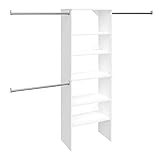
This system earned its place in our under-$200 guide as the drawers pick, and it is here again as the per-wall building block. The kit spans a full 96 inches with three shelving towers, built-in garment rods and three enclosed drawers, each about 20.2 inches wide, 16 inches deep and 12.8 inches tall. The shelves are a full 16 inches deep, which swallows folded sweaters in double rows where a 12-inch wire shelf lets them overhang, and the whole unit wall-mounts and can be cut down to fit a narrower wall. The white and white oak finishes sit at the lower end of this guide — the linked listing is the black finish, so check the current price on Amazon for your color before ordering. The maker rates the whole system at 1,000 lb, a figure we print because the listing leads with it, but read it the way you should read every total in this category: as a ceiling for a perfectly distributed load, not a promise for one shelf of books. Judged as a per-wall module — the deepest shelves and the most drawers on a single wall in this guide — it has no rival here.
The renter’s problem is in the phrase “cut down to fit.” A homeowner trims this system to a 7-foot wall and calls it custom. A renter trims it to this apartment’s 7-foot wall — and a system cut for one closet fits no standard closet in the next, because the next closet is a different width. Add the rest of the commitment: the shipping box weighs around 100 pounds, the install is a two-person afternoon, and once it is up, it is up — this is furniture fixed to a wall you do not own. The tenancy logic follows: on a 12-month lease this is a substantial commitment to a system you will almost certainly leave behind, and even the two-kit walk-in approach from our homeowner guide — one kit per wall — only makes sense in a rental if the lease is long and the walk-in is real. On those terms it earns its place. On a year-long lease, the VIPEK below or the Rubbermaid are the more portable uses of the budget, and both leave with you.
- Three enclosed drawers plus three towers across a full 8 ft span, per kit.
- 16-inch-deep shelves hold folded clothes without overhang.
- Sits at the lower end of this guide by finish — check the current price on Amazon for the finish you want.
Honest limitation: Finishes vary across the line, so check the current price on Amazon for your color before ordering. It is wall-mounted and cut to fit — the most permanent install here — and the 100-pound, two-person build is the heaviest commitment in the guide.
Choose it if you have a long lease, a big wall, and a second pair of hands for install day. Skip it if you move often, or your tenancy is measured in months rather than years.

VIPEK V5 Portable Closet Wardrobe
Who it suits: Most renters — anyone whose lease forbids drilling, whose room has no closet at all, or who simply refuses to buy furniture for a landlord.
Everything else in this guide drills, anchors or wall-mounts. The V5 stands on the floor and asks nothing of the building: 68.9 inches long, 15.7 inches deep and 76.4 inches tall, with four hanging rods and eight adjustable wire shelves in a powder-coated iron frame. In a room with no closet — the converted dining room, the studio, the spare room that became a bedroom — it is the wardrobe, a full double-hang-and-shelves wall at the lower end of this guide’s range. In an apartment that does have a closet, it is the overflow wall that needs no studs and can be rearranged, extended or removed when the plan changes. It sits at the lower end of this guide — check the current price on Amazon. Load honesty matters most on freestanding racks, so here are the maker’s own figures: up to 60 lb on a single hanging rod, under an 890 lb whole-rack total that deserves the same skepticism as every headline in this category — it is the sum of every component at its limit at once, not a working load. A rod of winter coats is exactly the load the 60 lb figure is about.
What makes the V5 the renter’s pick is not any single specification — it is the exit. Every other system in this guide converts some of your $700 into an improvement to someone else’s property; the V5 converts all of it into a wardrobe you own. Assemble it on Saturday, load the heavy shelves low, spread the weight across both sides, use the anti-tip hardware on carpet — and when the lease ends it comes apart, goes in the car, and stands up in the next apartment at a marginal cost of zero. That is also why it anchors the rental plans in the tenancy section below: it is the one purchase at this tier that is never wasted, whatever your landlord says about screws. Buy it first, live with it for a few weeks, and only then decide whether the closet you rent deserves a wall system as well.
- Freestanding: no drilling, no studs, no landlord permission needed.
- Four rods and eight shelves in a 68.9-inch footprint; assembles without wall hardware.
- Maker publishes a per-rod figure: 60 lb per hanging rod.
Honest limitation: The 890 lb total is a maker sum, not a working load — plan on the per-rod figure. It is open wire construction, so there are no drawers and no doors, and a tall loaded rack on thick carpet wants its anti-tip strap and sensible loading.
Choose it if you cannot or will not drill, or you need a wardrobe where no closet exists. Skip it if you want enclosed storage and a built-in finish — and have the lease length to justify the wall systems above.

Rubbermaid Configurations Deluxe Custom Closet Kit, 4–8 Ft, Titanium
Who it suits: Renters with permission for screws who want a real wall system — and want it back when they leave.
The Configurations Deluxe is the kit that defines the wire category. The box holds seven 26-inch shelves, two 48-inch shelves, two 48-inch top rails, nineteen brackets, five uprights with extensions, and two telescoping hang rods — up to 22 feet of shelving and 12 feet of hanging space once installed. The top rails screw to the wall, the uprights hang from the rails, and the shelves expand and overlap to meet your exact wall width, so nothing needs to be cut to length. It sits at the lower end of this guide — check the current price on Amazon. Living with wire is the one adjustment: the shelves are about 12 inches deep, folded stacks sit happily on them, and the open grid is genuinely good for shoes and ventilated storage — but small things, a belt buckle, a heel tip, a stray earring, can slip or poke through the wires. Rubbermaid sells shelf liners and a small army of add-ons for exactly this: sliding baskets, a tie-and-belt rack, extra shelf kits that clip into the same uprights.
For a renter, the design detail that matters is the one homeowners never think about: everything hangs from the two top rails. Shelves, rods and uprights lift off their brackets without tools; the rails themselves unscrew; and what is left behind is a row of small screw holes inside a closet — the least visible holes in any apartment, and the kind that patch like picture-hanging holes. That makes the Rubbermaid the only wall system in this guide designed, in effect, to be uninstalled: ask permission, install it properly into studs where the layout puts a loaded rod, and at move-out the whole kit — all 22 feet of shelving — goes with you to the next closet, where the expanding shelves will fit a different width because nothing was ever cut. It is also one of the most accessible routes to a genuine wall of storage here, which is why the renter’s plan below pairs it with the VIPEK rather than spending the whole budget on either. It is at its best mid-range, though: run at the full 8 feet, the expanding shelves are fully extended; run at 4 feet, they overlap, and you get fewer, deeper shelves than the box photo promises.
- Fits closets 4 to 8 feet wide with expanding shelves and telescoping rods — no cutting, so it refits the next apartment.
- Up to 22 ft of shelving and 12 ft of hanging from one box, hardware included.
- Components lift off the rails and the rails unscrew — the one wall kit here built to be removed.
Honest limitation: Rubbermaid does not publish a per-shelf load rating for this kit, and the warranty is a 1-year limited one — the shortest here. It is wire, with wire’s small-item compromises, and it does need screws in the wall, so renters without drilling permission should look at the VIPEK above.
Choose it if your landlord allows screws and you want wall storage that leaves with you. Skip it if you cannot drill at all, or you want drawers and a furniture finish in the same purchase.

Comparison Table
| Product | Type | Best use | Link |
|---|---|---|---|
| Aheaplus 8FT Closet System with 6 Drawers | Floor-standing wood system, wall-anchored | One complete 8 ft wall with six drawers, on a long lease | Check on Amazon |
| Easy Track OK1460 Deluxe Starter Kit | Wall-mounted rail and panel system | Designed-closet look for 4–8 ft reach-ins, with written permission | Check on Amazon |
| ClosetMaid SuiteSymphony 25-Inch Starter Kit | Wall-secured laminate tower system | A platform that grows with drawers and doors across renewals | Check on Amazon |
| Armocity 96-Inch Closet System | Wall-mounted wood-look towers | Deep shelves and drawers on one big wall, long tenancies | Check on Amazon |
| VIPEK V5 | Freestanding wire rack | No-drill wardrobe for renters, studios and spare rooms | Check on Amazon |
| Rubbermaid Configurations Deluxe, 4–8 Ft | Wall-mounted wire kit | Maximum shelving from a single kit — and removable at move-out | Check on Amazon |
How to Choose a Closet Organizer for an Apartment
- Read the lease before the listings. Many leases restrict drilling outright or require written permission for anything screwed into a wall. Knowing which systems you are even allowed to install — freestanding only, anchors only, or full rails — cuts this guide to your real shortlist in one step.
- Get permission in writing, and keep it. A landlord’s verbal yes at the viewing is worth little at the deposit inspection. An email confirming you may screw a closet rail into the back wall of the bedroom closet is the document that protects you.
- Run the tenancy test on anything permanent. Weigh what a system costs you against the lease you have actually signed, honestly — not the renewal you hope for. A substantial wall system left behind after a short tenancy is a very different purchase from the same system used across a long, renewing lease.
- Decide what leaves with you. Freestanding racks and the rail-hung Rubbermaid kit come away with you. Cut-to-fit and rail systems effectively stay. If a move is likely within the lease or just after it, buy from the portable end of this guide.
- Measure three numbers first. Wall width, closet depth and ceiling height decide which family you are even shopping in. Kits are sold by width range, and a kit behaves very differently at the edges of its range than in the middle of it.
- Count your hanging ratio. Mostly shirts and pants means double-hang rods are worth more than shelves. Mostly folded knitwear means towers, deep shelves and drawers. Long dresses need one uninterrupted drop of about 60 inches — protect it in the layout.
- Check the depth, not just the width. Shelves here run from about 12 inches (wire) to 16 inches (the wood towers). A standard hanger is about 17 inches wide, so in a shallow rental closet, rods on shallow brackets leave shoulders brushing the doors — normal, but know it before you buy.
- Read load figures per part, not per headline. Plan around the per-rod and per-shelf ratings where they exist — 35 lb a rod on the Aheaplus, 60 lb on the VIPEK — and treat four-figure totals as sums, not promises.
- Count the finish-out, not just the starter. A starter kit is the first stage of a collection. If your plan needs drawers and doors, check the current price on Amazon for those add-ons before comparing a platform kit against a complete system like the Aheaplus.
- Remember that floor-standing is not the same as no holes. Tall furniture systems must be anchored against tipping — the Aheaplus includes anti-tip kits for exactly this. If your lease forbids all wall contact, the freestanding rack is your only honest route.
- Plan the exit when you plan the install. Keep the boxes, the spare brackets and the instructions. The systems in this guide rearrange and uninstall for years; the parts you throw away on install day are the ones moving day will ask for.
The Lease Test: What Each System Asks of the Building
Line the six systems up by what they do to the apartment and the guide re-sorts itself. At one end, the VIPEK V5 asks for nothing: it stands on the floor, touches no wall, and the only conversation it requires with a landlord is none. Next, the Aheaplus asks for the least a furniture system can — its anti-tip anchors, a couple of small screw holes, in exchange for an 80-inch tower that will not fall on anyone. The Rubbermaid asks for two top rails screwed along the back wall: a real installation, but a reversible one, because everything else hangs from those rails and lifts off. The SuiteSymphony tower must be secured to the wall, and the Armocity wall-mounts across a full 8 feet. At the far end, the Easy Track asks for the most: a steel rail screwed level into studs along the entire wall, the installation the whole system hangs from.
Two practical points follow. First, holes inside a closet are the cheapest holes in any apartment to make good — they patch and paint like picture-hanging holes, in a space nobody inspects with a magnifier — but “cheap to repair” is not the same as “permitted,” and the lease, not the patching cost, is the document that governs. Ask before you drill, in writing, and name the system: landlords who would refuse “a closet installation” routinely approve “two rails screwed into the back wall of the closet, holes filled at move-out.” Second, notice what the lease test does to the budget: the systems that ask least of the building also sit at the lower end of this guide. A renter who cannot drill is not settling for a worse closet at this tier — the portable end of this guide is where the renter value lives, and the premium systems only pull ahead when a long tenancy gives them time to repay their installation.
Tenancy Value: What Your Lease Length Changes
Run the six systems through the tenancy test and the tier changes shape. The Aheaplus is the most complete wall here, and because it is hard to move, most of its value stays in the apartment when you go — which is why it belongs on long tenancies. The Easy Track, effectively abandoned at move-out, asks for the same long-lease justification, with nothing recovered at any term. The Armocity sits lower in this guide but is cut to one wall, so a short lease strands it just as completely. The SuiteSymphony starter is the smallest first commitment here, with finish-out spending staged only as renewals confirm you are staying. The Rubbermaid looks similar as a first purchase, but its removability hides its advantage: because the kit comes back off the wall and refits the next closet, one purchase serves every lease you ever use it in. And the VIPEK is the limiting case — a one-time purchase whose value carries intact to every apartment you take it to.
That logic produces the renter’s plans, which are the honest headline of this tier: in a rental, $700 is more closet money than one tenancy can repay, and most of it should stay unspent. The no-permission plan is the VIPEK alone, with most of the budget banked. The permission plan pairs the Rubbermaid kit with the VIPEK — a wall system in the closet, a wardrobe in the room with none — and still leaves much of the budget unspent. The long-lease plan, for tenancies of three years or more with anchors approved, is the Aheaplus plus the VIPEK, and even that leaves part of the budget unspent. Spend the full $700 only when the tenancy is long, the permission is written, and the closet is one you dress in every day. Otherwise the unspent remainder is not a compromise — it is the deposit-protecting, move-surviving part of the plan.
Moving Day: What Leaves With You, What Stays Behind
Audit the six systems the way a mover would. The VIPEK V5 leaves whole or in pieces, in the back of a car, and stands up in the next apartment the same evening — the only zero-loss exit in this guide. The Rubbermaid leaves almost as well: shelves, rods and uprights lift off the rails by hand, the two rails unscrew, and because nothing was cut to fit, the expanding shelves will meet a different wall width at the other end; your only homework is filling a row of small holes. The SuiteSymphony tower can be moved if it must — it is one tower, not a whole wall — but laminate joints loosen with each disassembly, and the rods’ trimmed lengths belong to the closet you measured them in. The Aheaplus can technically be taken apart, and renters do it, but six drawer boxes, aligned slides and MDF screw holes make it a half-day project with a real chance the rebuild is never quite as tight; most owners of this system sell it with the lease or leave it as a negotiated improvement.
At the far end, the Armocity and the Easy Track stay. The Armocity because it was cut to this wall — a trimmed system is a fitted system, and fitted is the opposite of portable. The Easy Track because its panels were cut to this width and its rail is this wall’s length; the components can come down, but what you would be carrying to the next apartment is a kit sized for the last one. None of this makes them bad systems — for a homeowner they are two of the best here. It makes them purchases whose price must be justified inside one tenancy, which is exactly the test the section above applies. The working rule is simple: the shorter and less certain the lease, the further toward the VIPEK end of this list your pick should sit, and the more of the $700 should still be in your account when the moving van comes.
Common Buying Mistakes
- Drilling a full-length rail into studs on a verbal okay, then meeting the lease clause — and the deposit deduction — at move-out.
- Judging a system only by what it offers on day one, instead of how long your lease lets you use it and whether it leaves with you.
- Cutting a wall system to fit this apartment’s closet, then discovering at the next place that “custom fit” meant “fits one wall, ever.”
- Assuming floor-standing means renter-safe, and finding the anti-tip anchor requirement after the tower is built.
- Buying a starter kit and budgeting as if it were a finished closet, before checking the current price on Amazon for the drawers and doors the plan actually needs — then finishing a tower you cannot take with you.
- Buying by the headline load total instead of the per-rod and per-shelf figures, then hanging every coat you own on one 35 lb rod.
- Measuring the closet’s width and forgetting its depth — then discovering the doors will not close over hangers on a deep tower.
- Spending the whole $700 on one wall system for a one-year lease, when a freestanding rack from the lower end of this guide would have served the same tenancy and left with you.
- Loading a freestanding rack from one side, heavy things high, and skipping the anti-tip hardware because the floor “seemed level.”
- Throwing away the boxes, spare brackets and instructions on install day — the parts that uninstalling and rearranging will ask for in a year.
Final Recommendation
- Most renters, no drilling: VIPEK V5 Portable Closet Wardrobe.
- Screws allowed, want it back at move-out: Rubbermaid Configurations Deluxe Custom Closet Kit.
- Long lease, drawers inside the closet: Aheaplus 8FT Closet Organizer System with 6 Drawers.
- The designed-closet look, permission in writing: Easy Track OK1460 Deluxe Starter Kit.
- Build it over renewals: ClosetMaid SuiteSymphony 25-Inch Starter Kit.
- One big wall on a long tenancy: Armocity 96-Inch Closet System.
Our top two depend on your lease, and at this tier that is the honest answer rather than a dodge. If your tenancy is long and your permission is written, the top two are the Aheaplus and the Easy Track, because between them they cover the two searches that bring most people here: the complete drawer wall finished in one purchase, and the rail-hung, panel-shelved platform built to be lived with for a decade. If your lease is measured in months, your top two are the VIPEK V5 — the only system here you own outright — and the Rubbermaid, the one wall kit designed to come back down. None of these systems will give you the boutique walk-in of a renovation show, and they do not try to. They are honest storage choices at the top of the kit market: read the lease, check the current price on Amazon, check the per-part load figures on the listing, and spend the $700 only where your tenancy — not the catalog — says it goes.
Frequently Asked Questions
Can I put a closet system in a rental apartment?
Often, yes — but the lease decides which kind. A freestanding rack needs no one’s permission. Anchored and wall-mounted systems need the landlord’s, ideally in writing, and many landlords grant it for inside-closet installations because the holes patch like picture holes. What you should not do is install first and negotiate at the deposit inspection; ask before you buy, and name the system and where the screws go.
Which of these systems can I take with me when I move?
The VIPEK V5, completely — it was designed to be assembled and taken apart. The Rubbermaid kit, almost completely: the shelves, rods and uprights lift off the two top rails, the rails unscrew, and because nothing is cut, the kit refits a different closet width. The SuiteSymphony tower can be moved once, carefully. The Aheaplus can be disassembled but dislikes it. The Armocity and Easy Track are cut to the wall they were fitted to and are, in practice, left behind.
Is a $700 closet worth it on a 12-month lease?
Almost never as a single wall system. A substantial wall system used for 12 months and left behind gives you only that one tenancy of use — poor value next to what the same closet space costs you in rent. On a short lease the logic favors the portable end of this guide: the VIPEK serves the same tenancy, leaves with you, and keeps serving at every apartment after. Save the premium systems for tenancies of two to three years or more.
My lease forbids drilling entirely. What are my options?
The VIPEK V5 is the pick — a full wardrobe of four rods and eight shelves that stands on the floor and touches nothing. Note that “floor-standing” alone does not qualify a system: the Aheaplus stands on the floor too, but its anti-tip anchors still go into the wall, so it fails a strict no-drilling lease. If one rack is not enough, two V5s are still well under this budget — check the current price on Amazon — and both leave with you.
Will closet screw holes cost me my deposit?
That depends on your lease and your landlord, and no guide can promise an outcome. The practical position: holes inside a closet are small, few for most of these systems, and patch like picture-hanging holes — but an unauthorized installation can be charged as damage regardless of how neatly it patches. Written permission before you drill is the only real protection, and keeping the email is part of the installation.
My apartment has no closet at all. What should I buy?
A freestanding wardrobe — the VIPEK V5 in this guide. It gives you four hanging rods and eight shelves in a 68.9-inch footprint with no installation at all, at the lower end of this guide’s range. Load the heavy shelves low, spread weight across both sides, and use the anti-tip hardware on carpet. Spend the rest of the $700 only if a second rack or a removable wall kit for another room earns it.
How much weight can these systems actually hold?
Plan by the part, not the headline. The verified per-part figures in this guide run from 35 lb for an Aheaplus hanging rod and 60 lb for a VIPEK rod, up to stud-anchored whole-run ratings like Easy Track’s 1,200 lb for an installed 8-foot section — a shared total, not a shelf rating. The SuiteSymphony publishes a modest 175 lb system figure and the Rubbermaid none at all. A full rod of winter coats is the heaviest normal load in a closet; spread it across rods and every system here will feel overbuilt.
What should I measure before ordering?
Four things: the wall width at two heights (rental closets are rarely square), the depth from the back wall to the door or opening, the ceiling height if you plan 80-inch towers, and the swing or slide path of the doors. Then check the kit’s width range against your width — aiming for the middle of the range, not the edge — and its depth against your hangers. Five minutes with a tape measure is the entire difference between a system that fits and a return label.
- Best Closet Organizer Under $200
- Best Closet Organizer Under $400
- Best Closet Organizer For Small Bedrooms Under $700
- Best Blackout Curtains For Apartments Under $200
Related Guides
- Best Closet Organizer For Apartments Under $30
- Best Closet Organizer For Apartments Under $75
- Best Closet Organizer For Apartments Under $100
- Best Closet Organizer For Apartments Under $200
- Best Closet Organizer For Apartments Under $400