A barrel charcoal grill is a long, half-cylinder grill, often shaped like a split steel drum, that holds a wide bed of coals under a hinged lid. The long cooking surface suits sausages, skewers, ribs and big cuts, and many models double as a basic smoker when you pair them with a side firebox.
The six grills below cover barrel and barrel-style charcoal designs at different sizes, from compact to heavy-duty. We have not used these products ourselves, so confirm cooking area, steel thickness and included parts on the current listing before you buy. Assembly is usually needed, and some listings differ between near-identical models.
As an Amazon Associate we earn from qualifying purchases. Links below are affiliate links, and they do not change the product information we give.
What to Look For
| Feature | Why it matters |
|---|---|
| Cooking area | A long barrel gives room for several foods at different heat levels |
| Steel thickness | Heavier steel holds heat and resists warping |
| Vents | Adjustable intake and exhaust control the fire |
| Height adjustment | A movable charcoal tray changes the heat on the food |
| Side firebox | Lets the barrel work as an offset smoker |
In this guide
Specs at a Glance
| Grill | Fuel | Style | Notes |
|---|---|---|---|
| Dyna-Glo 36-inch Barrel Charcoal Grill | Charcoal | Barrel with cart | Adjustable charcoal tray on many versions |
| Char-Griller Smokin Pro | Charcoal | Barrel | Side firebox available on some models |
| Char-Griller Grand Champ | Charcoal and wood | Barrel with firebox | Check the listing for exact build |
| Oklahoma Joe’s Rambler | Charcoal | Barrel style | Compact footprint |
| Royal Gourmet barrel charcoal grill | Charcoal | Barrel | Value line; sizes vary |
| Realcook barrel charcoal grill | Charcoal | Barrel | Check the model size |
The 6 Best Barrel Charcoal Grills
Top pickBest for backyard cooks who host
1. Dyna-Glo 36-Inch Barrel Charcoal Grill
A 36 inch class barrel grill on a cart-style base with shelves and a lidded body. It gives a long cooking area with room for different heat zones. Check the current listing for dimensions and included features.
Suits: backyard cooks who host. Strengths: big space with storage. Weaknesses: large and heavy. Skip it if your patio is small.
View Dyna-Glo 36-Inch Barrel Charcoal Grill on Amazon

Best for grilling and smoking in one unit
2. Char-Griller Smokin Pro
A barrel grill from a brand known for steel charcoal cookers, available with an optional side firebox. It can grill directly or run low and slow with the firebox attached. Confirm which version you are ordering.
Suits: grilling and smoking in one unit. Strengths: a flexible design. Weaknesses: some parts need seal tuning. Skip it if you want a ready-to-cook grill.

Best for low and slow cooking
3. Char-Griller Grand Champ
A barrel grill with a side firebox for offset smoking. It is the bigger sibling for cooks who care more about smoke than quick grilling. Listings may use slightly different names, so read the description.
Suits: low and slow cooking. Strengths: firebox and wide chamber. Weaknesses: takes space and attention. Skip it if you want a quick burger grill.
View Char-Griller Grand Champ on Amazon

Best for smaller spaces
4. Oklahoma Joe’s Rambler
A compact charcoal grill from a Texas barbecue brand, with a barrel-style body, a lid and a moderate cooking area. It is aimed at smaller yards and first-time charcoal owners.
Suits: smaller spaces. Strengths: a trusted barbecue name. Weaknesses: less area than a full barrel. Skip it if you cook for large groups.


Best for casual weekend cooking
5. Royal Gourmet Barrel Charcoal Grill
A value-oriented barrel grill line with a lidded body, shelf and charcoal tray. Several sizes exist, so look at the listing for the cooking area and assembly notes.
Suits: casual weekend cooking. Strengths: a lower entry cost. Weaknesses: thinner steel than premium lines. Skip it if you want a decade of heavy use.
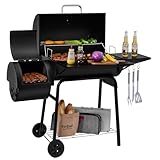

Best for a simple barrel for the yard
6. Realcook Barrel Charcoal Grill
A barrel charcoal grill sold under the Realcook name, usually with a side shelf and a temperature gauge. It is another budget option, so check size and weight on the listing.
Suits: a simple barrel for the yard. Strengths: a gauge and shelf. Weaknesses: less brand history. Skip it if you want long-term parts support.

Care and Setup
- Season the inside with a thin coat of cooking oil before the first fire.
- Remove ash after each cook once it is cool.
- Brush the grate while it is warm.
- Use a cover to keep rain off the steel.
- Touch up chipped paint with high-heat paint to slow rust.
Mistakes to Avoid
- Putting coals in one thick pile with no cool zone.
- Leaving ash to collect moisture and rust the bottom.
- Lighting the grill with the lid shut.
- Skimping on assembly care, which leaves gaps that leak heat.
- Choosing size without checking your patio space.
Sizing a Barrel Grill to How You Cook
The main appeal of a barrel grill is surface area, but more is not always better. A very long grate takes more charcoal to heat evenly, needs a larger patio footprint and can leave you with far more room than a typical weeknight meal uses. Start by thinking about the biggest meal you cook regularly. If it is a family dinner of burgers and sausages, a compact barrel is plenty. If you host groups, cook whole racks of ribs or like to run several foods at different temperatures, a longer barrel earns its space.
Cooking area on a listing sometimes counts only the main grate and sometimes adds warming racks or the side firebox chamber. Read the description to see what is included in the figure, and compare like with like when you weigh two models. Also note the height of the lid. A tall lid leaves room for a whole chicken or a large roast, while a shallow one limits what you can cook with the lid down.
Think about the zones you want. A long grate lets you pile coals at one end and leave the other end cool, which gives a hot side for searing and a gentle side for finishing. A shorter barrel can still do this, but the zones are tighter. If you plan to use a side firebox for smoking, check how the cooking chamber connects to it, since the sizes of the firebox and the main chamber together determine how stable the temperature will be.
Finally, match the footprint to your space. Measure the patio, leave clearance around the grill on all sides, and remember that the lid swings open and the side shelves may fold out. A grill that fits on paper but leaves no room to move is frustrating in use.
Steel Thickness, Welds and Overall Build
With barrel grills, build quality shows in how well the body holds heat and resists warping. Thicker steel generally retains heat better and is less likely to bend after repeated hot-and-cool cycles, while thinner steel heats quickly and can lose heat faster in wind or cold weather. Many listings give a gauge or thickness figure; if yours does not, treat that as a gap to check before ordering rather than assuming it is heavy-duty.
Weight is a rough clue. A heavier grill of similar size usually contains more or thicker metal, though it can also include extras like cast parts or bigger shelves. Compare shipping weights on listings of similar models and be wary of a large grill that is surprisingly light.
Look at the details that affect heat leaks. A lid that sits flat on the body with an even gap seals better than one that rocks. Check whether the manual or listing mentions gaskets or lets you add them later; some owners seal gaps over time with high-temperature gasket material, which is a common upgrade across many grills. The hinges, handle and any hardware should feel solid, and the handle should stay cool enough to grab, or you should plan to use a glove.
The cooking grate material also matters. Cast iron holds heat and sears well but needs oiling to prevent rust. Plated or coated steel grates are lighter and easier to maintain but can chip with rough cleaning. Porcelain-coated options can be easier to clean but may chip if scraped hard. Whatever you choose, check how easily the grate can be removed or replaced, since this is a wear part.
Lower-cost barrels are a reasonable entry point if you accept thinner metal and plan to tune the fit, while heavier models suit people who plan to cook often and keep the grill for years.
Airflow, Vents and Heat Control
Charcoal cooking is controlled by oxygen. More air through the intake means a hotter, faster fire, and less air means a cooler, slower one. On a barrel grill, look at how many vents there are and how easy they are to adjust. A bottom intake and a chimney or exhaust vent let you steer airflow across the cooking chamber, while a model with only a single small opening gives you less control.
A common approach is to start with the vents wide open until the coals are lit and the grill has come up to temperature, then close them partway to hold a steady heat. Close the intake too far and the fire can go out or smolder and produce bitter smoke. Leave the exhaust wide open and heat tends to escape. Make small changes and wait several minutes to see the effect, because barrel grills respond slowly.
A charcoal tray that moves up and down, as the post notes for some models, is a handy way to change heat without changing the fuel. Lower tray positions give high heat for searing and raised ones give gentler heat for slower cooking. If the grill lacks this, you can still change the amount of charcoal or the layout of the coals.
A built-in thermometer is useful, but lid-mounted gauges can read differently from the temperature at grate level. A separate probe thermometer placed near the food gives you a more reliable number. Weather also plays a part: wind pushes air through vents and cold air slows heat, so you may need to adjust more often outdoors.
Using a Barrel for Low and Slow Cooking
Many barrel grills can double as smokers, but the approach differs depending on whether you have a side firebox. With an offset firebox, the fire burns in the side chamber and heat and smoke travel across the main chamber before leaving through the chimney. The food never sits directly over flames, which suits ribs, brisket and other cuts that cook for hours. The trade-off is that you need to manage the fire steadily, adding fuel in small amounts and watching the temperature.
Without a firebox, you can still smoke by arranging coals to one side and placing the food at the far end, away from the heat. Add a small chunk of hardwood to the coals for smoke flavor. A drip pan under the food can catch fat and help moderate heat. This setup works for shorter smokes, but holding steady temperatures for many hours is harder in a thin-walled barrel.
Leaks matter more when smoking. Gaps around the firebox joint, the lid and the doors let air in uncontrolled, which makes temperature swing. Check these joints during assembly and plan to seal them if needed. Using a smaller, hot fire with good airflow produces cleaner smoke than a smoldering one that is starved of air.
Keep expectations realistic. A barrel grill can turn out excellent smoked food, but it takes practice, and a purpose-built smoker will be easier to hold steady. If smoking is your main goal, favor models with a firebox and heavier steel. If it is an occasional experiment, a standard barrel is sufficient.
Choosing Fuel and Lighting the Fire Safely
Briquettes burn evenly and predictably, which makes them a good default for long cooks. Lump charcoal lights faster, burns hotter and produces less ash, but pieces vary in size so temperatures can be less consistent. Wood chunks or splits add flavor and, in a model with a firebox, can serve as the main fuel, although that takes more skill. Check the manual for any fuel guidance and for limits on how much charcoal the tray should hold.
A chimney starter is the safest, most reliable way to light charcoal. Fill it, light a fire starter underneath and let the top coals turn gray before pouring them into the grill. This avoids the chemical taste that lighter fluid can leave on food and the flare-ups it can cause. Never add liquid fuel to hot or smoldering coals.
Place the grill on a stable, non-combustible surface well away from walls, railings, overhanging branches and fences. Never use a charcoal grill indoors, in a garage or in any enclosed space, because burning charcoal produces carbon monoxide, which is dangerous. Keep children and pets back from the grill while it is hot.
When you finish, close the vents and lid to starve the fire, and leave the coals alone until they are fully cold before disposing of ash. Dispose of ash in a metal container, not a paper bag or bin, since embers can stay hot for many hours. Keep a bucket of water or a fire extinguisher nearby in case of trouble.
Learning Airflow: Vents, Lid and Charcoal Layout
A barrel grill is a simple machine that rewards a little understanding. The shape holds heat well, and the dampers decide how fiercely the charcoal burns. Learning how air moves through the barrel gives you control over temperature, and it turns grilling from guesswork into a repeatable routine.
- Locate the intake vents, usually low on the body, and the exhaust vent in the lid or chimney.
- Note that opening the intake feeds more air, which raises the heat, while closing it reduces the burn.
- Arrange the charcoal in a pile or on one side to create hot and cooler zones.
- Use the lid to hold heat for thicker pieces, and leave it up for quick searing as the recipe suggests.
- Adjust vents in small steps and wait a few minutes to see the effect.
- Keep a notebook of vent positions and charcoal amounts for foods you cook often.
Follow the maker instructions for lighting and always use the grill outdoors, in a ventilated, open area away from structures, overhanging branches and anything flammable.
Cleaning, Ash Handling and Storage Between Cookouts
How you finish a cookout matters as much as how you begin. Hot ash and embers can stay dangerous long after the food is off, so a calm shutdown routine protects your deck, your lawn and your neighbours. The table shows a practical sequence.
| Step | What to do |
|---|---|
| Close the vents | Cut off the coals air supply and let them cool, following the manual |
| Wait | Allow ample time before touching or moving anything |
| Remove ash | Use a metal scoop and a metal container, and follow local disposal rules |
| Brush the grate | Clean while the metal is still warm but safe to handle |
| Wipe and cover | Keep moisture out to limit rust |
Never place ash in plastic or paper bins, and never assume that coals are out because they look grey. Water can also warp or damage some grills, so check the maker advice before using it to extinguish coals.
Look over the grill each season for rust, loose bolts and worn legs, and tighten fittings as needed. A coat of high-heat paint is only suitable where the maker allows it. Keep the grill on a stable, non-combustible surface, away from walls and fences.
A cover helps protect the barrel in wet weather, but wait until the grill is fully cold before putting it on.
When you assemble a new grill, take your time and follow the manual in order. Tighten bolts fully, check that the legs sit evenly and make sure the lid closes squarely. Wobbly legs or a crooked lid let heat escape and make the grill harder to control, and loose parts can become hazardous when everything is hot. A calm build leads to a safer first cook.
Putting the Decision Into Practice: A barrel charcoal grill
The advice earlier in this guide comes together when you apply it to your own space, habits and household. Start by writing down what your backyard demands on an ordinary week, not on the best day or the worst one. Most disappointing purchases happen because the decision was made against an imagined routine: the room as it looks in a photo, the household as it behaves when guests are coming, or the cook as they plan to be rather than the one who shows up on a tired weekday evening. A short, honest note about how the space is really used will do more for the outcome than any amount of browsing, because it turns a long list of possibilities into a short list that genuinely fits.
Work through the main criteria one at a time and give each a plain verdict. First, consider barrel size and grate space relative to what you cook most. Then weigh how air vents and dampers let you steer the fire, because the two often pull in opposite directions and the right balance depends on your household. Next, look honestly at the thickness and build of the barrel and how it holds heat; this is the point where many people compromise without noticing, and the compromise only shows up weeks later. After that, check whether you want the option of offset style cooking as well, and finally ash removal and cleaning access after a charcoal cook. When two options still look equal after all five checks, choose the one that is easier to live with on an ordinary day, since that is the day you will meet it most often.
It also helps to separate needs from preferences before you commit. A need is anything that would make the wrong choice fail outright: it does not fit, it cannot be cleaned the way your home requires, it does not suit the people who use it every day, or it fights the layout of the room. A preference is everything else, and preferences can flex when a strong option is weak in one small area. Writing the two lists side by side stops a minor preference from quietly overruling a real need, and it gives you a calm way to compare the picks in this guide without starting the whole search again each time you revisit the decision.
Matching the Choice to Real Households
Consider direct grilling for burgers and steaks over a hot fire. In that situation the priorities reorder themselves: the feature that looked like a nice extra in the abstract becomes the thing that decides whether the choice works at all, while a headline feature may matter far less than expected. Walk the scenario through step by step in your mind, from the first moment of use to putting things away afterwards, and notice where friction would appear. If a candidate handles the awkward moment in the middle of that routine gracefully, it is probably the right shape of answer for you, even if another option looks stronger on paper.
Consider slower cooks where the barrel shape and vents earn their keep. In that situation the priorities reorder themselves: the feature that looked like a nice extra in the abstract becomes the thing that decides whether the choice works at all, while a headline feature may matter far less than expected. Walk the scenario through step by step in your mind, from the first moment of use to putting things away afterwards, and notice where friction would appear. If a candidate handles the awkward moment in the middle of that routine gracefully, it is probably the right shape of answer for you, even if another option looks stronger on paper.
Consider cooking for a group where grate space runs out fast on smaller grills. In that situation the priorities reorder themselves: the feature that looked like a nice extra in the abstract becomes the thing that decides whether the choice works at all, while a headline feature may matter far less than expected. Walk the scenario through step by step in your mind, from the first moment of use to putting things away afterwards, and notice where friction would appear. If a candidate handles the awkward moment in the middle of that routine gracefully, it is probably the right shape of answer for you, even if another option looks stronger on paper.
Households also change. Children grow, routines shift, a room gets rearranged, a new hobby arrives, or an older relative comes to stay. A good choice in this category leaves a little room for that change: it can be moved, adjusted, combined with what you already own, or handed a slightly different job without being replaced. When you compare the options above, give quiet credit to that kind of flexibility. It rarely shouts from a product page, but over years of ownership it is often the difference between something that keeps earning its place and something that is worked around, resented and eventually replaced long before it has worn out.
A Step by Step Routine From Day One
Begin before the new arrival is even in use. Clear and prepare the space, and deal with the small jobs that are easy now and annoying later: cleaning the surface it will sit on or hang in, checking the fixings, light, ventilation or access around it, and reading any care guidance that came with it while you are still unhurried. Take a quick photo of the space as prepared, and keep any labels, spare parts or instructions in one labelled place. These small acts take minutes, yet they are the ones people most often wish they had done once the item is in daily service and everything has become harder to reach.
During the first week of use, pay deliberate attention rather than letting habit form by accident. Notice how the choice behaves at the busiest moment of the day, not the quietest. Notice who struggles with it, what gets left undone, and what small adjustment would remove the friction: a different position, a changed order of steps, a supporting accessory you already own, or simply a better place to keep the things that go with it. Small corrections made in the first week tend to stick, and they turn a reasonable purchase into one that feels made for the household rather than merely tolerated by it.
After that settling in period, settle into a simple rhythm of use. Keep the everyday steps light and repeatable, because a routine that depends on effort or special equipment will quietly stop happening. Pair the task with something that already happens, such as a weekly clean, a laundry day or a regular tidy of the room, so it is carried by an existing habit. And keep the standard realistic: the goal is a home that works comfortably and looks cared for, not a showroom that nobody is allowed to disturb. A routine you actually keep beats a perfect routine abandoned by the second month.
Care, Cleaning and Storage That Protect Your Purchase
Long life in this category comes mostly from ash disposal, grate oiling and protecting the barrel from rust, done little and often rather than in rare rescue missions. Dirt, moisture, heat and friction do their damage slowly and quietly, so the habits that matter are the small ones: dealing with marks promptly, letting things dry fully before they are put away, keeping the item out of harsh conditions it was never meant for, and checking the parts that move, rub or carry weight before wear turns into damage. None of this needs special products in most homes; it needs attention at the moment when the fix is still small.
Storage deserves the same thought as use. Keep the item and anything that goes with it clean, dry and easy to reach, in a place where it will not be crushed, snagged, faded or forgotten. If it is stored seasonally, check it when it comes out rather than when you next need it urgently, so there is time to clean, repair or replace it calmly. If it lives in daily use, give it a defined home so it is not constantly moved, stacked or balanced somewhere unsuitable. Things that are easy to put away properly tend to be put away properly, and that single fact protects them more than any special treatment.
When something does go wrong, work from the gentlest response upward. Identify what you are actually dealing with before reaching for a product or a tool, test any new approach in a hidden spot, and change one thing at a time so you can tell what helped. Stop and reassess if the problem spreads, the material reacts badly, or the fix would risk more than the fault costs. Many items in this category are replaced over problems that a patient, staged approach would have solved, and many others are damaged by a hurried fix that was stronger than the situation ever required.
Comparing the Picks in This Guide
The picks gathered in this guide, including Dyna-Glo Barrel Charcoal Grill, Char-Griller Smokin Pro, Char-Griller Grand Champ, Oklahoma Joe’s Rambler, Royal Gourmet Barrel Charcoal Grill and Realcook Barrel Charcoal Grill, were chosen to cover the main shapes this decision takes rather than to repeat the same answer several times. Read them against your own criteria list rather than against each other in the abstract. The right question is not which pick is strongest overall, but which one’s strengths land on the criteria you marked as needs, and which one’s weaknesses fall only on preferences you can flex. A pick that looks second best in a general comparison is often the best answer for a particular room, household or routine.
Pay particular attention to how each pick handles the middle of the task rather than the beginning or the end. Most options perform well in the moment they are designed to show off; the differences appear in the unglamorous middle: the repeated adjustment, the awkward reach, the cleaning afterwards, the storage between uses. The discussion of each pick above gives you the material to judge that middle honestly. If a pick’s limitation sits exactly in the part of the routine you perform most often, treat that as a serious mark against it, however strong the rest of its case may be.
Finally, decide with a simple rule for breaking ties. If two picks both meet your needs, prefer the one that is easier to care for, easier to store, and easier to adapt when the household changes, in that order. Those qualities compound quietly over years of ownership, while a small edge in a headline feature is usually forgotten within weeks. And once you have decided, stop comparing: continued browsing after a sound decision tends to manufacture doubt rather than improve the outcome, and the energy is better spent on the setup and habits that will make the choice succeed.
Mistakes That Quietly Undermine a Good Choice
The most common mistake in this category is deciding from a single moment: a photograph, a display, a recommendation meant for a different household, or one bad experience with a previous item. Each of those shows you something real, but none of them shows you your own room, your own routine and your own constraints together. The second most common mistake is measuring or judging carelessly at the start and then trying to compensate later with accessories, workarounds and patience. Time spent checking barrel size and grate space relative to what you cook most properly, before anything is ordered or begun, is almost never wasted.
Another quiet mistake is solving only the visible part of the problem. A choice can look right and still fail because the supporting details were ignored: the surface beneath it, the light or ventilation around it, the storage it needs, or the people who will use it differently from you. When you plan, plan the whole small system, not just the headline item. Equally, avoid overcorrecting from your last experience. The failure of a previous purchase tells you what to check this time; it does not automatically mean the opposite extreme is right for you now.
If the outcome still disappoints after a fair settling in period, diagnose before you replace. Work out whether the problem is the item itself, its position, the routine around it, or an expectation it was never going to meet. Position and routine problems are cheap to fix and surprisingly common; expectation problems are solved by adjusting how the item is used rather than by buying again. Only when the item itself fails a genuine need on your original list is replacement the honest answer, and by then your list will make the next decision faster and far more certain than the first.
How the Choice Holds Up Through the Year
Seasons test choices in this category in ways a single shopping day cannot. Light changes, rooms grow warmer or colder, windows open, guests arrive, and the household’s busiest weeks rarely resemble its quietest ones. A choice that was made with ash removal and cleaning access after a charcoal cook honestly in mind tends to absorb those swings without complaint, while one bought for a single season often becomes the thing that is worked around for the other three. As the year turns, watch for the moments when the choice is under strain and note whether the strain comes from the season itself or from a weakness that was there all along. Seasonal strain passes; a real weakness deserves a plan.
It is worth doing one short review each season, taking no longer than a few minutes. Look at how the item has worn, whether the routine around it still happens, and whether the space has changed around it: furniture moved, a new appliance nearby, different people using it, or new habits in the household. Catching a small drift early, whether that means a cleaning habit that slipped, a position that no longer suits the room, or wear that needs attention, keeps the choice performing as it did at the start and postpones replacement far more effectively than any single deep effort once a year.
A Final Walkthrough Before You Commit
Before you finalise anything, walk the whole decision once more in order. Stand in your backyard and look at the space with fresh eyes. Confirm the measurements or preparations one last time, because a surprising share of disappointments trace back to a figure written down in a hurry. Run through who will use the result, when they will use it, and what they will do immediately before and after. Check where the item and its companions will live when not in use. If any answer is vague, resolve it now, while resolving it is still free, rather than after delivery, fitting or first use has made it expensive in time and patience.
Keep a few simple notes as you go, and keep them afterwards. Record the measurements you settled on, the criteria that mattered most, what you chose and why, and any care steps that proved important in the first weeks. These notes feel unnecessary on the day everything is new, yet they become quietly valuable later: when a matching item is needed for another room, when a part or companion piece has to be replaced, when a new household member asks how something should be looked after, or when you face the same decision again years from now and cannot remember what you learned the first time. A single page of honest notes, kept where you keep household paperwork or saved with your other home records, turns one good decision into a reusable piece of household knowledge rather than a lesson that has to be relearned from scratch.
Then read the relevant pick in this guide one final time with your criteria list beside it, and mark each need as met, partly met or unmet by what the guide actually says, not by what you hope might be true. A partly met need is acceptable when you have a realistic way to cover the gap with something you already own or a habit you are genuinely willing to keep. An unmet need is a signal to look at another pick rather than to hope. This unglamorous final pass is what separates the households that buy once and settle from those that buy, doubt, return and buy again.
Barrel Charcoal Grill FAQ
How long should I expect a careful choice in this category to last?
That depends far more on care and fit than on the item itself. A choice that suits the space, is used as intended and is looked after little and often will usually serve for a long time, while a poor fit wears out patience long before it wears out materials. Judge lifespan by how well the choice matches your routine, and by whether you are willing to keep up the small habits that protect it.
What should I check in the first week of use?
Check the things that are easy to change early: position, setup, the order of your routine, and whether everyone who uses it can do so comfortably. Small frictions noticed in the first week are useful information, not failures. Correct what can be corrected while habits are still forming, and note anything that genuinely fails a need on your original list.
Is it worth keeping a spare or a backup?
For items in daily use, a modest backup often saves real disruption, provided you have somewhere sensible to keep it. For occasional items, a backup usually just becomes clutter. Decide by asking how disruptive a short gap would be, and how likely the item is to be needed again at short notice in your household.
How do I know when it is time to replace rather than repair or adjust?
Replace when the item fails a genuine need, when wear affects how safely or comfortably it can be used, or when you have already adjusted position and routine and the same problem keeps returning. Adjust or repair when the problem is local, recent or clearly caused by setup. A clear original criteria list makes this judgement much easier.
Can one choice serve two different rooms or purposes?
Sometimes, and versatility is worth credit when it is real. Test the idea honestly against both jobs, though: a compromise that serves two purposes poorly helps nobody. If the second use is occasional and undemanding, a shared choice often works well. If both uses are daily and demanding, separate choices usually serve better.
Should I involve the rest of the household in the decision?
Yes, at least briefly, for anything used daily by more than one person. Other users notice different frictions: a reach that is awkward, a step that gets skipped, a preference that changes how the item should be set up. Five minutes of their input before you commit is far cheaper than months of small complaints afterwards, and people look after things better when they helped choose them.
What if my space or needs are unusual?
Then weight the criteria in this guide by your own situation rather than following the general order. Unusual spaces and routines do not need unusual products nearly as often as they need honest measuring, a clear list of needs, and a willingness to test setup and position during the first weeks. The worked scenarios above show how to reorder priorities when your household does not match the average case.
What is the single most useful habit after buying?
Keep the small routine: use the item as intended, deal with marks and mess promptly, let things dry and settle properly, and review the setup once after the first weeks rather than never. That one loop of use, quick care and occasional review prevents most of the problems that lead people to replace items in this category far earlier than they needed to.
Can a barrel grill also smoke food?
Yes, especially with a side firebox, or by keeping coals low and to one side.
Is a barrel grill better than a kettle?
It offers a longer cooking surface. A kettle is more compact and holds heat in a round shape.
How long does assembly take?
It varies by model, so check the listing and set aside time.
Does the cooking grate need seasoning?
Oiling it helps release food and slows rust.
How much charcoal does a barrel grill use?
It depends on the size of the grill, the heat you want and the length of the cook. Larger barrels use more fuel to heat the whole grate. Check the manual for the recommended charge and start small.
Can I add a side firebox later?
Some models accept a firebox as an optional accessory and others do not. Look at the manufacturer's listing for compatible parts before you buy. If smoking matters, buying a model that includes one is simpler.
Do I need a cover for a barrel grill?
A cover helps protect steel from rain and sun, which slows rust and fading. Choose one that matches your grill dimensions. Let the grill cool completely before covering it.
Why does my barrel grill run hotter at one end?
Heat is usually strongest near the coals and the air intake. That uneven heat is useful for creating hot and cool zones. If you want more even cooking, rotate food or spread the coals more evenly.
How do I stop rust on a barrel grill?
Keep the steel dry, remove ash after each cook, cover the grill and touch up chips with high-heat paint. A light coat of cooking oil on bare metal also helps. Rust is common on steel grills and can be managed with regular care.
Can I cook on a barrel grill in cold or windy weather?
Yes, but it uses more fuel and needs more vent adjustment. Position the grill so wind does not blow straight into the intake. Check temperatures more often than you would in mild weather.
What accessories are worth having?
A chimney starter, a probe thermometer, heat-resistant gloves and a grill brush cover most needs. Tongs and a drip pan are also useful. Skip extras until you know how you cook.
How do I tell when it is time to replace the grate or the grill?
Replace a grate when it is badly rusted, pitted or cracked. Consider replacing the grill when the body has rusted through, the lid no longer seats or parts are no longer available. Surface rust alone can usually be cleaned and repaired.
The Short Version
For a cart-style barrel, the Dyna-Glo 36-inch. For grilling and smoking, the Char-Griller Smokin Pro. For an offset feel, the Grand Champ. For a small yard, the Oklahoma Joe’s Rambler. For value, the Royal Gourmet. For a budget barrel, the Realcook.


