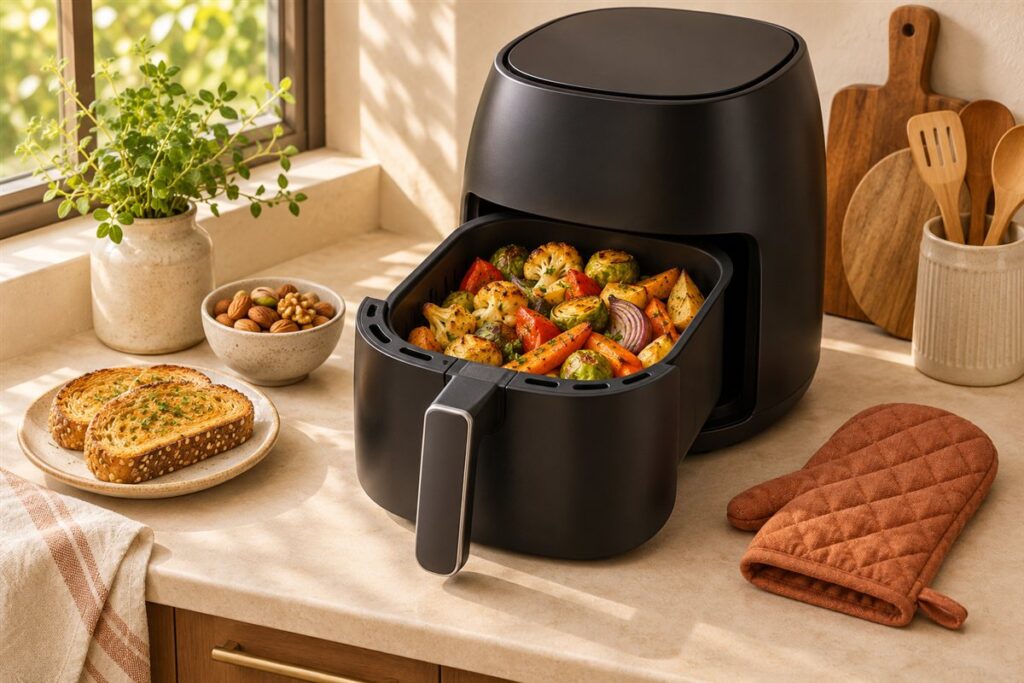
A rack lifts food or adds a second level inside the basket, while skewers hold pieces of meat and vegetables off the floor so hot air reaches every side. Both can add variety and capacity to your air fryer. This guide covers what they do and how to use them well.
What a Rack Does
Most racks are simple metal frames that sit in the basket. A flat one raises food a little, so air flows under it as well as over it. A stacking one creates two layers, which helps when you cook several small items at the same time.
Layers need room. If food sits too close to the top, it can brown unevenly or touch the heating area, so check the height of your basket before choosing.
What a Skewer Set Does
Skewer sets usually include several rods and sometimes a holder that rests across the basket. They suit kebab-style meals, with cubes of chicken, vegetables, or tofu. Because food hangs in open air, edges tend to cook evenly.
- Cut pieces to a similar size so they cook at the same pace.
- Leave small gaps between pieces.
- Trim long rods so they do not touch the walls or the top.
- Turn the skewers partway through, as the recipe suggests.
Fit and Material Checks
| Check | Why it matters |
|---|---|
| Basket width and depth | An oversized rack blocks the drawer or tilts |
| Material and heat limit | Use only items stated to suit air fryer use |
| Coating | Follow the care notes so it lasts |
| Cleaning | Narrow gaps can trap grease |
Cleaning and Storage
Soak racks and rods in warm soapy water soon after cooling, then scrub with a soft brush. Dry them fully before putting them away. Metal handles and tips can be hot for some time, so let everything cool first and use tongs or an oven mitt when in doubt.
Ideas for Using Them
Use a stacking rack to cook vegetables on one level and chicken thighs on another, then swap positions partway through. Use skewers for mixed vegetable kebabs, meatballs, or pieces of fish. Smaller pieces cook faster, so keep each skewer to one type of food when the cooking times differ. Check early and often the first time until you know how your model behaves.
Materials and Finishes Compared
Racks and skewers come in a few common materials, and each behaves differently in a small, hot, fan-driven space. Stainless steel is widely used because it handles high heat, resists rust, and is straightforward to clean. Chrome-plated or coated wire racks are also common, but the coating should be described as suitable for high heat, and it needs gentle cleaning so it does not flake. Plain uncoated carbon steel can rust if it is not dried promptly.
Silicone appears on handles, tips, and some trays. It can be useful for grip and for protecting the basket, but it must be rated for the temperatures you plan to use. Wood and bamboo skewers are inexpensive and can work if soaked and used within the limits in your manual, though they can char and are single-use in most cases. Metal skewers are reusable and avoid this worry, but they get very hot, so handle them with mitts or tongs.
Check the finish for smoothness. Rough welds and sharp edges can scratch a nonstick basket and are unpleasant to clean. Read the product description for the stated heat rating and any notes on dishwasher use. If the listing is vague about materials or limits, choose a different product. Thin, flimsy wire may bend under weight, so look for sturdy construction that holds its shape.
Fit, Clearance, and Stability
A rack that does not fit properly is more trouble than it is worth. Start with the floor of your basket, and compare it to the stated size of the rack, remembering that the rack should leave a gap around the edges for air. A rack that is too wide may tilt, wedge, or stop the drawer from closing. One that is too small may slide around and tip.
Height is the second check. A rack that lifts food can bring it closer to the heating area, so measure the space between the basket floor and the element. Food on the top layer should be well clear of the element, with room to brown. Stacking racks often have legs that raise the upper level, so look at leg height and ask whether the layers are adjustable.
- Look for feet or legs that sit securely on the basket floor and do not scratch it.
- Check that the rack can be placed and removed without twisting or forcing.
- Think about the weight of the food, since heavy items can bend a thin rack.
- Test the fit empty before cooking, to be sure the drawer closes smoothly.
For skewers, check the length and the way they rest. Rods should be short enough that they do not touch the walls or the top, and the holder should keep them level and stable.
What to Cook on Racks and Skewers
Racks and skewers suit different foods. A flat rack is helpful for items that benefit from air underneath, such as bacon, sausages, ribs, and breaded pieces. The fat drips below, and the food crisps on all sides. A two-level rack lets you cook small items side by side, such as vegetable pieces on one level and chicken on another. Remember that the top level cooks faster in many units, so swap positions halfway.
Skewers work well for compact, evenly cut foods. Chicken, beef, and firm fish cubes, vegetable pieces, halloumi-style cheese, tofu, and meatballs all work. Pieces should be similar in size and thickness so they finish together. Alternate quick-cooking vegetables with slower foods carefully, or put them on separate skewers if they cook at different rates. Soft items, like cherry tomatoes, may collapse, so add them near the end or skewer them separately.
Use marinades, but pat the surface dry before cooking so the food browns. Sugary glazes burn easily, so brush them on in the last few minutes. If you plan to cook meat or fish, use a thermometer to confirm doneness, and follow safe handling guidance. For simple results, start with one type of food at a time until you learn how your model behaves.
Safe Handling While Hot
Hot metal is the main hazard. Racks and skewers hold heat long after cooking, so use tongs, mitts, or heat-resistant gloves to lift them out. Open the drawer slowly and keep your face back, as steam and hot air rush out. Set hot items on a trivet or heat-safe surface and not directly on the counter.
Skewer tips can be sharp. Take care when loading, and keep the points away from your hands and from the basket coating. When removing food, slide it off with a fork or tongs held away from your body. Wooden skewers may flare or char if they touch the element, so keep them well clear and trim them if they are too long.
Do not overload a rack. Heavy loads can tip, and unstable stacks can spill hot juices. Keep an eye on the drip area, since fat collecting underneath can smoke if it overheats. If the drawer is greasy, clean it before the next use. Never leave the unit unattended when trying a new setup, and unplug it when finished. Keep these accessories out of the reach of children, who may not realize how hot or sharp they are. Take your time when moving hot accessories, and plan where you will set them down.
Cleaning, Storage, and Replacement Signs
Clean racks and skewers soon after they cool, because grease is easier to remove before it hardens. Soak them in warm, soapy water, then scrub with a soft brush, getting into the joints and the gaps between wires. If the set is dishwasher safe according to the listing, place it where water can reach all the surfaces, but hand washing is gentler on coatings. Dry thoroughly to prevent rust and spotting.
For storage, keep the set together so pieces do not go missing. A narrow container, a drawer organizer, or a hook inside a cabinet works well. Store skewers with the points protected, perhaps in a sleeve, and keep racks flat or nested so they do not bend. Avoid stacking heavy items on them.
Know when to retire them. Replace a rack if it is bent, wobbles, or has rust that will not wipe away. Replace a coated piece if the coating flakes or peels. Throw away wooden skewers after use, and discard metal skewers that are bent or loose at the handle. A new set is a modest expense compared with the risk of spilled hot food or damaged baskets. When buying, match the size to your model again, and keep notes of which sizes fit.
FAQ
Can I use wooden skewers?
Some cooks do, usually after soaking them in water, but the manual for your air fryer is the best guide. Metal rods made for this purpose avoid the question.
Will a rack change cooking time?
It can, since food sits closer to the heat or in a different airflow. Check early the first time you try it.
Do racks work in every air fryer?
Only if they fit your basket with gaps for airflow and the heating area stays clear. Measure the width, depth, and height before buying.
How long should skewers be?
Short enough that they do not touch the walls, the top, or the heating area. Check the length against your basket and trim wooden ones if needed.
Can I cook frozen food on a rack?
Often yes, but follow the packet directions and check doneness with a thermometer. Frozen items can drip more, so watch the drawer.
Should I oil the rack?
A light film of oil can help food release, but keep it thin. Check your manual and the care notes for any coating on the rack.
Why does the top layer cook faster?
It is closer to the heating area and the airflow, so swap the levels partway through and check early the first time.
Are metal skewers better than wooden ones?
Metal ones are reusable and need no soaking, but they get very hot. Wooden ones are cheaper and disposable, and they need extra care to avoid charring.
The Short Version
Racks add layers and skewers add open-air cooking. Measure your basket, leave airflow gaps, and follow the maker’s manual for your model.