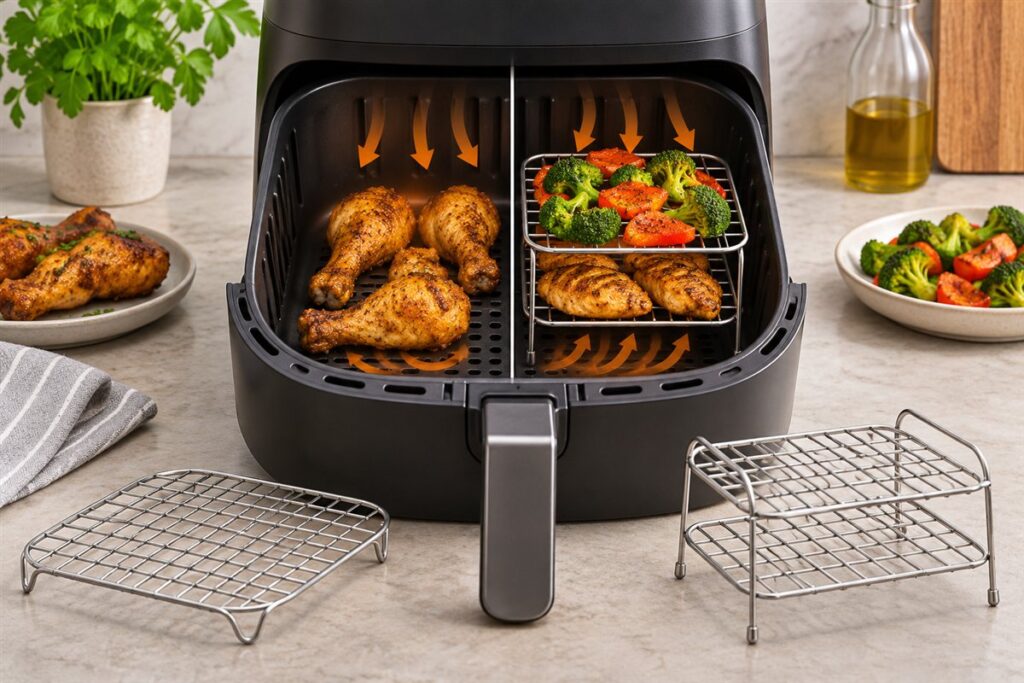
A wire rack lifts food off the basket floor so air can reach the underside, and a multi-level rack lets you cook two layers at once. Both help when you have more food than one layer can hold. Choose a rack that fits the basket with space around it, and leave a gap between layers.
How a Rack Helps
Air fryers cook by moving hot air around food. When food sits flat on the floor, the underside gets less airflow. A rack raises it, so the bottom crisps more evenly. A tiered rack adds a second shelf, which can double your space but also slows airflow if packed too tightly.
Types of Racks
- Flat single racks: a simple grid that sits on the basket floor.
- Stackable two-tier racks: a base and a second shelf for more items.
- Skewer racks: hold sticks above the floor.
- Folding racks: store flatter but may feel less rigid.
What to Check Before You Buy
| Factor | Why it matters | What to check |
|---|---|---|
| Footprint | It must lie flat without tilting | Measure the basket floor |
| Height | Tall racks bring food near the heating area | Measure up to the top area |
| Grid spacing | Wide gaps let small items fall through | Match the spacing to your food |
| Material | Heat limits vary | Read the maker’s guide |
Cooking on Two Levels
- Put the slower-cooking food on the lower level, nearer the airflow source if your model sends air from above.
- Place quicker items on the top shelf.
- Keep the pieces in a single layer on each shelf.
- Pause midway to swap the levels or turn the food.
- Check doneness on both levels before removing anything.
Models differ in how air moves, so the order that works best may vary. Check the maker’s manual and follow its safety instructions, especially for total weight and clearance.
Common Problems
Overloading is the usual issue. Food piled on two levels can end up pale on one and dry on the other. Light foods, like leaves or small bits, can blow around, so weigh them down or use a tray. Sticky foods may cling to wire, so a light coat of oil helps.
Foods That Suit a Rack
Racks work well for foods that release fat or moisture and benefit from airflow below, such as chicken pieces, bacon, sausages and breaded items. Vegetables cut into larger pieces also do well. Small or crumbly foods are better in a basket or pan, where nothing can slip through the grid.
Cleaning
Soak the rack in warm soapy water and use a brush to clear grid corners. Dry it fully to prevent spotting. Avoid abrasive pads on coated racks.
FAQ
Can I use a rack for every recipe?
No. Wet batters and loose foods may drip through, so use a pan or liner for those.
Is a two-tier rack always better?
Not always. It helps with volume, but a single layer usually browns more evenly.
The Short Version
Use a rack to improve airflow, and a second level when you need volume. Measure first, keep layers light and rotate partway through.