The best water sealant for kitchen sinks is a 100 percent silicone caulk or a hybrid polymer sealant that stays flexible, resists mould, and is ready for water in about 30 minutes. The seal around a kitchen sink takes constant water, heat from pots, and movement as the sink flexes under a full load, so a cheap filler that shrinks or cracks will leak within months. The six sealants below are all made for kitchen and bath use, checked against their full product titles, and each one states its size, colour, and cure behaviour.
This guide covers the best water sealant for kitchen sinks from the two brands most plumbers reach for, GE and Gorilla, plus DAP and Flex Caulk. Every pick is a real sealant sold on Amazon, and every size, colour, and cure time stated here comes from its product title or its listed features. We explain how to pick the right colour and size, how to apply a clean bead, and how to keep the seal working for years.
A kitchen sink seal has two jobs: it stops water running down behind the sink and into the cabinet, and it lets the sink move slightly without breaking the bond. Silicone does both, because it stays permanently flexible and bonds to porcelain, stainless steel, granite, tile, and laminate. A hybrid polymer does the same and adds paintability, which matters when the seal must match a painted wall. The rest of this guide compares six sealants side by side, explains the application, and answers the questions buyers ask most about sealing a kitchen sink.
How we chose the best water sealant for kitchen sinks
We picked sealants whose full product titles state kitchen and bath use and 100 percent silicone or hybrid polymer construction, so the water resistance is confirmed rather than assumed. We covered clear and white colours, small squeeze tubes for touch ups and large cartridges for full jobs, and both a gun cartridge and a trigger nozzle that needs no gun. We looked for a stated water ready time, mould resistance, and a stated size, and we left out paint, tape, and tools that are not sealants. Every pick is a sealant, not a tool, and every pick is made to seal a sink.
We also checked the pack size, because a 2.8 ounce tube suits a touch up while a 10 ounce cartridge suits a full reseal of a sink and a countertop. A sealant that comes only in a large cartridge wastes money on a small job, and a sealant that comes only in a small tube runs out halfway through a large job, so the guide covers both sizes.
In this guide
The picks at a glance
The six sealants below cover clear and white, small and large, and gun and no gun application. Two are GE Advanced Silicone in different colours and sizes, two are Gorilla 100 percent silicone in different colours and sizes, one is DAP Silicone Max, and one is Flex Caulk hybrid polymer with a trigger nozzle. All six are ready for water in about 30 minutes, and all six stay flexible after curing.
All six sealants state kitchen and bath use in their product titles, and all six are 100 percent silicone or hybrid polymer, so the water resistance is confirmed for every pick. The list runs from the small clear GE tube to the no gun Flex Caulk, so the first picks suit a quick touch up and the later picks suit a full reseal.

1. GE Advanced Silicone Caulk, Clear, 2.8 fl oz Tube
The GE Advanced Silicone Caulk for Kitchen and Bathroom in clear, 2.8 fluid ounces, is a 100 percent silicone sealant in a small squeeze tube. The clear colour suits any sink and countertop, because it disappears against stainless steel, white porcelain, granite, and tile, so there is no colour matching to get wrong. The tube needs no caulk gun, which makes it the pick for a quick touch up: cut the tip, squeeze a bead, and smooth it with a wet finger. The formula is ready for water exposure in as little as 30 minutes, stays permanently flexible, and is shrink and crack proof, which matters around a sink that moves slightly under a full load. At 2.8 fluid ounces it covers a sink rim and a short run of countertop, and the small tube stays fresh because it is used up in one job.
Key specs: Clear, 2.8 fl oz squeeze tube, 1 pack. GE Advanced Silicone, 100 percent silicone. Water ready in 30 minutes, permanently flexible, shrink and crack proof, 5 times stronger adhesion.
Strengths:
- The clear colour disappears against any sink and countertop, so no colour matching is needed.
- The squeeze tube needs no caulk gun, which suits a quick touch up.
- Ready for water in as little as 30 minutes, so the sink can be used the same day.
Trade-offs:
- At 2.8 fluid ounces it is too small for a full reseal of a sink and a countertop.
- Clear silicone can yellow slightly over years in strong sunlight.
- The squeeze tube is hard to control for a long straight bead.
This sealant suits a quick touch up around one sink, and anyone who wants a clear seal that matches any colour scheme without a caulk gun.
Clean the old seal out fully, dry the joint, and cut the tip at a 45 degree angle to the bead size you want. Apply a steady bead, smooth it with a wet finger, and wait 30 minutes before running water.
Best for: A small tube for a touch up around one sink, where a large cartridge would be wasteful.
Not suited for: A full reseal of a large sink and a long countertop run, where a 10 ounce cartridge fits better.
The clear colour and the squeeze tube make this the simplest pick in the guide for a first time sealant job.
Check price on Amazon: GE Advanced Silicone Caulk, Clear, 2.8 fl oz Tube

2. GE Advanced Silicone Caulk, White, 10 fl oz Cartridge
The GE Advanced Silicone Caulk for Kitchen and Bathroom in white, 10 fluid ounces, is a 100 percent silicone sealant in a standard cartridge that fits a caulk gun. The white colour suits a white porcelain or fireclay sink and a light countertop, where it reads as part of the sink rather than as a repair. The 10 ounce cartridge covers a full reseal: the sink rim, the countertop joint, and the backsplash in one tube, with enough left for a second pass. The formula is 100 percent silicone, stays permanently flexible, and is shrink and crack proof, so it handles the expansion and contraction of a sink that heats up with hot water and cools down overnight. It is ready for water in 30 minutes, which means the sink can be used the same day it is sealed.
Key specs: White, 10 fl oz cartridge, 1 pack. GE Advanced Silicone, 100 percent silicone. Water ready in 30 minutes, permanently flexible, shrink and crack proof, 5 times stronger adhesion.
Strengths:
- The 10 ounce cartridge covers a full reseal of a sink, a countertop, and a backsplash.
- The white colour suits a white porcelain or fireclay sink.
- Stays permanently flexible, so the seal survives heat and movement.
Trade-offs:
- A cartridge needs a caulk gun, which is a separate purchase if you do not own one.
- White silicone can stain if coffee or turmeric sits on it.
- At 10 ounces it is too much sealant for a single small touch up.
This sealant suits a full reseal of a white sink and a light countertop, and anyone who already owns a caulk gun.
Load the cartridge in a caulk gun, cut the tip to the bead size, and apply a steady bead along the joint. Smooth with a wet finger, wipe the excess at once, and wait 30 minutes before running water.
Best for: A full reseal, where one cartridge should cover the whole job.
Not suited for: A small touch up, where a 2.8 ounce squeeze tube is cheaper and simpler.
The 10 ounce cartridge and the white colour make this the workhorse pick for a full reseal of a white sink.
Check price on Amazon: GE Advanced Silicone Caulk, White, 10 fl oz Cartridge

3. Gorilla 100 Percent Silicone Caulk, Clear, 2.8 fl oz
The Gorilla 100 Percent Silicone Caulk for Kitchen and Bathroom in clear, 2.8 fluid ounces, is a small squeeze tube made for touch ups. The removable nozzle cuts at a 45 degree angle to the bead size you want, which gives a clean even bead without a gun, and the formula is designed for quick application by a home owner. It is 100 percent silicone, waterproof, and mould resistant, which matters around a sink where water sits and mould grows fast. The clear colour suits any sink, and the tube is sized for refreshing a tired caulk line around a sink, a tub, a shower, a faucet, or a tile edge, so one tube can fix several small spots in a kitchen and a bathroom. It is ready for water quickly and stays flexible, so the seal does not crack when the sink moves.
Key specs: Clear, 2.8 fl oz squeeze tube, 1 pack. Gorilla 100 percent silicone. Waterproof, mould resistant, removable nozzle, made for touch ups.
Strengths:
- The removable nozzle gives a clean even bead without a caulk gun.
- Made for touch ups, so it suits refreshing a tired caulk line.
- Mould resistant, which matters in the wet area around a sink.
Trade-offs:
- At 2.8 fluid ounces it is too small for a full reseal.
- Clear silicone can yellow slightly over years in strong sunlight.
- The squeeze tube is hard to control for a long straight bead.
This sealant suits refreshing a tired caulk line around a sink, and anyone who wants a no gun tube for small fixes.
Cut the nozzle at a 45 degree angle, apply a steady bead, and smooth it with a wet finger. Clean the excess at once and let the seal cure before heavy use.
Best for: A touch up job across several small spots, where a large cartridge would be wasteful.
Not suited for: A full reseal of a sink and a countertop, where a 10 ounce cartridge fits better.
The removable nozzle and the mould resistance make this the best pick for refreshing a tired caulk line.
Check price on Amazon: Gorilla 100 Percent Silicone Caulk, Clear, 2.8 fl oz
4. Gorilla 100 Percent Silicone Caulk, White, 10 oz Cartridge
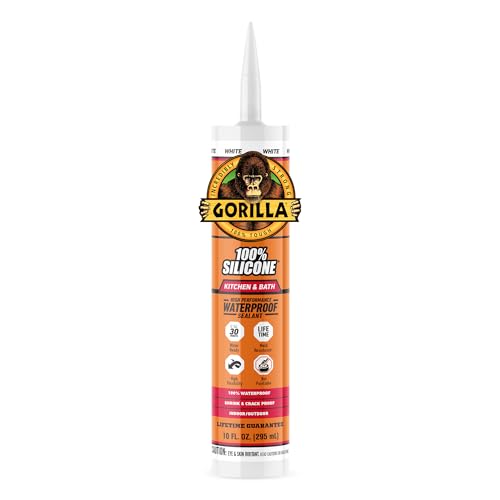
The Gorilla 100 Percent Silicone Caulk in white, 10 ounces, is a kitchen and bath sealant in a standard cartridge. The white colour suits a white sink and a light tile backsplash, and the formula is 100 percent waterproof with mould and mildew resistance, which keeps the seal clean in the wettest part of the kitchen. It is water ready in 30 minutes and fully cured in 24 hours, so the sink can be used the same day and the seal reaches full strength overnight. The cartridge fits a standard caulk gun and covers a full reseal of a sink rim, a countertop joint, and a backsplash. The seal stays flexible and durable, which handles the daily heating and cooling of a sink that takes hot water from pots and cold water from the tap.
Key specs: White, 10 oz cartridge, 1 pack. Gorilla 100 percent silicone. Water ready in 30 minutes, full cure in 24 hours, mould and mildew resistant, 100 percent waterproof.
Strengths:
- Water ready in 30 minutes, with a full cure in 24 hours.
- Mould and mildew resistant, which keeps the seal clean.
- The 10 ounce cartridge covers a full reseal in one tube.
Trade-offs:
- A cartridge needs a caulk gun, which is a separate purchase if you do not own one.
- White silicone can stain if coffee or turmeric sits on it.
- At 10 ounces it is too much sealant for a single small touch up.
This sealant suits a full reseal of a white sink with a tile backsplash, and anyone who wants a 30 minute water ready time.
Load the cartridge in a caulk gun, cut the tip, and apply a steady bead. Smooth with a wet finger, wipe the excess at once, and use the sink lightly after 30 minutes and fully after 24 hours.
Best for: A full reseal of a white sink, where mould resistance matters.
Not suited for: A small touch up, where a 2.8 ounce squeeze tube is cheaper and simpler.
The 30 minute water ready time and the 24 hour full cure make this the most forgiving pick for a weekend job.
Check price on Amazon: Gorilla 100 Percent Silicone Caulk, White, 10 oz Cartridge

5. DAP Silicone Max Kitchen and Bath Sealant, White, 2.8 Oz
The DAP Silicone Max Kitchen and Bath Sealant in white, 2.8 ounces, is a small tube with a food safety credential that the other picks in this guide do not state: it is NSF certified to ANSI Standard 51 and safe for incidental food contact. That matters around a kitchen sink, where food and water touch the seal every day, and a sealant that is certified for food contact gives extra confidence. The silicone rubber formula gives a flexible bond that will not crack or shrink, and it is water ready in 30 minutes, so the sink can be used the same day. The white colour suits a white porcelain sink, and the 2.8 ounce tube needs no caulk gun, which makes it a touch up pick. The sealant is not paintable, so paint the surface before applying it, and it works for a range of interior uses beyond the sink.
Key specs: White, 2.8 oz tube. DAP Silicone Max, silicone rubber formula. Water ready in 30 minutes, flexible bond, will not crack or shrink, NSF certified to ANSI Standard 51 for incidental food contact, not paintable.
Strengths:
- NSF certified for incidental food contact, which suits a kitchen sink.
- The flexible bond will not crack or shrink.
- Water ready in 30 minutes, so the sink can be used the same day.
Trade-offs:
- The sealant is not paintable, so paint before applying.
- At 2.8 ounces it is too small for a full reseal.
- White silicone can stain if coffee or turmeric sits on it.
This sealant suits a kitchen sink where food contact matters, and anyone who wants a certified food safe seal in a small no gun tube.
Clean the joint fully and dry it, then cut the tip and apply a steady bead. Smooth with a wet finger and wait 30 minutes before running water. Remember that this sealant cannot be painted over.
Best for: A kitchen sink, where food contact certification gives extra confidence.
Not suited for: A job that needs a paintable seal, where a hybrid polymer fits better.
The NSF food contact certification makes this the safest pick for a sink where food touches the seal every day.
Check price on Amazon: DAP Silicone Max Kitchen and Bath Sealant, White, 2.8 Oz

6. Flex Caulk Hybrid Polymer Waterproof Sealant, Clear, 6.6 oz
The Flex Caulk Hybrid Polymer Waterproof Sealant in clear, 6.6 ounces, is the only hybrid polymer in this guide, and it is the only pick that needs no caulk gun. The trigger flow nozzle adjusts the flow, so the bead size is controlled by the trigger rather than by hand pressure, which gives a steadier bead than a squeeze tube. The cap snaps shut to save the rest of the tube, which stops waste between jobs. The hybrid polymer formula seals out water, air, and moisture, sticks to almost any surface wet or dry, will not shrink, crack, or become brittle, and is UV and chemical resistant. It is fully paintable, which is the key difference from silicone: a silicone seal cannot be painted, while this one can, so it suits a joint that must match a painted wall or cabinet.
Key specs: Clear, 6.6 oz tube with trigger flow nozzle, 1 pack. Flex Caulk hybrid polymer. No caulk gun needed, fully paintable, sticks wet or dry, will not shrink or crack, UV and chemical resistant, snap and save cap.
Strengths:
- No caulk gun is needed, because the trigger nozzle controls the flow.
- Fully paintable, unlike silicone, so it matches a painted surface.
- Sticks to a wet or dry surface, which helps in a damp sink area.
Trade-offs:
- At 6.6 ounces it sits between a touch up tube and a full cartridge, so it may not cover a very large job.
- The trigger nozzle takes practice to get an even bead.
- A hybrid polymer costs more per ounce than a basic silicone.
This sealant suits a joint that must be painted, and anyone who wants a no gun sealant with a controlled trigger nozzle.
Snap the cap off, adjust the trigger for the bead size, and apply a steady bead. Smooth with a wet finger, snap the cap back on to save the rest, and paint over it once it has cured if the joint needs colour.
Best for: A painted joint, or a job where no caulk gun is available.
Not suited for: A large full reseal, where a 10 ounce cartridge covers more for less.
The trigger nozzle and the paintable formula make this the most flexible pick for a painted joint.
Check price on Amazon: Flex Caulk Hybrid Polymer Waterproof Sealant, Clear, 6.6 oz
Comparison table
| Product | Key detail | Suits |
|---|---|---|
| GE Advanced Silicone Clear 2.8 oz | Clear, squeeze tube, water ready 30 min | Touch ups |
| GE Advanced Silicone White 10 oz | White, cartridge, water ready 30 min | Full reseals |
| Gorilla Silicone Clear 2.8 oz | Clear, squeeze tube, mould resistant | Touch ups |
| Gorilla Silicone White 10 oz | White, cartridge, cure 24 hours | Full reseals |
| DAP Silicone Max White 2.8 oz | White, NSF food contact certified | Food safe sinks |
| Flex Caulk Hybrid Polymer Clear 6.6 oz | Clear, trigger nozzle, paintable | Painted joints |
Buying guide: choosing a water sealant for a kitchen sink
Start with the colour. Clear sealant disappears against any sink and countertop, so it is the safe choice when the sink is stainless steel, granite, or a dark stone, and when the countertop and the sink are different colours. White sealant suits a white porcelain or fireclay sink and a light countertop, where it reads as part of the sink. A clear sealant can yellow slightly over years in strong sunlight, while a white sealant can stain if coffee or turmeric sits on it, so wipe both down after use. Choose the colour that matches the sink, not the countertop, because the seal sits against the sink edge.
Next, choose the size and the application. A 2.8 ounce squeeze tube suits a touch up around one sink and needs no caulk gun, while a 10 ounce cartridge suits a full reseal and needs a standard caulk gun. A 6.6 ounce trigger tube sits between the two and needs no gun, which suits a medium job. Count the joints before buying: a sink rim, a countertop joint, and a backsplash need more sealant than a single rim, and a tube that runs out halfway leaves a weak joint. Buy one tube more than you think you need, because sealant is cheap and a second trip costs more than the tube.
Then check the cure time and the paintability. Most silicone sealants are water ready in 30 minutes and fully cured in 24 hours, so plan the job for a morning and use the sink lightly that day. A sealant that is not paintable must go on after painting, while a hybrid polymer can be painted over, so choose the hybrid if the joint must match a painted wall. Finally, check the food contact certification if the seal sits where food and water touch it every day: the DAP pick in this guide is NSF certified for incidental food contact, which is the credential to look for.
Finally, check the surface before you buy. Silicone bonds to porcelain, stainless steel, granite, tile, and laminate, but it will not stick to a dirty, wet, or greasy joint, so the old seal must come out fully and the surface must be clean and dry. A hybrid polymer sticks wet or dry, which helps in a damp area, but it still needs a clean surface. Test the bead on a scrap surface first, because the bead size is set by the cut in the nozzle, and a cut that is too large cannot be made smaller.
How to apply sealant around a kitchen sink
Remove the old seal fully before applying a new one, because new silicone will not bond to old silicone. Cut the old bead out with a utility knife, scrape the residue with a plastic scraper, and clean the joint with rubbing alcohol so no grease or soap film is left. Let the joint dry fully, because water under the seal causes it to lift. Tape both sides of the joint with painters tape, leaving a gap the width of the bead you want, which gives a straight edge and an easy cleanup.
Cut the nozzle at a 45 degree angle to the bead size you want, then apply a steady bead in one pass without stopping, because a stop leaves a blob. Smooth the bead at once with a wet finger or a caulk smoothing tool, pushing the sealant into the joint rather than dragging it along the surface. Pull the tape off while the sealant is still wet, wipe the excess with a damp cloth, and do not run water for 30 minutes. Wait a full 24 hours before heavy use, and check the seal the next day for gaps or bubbles.
Common mistakes when sealing a kitchen sink
The most common mistake is applying new sealant over old sealant. Silicone does not bond to silicone, so the new bead sits on top of the old one and peels off within weeks. Always remove the old seal fully, clean the joint, and let it dry before applying a new bead. The second mistake is cutting the nozzle too large: a wide bead is hard to smooth, it wastes sealant, and it looks messy. Cut the tip small and test the bead on a scrap surface first.
The third mistake is using the sink too soon. A sealant that is water ready in 30 minutes is not fully cured, and heavy water pressure can wash it out of the joint. Use the sink lightly for the first day and wait 24 hours before running a full load. The fourth mistake is choosing the wrong colour: a white sealant on a dark granite sink looks like a repair, and a clear sealant on a white sink can look yellow in sunlight. Match the sealant to the sink, and wipe it down after use to keep it clean.
Silicone vs hybrid polymer for a kitchen sink
Silicone is the standard sealant for a kitchen sink, because it stays permanently flexible, resists water and mould, and bonds to porcelain, steel, stone, and tile. Its weakness is paint: silicone cannot be painted, so a joint that must match a painted wall needs a different product. Silicone also needs a clean dry surface to bond, and it will not stick to old silicone, so preparation matters more than the brand. Five of the six sealants in this guide are silicone, and they cover every common sink job.
A hybrid polymer seals like silicone but adds two things: it sticks to a wet or dry surface, and it can be painted over once it has cured. That makes it the pick for a joint against a painted wall or a painted cabinet, where a silicone bead would stand out. It also needs no caulk gun in the Flex Caulk form, because the trigger nozzle controls the flow. The trade off is cost per ounce, which is higher than a basic silicone, and a smaller size range. Choose silicone for a standard sink joint and hybrid polymer for a painted joint or a damp surface.
How long a kitchen sink seal lasts
A well applied silicone seal around a kitchen sink lasts several years, because the formula stays flexible and resists water, mould, and heat. The seal fails first where the sink moves most, which is the rim near the faucet and the joint at the back of the sink, so check those spots once a year. A seal that has shrunk, cracked, or pulled away from the edge needs replacing, because water running behind the sink rots the cabinet and breeds mould. Do not patch a failed seal with more sealant: remove it fully and apply a new bead.
Heat and cleaning chemicals shorten the life of a seal. Hot water from pots and boiling water poured down the sink heat the seal and cool it again every day, which is why a flexible formula matters. Harsh cleaners and bleach can attack the surface of the seal, so clean the sink with a mild soap and rinse the seal after using a strong cleaner. A seal that is wiped dry after use lasts longer than one that stays wet, because standing water breeds mould at the edge.
How to choose between a squeeze tube and a cartridge
A squeeze tube suits a touch up, because it needs no caulk gun, it is used up in one job, and it costs less than a cartridge and a gun together. The 2.8 ounce tubes in this guide cover a sink rim and a short run of countertop, which is enough for a repair, but they run out halfway through a full reseal, so a buyer who needs a full job should not start with a tube. A squeeze tube also gives less control over a long bead, because the pressure comes from the hand rather than from a gun, so the bead can vary in width.
A cartridge suits a full reseal, because a 10 ounce cartridge covers a sink rim, a countertop joint, and a backsplash in one tube, and a caulk gun gives a steady even bead over a long run. The trade off is the gun itself, which is a separate purchase if you do not own one, and the leftover sealant, which dries in the nozzle between jobs unless the tip is sealed. A trigger nozzle tube sits between the two: it needs no gun, it gives better control than a squeeze tube, and it covers a medium job. Choose a tube for a touch up, a cartridge for a full reseal, and a trigger nozzle for a medium job without a gun.
Frequently asked questions
What is the best water sealant for kitchen sinks?
A 100 percent silicone caulk made for kitchen and bath use is the best water sealant for kitchen sinks, because it stays flexible, resists mould, and is water ready in about 30 minutes. The GE and Gorilla picks in this guide are 100 percent silicone, while Flex Caulk is a hybrid polymer that can be painted.
How long before I can use the sink after sealing?
Most silicone sealants are water ready in 30 minutes, so the sink can be used lightly the same day. Wait a full 24 hours before heavy use, because the seal reaches full strength overnight. Check the product title for the exact cure time.
Should I use clear or white sealant for a kitchen sink?
Clear sealant disappears against any sink and countertop, so it is the safe choice for a stainless steel or granite sink. White sealant suits a white porcelain or fireclay sink, where it reads as part of the sink. Match the sealant to the sink, not the countertop.
Can I apply new sealant over old sealant?
No. Silicone does not bond to silicone, so a new bead over an old one peels off within weeks. Remove the old seal fully, clean the joint, let it dry, and then apply a new bead.
Do I need a caulk gun for kitchen sink sealant?
It depends on the tube. A 2.8 ounce squeeze tube and a trigger nozzle tube need no gun, while a 10 ounce cartridge needs a standard caulk gun. A squeeze tube suits a touch up, and a cartridge suits a full reseal.
Is silicone sealant safe around food?
Yes, once cured, silicone is safe around a kitchen sink. The DAP pick in this guide is NSF certified to ANSI Standard 51 for incidental food contact, which is the credential to look for if food touches the seal.
Can I paint over kitchen sink sealant?
Silicone cannot be painted, so paint the surface before applying a silicone seal. A hybrid polymer such as Flex Caulk can be painted over once it has cured, which suits a joint that must match a painted wall or cabinet.
Why does my kitchen sink seal keep cracking?
A seal cracks when the formula is not flexible enough, when it was applied over old sealant, or when the joint was dirty or wet. Use a 100 percent silicone that stays permanently flexible, remove the old seal fully, and let the joint dry before applying a new bead.
How much sealant do I need for a kitchen sink?
A 2.8 ounce tube covers a sink rim and a short run of countertop, which is enough for a touch up. A 10 ounce cartridge covers a sink rim, a countertop joint, and a backsplash, which is enough for a full reseal. Buy one tube more than you think you need, because sealant is cheap and a second trip costs more than the tube.
How do I remove old silicone sealant?
Cut the old bead out with a utility knife, scrape the residue with a plastic scraper, and clean the joint with rubbing alcohol so no grease or soap film is left. Let the joint dry fully before applying a new bead, because new silicone will not bond to old silicone or to a wet surface.
Our recommendation
The best water sealant for kitchen sinks is a 100 percent silicone caulk made for kitchen and bath use, in the colour that matches the sink and the size that matches the job. Use a small clear tube for a touch up, a large white cartridge for a full reseal of a white sink, a certified food safe tube when food contact matters, and a paintable hybrid polymer when the joint must match a painted surface. Remove the old seal fully, apply a steady bead, and wait a day before heavy use.
When the sealant arrives, check the size and colour against the product title before opening it, because an opened tube cannot be returned. Keep the tube upright and the cap on between jobs so the sealant stays fresh.