Disclosure: airfryerkitchensupply.com is reader-supported. When you buy through links on our site, we may earn an affiliate commission at no extra cost to you.
Where to buy
Our verified shortlist of the best rug under rolling office chairs starts with the buying links in this section.
A naming honesty note that runs through this whole guide: most products sold for this job are low-pile rug-and-mat hybrids — a washable rug surface engineered to behave like a chair mat — and one pick below is an outright plastic chair mat, labelled as not a rug in its headline. Every product was verified, and sizes are quoted exactly as the titles print them, never rounded up. Check price on Amazon on the exact size, because under-desk products live and die by their dimensions.
- JTJ Office Chair Mat Rug — 48″x60″ Dark Green Vintage Rug — check price on Amazon
- 36″x48″ Office Chair Mat Rug — Washable Low Pile, Taupe — check price on Amazon
- Office Chair Mat Rug for Hardwood Floor — 36″x48″ Machine Washable, Black — check price on Amazon
- BesWin Office Chair Mat — 48″ x 36″ Low Pile Washable Rug for Hard Floors — check price on Amazon
- Office Chair Mat for Hardwood & Tile — 36″X 48″ Low Pile Rug — check price on Amazon
- BesWin Office Chair Mat for Carpet — 30″ x 48″ Clear (NOT a Rug) — check price on Amazon
Finding the best rug under rolling office chairs means solving two problems that fight each other: a rug softens a room, protects the floor and kills the echo of a home office — but chair casters hate rugs. Deep pile traps wheels, edges curl into trip lips, and a standard decorative rug under a rolling chair becomes a daily wrestling match. The products that work are built differently: low pile, dense and flat, with non-slip backing, sized so the chair’s full rolling range stays on the surface.
This guide is precise about what these products are. Most are hybrids — a genuine low-pile rug surface, washable and soft underfoot, engineered flat enough for casters — and their titles say so, calling themselves chair mats and area rugs in the same breath. One pick is a clear plastic chair mat included deliberately and labelled as not a rug, because on carpet it is sometimes the right tool and you deserve the comparison made honestly. Sizes are printed exactly as titles state them; a 36 by 48 inch product is never described as anything larger.
Measure before you fall in love: the chair’s casters travel further than you think, especially reclined, and the right size covers the whole travel zone plus the space your feet use. The six picks below span the common under-desk sizes and both floor worlds — hard floors, where rugs protect and quiet, and carpet, where the honest answer is often not a rug at all.
In this guide
Quick Picks
- JTJ Office Chair Mat Rug — 48″x60″ Dark Green Vintage Rug — Best Overall: check price on Amazon
- 36″x48″ Office Chair Mat Rug — Washable Low Pile, Taupe — Best Standard Size: check price on Amazon
- Office Chair Mat Rug for Hardwood Floor — 36″x48″ Machine Washable, Black — Best in Black: check price on Amazon
- BesWin Office Chair Mat — 48″ x 36″ Low Pile Washable Rug for Hard Floors — Best Alternative Orientation: check price on Amazon
- Office Chair Mat for Hardwood & Tile — 36″X 48″ Low Pile Rug — Best for Tile Floors: check price on Amazon
- BesWin Office Chair Mat for Carpet — 30″ x 48″ Clear (NOT a Rug) — Not a Rug — The Carpet Answer: check price on Amazon
How These Picks Were Chosen
Candidates were verified by brand and model, with links granted only on exact title matches. Decorative rugs with no stated suitability for rolling chairs were excluded — a pretty rug that fights your casters fails this search. Duplicate size variants of one product were counted once: where a line offers the same rug in two sizes, a single size represents it here.
Ranking weighed caster compatibility first — low pile stated in the title, flat dense construction, non-slip backing — then washability, since an under-desk surface collects coffee, dust and chair-tracked grit, and finally size honesty: the title’s stated dimensions, quoted verbatim. The plastic mat was admitted under a disclosed exception for carpeted floors, where rugs of any pile sit on top of carpet pile and wander.
The 6 Best Rug Under Rolling Office Chairs

JTJ Office Chair Mat Rug — 48″x60″ Dark Green Vintage Rug — Best Overall
The JTJ is the pick for the home office that wants to look like a room, not a workstation: the largest rug-format surface in this guide at a title-stated 48 by 60 inches, in a dark green vintage rug design, washable and non-slip with low pile for rolling chairs. It suits hard floors under a full-size desk where the chair’s travel zone is generous.
Strengths
- Largest stated rug size here — 48×60 covers a full recline-and-roll zone
- A real vintage rug look, not a mat pretending
- Washable and non-slip with low pile stated in the title
Trade-offs
- The vintage pattern is a décor commitment — it will set the room’s tone
- Rug-format hybrids roll better than deep rugs but never as freely as hard plastic
- Confirm your floor type matches the title’s hardwood and tile positioning
| Detail | Per listing title |
|---|---|
| Size per title | Size per title: 48 x 60 inches — the largest rug-format pick here |
| Surface per title | Surface per title: Washable, non-slip, low pile |
| Style per title | Style per title: Dark green vintage rug design |
| Floors per title | Floors per title: Hardwood and tile; home office use |
Size is the under-desk specification buyers get wrong, and 48 by 60 is the size that forgives. The extra foot of depth over the common 36×48 format covers the caster travel of a reclined chair — the moment in every workday when a too-small mat deposits a wheel off its edge onto the floor, and the chair lurches. If your desk has the floor for it, this is the format that stops the edge problem entirely.
The vintage design does quieter work: it makes the home office read as a furnished room in video calls and in life, while the low pile keeps the daily roll honest. Washability matters more under a desk than anywhere — this surface will meet coffee — and the non-slip backing keeps the whole arrangement from migrating across the week, which is the slow failure mode of under-desk rugs generally.
Best for: Hard-floor home offices with room for a full-size, good-looking rolling surface / Not suited for: Carpeted floors, or minimalists who want the surface invisible

36″x48″ Office Chair Mat Rug — Washable Low Pile, Taupe — Best Standard Size
This is the standard-format answer in a neutral taupe: 36 by 48 inches of washable low-pile rug-mat, a stated 1/5 inch thin profile, non-slip backing, sized for the typical single-desk footprint on hardwood. It suits the majority of home offices — one desk, one chair, hard floor — that need the problem solved without a design statement.
Strengths
- The classic 36×48 format fits most desk setups exactly
- Stated 1/5-inch low profile keeps caster transitions gentle
- Washable, non-slip and neutral — the low-maintenance default
Trade-offs
- 36×48 is too small for wide travel zones or deep reclines — measure first
- Taupe shows chair-tracked dust in high-traffic weeks; washing is part of ownership
- A hybrid surface, not a plush rug — set softness expectations accordingly
| Detail | Per listing title |
|---|---|
| Size per title | Size per title: 36 x 48 inches |
| Thickness per title | Thickness per title: 1/5 inch, low pile thin profile |
| Surface per title | Surface per title: Non-slip, washable |
| Colour | Colour: Taupe |
There is a reason 36×48 became the standard under-desk size: it matches the footprint of a typical desk-and-chair arrangement, covering the working roll zone for an upright chair at a standard desk. The stated thin profile is the operative detail — at a fifth of an inch, casters climb the edge without the jolt of thicker rugs, and the chair returns to the floor without dropping.
Taupe is the diplomatic colour: it disappears under most desks, hides the midweek dust better than black, and shows less chair-track marking than white or cream formats. Paired with washability, this is the pick for buyers who want the category solved quietly and permanently rather than styled. Measure your recline travel honestly; if your chair roams, step up to the 48×60 above instead.
Best for: Standard single-desk home offices on hard floors / Not suited for: Deep recliners or wide rolling ranges — size up instead

Office Chair Mat Rug for Hardwood Floor — 36″x48″ Machine Washable, Black — Best in Black
The black counterpart in this guide’s standard size: a machine-washable, non-slip, low-pile rug-format mat in black, positioned by its title for hardwood floors. It suits darker office schemes, gaming-adjacent setups and anyone whose taupe would clash — with the same 36×48 footprint and the same measure-first warning.
Strengths
- Black finish suits dark desks and gaming setups
- Machine washable with non-slip backing and low pile
- Heavy duty positioning in the title for daily rolling
Trade-offs
- Black shows dust, lint and pet hair at maximum contrast — washing is frequent
- Same 36×48 limit: not for wide travel zones
- Rug-format roll feel, not hard-mat glide
| Detail | Per listing title |
|---|---|
| Size per title | Size per title: 36 x 48 inches |
| Surface per title | Surface per title: Machine washable, non-slip, low pile heavy duty area rug format |
| Colour | Colour: Black |
| Floors per title | Floors per title: Hardwood floor positioning |
Colour choice in this category is a cleaning decision disguised as a style one. Black hides chair-track scuffing and coffee completely, then betrays every speck of dust and hair; taupe splits the difference; light colours hide dust and show scuffs. The right answer is the one matching your room’s actual dirt — and your actual willingness to wash, because this surface’s washability is only a benefit if it gets used.
Specification-wise this matches the standard format’s virtues: low pile for casters, non-slip backing against migration, and a heavy duty framing for daily use. In a dark-themed office it disappears visually in the best way, letting the desk and chair carry the room while the floor stays protected and the roll stays smooth.
Best for: Dark-themed offices and gaming setups on hard floors / Not suited for: Pet-hair-heavy homes that hate visible lint, or wide rolling zones

BesWin Office Chair Mat — 48″ x 36″ Low Pile Washable Rug for Hard Floors — Best Alternative Orientation
The BesWin states its size as 48 by 36 — the same area as the standard format, oriented the other way: wider than deep. That orientation suits desks against a wall where the chair rolls side to side along the desk more than it travels backwards, and rooms where depth is the scarce dimension. A small distinction that matters in real floor plans.
Strengths
- Wide orientation fits wall desks and side-to-side rolling patterns
- Low pile and washable, stated in the title
- Hard floor positioning with an under-desk rug format
Trade-offs
- Shallower depth means deep reclines run out of surface sooner
- Brand-line variants exist in multiple sizes — confirm the exact stated size at checkout
- Hybrid roll feel, as with all rug-format picks
| Detail | Per listing title |
|---|---|
| Size per title | Size per title: 48 x 36 inches |
| Surface per title | Surface per title: Low pile office rug for rolling chairs, washable |
| Floors per title | Floors per title: Hardwood floor positioning |
Orientation is the overlooked variable in under-desk sizing. Most rolling is not a straight line back from the desk; it is a working arc — along the desk to a drawer, sideways to a shelf, back to centre. A wide, shallower format covers that arc while keeping the chair’s deepest recline travel as the only compromise, which many upright workers never use anyway.
BesWin’s line appears in the searches in near-identical listings at the same size, so this guide counts the product once and warns plainly: at checkout, confirm the size in the title of the exact listing you buy is 48 by 36 inches. That ten-second check is the difference between the orientation strategy working and a second purchase.
Best for: Wall desks and side-rolling work patterns on hard floors / Not suited for: Deep recliners who need depth more than width

Office Chair Mat for Hardwood & Tile — 36″X 48″ Low Pile Rug — Best for Tile Floors
This pick’s title names tile explicitly alongside hardwood, which earns it the tile slot: a heavy duty, anti-slip, low-pile rug-format mat at 36 by 48 inches. Tile adds two problems — grout lines that telegraph through thin surfaces and a harder, colder feel — and a rug-format surface addresses both better than a thin plastic sheet.
Strengths
- Tile floors named in the title — grout-line households are the target
- Anti-slip backing matters doubly on smooth tile
- Rug surface softens tile’s hardness and echo under a desk
Trade-offs
- A larger 48×60 variant of this line exists — this guide counts the product once, at this stated size
- On deep-grout tile, any thin surface can feel uneven; test placement
- Standard 36×48 coverage limits apply
| Detail | Per listing title |
|---|---|
| Size per title | Size per title: 36 x 48 inches |
| Surface per title | Surface per title: Heavy duty, anti-slip, low pile carpet floor format |
| Floors per title | Floors per title: Hardwood and tile floors |
Tile is the floor type under-desk products most often forget, and its users feel forgotten daily: casters chatter across grout lines, thin mats bridge and flex, and the room rings. A low-pile rug-format mat cushions the grout transitions, damps the chatter, and gives the chair a consistent surface — the closest thing to changing the floor without changing the floor.
The anti-slip backing does heavier duty here than on wood, because tile offers the least natural grip; check the mat’s position weekly for the first month until you know its habits in your room. Sized honestly at 36 by 48, this is the tile office’s standard-format answer — with the same invitation as its siblings to size up if your chair’s travel demands it.
Best for: Home offices on tile floors / Not suited for: Carpet, or travel zones larger than 36×48
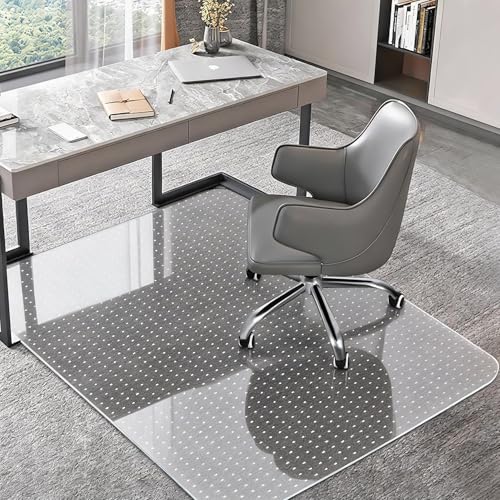
BesWin Office Chair Mat for Carpet — 30″ x 48″ Clear (NOT a Rug) — Not a Rug — The Carpet Answer
The disclosed exception, labelled in its headline: this is a clear plastic chair mat, not a rug, included because carpet changes the problem completely. A rug placed on carpet pile wanders, bunches and fights casters from above and below; a rigid mat made for low carpet gives casters a firm surface and stays put. If your office is carpeted, this — or a mat like it — is the honest recommendation, and no rug in this guide will serve you better.
Strengths
- The correct tool for low carpet: firm glide surface that does not bunch
- Clear format disappears visually over carpet
- Heavy duty build that stays flat without curling, per the title
Trade-offs
- It is plastic, not a rug — no softness, no warmth, no pattern
- Sized 30×48 — the narrowest footprint here; measure the travel zone
- For low carpet per the title; deep pile carpet needs a different, heavier solution
| Detail | Per listing title |
|---|---|
| DISCLOSURE | DISCLOSURE: Clear plastic chair mat — this is NOT a rug |
| Size per title | Size per title: 30 x 48 inches |
| Surface per title | Surface per title: Heavy duty, for low carpeted floors |
| Behaviour per title | Behaviour per title: Easy glide, flat without curling |
Including a non-rug in a rug guide needs its reasoning on the label, and here it is: the search’s intent is a working surface under a rolling chair, and on carpet the rug format fails that intent physically. Two soft layers cannot give casters purchase; the top rug migrates across the bottom one all week. A rigid mat restores the single firm surface the chair needs, and its clarity means the carpet you chose still shows.
Respect its stated limits. The title says low carpeted floors — on deep pile, a mat this weight can sink and crack at the edges over time, and the honest answer there is a thicker carpet-specific mat or a different flooring decision. Within its stated world, though, this is the pick that will actually work on Monday morning, which is the standard this guide applies to every slot.
Best for: Offices on low-pile carpet where rugs physically cannot work / Not suited for: Anyone who specifically wants a rug’s softness or look — on hard floors, choose the picks above
Comparison Table
| Pick | Badge | Key spec | Best for |
|---|---|---|---|
| JTJ Office Chair Mat Rug — 48″x60″ Dark Green Vintage Rug | Best Overall | Size per title: 48 x 60 inches — the largest rug-format pick here | Hard-floor home offices with room for a full-size, good-looking rolling surface |
| 36″x48″ Office Chair Mat Rug — Washable Low Pile, Taupe | Best Standard Size | Size per title: 36 x 48 inches | Standard single-desk home offices on hard floors |
| Office Chair Mat Rug for Hardwood Floor — 36″x48″ Machine Washable, Black | Best in Black | Size per title: 36 x 48 inches | Dark-themed offices and gaming setups on hard floors |
| BesWin Office Chair Mat — 48″ x 36″ Low Pile Washable Rug for Hard Floors | Best Alternative Orientation | Size per title: 48 x 36 inches | Wall desks and side-rolling work patterns on hard floors |
| Office Chair Mat for Hardwood & Tile — 36″X 48″ Low Pile Rug | Best for Tile Floors | Size per title: 36 x 48 inches | Home offices on tile floors |
| BesWin Office Chair Mat for Carpet — 30″ x 48″ Clear (NOT a Rug) | Not a Rug — The Carpet Answer | DISCLOSURE: Clear plastic chair mat — this is NOT a rug | Offices on low-pile carpet where rugs physically cannot work |
How to Choose a Rug Under a Rolling Office Chair
Measure the travel zone, not the desk. Sit in your chair, work and recline as you normally do, and note where the casters actually go — the zone is almost always deeper and wider than the desk’s footprint, and reclined travel is the dimension that escapes small mats. Then buy the size that covers the zone with margin, using the title’s stated dimensions exactly; in this category a size is a promise, and this guide quotes sizes verbatim for that reason.
Pile decides everything. For casters, the surface must be low pile, dense and flat — which is why every rug pick here states low pile in its title. Standard decorative rugs, however beautiful, trap wheels in pile and curl at the edges under rolling loads. Non-slip backing is the second requirement: an under-desk rug that migrates a centimetre a day ends the month bunched against the wall, and bunching is both a trip hazard and a caster jam.
Match the product to the floor honestly. On hardwood and tile, rug-format hybrids protect the finish, quiet the room and roll well enough for office casters. On carpet, physics vetoes the rug: choose a rigid carpet mat, disclosed here as not a rug, and match its rating to your carpet’s pile depth. Washability is the final filter — the under-desk surface collects everything a workday sheds, and a surface you can wash is a surface that stays pleasant.
Rug, Hybrid or Mat: What You Are Actually Buying
The market’s language blurs three products. A true rug is soft furnishing — in this category, only in low-pile engineered forms does it survive casters. A hybrid wears a rug surface over a mat’s discipline: flat, backed, washable, sized in mat dimensions. Most picks here are hybrids and say so in their titles, using the words chair mat and area rug together — read that pairing as the product’s honest self-description.
A chair mat is a functional surface, usually clear plastic, optimised purely for glide and floor protection. It wins on carpet and loses on warmth, softness and looks. None of the three is the correct answer universally; the floor under your desk decides, and any guide that recommends one product type for every floor is selling, not advising.
Caster Physics: Why Wheels and Rugs Fight, and How Low Pile Wins
A caster is a small wheel asked to roll while carrying a quarter of a loaded chair. On a hard floor it rolls nearly free. On a rug, every millimetre of pile is a tiny hill the wheel must climb continuously — and pile that compresses under the wheel and springs back behind it acts like soft ground, multiplying the effort of every move. That is why a standard rug under an office chair feels like rolling through sand, and why the chair’s user starts dragging, twisting and levering the chair instead of rolling it, which is how both rug edges and caster stems die.
Low pile wins the fight by shrinking the hills. A dense, flat surface a few millimetres deep presents the caster with something close to a floor that happens to be soft underfoot — rolling resistance rises slightly over bare wood, but stays in the range a normal push handles all day. Density matters as much as depth: a sparse low pile still lets wheels sink between tufts, while the dense weaves in this guide’s picks hold the wheel up on the surface. The stated thin profile of the standard pick — a fifth of an inch — is the category’s sweet spot for hard floors.
The edge is the other battlefield. Every transition on or off the rug is a climb, and a thick or curled edge turns it into a jolt that loosens caster stems over months. Thin profiles, flat-laying construction and correct sizing — so the transition happens rarely, at the zone’s edge, rather than constantly in its middle — are the engineering answers. When a setup still fights, the remaining lever is the casters themselves: larger, softer rollerblade-style wheels roll over pile and edges more kindly than small hard twin-wheels, and are the classic upgrade for rug-based offices.
Hard Floor Protection: What the Rug Is Really Doing
Under the rolling question sits the protection question, because casters damage floors in a specific pattern: the travel zone. A chair rolls the same few square metres thousands of times a year, and hard casters on hardwood act as slow sandpaper — the finish dulls in an arc behind the desk long before the rest of the room shows wear. Add the grit that shoes import and the chair tracks across the surface, and the arc becomes a scar. A rug or mat in the zone interrupts that entire mechanism: the wear lands on a replaceable surface instead of the floor.
The protection only works if the surface stays clean, which is the part owners skip. Grit trapped under a caster on top of a rug still grinds — now into the rug’s backing and through it toward the floor — so the weekly vacuum in this guide’s installation section is structural advice, not housekeeping fuss. Washable picks earn their premium here: a surface that can be properly washed resets to clean in a way a vacuumed-only surface never quite does, and in a coffee-spilling environment that difference compounds monthly.
There is also the acoustic dividend, rarely advertised and immediately missed when absent: casters on hard floors are loud, in the room and through the floor below it. A rug-format surface absorbs the rumble that a plastic mat only partially damps, which in flats and shared houses is a diplomatic feature. Judge the picks in this guide on all three jobs — rolling, protecting, quieting — because the under-desk surface is doing all three whether it was bought for them or not.
Sizing Workshop: Worked Examples for Real Desks
Abstract measuring advice lands better as examples. The compact upright worker: desk against a wall, chair that rarely reclines, travel zone roughly a metre deep and a metre and a half wide. The standard 36 by 48 inch formats in this guide cover that zone with the margin that keeps transitions at the edges — this is the setup the category’s standard size was designed around, and it works. The recliner-reader: same desk, but the chair travels back at every break, extending the zone’s depth by the recline’s full arc. That zone wants the 48 by 60 — the JTJ’s stated size — or it wants the honesty of accepting that the deepest recline will end with two casters on the floor.
The side-worker is the third pattern: an L-shaped or long desk where the chair rolls laterally between workstations more than it travels in depth. Width is the scarce dimension there, and the wide-orientation pick — 48 wide by 36 deep — exists for exactly this floor plan. Rotating a deep rug sideways is the same idea when the design is plain, but patterned rugs and shaped edges punish improvisation; buying the orientation you need is cleaner. The standing-desk alternator, finally, should size for the chair’s parked position plus its working zone, and accept a larger surface: the chair spends half its life pushed aside, and a rug that only fits its working position spends that half-life curled under a parked caster.
In every pattern, the method is identical and takes ten minutes: tape the real zone during a real work session, measure the tape, and buy the stated size that covers it — verbatim dimensions, no rounding. The examples differ; the discipline does not.
What About a Rug Over the Whole Room?
A fair question follows this whole category: why not simply carpet the office or lay a room-size rug and roll anywhere? The physics answer is pile — a room rug chosen for looks is almost always too deep for casters, and the chair spends its life in a rolling resistance workout. The economic answer is wear concentration: the chair’s travel zone destroys a surface years before the rest of it fades, and replacing a room rug for one worn arc is waste that a zone-sized product exists to prevent. And the practical answer is the desk: room rugs must be laid under furniture, while a zone rug installs in minutes around an existing setup.
The exception is the deliberate one: a room-size, genuinely low-pile, dense rug — contract-style — chosen with casters in mind from the start. In a dedicated office being furnished from empty, that is a legitimate and elegant solution, and this guide’s physics sections give you the specification to shop it by. What it will not do is rescue the beautiful deep-pile rug already in the room; that rug’s correct fate is a room without a rolling chair, and forcing the marriage costs a rug, a set of casters and a quantity of daily patience.
Noise, Neighbours and the Night Shift
An under-desk surface has a constituency beyond its buyer: everyone below and beside the office. Caster rumble transmits through hard floors with surprising fidelity, and in flats it is the single most complained-about home-office sound — worse than calls, because it is random, mechanical and happens at chair-users’ hours, which include the night shift’s. A rug-format surface absorbs that rumble at its source; a hard mat reduces the floor’s damage but keeps much of the music. If your office sits over a neighbour’s bedroom, the rug picks in this guide are not a style preference but a peace treaty.
The same logic runs inside the home. A chair rolled at midnight in a house of sleepers argues for the soft surface and, if needed, soft wheels to match. None of this appears in any listing title — titles state pile, size and washability, and this guide has quoted them exactly — but the lived difference between the rug formats and the hard mat is substantially an acoustic one, and buyers choosing between the disclosed plastic pick and its rug siblings should weigh the floor’s audience alongside the floor itself.
Maintaining the Surface: A Calendar for the Under-Desk Zone
The under-desk zone ages on a faster clock than the rest of the room, because it concentrates traffic, spills and mechanical wear into a few square metres. A light calendar keeps any pick in this guide performing. Weekly: vacuum the surface — slowly, because the point is extracting grit from the pile, not skating over it — and check the rug’s position against its original placement, correcting drift while it is still centimetres. The chair’s casters will tell you if you have waited too long: a rising rolling resistance is the pile asking for attention.
Monthly: inspect the edges, especially the edge your casters cross most, for the first signs of curl or fray, and inspect the floor beneath by lifting a corner — moisture, grit migration and backing marks all announce themselves early and cheaply. Wash the washable picks on the maker’s guidance or when the coffee count demands it, and let them dry fully and flat before the chair returns; a damp rug under a working chair is a mustiness farm with a deadline. Seasonally: rotate the rug a half-turn if the design allows, so the travel zone’s wear distributes instead of engraving one arc, and re-check the sizing against your current chair habits — desks move, chairs change, and the zone you taped last year may have migrated.
None of this exceeds a few minutes at a time, which is precisely the design intent of the category: a sacrificial, maintainable surface that absorbs the office’s wear so the floor does not have to. The owners who skip the calendar do not save the time; they spend it later, on a curled rug, a scarred floor and a replacement bought in irritation. The calendar is the cheapest pick in this entire guide, and it is not even sold anywhere.
When the Answer Is Not a Product: Rearranging Instead
A percentage of under-desk problems are layout problems wearing a product’s clothes, and it is worth ruling them out before spending. If the chair’s travel zone is huge because the desk faces into the room and the chair roams a semicircle, turning the desk to a wall shrinks the zone to product size. If the casters constantly escape the rug because the chair is really a second sofa — rolled to a window, a shelf, a colleague’s desk across the room — no zone product will civilise it, and the honest solutions are a room-scale low-pile surface or accepting hard-floor life with soft wheels. Diagnose before you buy: tape the zone, live a day, and look at the shape you made.
The shape tells the story. A tidy rectangle near the desk is a product problem, and this guide’s six picks are its answers in ascending size and descending rug-ness. A wandering amoeba across the room is a layout problem, and money spent on a rectangle will be spent again on the rearrangement that should have come first. Home offices evolve — monitors multiply, chairs upgrade, a standing desk arrives — and each evolution redraws the zone; the tape measure, not the shopping cart, is the first tool of every redraw.
None of which diminishes the products: in the right zone, they are the difference between a floor that survives the office and a floor that records it. It only insists on the order of operations this guide has followed throughout — measure, match, then buy — because in this category the dimensions are the product, and a product bought for the wrong room is wrong at any price.
How to Measure and Install an Under-Chair Rug Correctly
- Clear the desk area completely and mark your chair’s real travel zone with painter’s tape: sit, work, swivel and recline through a normal routine, then tape the boundary the casters actually reach.
- Measure the taped zone’s width and depth, add a small margin on the sides your feet use, and match the result to a stated product size — width and depth in the orientation your zone needs, remembering wide and deep formats swap by rotation only if the design allows.
- Unroll or unfold the rug fully and let it relax flat before first use; place heavy books on reluctant corners for the first day rather than fighting them with the chair.
- Position the rug so the desk’s front legs sit off it or fully on it — never half-on, which creates a rocking desk and a curled edge — then set the chair on the surface and test the full travel zone, especially the recline edge.
- Check position weekly for the first month: non-slip backings settle, and a small early correction prevents the slow migration that ends in bunching. Vacuum the surface weekly and wash it on the maker’s schedule — grit under casters is sandpaper for your floor finish.
Twenty minutes of measuring buys years of a chair that rolls where you point it, on a floor that still looks like yours.
Common Buying Mistakes
Buying a decorative rug for a caster job. Pile traps wheels and edges curl. If the title does not state low pile and rolling-chair suitability, it is the wrong product however good it looks.
Under-sizing the travel zone. The classic failure: a 36×48 under a chair that reclines to a 60-inch travel. Measure the real zone, then buy the stated size that covers it.
Putting a rug on carpet. Soft on soft migrates and bunches. Carpet needs a rigid mat rated for its pile depth — the disclosed non-rug pick exists for exactly this reason.
Rounding sizes up in your head. A 36×48 is not ‘about four feet by five’. This guide quotes title sizes verbatim; do the same when you measure your floor.
Ignoring the desk legs. Half-on placement rocks the desk and curls the rug edge. Legs fully on or fully off — decide during installation, not after.
Never washing it. The under-desk surface collects coffee, dust and grit that grinds into your floor under the casters. Washability unused is just a word in a title.
Final Recommendation
On hard floors, most home offices should start with the JTJ 48×60 if the room allows it — full travel coverage in a real rug design — or the standard 36×48 formats in taupe or black where space or scheme dictates, with the BesWin’s wide orientation for wall desks and the tile-named pick for grout-line floors. On low carpet, skip the rugs entirely and take the disclosed plastic mat: the right tool, honestly labelled.
Measure the travel zone, trust stated sizes exactly as printed, and check price on Amazon on the precise size — in this category, the dimensions are the product.
Best Rug Under Rolling Office Chairs Best Chair Mat For Carpets Rolling Chairs Best Relaxing Office Chairs Best Nursery Area Rugs Best Seat Cushions For Dining Chairs With Velcro
Frequently Asked Questions
Can I put a normal rug under my office chair?
A standard decorative rug is a poor choice: its pile traps casters and its edges curl under rolling loads. The rugs that work here are low-pile, dense and backed for the job — every rug pick in this guide states low pile in its title.
What size do I need under my desk?
Measure your chair’s actual travel zone — including reclined travel — and cover it with margin. 36×48 inches suits compact upright setups; 48×60 covers generous recline-and-roll zones. Sizes in this guide are quoted exactly as titles state them.
Will a rug work on top of carpet?
No — soft on soft migrates and bunches, and casters fight both layers. On low carpet, use a rigid chair mat rated for carpet, like the disclosed plastic pick here. Deep pile carpet needs a heavier carpet-specific solution.
Are these products rugs or chair mats?
Most are hybrids: a washable low-pile rug surface engineered flat like a mat, which their titles reflect by using both terms. One pick is an outright clear plastic chair mat, labelled not a rug, included for carpeted floors.
Do low-pile rugs protect hardwood floors?
Yes — they separate casters from the finish across the whole travel zone, which is where floor damage concentrates. Keep the surface clean: trapped grit under a caster can still scratch, so vacuum weekly.
How do I stop the rug sliding?
Choose a non-slip backing — every rug pick here states one — install it flat with desk legs fully on or off, and check its position weekly during the first month while it settles.


