Disclosure: airfryerkitchensupply.com is reader-supported. When you buy through links on our site, we may earn an affiliate commission at no extra cost to you.
Where to buy
Our verified shortlist of the best rocking chairs that are american made starts with the buying links in this section.
This guide applies the strictest labelling rule in the batch: a chair counts as American made here only when its own listing title says Made in USA or Made in the USA in so many words. Chairs described as Amish-made — a craft tradition, not a country claim in the title — are discussed honestly in the guide section but do not receive picks, because their titles do not state the country. Every linked chair below passed that test. Check price on Amazon on the exact model and finish.
- POLYWOOD Estate Rocking Chair — Made in USA, Black — check price on Amazon
- POLYWOOD Vineyard Porch Rocking Chair — Made in USA, Teak — check price on Amazon
- Suncast Outdoor Patio Rocking Chair — Made in the USA — check price on Amazon
- LuxCraft Outdoor Rocking Chair — Amish Made in USA — check price on Amazon
The best rocking chairs that are american made come with a labelling problem that this guide refuses to participate in: plenty of rocking chairs look the part — Amish styling, workshop photography, heritage names — while their listing titles never actually state where they are made. So the rule here is strict and simple. A chair is a pick only if its own manufacturer’s title says Made in USA or Made in the USA, word for word. Four chairs pass. The rest of this guide explains what to do with that short, honest list.
The four verified chairs share a material story: all-weather HDPE and poly lumber outdoor rockers from makers who print their origin in the title — two POLYWOOD designs, a Suncast rocker with under-seat storage, and an Amish-made-in-USA LuxCraft chair whose title says both things at once. Indoor wooden rockers with a title-stated American origin could not be verified in the marketplace searches behind this guide, and the empty slots below say exactly that rather than borrowing an origin claim the listings do not make.
If your priority is a verifiable American-made chair for a porch, deck or garden, the four picks are genuinely strong — weatherproof, low-maintenance and built for decades of outdoor rocking. If your priority is an indoor hardwood rocker with a provable origin, this guide’s honest answer is that the marketplace’s titles do not currently prove one, and the buying-guide section shows you how to shop that search without being misled.
In this guide
Quick Picks
- POLYWOOD Estate Rocking Chair — Made in USA, Black — Best Overall: check price on Amazon
- POLYWOOD Vineyard Porch Rocking Chair — Made in USA, Teak — Best Finish Options: check price on Amazon
- Suncast Outdoor Patio Rocking Chair — Made in the USA — Best Storage Feature: check price on Amazon
- LuxCraft Outdoor Rocking Chair — Amish Made in USA — Best Craft Option: check price on Amazon
- Indoor Wooden Rocker, Title-Stated Origin — Buying Brief (No Verified Match): a fresh Amazon check on 22 November 2026 again found no indoor wooden rocker whose title states an American origin; this slot is a buying brief with no purchase link.
- Second Verified Maker — Buying Brief (No Verified Match): the same fresh check found no fifth maker with a title-stated origin; this slot is a buying brief with no purchase link.
How These Picks Were Chosen
The verification ran on made-in-USA rocking chair terms, and every returned title was read literally. Made in USA and Made in the USA counted. Amish Made alone did not — it describes a maker tradition, and while such chairs are strongly associated with American workshops, association is not a title claim, and this guide does not upgrade claims. Designed-in, assembled-in and brand-heritage phrasings were likewise not treated as origin statements.
That filter left four linked chairs and two reserved slots, marked in place. It also produced this guide’s most useful finding: the verifiable American-made rocking chair market, as the marketplace titles tell it, is an outdoor poly-lumber market. Indoor wooden rockers with title-stated origin are the gap — noted, not filled with guesses.
The Best Rocking Chairs That Are American Made — Verified by the Title

POLYWOOD Estate Rocking Chair — Made in USA, Black — Best Overall
The Estate is the cleanest answer to this search: an adult-size porch rocker in all-weather HDPE whose title states Made in USA outright. It suits the buyer who wants the origin claim verifiable, the classic porch-rocker silhouette, and a chair that can live outside through every season without a maintenance ritual.
Strengths
- Made in USA stated in the manufacturer’s own title — the standard this guide demands
- HDPE poly lumber shrugs off rain, sun and frost that would age wooden rockers
- Classic porch styling in a go-with-everything black finish
Trade-offs
- An outdoor chair — its weight and feel are porch furniture, not indoor hardwood
- HDPE has a different hand-feel from wood; traditionalists should know that going in
- Title states no dimensions or capacity — Not stated
| Detail | Per listing title |
|---|---|
| Origin per title | Origin per title: Made in USA |
| Format | Format: Outdoor porch rocker, adult size |
| Material per title | Material per title: All-weather HDPE |
| Colour | Colour: Black |
POLYWOOD’s proposition is the pairing of two claims: an origin printed in the title and a material that removes the rocking chair’s traditional weakness. Wooden porch rockers ask for paint, sealing and winter storage; HDPE lumber asks for a hose-down. For a chair whose job is to live on a porch and be ready every evening, that maintenance gap compounds over years into the real ownership difference.
The Estate’s styling plays it straight — a recognisable porch rocker profile rather than a design experiment — which is what most porches want. Buy it as the verified, weatherproof, American-titled anchor of an outdoor room, and judge it on evenings used per year; by that metric, low-maintenance chairs quietly win.
Best for: Porches and decks wanting a verified Made in USA rocker with minimal upkeep / Not suited for: Indoor use or buyers who want the feel of real wood
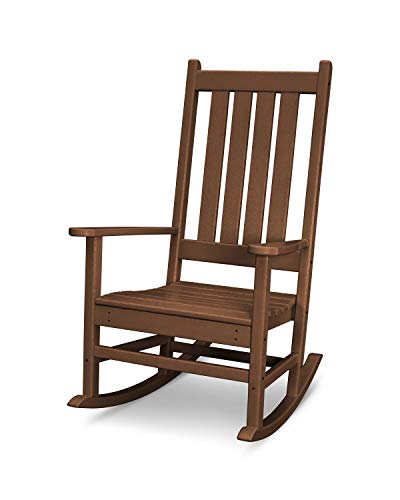
POLYWOOD Vineyard Porch Rocking Chair — Made in USA, Teak — Best Finish Options
The Vineyard takes the same verified formula — HDPE porch rocker, Made in USA in the title — and finishes it in a teak tone for buyers who want the look of a wooden porch without wood’s upkeep. It suits traditional porches, garden seating and anyone furnishing a pair of rockers to flank a front door.
Strengths
- Made in USA stated in the title, in a warm wood-look teak finish
- HDPE build for all-weather outdoor life
- Vineyard styling suits classic porch architecture
Trade-offs
- Wood-look is not wood — the feel and weight differ from a hardwood rocker
- Outdoor format; not an indoor chair
- Dimensions and capacity Not stated in the title
| Detail | Per listing title |
|---|---|
| Origin per title | Origin per title: Made in USA |
| Format | Format: Porch rocking chair |
| Material per title | Material per title: HDPE outdoor construction |
| Colour | Colour: Teak (wood-look finish) |
Finish is the Vineyard’s argument. The teak tone lets a porch keep its traditional palette — warm rails, classic lines — while the material underneath behaves like the modern lumber it is: no sanding weekends, no peeling stain, no rot at the rocker rails where wooden chairs die first. For a pair flanking a door, that consistency also means both chairs weather identically, which natural wood pairs rarely manage.
As with its sibling, the honest trade is tactile. HDPE is dense, cool and uniform; hardwood is warm, varied and alive under the hand. Porch hours are mostly spent sitting rather than stroking the armrest, and on sitting the Vineyard performs the rocker brief completely — but the buyer who dreams in oak should read the reserved slots below and the guide’s advice on shopping the indoor search honestly.
Best for: Traditional porches wanting a wood-look finish with a verified origin and no wood upkeep / Not suited for: Buyers who want genuine hardwood in hand

Suncast Outdoor Patio Rocking Chair — Made in the USA — Best Storage Feature
Suncast’s rocker adds the cleverest practical touch in this guide — storage under the seat — to a Made in the USA title claim and a faux-wood patio design. It suits smaller patios and balconies where the chair must earn its footprint twice: a rocker when you sit, a hiding place for cushions, tools or toys when you do not.
Strengths
- Made in the USA stated in the title
- Under-seat storage is genuinely useful on small patios
- Faux wood styling in light, modern colour options
Trade-offs
- Storage adds a design compromise purists may not want
- Patio format — not a living room rocker
- Dimensions, storage volume and capacity Not stated in the title
| Detail | Per listing title |
|---|---|
| Origin per title | Origin per title: Made in the USA |
| Format | Format: Outdoor patio rocking chair |
| Extras per title | Extras per title: Under-seat storage |
| Style per title | Style per title: Faux wood look; colours Dove Gray and Ice Cube |
Small outdoor spaces punish single-purpose furniture, and this chair’s answer is built in rather than bolted on: a compartment under the seat sized for the small clutter patios accumulate. Cushions during a shower, the watering can, the dog’s outdoor toys — the storage swallows the category of things that otherwise live visibly in corners.
The origin claim is printed in the title in the full Made in the USA form, which is precisely the evidence standard this guide applies — no inference, no flag-waving by association. Combined with the faux-wood look in pale modern colours, the Suncast is the practical household’s verified pick: origin stated, storage included, styling that suits newer homes.
Best for: Small patios and balconies needing a verified-origin rocker that stores its own clutter / Not suited for: Large traditional porches or indoor use

LuxCraft Outdoor Rocking Chair — Amish Made in USA — Best Craft Option
The LuxCraft is the one chair in this guide whose title carries both halves of the heritage story — Amish made and in USA, stated together. It is an ergonomic, oversized outdoor rocker with wide armrests, aimed at buyers who want the craft tradition and the verifiable origin in a single listing, for patio, lawn and yard rocking.
Strengths
- Title states Amish Made in USA — craft tradition and country claim together
- Oversized ergonomic format with wide armrests for long sits
- All-weather outdoor positioning for patio and lawn
Trade-offs
- Outdoor chair — the indoor hardwood search remains unanswered by this pick too
- Oversized format needs a porch or patio that can take it
- Dimensions and capacity Not stated in the title
| Detail | Per listing title |
|---|---|
| Origin per title | Origin per title: Amish Made in USA |
| Format | Format: Outdoor rocking chair for patio and lawn |
| Design per title | Design per title: Ergonomic oversized chair with wide armrests |
| Colours per title | Colours per title: Dove Gray & Black |
This listing matters to the guide’s honesty project as much as to its shopping list: it proves the two claims can coexist in a title when a maker chooses to state them. Amish-made describes who and how; made in USA describes where. Buyers who care about both should demand both, in words — and this chair is what that demand looks like when it is met.
As a chair, the oversized ergonomic brief suits long outdoor sits: wide armrests that take a book and a drink’s worth of elbow, a format scaled for adults who find standard porch rockers pinched. Place it where the evening sun argument is settled — it is a chair that will anchor its spot for years — and it represents the craft end of the verified market at its most complete.
Best for: Buyers wanting Amish craft and a stated USA origin in one verified outdoor rocker / Not suited for: Indoor hardwood seekers or small balconies
Indoor Wooden Rocker, Title-Stated Origin — Buying Brief — No Verified Match
This buying brief covers the product this search’s searchers most imagine: an indoor wooden rocking chair whose title states its American origin. The verification searches behind this guide returned Amish-styled and Amish-made wooden rockers whose titles did not state a country, and imported wooden rockers whose titles stated nothing at all. Neither group can be labelled American made under this guide’s rule. A fresh verification round on 22 November 2026 returned the same picture — Amish-made walnut and mission-style rockers and well-known poly-lumber porch rockers whose titles state no country — so this slot is published as a buying brief, not a pick. ‘Amish’ in a title was not treated as proof of American manufacture in that round either, because the rule is the title’s own words.
Strengths
- Names the exact gap in the market instead of papering over it
- Protects buyers from origin-by-association labelling
Trade-offs
- The imagined product is not currently verifiable on this marketplace
- Buyers must shop this niche with the guide section’s checklist instead
| Detail | Per listing title |
|---|---|
| Status | Status: Checked 22 November 2026 — no verified product |
The Amish-made listings deserve a fair paragraph. Amish furniture making is a real American craft tradition centred in states like Pennsylvania, Ohio and Indiana, and many such chairs are indeed built there. But a guide that prints American made on the strength of a tradition is making a claim the seller did not make — and if a specific chair’s production differed, the reader was misled by us, not by the listing.
Until a wooden indoor rocker’s title states its origin in words, this brief remains what it is: the most honest entry in the guide, and the exact test to apply to any listing you find elsewhere.
Best for: Indoor wooden rocker shoppers who want the exact origin test to apply / Not suited for: Immediate purchase — there is no verified product in this slot
Second Verified Maker — Buying Brief — No Verified Match
A final buying brief, for breadth: a fifth verified maker beyond the outdoor poly-lumber names above — perhaps an indoor chair, a glider rocker, or a wooden porch rocker — whose title states Made in USA or Made in America. Searches for this guide found the claim concentrated in one material category and a handful of brands; competition with stated origins is thinner than the search’s popularity suggests.
Strengths
- Documents the true concentration of the verified market
- Leaves the door open for new makers who state their origin
Trade-offs
- Choice today is four chairs, all outdoor
- Buyers wanting variety must relax either the format or the proof standard
| Detail | Per listing title |
|---|---|
| Status | Status: Checked 22 November 2026 — no further verified maker |
There is a lesson in this slot about how origin marketing works. Brands that manufacture domestically and say so in titles are findable and verifiable; brands that benefit from an American aura without a title claim are asking for trust they have not documented. The four picks here chose documentation. A market that rewarded that choice with purchases would produce more of it — which is the most practical argument for buying by the strict rule.
The fresh 22 November 2026 pass looked again for exactly that title and did not find one. Four honest chairs and two honest briefs are the true shape of this search today.
Best for: Market watchers who want the documented shape of this market / Not suited for: Immediate purchase
Comparison Table
| Pick | Badge | Key spec | Best for |
|---|---|---|---|
| POLYWOOD Estate Rocking Chair — Made in USA, Black | Best Overall | Origin per title: Made in USA | Porches and decks wanting a verified Made in USA rocker with minimal upkeep |
| POLYWOOD Vineyard Porch Rocking Chair — Made in USA, Teak | Best Finish Options | Origin per title: Made in USA | Traditional porches wanting a wood-look finish with a verified origin and no wood upkeep |
| Suncast Outdoor Patio Rocking Chair — Made in the USA | Best Storage Feature | Origin per title: Made in the USA | Small patios and balconies needing a verified-origin rocker that stores its own clutter |
| LuxCraft Outdoor Rocking Chair — Amish Made in USA | Best Craft Option | Origin per title: Amish Made in USA | Buyers wanting Amish craft and a stated USA origin in one verified outdoor rocker |
| Indoor Wooden Rocker — Buying Brief | No Verified Match | Status: Checked 22 November 2026 — no verified product | Indoor wooden rocker shoppers who want the origin test a listing must pass |
| Second Verified Maker — Buying Brief | No Verified Match | Status: Checked 22 November 2026 — no further verified maker | Market watchers who want the true concentration of stated-origin makers |
How to Shop for an American-Made Rocking Chair Without Being Misled
Use the title test this guide used. Read the manufacturer’s own listing title and look for the country claim in words: Made in USA, Made in the USA, Made in America. If the title instead offers Amish made, American design, a heritage brand name or a flag in the photographs, the origin has not been stated — however likely it may seem. Likelihood is not labelling, and your money should follow statements.
Understand what the verified market actually is today: outdoor poly-lumber rockers. HDPE makers print their origin proudly because domestic production is their pitch against imported plastic furniture, and the product genuinely suits the claim — weatherproof chairs for porches, built to sit outside for decades. If that is your use, the four picks are a complete shortlist. If your use is a hardwood rocker by the fireplace, take the title test to the wider market — manufacturer websites and direct workshop sales state origins that marketplace titles often omit — and buy where the statement is made in writing.
Finally, weigh origin alongside the chair itself. A verified American-made chair still needs the right size, a smooth rock and a finish your porch can live with — the titles here state no dimensions or capacities, so verify those on each listing. Origin is a reason to choose between good chairs, not a reason to buy a wrong one.
Why Poly Lumber Dominates the Verified List
It is not an accident that all four verified picks are outdoor HDPE chairs. Poly lumber furniture is a category built by domestic manufacturers as an alternative to imported outdoor furniture, so origin is core to their marketing and appears in their titles. Traditional wooden rocking, by contrast, is split between import brands that state nothing and domestic workshops that sell through channels where the title field is treated casually.
The material also fits the product. A rocker lives at floor level, its rails in contact with porch boards, rain splash and winter frost. HDPE does not rot, peel or need refinishing, so the chair an American maker sells today still looks like their work in fifteen years — which may be the most underrated argument for buying origin-verified in this category at all.
What Made in USA Actually Requires — and What It Does Not Say
The phrase carries a legal meaning in the United States: for an unqualified Made in USA claim, a product must be all or virtually all made in the country — domestic parts and labour, with negligible foreign content. That stringency is exactly why the claim is valuable when a manufacturer prints it in a title, and why this guide insists on the words themselves. A seller using the phrase is making a regulated claim, not a mood. It is also why so many listings avoid it: products with imported components, however American their brand or design, cannot honestly carry the unqualified phrase.
The near-miss phrases each describe a real but smaller truth. Assembled in USA means final assembly happened domestically, with parts of unstated origin. Designed in USA locates the studio, not the factory. Made in USA with US and imported parts is a qualified claim — honest, and different from the unqualified one. Amish made, as this guide’s main sections explain, names a craft tradition and a community of makers, strongly centred in the United States, without stating a country in the listing. None of these phrases is a lie. All of them are different purchases, and a buyer paying for origin should know which one is in the basket.
What the claim does not say also matters. Made in USA is not a quality certification, a safety standard or a warranty; a badly designed chair can be impeccably domestic. The four picks in this guide were chosen as chairs first — porch-worthy, weatherproof, sensibly built — with the origin claim as the search’s defining filter, not as a substitute for judgement. Buy the claim for the reasons it matters to you: supporting domestic manufacturing, shortening supply lines, the accountability of a maker you can name. Those are good reasons. They are reasons about values, and values purchases deserve the most literal verification of all.
Poly Lumber vs Wooden Rockers: An Honest Material Comparison
Since the verified American-made list is entirely poly lumber, the comparison with wood deserves a fair hearing rather than a sales pitch. Wood’s case is sensory and traditional: warmth under the hand, grain that varies chair to chair, a creak and flex that many rockers read as the chair being alive, and a repairable surface — a wooden rocker can be sanded, refinished and re-glued back to youth by a competent owner, indefinitely. A hardwood rocker is also the indoor object: its weight, finish and presence belong by a fireplace in a way no outdoor material imitates.
Poly lumber’s case is operational. HDPE does not absorb water, so it does not rot, swell, peel or feed insects; it does not need paint, stain or sealant; it hoses clean; and its colour runs through the material, so scratches show the same colour rather than a wound. On a porch — where a rocker’s rails sit in rain splash, frost and sun — those properties are not conveniences but the difference between a chair that is maintained and a chair that is simply used. Its costs are tactile uniformity, significant weight, and an end-of-life story that depends on recycling streams rather than a workshop’s offcut bin.
The deciding question is placement and temperament. Indoors, or for the owner who enjoys maintenance as part of ownership, wood wins on everything except the verification problem this guide documents. Outdoors, for the owner who wants the chair ready every evening and forgotten every winter, poly lumber wins on everything except feel. Neither verdict is a defeat — but only one of them currently comes with a title that states its American origin, and pretending otherwise would be the actual disservice.
Porch Placement: Getting Decades Out of an Outdoor Rocker
An all-weather rocker still has a right and wrong place to live. The right place is under some cover — a porch roof, an eave — not because the material fears rain, but because the sitter does: a chair that is dry at sitting time gets sat in, and a chair that must be wiped and waited for gets admired. Face the rocker toward the view the household actually watches — the street’s evening parade, the garden, the water — rather than the architecturally symmetrical spot; rocking is a viewing activity, and chairs placed for photographs lose to chairs placed for sunsets.
Mind the surface beneath. Rocker rails concentrate the chair’s weight and motion into two lines, and on soft decking or painted porches those lines will polish, dent or wear through finishes over seasons. Outdoor rugs or rail pads spread the load and quiet the rock on hard surfaces — a small spend that protects both the porch and the neighbours’ peace. Leave clearance behind for the rock’s travel and in front for feet and passing grandchildren, and the chair becomes what it should be: the fixed point of the porch’s geography.
Seasonal care is brief by design: wash with soap and water when pollen or grime builds, check fasteners annually, and store cushions — if you add them — dry. That is the entire contract. A wooden rocker in the same spot would ask for inspection, sanding and refinishing on a cycle; the poly chairs in this guide ask for a hose. Choose the contract your household will actually honour, because an unhonoured maintenance contract is just a slow way of buying a worse chair.
How This Guide’s Rule Plays Out Across the Wider Market
It is worth being transparent about the searches behind the shortlist, because the pattern they revealed is the most useful thing in the article. Querying the marketplace for rocking chairs with American origin language returns three populations. The first states the claim in the title — the four picks, all outdoor poly lumber. The third population is the mainstream import market, which makes no origin suggestion at all and is priced accordingly.
The interesting question is why the second population stays silent. In some cases the honest answer is probably that production is mixed — domestic workshops using imported components, or a brand whose lines differ in origin model by model — and a title claim would be wrong for part of the range. In others, the silence may be mere listing laziness by makers whose own websites state their production proudly. Either way, the buyer’s move is the same and this guide has modelled it: the claim you can verify is the claim you can buy, and where the marketplace is silent, the manufacturer’s own channel is the place to ask — in writing, before money moves.
Markets respond to what buyers reward. Every purchase made on a verified title claim — and every purchase withheld from an unverified aura — is a small vote for listings that state their facts. The four chairs in this guide earned their places under that discipline; the two open slots are standing invitations for the market to earn more.
Caring for Poly Lumber Across the Seasons
The maintenance contract for HDPE rockers is short, but it is not empty, and honouring it is what converts a twenty-year material into a twenty-year chair. Wash the chair with soap and water when pollen, mildew film or barbecue weather builds up — the material does not stain deeply, so surface cleaning restores it fully, and a soft brush reaches the texture that flat cloths skip. Check the rocker rails’ contact lines each spring: grit ground into the rail’s path will wear both rail and porch, and a rinse of the porch boards under the chair is part of the chair’s care, oddly enough.
Fasteners deserve an annual minute with a screwdriver — outdoor furniture lives through thermal cycles that loosen hardware a fraction at a time, and a rocker announces looseness as a developing wobble that owners adapt to instead of fixing. In winter, the chairs in this guide can stay out; that is their design brief. Owners who store them anyway should store them clean and dry, because a season of storage amplifies whatever was left on the surface. That is the whole liturgy: wash, check, rinse, repeat yearly — the lightest ownership contract in outdoor furniture, and a fair part of why the verified American-made market settled on this material.
The Resale and Heirloom Angle: What Origin Does to a Chair’s Afterlife
A rocking chair is one of the few furniture categories with a genuine afterlife — chairs pass to children, to porches of second homes, to buyers who specifically hunt them. Origin documentation plays a quiet role in that afterlife: a chair whose manufacture is stated and provable carries its story with it, and story is a component of value in every secondhand market that exists. The poly lumber picks complicate the heirloom idea in an interesting way — they will not develop the patina or the repair-history that makes a wooden rocker an heirloom object — but they offer a different longevity: the chair that needs nothing, that a grandchild finds on the porch in the same condition as the day it arrived, is its own kind of inheritance.
Wooden rockers win the traditional afterlife argument outright, which is one more reason the indoor wooden gap in this guide’s verified list matters. A domestically made hardwood rocker, documented, is precisely the object that families keep for generations and that the secondhand market prices with respect. The verification problem is that the marketplace’s titles rarely let a buyer establish that documentation at purchase — which pushes the heirloom-intent buyer, once again, toward makers’ own channels, order confirmations and paperwork kept with the chair. If you buy a wooden rocker for the generations, buy its documents as deliberately as its joinery.
For the four verified picks, the practical advice is simpler: keep the order record that shows the title claim you bought under, register what can be registered, and let the chair’s condition do the rest. A decade of evenings on a porch is a value story no resale listing needs to embellish — and it begins, as this guide began, with a title that said what the chair is.
A Buyer’s Checklist for Origin-First Shopping
Consolidate this guide’s method into the checklist form it was always heading toward. One: find the claim in the title, in words — Made in USA, Made in the USA, Made in America — attached to the specific model and finish you are buying, because claims vary within brands and even within a brand’s colour range. Two: cross-check the listing’s country-of-origin field and the manufacturer’s own product page; three agreeing sources is what certainty looks like in marketplace shopping. Three: file the evidence — a screenshot of the title and the order confirmation — with the chair’s paperwork, so the claim you paid for remains the claim you can show.
Four: verify the chair as a chair with the same rigour — dimensions against your porch, the rock’s travel against your walls, the finish against your climate — because origin is a filter, not a fitting. Five: when the marketplace cannot verify what you want, change channels rather than standards: the maker’s own store, a regional dealer, a workshop’s order book. The indoor wooden rocker with a stated origin exists in the world; it simply does not currently present itself in this marketplace’s titles, and shopping for it where it does present itself is the rational response.
Six, and last: tell the market what you did. Reviews that mention verifying an origin claim, questions on listings that ask for the country in words — these are the signals that teach sellers to state their facts in titles. The four chairs in this guide are what the market currently offers a strict buyer. The checklist is how strict buyers, in aggregate, get offered more.
One Last Distinction: Buying American vs Buying the Claim
A closing precision, because the two are often confused: this guide verified claims, and claims are what marketplaces sell. A buyer whose goal is supporting domestic manufacturing in fact — not in label — should know that the title test is a proxy: a strong one, because the unqualified claim is regulated, but a proxy still. The buyer who wants the fact itself, fully, goes one step further to the maker’s own disclosures, factory information and direct answers. Both buyers are served by starting where this guide started, with the words in the title; they simply stop at different depths of the same diligence.
How to Verify an Origin Claim Before You Buy
- Read the listing title first and find the claim in words. Made in USA or Made in the USA in the manufacturer’s title is the standard this guide applied; anything less specific is not a stated origin.
- Check the listing’s specification and origin fields for a country of origin entry, and compare it with the title. Agreement between the two is what confidence looks like.
- Be precise about near-misses: Amish made states a craft tradition; assembled in USA states a final step, not full manufacture; designed in USA states where the drawings were made. Each may be perfectly honest — none is the claim this search asks for.
- If origin decides the purchase and the marketplace listing is silent, go to the manufacturer’s own site, where domestic makers state their production clearly — and keep a screenshot or the page details with your order records.
- Apply the same discipline after delivery: keep the packaging and documentation that state the origin with your purchase records, so the claim you paid for stays provable.
Five minutes of this checking is the difference between buying an American-made chair and buying an American-flavoured one.
Common Buying Mistakes
Treating Amish made as a country claim. It states a craft tradition, not a country. Some chairs in that tradition are American-built; the title still has not said so. This guide lists such products in its sources, not its picks.
Trusting flag imagery. Photographs, brand names and heritage styling are not origin statements. Only words in the title or specifications commit the seller.
Assuming all POLYWOOD-style chairs state their origin. Even within one brand, read each title: the Estate and Vineyard listings here state Made in USA; another model in the same searches did not, and was not picked.
Skipping dimensions because the origin checked out. These titles state no sizes or capacities. Verify fit on the listing — a verified origin does not make a wrong-sized chair right.
Expecting an indoor hardwood shortlist that the market has not documented. The verified marketplace market is outdoor poly lumber. For indoor wood with a stated origin, shop makers’ own channels with the title test in hand.
Confusing assembled or designed with made. Each phrase describes a different share of the work happening domestically. Know which claim you are paying for.
Final Recommendation
The verified shortlist is four chairs: the POLYWOOD Estate as the all-round porch answer, the Vineyard for a wood-look finish, the Suncast for small patios that need its under-seat storage, and the LuxCraft for buyers who want Amish craft and a stated USA origin in the same title. All four are outdoor HDPE rockers, because that is where title-stated American manufacture verifiably lives in this market today.
The two open slots are the guide’s promise kept: no chair was labelled American made on association, styling or hope. Check price on Amazon on the exact finish, verify the unstated dimensions on the listing — and if you shop beyond this list, take the title test with you.
Best Rocking Chairs That Are American Made Best Rocking Chairs For Newborn Best Outdoor Rocking Chairs Plastic Best Chairs For A Dock Best Rocker Recliner Chairs Camo
Frequently Asked Questions
Why are there only four picks instead of six?
Because only four listing titles verified for this guide state Made in USA or Made in the USA in words. The other two slots are buying briefs rather than chairs whose origin is implied by styling or tradition but never stated — a fresh check on 22 November 2026 confirmed that position.
Does Amish made mean American made?
Not as a title claim. Amish-made describes a craft tradition strongly associated with American workshops, but the country is not stated in those titles, so this guide records such chairs in its sources instead of labelling them American made.
Are all four picks outdoor chairs?
Yes — all four verified picks are all-weather HDPE or poly outdoor rockers. That is where title-stated American manufacture is concentrated in the current marketplace. Indoor wooden rockers with a stated origin could not be verified.
Is HDPE a good rocking chair material?
For outdoor use it is arguably the most practical: it does not rot, peel or need refinishing, and it tolerates rain and frost that age wooden rails. It feels different from wood — denser and cooler — which is a preference to weigh, not a flaw.
How can I verify a chair’s origin myself?
Read the title for the claim in words, cross-check the listing’s country-of-origin field, and if the marketplace is silent, check the manufacturer’s own site. Keep the documentation with your order records.
Do the titles state dimensions or weight capacities?
No — all four picks leave those unstated in their titles. Verify both on the current listing before ordering, especially for porch fit and for larger users.


