Disclosure: airfryerkitchensupply.com is reader-supported. When you buy through links on our site, we may earn an affiliate commission at no extra cost to you.
Where to buy
Our verified shortlist of the best rocking chairs for newborn starts with the buying links in this section.
Every chair below was verified feed for this site, and certifications are quoted only where the manufacturer’s title itself states them. One safety point before any shopping: these are chairs for adults holding a baby. A baby sleeps in a crib or bassinet, on their back, on a firm flat surface — never asleep on an adult in a chair, where an adult dozing off creates a real suffocation risk. Check price on Amazon on the exact chair and finish.
- Babyletto Kiwi Electronic Power Recliner & Swivel Glider — check price on Amazon
- Carter’s by DaVinci Arlo Recliner — Cozy Cream — check price on Amazon
- Evolur Raleigh Upholstered Manual Glider Recliner — check price on Amazon
- Storkcraft Premium Hoop Glider & Ottoman — Espresso/Gray Swirl — check price on Amazon
- Korser 360° Rocking Chair — Nursery Rocker with Side Pockets — check price on Amazon
- Costzon Nursery Glider with Ottoman — check price on Amazon
The best rocking chairs for newborn care are, to be precise, chairs for the adults doing the caring: a place to feed, burp, soothe and rock a newborn through the day and the long night, with motion smooth enough to settle a baby and support strong enough to hold a tired parent safely for the thousandth hour. The baby in this picture is always in your arms or in a safe sleep space — because the safety rule that outranks every product in this guide is simple: newborns sleep in a crib or bassinet, on their backs, and never asleep on an adult in a chair.
That rule shapes the recommendations rather than limiting them. A great nursery chair earns its place on feeding comfort — arm height that supports your elbow during bottle or breast feeds, a back you can lean into at 3 a.m., motion that starts and stops without a jolt — and on certifications the manufacturer states in its own title, such as the GREENGUARD Gold and CertiPUR-US claims quoted exactly where they appear below. No chair here is called safe for a newborn as a product claim, because chairs are furniture; safety comes from how and where the baby sleeps.
The six verified picks split into classic glider-and-ottoman sets, modern swivel glider recliners with stated certifications, and compact rockers for small nurseries. Each review covers the night-feed reality — noise, motion smoothness as described, cleaning, and how the chair treats a half-asleep adult — alongside the usual strengths and trade-offs.
In this guide
Quick Picks
- Babyletto Kiwi Electronic Power Recliner & Swivel Glider — Best Overall: check price on Amazon
- Carter’s by DaVinci Arlo Recliner — Cozy Cream — Best Certified Glider Recliner: check price on Amazon
- Evolur Raleigh Upholstered Manual Glider Recliner — Best Manual Certified Option: check price on Amazon
- Storkcraft Premium Hoop Glider & Ottoman — Espresso/Gray Swirl — Best Classic Glider Set: check price on Amazon
- Korser 360° Rocking Chair — Nursery Rocker with Side Pockets — Best for Small Nurseries: check price on Amazon
- Costzon Nursery Glider with Ottoman — Best Value Glider Set: check price on Amazon
How These Picks Were Chosen
Candidates were verified by brand and model; a chair earned its link only on an exact title match. Children’s rocking chairs — small chairs sized for toddlers — were excluded, because this search is about the adult caregiver’s chair. Slipcovers and covers sold alone were likewise excluded as accessories, not chairs.
Ranking weighed the caregiving ergonomics first: glide or rock smoothness as the format implies, arm and back support for feeding, and whether the chair also reclines or swivels for the many non-feeding hours it will serve. Stated certifications were recorded exactly as titles print them. Dimensions and capacities appear only where titles state them — mostly they do not, and the reviews say so.
The 6 Best Rocking Chairs for Newborn Care

Babyletto Kiwi Electronic Power Recliner & Swivel Glider — Best Overall
The Kiwi is the modern nursery flagship: powered recline — no pushing against a manual mechanism while holding a baby — combined with a swivel glide, in a water and stain resistant fabric, with GREENGUARD Gold and CertiPUR-US certifications stated in its title. It suits the parent who will live in this chair for months and wants the adjustments to happen by button.
Strengths
- Power recline works one-handed — the hand that is not holding the baby
- GREENGUARD Gold and CertiPUR-US certifications stated in the manufacturer’s title
- Water and stain resistant fabric is the right spec for milk, spills and worse
Trade-offs
- Power means an outlet, a cord to route safely, and a motor’s cost
- Electronic mechanisms need the smooth, quiet operation checking on day one
- Title states no dimensions or capacity — Not stated
| Detail | Per listing title |
|---|---|
| Format | Format: Electronic power recliner and swivel glider |
| Certifications per title | Certifications per title: GREENGUARD Gold & CertiPUR-US Certified |
| Fabric per title | Fabric per title: Water and stain resistant |
| Colour | Colour: Beach |
Powered recline sounds like luxury until the first week of night feeds, when it reveals itself as logistics. A manual recliner needs a push from legs or back — precisely the limbs busy holding a sleeping baby you are trying not to wake. A button moves the chair while your body stays still, and the transfer from feeding upright to resting reclined happens without the jolt that restarts the whole soothing process.
The fabric and certifications complete a thoughtfully aimed product. Water and stain resistance will be tested by milk in week one, not hypothetically. GREENGUARD Gold addresses emissions from the chair’s materials — relevant in a small, closed nursery — and CertiPUR-US covers the foam. Both are quoted here exactly as the title states them; together they make this the most completely specified nursery pick in the guide.
Best for: Parents wanting powered, one-handed adjustment and stated certifications / Not suited for: Nurseries with no safe outlet position, or buyers avoiding electronics

Carter’s by DaVinci Arlo Recliner — Cozy Cream — Best Certified Glider Recliner
The Arlo combines the three motions a nursery chair can offer — glide, recline and a full 360-degree swivel — in a cream upholstered design with GREENGUARD Gold and FSC certifications stated in the title. It suits parents who want one chair to handle feeding, soothing and the toddler-story years that follow the newborn months.
Strengths
- Glide plus recline plus swivel covers every caregiving motion in one chair
- GREENGUARD Gold and FSC certifications stated in the title
- Neutral cream finish fits most nursery schemes and later rooms
Trade-offs
- Cream upholstery will meet milk and baby food — plan cleaning from day one
- Title does not state water or stain resistance — Not stated
- Dimensions and capacity are Not stated in the title
| Detail | Per listing title |
|---|---|
| Format | Format: Glider recliner nursery chair with 360-degree swivel |
| Certifications per title | Certifications per title: GREENGUARD Gold & FSC Certified |
| Colour | Colour: Cozy Cream |
Motion choice is personal in a way few product categories are: some babies settle to a glide’s linear travel, some to a rock’s arc, and parents discover their baby’s preference at 2 a.m., not in a showroom. A chair combining glide with recline and swivel hedges that discovery — and the swivel quietly becomes the most-used feature, turning you toward the crib, the door and the side table without standing up mid-feed.
The FSC certification, stated alongside GREENGUARD Gold in the title, speaks to responsibly sourced wood in the frame’s supply chain — a values detail many nursery buyers actively seek. Paired with the emissions certification, the Arlo’s paperwork is the most complete here for buyers who shop certifications first. Just budget the cream fabric the respect it demands: a washable throw over the seat from the first week is cheaper than regret.
Best for: Certification-focused parents wanting glide, recline and swivel in one chair / Not suited for: Anyone who cannot face cream upholstery near newborn feeding
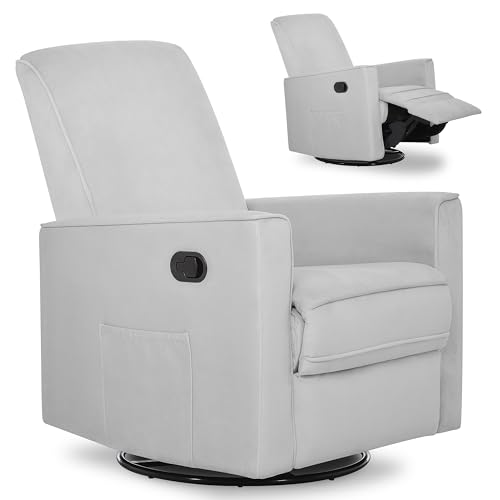
Evolur Raleigh Upholstered Manual Glider Recliner — Best Manual Certified Option
The Raleigh offers the Arlo’s motion set — glide, rock, swivel, recline — with a manual mechanism instead of electronics, plus GREENGUARD Gold and FSC certifications in its title and a forgiving grey finish. It suits parents who want certifications and full motion without a motor, a cord or a power bill of surprises.
Strengths
- Full motion set with no electronics to fail or plug in
- GREENGUARD Gold and FSC certifications stated in the title
- Grey upholstery hides the evidence of newborn life better than cream
Trade-offs
- Manual recline needs a push — harder mid-feed with a sleeping baby in arms
- Smooth glide is the title’s wording; test the feel in the first days at home
- Dimensions and capacity Not stated in the title
| Detail | Per listing title |
|---|---|
| Format | Format: Manual glider recliner with rocking and 360-degree swivel |
| Motion per title | Motion per title: Smooth glide |
| Certifications per title | Certifications per title: GREENGUARD Gold & FSC Certified |
| Colour | Colour: Grey |
Manual mechanisms have a real argument in a nursery: silence by design, no motor hum at the exact moment a baby drops off, and nothing to stop working in year three. The Raleigh leans on that argument while keeping the certifications and the swivel that make modern nursery chairs so usable — a combination for parents who distrust nursery electronics on principle.
The cost is the mid-feed adjustment problem the Kiwi solves by button: changing a manual recline position while holding a baby takes choreography. Experienced parents pre-set the chair before picking the baby up, and treat the recline as a between-feeds setting rather than a during-feed one. If that rhythm sounds workable, the Raleigh’s simplicity is a feature; if it sounds like friction, buy the power chair.
Best for: Parents wanting certified materials and full motion without electronics / Not suited for: Anyone who needs one-handed position changes during feeds

Storkcraft Premium Hoop Glider & Ottoman — Espresso/Gray Swirl — Best Classic Glider Set
The Hoop glider is the classic nursery formula — a solid-wood glider with a matching gliding ottoman, storage pockets for the feeding kit, and a GREENGUARD Gold certification stated in its title. The ottoman deserves its billing: feet up changes feeding posture completely, and a gliding ottoman moves with the chair instead of anchoring your legs.
Strengths
- Matching gliding ottoman included — the feeding-posture upgrade most chairs charge extra for
- GREENGUARD Gold certification and solid wood craftsmanship stated in the title
- Storage pockets keep bottles, cloths and the phone within arm’s reach
Trade-offs
- No recline and no swivel — the classic format keeps to glide alone
- Two-piece footprint needs more nursery floor than a single chair
- Dimensions and capacity Not stated in the title
| Detail | Per listing title |
|---|---|
| Format | Format: Glider with matching ottoman |
| Certification per title | Certification per title: GREENGUARD Gold Certified |
| Build per title | Build per title: Solid wood craftsmanship; storage pockets |
| Colour | Colour: Espresso with Gray Swirl |
Generations of parents have fed babies in glider-and-ottoman sets because the formula solves the actual problems: a smooth enclosed glide that cannot trap tiny fingers the way open rocker rails can concern parents about, an ottoman that lets the feeder’s legs rest at the right height, and pockets because the thing you need is always on the other side of the room. The Hoop executes that formula with a stated emissions certification on top.
Its limits are the classic format’s limits. There is no recline for the parent’s own rest between feeds, and no swivel for turning toward the crib. Households choosing the Hoop are choosing feeding ergonomics and simplicity over multi-function — a defensible, even wise, trade for the newborn months specifically, with the chair later graduating to a reading corner.
Best for: Parents wanting the classic ottoman-included feeding setup with stated certification / Not suited for: Anyone needing recline or swivel in the nursery chair

Korser 360° Rocking Chair — Nursery Rocker with Side Pockets — Best for Small Nurseries
The Korser is the compact answer: a 360-degree rocking glider chair on a steel structure base, with side pockets, that its own title positions as a small chair for small spaces. It suits the box-room nursery, the corner-of-the-bedroom setup, and any home where the flagship gliders simply do not fit the floor plan.
Strengths
- Compact format the title itself aims at small spaces
- Steel structure base and full 360-degree movement
- Side pockets keep the feeding kit on the chair, not the floor
Trade-offs
- Compact means a narrower sit — larger parents should weigh the fit carefully
- No certifications are stated in the title — Not stated
- No recline; dimensions and capacity Not stated in the title
| Detail | Per listing title |
|---|---|
| Format | Format: 360-degree rocking chair / glider nursing chair |
| Build per title | Build per title: Steel structure base |
| Extras | Extras: Side pockets |
| Positioning per title | Positioning per title: Small chair for small spaces |
Small nurseries are the norm, not the exception, and the big certified gliders can consume a box room’s entire floor. A chair designed small from the start — rather than a big chair squeezed in — keeps the room usable: space for the crib, the changing surface and an adult moving safely in the dark with a baby in their arms. That last point is a safety feature in itself, even though no listing will ever phrase it that way.
The trade-offs are honestly listed: no stated certifications, no recline, and a seat that smaller adults will find cosy and larger adults may find confining. For the household it targets — small room, feeding and soothing as the whole brief — the Korser covers the brief at the right scale, with pockets and steel underneath.
Best for: Small nurseries and bedroom-corner feeding stations / Not suited for: Larger parents, or buyers requiring stated certifications

Costzon Nursery Glider with Ottoman — Best Value Glider Set
The Costzon pairs an upholstered glider with its ottoman on a solid wood base, with padded cushioning and a storage pocket — the classic set formula in a value-tier package. It suits grandparents’ houses, second nurseries and budget-first setups where the ottoman matters and the budget is real.
Strengths
- Glider plus ottoman as one set — no accessory purchase needed
- Solid wood base and padded cushioning per the title
- Storage pocket for the feeding essentials
Trade-offs
- No certifications are stated in the title — Not stated
- No recline or swivel in this classic format
- Dimensions and capacity Not stated in the title
| Detail | Per listing title |
|---|---|
| Format | Format: Upholstered glider rocker with ottoman |
| Build per title | Build per title: Solid wood base; padded cushion |
| Extras | Extras: Storage pocket |
Second-location chairs are an under-discussed newborn reality: the grandparent’s spare room, the downstairs corner for daytime feeds. A value glider set serves those spots properly — real glide, real ottoman, real padding — without flagship money, and the solid wood base keeps the motion honest rather than wobbly.
Set expectations by the tier: upholstery and finish will not match the premium certified chairs, and the title states no certifications, which buyers who prioritise them should weigh. For a chair whose job is daytime feeds and grandparent rocking duty, the Costzon’s formula is the right spend — money saved here buys the crib, which is where the baby actually sleeps.
Best for: Grandparents’ homes, second nurseries and budget-first setups / Not suited for: Certification-first buyers or anyone needing recline
Comparison Table
| Pick | Badge | Key spec | Best for |
|---|---|---|---|
| Babyletto Kiwi Electronic Power Recliner & Swivel Glider | Best Overall | Format: Electronic power recliner and swivel glider | Parents wanting powered, one-handed adjustment and stated certifications |
| Carter’s by DaVinci Arlo Recliner — Cozy Cream | Best Certified Glider Recliner | Format: Glider recliner nursery chair with 360-degree swivel | Certification-focused parents wanting glide, recline and swivel in one chair |
| Evolur Raleigh Upholstered Manual Glider Recliner | Best Manual Certified Option | Format: Manual glider recliner with rocking and 360-degree swivel | Parents wanting certified materials and full motion without electronics |
| Storkcraft Premium Hoop Glider & Ottoman — Espresso/Gray Swirl | Best Classic Glider Set | Format: Glider with matching ottoman | Parents wanting the classic ottoman-included feeding setup with stated certification |
| Korser 360° Rocking Chair — Nursery Rocker with Side Pockets | Best for Small Nurseries | Format: 360-degree rocking chair / glider nursing chair | Small nurseries and bedroom-corner feeding stations |
| Costzon Nursery Glider with Ottoman | Best Value Glider Set | Format: Upholstered glider rocker with ottoman | Grandparents’ homes, second nurseries and budget-first setups |
How to Choose a Rocking Chair for Newborn Care
Start with the safety frame, because it outranks every feature: the chair is for you. Your newborn sleeps in a crib or bassinet meeting current safety standards, on their back, on a firm flat mattress with nothing soft in the sleep space. Never plan to sleep holding the baby in the chair — adult sleep plus a newborn on a chest or in an arm is a recognised suffocation risk, and it is the reason night-feed chairs should be comfortable enough to enjoy awake, in a room where you can put the baby down safely the moment you feel yourself drifting.
With that fixed, choose the motion. Gliders move in a flat, enclosed linear path — smooth, quiet, and with no exposed rocking rails. Rockers arc, which some babies prefer and some parents find more tiring over a long feed. Swivel earns its keep daily, turning you to the crib and the side table. Recline serves the parent’s rest between feeds. Try to match the motion set to your real routine: feeding, soothing, resting, in that order of hours.
Then read the title like this guide does. Certifications — GREENGUARD Gold for emissions, CertiPUR-US for foam, FSC for wood sourcing — appear in these listings’ own titles and are quoted verbatim; a chair whose title states none may still be fine furniture, but you are buying it without that paperwork. Fabric practicality is the last filter: milk finds every chair, so water and stain resistance, removable covers or a sacrificial washable throw are not luxuries in this category.
Setting Up the Feeding Station
The chair is the centre of a station, not a solo purchase. Place it within arm’s reach of a side surface for bottles, water for the adult — feeding parents dehydrate heroically — and the cloth that is always needed. Keep the path from chair to crib clear and night-visible: you will walk it half-asleep, carrying the baby, hundreds of times.
If the chair is powered, route its cord along the wall where it can never cross the walking path or the chair’s own mechanism. If it has pockets, stock them once — cloths, a spare onesie, the night-light remote — and the station starts working for you instead of the other way round.
Glide, Rock, Swivel: Matching Motion to Your Baby and Your Nights
Parents shop motion by name — glider, rocker — but babies respond to motion by feel, and the three motions in this guide feel genuinely different. A glide travels in a flat line, back and forth, with an even rhythm that never changes height; it is the motion of a train seat, and it suits babies who settle to steadiness. A rock arcs, rising and dipping slightly with each cycle; it is the motion of arms and of porches, and some babies who resist the glide melt into the arc. Neither preference is predictable before the baby arrives, which is a real argument for chairs that combine motions, or for buying the motion you yourself can sustain happily for an hour — because the adult’s endurance is half the system.
Swivel is the motion nobody shops for and everybody uses. Feeding life is a triangle — chair, crib, side table — and a swivel chair rotates through that triangle without the stand-sit cycle that wakes babies and exhausts parents. It also turns the chair toward conversation, toward the door, toward the window light for a morning feed. When this guide ranks chairs with swivel highly, it is on the testimony of that triangle: the feature sounds like a gimmick in a listing and behaves like infrastructure in a nursery.
Recline is the parent’s motion, for the hours that are not feeding: the between-feeds rest, the contact-nap-that-must-not-become-sleep vigilance, the evening wind-down while the baby is safely in the crib. Judge it by how it operates with full arms — the powered Kiwi’s button against the manual chairs’ pre-set positions — and remember the safety frame that governs all of it: recline is for an awake adult. The moment sleep approaches, the baby goes to the crib and the chair’s job is done.
The 3 A.M. Test: What Actually Matters in a Night Feed
Every nursery chair should be reviewed at 3 a.m., because that is its workplace. Noise first: a mechanism that clicks, a glide that squeaks, a motor that hums at the exact pitch that surfaces a sleeping baby — these are failures no daytime showroom reveals. The chairs here were chosen partly on format reputation for quiet — enclosed glides, smooth swivels — but the honest advice is to test your delivered chair through a full motion cycle in a silent room on day one, while returns are easy, and to treat any developing squeak in the first months as a warranty conversation, not a lullaby.
Light and reach come next. The night feed runs on the least light possible, so the chair’s station — side table, supplies, water — must be findable by touch, in the same places every night. Pockets on the chair, like the Storkcraft’s and Korser’s, are 3 a.m. features disguised as storage. And the adult’s own state is the third factor: a chair that supports your back and arms properly is not indulgence at 3 a.m., it is what keeps your hold secure and your posture safe through a drowsy half hour. Tired arms are a safety topic, and this category should say so plainly.
Finally, the exit. The feed ends with the most delicate manoeuvre in parenting — standing up with a sleeping baby and walking to the crib. Chairs that help are chairs with arms at a height you can push from, a motion that stops dead when you stop it, and a clear, memorised path to a crib placed a few steps away. When you arrange the nursery, rehearse that walk empty-handed in the dark. The chair is half the system; the room is the other half.
After the Newborn Months: The Chair’s Second Life
A nursery chair’s intensive service lasts perhaps eighteen months; its life should last a decade, and the second life is worth planning at purchase. The toddler years extend the first: stories in the chair, settling after nightmares, the sick-day rock. Chairs with swivel and recline — the Kiwi, the Arlo, the Raleigh pattern — handle a wriggling toddler and a picture book more gracefully than fixed gliders, because the adult can angle toward the light and the child can climb into a stable, low-armed seat.
Beyond that, the chair graduates. Neutral finishes — the Arlo’s cream, the Raleigh’s grey, the Kiwi’s beach tone — were chosen by their makers for exactly this migration, into a bedroom corner, a reading nook, a guest room. Classic gliders like the Storkcraft become the chair grandparents keep. The buying implication is unfashionable but sound: in this category, boring colours and standard silhouettes are features, because the chair will outlive the nursery scheme by years and should not have to apologise for existing in the next room it serves.
Resale and handing-down complete the picture. Certified, well-kept nursery chairs from recognised makers hold value in a way anonymous chairs do not, and they pass between siblings and cousins as a matter of course. Keep the assembly instructions, the certification paperwork the titles advertise, and a note of the purchase date with the chair. The newborn months feel endless at 3 a.m. and brief by the first birthday — buy the chair for both truths.
What Certifications Do and Do Not Cover
Three certification names recur in this guide’s titles, and each covers a different slice of a chair. GREENGUARD Gold, stated by the Babyletto, the Arlo, the Raleigh and the Storkcraft Hoop, certifies low chemical emissions from the finished product — the air-quality slice, tested to thresholds intended for sensitive environments and occupants. CertiPUR-US, stated by the Babyletto, certifies the foam inside: its content, emissions and durability standards. FSC, stated by the Arlo and Raleigh, certifies that wood in the supply chain comes from responsibly managed sources — a sourcing claim, not a product-safety one.
What none of them certifies is the thing new parents most want certified: that a chair is safe for a baby. No such certification exists for furniture of this kind, because the safety of a nursery chair is a property of its use — an awake adult, a supported hold, a baby who sleeps in a crib — rather than of its materials. A guide or a listing that implied otherwise would be selling reassurance it cannot mint. The certifications are worth having and worth paying for, on their actual merits: cleaner air in a small room, accountable foam, responsible wood. Buy them for what they say, in the words the titles use.
Practical follow-through: certifications attach to specific products and finishes, and they are maintained over time. The titles quoted here state them plainly, which is the strongest form a marketplace gives you; keep the product documentation on delivery, and you hold the same evidence this guide relied on.
Twins, Second Babies and the Chair That Has to Work Harder
Everything in this guide is written for one baby and one adult, and households with twins — or a newborn and a toddler — should adjust two assumptions. The first is width and stability: feeding two, or feeding one while a toddler climbs to join, rewards the widest, most planted chairs and punishes narrow novelty formats; the glider-and-ottoman sets and the substantial recliners carry this load more gracefully than compact rockers, and the compact Korser’s small-space virtue becomes a constraint. The second is motion discipline: with more arms full more of the time, powered adjustment stops being a luxury entirely, and the Kiwi’s button-operated recline becomes the category’s most defensible premium.
The safety frame tightens rather than changes. More babies means more transfers, more fatigue, and more moments where the crib rule does its quiet work: each baby sleeps in their own safe sleep space, every time, however full the adult’s arms and however deep the night. A chair that serves a multiples household well is one that makes the awake hours sustainable — support, pockets, washable surfaces — so that the adults can keep the safe routine without heroics. Buy for endurance, and let the cribs do the sleeping.
Partners, Shifts and the Economics of Night Feeds
Nursery chairs are usually discussed as if one parent does every feed, and households that share the nights should shop differently. A shared chair serves two bodies of different sizes, in the dark, in relay — which elevates exactly the features this guide has been quietly ranking: a swivel that turns toward whichever side the next task waits on, arms at a height that suits the average of two people rather than the perfection of one, and adjustments that can be made silently and instantly, because a mechanism that needs two hands and a manual is a mechanism the night shift will stop using. Powered chairs win this household outright; manual chairs serve it when their positions are pre-set and their motion is smooth enough to need no mid-feed changes.
The shift system itself deserves the chair’s help. Households that split the night — one parent on duty until two, the other after — sleep better and resent less, and the chair is the duty station: stocked the same way for both, with the light, the supplies and the handover notes in their places. The chair’s pockets and side table stop being conveniences in this system and become the protocol that lets a half-awake handover happen without waking the baby or fully waking the off-duty parent. Set the station up once, together, in daylight, and the nights run on rails the chair provides.
And a word for the household’s economics, because newborn spending competes: the crib, the feeding supplies and the car seat are non-negotiable spends, and the chair is the largest discretionary one in the nursery. This guide’s spread — from the Costzon’s value set to the Kiwi’s powered flagship — exists because both ends are defensible. What is not defensible is the reverse allocation: a flagship chair beside a compromised sleep space. The baby sleeps in the crib; the adult sits in the chair; fund them in that order, and let the chair be as good as what remains allows. It will still be the best seat in the house at 3 a.m.
Grandparents, Visitors and the Spare Chair Question
Newborns attract an audience, and the audience needs somewhere to sit — ideally not in the feeding chair, which should stay set up, stocked and reserved for the work it does. Households with space solve this with the second-location chair this guide’s value pick serves: a glider at the grandparents’ house or in the living room, where visitors can rock the baby under supervision during the day and the primary station stays undisturbed for the night. Households without space solve it with a rule instead: the nursery chair is a workstation, guests hold the baby on the sofa, and nobody has to rebuild the feeding station at midnight because a well-meaning visitor rearranged it at noon.
Grandparents deserve a specific word, because they will do real hours in whatever chair is provided, often with backs and knees that have their own opinions. A chair with a higher seat, firm arms to push up from and a smooth, predictable motion serves an older body better than the deep, low, ultra-soft formats young parents gravitate toward. If one chair must serve both generations, the classic glider sets in this guide — upright, armed, ottoman-supported — are the diplomatic choice, and the conversation about it is worth having before the baby arrives rather than after the first sore morning.
The thread through all of it is the same as the thread through this whole article: the chairs serve the adults, the adults serve the baby, and the baby sleeps in the crib. Arrange the furniture for that chain, and the newborn months — loud, broken, brief — run as smoothly as they ever run.
How to Rock and Feed Safely, Hour After Hour
- Set the chair before you pick up the baby: position, ottoman or footrest placed, supplies on the side table, so no adjustment needs a free hand you do not have.
- Sit back fully so the chair’s back carries you, with your feeding arm supported by the armrest or a cushion at elbow height — an unsupported arm aches within minutes and tenses the whole feed.
- Hold the baby close and supported in your arms for feeding and soothing, following your midwife’s or paediatrician’s guidance on feeding positions, and burp the baby upright against your shoulder as advised.
- Use the chair’s motion gently and steadily; if the baby falls asleep in your arms, that is the cue for the transfer — into the crib or bassinet, on their back, in the clear sleep space — not for settling deeper into the chair together.
- If you feel yourself drifting during a night feed, stand up, put the baby down safely, and reset with light, water and movement. A crying baby in a safe crib for two minutes is always safer than a sleeping baby on a sleeping adult.
- After feeds, wipe spills from the upholstery promptly — milk sours in fabric — and keep a washable throw over the seat during the messiest weeks.
The chair’s job is to keep the awake adult comfortable and supported. The crib’s job is sleep. Keeping those jobs separate is the whole safety story of this category.
Common Buying Mistakes
Planning to sleep in the chair with the baby. The most dangerous mistake in this category. Adults who doze holding a newborn create a real suffocation risk. Feed, soothe, then transfer the baby to the crib — every time.
Buying a child’s rocking chair by mistake. Search results mix toddler-sized rockers into this search. This guide excludes them: the chair must be sized and built for the adult caregiver.
Choosing motion by the photograph. Glide, rock and swivel feel different at 3 a.m. than they look at noon. Match the motion set to feeding and soothing, and value smoothness over novelty.
Ignoring fabric practicality. Milk, spit-up and worse are certainties. Water-resistant fabric, removable covers or a washable throw are functional requirements, not upgrades.
Overvaluing certifications — or ignoring them entirely. Stated certifications like GREENGUARD Gold are real information about materials and emissions. A title that states none is not condemned, but the difference should be a conscious part of the decision.
Letting a power cord cross the room. Nursery floors are walked barefoot, in the dark, carrying a baby. Route cords along walls, always, and keep the chair-to-crib path completely clear.
Final Recommendation
For most nurseries the Babyletto Kiwi is the complete answer: powered one-handed recline, swivel glide, stain-resistant fabric and both certifications stated in its title. The Carter’s by DaVinci Arlo matches it on certification and adds a full swivel for parents who prefer its manual-friendly format, while the Evolur Raleigh keeps the certifications and drops the electronics. Classicists get the Storkcraft Hoop’s ottoman set, small rooms get the Korser, and grandparents get the Costzon’s honest value.
Whichever chair you choose, set it up as a feeding station, keep the crib as the only sleep plan, and check price on Amazon on the exact finish — the newborn months are short, intense, and much better in a good chair.
Best Rocking Chairs For Newborn Best Chairs To Nurse Babies Best Nursery Area Rugs Best Rocking Chairs For Bad Backs Best Rocker Recliner Chairs Camo Best Rocking Chairs That Are American Made
Frequently Asked Questions
Is it safe for my newborn to sleep in the rocking chair with me?
No. Babies should sleep in a crib or bassinet, on their backs, on a firm flat surface with a clear sleep space. Sleeping while holding a baby in a chair is a recognised suffocation risk — always transfer a sleeping baby to their crib.
Glider or rocker for a nursery?
Gliders move in a smooth, enclosed linear path and are the classic nursery choice; rockers move in an arc some babies prefer. Both work — the better question is which motion soothes your baby and tires you less over a long feed.
What does GREENGUARD Gold mean on these chairs?
It is a certification, stated in several titles here, covering low chemical emissions from the product’s materials — relevant in a small nursery where a baby and a tired parent breathe the air for hours. CertiPUR-US similarly certifies foam, and FSC certifies wood sourcing.
Do I need the ottoman?
For feeding posture, it is one of the most useful extras in this category: feet supported changes how your back and arms hold up through a feed. Gliding ottomans move with the chair; two picks here include one in the set.
Power or manual recline for night feeds?
Power reclines at a button press while your arms stay still — a genuine advantage mid-feed. Manual chairs are simpler, silent and cord-free, but need pre-setting before you pick the baby up. Both patterns work; choose for your own nights.
How long will a nursery chair be used?
Intensively through the newborn and infant months, then for stories and settling through the toddler years. Chairs with swivel and recline tend to graduate into general family use; classic gliders often become reading chairs.


