Disclosure: airfryerkitchensupply.com is reader-supported. When you buy through links on our site, we may earn an affiliate commission at no extra cost to you.
Where to buy
All six chairs in this guide to the best office chairs for kids are sold on Amazon, and every one is a genuine children’s desk chair — stated as a kids, children or student chair in its listing, never an adult chair described as small. Use the links to check current prices and confirm age and size details on the product page before ordering.
- VIVO Children’s Height Adjustable Desk Chair (Gray) — check price on Amazon
- GIANTEX Kids Desk Chair (Purple) — check price on Amazon
- Primy Kids Desk Chair (Pink) — check price on Amazon
- chirvana Kids Desk Chair (Deer, Blue) — check price on Amazon
- HONEY JOY Kids Desk Chair (Purple) — check price on Amazon
- Ergonomic Kids Desk Chair (Ages 3-12) — check price on Amazon
The best office chairs for kids are not small office chairs. They are chairs designed around growing bodies: lower seat heights so feet reach the floor, adjustability that extends the chair’s life across growth spurts, footrests that give short legs somewhere to rest, and sizes that fit a child’s proportions at a child’s desk. Every pick in this guide is stated as a kids, children or student chair in its own listing — that was the entry rule, applied without exceptions.
Why does the distinction matter? A child in an adult chair sits with feet dangling, perched on the front edge, back nowhere near the backrest — a posture that guarantees fidgeting and quietly teaches slouching. A proper kids’ chair lets feet rest flat, supports a smaller back at the right height, and adjusts upward as its owner grows, which is why the listings here emphasise height adjustment, footrests and stated age ranges.
The six picks cover the realistic range: a workstation-style chair from VIVO, an armless mesh study chair, a pink height-adjustable chair with a stated age range, an ergonomic deer-model chair with a footrest, a mesh chair with adjustable arms and footrest, and a breathable chair stating ages 3 to 12. Match the chair to your child’s age, desk height and how long it needs to last.
A note on what a good kids’ chair does for homework, because it is easy to overclaim. A chair will not create concentration, and no parent should buy one expecting transformed study habits. What the right chair does is remove the physical reasons a child leaves the desk: feet aching from dangling, a back unsupported, a seat edge digging in. Children fidget for many reasons, but discomfort is the one a purchase can actually fix — and a child who is physically settled has one less obstacle between them and the work.
Key Takeaways
- Every pick is a stated children’s chair — kids, children or student positioning in the listing itself. No small adult chairs.
- Feet supported is the whole game: floor, or the chair’s footrest. Dangling feet cause the perch-and-fidget pattern.
- Height adjustment is essential; footrest and backrest adjustment buy extra years across growth spurts.
- Stated age ranges (4-12, 3-12) are starting points — confirm dimensions on the product page against your child.
In this guide
Quick Picks
Best Overall — VIVO Children’s Height Adjustable Desk Chair (Gray). A children’s desk chair from a workstation brand, height adjustable and stated for school writing, study or play. VIVO builds desk equipment for a living, and that shows in the brief: a proper little workstation chair in a sensible gray that survives changes in bedroom decor and siblings.
Best Armless Mesh Study Chair — GIANTEX Kids Desk Chair (Purple). An armless mesh study chair for children, with adjustable height and stated lumbar support in purple. Armless means it tucks fully under a child’s desk — no small arms colliding with small desk drawers — and mesh keeps a warm, wriggly sitter cooler through homework time.
Best Stated Age Range — Primy Kids Desk Chair (Pink). The longevity pick: a pink swivel mesh chair whose listing states an age range of 4 to 12 and describes it as a growing teen chair. A stated range that wide, backed by height adjustment, is a promise that one purchase can cover most of primary school — the economics parents actually care about.
Best Ergonomic Kids Design — chirvana Kids Desk Chair (Deer, Blue). The most adjustable kids’ chair here: adjustable footrest, backrest and height, flip-up armrests and a breathable mesh back, in a friendly Deer design in blue. The footrest is the headline for younger children — it gives short legs a proper place to rest instead of dangling or wrapping around the chair base.
Best Full Adjustment for Growing Kids — HONEY JOY Kids Desk Chair (Purple). The everything-adjusts pick: height, armrests and footrest all stated as adjustable, in a swivel rolling mesh chair for children and teens. Three adjustable supports mean the chair can be re-fitted repeatedly as its owner grows — the difference between a chair that lasts years and one that lasts a growth spurt.
Best for Youngest Sitters — Ergonomic Kids Desk Chair (Ages 3-12). The youngest-starting pick: a breathable kids’ chair stating ages 3 to 12, with adaptive back support, an adjustable footrest and 90-degree flip-up armrests. Starting at age three means the footrest and back support are sized for genuinely small bodies — rare, and exactly what parents of preschoolers struggle to find.
How These Picks Were Chosen
The screen for this guide was identity before features: the listing had to describe a chair for children — kids, children, student or youth positioning in the title itself. Adult chairs marketed as compact, petite or small-space were excluded, however suitable they looked, because a chair designed for a small adult is still proportioned for an adult. All six picks passed that test on their listing titles.
Within the children’s field, we prioritised the features that decide whether a kids’ chair actually works: height adjustment to follow growth, footrests for legs that cannot yet reach the floor, back support shaped for smaller backs, and mesh where it helps restless, warm little sitters. Stated age ranges are quoted where listings give them — 4 to 12 and 3 to 12 appear below — and flagged as listing claims to confirm on the product page.
Safety and honesty notes: assembly should be done or checked by an adult, casters on hard floors can roll faster than a child expects, and no chair in this guide is a toy, a booster or a high chair. Those are different products with different standards, and nothing here substitutes for them.
We also weighed how each chair handles the reality of children’s rooms: desks shared with crafts and computers, chairs borrowed by siblings of different sizes, and the nightly requirement to tidy the chair away. Swivel and rolling designs that tuck under the desk scored well; so did finishes that survive art supplies. A kids’ chair lives a harder, messier life than an office chair, and the picks reflect the household it will actually serve.
The 6 Best Office Chairs for Kids

VIVO Children’s Height Adjustable Desk Chair (Gray) — Best Overall
VIVO’s children’s chair leads this guide because it treats a child’s desk with the same seriousness as an adult’s. The listing describes a height-adjustable kids’ chair for a multifunctional interactive workstation, intended for school writing, study or play — and states plainly that the sale is the chair only. That clarity, plus a neutral gray finish, makes it the easiest recommendation for a dedicated homework setup.
Strengths
- Height adjustment lets the chair follow growth across several school years
- Workstation design pairs naturally with a proper study desk setup
- Neutral gray finish survives redecoration and hand-me-downs to siblings
Trade-offs
- No footrest is mentioned in the listing — shorter legs may need a box or stool under the desk
- Desk is not included, as the listing states — budget for the full setup
- The listing title does not state an age range — check the product page for sizing
Listing-stated features (from the Amazon listing title): Children’s desk chair stated in listing; Height adjustable; Described as a kid’s multifunctional interactive workstation chair; Stated for school writing, study or play; Chair only — desk not included, stated in listing; Gray finish.
The setup detail that decides whether this chair works is foot support. Height adjustment lets you set the seat so your child’s back is supported, but if their feet then dangle, add a stable footrest, box or low stool under the desk — dangling feet are the number one cause of the perch-and-fidget pattern parents blame on concentration. Set the desk and chair together: screen or book at eye height, feet supported, back in contact. For a child with a real study desk and homework to match, this is the most grown-up and durable answer in the guide.
Because VIVO’s ecosystem is desk-focused, this chair pairs naturally with a height-matched kids’ desk from any maker — the key is that desk height and chair height are chosen together. If you are buying both, measure your child first and let those numbers, not a bundle deal, pick the sizes.
Best for: school-age children with a dedicated study desk / Not suited for: toddlers — this is a school desk chair, not a toddler seat
Check the current price on Amazon

GIANTEX Kids Desk Chair (Purple) — Best Armless Mesh Study Chair
GIANTEX’s kids chair is the small-desk specialist: an armless, swivel mesh task chair with adjustable height and lumbar support stated in the listing, sized and described for children. In children’s rooms, desks are small and chairs live half under them; an armless design that slides completely away is not a compromise but the correct shape, and the mesh back suits kids who run warm and sit restlessly.
Strengths
- Armless profile tucks completely under children’s desks and tables
- Mesh back breathes for warm, active sitters
- Height adjustment and stated lumbar support cover the ergonomic basics for kids
Trade-offs
- No armrests for children who like to lean while reading
- No footrest is mentioned — pair with a foot support for shorter legs
- Purple finish will not suit every child’s changing taste
Listing-stated features (from the Amazon listing title): Kids desk chair stated in listing; Adjustable children study chair; Swivel armless design; Mesh task chair construction; Adjustable height; Lumbar support stated in listing; Purple finish.
Judge this chair by homework-hour reality. A child does not sit like an office worker; they swivel, lean, kneel sideways and vanish to the floor and back. A light, armless, mesh chair tolerates that movement, stores invisibly and does not overheat its occupant. The lumbar support is a welcome stated feature at this size — most kids’ chairs are bare shells — but fit still depends on setting the height so the support meets the small of your child’s back. For compact rooms and compact desks, this is the most practical shape in the guide.
The armless design has a musical-instrument bonus: children learning guitar, violin or keyboard at the same desk often need arms out of the way entirely. If the desk doubles as a practice space, this is the pick that serves both timetables.
Best for: children at compact desks who need a breathable, tuck-away chair / Not suited for: children who lean heavily on armrests
Check the current price on Amazon

Primy Kids Desk Chair (Pink) — Best Stated Age Range
Primy’s pink kids chair states the thing parents most want to know: the listing gives an age range of 4 to 12 and calls it a growing teen office chair, with height adjustment and a swivel mesh task design. Age ranges in listings are claims to verify on the product page, but a seller willing to print one — and to back it with adjustment — is designing for growth rather than for a single birthday.
Strengths
- Stated 4-to-12 age range signals genuine growth headroom
- Height-adjustable mesh design adapts as legs lengthen
- Swivel task format suits homework desks now and study desks later
Trade-offs
- No footrest is mentioned — the youngest, shortest users will need foot support added
- Pink finish is a taste commitment across many years of changing preferences
- Confirm the stated age range and dimensions on the product page before relying on them
Listing-stated features (from the Amazon listing title): Kids desk chair stated in listing; Stated for ages 4-12 in listing; Height adjustable; Swivel mesh task design; Described as a growing teen office chair; Pink finish.
The way to use a wide-range chair well is to re-fit it on a schedule — birthdays and new school years are natural moments. Raise the seat as legs grow, and check that feet still rest supported; a chair set correctly at six is wrong at nine if nobody touches it. Bought with that habit, a stated 4-to-12 chair is the best value in this guide: one purchase, many years, no interim chairs. If your child is at the very bottom of the range, budget for a footrest solution from day one, because the chair’s back support only works when feet are planted.
To protect the long stated age range, involve your child in the re-fitting ritual each year — a child who helps adjust their own chair learns what supported sitting feels like, which is the actual long-term prize here, outlasting the chair itself.
Best for: children from early school years toward the teens, in one chair / Not suited for: children who need a footrest for much shorter legs
Check the current price on Amazon

chirvana Kids Desk Chair (Deer, Blue) — Best Ergonomic Kids Design
chirvana’s Deer chair is what happens when a maker designs a kids’ chair the way ergonomic chairs are designed for adults: the listing states an adjustable footrest, adjustable backrest, adjustable height, flip-up armrests and a breathable mesh back. The playful Deer styling in blue keeps it a child’s chair rather than a shrunken office product — an important distinction for whether a child actually wants to sit in it.
Strengths
- Adjustable footrest solves the dangling-feet problem properly, in the chair itself
- Backrest and height both adjust, so fit can track growth precisely
- Breathable mesh back suits warm rooms and restless sitters
Trade-offs
- Character styling may age out before the chair does
- Most adjustments in the guide means the most setup for parents
- Confirm sizing and age guidance on the product page — the title does not state an age range
Listing-stated features (from the Amazon listing title): Kids desk chair stated in listing; Ergonomic study chair for kids; Model Deer (Blue); Adjustable footrest; Flip-up armrests; Adjustable backrest; Adjustable height; Breathable mesh back.
The footrest deserves emphasis because it changes the whole sitting equation for a young child. With feet supported, a child can sit back, use the backrest and keep the mesh against their back instead of perching forward. That is the posture every parent is hoping homework time builds. Set the footrest so knees bend comfortably, set the backrest to meet the back, and revisit both as your child grows. If you want one chair that takes fit seriously from the early school years, this is the most complete design in the guide.
The Deer styling works best for children at the younger end of the range; if your child is style-conscious and nearing double figures, show them the design before ordering. A chair a child is embarrassed by is a chair that migrates out of the room.
Best for: children who need foot support and full adjustability in a fun design / Not suited for: parents who want a plain, furniture-blend look
Check the current price on Amazon
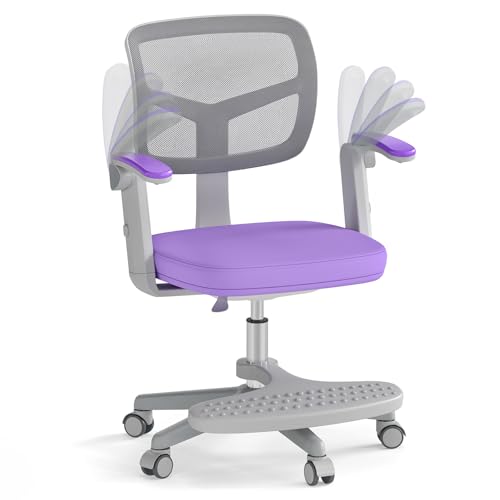
HONEY JOY Kids Desk Chair (Purple) — Best Full Adjustment for Growing Kids
HONEY JOY’s purple chair states the fullest adjustment list in this guide for a children’s chair: adjustable height, armrest and footrest, in a swivel rolling mesh task design described for kids and teens, girls and boys. Each adjustment answers a growth problem — legs lengthen, arms reach differently, feet need support at new heights — and together they make this the re-fittable choice.
Strengths
- Height, armrest and footrest all adjust — the fullest stated set here
- Mesh construction breathes for active, warm sitters
- Rolling swivel format works from homework desk to teen study setup
Trade-offs
- Armrests, even adjustable ones, can collide with narrow desk openings — measure first
- Purple finish is a long-term taste commitment
- The listing title does not state an age range — verify sizing on the product page
Listing-stated features (from the Amazon listing title): Kids desk chair stated in listing; Children study chair positioning; Adjustable height, armrest and footrest stated in listing; Swivel rolling mesh task design; Kids computer chair for teens, girls and boys stated in listing; Purple finish.
Treat this chair as a small system to be serviced twice a year. Height for the legs, footrest for the feet, armrests for the desk — five minutes with all three keeps the fit honest as your child grows, and a well-fitted chair quietly supports longer, calmer homework sessions. The mesh body is the right call for children, who run warmer and move more than adult sitters. For families who want to buy once and adjust rather than buy repeatedly, this and the chirvana are the two serious candidates — this one if armrest adjustment matters, the chirvana if backrest adjustment does.
With three adjustable supports, label the settings with a small sticker system — a dot for this term’s height, another for the footrest — so any adult in the house can restore the fit after the chair has been borrowed or moved for cleaning.
Best for: growing children and younger teens who need every adjustment / Not suited for: parents wanting an armless chair for a very small desk
Check the current price on Amazon

Ergonomic Kids Desk Chair (Ages 3-12) — Best for Youngest Sitters
This ergonomic kids chair closes the guide at the youngest end: its listing states ages 3 to 12, with adaptive back support, an adjustable footrest, flip-up armrests that move a stated 90 degrees, and breathable construction. A chair honestly sized for a three-year-old’s first desk — for drawing, puzzles and early writing — is a different product from a school chair, and the stated range plus footrest suggest this one was designed for exactly that span.
Strengths
- Stated 3-to-12 age range starts younger than any other pick here
- Adjustable footrest is essential at the youngest ages and included
- Adaptive back support aims to fit small backs as they grow
Trade-offs
- Verify the stated age range and dimensions on the product page before ordering for a very young child
- Flip-up arms add moving parts a determined toddler will test — supervise and check fixings
- Children at the top of the range will outgrow it into a teen chair, as with all kids’ sizing
Listing-stated features (from the Amazon listing title): Ergonomic kids desk chair stated in listing; Stated for ages 3-12 in listing; Adaptive back support; Adjustable footrest; 90 degree flip-up armrests stated in listing; Breathable construction.
For the youngest sitters, keep the goal modest and correct: feet supported, back met by the chair, sessions short and voluntary. No preschooler should be parked at a desk, but for the drawing and puzzle sessions they choose, a properly sized chair beats the floor-cushion slump and the adult-chair perch. Set the footrest first — at this age it is the feature that makes everything else possible — and let the flip-up arms clear the way for climbing in and out. Confirm all sizing on the product page, assemble it as an adult, and this is the gentlest start to desk life in the guide.
For the youngest users, treat the chair as session furniture, not a seat for the day: short, chosen activities at the desk, then back to the floor and movement. The chair’s job at age three or four is to make desk time comfortable in small doses, and it is sized to do exactly that.
Best for: the youngest desk users, from preschool age upward / Not suited for: older teens who have outgrown children’s sizing
Check the current price on Amazon
Comparison Table
Compare these six by your child’s stage first — youngest sitters, primary school, approaching teens — and by foot support second. The table’s best-use column is written in those terms deliberately, because a chair that is perfect at eight can be wrong at four, and the stated age ranges are there to be used.
| Pick | Badge | Key spec (listing-stated) | Best for |
|---|---|---|---|
| VIVO Children’s Height Adjustable Desk Chair (Gray) | Best Overall | Children’s height-adjustable chair for study workstation setups | school-age children with a dedicated study desk |
| GIANTEX Kids Desk Chair (Purple) | Best Armless Mesh Study Chair | Armless mesh kids chair, adjustable height, lumbar support | children at compact desks who need a breathable, tuck-away chair |
| Primy Kids Desk Chair (Pink) | Best Stated Age Range | Stated ages 4-12, height adjustable swivel mesh | children from early school years toward the teens, in one chair |
| chirvana Kids Desk Chair (Deer, Blue) | Best Ergonomic Kids Design | Adjustable footrest, backrest and height, breathable mesh back | children who need foot support and full adjustability in a fun design |
| HONEY JOY Kids Desk Chair (Purple) | Best Full Adjustment for Growing Kids | Adjustable height, armrests and footrest, swivel mesh | growing children and younger teens who need every adjustment |
| Ergonomic Kids Desk Chair (Ages 3-12) | Best for Youngest Sitters | Stated ages 3-12, adaptive back support, adjustable footrest | the youngest desk users, from preschool age upward |
How to Choose an Office Chair for Kids
Start with the two measurements that decide everything: your child’s popliteal height — floor to the back of the knee while seated — and the desk height. The chair’s lowest seat height must let feet rest flat or on a footrest with the back supported; if a chair cannot go low enough for your child today, it is a chair for later, whatever the marketing says. Stated age ranges, like the 4-to-12 and 3-to-12 in this guide, are starting points — confirm them against dimensions on the product page.
Then buy adjustability, because children are a moving target. Height adjustment is essential; a footrest — adjustable on two picks here — covers the years when legs are growing into the chair; adjustable backrests and armrests extend the fit further. Every adjustment is extra years before the next purchase, which is why the fullest-adjustment chairs headline this guide’s recommendations for growing kids.
Finally, match the chair to the room and the child. Armless designs tuck under small desks; mesh suits warm rooms and restless sitters; colours and characters decide whether a child claims the chair as theirs. A chair a child likes, fitted correctly, at a desk set to their height — that combination, not any single feature, is what good homework posture is made of.
Safety and Setup Notes for Children’s Desk Chairs
An adult should assemble the chair, check every fixing, and re-check after the first weeks — children test furniture in ways adults do not predict. Rolling casters on hard floors move quickly; if your child is young or the floor is slick, position the desk so the chair cannot roll into trouble, and teach the chair’s job early: it is for sitting and studying, not for standing, climbing or racing.
Keep categories clean in your mind. A desk chair is not a booster seat, high chair or car seat, and it carries none of those products’ safety roles. Used as intended — at a desk, feet supported, back supported, sessions broken up with play — a proper kids’ chair is a genuinely useful piece of furniture. Used as anything else, it is the wrong product, and no listing claim changes that.
How to Set Up a Kids’ Desk Chair Correctly
Five minutes of setup, repeated as your child grows, is what separates a kids’ chair that supports good habits from one that teaches perching. Work through these steps with your child sitting in the chair.
- Set seat height so your child can sit back against the backrest with feet supported — flat on the floor, or on the chair’s footrest if their legs are not there yet.
- If the chair has a footrest, adjust it so knees bend comfortably and feet rest fully on it, not on tiptoe.
- Check the back: the backrest should meet your child’s back without pushing them forward. Adjust the backrest position if the chair allows it.
- Set armrests, if adjustable, low enough that shoulders stay relaxed — or flip them up if they collide with the desk.
- Match the desk: books and screens should sit near eye level so your child is not hunching over the surface to see.
- Put a note in your calendar to re-fit the chair each school term. Growth is gradual; misfit is too, until it suddenly is not.
Finish by watching one real homework session. If your child sits back, feet supported, and forgets the chair exists, the setup is right. If they perch, dangle or wrap their legs around the base, adjust again — the chair is telling you what to fix.
How Long Should a Child Sit at a Desk, Anyway?
Parents buying a desk chair often carry an unspoken hope: that the right chair will produce long, still, focused sitting. It is worth replacing that hope with a better target. Children are built to move, and healthy desk habits for kids look like a rhythm — a focused stretch of homework or drawing, then movement, then back — not like an office shift. The chair’s role in that rhythm is to make the sitting stretches genuinely comfortable and supportive, so that sitting is never the reason the stretch ends early.
As a rough pattern, younger children do best with shorter desk sessions and frequent breaks, lengthening gradually with age and with the demands of school. The practical signals matter more than any timetable: when posture collapses, legs wrap around the chair base and the work slows, the session has outlasted the sitter. A well-fitted chair extends the comfortable stretch; it does not abolish the limit, and it should not be asked to.
So buy the chair as one part of a desk setup that includes light, space, foot support and permission to move. Re-fit it each term, keep sessions humane, and let the chair do its one job well: when your child is at the desk, their body is supported, their feet are planted, and the furniture has disappeared from their attention. That disappearance — not stillness — is the sign the purchase worked.
Siblings, Sharing and the One-Chair Household
In many homes, one desk chair serves two children of different sizes, and the honest advice is to fit it to the child who uses it most, then bridge the gap for the other. A footrest or stable box solves the shorter child’s feet; a cushion behind the smaller back can shorten an over-deep seat for a session. Adjustable chairs — the HONEY JOY and chirvana especially — repay their complexity here, because a thirty-second re-fit between siblings beats a permanent compromise that fits neither.
Hand-me-downs flow the other way too: a well-kept kids’ chair passes from elder to younger with years of life left, which is another argument for the adjustable, neutrally finished picks. Keep the assembly tools and a note of each child’s last settings with the chair, and the hand-down becomes a fitting appointment rather than a fresh research project.
What not to do is promote a child into an adult’s chair as a rite of passage before their body fits it. The milestone that matters is measurement, not age: when a teenager’s legs and back genuinely meet an adult chair’s proportions, the adult chair becomes the right tool — and the kids’ chair passes down or on, its job properly finished.
Care and Maintenance for Children’s Chairs
Children’s chairs live hard lives, so the adult routine is: check all fixings monthly, tighten anything that has worked loose, wipe mesh and surfaces after the inevitable spills and art incidents, and inspect casters for the hair, string and sticker debris that children’s rooms generate. Five minutes, monthly, keeps the chair safe and silent.
Re-check the fit at the same appointment — height, footrest, backrest — because a growing child will not report a gradual misfit; they will simply start perching, and you will blame concentration. The calendar reminder recommended in the setup section exists precisely to catch what nobody notices day to day.
Building the Whole Kids’ Desk Setup Around the Chair
A chair is one third of a child’s desk setup, and the other two thirds — desk and light — decide whether the chair’s good fit survives contact with reality. Desk height should let your child rest forearms on the surface with shoulders relaxed while their feet stay supported; if the desk is an adult hand-me-down, the chair and a footrest must bridge the difference, which is precisely what the footrest picks here are for. Books and tablets should rise toward eye level on a stand or a stack of books, because a child reading flat on a desk will hunch over it in any chair ever made.
Light is the silent partner: a desk lamp positioned to light the work without glare keeps a child sitting back to read rather than leaning into a dim page. And storage within reach — pencils, paper, the current book — prevents the constant climbing and twisting that undo good posture faster than any chair can restore it.
Review the whole setup each school year as one system: chair height, footrest, desk surface, screen or book height, lamp. Fifteen minutes, twice a year, keeps a growing child fitted to their furniture instead of gradually folded around it. That habit, more than any single product in this guide, is what good desk posture in childhood is actually made of.
Before You Order: A Five-Point Check for Parents
Five checks, all answerable from the product page and a tape measure, before a child’s chair is ordered.
- Confirm the chair is a stated children’s chair, and note any stated age range the listing gives.
- Compare the seat height range with your child’s measurements — feet must reach the floor or a footrest.
- Check the desk opening the chair must fit, especially if the chair has armrests.
- Decide the foot support plan now: built-in footrest, or a stable support under the desk.
- Read the assembly and care details, and plan for an adult to assemble and periodically re-check the chair.
A chair that passes those checks, fitted to your child on the day it arrives and re-fitted each term, will do everything furniture can honestly do for a young student.
Common Buying Mistakes
Buying a small adult chair. Petite adult chairs are proportioned for small adults — seat depth, back height and lumbar position are all wrong for a child. Every pick in this guide is a stated children’s chair; keep that standard for any chair you consider.
Letting feet dangle. The most common and most fixable error. If feet cannot reach the floor at a back-supporting height, use the chair’s footrest or add a stable support under the desk.
Buying for the age on the box without checking dimensions. Children of the same age vary enormously. Stated age ranges are guidance; seat height and depth measurements are facts. Compare both before ordering.
Forgetting to re-fit. A chair fitted in September can be wrong by spring. Height and footrest adjustments take minutes — build the check into the school-term routine.
Which Pick for Which Buyer
For a dedicated homework desk: the VIVO. A serious little workstation chair from a desk-equipment maker, in a finish that survives years of bedroom redecoration and sibling inheritance.
For compact desks and tidy rooms: the GIANTEX armless mesh chair. It tucks away completely, breathes for warm little sitters, and states lumbar support where most kids’ chairs offer a bare shell.
For one chair across primary school: the Primy, on its stated 4-to-12 range and height adjustment — provided you re-fit it yearly and add foot support while your child is small.
For the most complete ergonomic fit: the chirvana Deer, whose adjustable footrest, backrest and height take a young child’s posture as seriously as adult chairs take yours.
For siblings and fast growers: the HONEY JOY, because height, armrests and footrest all adjust — the re-fittable chair for households where the user keeps changing size or identity.
For the very youngest desk users: the ages 3-to-12 chair with adaptive back support and footrest. Start desk life with feet supported and sessions short, and it is the gentlest beginning in the guide.
Final Recommendation
For a dedicated study desk, the VIVO is the grown-up, durable default. The chirvana and HONEY JOY are the growth specialists — footrests and full adjustment for children who will keep the chair for years — while the Primy offers the widest stated school-age range, the GIANTEX serves compact armless setups, and the ages 3-to-12 chair is the one honest starting point for the very youngest desk users.
Whichever you choose, confirm the sizing on the product page, assemble it as an adult, set it up with your child in it, and re-fit it every term. A children’s chair is not a purchase you make once and forget — it is a small, adjustable piece of your child’s school life, and treated that way it earns its place.
Buy the chair that fits your child today with room to adjust for tomorrow, set up the whole desk around it, and revisit the fit as they grow. That is the complete recipe — the chair is just the ingredient that arrives in a box.
Related guides worth reading next: Best Office Chairs For Children Best Office Chairs For College Students Best Inexpensive Comfortable Office Chairs Best Office Chairs For All Day Sitting Men Best Office Chairs Around 100
Frequently Asked Questions
What age can a child use a desk chair like these?
It depends on the chair’s stated range and, more importantly, its dimensions versus your child. This guide includes chairs stating ages 4 to 12 and 3 to 12. Whatever the range, the chair fits when your child can sit back with feet supported — on the floor or a footrest.
Is an adult chair okay for a child if it is small?
Generally no. Small adult chairs keep adult proportions — deeper seats, higher backs, lumbar in the wrong place — so children perch on the edge with feet dangling. A stated children’s chair is designed around a child’s body, which is why this guide only includes those.
Does my child need a footrest on their chair?
If their feet cannot rest flat on the floor while their back is supported, yes — dangling feet cause perching and fidgeting. Two picks here include adjustable footrests; otherwise a stable box or low stool under the desk does the same job.
How long will a kids’ desk chair last?
A height-adjustable chair with a stated wide age range can serve through most of primary school, provided you re-fit it as your child grows. Chairs with footrest and backrest adjustment last longest of all, because they adapt in more dimensions.
Are rolling casters safe for children?
With adult assembly, checked fixings and sensible rules — sitting only, no standing or racing — casters are a normal part of children’s desk chairs. On very slick floors, position the desk thoughtfully and supervise younger children until the chair’s movement is familiar.
Mesh or padded for a child’s chair?
Mesh breathes and suits warm rooms and restless sitters, and it wipes down well. Padded seats can feel cosier for short sessions. For homework-length sitting in normal rooms, mesh is the practical default, which is why most picks here use it.


