Disclosure: airfryerkitchensupply.com is reader-supported. When you buy through links on our site, we may earn an affiliate commission at no extra cost to you.
Where to buy
A chair mat is the difference between gliding and ploughing on carpet. Every mat below is a verified chair mat for carpeted floors — confirmed, with sizes and thicknesses taken only from the listing titles themselves. These are the best floor mats for office chairs on carpet across the common sizes, from compact 30 x 48 inch desk setups to a 46 x 60 inch tempered glass statement piece.
- Best Overall — BesWin Office Chair Mat for Carpet, 30″ x 48″, Clear: check price on Amazon
- Best with Lip for Standard Desks — Azadx Clear Office Chair Mat, 36″ x 48″: check price on Amazon
- Best Compact Rectangle — Kuyal Desk Chair Mat for Carpet, 30″ x 48″: check price on Amazon
- Best Thick Plastic — Chair Mat for Carpet, 1/4″ Thick, with Lip (TONOS): check price on Amazon
- Best Premium Glass — Koonmi Tempered Glass Chair Mat, 46″ x 60″: check price on Amazon
- Best Office-Brand Pick — HON Office Chair Mat for Carpet, 36″ x 48″: check price on Amazon
Shopping for the best floor mats for office chairs on carpet starts with a confession the product photos will not make: a mat that works beautifully on low pile carpet can skate, crack or curl on medium pile, and the difference is thickness and grip, not branding. This guide only includes mats whose listings explicitly position them for carpeted floors, and it reports sizes and thicknesses exactly as the listings state them — no rounding up, no invented specs.
The six picks cover the real decision space. There are three clear 30 x 48 inch mats for standard desks, a 36 x 48 with a lip from Azadx, a quarter-inch-thick heavy option with a lip for buyers who want the firmest plastic platform, and a tempered glass mat at 46 x 60 inches for large desks and heavier use. Plastic mats differ more than they look: edge finishing decides whether the mat curls, clarity decides how much carpet shows through, and the underside decides whether it stays where you put it.
Measure before you fall in love. The mat must cover the full roll zone of your chair — forward lean, back push-off and side swivels — with margin, or you will spend your days climbing the mat’s edge with a caster, which is worse than no mat at all. The buying guide below walks through pile height, sizing and materials so the pick you order is the pick your floor needed.
In this guide
Quick Picks
Six carpet chair mats, verified against their listings, spanning compact plastic to full-size tempered glass.
- Best Overall — BesWin Office Chair Mat for Carpet, 30″ x 48″, Clear: A clear heavy duty 30 x 48 mat for low carpeted floors that promises easy glide and lies flat without curling. Check on Amazon
- Best with Lip for Standard Desks — Azadx Clear Office Chair Mat, 36″ x 48″: A 36 x 48 clear plastic mat for low and no pile carpet, with the extra width that catches side-to-side rolling. Check on Amazon
- Best Compact Rectangle — Kuyal Desk Chair Mat for Carpet, 30″ x 48″: A transparent 30 x 48 rectangle for low and no pile carpet — the tidy, no-lip option for smaller workstations. Check on Amazon
- Best Thick Plastic — Chair Mat for Carpet, 1/4″ Thick, with Lip (TONOS): A quarter-inch-thick semi-transparent mat with a lip, built as a heavy duty protector for carpeted floors. Check on Amazon
- Best Premium Glass — Koonmi Tempered Glass Chair Mat, 46″ x 60″: A 46 x 60 tempered glass mat with rounded, polished edges — the largest, smoothest rolling surface in the guide. Check on Amazon
- Best Office-Brand Pick — HON Office Chair Mat for Carpet, 36″ x 48″: A 36 x 48 heavy duty clear mat with an extended lip from an established office furniture brand. Check on Amazon
How These Picks Were Chosen
Candidates came from Amazon listing data searches for office chair mats for carpet on this site’s Amazon connection. Eligibility required the listing itself to position the mat for carpeted floors — hardwood-only mats were excluded even when highly rated — and sizes or thicknesses are only printed in this guide where the verified listing title states them. One listing we found described an under-desk rug style mat rather than a rigid chair mat and was set aside, since a soft rug does not give casters a rolling platform.
The final six span the genuine decision points: two widths (30 and 36 inches) in clear plastic, one stated-thickness heavy plastic mat with a lip, one extended-lip office-brand mat, and one large tempered glass mat. Variants of the same mat in other sizes were treated as one product, not separate picks.
The 6 Best floor mats for office chairs on carpet
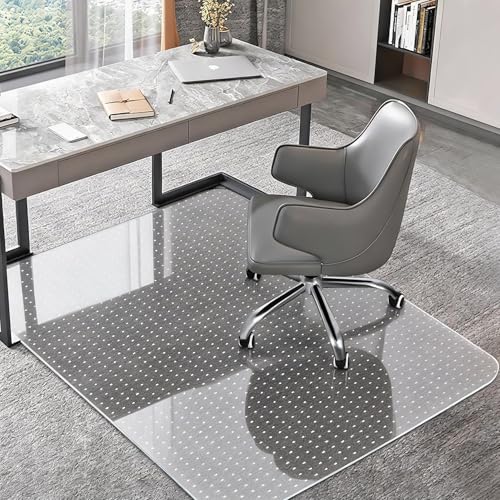
BesWin Office Chair Mat for Carpet, 30″ x 48″, Clear — Best Overall
The BesWin takes the overall badge because it answers the three standard complaints about plastic chair mats in its own listing: it is described as heavy duty, built for low carpeted floors, and designed for easy glide while lying flat without curling. Curling edges are the number-one reason mats get returned — a mat that will not lie flat trips casters and feet all day — so a listing that leads with flatness is addressing the right problem. At 30 x 48 inches it covers the standard single-desk roll zone for most seated work.
Clear construction keeps the carpet visible, which matters in rented homes and tidy offices where a big opaque rectangle reads as an eyesore. The easy-glide surface is the working feature: on low pile carpet, a chair should roll with a nudge rather than a shove, and the mat’s job is to turn carpet drag into something closer to hard-floor movement while the carpet underneath stays protected from caster wear.
Its honest boundary is right in the listing: low carpeted floors. On medium or plush pile, a mat of this class can flex and wander; those floors want the thicker or glass options below. For the common case — office carpet tiles or low pile in a home office — this is the balanced pick.
A note on living with the BesWin day to day: clear mats earn a quick wipe more often than coloured ones, because the same transparency that shows your carpet also shows the dust your casters grind into a faint traffic lane. A damp cloth monthly keeps the lane invisible. Owners of mid-tone carpets get the best of this mat — enough pattern to look intentional through the clear surface, not so dark that every scuff announces itself.
Strengths
- Listing promises flat, no-curl behaviour
- Heavy duty build for low carpeted floors
- Clear finish keeps carpet visible
Trade-offs
- Specified for low pile, not plush carpet
- 30 x 48 is snug for wide roll patterns
- Plastic can scuff over years of caster use
| Detail | What the listing states |
|---|---|
| Size | 30″ x 48″ (as listed) |
| Colour | Clear |
| Floor type | Low carpeted floors (as listed) |
| Surface | Easy glide (as listed) |
Best for: standard desks on low pile or carpet tiles / Not suited for: medium or plush pile carpet

Azadx Clear Office Chair Mat, 36″ x 48″ — Best with Lip for Standard Desks
Six extra inches of width changes a chair mat from adequate to comfortable, and the Azadx is the pick for desks where the chair roams. Its listing confirms a clear office chair mat for low and no pile carpeted floors at 36 x 48 inches, in plastic, described as a durable carpet protector for easy rolling. That width covers the sideways drift every worker does — the lean to the filing drawer, the swivel to the printer — without a caster dropping off the edge.
The listing’s “low and no pile” phrasing is usefully honest: this mat is at its best on the flat carpets of offices and modern homes, where its underside can grip and its surface stays a true plane. On those floors the rolling feel is the closest plastic gets to glass, at a fraction of the weight and with far less commitment if you rearrange the room.
Choose the Azadx if your desk is a standard width and your chair habits are mobile. If your desk is a compact writing table, the 30-inch-wide picks save floor; if your carpet has real pile, step up in thickness or go glass. Within its stated lane, it is the most versatile plastic mat here.
The Azadx’s width also makes it the natural pick for sit-stand desks, where the chair’s parked position sits further from the desk than at a fixed desk and the roll zone stretches sideways as you move between sitting and standing spots. If your desk moves through the day, your mat needs to cover the chair’s whole life, not just its typing position — 36 inches is where that coverage starts.
Strengths
- 36-inch width covers lateral chair movement
- Clear plastic protects while showing the carpet
- Stated for low and no pile carpet
Trade-offs
- Not the choice for medium or plush pile
- Larger footprint needs the floor space to match
- Plastic surface can mark under heavy point loads
| Detail | What the listing states |
|---|---|
| Size | 36″ x 48″ (as listed) |
| Colour | Clear |
| Floor type | Low and no pile carpet (as listed) |
| Material | Plastic (as listed) |
Best for: mobile chair habits at a standard desk / Not suited for: plush carpet or very compact desks

Kuyal Desk Chair Mat for Carpet, 30″ x 48″ — Best Compact Rectangle
Not every desk needs a lip, and not every room wants one. The Kuyal’s verified listing describes a 30 x 48 inch rectangle transparent mat for chairs, for desks, office and home, with easy glide, protecting floors for low and no pile carpeted floors. The plain rectangle shape suits desks against walls, standing-desk frames with mats tucked under, and anyone whose chair rolls in a simple forward-back pattern rather than roaming.
Transparency is the aesthetic argument: on a nice carpet, a clear mat nearly disappears, protecting the fibres without announcing itself. The easy-glide claim in the listing matches the category standard for this class — the value here is the honest specification, the rectangular footprint and a size that fits the smaller desks common in spare-room offices and student setups.
Its limits mirror its virtues: no lip means no under-desk extension, so deep desks where you pull in close may leave your casters at the mat’s front edge, and the low/no-pile specification rules out shaggier carpets. For a compact, tidy workstation on flat carpet, it is the cleanest solution in the guide.
The Kuyal rectangle has an underrated second use: as the mat for a secondary chair — a guest chair at a shared desk, a student’s homework seat, the sewing or craft station that migrates around a spare room. Compact rectangles are cheap insurance for any rolling chair that occasionally works on carpet, and buying the second mat before the carpet shows a wear ring is the order of operations most households wish they had followed.
Strengths
- Plain rectangle suits wall-side and compact desks
- Transparent finish is visually quiet
- Stated easy glide for low and no pile carpet
Trade-offs
- No lip for under-desk coverage
- 30-inch width limits lateral rolling
- Not specified for medium pile
| Detail | What the listing states |
|---|---|
| Size | 30″ x 48″ (as listed) |
| Shape | Rectangle |
| Colour | Transparent |
| Floor type | Low and no pile carpet (as listed) |
Best for: compact desks and tidy, minimal setups / Not suited for: deep desks needing lip coverage

Chair Mat for Carpet, 1/4″ Thick, with Lip (TONOS) — Best Thick Plastic
Thickness is the one plastic-mat specification that genuinely changes behaviour on carpet, and this is the only plastic pick whose listing states it: a quarter inch thick, per the verified title, in a semi-transparent finish with a lip, described as a heavy duty desk chair mat for carpeted floors and a carpet protector for low pile. That quarter inch is what keeps a mat feeling like a floor instead of a flexible sheet when casters press into pile — the mat bridges the carpet rather than sinking into it.
The lip extends coverage under the desk, which suits deeper desks and workers who pull in close and park their casters near the desk edge. Semi-transparent is a fair aesthetic compromise: it softens the carpet pattern slightly in exchange for a surface that hides scuffs and wear better than crystal-clear mats, which show every mark they earn.
Thick plastic is heavier and less flexible to position than thin mats, and it still belongs to the low-pile world its listing describes — truly plush carpet defeats any plastic mat eventually. For buyers whose previous thin mat cracked, curled or wandered, this is the plastic upgrade path before glass.
Thickness changes one more behaviour buyers notice: sound. A quarter-inch mat under casters on carpet is noticeably quieter than thin plastic, which can drum and flex audibly on hard-backed carpet tiles. In shared homes and flats where a home office sits above someone else’s ceiling, that acoustic difference is a genuine quality-of-life feature that never appears in a spec table — and one more reason the stated thickness is the specification that matters in this category.
Strengths
- Quarter-inch thickness stated in the listing
- Lip extends under-desk coverage
- Semi-transparent finish hides scuffs
Trade-offs
- Heavier and stiffer to position
- Still a low-pile specification
- Semi-transparent softens carpet pattern
| Detail | What the listing states |
|---|---|
| Thickness | 1/4″ (as listed) |
| Shape | With lip (as listed) |
| Colour | Semi transparent |
| Floor type | Low pile carpet (as listed) |
Best for: buyers whose thin mats cracked or wandered / Not suited for: plush carpet or frequent rearrangers
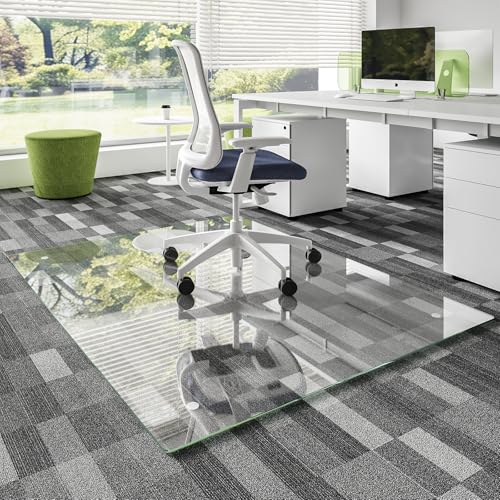
Koonmi Tempered Glass Chair Mat, 46″ x 60″ — Best Premium Glass
Glass is the endgame chair mat material, and the Koonmi is the verified representative: its listing confirms a glass chair mat for carpet at 46 x 60 inches, in tempered glass with round and polished edges. That size is a full workstation platform — chair, side drift and all — and glass delivers the one rolling feel plastic imitates: genuinely frictionless, silent, and unchanged by years of caster traffic because the surface does not wear, dent or develop ruts.
The rounded, polished edges matter for two reasons: comfort when a caster or a bare foot crosses the boundary, and safety in handling, since a large glass panel is a two-person, plan-the-route installation rather than a casual unroll. Once placed, though, glass asks nothing — no uncurling, no repositioning, no replacement cycle. It also shows the carpet beneath with perfect clarity, the best-looking option over a carpet worth seeing.
The honest costs are commitment and care in placement: it is the heaviest pick, the least portable, and the one to think hardest about on very deep pile, where any rigid platform should be tested for rocking. For a permanent desk on low-to-medium carpet, it is the last chair mat most buyers ever purchase.
Plan the Koonmi’s arrival like furniture, not like a parcel: measure doorways and the route to the desk, arrange the second pair of hands, and decide its final position before it comes out of its packaging. Once placed, resist micro-adjustments — glass mats settle into carpet over the first days and sit flatter for it. Buyers who treat it as a permanent installation get the decade of silence it promises; buyers who drag it monthly get the risks without the rewards.
Strengths
- Largest coverage here: 46 x 60 inches
- Tempered glass never dents, ruts or curls
- Round polished edges, per the listing
Trade-offs
- Heavy two-person installation
- Least portable pick in the guide
- Premium tier pricing as a category
| Detail | What the listing states |
|---|---|
| Size | 46″ x 60″ (as listed) |
| Material | Tempered glass |
| Edges | Round and polished (as listed) |
| Floor type | Carpet (as listed) |
Best for: permanent workstations and heavy daily use / Not suited for: renters who rearrange or move often

HON Office Chair Mat for Carpet, 36″ x 48″ — Best Office-Brand Pick
HON is a name from the contract office world, and its mat brings that sensibility: the verified listing describes a heavy duty, clear office chair mat for carpet at 36 x 48 inches, with an extended lip, positioned as a desk mat that protects carpet and floors. The extended lip is the distinguishing feature — it reaches further under the desk than standard lips, covering the zone where casters actually rest when you are pulled in and working, which is where carpet crush damage concentrates.
At 36 inches wide it matches the Azadx on lateral coverage, and the heavy duty billing suits shared offices, heavier users and chairs that move all day rather than occasionally. Clear construction keeps it visually neutral in a professional room, and a brand with an office-furniture reputation is a reasonable tiebreaker for buyers who have been burned by anonymous mats that curled in a month.
It shares the family limits of plastic mats: it is a carpet mat in the low-pile mainstream, not a plush-carpet solution, and plastic will eventually show caster wear that glass would shrug off. As a durable, sensibly specified plastic mat from a known office brand, it earns its place as the conservative buyer’s pick.
The HON’s extended lip deserves one more practical word: it protects the exact rectangle of carpet where a pulled-in chair parks for eight hours a day, which is where pile crush becomes permanent first. If your carpet already shows a pale parked-chair patch, that patch is the argument for the extended lip — the mat arrives too late for the fibres already crushed, but it stops the damage at its current border and gives the chair a surface that does not care.
Strengths
- Extended lip covers the parked-caster zone
- Heavy duty build for all-day movement
- Established office furniture brand
Trade-offs
- Plastic wear over years, unlike glass
- Low-pile mainstream specification
- Clear surface shows scuffs over time
| Detail | What the listing states |
|---|---|
| Size | 36″ x 48″ (as listed) |
| Shape | Extended lip (as listed) |
| Colour | Clear |
| Build | Heavy duty (as listed) |
Best for: shared offices and conservative buyers / Not suited for: plush carpet or a buy-it-for-life brief
Comparison Table
| Pick | Badge | Key spec | Best for |
|---|---|---|---|
| BesWin Office Chair Mat for Carpet, 30″ x 48″, Clear | Best Overall | 30×48 clear, heavy duty, for low carpet | standard desks on low pile or carpet tiles |
| Azadx Clear Office Chair Mat, 36″ x 48″ | Best with Lip for Standard Desks | 36×48 clear plastic, low/no pile carpet | mobile chair habits at a standard desk |
| Kuyal Desk Chair Mat for Carpet, 30″ x 48″ | Best Compact Rectangle | 30×48 transparent rectangle, low/no pile | compact desks and tidy, minimal setups |
| Chair Mat for Carpet, 1/4″ Thick, with Lip (TONOS) | Best Thick Plastic | 1/4″ thick, with lip, semi-transparent | buyers whose thin mats cracked or wandered |
| Koonmi Tempered Glass Chair Mat, 46″ x 60″ | Best Premium Glass | 46×60 tempered glass, polished round edges | permanent workstations and heavy daily use |
| HON Office Chair Mat for Carpet, 36″ x 48″ | Best Office-Brand Pick | 36×48 clear, extended lip, heavy duty | shared offices and conservative buyers |
Start With Your Carpet: Pile Height Decides Everything
Pile height is the specification that decides whether a chair mat works, and it is about your carpet, not the mat. Low pile — office carpet tiles, commercial loop and most modern home office carpet — accepts any mat in this guide. Medium pile needs help: a thicker mat like the quarter-inch pick, or glass, bridges the fibres instead of sinking between them. Plush and shag carpets defeat rigid mats generally; if a mat rocks or casters sink at the edges, the honest fixes are a glass mat tested in place or replacing the casters with carpet-friendly wheels and accepting slower rolling.
A quick test before ordering: press your thumb hard into the carpet. If you feel the backing easily, you are in low-pile territory and can buy freely. If your thumb disappears into softness, prioritise thickness and stiffness, and be suspicious of any thin mat’s promises, however cheerful its listing.
Sizing a Chair Mat: Cover the Roll Zone, Not the Desk
The mat must cover where the chair actually goes, which is a bigger area than where the chair parks. Sit at your desk, roll through a normal hour in your head — forward to type, back to think, sideways to the drawer — and measure that rectangle, then add margin on every side. Most single desks land at 30 x 48 inches minimum; mobile workers and corner desks want 36 inches of width; large L-desks justify the 46 x 60 glass platform.
Lips exist for desks you pull into: the lip slides under the desk so your casters stay on the mat when you are tucked in close. If your desk is shallow or you sit back from it, a plain rectangle covers you and looks tidier. The one unforgivable sizing error is a mat slightly too small — a caster dropping off an edge twenty times a day will annoy you more than carpet drag ever did.
Plastic vs Glass Chair Mats
Plastic mats are light, inexpensive as a category, easy to position and forgiving of odd rooms. Their costs arrive slowly: edges can curl if the mat is thin or the room runs hot, surfaces scuff and cloud with caster wear, and on borderline pile they flex. Good plastic mats — heavy duty builds, stated thickness, flat-lying designs — postpone those costs for years, which is why the picks above specify build wherever the listing states it.
Glass mats cost more, weigh far more, and then simply stop being a topic: no curl, no rut, no wear, perfect clarity over the carpet, and the smoothest roll in the category. The decision is really about permanence. A desk that will sit in this room for years deserves glass; a first apartment or a room that rearranges every season deserves good plastic.
Chair Mats and Casters: The Other Half of the Rolling Equation
A mat can only do so much with the wrong wheels. The hard twin-wheel casters fitted to most office chairs concentrate your weight onto two narrow contact lines, which is why they dig into carpet and why they feel grabby even on a mat. On any mat in this guide, those casters work — but the pairing that transforms rolling is a mat plus softer, larger single-wheel casters of the kind sold as floor-friendly upgrades. The mat spreads the load; the wheels stop point-loading it.
This matters most on borderline pile. A medium-pile carpet with a standard mat and standard casters can feel like rolling through sand; the same carpet with the quarter-inch mat and better casters feels like an office. Before concluding that a mat has failed, check whether the casters are the real culprits — spin them by hand and look for the flat spots, hair and grit that accumulate in the wheel housings of any chair over a year old.
The reverse also holds: on hard floors, mats are unnecessary and casters do all the work. The carpet case is the one where the system matters, and this guide’s mats are the foundation half of that system.
Renting, Resale and Carpet Evidence: The Financial Case for a Mat
Carpet wear from an office chair is one of the few kinds of damage that is both invisible day to day and undeniable at the end. The casters crush pile in a fixed arc, grind in grit, and leave a pale, flattened record of exactly where you sat for two years — a record landlords and buyers read fluently. A chair mat is, in rental terms, deposit insurance that costs less than a single professional carpet repair visit, and unlike most insurance it also makes every working day in between more comfortable.
Homeowners planning to sell should think of the mat the same way: the home office is now a selling feature, and a wear ring in its carpet argues against the room. A clear mat like the BesWin or Azadx protects without hiding the carpet the room was sold on, which is why clear dominates this category despite showing scuffs sooner than opaque mats.
Even without a move on the horizon, the arithmetic holds: carpet replacement is priced by the room, mats by the mat. Protecting the two square metres your chair actually uses is the cheapest carpet care decision available to anyone who works from home.
Troubleshooting: Curling, Cracking, Wandering and Clouding
Curling is a memory problem: plastic remembers the roll it shipped in, and cold rooms set that memory. Warmth, time and weight reverse it — a mat that will not flatten after a warm weekend under books is a mat to return inside its window, because it will not improve with age. Cracking is a load-and-age problem concentrated at the lip and edges, and it is the failure mode that stated thickness and heavy duty builds exist to postpone; a cracked mat should be replaced before its edges become trip points.
Wandering is a grip problem, almost always a pile mismatch — the mat is too light or too smooth for the carpet under it — and the honest fixes are a heavier mat, a glass mat, or accepting a repositioning nudge as part of the morning routine on borderline pile. Clouding is cosmetic: caster wear fogging a clear surface over years. It does not affect function, and it is the one flaw glass never develops, which is part of what the Koonmi’s premium actually buys.
Every one of these failure modes arrives slower on a mat matched to its carpet at purchase. Troubleshooting is the consolation prize; the pile-first buying method in this guide is the real cure.
Chair Mats in Shared and Multi-Desk Rooms
A room with two desks is not two one-desk problems. Chairs in shared offices roam into each other’s territory, and two undersized mats leave a no-man’s-land of carpet between them that both chairs cross fifty times a day. In shared rooms, size mats to overlap the traffic pattern rather than the desks: two 36-inch mats, or one large glass platform anchoring the main desk and a standard mat at the second, will outperform two minimal mats that technically “fit” each desk.
Shared rooms also multiply the appearance argument for clear and glass mats, because a patchwork of opaque mats in different states of wear is the first thing a visitor sees. One material language across the room — all clear plastic, or plastic with a glass anchor — reads as a designed workspace rather than an accumulation of fixes.
And in rooms where chairs are shared as well as desks — hot-desking homes, family homework rooms — the mat is doing silent diplomatic work: it defines each workstation’s territory more clearly than the desk does. Buy the mat for the room’s traffic, not the individual’s chair, and the whole space works better.
Chair Mats for Gamers and Streamers: The High-Movement Case
Gaming is the chair-mat stress test: hours of micro-movements, sudden leans, and a chair that travels further in an evening than an office chair does in a week. Gamers should size up without debating it — the 36-inch widths are the floor, and the 46 x 60 glass platform is the ceiling that serious setups end at — because a caster dropping off a mat edge mid-game is not an annoyance, it is a lost round. Thickness matters here too, since gaming chairs and their occupants lean harder on casters than office work ever does.
Streamers add an aesthetic demand the office never makes: the mat is on camera. Clear plastic reads as nothing, which is usually the goal; glass reads as premium and shows the carpet or floor design beneath a setup that was composed to be seen. A clouded, curled budget mat undermines a carefully lit room in a way viewers notice before the streamer does.
The shared conclusion with office buyers is that movement is the spec. Whether the movement is spreadsheets or ranked matches, the mat must cover the chair’s real travel with margin — measure the game, not the desk.
Disposing and Replacing: The End of a Chair Mat’s Life
A chair mat’s retirement signs are the troubleshooting list made permanent: cracks that catch casters, edges that will not lie flat after a warm weekend, a surface so clouded and rutted that rolling feels like gravel. At that point replacement is not consumption, it is maintenance — a failed mat damages carpet more honestly than no mat, because its curled edges concentrate caster pressure into lines.
When the new mat arrives, let the old one teach the purchase: measure where it cracked, note whether it wandered, and buy the thickness or material that answers that specific failure. The glass mat’s entire market is people on their third plastic mat doing this arithmetic. Disposal is mundane — plastic mats are bulky waste in most areas — but the carpet underneath, unmarked after years, is the receipt that the whole arrangement worked.
A Note for Standing-Desk Users Who Sit Half the Day
Sit-stand desks create a mat pattern of their own: the chair is parked hard against the desk for standing hours, then roams for sitting hours, and the mat must serve both a storage position and a working range. The parked position is where the damage concentrates — eight static hours of caster pressure on one carpet patch — which is why the extended-lip HON and the wide Azadx earn their keep in sit-stand rooms even when the sitting roll zone seems modest.
If you stand more than you sit, invert the usual advice: buy the mat for the parked chair and the occasional sit, not for a roaming worker you are not. A compact mat placed precisely under the parking spot protects the carpet that actually suffers, and the money saved over a glass platform buys the standing mat your feet wanted anyway.
How to Install a Chair Mat on Carpet and Keep It Flat
Five minutes of care at installation prevents the two classic complaints — curling edges and a mat that migrates across the room.
- Vacuum the carpet thoroughly first; grit trapped under a mat grinds into both the carpet and the mat’s underside.
- Unroll or unpack the mat in a warm room and let it relax — plastic mats shipped rolled need time, sometimes a day, to lie fully flat.
- Position the mat with the lip under the desk before the chair goes on it, centred on your real roll zone rather than on the desk alone.
- Walk the edges down and, for rolled plastic mats, weight the corners with books overnight if any lift remains.
- Roll the chair on slowly the first time and check the mat has not shifted; a mat that moves on day one needs its underside checked for carpet incompatibility.
- Clean with a damp cloth and mild cleaner as needed, and lift the mat every few months to vacuum beneath it.
A glass mat follows the same logic with one change: plan the carry with two people and place it once, deliberately. Its weight is its grip — once down, it should not move again.
Common Buying Mistakes
Buying a hard-floor mat for carpet
Hard-floor mats are smooth underneath and skate on carpet; carpet mats are built to grip pile. The listings in this guide state carpet use explicitly — insist on the same clarity anywhere else you shop.
Guessing the size from the desk width
The roll zone is wider and deeper than the desk footprint suggests. Measure the chair’s actual travel, add margin, and only then choose between 30, 36 and 46-plus inch widths.
Putting a thin mat on plush carpet
Thin flexible mats sink into deep pile and feel worse than the carpet alone. Match stiffness to pile: thicker plastic or glass as pile rises.
Fighting curl instead of preventing it
A mat unrolled in a cold room and sat on immediately keeps its curl for weeks. Warmth, time and corner weights at installation are the whole secret.
Forgetting what is under the mat
Grit under a mat damages carpet invisibly for months. The two-minute lift-and-vacuum every few months is the cheapest insurance in the home office.
Final Recommendation
For the standard home office on low pile carpet, buy the BesWin 30 x 48 for its flat-lying, heavy duty brief — or the Azadx 36 x 48 if your chair roams sideways. The HON is the conservative alternative with its extended lip, the Kuyal the tidiest compact rectangle, and the quarter-inch TONOS the plastic upgrade for buyers whose thin mats failed them. If the desk is permanent and the budget allows one final purchase, the Koonmi glass mat ends the topic entirely.
Whichever you choose, match it to your pile first and your desk second. Related reading: Best Chair Mat For Carpets Rolling Chairs covers the rolling-chair angle in depth, and Best Area Rugs For Under Office Chair is the alternative approach for rooms where a rug suits the decor better than a mat.
Best Chair Mat For Carpets Rolling Chairs Best Area Rugs For Under Office Chair
Frequently Asked Questions
Will a chair mat damage my carpet?
A proper carpet chair mat protects carpet from the real damage: caster wheels grinding fibres and crushing pile in one spot. Lift and vacuum under the mat every few months so trapped grit does not abrade the carpet unseen.
How thick should a chair mat be for carpet?
For low pile, standard heavy duty plastic mats work well. As pile rises, thickness and stiffness matter more — a stated quarter-inch mat or tempered glass bridges deeper fibres instead of sinking. No rigid mat fully conquers plush shag; test carefully there.
Do I need a mat with a lip?
Only if you pull in close to a deeper desk, so your casters rest under the desk while you work. Shallow desks and sit-back workers are fully covered by a plain rectangle, which also looks tidier.
Why does my chair mat keep moving?
Usually a pile mismatch — a mat too light or smooth for the carpet — or a mat slightly too small, so casters catch its edge and drag it. Confirm the mat is a carpet model, check sizing, and let it settle under the chair’s weight for a day before judging.
Are glass chair mats safe?
Tempered glass mats like the Koonmi pick are made for this job and are the most wear-proof option in the category. Handle them with two people during installation, choose polished edges, and place them deliberately — after that they are the lowest-maintenance mat you can own.
Can I use a chair mat on carpet over a heated floor?
Check both the mat maker’s and flooring maker’s guidance before combining heat with any mat, since trapped heat affects both carpet and mats. This guide’s listings do not state heated-floor ratings, so we do not claim them.
Can I put a chair mat over a rug instead of carpet?
A rug on a hard floor moves and bunches under a mat in ways carpet does not, and the combination rarely rolls well. If the rug is flat, heavy and fully settled, a stiff or glass mat can work — but the cleaner solutions are a mat on the carpet the rug was covering, or a low-pile rug designed as the chair surface itself, as our linked rug guide covers.
How long should a plastic chair mat last?
A heavy duty mat on matched low pile should serve for years of daily use; thin mats on borderline pile can curl or crack within the first year. The stated-thickness and heavy duty picks in this guide exist for buyers who have already lived the short version of that story.


