Disclosure: airfryerkitchensupply.com is reader-supported. When you buy through links on our site, we may earn an affiliate commission at no extra cost to you.
Where to buy
For best sustainable bed pillows — start here. Sustainable pillows are sold across Amazon’s bedding category under a fog of green language. This guide cuts through it the only honest way: every pick was verified against Amazon’s catalogue data, and each review states exactly what its listing title actually certifies or names — and what it does not. A seller’s use of the word ‘natural’ or ‘eco’ is reported as seller wording, never as our conclusion.
Every linked pick below was verified against Amazon’s own catalogue data before this guide was published: ORGANIC TEXTILES GOLS Latex Pillow, Delara GOTS Shell Pillows, Organic Cotton Bed Pillow, LOFE Buckwheat Pillow, Bean Products Organic Kapok Pillow, Cheer Collection Organic Kapok Pillow. Use the Check on Amazon buttons throughout the article to see live availability and check price on Amazon, because we never print fixed prices that can go stale.
Shopping for the best sustainable bed pillows requires more scepticism than shopping for almost any other bedding, because the evidence behind the word ‘sustainable’ ranges from rigorous third-party certification to a leaf printed on the packaging. This guide is built to separate those levels plainly. Every pick below has something real behind it — a named certification in its verified title, an organic fill, or a traditional plant or animal fibre — and every review tells you exactly how strong that evidence is.
Learn the four names that matter before you spend anything. GOTS certifies organic textiles — the cotton cover, and the product’s organic chain of custody. GOLS certifies organic latex specifically. OEKO-TEX certification means the product was tested for harmful substances; it is a safety screen, not an organic or sustainability certification, and we will not upgrade it into one. CertiPUR-US, which you will meet on foam pillows elsewhere, is a foam standard — again, not an organic claim. A pillow can carry several of these at once, and the strongest picks here do.
You will also meet honest, uncertified options: buckwheat hulls and kapok fibre are traditional, renewable, biodegradable fills with centuries of use, whose sustainability rests on what they are rather than on a certificate. We include them with that evidence level stated clearly, because a guide that only lists certificates would miss two of the most genuinely low-impact fills you can sleep on — and a guide that calls everything ‘eco’ would be lying to you.
Key Takeaways
- GOTS = organic textile; GOLS = organic latex; OEKO-TEX = tested for harmful substances, NOT organic.
- The strongest pick here carries GOLS latex with a GOTS cotton cover — both named in its title.
- A GOTS shell with a synthetic fill is a partial claim; we say so on the pick it applies to.
- Buckwheat and kapok are genuinely renewable fills whose evidence is the material itself, not a certificate.
- Seller words like ‘eco’ and ‘natural’ are marketing until a named standard backs them.
In this guide
Quick Picks
ORGANIC TEXTILES GOLS-Certified Organic Latex Pillow — Strongest Verified Claim: GOLS-certified organic latex in a contour shape, wrapped in a GOTS-certified organic cotton cover — the fullest certification story here. — Check on Amazon
Delara GOTS-Certified Organic Cotton Shell Pillows (Set of 2) — Best Certified Shell, Honest Limits: A GOTS-certified organic cotton sateen shell around a down-alternative fill, with OEKO-TEX and GRS also named — a partial claim, labelled as one. — Check on Amazon
Organic Cotton Bed Pillow with Organic Cotton Casing — Best All-Cotton Simplicity: An organic cotton pillow in an organic cotton casing — the simplest material story in the guide: cotton, throughout. — Check on Amazon
LOFE Buckwheat Pillow 20×26 with Organic Cotton Pillowcase — Best Traditional Renewable Fill: Tartary buckwheat hulls in a full-size 20×26 pillow with an organic cotton pillowcase — adjustable, airy and centuries-proven. — Check on Amazon
Bean Products Organic Kapok Pillow, Queen — Best Plant-Down Alternative: Organic kapok fibre in a queen pillow, adjustable and made in the USA — the soft, lofty plant fill. — Check on Amazon
Cheer Collection Organic Kapok Pillow, Standard — Best Accessible Kapok Option: Organic kapok fill in a cotton cover at standard size — the easier entry point into kapok. — Check on Amazon
How These Picks Were Chosen
Candidates were verified through Amazon’s own catalogue data by searching for certified-organic, latex, buckwheat and kapok pillows and matching returned titles line by line. We excluded pillows whose only sustainability evidence was an unverifiable adjective, pillows for children and travel sizes, and loose fill products sold for stuffing — every pick is a complete bed pillow. Duplicate loft and size variants of the same model were merged into one pick.
Each surviving pick is graded in its review by evidence level: certified organic content named in the title at the top; organic components with conventional components disclosed next; and traditional renewable fills with no certification claimed at the bottom — still included, because the material facts are good, but labelled as what they are. That grading, not the marketing, is the spine of this guide.
The 6 Best Sustainable Bed Pillows

ORGANIC TEXTILES GOLS-Certified Organic Latex Pillow — Strongest Verified Claim
This is the pick against which the rest of the guide’s claims are measured: organic latex certified to GOLS, in a contour profile, inside a cover certified organic cotton to GOTS. Both halves of the pillow — fill and shell — carry the relevant named organic standard, stated plainly in its verified title.
Strengths
- GOLS-certified organic latex fill — the latex-specific organic standard
- GOTS-certified organic cotton cover completes the claim
- Contour shape suits back and side sleepers who like structure
Trade-offs
- Contour profile is wrong for stomach sleepers and pillow-huggers
- Latex has a responsive, springy feel some find unfamiliar
- Certified organic latex sits at the premium end of the market
| Spec | Detail (from verified listing title) |
|---|---|
| Fill | Organic latex — GOLS certified |
| Cover | Organic cotton — GOTS certified |
| Shape | Contour |
| Loft | Medium-loft, medium feel |
Certification literacy is the whole story here. GOLS exists because latex needed its own organic standard — it verifies the latex itself is organic, not merely that it is ‘natural’, a word any latex can claim since latex begins as tree sap. Paired with a GOTS cover, this pillow’s organic claim covers everything you sleep on, which is precisely the completeness most ‘organic’ pillows quietly lack.
The contour shape is the practical filter: it cradles the neck and suits back and side sleeping, and it will annoy anyone who sleeps on their stomach or likes to bunch a pillow into shape. Latex also feels different — buoyant rather than sink-in — and holds that feel for years without fluffing. If the shape suits your sleep, this is the most defensible sustainable purchase in the guide.
Best for: Back and side sleepers wanting the strongest certified-organic evidence / Not suited for: Stomach sleepers or anyone who hates a shaped pillow
Check on Amazon — check price on Amazon and confirm the exact size, colour and configuration before ordering.

Delara GOTS-Certified Organic Cotton Shell Pillows (Set of 2) — Best Certified Shell, Honest Limits
The Delara set is this guide’s honesty test, and it passes because its own title is honest: the shell is GOTS-certified organic cotton sateen, the fill is down alternative — which means a synthetic fill — and the title names GOTS, OEKO-TEX and GRS certifications. You sleep against certified organic cotton; you do not sleep on an organic pillow, and this review will not call it one.
Strengths
- GOTS-certified organic cotton sateen is what touches your skin
- Down-alternative fill suits buyers avoiding animal products and down allergies
- Set of two, with OEKO-TEX and GRS also named in the title
Trade-offs
- Fill is synthetic — the organic claim covers the shell only
- Sateen shell is smooth but less crisp than percale
- Cooling claims are the seller’s wording, not a certification
| Spec | Detail (from verified listing title) |
|---|---|
| Shell | Organic cotton sateen — GOTS certified |
| Fill | Down alternative (synthetic) |
| Also named | OEKO-TEX; GRS |
| Pack | Set of 2 |
There is a real buyer for exactly this compromise: someone who wants certified organic cotton against their face, a washable and allergy-friendly synthetic fill inside, and a price and care routine that certified latex cannot match. The OEKO-TEX naming adds a harmful-substances screen, and GRS relates to recycled content standards — useful evidence, as long as nobody upgrades it into ‘organic pillow’, which the fill prevents.
Judge it against the Organic Textiles pick above and the difference is the fill, full stop. If your sustainability priority is organic content throughout, pay for the latex. If your priority is an organic sleeping surface with practical fill economics, the Delara is a legitimate, clearly-labelled choice — and its clarity is more than most of this market offers.
Best for: Buyers wanting certified organic cotton at the skin with easy-care fill / Not suited for: Anyone wanting organic content throughout the whole pillow
Check on Amazon — check price on Amazon and confirm the exact size, colour and configuration before ordering.

Organic Cotton Bed Pillow with Organic Cotton Casing — Best All-Cotton Simplicity
This long-running standard-size pillow makes the most legible claim in the guide: organic cotton, in an organic cotton casing. No foam, no latex, no synthetic fill — just the traditional pillow material, grown and made as cotton. Its title names no certification acronym, so we present its claim at face value as the maker’s organic cotton statement, plainly labelled as such.
Strengths
- Single-material story — cotton fill, cotton casing
- No foam or latex feel to get used to
- Standard size fits every standard pillowcase you own
Trade-offs
- No named certification acronym in the verified title
- Cotton fill compresses over time and needs fluffing
- Firmer, flatter feel than modern engineered pillows
| Spec | Detail (from verified listing title) |
|---|---|
| Fill | Organic cotton (maker’s claim) |
| Casing | Organic cotton |
| Size | Standard |
| Certification named | Not stated in title |
Cotton pillows sleep the way pillows slept for generations: breathable, matte, gradually compressing, revivable with a good fluff and an hour of sun. For buyers whose sustainability thinking is about material simplicity and the end of synthetic fills, that traditional profile is the point — there is nothing in this pillow but cotton, and its eventual end of life is correspondingly simple.
Hold its evidence at the right level. Unlike the GOLS/GOTS pick, the title here names no certifying body, so the organic claim rests on the maker’s word. We include it because the all-cotton construction is verifiable from the title and genuinely low-impact in material terms — but if third-party proof is your priority, the certified picks outrank it, and this guide’s ordering says so.
Best for: Material purists wanting an all-cotton, foam-free pillow / Not suited for: Buyers who require named third-party certification
Check on Amazon — check price on Amazon and confirm the exact size, colour and configuration before ordering.

LOFE Buckwheat Pillow 20×26 with Organic Cotton Pillowcase — Best Traditional Renewable Fill
Buckwheat hull pillows are the oldest technology in this guide and, by material, among the most sustainable: the fill is the husk of a seed, a by-product that is renewable, biodegradable and needs no foaming chemistry at all. The LOFE brings it to a full 20×26 bed-pillow size with an organic cotton pillowcase and a zip to adjust the fill.
Strengths
- Hulls are a renewable, biodegradable seed by-product
- Fully adjustable — add or remove hulls to set height exactly
- Air flows through hulls, so it sleeps notably cool
Trade-offs
- Firm and mouldable, not soft — a real adjustment period
- Hulls rustle when you move; light sleepers notice
- Heavier than any foam pillow here
| Spec | Detail (from verified listing title) |
|---|---|
| Fill | Tartary buckwheat hulls |
| Pillowcase | Organic cotton |
| Size | 20 x 26 inches |
| Adjustability | Add or remove fill |
A buckwheat pillow behaves like a beanbag for your head: push it into shape and it holds that shape, supporting the neck at exactly the height you set by adding or removing hulls. Side and back sleepers who feel unsupported by soft pillows often find this moulded support transformative — and the airflow between hulls makes it the coolest-sleeping fill in this guide, no gel required.
Be honest with yourself about the trade-offs before ordering: it is heavy, it rustles, and the first nights feel strange if you have only known foam and down. Its sustainability evidence is the material itself — hulls need no certification to be what they are — and the organic cotton pillowcase is the certified-style touch on top. Give it a week before judging it.
Best for: Hot sleepers and side/back sleepers wanting firm, shaped support / Not suited for: Softness seekers and very light sleepers bothered by rustling
Check on Amazon — check price on Amazon and confirm the exact size, colour and configuration before ordering.

Bean Products Organic Kapok Pillow, Queen — Best Plant-Down Alternative
Kapok is the seed fibre of the kapok tree — silky, buoyant and naturally resistant to moisture — and it fills this queen-size pillow from Bean Products, a long-standing American maker of natural bedding. Where buckwheat is firm and mouldable, kapok is the soft option: the closest feel to down in this guide, from a tree rather than a bird or a chemical plant.
Strengths
- Organic kapok fibre — a renewable tree-seed fill
- Soft, lofty, down-like feel without animal products
- Adjustable fill and made in the USA
Trade-offs
- Kapok slowly compresses and needs regular fluffing
- Not for stomach sleepers who need a very flat pillow
- Premium pricing for a natural speciality fill
| Spec | Detail (from verified listing title) |
|---|---|
| Fill | Organic kapok fibre |
| Size | Queen, 20 x 30 inches |
| Adjustability | Adjustable firmness |
| Origin | Made in USA |
Kapok’s sustainability case is material and simple: the trees grow with minimal inputs, the fibre is harvested from seed pods without felling the tree, and the fill is biodegradable at end of life. Its feel is the surprise — light, airy and soft, yet springier than cotton — and the adjustable fill lets you pull out handfuls until the loft matches your shoulder width and sleep position.
Its maintenance is the honest cost: kapok compresses gradually and rewards a daily fluff and occasional sunning, and it will never have the set-and-forget resilience of latex. Buyers who want softness with a clean material story, and who will actually fluff a pillow, will love it; buyers who want a pillow to disappear from their attention should choose the latex pick instead.
Best for: Softness lovers wanting a plant-based, down-free fill / Not suited for: Anyone unwilling to fluff and maintain a natural fill
Check on Amazon — check price on Amazon and confirm the exact size, colour and configuration before ordering.
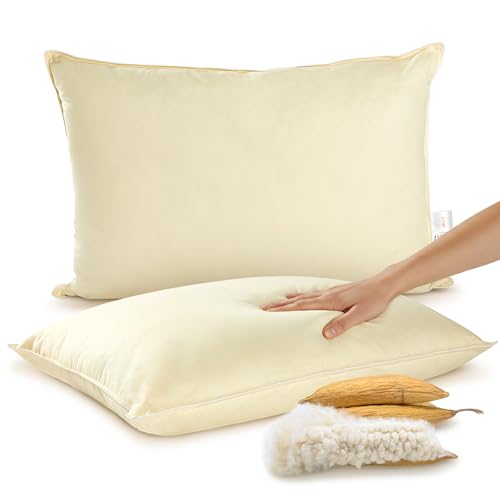
Cheer Collection Organic Kapok Pillow, Standard — Best Accessible Kapok Option
The Cheer Collection brings the same organic kapok concept to a standard-size pillow with a cotton cover, at the more accessible end of the kapok market. It is the pick for buyers who like the material story — renewable tree fibre, no foam, no down — and want to try it without committing to the premium queen-size option.
Strengths
- Organic kapok fibre fill in a cotton cover
- Standard size suits existing pillowcases
- Softer, breathable feel for back and side sleeping
Trade-offs
- Standard size only in this listing
- Kapok care applies — fluff to keep the loft
- Certification detail is thinner than the guide’s top pick
| Spec | Detail (from verified listing title) |
|---|---|
| Fill | Organic kapok fibre |
| Cover | Cotton |
| Size | Standard |
| Certification named | Not stated in title |
Think of this as kapok’s front door. The feel is the same family — light, soft, breathable, faintly springy — in the size most people already own cases for, which makes it the lowest-friction way to find out whether a plant-fibre pillow suits your sleep before investing in larger or premium versions.
Its evidence level sits with the material claim rather than named certification, as its title states the fill and cover without acronyms. That places it honestly in this guide’s third tier of evidence — real material, maker’s word — and buyers for whom third-party proof is the priority should step up to the GOLS/GOTS latex pick at the top of the guide.
Best for: First-time kapok buyers and standard-size bedding setups / Not suited for: Certification-first buyers or queen/king bedding
Check on Amazon — check price on Amazon and confirm the exact size, colour and configuration before ordering.
Comparison Table
| Pick | Badge | Key spec | Best for |
|---|---|---|---|
| ORGANIC TEXTILES GOLS-Certified Organic Latex Pillow | Strongest Verified Claim | GOLS organic latex + GOTS organic cotton cover | Back and side sleepers wanting the strongest certified-organic evidence |
| Delara GOTS-Certified Organic Cotton Shell Pillows (Set of 2) | Best Certified Shell, Honest Limits | GOTS organic cotton shell; down-alternative fill | Buyers wanting certified organic cotton at the skin with easy-care fill |
| Organic Cotton Bed Pillow with Organic Cotton Casing | Best All-Cotton Simplicity | Organic cotton fill and casing, standard size | Material purists wanting an all-cotton, foam-free pillow |
| LOFE Buckwheat Pillow 20×26 with Organic Cotton Pillowcase | Best Traditional Renewable Fill | Buckwheat hull fill; organic cotton pillowcase; adjustable | Hot sleepers and side/back sleepers wanting firm, shaped support |
| Bean Products Organic Kapok Pillow, Queen | Best Plant-Down Alternative | Organic kapok fill; queen size; adjustable | Softness lovers wanting a plant-based, down-free fill |
| Cheer Collection Organic Kapok Pillow, Standard | Best Accessible Kapok Option | Organic kapok fill; cotton cover; standard size | First-time kapok buyers and standard-size bedding setups |
Read this table by evidence level, top to bottom: named organic certification for fill and cover; certified shell with disclosed synthetic fill; organic material claims without named certifiers; and traditional renewable fills. All six are defensible purchases — they are not equally proven, and the table refuses to pretend otherwise.
How to Choose the Best Sustainable Bed Pillows — By Evidence, Not Adjectives
Start by demanding the noun behind the adjective. ‘Organic’ should name what is organic — the latex, the cotton, the whole product — and ideally who certified it. ‘Natural’ names nothing verifiable at all: latex, cotton and kapok are all natural in origin, including in pillows with no sustainability effort behind them. The picks in this guide were graded on exactly this distinction, and your own shopping should be too.
Next, match the fill to your sleep before your values finish the sentence. The most certified pillow in the world is waste if its contour shape keeps a stomach sleeper awake — an unused product is the least sustainable outcome of all. Latex for structure and longevity, buckwheat for firm cool adjustability, kapok for softness, cotton for simplicity: choose the feel first, then take the strongest evidence available within that feel.
Finally, think in years. A latex pillow that serves seven years has a smaller footprint than three cheap pillows landfilled in the same period, even before materials are compared. Durability is a sustainability feature, and it is the one most often missing from green marketing.
The Certifications, Translated Into Plain English
GOTS — the Global Organic Textile Standard — certifies that a textile product is genuinely organic, from fibre through processing, with a tracked chain of custody. On a pillow it usually covers the cotton shell; when a title says a cover is GOTS certified, the claim is about that textile, which is exactly how the Delara review above treats it.
GOLS is the latex counterpart: the Global Organic Latex Standard certifies that latex is organic latex, with minimum organic content requirements. It is the strongest single claim a latex pillow can make, and it is why the Organic Textiles pick, pairing GOLS latex with a GOTS cover, tops this guide’s evidence ranking.
OEKO-TEX Standard 100 certifies that a product has been tested for harmful substances and passed. That is a genuine safety credential — and it is not an organic, recycled or sustainability certification, however often it is photographed beside leaves. CertiPUR-US does a similar standards job for foam. Value these marks for what they prove, and refuse the upgrade retailers invite you to imagine.
End of Life and Care: The Forgotten Half of Sustainable Bedding
A pillow’s footprint includes its death. Latex, cotton, kapok and buckwheat are all biodegradable fills; synthetic fills and foam are not, and will outlast you in landfill. When a natural-fill pillow finally tires, the fill can often be composted where facilities allow, and the cotton cover with it — a genuinely different end from a foam pillow’s.
Care extends life, which is the cheapest sustainability there is. Use a washable pillow protector from day one — it is far easier to wash than any pillow — air natural fills in sun occasionally to refresh them, and fluff kapok and cotton daily. Buckwheat hulls can be topped up rather than replacing the whole pillow, and adjustable fills generally turn a worn pillow into an adjusted one.
When you do replace a pillow, step the old one down rather than binning it: pet beds, floor cushions and draught excluders all accept a tired pillow gratefully, and every extra year of use is footprint already paid for.
How to Adjust and Care for Natural-Fill Pillows
Latex, buckwheat, kapok and cotton each ask for slightly different handling. These steps cover the shared routine and the fill-specific points that keep a sustainable pillow performing.
- Fit a washable pillow protector before the first night — it guards every fill type and washes in minutes.
- For adjustable fills (buckwheat, kapok), set the height over three nights: start full, remove a handful at a time until your neck sits level.
- Fluff kapok and cotton pillows daily with a few firm shakes and pats; natural fibres compress and recover by hand, not by themselves.
- Air natural-fill pillows in indirect sun for an hour monthly to refresh them; avoid soaking any natural fill in water.
- Spot-clean latex rather than washing it, and never wring a latex pillow — water and twisting damage its structure.
- Top up buckwheat hulls instead of replacing the pillow when it feels low; keep the spare hulls dry and sealed.
- Rotate the pillow end-to-end weekly so wear and compression spread evenly.
- Replace the protector, not the pillow, when freshness fades — most ‘tired pillow’ complaints are tired-protector problems.
Keep a small note of what you removed from adjustable fills and how the height felt; dialling a natural pillow in is a short experiment, and notes make it a short one.
Common Buying Mistakes
Treating OEKO-TEX as an organic certification. It certifies testing for harmful substances — valuable, but a different claim. Organic means GOTS or GOLS, named on the product.
Believing the word ‘natural’ proves anything. Nearly every pillow fill is natural in origin. Demand the certified noun: organic latex, organic cotton, named in the title.
Buying the most certified pillow in the wrong shape. An unused pillow is pure waste. Match the fill and profile to your sleep first, then maximise evidence within that match.
Washing fills that should only be aired. Latex and hulls are damaged by soaking. Protectors and spot-cleaning are the sustainable pillow’s washing system.
Ignoring end of life. Foam and synthetic fills persist in landfill; natural fills biodegrade. The disposal difference is real and belongs in the decision.
Why Latex Ages Better Than Foam, and Why It Matters Here
Conventional foam pillows die by compression: the cells collapse, the pillow thins, and within a couple of years it is replaced. Latex — a tapped, natural material — keeps its spring far longer, which is why a certified latex pillow can be the cheapest sustainable option per year of sleep despite the highest shelf price in this guide.
Longevity also forgives other footprints. Transport, packaging and retail impact are paid once for a seven-year pillow and three times for three two-year pillows. When you compare sustainable pillows, divide every claim by expected years of service and the ranking often rearranges itself.
The Pillow Industry’s Waste Problem, and Where Your Purchase Fits
Most pillows are replaced every one to two years, and most are made of materials that do not biodegrade: polyester fills and polyurethane foams that will persist in landfill for centuries, multiplied by hundreds of millions of sleepers. That arithmetic — not any single product’s virtue — is the sustainability problem of this category, and it explains why this guide keeps returning to two unfashionable virtues: durability and end of life. A pillow that lasts, made of fill that rots, is the whole solution in one sentence.
Against that background, judge every green claim you meet by the two questions this guide asked of its own picks: what is it made of, proven by whom — and what happens when it is done? A certification answers the first question for the component it covers. The second question is answered by the material itself: latex, cotton, kapok and buckwheat return to the earth; synthetics do not, whatever the packaging’s leaf count says.
Your own behaviour completes the picture. A protector that doubles a pillow’s hygienic life, a daily fluff that keeps natural fills working, a refusal to replace on schedule rather than on condition — these unglamorous habits are worth more footprint than any single purchasing decision. Sustainability in bedding is mostly maintenance, and maintenance is mostly attention, which is good news: it means the greenest pillow available to you tonight is the one you already own, properly cared for.
Down, Wool and the Animal-Derived Options: An Honest Word
A complete sustainable-pillow guide should acknowledge the fills it did not shortlist. Down and feather are natural, biodegradable and extraordinarily durable — a quality down pillow can serve a decade — and their sustainability debate is an ethical one about animal welfare and sourcing standards rather than a materials one. Buyers who choose down should look for responsible-down certification with the same rigour this guide applies to GOTS and GOLS, and buyers who avoid animal products entirely will find kapok the closest plant-based feel.
Wool is the other traditional fill with a serious case: temperature-regulating, durable, biodegradable, and produced as part of an existing agricultural cycle. Wool pillows are firmer and flatter than most modern sleepers expect, which is why they appear in this market as a niche rather than a headline — but a sleeper who likes a low, firm pillow may find wool the most sustainable option of all, and honesty requires saying so even though no wool pick made this verified shortlist.
The lesson generalises: sustainability rankings depend on which impact you weight — carbon, animal welfare, biodegradability, longevity — and reasonable people weight them differently. This guide has weighted certified content, material end-of-life and durability, and said so. Your own weighting may reorder these six picks, and the evidence labels in every review are there precisely so that you can.
Reading a Pillow Listing Like an Auditor
Open any pillow listing and perform the three-minute audit this guide performed. First, find the fill — the actual material, named, not described. ‘Cloud-like comfort fill’ is not a material; ‘kapok fibre’ is. If the fill cannot be named from the listing, the listing is asking for trust it has not earned, and the audit can end there.
Second, find the certification’s scope. A named standard — GOTS, GOLS, OEKO-TEX — always certifies something specific: a cover, a latex core, a test passed. Listings that splash a logo without saying what it covers are relying on you to imagine the widest scope, which is the oldest trick in this market. The picks in this guide state their scopes in their spec boxes because the scope is the claim.
Third, find the care and the end. Can it be protected, aired, topped up, repaired? Does the maker say what it is made of plainly enough that you could dispose of it responsibly? A maker who answers all three audits — material, scope, end — without evasion has earned the word sustainable on their packaging. Very few do. The six in this guide came closest, at the evidence levels stated, and the distance between them and the rest of the market is the real finding of this research.
Sustainable Pillows for Different Sleepers: A Fitting Guide
Sustainability chooses the material; your sleep position chooses the shape, and ignoring the second choice wastes the first. Side sleepers need loft — enough height to fill the shoulder gap and keep the neck level — which makes the adjustable fills in this guide, buckwheat and kapok, particularly practical: both can be tuned handful by handful until the shoulder test passes. The contour latex pick also serves side sleepers well, its shaped profile doing the alignment work that loose fills do by volume.
Back sleepers need less height and more neck support, and they are the contour pillow’s natural audience; a too-lofty pillow pushes the back sleeper’s chin down all night, which is why the medium-loft specification of the GOLS pick matters and why adjustable fills should be set lower for back sleeping than side. Judge by the morning: a level, unstrained neck is the only review that counts.
Stomach sleepers need the flattest pillow available and are the hardest for this category to serve, because natural fills tend towards substance. The all-cotton pick, allowed to compress, or a kapok pillow with much of its fill removed, are the workable routes; a contour or a full buckwheat pillow will fight a stomach sleeper all night, and an honest guide says so rather than selling the fight.
Combination sleepers — most people — should default to adjustability above all, because a pillow that can be re-tuned as habits change outlasts three pillows bought for phases. That is the quiet sustainability argument inside the fitting advice: the pillow that still suits you in three years is the greenest one, whatever it is made of, and adjustable natural fills are the rare case where the greenest choice and the most adaptable one are the same product.
Building a Whole Sustainable Bed, One Honest Layer at a Time
A pillow is one layer of a bed, and buyers who think in layers make better decisions at every level. The same evidence discipline this guide applies to pillows — name the material, name the certification and its scope, ask about end of life — transfers directly to the layers around it: the protector that extends the pillow’s life, the sheets whose cotton claims deserve the same GOTS question, the duvet whose fill should be named as plainly as any pillow’s. A bed built by that discipline, layer by layer, ends up genuinely lower-impact without ever having chased a single miracle product.
Sequence matters more than perfection. The protector comes first, because it protects every later purchase. The pillow comes second, because it is replaced most often and touches you most closely. Sheets and duvet follow as their predecessors wear out — replaced on condition, with the audit applied, rather than in a single expensive purge that sends serviceable bedding to landfill in sustainability’s name, which is the one outcome worse than buying conventionally.
Keep the old layers in service where you can: retired pillows become pet beds and floor cushions, retired sheets become dust covers and cleaning cloths, and every demotion is footprint already paid being spent twice. The sustainable bed, honestly built, looks less like a showroom and more like a well-run household — everything in use, everything accounted for, nothing wasted on appearances.
That is the standard this guide has tried to model in miniature: six pillows, each with its evidence stated at its true level, none oversold, all of them good at the job of being slept on. Apply the same standard outward, layer by layer and year by year, and the bed you end up with will be sustainable in the only sense that survives scrutiny — materially, measurably, and without a single claim you would be embarrassed to explain.
Certification Beyond the Pillow: Teaching Yourself to Read Any Label
The skill this guide has practised on pillows — demanding the material, the certifier and the scope — is worth keeping for every textile you will ever buy, because the fog in this market is general. A towel, a sheet, a child’s pyjamas: each arrives with its adjectives pre-installed, and each yields to the same three questions. What is it made of, named in nouns? Who says so, in the form of a standard with a scope? And what happens to it at the end? A product that answers all three plainly is rare enough to be worth its price; a product that answers none is telling you something too.
Notice, as you practise, how the honest listings read differently. They are specific where marketing is vague, modest where marketing is grand, and they put their certifications in sentences rather than in leaf-shaped logos. The verified titles behind this guide’s picks read exactly that way — GOLS named against the latex, GOTS against the cotton, a synthetic fill disclosed in the same breath as the organic shell — and learning to hear that tone is worth more than memorising any acronym, because acronyms change and tone does not.
Carry the standard gently, though. The goal is a bed — and a home — that is materially honest, not a life spent auditing duvets. Buy the big, long-lived, skin-touching things with full rigour; let the small things be simple; replace on condition rather than on schedule or on guilt. Sustainability practised that way survives contact with real life, which is the only place it was ever going to happen. The six pillows in this guide are a good place to start, and the questions are now yours to keep.
A Final Word on Price and Proof
Certified materials cost more to produce, and this guide will not pretend otherwise: the GOLS latex pick asks a premium because organic latex, audited through a chain of custody, is genuinely more expensive than foam poured to no standard at all. What the premium buys is not virtue signalling but verifiability — a claim you can check, from a body that checks it for a living. Judged per year of service, with latex’s longevity counted honestly, that premium narrows to very little, and judged per claim actually proven, it is the cheapest pillow in this guide. Spend where the proof is, save where it is not, and let every seller who wants your money meet the same standard these six were held to.
Final Recommendation
If you want the strongest evidence and sleep on your back or side, buy the Organic Textiles GOLS latex pillow — it is the guide’s benchmark for a reason. If you want certified organic cotton at your face with easy-care fill, take the Delara set with its limits understood. Material purists should choose between the all-cotton pillow, the LOFE buckwheat for firm cool adjustability, and the two kapok pillows for softness — Bean Products in queen, Cheer Collection in standard. Every one of the six is a defensible purchase; they simply carry different levels of proof, and now you know exactly which is which.
Related guides on this site: Best Support Pillows For Elderly; Best Buckwheat Pillows Under $50; Best Barley Pillows; Best Affordable Pillows; Best Alternative To Down Pillows.
Frequently Asked Questions
What is the difference between GOTS and GOLS?
GOTS certifies organic textiles — typically a pillow’s cotton cover. GOLS certifies organic latex — the fill of a latex pillow. The strongest claim pairs both, as the top pick in this guide does.
Is OEKO-TEX the same as organic?
No. OEKO-TEX certifies that a product was tested for harmful substances. It says nothing about organic content. Treat it as a safety credential, not a sustainability one.
Which sustainable fill lasts longest?
Latex, by a wide margin — a quality latex pillow holds its shape for many years without fluffing. Kapok and cotton compress gradually and need maintenance; buckwheat hulls last well and can be topped up.
Are buckwheat pillows comfortable?
They are firm, mouldable and very cool, and side and back sleepers often love the shaped support. They rustle and feel strange for the first nights — allow a week before judging.
Is a GOTS shell with synthetic fill a sustainable pillow?
Partly — and it should be sold and bought as exactly that. The organic cotton at your skin is real; the fill is conventional. This guide labels such picks as partial claims rather than rounding them up.
How do I dispose of a natural-fill pillow responsibly?
Step it down to pet or floor use first. At true end of life, cotton, kapok, buckwheat and latex fills are biodegradable and can be composted where local facilities accept them; synthetic fills cannot.

