Disclosure: airfryerkitchensupply.com is reader-supported. When you buy through links on our site, we may earn an affiliate commission at no extra cost to you.
Where to buy
Every pick in this guide to the best buckwheat pillows under 50 was cross-checked against Amazon’s own catalog data before it earned a link, so the buttons below go to the exact product described — not a look-alike listing. Prices in this category move often, so each pick simply asks you to check the current price on Amazon rather than trusting a number printed here that could be stale by the time you read it.
- Beans72 Organic Buckwheat Pillow — Queen (Best Overall) — Check the current price on Amazon
- LOFE Buckwheat Pillow 20×26 (Best Adjustable Standard Size) — Check the current price on Amazon
- Beans72 Organic Buckwheat Pillow — Standard (Best No-Frills Value) — Check the current price on Amazon
- Zen Chi Organic Buckwheat Hull Pillow (Best Cooling Feel) — Check the current price on Amazon
- MIOTO Organic Buckwheat Pillow (Best Starter Kit) — Check the current price on Amazon
- LOFE Organic Buckwheat Pillow 14×20 (Best Compact / Travel) — Check the current price on Amazon
The best buckwheat pillows under 50 dollars share a simple idea: a shell of cotton filled with thousands of small buckwheat hulls that shift, lock together and hold the shape of your head and neck instead of springing back like foam. There is no bounce, no slow sink and no warm foam smell — just a firm, rustling, surprisingly cool surface that you mould with your hands before you lie down. For sleepers who have worked through memory foam, latex and down alternative and still wake up repositioning their pillow, that mouldable firmness is the whole appeal.
The honest catch with this price tier is that it is a tier of compromises, and this guide will not pretend otherwise. Genuine buckwheat pillows under $50 do exist — the six below were each confirmed in Amazon’s catalog — but at this level you are usually choosing between a smaller pillow with good hulls, a standard-size pillow with a basic single-chamber shell, or a pillow that includes a spare case instead of extra fill. What you should not accept at any price is a pillow with no zipper: adjustability is the entire point of buckwheat, and a sealed pillow you cannot add or remove fill from is a firm pillow you are stuck with.
Every pick below uses a zippered, refillable design, and the reviews are blunt about the trade-offs of the under-$50 tier: thinner shell fabric on some models, hull dust that needs a sifting before first use, and a rustling sound that light sleepers either stop noticing within a week or never accept at all. Read the fit notes before the strengths — with buckwheat, the sleeper the pillow does not suit matters more than the feature list.
In this guide
Quick Picks
If you only have a minute, these are the six shortlisted options for the best buckwheat pillows under 50, each chosen for a different kind of buyer. The full reviews further down explain who each one suits and where each one compromises.
- Beans72 Organic Buckwheat Pillow — Queen — Best Overall. The long-running benchmark in this tier: a generous 20×30-inch queen filled with organically grown hulls, sized for adults who found standard buckwheat pillows too small. — Check price on Amazon
- LOFE Buckwheat Pillow 20×26 — Best Adjustable Standard Size. A standard-size pillow filled with tartary buckwheat hulls and bundled with an organic cotton pillowcase, built around easy height adjustment. — Check price on Amazon
- Beans72 Organic Buckwheat Pillow — Standard — Best No-Frills Value. The same organically grown hulls and plain, durable build as the queen, in a standard 20×26-inch size for smaller beds and smaller budgets. — Check price on Amazon
- Zen Chi Organic Buckwheat Hull Pillow — Best Cooling Feel. A twin/standard pillow that leans into buckwheat’s natural airflow — hulls leave air channels that foam cannot match — with an all-cotton cover. — Check price on Amazon
- MIOTO Organic Buckwheat Pillow — Best Starter Kit. The most complete box on this list: pillow, an extra cotton pillowcase and a supply of extra tartary hulls for topping up or experimenting. — Check price on Amazon
- LOFE Organic Buckwheat Pillow 14×20 — Best Compact / Travel. A compact 14×20-inch Japanese-style pillow that doubles as a travel pillow — small, very firm and easy to pack into a car or carry-on routine. — Check price on Amazon
How These Picks Were Chosen
Picks were chosen by working from the fill outward. First, the fill itself: only pillows filled with buckwheat hulls — not whole seeds, not millet blends sold as buckwheat, and not foam with a buckwheat topper layer — were considered, and each product had to be confirmed against Amazon’s catalog data with a matching title before it received a link. Second, the shell: a zippered opening for adjusting fill height is mandatory, and an included cotton pillowcase scored heavily because hulls are abrasive enough that a case is not really optional.
Size and shape came next. Standard 20×26-inch pillows suit most adults and existing pillowcases; queen 20×30 suits broader shoulders and king-width beds; the smaller Japanese-style and travel sizes serve side sleepers who want a compact, very firm bolster-like feel. Finally, value inside the under-$50 frame: because printed prices drift, picks were judged on what the money buys — hull quality, shell weight, spare cases and extra fill included — rather than on a snapshot price.
The 6 Best Buckwheat Pillows Under $50
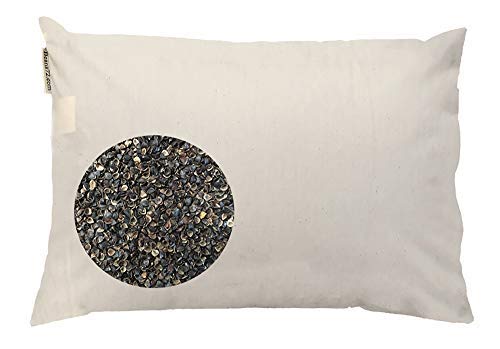
Beans72 Organic Buckwheat Pillow — Queen — Best Overall
Beans72 has sold buckwheat pillows for decades, and the queen is the one to buy if you are committing to the category rather than dabbling. The extra four inches of width over a standard pillow matters more than it sounds: hulls migrate away from your head as you settle, and a wider pillow keeps a supportive bank of fill under your neck instead of letting it all slide to the edges. It suits back and side sleepers with average-to-broad shoulders who want firm, shaped support.
Strengths
- True queen footprint (20×30 in) that fills a queen pillowcase properly
- Organically grown hulls with a sturdy cotton shell
- Zippered fill access, so height can be tuned handful by handful
Trade-offs
- Heavier than any foam pillow — expect to move it with two hands
- Rustles audibly when you change position
- Firmness is uncompromising; stomach sleepers usually hate it
| Size | Queen, 20 x 30 in |
| Fill | Organic buckwheat hulls |
| Shell | Cotton, zippered for fill adjustment |
What separates the Beans72 from cheaper imitations is hull consistency: the fill is evenly sized, so the pillow moulds smoothly instead of feeling lumpy, and it packs into a stable shape that holds through the night. Start with it slightly overfilled, sleep a week, then remove hulls a cup at a time — most people land lower than they expect. Store removed hulls in the bag they came in; you will want them back if you change mattress or sleeping position.
One practical note for couples: the queen’s width means it behaves on a shared bed. A standard buckwheat pillow in a queen bed leaves a gap the sleeper’s head finds at 3 a.m.; the 20×30 fills its half of the bed properly and the extra hull mass resists being dragged around by a restless partner’s pillow adjustments. If only one side of the bed is converting to buckwheat, this is the size that converts without compromise.
Best for: Committed back and side sleepers wanting a full-size buckwheat pillow / Not suited for: Stomach sleepers and anyone who wants a soft, quiet pillow

LOFE Buckwheat Pillow 20×26 — Best Adjustable Standard Size
LOFE’s standard-size pillow is the easiest recommendation for first-time buckwheat buyers who sleep on a twin, full or queen bed and already own standard cases. The included organic cotton pillowcase is a genuine saving — hulls chew through thin cases — and the tartary hulls are smaller and more uniform than common buckwheat, which many sleepers find moulds a little more smoothly. It suits side and back sleepers who want to experiment with fill height without buying accessories.
Strengths
- Organic cotton pillowcase included in the box
- Tartary hulls give a fine, even moulding feel
- Clear add/remove fill design for height tuning
Trade-offs
- Standard size can feel small to restless sleepers
- Tartary hulls feel slightly less ‘locked’ than larger hulls
- Case is basic cotton — a second spare is worth having
| Size | Standard, 20 x 26 in |
| Fill | Tartary buckwheat hulls |
| Extras | Organic cotton pillowcase included |
Treat the first fortnight as calibration. The LOFE arrives generously filled; side sleepers typically remove a few cups so the shoulder can sink while the neck stays bridged, while back sleepers often remove more. Because the case is included, setup is genuinely five minutes: sift the hulls if any dust is present, zip, case, sleep. It is the lowest-friction entry into buckwheat on this list.
The tartary hull choice deserves a word, because it is this pillow’s quiet differentiator. Tartary hulls are smaller and harder than common buckwheat hulls, so the fill packs into a smoother, more uniform surface with fewer large edges — sleepers who found ordinary buckwheat ‘gravelly’ often find tartary acceptable. The trade is a slightly less interlocked feel: the pillow moulds beautifully but relaxes its sculpture a touch faster over the night. For most sleepers that balance is the right one.
Best for: First-time buckwheat buyers in standard-size bedding / Not suited for: Queen/king beds where a wider pillow tracks movement better
Beans72 Organic Buckwheat Pillow — Standard — Best No-Frills Value
If the queen Beans72 is the full commitment, the standard is the same philosophy in a smaller, cheaper footprint. There is nothing decorative here — no gussets, no cooling panels, no marketing layers — just hulls, a cotton shell and a zipper. That simplicity is exactly why it has stayed in catalogs while trendier pillows vanished. It suits single-bed sleepers, teenagers, guest rooms and anyone who wants a second buckwheat pillow for a partner to try.
Strengths
- Same organic hulls as the queen at a lower tier position
- Dead-simple, durable construction with nothing to fail
- Standard size fits cases you already own
Trade-offs
- No pillowcase included — budget for one
- Plain shell fabric is functional rather than soft
- Same rustle and weight caveats as all buckwheat
| Size | Twin/Standard, 20 x 26 in |
| Fill | Organic buckwheat hulls |
| Shell | Cotton, zippered |
Buy this one if your decision is about the fill, not the furniture. The sleeping experience — firm, cool, mouldable, noisy — is essentially the queen’s, scaled down. It is also the sensible way to test buckwheat in a household: one standard pillow, two weeks, and you will know whether the category is for you before outfitting a whole bed.
Consider this pillow the control group of the category: if you sleep well on it, you like buckwheat, full stop — there are no cooling gels or contour cuts confusing the verdict. That purity also makes it the best second purchase in the guide: households routinely buy the standard first, confirm the love, then graduate the primary bed to the queen while the standard migrates to the guest room, where it will out-serve a decade of disposable guest pillows.
Best for: Value-focused buyers and buckwheat trial runs / Not suited for: Buyers wanting a case and extras bundled in
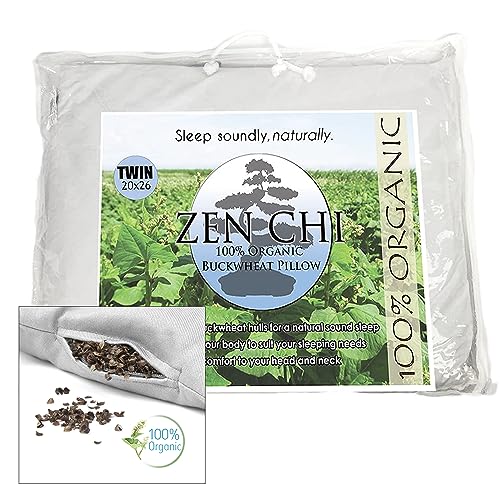
Zen Chi Organic Buckwheat Hull Pillow — Best Cooling Feel
Hot sleepers are the natural audience for buckwheat, and the Zen Chi is built for them: an all-cotton cover and a hull fill that never traps heat the way foam does. Air moves through the gaps between hulls every time you shift, so the surface resets to room temperature instead of holding a warm imprint of your head. It suits warm bedrooms, summer use and sleepers who flip the pillow hunting for a cool side that foam never provides.
Strengths
- Genuinely cool-touch surface from hull airflow
- All-cotton cover, no synthetic hot spots
- Contours firmly without foam’s slow rebound
Trade-offs
- Cool feel comes with the firmest ride on this list
- Cotton cover shows hull dust if not sifted first
- Not a plush pillow by any stretch
| Size | Twin, 20 x 26 in |
| Fill | Organic buckwheat hulls |
| Cover | All cotton |
Judge the Zen Chi on a warm night, not in a showroom squeeze. Its support is unyielding for the first minutes, then the hulls settle into a cradle that stays put. Pair it with a breathable cotton case and skip pillow protectors made of waterproof laminate — they defeat the airflow that is this pillow’s whole reason to exist.
A word about pairing: the Zen Chi rewards a breathable bedding system. A cotton percale sheet set, a light blanket rather than a synthetic duvet, and this pillow together produce the coolest sleep surface most hot sleepers have ever owned. Put a waterproof protector or a heavy flannel case over it and you have insulated away its one great talent. Buy it as part of a cool-bed strategy, not as an isolated gadget.
Best for: Hot sleepers who run warm on foam / Not suited for: Anyone wanting softness or a silent pillow

MIOTO Organic Buckwheat Pillow — Best Starter Kit
MIOTO understands the real friction with buckwheat: tuning it. Most pillows let you remove fill but give you nowhere to go if you overshoot or the hulls compress over time. This kit includes extra hulls and a spare case, so the adjustment process runs both directions and laundry day does not leave the pillow naked. It suits methodical sleepers who will actually spend two weeks dialling in height, and households where the pillow may be re-tuned for a different sleeper later.
Strengths
- Extra hulls included for topping up and re-tuning
- Spare cotton pillowcase in the box
- Adjustable height and firmness in both directions
Trade-offs
- Kit extras push it toward the top of the tier
- More parts to store than a basic pillow
- Off-white case shows marks sooner than darker options
| Fill | Organic tartary buckwheat hulls, plus extra fill included |
| Extras | Extra cotton pillowcase |
| Design | Adjustable height/firmness |
The spare hulls change the ownership experience more than any shell feature could. Hulls do slowly break down over years; a top-up restores the original loft without a new pillow. If you are the kind of buyer who keeps products for a decade, this is the under-$50 buckwheat pillow designed the way you think.
The extra-hull supply also future-proofs the pillow in a way buyers rarely consider: hulls are a natural material and batches vary slightly in size and feel. Owning a reserve from the same original batch means your top-ups match the fill you tuned — the pillow at year three feels like the pillow at month one, rather than drifting as mixed replacement fill is added. It is a small, thoughtful kind of consistency that suits the keep-it-a-decade buyer perfectly.
Best for: Long-term owners who will maintain and re-tune fill / Not suited for: Minimalists who want pillow-only simplicity
LOFE Organic Buckwheat Pillow 14×20 — Best Compact / Travel
Not everyone wants a bed-sized slab of hulls. The small LOFE follows the Japanese sobakawa tradition: a compact, densely filled pillow that supports the head and neck without surrounding them. It suits back sleepers who like a defined neck roll effect, campers and van travellers who need a real pillow in a small space, and anyone who wants to test buckwheat at the lowest commitment in size and tier. Its organic cotton pillowcase is included and washable.
Strengths
- Compact footprint for travel, camping and small beds
- Dense, defined support in the sobakawa style
- Case included and washable
Trade-offs
- Too small for restless sleepers who roam the pillow
- Very firm — the least forgiving feel here
- Not a substitute for a full-size bed pillow for most adults
| Size | 14 x 20 in |
| Fill | Organic buckwheat hulls |
| Extras | Organic cotton pillowcase, washable |
Use it where its size is the feature: a camper berth, a reading chair, a guest futon, or the car on a road trip where hotel pillows are a gamble. At home it also works as a between-the-knees or lumbar hull pillow. Just do not buy it as your only bed pillow unless you already know you love the compact sobakawa format.
Frequent flyers should note the practical detail: a 14×20 hull pillow is dense and will be the heaviest item in a carry-on, so this is a car-travel and camping champion rather than a flight companion. Where it truly shines is the road-trip hotel problem — unknown pillows, wrong heights, a sore neck by day two. Your own tuned sobakawa in the boot of the car ends that lottery entirely.
Best for: Travel, camping and sobakawa-style sleepers / Not suited for: Restless sleepers needing a wide target
Comparison Table
| Pick | Badge | Key spec | Best for |
|---|---|---|---|
| Beans72 Organic Buckwheat Pillow — Queen Check price on Amazon | Best Overall | Queen 20×30 in, organic hulls | Committed back and side sleepers wanting a full-size buckwheat pillow |
| LOFE Buckwheat Pillow 20×26 Check price on Amazon | Best Adjustable Standard Size | 20×26 in, tartary hulls, case included | First-time buckwheat buyers in standard-size bedding |
| Beans72 Organic Buckwheat Pillow — Standard Check price on Amazon | Best No-Frills Value | 20×26 in, organic hulls, zippered shell | Value-focused buyers and buckwheat trial runs |
| Zen Chi Organic Buckwheat Hull Pillow Check price on Amazon | Best Cooling Feel | 20×26 in, all-cotton cover, airflow hull fill | Hot sleepers who run warm on foam |
| MIOTO Organic Buckwheat Pillow Check price on Amazon | Best Starter Kit | Extra hulls + spare case included | Long-term owners who will maintain and re-tune fill |
| LOFE Organic Buckwheat Pillow 14×20 Check price on Amazon | Best Compact / Travel | 14×20 in compact, case included | Travel, camping and sobakawa-style sleepers |
How to Choose the Best Buckwheat Pillows Under $50
Start with the fill, because everything else is packaging. A real buckwheat pillow is filled with the hard outer hulls of buckwheat seeds — triangular, cupped pieces that interlock under pressure. That interlocking is what lets the pillow hold a sculpted shape: push a valley where your ear goes, raise a ridge under your neck, and it stays. If a listing is vague about whether the fill is hulls, whole seeds or a blend, treat that vagueness as your answer and move on. All six picks above state their hull fill plainly and were verified against catalog data.
Next, the zipper test. Adjustability is not a bonus feature on a buckwheat pillow; it is the mechanism by which the pillow fits you at all. Foam comes in lofts; buckwheat comes in one loft — yours, set by how much fill you leave in. A sealed pillow forces you to accept the factory’s guess. Every pick here opens, so you can remove hulls by the cupful during the first two weeks and add them back months later as the fill settles.
Size: standard, queen or compact
Match size to bed and body, not to ambition. Standard 20×26-inch pillows fit the cases in your linen cupboard and suit most sleepers. Queen 20×30 gives side sleepers and broad shoulders more material to build a neck ridge from, and fills a queen bed’s proportions. Compact 14×20 sobakawa-style pillows are a deliberate niche: excellent for travel and for back sleepers who want a firm, defined support, frustrating for anyone who moves around. Buying a compact pillow as a cheap way to try buckwheat is the most common sizing mistake — try the standard size of a budget pick instead.
Shell fabric and the case question
Hulls are abrasive. Over months, their edges work against the shell from inside, which is why shell weight matters and why a pillowcase is effectively mandatory. Plain cotton shells like the Beans72’s are durable and honest; what you want to avoid is a shell so thin you can see hull silhouettes through it. If a pillow includes a case — LOFE and MIOTO do — that is real value in this tier, because a decent cotton case bought separately closes much of the price gap to the next model up.
What the Under-$50 Tier Can and Cannot Buy
Honesty about this budget frame saves returns. Under $50 buys you genuine hulls, a serviceable cotton shell, a zipper and, in the better kits, a case or spare fill. It does not buy premium double-stitched shells, pre-sifted dust-free hulls in every batch, or designer covers. Expect to spend ten minutes at setup shaking and sifting hulls over a bin if dust is present — that is normal for the tier, not a defect.
What the tier should never cost you is the core experience. Firm, cool, mouldable support is identical in mechanism at this level and at twice the spend; you are paying extra elsewhere mainly for refinement. If your expectations are set there — a working pillow, honestly built — the under-$50 frame is one of the better bargains in bedding. If you want luxury finishing, this is the wrong shelf of the shop and no pick here will change that.
Buckwheat vs Memory Foam, Latex and Down Alternative
Foam supports by resisting you; buckwheat supports by rearranging around you and then stopping. That difference explains every strong opinion in this category. Memory foam sleepers who hate the trapped, slow feeling usually take to hulls immediately; down lovers who want to sink into softness usually bounce off within a night. Latex sits between — springy, durable, but not mouldable. Buckwheat is also the coolest of the four by a wide margin, the heaviest by a wider one, and the only one you can tune at home with a measuring cup. Choose by the sensation you keep shopping for, not by feature lists.
How to Set Up and Adjust a Buckwheat Pillow
A buckwheat pillow is not finished when it leaves the box — you finish it. This twenty-minute setup, then a two-week tuning habit, is what separates people who love these pillows from people who return them.
- Sift the hulls. Open the zipper over a large bowl or clean bin and pour the fill through your hands. Any fine dust or broken fragments fall away. This is normal in this price tier and noticeably reduces both mess and noise.
- Set a starting loft. Refill the shell to about three-quarters full for back sleeping or four-fifths for side sleeping. You are setting a starting point, not a final answer.
- Shape before you lie down. Each night, push hulls into a ridge under where your neck will rest and press a shallow hollow for your head. Hulls hold the sculpture; foam habits of just flopping down do not work here.
- Tune by the cupful. Every two or three nights, add or remove one cup of hulls based on the previous nights. Small changes feel large with an interlocking fill. Keep removed hulls bagged — you may want them back.
- Case it and keep it dry. Always use the cotton case. Hulls and moisture are enemies: never sleep on the pillow with wet hair, and air the pillow in a dry room monthly. The shell and case wash; the hulls themselves do not.
After two weeks of tuning, most sleepers stop thinking about the pillow — the real success state for any bedding. If you are still fighting it nightly at that point, the honest conclusion is that firm hull support is not your category, and no amount of adjustment will make it so.
Who Should (and Should Not) Buy a Buckwheat Pillow
Buy buckwheat if you sleep hot, if foam’s slow sink makes you feel trapped, if you rearrange a normal pillow into a neck ridge every night with your hands — buckwheat simply keeps the shape you build. Side sleepers with a gap between shoulder and head to fill, and back sleepers who like a defined cradle, are the classic converts. So are travellers-by-car who can bring their own tuned pillow and end the hotel pillow lottery.
Do not buy buckwheat if you sleep on your stomach (the firmness fights your neck angle all night), if you are a very light sleeper sharing with a restless partner (the rustle is real), or if the words ‘some assembly required’ annoy you — this pillow is a two-week tuning project, and people who want bedding to work silently out of the box should buy good foam instead and be happy. Honest self-knowledge is the whole of this category: the same pillow is a revelation to one sleeper and a return label to another, and both are right.
Buckwheat Pillow Care and Long-Term Ownership
Ownership is simple but not zero. Keep the pillow cased at all times. Air it monthly in a dry room — hulls equilibrate with ambient humidity, and a pillow stored in a damp room will feel and smell like it. Every year or two, empty the hulls onto a clean sheet in the sun for an afternoon: ultraviolet and dry air refresh them noticeably. Inspect the shell at the same time; the zipper and seams are the wear points, and a shell that is thinning can be replaced or reinforced before it fails dramatically at 2 a.m.
Expect the fill to need a top-up eventually — hulls polish smooth and settle. This is maintenance, not failure: it is exactly why the MIOTO’s spare hulls and every pick’s zipper matter. A buckwheat pillow maintained this way is a five-to-ten-year product, which reframes the under-$50 frame entirely: this is one of the cheapest cost-per-year pillows in bedding, bought at the tier where most buyers assume they are buying disposable.
The First Two Weeks: A Tuning Diary
Night one will probably disappoint you, and this guide would rather tell you now. The pillow arrives overfilled, the hulls are unfamiliar under your ear, and the rustle is new. Sleep on it anyway, and in the morning remove one cup of hulls if your head sat too high — judge by your neck’s angle, not by the pillow’s looks. Nights two to four are the sound adjustment: your brain files the rustle under ‘house noises’ and stops waking you for it, the same way it learned the fridge hum.
By night seven, most sleepers have removed two to four cups total and the pillow has begun to feel less like equipment and more like their pillow. This is the moment to make smaller changes — half a cup at a time — and to experiment with the sculpted shape: a deeper hollow, a firmer neck ridge. By night fourteen the verdict is honest either way. The sleepers who reach this point almost never go back to foam; the ones who quit at night two never met the product they bought. The two weeks are not a hurdle before the experience — they are the experience, the part where the pillow becomes yours.
One practical tip for the diary: keep the removed hulls in a labelled bag in the linen cupboard, not the bin. Seasonal changes, a new mattress, a shoulder that prefers a different height in winter — all of these send owners back to the bag, glad it exists.
Buckwheat and Your Bedding System
A buckwheat pillow changes two small things elsewhere in the bed. First, pillowcase choice matters more: a smooth, sturdy cotton case protects the shell and quiets the rustle slightly, while a thin or loosely woven case lets hull edges work through faster. The cases included with the LOFE and MIOTO picks are specified for exactly this duty. Second, your other pillow — if you keep a soft one for reading in bed — now has a clear job division: soft for sitting up, hulls for sleeping. Many converts end up with exactly that two-pillow system and wonder why beds ever pretended one pillow does both.
Mattress firmness interacts too. On a soft mattress your shoulders sink, narrowing the head-to-mattress gap, so you will tune the pillow lower; on a firm mattress you will keep more fill. This is why a buckwheat pillow that was perfect at a partner’s house can feel wrong at home — and why adjustability, not any fixed loft, is the feature that travels. Retune after any mattress change and the pillow is new again.
Verdict by Sleeper Type
The side sleeper with broad shoulders: buy the Beans72 Queen and tune it high — your shoulder-to-head gap is the largest of any position, and the queen’s extra width gives you the material to fill it. Keep the neck ridge pronounced; hulls will hold it all night in a way foam never does. The back sleeper: the LOFE 20×26 or the standard Beans72, tuned lower than instinct suggests, with a shallow hollow and a modest ridge. Back sleepers overfill more than any other group, because a full buckwheat pillow feels reassuring in the hands and pushes the chin down in practice.
The combination sleeper who rotates: the queen again, because roaming needs acreage, and its hull mass resists being shoved off the bed’s geography by your own movement. The hot sleeper: the Zen Chi inside a breathable bedding system, full stop. The traveller and camper: the compact LOFE, accepting its firmness as the price of a pillow that is truly yours in every strange bed. The methodical long-termer: the MIOTO kit, because you will maintain it and it is built to be maintained.
And the honest exclusions, once more: stomach sleepers should not buy anything on this page — spend the money on a thin, soft pillow from another category and sleep better tonight. Very light sleepers with restless partners should trial the standard Beans72 as a household experiment before committing a whole bed. Everyone else: pick your row in this verdict, tune for two weeks, and join the category’s quietly evangelical majority.
What to Do With a Buckwheat Pillow Besides Sleep On It
Owners discover the second life of hull pillows quickly. As a reading prop, a buckwheat pillow holds its sculpted angle behind your back in a way foam slumps out of within minutes. As a meditation cushion substitute, a compact hull pillow (the small LOFE is ideal) gives a firm, level seat that does not roll. Between the knees for side sleepers, a small hull pillow keeps its separation all night instead of flattening by midnight. As a travel neck support in the car — not the plane, given the weight — it outperforms every foam U-pillow ever sold at an airport.
There are limits worth stating: do not use a hull pillow as a hot or cold pack unless the maker designs it for that — hulls and microwaves are a combination this guide does not endorse improvising. And keep bed pillows for beds: the floor-sitting and prop duties are bonuses of ownership, best served by the compact second pillow rather than by dragging your tuned sleeping pillow around the house and back. Buy the standard as the sleeper, the compact as the everything-else, and the system is complete.
Common Buying Mistakes
Buying a sealed pillow. Without a zipper you cannot tune loft, cannot sift dusty hulls and cannot top up fill as it settles. It is the single feature that decides whether buckwheat works, and it is the first thing bargain listings quietly drop.
Judging it on night one. An untuned buckwheat pillow at factory fill is too high and too hard for most people. Buyers who quit after one night never met the pillow they actually bought. Give the two-week tuning process a fair run.
Expecting silence. Hulls rustle. It fades into background for most sleepers within days, but if you are an extremely light sleeper or share with one, weigh that honestly before ordering — no model in this tier is quiet.
Skipping the pillowcase. Hull edges abrade shells from inside and skin oils soil them from outside. Running a buckwheat pillow bare shortens its life and voids the point of a washable setup.
Using it as a stomach pillow. Firm, high, unyielding fill is close to the opposite of what stomach sleeping needs. If you are a committed stomach sleeper, this entire category is a mismatch, at any price.
Final Recommendation
For most buyers, the Beans72 Queen is the safest full-size commitment: proven hulls, a proper queen footprint and a shell that will outlast trends. If you would rather start smaller, the standard Beans72 delivers the same fill philosophy for less commitment, while the LOFE 20×26 is the friendliest first purchase thanks to its included case and fine tartary hulls. Hot sleepers should look at the Zen Chi, tinkerers at the MIOTO kit, and travellers at the compact LOFE.
Whichever you choose, keep the tier in perspective: under $50 buys the genuine buckwheat experience with honest compromises in finishing. Tune it patiently, case it always, and it will repay you with years of the firmest, coolest support in bedding. Readers comparing neighbouring categories may also find these guides useful:
Best Pillows For Side Sleepers
Best Cooling Pillows
Best Firm Pillows
Best Organic Cotton Sheet Sets
Related guides
Frequently Asked Questions
Are buckwheat pillows really comfortable, or just firm?
Both — the firmness is the mechanism, and comfort comes from shape. Hulls flow until they interlock, so the pillow ends up holding a mould of your head and neck rather than pushing back with uniform pressure. Sleepers who like that sculpted support call it the most comfortable pillow they own; sleepers who want softness call it a bag of gravel. The two-week tuning period decides which camp you are in.
How long do buckwheat hulls last?
Years. Hulls slowly polish and compress with use, which is why zippered access matters: a cup or two of fresh hulls restores loft. The pillows on this list with included spare fill, like the MIOTO, build that maintenance into the purchase. Shells and cases typically wear out before the fill does.
Is a buckwheat pillow noisy enough to wake a partner?
It rustles when you move, similar to a beanbag settling. Most couples report it stops registering within a week. If your partner is an exceptionally light sleeper, the honest answer is that no hull pillow is silent — a denser fill and a thicker case reduce, but do not remove, the sound.
Can I wash a buckwheat pillow?
You wash the shell and the case, never the hulls. Empty the fill into a clean dry container, wash and fully dry the cotton shell, then refill. Keep hulls dry at all times; damp hulls must be spread and air-dried immediately or replaced.
Why do some of these pillows feel too high at first?
Manufacturers overfill so the pillow can be tuned down — removing fill is easy, but a pillow shipped underfilled could never be raised. Treat factory fill as a maximum, and remove a cup at a time until your head, neck and shoulders sit level.
Is under $50 enough for a genuine buckwheat pillow?
Yes, with finishing compromises. The six picks here use real hull fills and zippered shells; what the tier trims is shell luxury, pre-sifting and extras. If a listing under this frame cannot say plainly what its fill is, that — not the price — is the red flag.
Do buckwheat pillows smell of anything?
Fresh hulls have a faint, dry, grain-like scent that most owners stop noticing within days and many find pleasant. It is not perfumed and it does not linger on hair or skin the way foam’s chemical newness can. If a pillow ever smells musty, that is a moisture problem — air the hulls thoroughly in a dry room and address the damp at its source.
Can children use buckwheat pillows?
Older children and teenagers often take to them well, tuned low. They are not suitable for infants or toddlers — firm, heavy, loose-fill bedding has no place in a small child’s sleep space. For kids, the compact LOFE also serves nicely as a reading and travel pillow under supervision.

