Disclosure: airfryerkitchensupply.com is reader-supported. When you buy through links on our site, we may earn an affiliate commission at no extra cost to you.
Where to buy
For best comfortable modern office chairs — start here. Modern office chairs are sold through Amazon’s office furniture category, where the honest divide is between mesh ergonomic chairs — adjustable, breathable, built for long hours — and styled chairs that photograph beautifully and support briefly. Every pick here was verified against Amazon’s catalogue data, and each one’s title confirms the ergonomic features this guide attributes to it.
Every linked pick below was verified against Amazon’s own catalogue data before this guide was published: SIHOO M18, SIHOO M57, Hbada P5, Mimoglad High Back Mesh Chair, Marsail Ergonomic Office Chair, YFO Modern Office Desk Chair. Use the Check on Amazon buttons throughout the article to see live availability and check price on Amazon, because we never print fixed prices that can go stale.
Finding the best comfortable modern office chairs means refusing the false choice the market offers you: sculptural chairs that look like a design magazine and feel like a punishment by Thursday, or beige ergonomic thrones that work beautifully and depress you daily. The current generation of mesh chairs has quietly closed that gap — clean modern lines, real lumbar engineering, breathable backs — and this guide’s six picks all live on the right side of it.
Comfort over an eight-hour day is a systems problem, not a cushion problem. Your lumbar curve needs support that meets it where it actually is; your arms need rests at elbow height, not shoulder height; the seat needs to fit your thigh length; and the back needs to move with you when you lean, reach and swivel. Each review below therefore leads with adjustability — what moves, how far, and who it fits — because a modern chair that cannot be fitted to your body is just modern sculpture.
A note on capacities and dimensions: where a listing title states a figure, such as the SIHOO chairs’ 330 lb capacity, we quote it. Where titles do not state dimensions or capacities, we say Not stated rather than invent numbers, and we advise checking the live listing for the measurements that decide fit. That discipline matters more in chairs than in almost any other category, because a chair is a body-sized purchase.
Key Takeaways
- Adjustability is comfort: lumbar, armrests, headrest and seat height must fit your body, not an average.
- Mesh backs breathe through long days; leather-look chairs trade breathability for executive styling.
- Title-confirmed capacity here reaches 330 lbs on the SIHOO models.
- Modern design and real ergonomics now coexist — you do not have to choose.
- Measure your desk height and your own seated dimensions before ordering any chair.
In this guide
Quick Picks
SIHOO M18 Ergonomic Office Chair — Best Overall: The benchmark mesh chair: adjustable lumbar, headrest, 2D armrests, wide cushion and a 330 lb title-confirmed capacity. — Check on Amazon
SIHOO M57 Ergonomic Office Chair — Best for Long Hours: The M18’s formula plus 3D armrests and an adjustable headrest — the long-hours upgrade. — Check on Amazon
Hbada P5 Ergonomic Office Chair — Best with Footrest: A mesh chair with an adjustable lumbar, a 2D headrest and the feature none of the others here offer: a footrest. — Check on Amazon
Mimoglad Ergonomic High Back Mesh Office Chair — Best Modern Looks: A high-back mesh chair in moon gray with adjustable lumbar and a thickened cushion — the design-conscious pick. — Check on Amazon
Marsail Ergonomic Office Chair — Best Full-Featured Mesh Chair: High-back mesh, adjustable lumbar, 3D armrests and a headrest — the complete feature list in one chair. — Check on Amazon
YFO Modern Ergonomic Office Desk Chair — Best Executive Leather Look: A grey leather modern chair with lumbar support, adjustable height and armrests — for offices that host meetings, not just work. — Check on Amazon
How These Picks Were Chosen
Every candidate was verified through Amazon’s own catalogue data: we searched ergonomic and modern office chair lines by brand and type, matched the returned titles, and linked only chairs whose titles confirm the features described — lumbar support, armrest type, headrest and capacity where claimed. Chairs with no verifiable ergonomic features, gaming chairs with purely cosmetic ‘ergonomic’ language, and duplicate colour listings of the same model were excluded or merged.
The six span the realistic market: two SIHOO mesh chairs at different adjustment levels, the footrest-equipped Hbada P5, a clean-lined Mimoglad, a fully featured Marsail, and one leather-look modern chair for buyers whose office is also a meeting room. Specifications come only from the verified titles; unstated figures are marked Not stated.
The 6 Best Comfortable Modern Office Chairs

SIHOO M18 Ergonomic Office Chair — Best Overall
The M18 is the chair this category is measured against, and its verified title reads like the checklist itself: mesh back, headrest, adjustable lumbar support, 2D armrests, a wide cushion, tilt lock and a 330 lb capacity. It is not the most adjustable chair here — that is its sibling below — but it covers every adjustment a long workday actually uses.
Strengths
- Full core adjustments: lumbar, headrest, 2D arms, tilt lock
- 330 lb capacity stated in the title
- Wide cushion suits broader sitters
Trade-offs
- 2D armrests lack the fore-aft and pivot range of premium models
- Mesh seat options divide opinion — this is a cushioned seat
- Assembly takes a realistic half hour
| Spec | Detail (from verified listing title) |
|---|---|
| Back | Mesh, with headrest |
| Lumbar | Adjustable |
| Armrests | 2D |
| Capacity | 330 lbs (title) |
| Tilt | Tilt lock |
What makes the M18 the overall pick is balance. Its lumbar support adjusts to meet your curve rather than offering a fixed bump at a fixed height — the single feature that most separates real ergonomic chairs from styled ones. The wide cushion and the stated capacity make it the safe recommendation for larger users, who are the worst served by the design-chair end of the market.
Its limits are at the premium end: the armrests move in two dimensions, not three or four, and there is no footrest or seat-depth adjustment. If your workday is ten hours and your budget stretches, the M57 below adds exactly those refinements. For the great majority of home offices, the M18 is the point of diminishing returns, reached early.
Best for: Most home-office workers and larger users wanting proven all-round ergonomics / Not suited for: Buyers wanting maximum armrest adjustment or a footrest
Check on Amazon — check price on Amazon and confirm the exact size, colour and configuration before ordering.

SIHOO M57 Ergonomic Office Chair — Best for Long Hours
The M57 takes everything the M18 does and adds the two adjustments long-hours workers feel most: 3D armrests that move up, across and forward to meet your elbows exactly, and a properly adjustable headrest for leaning back between tasks. Same mesh breathability, same 330 lb title-stated capacity.
Strengths
- 3D armrests fine-tune elbow support for typing and mousing
- Adjustable headrest supports reclined thinking time
- 330 lb capacity and full mesh breathability
Trade-offs
- Costs more than the M18 for refinements some will not miss
- No footrest for full recline lounging
- Mesh back feel is firm compared with padded chairs
| Spec | Detail (from verified listing title) |
|---|---|
| Back | Mesh, adjustable headrest |
| Armrests | 3D |
| Lumbar | Support (title) |
| Capacity | 330 lbs (title) |
Armrest geometry is the unglamorous detail that decides shoulder comfort. Arms set too wide or too far back leave your shoulders holding your arms up all day; the M57’s three-dimensional adjustment exists to end that, and typists who switch between keyboard, mouse and phone will feel the difference within a day. The adjustable headrest similarly converts the chair’s recline from a slump into a supported rest.
Buy it if your hours are long and your shoulders have opinions. If your workday is four hours at a desk between other activities, the M18 delivers the same core support for less, and the difference will never announce itself. The M57 is a specialist in endurance, priced like one, and worth it precisely to the people who need endurance.
Best for: Full-time desk workers, especially those with shoulder or neck tension / Not suited for: Part-time desk users who will not feel the premium adjustments
Check on Amazon — check price on Amazon and confirm the exact size, colour and configuration before ordering.

Hbada P5 Ergonomic Office Chair — Best with Footrest
The Hbada P5 answers a specific modern pattern: the home office that is also the rest space. Its adjustable lumbar and mesh back handle the work hours, and when the call ends, the footrest comes out and the swivel-tilt back goes back — a genuine break chair without buying a second piece of furniture.
Strengths
- Integrated footrest for real breaks at the desk
- Adjustable lumbar support and height
- 2D headrest and swivel-tilt function
Trade-offs
- Footrest comfort varies with leg length
- More moving parts to assemble and keep tight
- Recline-first design suits home offices better than formal ones
| Spec | Detail (from verified listing title) |
|---|---|
| Back | Mesh |
| Lumbar | Adjustable |
| Headrest | 2D |
| Footrest | Included |
| Capacity | Not stated |
Breaks are an ergonomic feature. A chair that lets you put your feet up and lean back properly for ten minutes returns you to work in better shape than a chair that merely supports typing, and the P5 builds that break in rather than leaving you to wander to the sofa and lose the thread of the day. For home workers whose office is a corner of a living space, that dual role is genuinely valuable.
Check the footrest against your legs before committing — footrests are the most body-dependent feature in this guide, and taller users may find it lands mid-calf. The P5’s capacity is not stated in its verified title, so larger buyers should confirm the figure on the live listing; the SIHOO pair above state theirs plainly.
Best for: Home workers who take breaks at their desk and value a footrest / Not suited for: Formal offices or buyers who need a stated high capacity
Check on Amazon — check price on Amazon and confirm the exact size, colour and configuration before ordering.

Mimoglad Ergonomic High Back Mesh Office Chair — Best Modern Looks
The Mimoglad is the chair for buyers who read ‘modern’ in this search and mean it: a high-back silhouette in moon gray that looks like it belongs in a styled workspace, with the ergonomic substance — adjustable lumbar support and a thickened seat cushion — confirmed in its title rather than merely implied by the photography.
Strengths
- Clean modern styling in a versatile moon gray
- Adjustable lumbar support
- Thickened seat cushion for longer sits
Trade-offs
- Title confirms fewer adjustments than the SIHOO pair
- Light colour shows wear and marks sooner
- No headrest or armrest detail stated in title
| Spec | Detail (from verified listing title) |
|---|---|
| Back | High back mesh |
| Lumbar | Adjustable |
| Seat | Thickened cushion |
| Colour | Moon Gray |
| Headrest | Not stated |
High-back mesh does two jobs at once: it supports the shoulders as well as the waist, and it draws a clean, tall line that makes a home office look deliberate. The thickened cushion addresses the most common complaint about mesh chairs — a seat that feels like a hammock — by giving the Mimoglad a padded, chair-like sit that suits people crossing over from traditional office chairs.
Its verified title is quieter about armrests and headrest than its rivals, and we will not invent those details: check the live listing for the armrest specification if that matters to you. What is confirmed — the lumbar, the cushion, the high mesh back — is the core of the chair, and on looks-per-ergonomic-substance it is the best balanced design pick here.
Best for: Style-led home offices wanting real lumbar support / Not suited for: Buyers needing every adjustment confirmed before purchase
Check on Amazon — check price on Amazon and confirm the exact size, colour and configuration before ordering.

Marsail Ergonomic Office Chair — Best Full-Featured Mesh Chair
The Marsail matches the M57 feature for feature — high-back mesh, adjustable lumbar, 3D armrests, headrest — and presents it as a rolling swivel task chair for serious home working. It is the alternative full-specification option for buyers comparing across brands rather than within one.
Strengths
- Complete adjustment set: lumbar, 3D arms, headrest
- High-back mesh supports shoulders and breathes
- Swivel task format suits multi-screen desks
Trade-offs
- Capacity not stated in the verified title
- Another premium price for the full feature set
- Assembly of fully featured chairs takes patience
| Spec | Detail (from verified listing title) |
|---|---|
| Back | High back mesh |
| Lumbar | Adjustable |
| Armrests | 3D |
| Headrest | Included |
| Capacity | Not stated |
Chairs at this specification level compete on execution rather than features: how smoothly the armrests move and stay, how the lumbar feels at hour six, how the mesh tensions across the back. The Marsail’s title confirms it plays at that level, and buyers choosing between it and the M57 are choosing between two good answers — availability, colour and the live listing’s confirmed dimensions should make the final call.
As with the Hbada, the absence of a title-stated capacity means larger users should verify the figure before ordering rather than assume. For everyone else, this is a no-wrong-answer chair: every adjustment that matters is present, and the high-back mesh format is the kindest to long, warm workdays.
Best for: Buyers wanting the full adjustment set from an alternative brand / Not suited for: Anyone who needs a confirmed capacity figure in advance
Check on Amazon — check price on Amazon and confirm the exact size, colour and configuration before ordering.
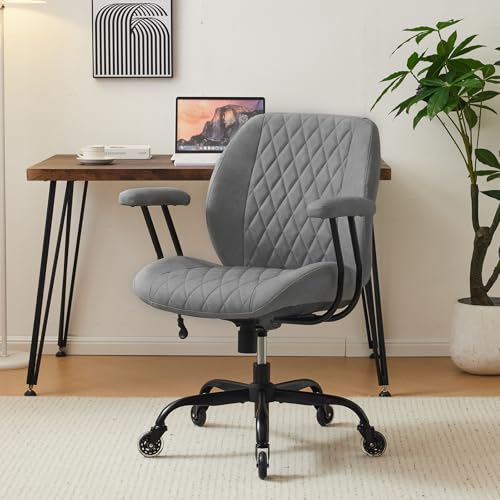
YFO Modern Ergonomic Office Desk Chair — Best Executive Leather Look
Not every modern office is a mesh office. The YFO is the leather-look executive option: grey leather upholstery, lumbar support, adjustable height, swivel and armrests, styled for a room where clients or cameras are part of the day. It trades the mesh chairs’ breathability for presence, deliberately.
Strengths
- Grey leather finish suits formal and client-facing offices
- Lumbar support and adjustable height cover the basics
- Swivel and armrests for meeting-friendly use
Trade-offs
- Leather-look upholstery breathes far less than mesh
- Fewer fine adjustments than the mesh specialists
- Padding compresses over years in a way mesh does not
| Spec | Detail (from verified listing title) |
|---|---|
| Upholstery | Grey leather (title) |
| Lumbar | Support |
| Height | Adjustable |
| Armrests | Included |
| Capacity | Not stated |
Judge this chair by its actual job. In a home office that doubles as a meeting space, or an executive office where the chair appears on video calls daily, a clean leather silhouette communicates something mesh cannot. The YFO keeps the ergonomic essentials — lumbar support, height adjustment, armrests — while delivering that look, which is more than purely decorative chairs offer.
The trade is thermal and long-term: leather-look surfaces run warm through a summer workday, and padded upholstery slowly compresses where mesh holds its tension. If your days are long and your room is warm, the mesh picks will serve you better; if your chair is as much furniture and signal as it is equipment, the YFO is the right kind of compromise.
Best for: Executive and client-facing offices; shorter, cooler workdays / Not suited for: Hot rooms and ten-hour mesh-comfort seekers
Check on Amazon — check price on Amazon and confirm the exact size, colour and configuration before ordering.
Comparison Table
| Pick | Badge | Key spec | Best for |
|---|---|---|---|
| SIHOO M18 Ergonomic Office Chair | Best Overall | Adjustable lumbar; 2D armrests; 330 lb capacity | Most home-office workers and larger users wanting proven all-round ergonomics |
| SIHOO M57 Ergonomic Office Chair | Best for Long Hours | 3D armrests; adjustable headrest; 330 lb capacity | Full-time desk workers, especially those with shoulder or neck tension |
| Hbada P5 Ergonomic Office Chair | Best with Footrest | Footrest included; adjustable lumbar; 2D headrest | Home workers who take breaks at their desk and value a footrest |
| Mimoglad Ergonomic High Back Mesh Office Chair | Best Modern Looks | Moon gray high-back mesh; adjustable lumbar; thickened cushion | Style-led home offices wanting real lumbar support |
| Marsail Ergonomic Office Chair | Best Full-Featured Mesh Chair | 3D armrests; headrest; adjustable lumbar; high-back mesh | Buyers wanting the full adjustment set from an alternative brand |
| YFO Modern Ergonomic Office Desk Chair | Best Executive Leather Look | Grey leather modern chair; lumbar support; adjustable height | Executive and client-facing offices; shorter, cooler workdays |
The mesh five compete on adjustments: the M18 is the balanced benchmark, the M57 and Marsail add 3D arms and headrests, the Hbada adds a footrest, and the Mimoglad leads on looks. The YFO stands apart as the leather-look option. Capacity is title-confirmed only on the SIHOO pair — verify it on the listing for the others if it matters to you.
How to Choose the Best Comfortable Modern Office Chairs
Fit the chair to three measurements before anything else: your desk height, which sets the seat height you need; your thigh length, which sets seat depth; and your torso, which sets where the lumbar support must reach. A chair whose lumbar bump sits two inches from your curve is a chair without lumbar support, whatever the box says — adjustability exists precisely to close that gap.
Then rank the adjustments by your own pain points. Shoulders and neck argue for armrest and headrest adjustability; lower back argues for lumbar range; restless sitters argue for a good tilt mechanism with lockable positions. There is no universal ranking — there is your body, your hours and your history, and the right chair is the one adjustable in the dimensions you personally need.
Finally, decide mesh or upholstered by climate and day length. Mesh wins long, warm days and holds its support for years; upholstery wins looks, first-sit softness and formal rooms. Most full-time home workers should default to mesh and treat leather-look as the exception that needs a reason.
The Adjustments That Matter, Ranked by Real-World Impact
Lumbar support that adjusts in height — and ideally depth — is the highest-impact feature in any office chair, because the lumbar curve sits at a different height on every body. Fixed lumbar bumps help the average body they were designed for and quietly miss everyone else.
Seat height is second, and it is really about your desk: elbows at desk height with feet flat on the floor is the position everything else builds on. If your feet dangle, no backrest can save the day; a footrest or a lower desk is part of the chair purchase, not an accessory.
Armrests rank third and are the most underrated: properly set, they carry the weight of your arms so your shoulders do not. Headrests matter mainly if you recline to think or take calls leaning back; tilt tension and lock matter if you change posture often, which you should. Footrests, like the Hbada’s, are a break feature — valuable, but after the working adjustments are right.
Setting Up Your Chair and Desk as One System
Assemble the chair fully, then set it in this order: seat height first, with feet flat and knees at roughly ninety degrees; lumbar second, adjusted until it fills your lower back’s curve without pushing; armrests third, raised until they just support your elbows with shoulders relaxed; headrest last, touching only when you lean back.
Then check the desk against the chair, not the other way round. Your screen’s top should sit near eye level — raise the monitor, not your shoulders — and your keyboard should let your wrists float flat. A perfect chair under a bad desk still produces a bad day.
Revisit the setup after a week. Foam settles, tilt tension preferences reveal themselves, and the lumbar height that felt right on day one often wants one notch of change. Chairs at this level are instruments; the second tuning is where they start to disappear beneath you, which is the whole goal.
How to Assemble and Adjust a Modern Office Chair
Most mesh chairs assemble in five stages with the included tool. Work on a rug or blanket to protect the mesh and your floor, and keep all bolts finger-tight until each stage is aligned.
- Unpack and lay out every part against the instruction list before starting; missing-parts discoveries belong at the start, not stage four.
- Fit the casters to the base, then the gas lift, keeping the lift’s cap on until the seat is ready to mount.
- Attach the armrests to the seat base loosely, so they can align with the backrest later.
- Mount the backrest to the seat mechanism, tightening bolts in a cross pattern once all are started.
- Set the seat assembly onto the gas lift and sit in it gently to seat the connection.
- Tighten every bolt fully, then adjust in order: seat height, lumbar height, armrest height and width, headrest, tilt tension.
- Test the tilt lock at each position and the swivel through a full turn before declaring the job done.
- Re-tighten all bolts after the first week of use — new chairs settle, and a two-minute check prevents months of creaks.
Keep the hex key in your desk drawer, not the garage. The week-one re-tightening and seasonal adjustments are what separate a chair that stays silent and supportive from one that slowly loosens into annoyance.
Common Buying Mistakes
Buying the photograph. A chair is worn eight hours a day. Adjustability you can verify beats styling you can see, every time.
Ignoring your desk’s height. The best chair cannot fix a desk that forces dangling feet or raised shoulders. Measure both as one system.
Assuming a stated capacity you have not seen. Only some titles state capacity. If it matters, confirm the figure on the live listing before ordering.
Setting it once and never again. Foam settles and bodies change. Re-tune monthly and re-tighten bolts after the first week.
Choosing leather-look for a hot room and long days. Upholstery trades breathability for looks. In warm rooms over long hours, mesh is the comfort choice.
Office Chair Care: Keeping Mesh and Mechanisms Honest
Vacuum mesh monthly with an upholstery brush — dust loads mesh, dulls its colour and slowly stiffens its feel. Spot-clean spills immediately; mesh dries fast, which is one of its quiet advantages, but a stain left to set in the weave is there for good.
Every few months, flip the chair and check the casters for hair and grit, which are the main cause of scratched floors and sticky rolling. A drop of care here protects both the chair and the floor it rolls on — and if your floor is hard, a chair mat remains the cheapest insurance in the whole setup.
The True Cost of a Bad Chair, Counted in Evenings
A bad office chair does not bill you at the desk; it bills you afterwards. The stiff shoulders at dinner, the headache that arrives at four, the evening spent too uncomfortable to enjoy — these are the interest payments on eight hours of poor support, and they compound quietly enough that most people blame their age, their mattress or their job before they blame the chair. Ergonomists have made the point for decades: the chair is the piece of equipment your body spends the most hours in contact with, more than your bed’s waking rivals and second only to the mattress itself.
Counted financially, the arithmetic is just as plain. A chair is a five-to-ten-year purchase used for thousands of hours; the difference between the adequate and the good chair, divided across those hours, is trivially small per day, while the difference in how those hours feel is not small at all. This is why this guide spends so little time on the cheapest chairs in the category: at office-chair hours, cheap is the most expensive way to sit.
None of that licenses extravagance — the M18 in this guide exists to prove that the point of diminishing returns arrives early and honestly. It licenses seriousness: measure your desk, rank your adjustments, buy the chair that fits your body and your hours, and then maintain it. The people who love their office chairs are not the people who spent the most; they are the people who fitted them properly and re-tightened the bolts in week two.
Chairs for Shared Desks, Hot Desks and Households
A chair fitted to one body is a personal instrument; a chair shared between two different bodies is a compromise that must be re-struck daily. Households increasingly share one good desk between partners, shifts and teenagers, and the chairs that survive that duty are the ones whose adjustments are quick, obvious and wide-ranging — lumbar height that moves in seconds, armrests that reset without tools, a gas lift with real range. Every mesh pick in this guide adjusts without tools for exactly this reason.
The discipline that makes sharing work is a thirty-second reset ritual: each user sets height, lumbar and arms on sitting down, the way a driver adjusts a car seat and mirrors. Chairs with memory or marked positions help; absent those, a phone photograph of each user’s settings on the desk drawer is a humble and effective system. What does not work is the polite stalemate where neither user adjusts anything and both sit in a stranger’s posture.
Where sharing is permanent and bodies differ greatly, be honest that one chair may not serve both — a petite user and a very tall user can exceed a single chair’s adjustment range at both ends. In that case, two mid-priced chairs fitted individually will outperform one premium chair fitted to nobody, which is the same lesson this guide teaches everywhere: fit beats features, and features exist only to serve fit.
Video Calls, Cameras and the Modern Office Chair’s Second Job
The modern office chair appears on camera, which has quietly added a second job to its specification: it is part of your professional image, framed behind your shoulders in every meeting. High-back mesh chairs read as serious and contemporary on screen; leather-look chairs read as executive; gaming chairs read as gaming, whatever your job is. None of this should outrank ergonomics — but between two chairs that fit you equally, the one that represents you better on camera is making a legitimate claim.
Camera practicalities matter too. A headrest that pokes above your head in frame, a chair that squeaks audibly when you shift, casters that let you drift slowly out of shot during a long call — these are real annoyances that no specification sheet lists. Test your chair on a call in the first week, while adjustments are still free, and set its tilt and height with the camera’s view in mind as well as your spine’s.
Lighting completes the picture: pale mesh like the Mimoglad’s moon gray reflects light pleasantly in bright rooms and can glare in harsh ones; dark chairs disappear against dark backgrounds. Your chair, your wall and your window are one composition on screen — the modern office simply asks you to arrange all three deliberately, the way you already arrange the desk itself.
Desk, Chair, Screen, Light: The Whole Ergonomic Picture
Ergonomics advice fails when it sells a chair as a cure. Your working posture is produced by a system — desk height, screen position, keyboard, light, and the chair — and the best chair in this guide cannot compensate for a screen that forces your neck down forty degrees or a desk that lifts your shoulders to your ears. Treat the chair as the foundation of the system, then audit the rest with the same honesty: screen top near eye level, elbows at desk height, feet supported, and light that does not make you lean towards the page.
Movement is the system’s other half. The healthiest sitting posture is the next one: a good chair’s tilt, swivel and adjustability exist to make posture changes effortless, and the workers who fare best in long desk careers are the ones who shift, lean, stand and walk in small doses all day. Set a rhythm — change position whenever a call ends, stand for one task in every three, walk for water rather than keeping a bottle — and the chair becomes a partner in movement rather than a mould you set in.
Breaks deserve the same deliberateness as equipment. The Hbada P5’s footrest in this guide is a small monument to a large truth: rest taken properly, in position, with the body supported, restores more than rest taken slumped. Whether your break is a reclined ten minutes at the desk or a walk around the building, schedule it like a meeting, because the afternoon’s work quality is decided by it.
Finally, review the system seasonally. Bodies change, projects change, a winter of heavy typing and a summer of calls ask different things of the same chair. The adjustments you set in January are a draft, not a contract, and the two minutes it takes to re-tune them each season is the cheapest ergonomic intervention you will ever make.
Office Chairs for Tall, Petite and Broad Bodies: Fitting Beyond the Average
Chairs are designed around an average body that most people do not have, and the further your body sits from that average, the more the adjustment ranges in this guide matter. Tall users should interrogate three numbers on any listing: seat height range, which must let long legs sit with feet flat; back height, which must reach the shoulders; and headrest travel, which is where tall users are most often failed by chairs that fit them everywhere else. The high-back picks here — the M57, the Marsail, the Mimoglad — are the natural starting points.
Petite users face the mirror problem: seats too deep, pushing them forward off the lumbar support; armrests too wide and too high; feet dangling above the floor. For them, lumbar support that adjusts low enough to meet a shorter back is the critical feature, and a footrest — a separate one, or the Hbada’s built-in — stops being a luxury and becomes the piece that makes the whole chair work. Never solve dangling feet by perching forward; that trades the chair’s entire support away for floor contact.
Broad and heavier users should start from stated capacity and seat width, which is why the SIHOO pair’s title-confirmed 330 lb figure features so prominently in this guide: it is information a buyer can act on. Where a title does not state capacity, verify it on the live listing before purchase, and prefer cushions described as wide — a seat that fits the body is not a comfort detail but the precondition of every other adjustment working at all.
In every direction, the principle is the same: your body is the specification, and the chair’s job is to meet it. The adjustment lists in these reviews are not feature bingo; they are the vocabulary in which a chair says whether it can fit you. Read them that way, measure yourself honestly, and the right chair usually selects itself.
When to Repair, When to Replace, and What Actually Wears Out
Office chairs rarely die whole; they die by components, and knowing the order of mortality saves money. Casters go first — hair, grit and cracked wheels — and are cheap, universal and replaceable in minutes. Gas lifts go second, announcing themselves as a chair that slowly sinks through the day; also replaceable, also standard. Armrest pads crack and split third. None of these deaths justifies replacing a chair whose mesh, mechanism and frame remain sound, and a household that replaces components will keep a good chair a decade.
The true end-of-life signs are structural: a tilt mechanism that no longer holds its lock, a back frame cracked at its mount, mesh torn or sagging beyond tension, a seat base creaking from the frame rather than from a loose bolt. Distinguish creaks before condemning — the week-one re-tightening in this guide exists because most ‘broken chair’ noises are simply settled bolts asking for their second turn. A chair should be retired for structure, never for sound effects.
When replacement time does come, let the old chair teach the purchase. Which adjustment did you use daily, and which never moved? Where did it fail your body — lumbar height, seat depth, arm width? Those answers, written down before you shop, are a better specification than any review, including this one. The six picks here were chosen to cover the common answers, but your own chair’s autopsy is the most personalised buying guide you will ever be given.
Dispose of the old chair thoughtfully where you can: components separate, metal recycles, and a chair with life left in it suits a spare room, a teenager’s desk or a donation far better than a skip. A decade of service deserves a retirement plan — and a marketplace listing described honestly will usually find it one within the week.
The First Month With a New Chair: A Settling-In Diary Worth Keeping
Week one is assembly, adjustment and suspicion. Every new chair feels wrong in some small way because your body has memorised the old one’s failures as normal; give the new settings the full week before re-tuning, change one variable at a time, and note what you changed and why in the desk drawer. The note matters: without it, week three’s adjustments chase week two’s in circles, and the chair gets blamed for a process problem.
Week two is the re-tightening and the honest verdict on fit. Bolts get their second turn, casters get cleared, and the body’s data comes in — which shoulder, which hour of the day, which task still produces the old ache. Targeted adjustments answer targeted data: armrests for the shoulder, lumbar height for the four o’clock back, tilt tension for the restlessness. A chair at this level has a remedy for most complaints, provided the complaint is specific enough to aim at.
By week four the chair should be disappearing — the state this guide has described as the goal, where you notice the work and not the sitting. If it is not disappearing, the remaining misfit is real information: a dimension the chair cannot reach, a body need it cannot meet, and the returns or exchange decision should be made on that evidence while it is still cheap to make. The month-long diary converts an expensive guess into a measured trial, and it is the last piece of method this guide can give you: after it, the chair is yours, fitted, maintained and — for the next several years of working days — mercifully uninteresting.
Final Recommendation
Start with the SIHOO M18 unless you have a reason not to: it is the balanced benchmark, with its capacity stated plainly. Long-hours workers should step up to the M57 or the Marsail for 3D armrests and headrests; break-takers should take the Hbada P5 and its footrest; the design-led should take the Mimoglad; and the client-facing should take the YFO’s leather finish with eyes open about warmth. Fit whichever you choose properly, in the order this guide sets out, and give it a week before judging it.
Related guides on this site: Best Comfortable Floor Chairs With Backs; Best Chairs For 8 Hours; Best Chair Mat For Carpets Rolling Chairs; Best Carpet For Under Desk Chairs; Best Chairs Affordable.
Frequently Asked Questions
Are mesh chairs really more comfortable than padded chairs?
Over long days, for most people, yes: mesh breathes and holds its support shape for years. Padded chairs feel softer for the first hour and in cooler rooms. Your climate and day length should decide.
What does 3D armrest adjustment mean?
The armrests move in three dimensions — typically height, width or angle, and forwards-backwards — so they can meet your elbows exactly in different tasks. 2D armrests adjust in two of those directions.
How much capacity do I need?
Your body weight plus a margin. The SIHOO chairs here state 330 lbs in their titles; where a title does not state capacity, check the live listing before buying rather than assuming.
Do I need a headrest?
Only if you recline — for calls, reading or thinking time. For pure upright typing it is unused furniture. Chairs like the M57 and Marsail include adjustable ones; the M18 includes a headrest at a lower price point.
How long should a good office chair last?
A quality mesh chair should give five or more years of daily use. Gas lifts and casters are the usual first failures and are replaceable; mesh and mechanisms should outlast them.
Can a footrest chair replace a recliner?
For desk breaks, largely yes — the Hbada P5’s footrest and tilt make a genuine rest position. It will not match a dedicated recliner for an evening’s lounging, nor is it meant to.


