Disclosure: airfryerkitchensupply.com is reader-supported. When you buy through links on our site, we may earn an affiliate commission at no extra cost to you.
Where to buy
For readers comparing the best standard pillows for kids with allergies, please read the framing in this box before the picks, because it matters more than any single pillow: no pillow treats or cures allergies, and this guide claims nothing of the sort. What follows is general bedding information for allergy-conscious households — pillows whose verified titles state ‘hypoallergenic’ (that word is used only where a title uses it), washable designs, and an honest map of kids’ pillow sizes, because ‘standard’ in kids’ listings does not always mean the adult 20 x 26 inches. If your child has symptoms, the right next step is your paediatrician, not a pillow purchase. Check the current price on Amazon from the links below.
- cutie pumpkin Kids Pillow — Low Profile 14 x 22, Hypoallergenic Cotton, ‘Kids Standard Size’ — Check the current price on Amazon
- Little Sleepy Head Bed Pillow for Sleeping — Youth Pillow, Hypoallergenic, Down-Like Fill — Check the current price on Amazon
- LOFE Adjustable Kids Pillow, Ages 4–12, 16 x 22, Hypoallergenic Pearl Fiber Fill — Check the current price on Amazon
- Kinder Fluff Children Pillows (2 Pack), Ages 7+, Hypoallergenic Down Alternative — Check the current price on Amazon
- Amazon Basics Bed Pillow, Standard 20 x 26, Hypoallergenic Down-Alternative (2 Pack) — an Adult Standard Pillow — Check the current price on Amazon
- ZPECC Toddler Pillow with Organic Cotton Pillowcase, 13 x 18 — Hypoallergenic (Toddler Size) — Check the current price on Amazon
Looking for the best standard pillows for kids with allergies starts with two honesties. The first is medical: a pillow does not treat allergy, reduce a diagnosis or replace any part of a care plan — and any listing implying otherwise should be distrusted on sight. What a household can control is the bedding environment in general ways: choosing fills described by their makers as hypoallergenic, washing pillows and cases on a regular rhythm, and using protectors — ordinary hygiene practices that this guide discusses as general information only. For your child’s actual symptoms and management, your paediatrician is the authority, full stop.
The second honesty is about size, because this search hides a trap. In adult bedding, ‘standard’ means 20 x 26 inches. In kids’ bedding, listings use ‘standard size’ loosely: one verified pick below uses that phrase for a 14 x 22 inch youth pillow, others are 16 x 22 youth sizes, and true toddler pillows are 13 x 18 — a different product for a different bed. This guide prints every pick’s stated dimensions in its spec box and never relabels a toddler pillow as standard or an adult pillow as a kids’ pillow. Where a pick is a general standard pillow that an older child might use, it is described exactly that way.
All six picks were verified. Five state ‘hypoallergenic’ in their titles; the sixth (Kinder Fluff) states a hypoallergenic down-alternative fill in its verified record. Certifications are repeated only where titles state them. Beyond the picks, the guide covers the size map in full, the washing and protector practices that do the everyday work, and the questions parents actually ask — answered within the same careful framing.
In this guide
Quick Picks
Best Kids’ Standard Size — cutie pumpkin Kids Pillow — Low Profile 14 x 22, Hypoallergenic Cotton, ‘Kids Standard Size’. The pick that uses this search’s own phrase — ‘Kids Standard Size’ — at an honestly stated 14 x 22 inches: low profile, hypoallergenic cotton, machine washable, sized for a toddler bed and beyond. Check on Amazon
Best Youth Pillow — Little Sleepy Head Bed Pillow for Sleeping — Youth Pillow, Hypoallergenic, Down-Like Fill. A youth pillow by name, with hypoallergenic and down-like fill stated in the title — the soft, supportive middle option for kids between toddler and teen bedding. Check on Amazon
Best Adjustable for Growing Kids — LOFE Adjustable Kids Pillow, Ages 4–12, 16 x 22, Hypoallergenic Pearl Fiber Fill. The most documented pick in the guide: ages 4–12 stated, 16 x 22 stated, adjustable, with CPSC and OEKO-TEX 100 certification and hypoallergenic fill stated in its record. Check on Amazon
Best for Older Kids — Kinder Fluff Children Pillows (2 Pack), Ages 7+, Hypoallergenic Down Alternative. A two-pack for ages 7+ per its title, with a 300TC pure cotton shell and hypoallergenic down-alternative fill stated — and a design that needs no separate pillowcase. Check on Amazon
Best True 20 x 26 (Adult Pillow) — Amazon Basics Bed Pillow, Standard 20 x 26, Hypoallergenic Down-Alternative (2 Pack) — an Adult Standard Pillow. Stated plainly: this is a general adult standard pillow — 20 x 26, hypoallergenic down-alternative fill, medium for back sleepers — included for older children whose parents are deliberately choosing the full adult size. Check on Amazon
Best Toddler Size (Not Standard) — ZPECC Toddler Pillow with Organic Cotton Pillowcase, 13 x 18 — Hypoallergenic (Toddler Size). Included with its size in the badge so nobody misbuys it: a 13 x 18 toddler pillow — hypoallergenic stated, flat profile, organic cotton pillowcase, intended for age 2 and up — for the younger children this search often actually serves. Check on Amazon
Key Takeaways
- No pillow treats or reduces allergies. This guide offers general bedding information only; your child’s symptoms belong in a conversation with your paediatrician.
- ‘Hypoallergenic’ appears in this article only where a verified title states it — it is the maker’s description of the fill, not a medical promise.
- Size honesty: kids’ ‘standard’ is not one size. Stated dimensions here are 14 x 22 and 16 x 22 (youth), 20 x 26 (adult standard) and 13 x 18 (toddler) — each labelled as what it is.
- Washability and protectors do the everyday work: several picks are machine washable or have washable covers, stated in their titles.
- Age guidance is repeated only where titles state it (LOFE: ages 4–12 and 2–4 for its toddler model; Kinder Fluff: 7+) — follow the maker’s stated ages and your clinician’s advice.
How These Picks Were Chosen
The pool came from Amazon listing data searches on kids’ pillows, standard-size kids’ pillows and hypoallergenic pillows. The first filter was the word itself: a pick had to state ‘hypoallergenic’ in its verified title or record — not merely be a synthetic pillow a writer assumed qualified. The second filter was genuine kids’ positioning: a stated age range, a youth size, or a kids’ product design. One general adult standard pillow (the Amazon Basics pick) was admitted only as a clearly-labelled option for older children, because parents of older kids do buy true 20 x 26 pillows — and it is labelled as an adult standard pillow throughout, never as a kids’ product.
The third filter was size transparency. Every pick’s stated dimensions are printed, and the set was deliberately composed to teach the size map: a ‘kids standard size’ 14 x 22, youth 16 x 22 options, an adult standard 20 x 26, and a 13 x 18 toddler pillow included explicitly as the smaller size it is, for younger children whose parents land on this search by mistake.
The final filter was framing. What remains is a bedding shortlist a careful parent can use alongside — never instead of — professional guidance.
Best standard pillows for kids with allergies — the six picks in depth

cutie pumpkin Kids Pillow — Low Profile 14 x 22, Hypoallergenic Cotton, ‘Kids Standard Size’ — Best Kids’ Standard Size
This pillow suits the child who has outgrown the 13 x 18 toddler pillow but is not ready for an adult 20 x 26: the title’s ‘kids standard size’ is 14 x 22, a youth proportion with a low profile that suits smaller sleepers’ shoulders. It is the natural centre of this guide’s size map.
Strengths
- Dimensions stated exactly — 14 x 22 in — so there is no size guessing
- Hypoallergenic stated in the title, describing the cotton pillow as the maker presents it
- Machine washable stated — the whole pillow can join the household’s regular bedding hygiene rhythm
Trade-offs
- It is not the adult standard 20 x 26; buyers wanting that exact size should look at the Amazon Basics pick, labelled as an adult pillow
- Low profile suits younger and smaller sleepers; a tall older child may want more loft
- The title positions it for a toddler bed — check it against your child’s actual bed and pillowcase size
Key specs (from the verified listing title):
- Dimensions stated: 14 x 22 in
- Maker’s size wording: ‘Kids Standard Size’
- Material wording stated: Hypoallergenic cotton
- Care stated: Machine washable
- Profile stated: Low profile
This listing deserves credit for doing two honest things at once: using the phrase parents search for — kids standard size — and printing the actual dimensions right beside it. Fourteen by twenty-two inches is a youth pillow, proportioned between the toddler 13 x 18 and the adult 20 x 26, and for many children in the kindergarten-to-primary years it is simply the right physical size: wide enough to stay under a turning head, low enough not to push a small neck upward.
The stated qualities line up with what an allergy-conscious household can actually use: a hypoallergenic description from the maker and — just as practically — machine washability, because a pillow that can be washed whole can be kept on a regular hygiene rhythm without special equipment. As everywhere in this guide, that is a bedding-practice statement, not a health claim: the pillow’s job is to be a clean, correctly sized pillow, and this one states the facts a parent needs to choose it.
Best for: children who have outgrown toddler size but not yet adult standard / Not suited for: buyers who need the exact adult 20 x 26 dimensions
Check on Amazon — check price on Amazon before you decide, since sizes and finishes change what a listing includes.
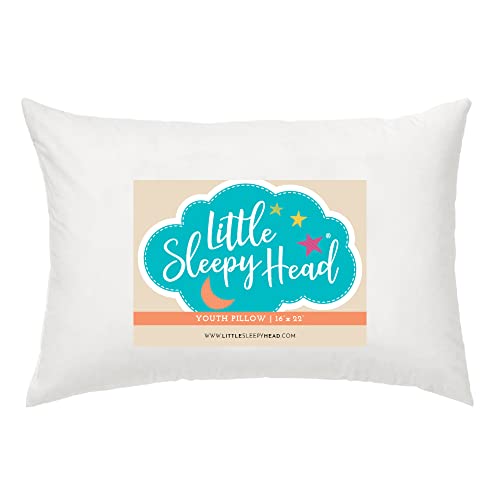
Little Sleepy Head Bed Pillow for Sleeping — Youth Pillow, Hypoallergenic, Down-Like Fill — Best Youth Pillow
The Little Sleepy Head suits the child whose complaint is feel: toddler pillows have gone flat and small, adult pillows are castles. A youth pillow with a down-like fill gives a soft, mouldable sleep surface sized for a younger sleeper, without handing them a feather pillow.
Strengths
- Youth pillow stated in the title — honest category positioning
- Hypoallergenic stated, with a down-like fill that mimics down’s softness without feathers
- Described as soft and supportive in the title, the balance younger sleepers usually want
Trade-offs
- Dimensions are not stated in the title — confirm the youth size on the listing before ordering cases
- Down-like synthetic fills compress over time like all synthetics; expect a normal replacement rhythm
- Single pack in this listing; siblings mean multiple purchases
Key specs (from the verified listing title):
- Category stated: Youth pillow
- Fill stated: Down-like fill
- Material wording stated: Hypoallergenic
- Dimensions: Not stated
- Pack: 1 pack
Youth is the most under-served pillow category: toddlers are marketed to heavily, adults endlessly, and the seven-to-twelve group is offered adult pillows and told to adapt. The Little Sleepy Head is built for that gap and says so in its title. Its down-like fill is a sensible choice for the age — the soft, scrunchable behaviour kids like from a pillow, in a synthetic fill the maker describes as hypoallergenic, without feathers to poke or special washing rituals.
The gap in its title is dimensions, and this guide leaves that row at ‘Not stated’ rather than borrowing a figure from another listing. Youth pillows commonly sit between toddler and standard sizes, but ‘commonly’ is not a measurement: check the listing’s stated size against your child’s pillowcases before ordering. With that one check done, this is the feel-first pick of the six — the one to choose when the child has opinions about softness and the parent has opinions about honest labelling.
Best for: older children and young teens wanting a soft, youth-sized pillow / Not suited for: buyers who need dimensions confirmed in the title itself
Check on Amazon — check price on Amazon before you decide, since sizes and finishes change what a listing includes.

LOFE Adjustable Kids Pillow, Ages 4–12, 16 x 22, Hypoallergenic Pearl Fiber Fill — Best Adjustable for Growing Kids
The LOFE suits the parent buying for the long middle of childhood — ages 4 to 12 by its own title — who wants one pillow that adapts as the child grows. Adjustability is the headline: as shoulders widen, the pillow’s loft can be adjusted rather than the pillow replaced.
Strengths
- Age range (4–12) and dimensions (16 x 22) both stated — the most complete sizing information here
- Certifications stated in the record: CPSC and OEKO-TEX 100, with organic cotton named
- Adjustable design with a washable cover stated — grows and cleans with the child
Trade-offs
- At 16 x 22 it is a youth size, not adult standard 20 x 26 — the title’s own ‘toddler pillow’ wording undersells its stated age range, so trust the dimensions and ages, not the label
- Adjustable fills need occasional re-fluffing and adjustment to stay even
- Premium documentation comes at a premium tier relative to basic kids’ pillows
Key specs (from the verified listing title):
- Ages stated: 4–12 years
- Dimensions stated: 16 x 22 in
- Fill stated: Hypoallergenic pearl fiber fill
- Certifications stated: CPSC and OEKO-TEX 100 certified; organic cotton
- Cover stated: Washable cover
Read this title the way this guide teaches: by its facts, not its labels. It calls itself a toddler pillow, then states ages 4–12 and dimensions of 16 x 22 — neither of which is a toddler specification. The facts describe a youth pillow for the whole primary-school span, and a well-documented one: named certifications, an organic cotton element, a hypoallergenic fill description and a washable cover, all stated in the verified record rather than assumed.
The adjustable design is the practical centrepiece. Children’s pillow needs change faster than any other bedding in the house, and a pillow whose loft can be tuned turns a growth spurt from a shopping trip into a two-minute adjustment. For allergy-conscious households the stated washable cover supports the regular-washing rhythm this guide recommends as general practice. It is the most expensive-feeling specification here — and the one most likely to still be in service in three years.
Best for: ages 4–12, parents wanting certifications and adjustability in writing / Not suited for: actual toddlers (see the ZPECC pick) or buyers needing adult 20 x 26
Check on Amazon — check price on Amazon before you decide, since sizes and finishes change what a listing includes.

Kinder Fluff Children Pillows (2 Pack), Ages 7+, Hypoallergenic Down Alternative — Best for Older Kids
The Kinder Fluff pair suits older children — 7 and up by the maker’s own statement — whose parents want the washing routine simplified: a pillow whose shell is finished to be used without a case is a pillow that gets washed whole, often, without a laundry-day negotiation.
Strengths
- Age guidance stated (7+), with a two-pack format for siblings or a wash-day spare
- 300TC pure cotton shell and hypoallergenic down alternative fill stated in the record
- No-pillowcase-needed design stated — simplifies the regular washing rhythm
Trade-offs
- Dimensions are not stated in the title; confirm the size against your child’s bed before ordering
- The record’s ‘baby pillow’ award wording sits oddly beside the stated 7+ age — follow the stated age, not the award line
- A case-free design means the pillow itself takes the wear a case would have absorbed
Key specs (from the verified listing title):
- Ages stated: 7+
- Pack: 2 pack
- Shell stated: 300TC pure cotton shell
- Fill stated: Hypoallergenic down alternative
- Dimensions: Not stated
The Kinder Fluff’s design insight is about laundry, not loft. In most houses the pillowcase gets washed weekly and the pillow itself rarely, because the pillow is a production. A finished cotton shell designed to be used without a case — and therefore washed as one piece — collapses that friction. For an allergy-conscious household following the general practice of regular bedding washing, that is a genuinely useful architecture, and the two-pack format means one pillow can be in the wash while the other is on the bed.
Hold the same two cautions as elsewhere: the title does not state dimensions, so verify the physical size on the listing; and the record mixes an award phrase about baby pillows with a stated age of 7+ — when a listing disagrees with itself, follow the safety-relevant fact, which is the stated age. Within those checks, this is the low-friction pick for older kids: cotton shell, stated hypoallergenic fill, and a wash routine a busy household will actually keep.
Best for: children 7+ and households that wash bedding frequently / Not suited for: buyers who need dimensions in the title, or children under the stated age
Check on Amazon — check price on Amazon before you decide, since sizes and finishes change what a listing includes.

Amazon Basics Bed Pillow, Standard 20 x 26, Hypoallergenic Down-Alternative (2 Pack) — an Adult Standard Pillow — Best True 20 x 26 (Adult Pillow)
This pick exists for one situation: the older child or teenager whose bed, cases and shoulders are ready for a true adult standard pillow, and whose parent wants the exact 20 x 26 dimensions with a hypoallergenic fill description. It is not a kids’ pillow and is not presented as one anywhere in this review.
Strengths
- Exact adult standard dimensions stated: 20 x 26 in — the only pick that is truly ‘standard’ in the adult sense
- Hypoallergenic down-alternative fill stated; cool-to-touch positioning for warm sleepers
- Two-pack, medium loft described for back sleepers — suits the older-child transition bed
Trade-offs
- Not designed or sized for young children — adult loft and dimensions will overwhelm a small sleeper
- No kids’ age guidance in the title, because it is not a kids’ product
- Medium adult loft may be too high for a younger teen who sleeps on their stomach
Key specs (from the verified listing title):
- Dimensions stated: 20 x 26 in (adult standard)
- Fill stated: Hypoallergenic down-alternative
- Loft stated: Medium, for back sleepers
- Pack: 2 pack
- Kids’ age guidance: Not stated — adult product
Every guide to this search faces a choice: pretend kids’ sizes are standard, or show the real map. This pick is the map’s far edge, labelled in its badge and throughout this review as an adult pillow. For a teenager in a full bed with standard cases, it may be exactly the right purchase — the dimensions are the true standard, the fill carries the maker’s hypoallergenic description, and the medium loft suits the back-sleeping position many teens default to.
For a younger child it would be the wrong purchase, and the review says so without hedging: adult loft under a small head and neck is poor ergonomics, and no fill description changes that. Parents should choose this pick by the child’s size and bed, not by the search that brought them here — and if you are unsure which size your child needs, the size guide section below walks the whole map from toddler to adult.
Best for: older children and teens deliberately moving to a true adult standard pillow / Not suited for: younger children — this is an adult product, full stop
Check on Amazon — check price on Amazon before you decide, since sizes and finishes change what a listing includes.

ZPECC Toddler Pillow with Organic Cotton Pillowcase, 13 x 18 — Hypoallergenic (Toddler Size) — Best Toddler Size (Not Standard)
The ZPECC is for the parent of a two-to-five-year-old who searched ‘standard’ because it is the only pillow word they know. What their child needs is this: a small, flat toddler pillow with its own pillowcase, sized for a toddler bed, crib transition, daycare nap or travel.
Strengths
- Dimensions (13 x 18) and intended age (2 and up) both stated — exemplary toddler labelling
- Hypoallergenic stated; small flat profile suits toddler proportions
- Organic cotton pillowcase included; sized for toddler beds, daycare and travel
Trade-offs
- It is not a standard pillow in any sense — buyers needing 14 x 22, 16 x 22 or 20 x 26 should choose the picks above
- A flat toddler profile will be outgrown; expect to size up within a few years
- The included case is sized to this pillow; standard cases will not fit it properly
Key specs (from the verified listing title):
- Dimensions stated: 13 x 18 in (toddler size)
- Ages stated: Intended for age 2 and up
- Material wording stated: Hypoallergenic; organic cotton pillowcase
- Profile stated: Small, flat
- Use stated: Toddler bed, travel, daycare, nap
This pick is in a ‘standard pillows’ guide as an act of reader protection. A meaningful share of the parents type this query have toddlers, and the market will happily sell them an adult pillow. The ZPECC is what a toddler pillow should look like on paper: dimensions stated, age stated (2 and up), a flat profile matched to small shoulders, a hypoallergenic description from the maker, and an included organic cotton pillowcase cut to fit — no bunching standard case around a small pillow.
Its presence also completes the size map this guide keeps teaching: 13 x 18 toddler, 14 x 22 and 16 x 22 youth, 20 x 26 adult standard. Buy the size your child’s body and bed dictate, in that order, and let the keyword go. If your child is under two, this guide offers no pillow recommendation at all — safe-sleep guidance for the youngest children is a conversation for your paediatrician, and pillows in cribs for infants are not a shopping question.
Best for: children aged 2+ in toddler beds, daycare naps and travel / Not suited for: anyone shopping for an actual standard or youth size — or for a child under 2
Check on Amazon — check price on Amazon before you decide, since sizes and finishes change what a listing includes.
Comparison Table
| Pick | Badge | Key spec | Best for |
|---|---|---|---|
| cutie pumpkin Kids Pillow — Low Profile 14 x 22, Hypoallergenic Cotton, ‘Kids Standard Size’ | Best Kids’ Standard Size | 14 x 22 in stated, ‘kids standard size’, hypoallergenic cotton, machine washable | children who have outgrown toddler size but not yet adult standard |
| Little Sleepy Head Bed Pillow for Sleeping — Youth Pillow, Hypoallergenic, Down-Like Fill | Best Youth Pillow | Youth pillow, hypoallergenic, down-like fill, dimensions not stated in title | older children and young teens wanting a soft, youth-sized pillow |
| LOFE Adjustable Kids Pillow, Ages 4–12, 16 x 22, Hypoallergenic Pearl Fiber Fill | Best Adjustable for Growing Kids | Ages 4–12, 16 x 22, adjustable, hypoallergenic fill, CPSC/OEKO-TEX stated | ages 4–12, parents wanting certifications and adjustability in writing |
| Kinder Fluff Children Pillows (2 Pack), Ages 7+, Hypoallergenic Down Alternative | Best for Older Kids | Ages 7+, 2-pack, cotton shell, hypoallergenic down-alternative, size not stated in title | children 7+ and households that wash bedding frequently |
| Amazon Basics Bed Pillow, Standard 20 x 26, Hypoallergenic Down-Alternative (2 Pack) — an Adult Standard Pillow | Best True 20 x 26 (Adult Pillow) | Adult standard 20 x 26, hypoallergenic down-alternative, 2-pack — not a kids’ pillow | older children and teens deliberately moving to a true adult standard pillow |
| ZPECC Toddler Pillow with Organic Cotton Pillowcase, 13 x 18 — Hypoallergenic (Toddler Size) | Best Toddler Size (Not Standard) | 13 x 18 toddler size — NOT standard — hypoallergenic, age 2+ stated | children aged 2+ in toddler beds, daycare naps and travel |
How to Choose a Kids’ Pillow by Size — the Honest Map
Forget the labels for a moment and learn the four real sizes. Toddler: 13 x 18 inches, flat, for the roughly 2–5 group in toddler beds. Youth (sometimes sold as ‘kids standard’): 14 x 22 or 16 x 22 inches, for primary-school children. Adult standard: 20 x 26 inches, for teens and adults. Adult queen and king sizes have no place in a child’s bed at all. The label on a listing is marketing; the dimensions are the product. Every pick in this guide prints its stated dimensions, and any listing that hides them is asking you to guess at the one fact that decides the purchase.
Match size to the child’s shoulders, not their enthusiasm. A pillow that is too large or too lofty pushes a small head upward and forward; too small and flat, and a restless sleeper spends the night off the pillow entirely. The adjustable LOFE exists precisely because children cross these boundaries mid-childhood — if your child is between sizes, adjustability is worth more than any single fixed dimension.
Then layer the household practices that this guide can legitimately discuss: a protector under the case, a regular washing rhythm for pillows and cases alike, and fills whose makers describe them as hypoallergenic if that is your household’s preference. These are cleanliness and comfort practices. They are not treatment, and this guide will not dress them as treatment.
- Shop by stated dimensions: 13×18 toddler, 14×22 / 16×22 youth, 20×26 adult standard.
- Use stated age ranges (2+, 4–12, 7+) as the maker’s guidance — and your paediatrician’s advice above all.
- Prefer washable pillows or washable covers; the routine only works if it is easy.
- Add a pillow protector; it is the washable layer that protects the pillow itself.
- Replace a child’s pillow when it stays folded or lumpy — fit and cleanliness both degrade with age.
Washing, Protectors and the Everyday Routine
The most useful sentence in this guide is unglamorous: the pillow routine that matters is the one your household actually keeps. That argues for machine-washable pillows (the cutie pumpkin states it outright), washable covers (the LOFE), case-free washable designs (the Kinder Fluff) and protectors everywhere else. A protector is the highest-leverage item in children’s bedding — it takes the moisture, the drool and the midnight accidents, washes in minutes, and keeps the pillow beneath it in service far longer.
Wash bedding on the rhythm your household and your clinician’s general guidance suggest, dry pillows completely before they return to the bed — a damp pillow is a failed routine, not a completed one — and air pillows when you change the bed. None of this is medical advice and none of it is presented as such; it is the ordinary hygiene of a child’s sleep environment, stated plainly so it can be followed plainly.
What ‘Hypoallergenic’ on a Pillow Label Does and Does Not Mean
On a pillow listing, ‘hypoallergenic’ is the maker’s description of the fill or fabric — typically that the material is chosen to be less likely to harbour or provoke common irritants than a traditional alternative. It is a product description, not a clinical finding, and it is not regulated the way parents often assume. That is why this guide repeats the word only where a verified title states it, and why it never converts the word into a promise about a child’s symptoms.
If your child has diagnosed allergies or asthma, the decisions that matter — encasements, room environment, medication, when to seek care — belong to your paediatrician or allergist. Bring this guide’s size map to that conversation if it helps; leave the treatment plan to the professional who knows your child.
Setting Up the Whole Sleep Environment, Not Just the Pillow
Parents understandably fixate on the pillow, because it is the item touching the child’s face. It helps to see it as one layer of a sleep environment that is managed in general, ordinary ways: bedding washed on a regular rhythm, a protector on the pillow and ideally an encasement strategy you have discussed with your clinician if one has been recommended, soft toys that join the wash rotation or sleep outside the bed, and a bedroom that gets aired and vacuumed as part of the household’s normal cleaning. None of these steps is a treatment, and this guide presents them only as the common-sense hygiene background against which a pillow choice is made.
That framing also protects against the market’s favourite upsell: the ever-more-specialised pillow, each generation promising a purer sleep. Once the environment is reasonably managed and the pillow is the right size, cleanable and honestly labelled, the marginal return on further pillow technology is small. Spend the remaining energy where it demonstrably matters — on the child’s sleep routine, the room’s darkness and quiet, and on raising health questions with the professional who knows your child.
When a Child’s Pillow Needs Replacing — and What to Do with the Old One
Children’s pillows age faster than adults’ because they are washed more, slept on by smaller, hotter, more restless sleepers, and occasionally conscripted into pillow-fort architecture. Replace on evidence: the pillow stays folded in the fold test, the fill has migrated into lumps that no fluffing redistributes, stains or smells survive a proper wash, or — the reason unique to this category — the child has simply grown out of its size band. A pillow that was correct at four is furniture at eight, and keeping it ‘because it still looks fine’ is how a child ends up sleeping on the wrong height for a year.
Retired kids’ pillows have honourable second lives that keep them out of landfill a while longer: pet beds, car cushions for long drives, fort and reading-nook duty, kneeling pads for gardening parents. What they should not become is a hand-me-down to a younger sibling by default — hygiene and fit both argue for each child starting with a fresh, correctly sized pillow of their own, which at the youth sizes in this guide is a modest purchase made at the right moment.
How to Set Up and Maintain a Child’s Pillow Routine
A simple, repeatable routine keeps a child’s pillow correctly sized, clean and in service. These steps are general household practice, offered as information only.
- Start with the tape measure: measure the child’s current pillow and the bed’s pillowcases, and buy the stated size that matches the child — toddler, youth or adult standard — not the label that sounds familiar.
- Fit a washable pillow protector before the pillowcase (except on case-free designs like the Kinder Fluff, which are built to be washed whole).
- On the first night, check the child’s sleeping line: lying on their back or side, the head and neck should look level and relaxed, not pushed up or dropped down. If the line looks wrong, the size or loft is wrong.
- Wash cases and protectors with the regular bedding laundry; wash the pillow itself on the maker’s stated method and rhythm, and dry it completely before use.
- Air the pillow while the bed is stripped on laundry day; a few hours of airflow freshens any fill.
- Re-check size every year or after a growth spurt — the pillow that fit at five may be the flat, small reason a seven-year-old sleeps badly.
- Retire pillows that stay folded in the fold test, smell stale after washing, or have lumpy, migrated fill.
- Keep the child’s clinician in the loop: new or worsening symptoms, snoring or disturbed sleep are health questions, and no bedding change is a substitute for raising them.
If a child rejects a new pillow, give it a few nights before concluding — new loft feels strange before it feels right. Persistent discomfort, though, is information: re-check the size against the map in this guide rather than adding a second pillow, which doubles the height problem instead of solving it.
Common Buying Mistakes
Believing a pillow can treat a child’s allergy. It cannot, and any seller implying treatment is disqualifying themselves. Bedding choices are comfort and hygiene decisions; diagnosis and management belong to your paediatrician.
Trusting the word ‘standard’ without dimensions. Kids’ listings use ‘standard’ for 14 x 22 youth pillows while adults mean 20 x 26. Buy the stated dimensions that fit your child — the label is not the size.
Giving a young child an adult pillow. Adult loft under a small head is poor ergonomics and worse sleep. The size map exists because children are not small adults; a toddler needs 13 x 18 and flat, not 20 x 26 and plump.
Ignoring stated age ranges. Makers state ages (2+, 4–12, 7+) for fit and safety reasons. When a listing’s own facts conflict — a ‘baby’ award line beside a 7+ age — follow the age statement and your clinician’s guidance.
Letting the washing routine slide because the pillow is hard to wash. Choose washable designs from the start — machine-washable pillows, washable covers, case-free builds — so the hygiene routine is the easy routine.
Adding a second pillow to fix a bad fit. Stacking doubles height and worsens the neck angle. One correctly sized pillow, checked against the sleeping-line test, beats two wrong ones every night.
Final Recommendation
For most families landing on this search, the cutie pumpkin is the centred choice: the maker’s own ‘kids standard size’ at an honestly stated 14 x 22, hypoallergenic cotton as described, and machine washable. For the long primary-school years, the LOFE’s stated ages, dimensions, certifications and adjustability make it the documented, grow-with-them pick; the Little Sleepy Head serves the child who cares most about soft feel; the Kinder Fluff pair serves the 7+ household that washes often. The Amazon Basics pick is there for the deliberate move to a true adult 20 x 26 — labelled as the adult pillow it is — and the ZPECC protects the toddler end of the family at its correct 13 x 18.
And the closing note is the opening one, because it is the most important thing in this guide: pillows are bedding, not medicine. Choose the right size, keep it clean, and take every symptom question to your paediatrician. Check the current price on Amazon for your shortlist, and measure before you order.
Related reading on this site: Best Standard Bed Pillows, Best Baby Pillows For One Year Old, Best Baby Sleep Pillows, Best Affordable Pillows, Best Affordable Travel Pillows.
Frequently Asked Questions
Can a hypoallergenic pillow cure or reduce my child’s allergies?
No — and this guide will not pretend otherwise. ‘Hypoallergenic’ on these listings is the maker’s description of the fill, not a medical claim. Bedding choices are about comfort and general hygiene. For diagnosis, management and any symptom questions, talk to your child’s paediatrician or allergist.
What size pillow should my child use?
By body and bed, not by label: roughly 13 x 18 (toddler, age 2+) for the youngest, 14 x 22 or 16 x 22 (youth) through primary school, and the adult standard 20 x 26 only for older children and teens. Stated dimensions and stated ages are printed for every pick in this guide — use them.
Why does one pick say ‘kids standard size’ but measure 14 x 22?
Because kids’ bedding uses ‘standard’ loosely. The cutie pumpkin listing uses the phrase ‘Kids Standard Size’ and honestly prints 14 x 22 beside it — a youth size, not the adult 20 x 26. This guide repeats the maker’s phrase only with the dimensions attached, so the size is never misrepresented.
How often should I wash my child’s pillow?
Follow the maker’s care instructions and your household’s routine, washing cases and protectors with the regular bedding laundry and the pillow itself as its care label allows. The practical secret is choosing washable designs — several picks here state machine washability or washable covers — so the routine is easy enough to keep. Dry pillows completely before they go back on the bed.
Is an adult standard pillow ever right for a child?
For an older child or teenager whose bed and body have reached adult proportions, yes — that is why the Amazon Basics 20 x 26 is included, labelled clearly as an adult pillow. For younger children it is the wrong size and loft, and this guide recommends the youth and toddler picks instead.
Should my toddler have a pillow at all?
The toddler pick here is stated by its maker for age 2 and up. For children under two, this guide makes no pillow recommendation: safe-sleep questions for the youngest children belong with your paediatrician, whose guidance outranks any shopping guide.

